REVIEW 4 major objections 5 minor 120 references
Tabletop Object Rearrangement: Structure, Complexity, and Efficient Combinatorial Search-Based Solutions
T0 review · 4 major / 5 minor · reviewed 2026-08-11 · deepseek-v4-flash
Pith's one-line read Computing the minimum running buffer for tabletop rearrangement is NP-hard, yet exact search can handle over 100 objects.
desk verdict The TORE running-buffer chapter is genuinely solid; the rest is a compilation of the author's previously published work, with the usual dissertation-level reproducibility gaps. read the letter →
The pith
A machine-rendered reading of the paper's core claim, the machinery that carries it, and where it could break.
The reading
What carries the argument
The dependency graph is the central object: a directed graph whose arcs record that object i occupies object j's goal pose in the labeled setting, and a planar bipartite graph between start and goal poses in the unlabeled setting. The paper's key identity is that MRB equals the minimum over linear vertex orderings of the number of vertices whose dependency edges cross the moving boundary (vertex separation), up to an additive-one slack; this connects running buffers to vertex separation, links NP-hardness to planar vertex separation, and lets separator-based recursion and depth-first dynamic programming carry the algorithms.
What would settle it
A concrete TORE instance whose optimal plan moves an object to a buffer more than once before reaching its goal, achieving a smaller running-buffer peak than any single linear vertex ordering of the dependency graph, would refute the claimed reduction of MRB to linear ordering. Constructing such an instance is the direct test of Proposition 2.3.1 and Theorem 2.4.1.
Extended reading notes
Core claim
The paper's central claim is that the running-buffer problem for tabletop object rearrangement with overhand grasps (TORO) reduces to a graph-ordering problem: every rearrangement plan corresponds to a linear ordering of the vertices of a labeled or unlabeled dependency graph, and the maximum number of objects stored simultaneously equals the "cut" size of that ordering. Computing the minimum such cut (MRB) is NP-hard even when only collision-free placement between any two poses is assumed, so no polynomial-time optimal algorithm exists unless P = NP. The paper also establishes that MRB can be as large as Ω(√n) for n uniform cylinders in both labeled and unlabeled settings, and that the unlabeled bound is tight because a separator-based algorithm always produces plans with O(√n) running buffers. For the labeled setting the gap between lower and upper bounds is left open. It then shows that exact depth-first dynamic programming finds MRB-optimal plans and witness sequences for random and adversarially constructed instances with over 100 objects, and that the same planning primitives, combined with lazy buffer verification, produce state-of-the-art solutions for internal-buffer, heterogeneous-object, dual-arm, and mobile-robot variants.
Load-bearing premise
The dependency-graph abstraction assumes that any object can be moved from any collision-free pose to any other by an overhand pick-n-place, so pairwise footprint overlap is the only constraint that determines whether one object blocks another.
Editorial extensions
If this is right
- For any TORE instance, the minimum number of external buffer slots needed for feasibility is exactly the MRB of its dependency graph, so hardware designers can size buffer space from graph structure.
- Unlabeled instances of uniform cylinders are always solvable with O(√n) running buffers, and that bound cannot be improved in the worst case.
- Exact MRB computation is NP-hard, so large arbitrary instances cannot be solved exactly in polynomial time unless P = NP.
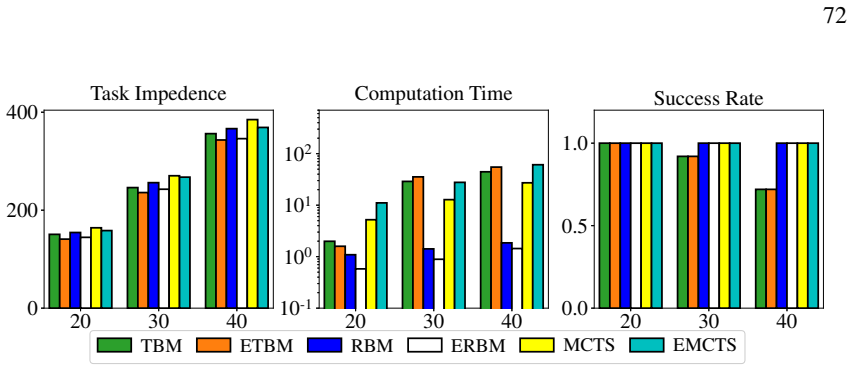
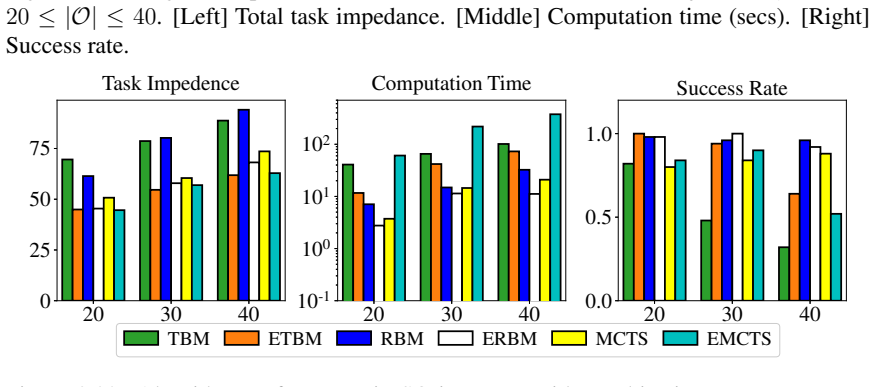
- Depth-first dynamic programming (DFDP) computes optimal MRB and witness plans for instances with over 100 objects, and can also minimize total buffers subject to the MRB constraint.
- Lazy buffer verification converts these external-buffer plans into feasible internal-buffer plans reliably and up to two orders of magnitude faster than prior baselines.
Reading between the lines
- The linear-ordering reduction suggests a direct connection to graph layout problems such as pathwidth and search number; an exact polynomial algorithm for bounded-treewidth dependency graphs is a natural next step that follows from existing separator structure.
- Because random instances have MRB values near zero or a small constant, practical systems can probabilistically rely on a small constant number of buffer slots; a testable extension is to characterize the distribution of MRB under random geometric placements.
- The lazy buffer verification idea could be applied to other task-and-motion planning settings where a coarse combinatorial schedule is refined into geometric feasibility, such as rearrangement with pushing actions or with deformable objects.
Editorial analysis
A structured set of objections, weighed in public.
Referee Report
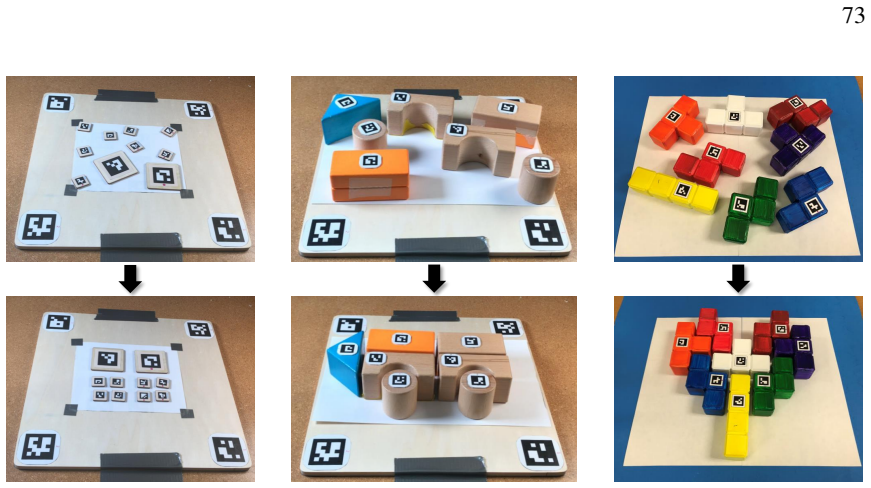
Summary. The dissertation studies tabletop object rearrangement with overhand grasps (TORO) under four settings: external buffers (TORE), internal buffers (TORI), dual-arm coordination (CDR), and mobile-robot rearrangement (ORLA*). The central theoretical contribution is a structural analysis of the minimum running buffer (MRB) problem for TORE. The thesis proves that computing MRB is NP-hard (Theorems 2.4.1 and 2.4.2), establishes an Omega(sqrt(n)) lower bound on MRB for uniform cylinders in both labeled and unlabeled settings, provides a matching O(sqrt(n)) upper bound for the unlabeled setting via a separator-based algorithm (SEPPLAN), and develops exact search algorithms (DP, DFDP, PQS) that scale to over 100 objects on random and structured instances. The later chapters extend these ideas to internal-buffer rearrangement with lazy buffer allocation (TRLB), dual-arm task and motion planning (MCHS/MODAP), and A*-based lazy buffer allocation on mobile platforms (ORLA*). The manuscript is a PhD thesis and largely consolidates the author's previously published work.
Significance. If the TORE results are fully rigorous, they provide a valuable bridge between rearrangement planning and graph layout problems: the running-buffer objective is connected to vertex separation, the dependency graph abstraction is shown to be the right combinatorial object for overhand-grasp manipulation with external buffers, and the exact algorithms with witnessed plans are practically useful and parameter-free. The empirical evaluation is extensive, including physical robot demonstrations, and the DFDP algorithm's scaling to over a hundred objects is genuinely impressive. The later chapters are more heuristic in nature but the experimental methodology is generally sound. The thesis does not overclaim exactness for the TORI/TRLB framework, framing it as a high-quality heuristic, which is appropriate. The main risk is not circularity or fitted constants but the completeness of several load-bearing proofs, which are deferred to the appendix or stated informally.
major comments (4)
- [Section 2.4.2 (around the equation MRB(G^l) = min_phi RB(G^l, phi))] The equivalence between arbitrary rearrangement plans and linear orderings of the dependency graph is asserted as 'straightforward to see' but is not proved. A formal argument must show that for any plan using b running buffers there exists a linear ordering phi with RB(G^l, phi) <= b, and conversely that the greedy execution of any ordering uses exactly the computed number of running buffers. The forward direction is the nontrivial part: one must prove that an optimal plan can be assumed to move each object from its start pose at most once, either directly to its goal or to a buffer, and that buffered objects are placed at their goals at the earliest possible time, without increasing the maximum running-buffer count. This equivalence is load-bearing because the DP in Algorithm 2 and the hardness reduction in Theorem 2.4.1 both search only over such restricted linear-order plans.
- [Section 2.4.3, Theorem 2.4.2 and Figure 2.7] The reduction from planar vertex separation to TORE is described informally with 'object gadgets' and a rotation by 'some small angle epsilon'. To constitute a valid NP-hardness proof for TORE instances (as opposed to arbitrary dependency graphs), the construction must specify the exact object footprint geometry, the epsilon value, and a proof that the resulting labeled dependency graph contains exactly the bidirectional edges of the original planar graph with no extraneous dependencies between non-adjacent gadgets. The sentence 'It is straightforward to check' is not sufficient for a complexity-theoretic claim, especially because the construction must work for all planar graphs, including those with vertices of degree up to five.
- [Section 2.5.2, Theorem 2.5.2 and the SEPPLAN sketch] The main text states 'As shown in detail in the appendix, SEPPLAN guarantees an MRB upper bound of 20/(1-sqrt(2/3)) sqrt(n)' but the derivation of this constant and the proof of the key invariant (that after removing the separator C and the neighbors of goal vertices in C, the subgraphs A' and B' are independent and can be solved recursively without exceeding the claimed bound) are not presented in the main text. If the appendix contains a complete proof, the manuscript should refer to it explicitly; if not, this is a gap in a central upper-bound theorem. The proof of Lemma 2.5.1 is similarly deferred, which is acceptable for a thesis but should be flagged in a journal version.
- [Section 3.4, Algorithms 6 and 7 (TRLB)] The TRLB framework's two-step procedure, which computes a primitive plan using the external-buffer abstraction and then greedily allocates internal buffers with random restarts, has no completeness guarantee. The manuscript states that randomness allows recovery from failures, but there is no theorem ensuring that a feasible internal-buffer plan will be found when one exists, nor a bound on the number of restarts. The chapter is consequently a heuristic contribution, which is acceptable given the experimental evidence, but the limitation should be stated explicitly in Section 3.4 and in the chapter summary to avoid the impression that TRLB is an exact planner.
minor comments (5)
- [Abstract and Chapter 1] The abstract and Chapter 1 promise 'efficient combinatorial search-based solutions' and 'exact algorithms' for TORE, but the later chapters (TORI, CDR, ORLA*) are largely heuristic or approximate; a brief sentence clarifying which parts are exact and which are heuristic would help the reader.
- [Section 2.7.1 (experimental setup)] Gurobi is cited as 'Gurobi 9.16.0', which does not match the known version numbering (Gurobi 9.1.x is a plausible intended version); please verify the version number.
- [Appendix A, Figure A.2 caption] The caption contains a duplicated phrase: 'A counterexample of the proof of Prop.Proposition 2.3.3' should read 'A counterexample to the proof of Proposition 2.3.3'.
- [Chapter 4 (notation)] The density measure is denoted rho in Chapter 2 and D in Chapter 4; using consistent notation across chapters would reduce confusion, even though the definitions are analogous.
- [General (reproducibility)] The empirical results would be easier to reproduce if the code and benchmark instance generators were made available; the thesis currently provides only textual descriptions and videos.
Circularity Check
No significant circularity: the MRB hardness and bound theorems are proven in-text from external standard results; self-citations to the author's prior TORO/TRLB papers are background support, not load-bearing circular steps.
full rationale
Walked the claimed derivation chain. The load-bearing structural results—MRB NP-hardness (Theorems 2.4.1–2.4.2), the Ω(√n) lower bound for uniform cylinders (Theorem 2.5.1), and its O(√n) separator-based upper bound for URBM (Theorem 2.5.2)—are proven in the thesis by explicit reductions to established external results (vertex-separation inapproximability [55]; VSP NP-completeness on planar bounded-degree graphs [67]; the planar separator theorem [57]; straight-line planar embeddings [68]) and by concrete constructions (object gadgets, dependency grids) that do not presuppose the conclusions. The MRB/linear-ordering identification (Section 2.4.2, Lemma 2.4.1) is an argued equivalence between the Problem 1 minimization over plans and a combinatorial ordering objective, and the DP/DFDP/PQS recurrences compute that objective exactly; no fitted parameter is renamed as a prediction, and the identity max(0,|N(g)|−|g|) in Section 2.5.2 is a displacement-conservation count under the move semantics, not a circular definition. Self-citations are pervasive because this is a compilation thesis of the author's publications P1–P7: [1] supplies the TORO model and the total-buffer/MFVS equivalence, while [74], [81], [97] supply running-buffer, MCTS, and lazy-buffer background. These are published, parameter-free results and are not the load-bearing premise for the new theorems; Chapter 3's 'TORI is also NP-hard' simply inherits published TORE hardness, and the thesis independently proves TORE MRB-hardness in Chapter 2. StabilNet's fitted weights (Chapter 5) form an empirical feasibility oracle evaluated by ablations and never feed back into the structural theorems. TRLB's greedy internal-buffer allocation with random-restart recovery is explicitly presented as a heuristic (Section 3.4.2), an honest limitation rather than circularity. Comparisons against external baselines (BiRRT(fmRS), MCTS, lattice benchmarks, real-robot execution) are self-contained. Verdict: no circular step; residual concern is only minor, non-load-bearing self-citation, consistent with score 2.
Assumptions & free parameters
free parameters (3)
- StabilNet network weights =
trained on simulated stability data
- CDR and FC cost parameters tg, tr, th, td =
set equal to td in experiments
- MODAP sampling constants gamma0, gamma_n, k1, k2 =
constants used in Algorithms 11 and 12
assumptions (8)
- standard math Planar separator theorem of Lipton and Tarjan
- standard math NP-hardness and non-approximability of vertex separation
- standard math Fáry's theorem that every planar graph has a straight-line embedding
- domain assumption Overhand pick-n-place can realize any sequence of collision-free poses
- domain assumption Unlabeled dependency graphs for uniform discs are planar with maximum degree 5
- domain assumption Greedy buffer allocation with random restarts is sufficient for TORI
- domain assumption Dual-arm reachability S(r1) union S(r2) covers the workspace and handoff poses are always available
- standard math NP-hardness of feedback vertex set and TSP as established in [1]
invented entities (1)
-
StabilNet
independent evidence
Cite this review
Pith. "Pith review of Tabletop Object Rearrangement: Structure, Complexity, and Efficient Combinatorial Search-Based Solutions." pith.science (2026). https://pith.science/paper/MTVKC7NX
@misc{pith2026241215398,
  author       = {Pith},
  title        = {Pith review of: Tabletop Object Rearrangement: Structure, Complexity, and Efficient Combinatorial Search-Based Solutions},
  year         = {2026},
  howpublished = {\url{https://pith.science/paper/MTVKC7NX}},
  note         = {Machine review of arXiv:2412.15398}
}
read the original abstract
This thesis provides an in-depth structural analysis and efficient algorithmic solutions for tabletop object rearrangement with overhand grasps (TORO), a foundational task in advancing intelligent robotic manipulation. Rearranging multiple objects in a confined workspace presents two primary challenges: sequencing actions to minimize pick-and-place operations - an NP-hard problem in TORO - and determining temporary object placements ("buffer poses") within a cluttered environment, which is essential yet highly complex. For TORO with available external free space, this work investigates the minimum buffer space, or "running buffer size," required for temporary relocations, presenting both theoretical insights and exact algorithms. For TORO without external free space, the concept of lazy buffer verification is introduced, with its efficiency evaluated across various manipulator configurations, including single-arm, dual-arm, and mobile manipulators.
Figures


Figures from the paper (129 more)
















Reference graph
Works this paper leans on
-
[1]
Complexity results and fast methods for optimal tabletop rearrangement with overhand grasps,
S. D. Han, N. M. Stiffler, A. Krontiris, K. E. Bekris, and J. Yu, “Complexity results and fast methods for optimal tabletop rearrangement with overhand grasps,” The International Journal of Robotics Research , vol. 37, no. 13-14, pp. 1775–1795, 2018
2018
-
[2]
Robotic grasping of novel objects using vision,
A. Saxena, J. Driemeyer, and A. Y . Ng, “Robotic grasping of novel objects using vision,” The International Journal of Robotics Research , vol. 27, no. 2, pp. 157– 173, 2008
2008
-
[3]
High precision grasp pose de- tection in dense clutter,
M. Gualtieri, A. ten Pas, K. Saenko, and R. Platt, “High precision grasp pose de- tection in dense clutter,” in2016 IEEE/RSJ International Conference on Intelligent Robots and Systems (IROS), Daejeon, Korea (South), 2016, pp. 598–605
2016
-
[4]
A self-supervised learning system for object detection using physics simulation and multi-view pose estimation,
C. Mitash, K. E. Bekris, and A. Boularias, “A self-supervised learning system for object detection using physics simulation and multi-view pose estimation,” in 2017 IEEE/RSJ International Conference on Intelligent Robots and Systems (IROS), IEEE, Vancouver, BC, Canada, 2017, pp. 545–551
2017
-
[5]
Posecnn: A convolutional neu- ral network for 6d object pose estimation in cluttered scenes,
Y . Xiang, T. Schmidt, V . Narayanan, and D. Fox, “Posecnn: A convolutional neu- ral network for 6d object pose estimation in cluttered scenes,” in Proceedings of Robotics: Science and Systems, Pittsburgh, Pennsylvania, Jun. 2018
2018
-
[6]
Navigation among movable obstacles: Real-time reasoning in complex environments,
M. Stilman and J. J. Kuffner, “Navigation among movable obstacles: Real-time reasoning in complex environments,”International Journal of Humanoid Robotics, vol. 2, no. 04, pp. 479–503, 2005
2005
-
[7]
Asymptotically optimal algorithms for one-to-one pickup and delivery problems with applications to transportation sys- tems,
K. Treleaven, M. Pavone, and E. Frazzoli, “Asymptotically optimal algorithms for one-to-one pickup and delivery problems with applications to transportation sys- tems,” IEEE Transactions on Automatic Control , vol. 58, no. 9, pp. 2261–2276, 2013
2013
-
[8]
Geometric rearrangement of multiple movable objects on cluttered surfaces: A hybrid reasoning approach,
G. Havur, G. Ozbilgin, E. Erdem, and V . Patoglu, “Geometric rearrangement of multiple movable objects on cluttered surfaces: A hybrid reasoning approach,” in 2014 IEEE International Conference on Robotics and Automation (ICRA) , IEEE, Hong Kong, China, 2014, pp. 445–452
2014
Show all 120 references
-
[9]
Dealing with difficult instances of object rearrange- ment.,
A. Krontiris and K. E. Bekris, “Dealing with difficult instances of object rearrange- ment.,” in Robotics: Science and Systems, vol. 1123, 2015
2015
-
[10]
Rearrangement planning using object- centric and robot-centric action spaces,
J. E. King, M. Cognetti, and S. S. Srinivasa, “Rearrangement planning using object- centric and robot-centric action spaces,” in 2016 IEEE International Conference 138 on Robotics and Automation (ICRA), IEEE, Stockholm, Sweden, 2016, pp. 3940– 3947
2016
-
[11]
Efficient obstacle rearrangement for object manipulation tasks in cluttered environments,
J. Lee, Y . Cho, C. Nam, J. Park, and C. Kim, “Efficient obstacle rearrangement for object manipulation tasks in cluttered environments,” in 2019 International Con- ference on Robotics and Automation (ICRA), IEEE, Montreal, QC, Canada, 2019, pp. 183–189
2019
-
[12]
Sensor-based manipulation plan- ning as a game with nature,
R. H. Taylor, M. T. Mason, and K. Y . Goldberg, “Sensor-based manipulation plan- ning as a game with nature,” inProceedings of the 4th International Symposium on Robotics Research, Univ. of California, Santa Clara, California, USA: MIT Press, 1988, pp. 421–429, ISBN : 0262022729
1988
-
[13]
Orienting polygonal parts without sensors,
K. Y . Goldberg, “Orienting polygonal parts without sensors,” Algorithmica, vol. 10, no. 2, pp. 201–225, 1993
1993
-
[14]
Dynamic nonprehensile manipulation: Controlla- bility, planning, and experiments,
K. M. Lynch and M. T. Mason, “Dynamic nonprehensile manipulation: Controlla- bility, planning, and experiments,”The International Journal of Robotics Research, vol. 18, no. 1, pp. 64–92, 1999
1999
-
[15]
A framework for push-grasping in clutter,
M. Dogar and S. Srinivasa, “A framework for push-grasping in clutter,” Jun. 2011
2011
-
[16]
Data-driven grasp synthesis—a survey,
J. Bohg, A. Morales, T. Asfour, and D. Kragic, “Data-driven grasp synthesis—a survey,” IEEE Transactions on Robotics, vol. 30, no. 2, pp. 289–309, 2013
2013
-
[17]
Extrinsic dexterity: In-hand manipulation with external forces,
N. C. Dafle et al., “Extrinsic dexterity: In-hand manipulation with external forces,” in 2014 IEEE International Conference on Robotics and Automation (ICRA), IEEE, Hong Kong, China, 2014, pp. 1578–1585
2014
-
[18]
Learning to manipulate unknown objects in clutter by reinforcement,
A. Boularias, J. Bagnell, and A. Stentz, “Learning to manipulate unknown objects in clutter by reinforcement,” 1, vol. 29, Feb. 2015
2015
-
[19]
Prehensile pushing: In-hand manipulation with push-primitives,
N. Chavan-Dafle and A. Rodriguez, “Prehensile pushing: In-hand manipulation with push-primitives,” in 2015 IEEE/RSJ International Conference on Intelligent Robots and Systems (IROS), IEEE, Hamburg, Germany, 2015, pp. 6215–6222
2015
-
[20]
Hierarchical task and motion planning in the now,
L. P. Kaelbling and T. Lozano-P ´erez, “Hierarchical task and motion planning in the now,” in 2011 IEEE International Conference on Robotics and Automation, 2011, pp. 1470–1477
2011
-
[21]
End-to-end training of deep visuomo- tor policies,
S. Levine, C. Finn, T. Darrell, and P. Abbeel, “End-to-end training of deep visuomo- tor policies,” The Journal of Machine Learning Research, vol. 17, no. 1, pp. 1334– 1373, 2016. 139
2016
-
[22]
Dex-net 2.0: Deep learning to plan robust grasps with synthetic point clouds and analytic grasp metrics,
J. Mahler et al., “Dex-net 2.0: Deep learning to plan robust grasps with synthetic point clouds and analytic grasp metrics,” in Proceedings of Robotics: Science and Systems, Cambridge, Massachusetts, Jul. 2017
2017
-
[23]
Robotic pick-and-place of novel objects in clutter with multi- affordance grasping and cross-domain image matching,
A. Zeng et al. , “Robotic pick-and-place of novel objects in clutter with multi- affordance grasping and cross-domain image matching,” in 2018 IEEE interna- tional conference on robotics and automation (ICRA), IEEE, Brisbane, QLD, Aus- tralia, 2018, pp. 3750–3757
2018
-
[24]
Learning feasi- bility for task and motion planning in tabletop environments,
A. M. Wells, N. T. Dantam, A. Shrivastava, and L. E. Kavraki, “Learning feasi- bility for task and motion planning in tabletop environments,” IEEE robotics and automation letters, vol. 4, no. 2, pp. 1255–1262, 2019
2019
-
[25]
On the complexity of motion plan- ning for multiple independent objects; pspace-hardness of the ‘warehouseman’s problem’,
J. E. Hopcroft, J. T. Schwartz, and M. Sharir, “On the complexity of motion plan- ning for multiple independent objects; pspace-hardness of the ‘warehouseman’s problem’,” The International Journal of Robotics Research , vol. 3, no. 4, pp. 76– 88, 1984
1984
-
[26]
Motion planning in the presence of movable obstacles,
G. Wilfong, “Motion planning in the presence of movable obstacles,” Annals of Mathematics and Artificial Intelligence, vol. 3, no. 1, pp. 131–150, 1991
1991
-
[27]
Manipulation planning among movable obstacles,
M. Stilman, J.-U. Schamburek, J. Kuffner, and T. Asfour, “Manipulation planning among movable obstacles,” inProceedings 2007 IEEE international conference on robotics and automation, IEEE, Rome, Italy, 2007, pp. 3327–3332
2007
-
[28]
Lazy rearrangement planning in confined spaces,
R. Wang, K. Gao, J. Yu, and K. Bekris, “Lazy rearrangement planning in confined spaces,” in Proceedings of the International Conference on Automated Planning and Scheduling, vol. 32, 2022, pp. 385–393
2022
-
[29]
The euclidean travelling salesman problem is np-complete,
C. H. Papadimitriou, “The euclidean travelling salesman problem is np-complete,” Theoretical computer science, vol. 4, no. 3, pp. 237–244, 1977
1977
-
[30]
Reducibility among combinatorial problems,
R. M. Karp, “Reducibility among combinatorial problems,” in Complexity of com- puter computations, Springer, 1972, pp. 85–103
1972
-
[31]
The lifting model for reconfiguration,
S. Bereg and A. Dumitrescu, “The lifting model for reconfiguration,” Discrete & Computational Geometry, vol. 35, no. 4, pp. 653–669, 2006
2006
-
[32]
Planning for target re- trieval using a robotic manipulator in cluttered and occluded environments,
C. Nam, J. Lee, Y . Cho, J. Lee, D. H. Kim, and C. Kim, “Planning for target re- trieval using a robotic manipulator in cluttered and occluded environments,” arXiv preprint arXiv:1907.03956, 2019
1907 arXiv
-
[33]
Space-aware re- configuration,
D. Halperin, M. van Kreveld, G. Miglioli-Levy, and M. Sharir, “Space-aware re- configuration,” Discrete & Computational Geometry, pp. 1–38, 2022. 140
2022
-
[34]
Practical pushing planning for rearrangement tasks,
O. Ben-Shahar and E. Rivlin, “Practical pushing planning for rearrangement tasks,” IEEE Transactions on Robotics and Automation, vol. 14, no. 4, pp. 549–565, 1998
1998
-
[35]
Large-scale multi-object rearrangement,
E. Huang, Z. Jia, and M. T. Mason, “Large-scale multi-object rearrangement,” in 2019 International Conference on Robotics and Automation (ICRA) , IEEE, Mon- treal, QC, Canada, 2019, pp. 211–218
2019
-
[36]
Interactive singulation of objects from a pile,
L. Chang, J. R. Smith, and D. Fox, “Interactive singulation of objects from a pile,” in 2012 IEEE International Conference on Robotics and Automation , IEEE, Saint Paul, MN, USA, 2012, pp. 3875–3882
2012
-
[37]
Robot grasping in clutter: Using a hierarchy of supervisors for learning from demonstrations,
M. Laskey et al., “Robot grasping in clutter: Using a hierarchy of supervisors for learning from demonstrations,” in2016 IEEE International Conference on Automa- tion Science and Engineering (CASE), IEEE, Fort Worth, TX, USA, 2016, pp. 827– 834
2016
-
[38]
Learning to singulate objects using a push proposal network,
A. Eitel, N. Hauff, and W. Burgard, “Learning to singulate objects using a push proposal network,” in Robotics Research, N. M. Amato, G. Hager, S. Thomas, and M. Torres-Torriti, Eds., Cham: Springer International Publishing, 2020, pp. 405– 419, ISBN : 978-3-030-28619-4
2020
-
[39]
Multi-object rearrangement with monte carlo tree search: A case study on planar nonprehensile sorting,
H. Song et al., “Multi-object rearrangement with monte carlo tree search: A case study on planar nonprehensile sorting,” pp. 9433–9440, 2020
2020
-
[40]
Decision making in joint push-grasp action space for large- scale object sorting,
Z. Pan and K. Hauser, “Decision making in joint push-grasp action space for large- scale object sorting,” in 2021 IEEE International Conference on Robotics and Au- tomation (ICRA), Xi’an, China, 2021, pp. 6199–6205
2021
-
[41]
Learning synergies between pushing and grasping with self-supervised deep reinforcement learning,
A. Zeng, S. Song, S. Welker, J. Lee, A. Rodriguez, and T. Funkhouser, “Learning synergies between pushing and grasping with self-supervised deep reinforcement learning,” in 2018 IEEE/RSJ International Conference on Intelligent Robots and Systems (IROS), IEEE, Madrid, Spain, 20...
2018
-
[42]
Dipn: Deep interaction prediction network with application to clutter removal,
B. Huang, S. D. Han, A. Boularias, and J. Yu, “Dipn: Deep interaction prediction network with application to clutter removal,” in 2021 IEEE International Confer- ence on Robotics and Automation (ICRA), Xi’an, China, 2021, pp. 4694–4701
2021
-
[43]
Visual foresight trees for object retrieval from clutter with nonprehensile rearrangement,
B. Huang, S. D. Han, J. Yu, and A. Boularias, “Visual foresight trees for object retrieval from clutter with nonprehensile rearrangement,” IEEE Robotics and Au- tomation Letters, vol. 7, no. 1, pp. 231–238, 2021
2021
-
[44]
Persistent homology for effective non-prehensile manipulation,
E. R. Vieira, D. Nakhimovich, K. Gao, R. Wang, J. Yu, and K. E. Bekris, “Persistent homology for effective non-prehensile manipulation,”arXiv preprint arXiv:2202.02937, 2022. 141
2022 arXiv
-
[45]
S. J. Buckley, Fast motion planning for multiple moving robots . IBM Thomas J. Watson Research Division, 1988
1988
-
[46]
Centralized path plan- ning for multiple robots: Optimal decoupling into sequential plans.,
J. van Den Berg, J. Snoeyink, M. C. Lin, and D. Manocha, “Centralized path plan- ning for multiple robots: Optimal decoupling into sequential plans.,” in Robotics: Science and systems, vol. 2, 2009, pp. 2–3
2009
-
[47]
Efficiently solving general rearrangement tasks: A fast extension primitive for an incremental sampling-based planner,
A. Krontiris and K. E. Bekris, “Efficiently solving general rearrangement tasks: A fast extension primitive for an incremental sampling-based planner,” in 2016 IEEE International Conference on Robotics and Automation (ICRA) , IEEE, 2016, pp. 3924–3931
2016
-
[48]
Robot packing with known items and nondeterministic arrival order,
F. Wang and K. Hauser, “Robot packing with known items and nondeterministic arrival order,” IEEE Transactions on Automation Science and Engineering, 2020
2020
-
[49]
Toward efficient task planning for dual-arm tabletop object rearrangement,
K. Gao and J. Yu, “Toward efficient task planning for dual-arm tabletop object rearrangement,” in 2022 IEEE/RSJ International Conference on Intelligent Robots and Systems (IROS), 2022, pp. 10 425–10 431
2022
-
[50]
A survey of graph layout problems,
J. D ´ıaz, J. Petit, and M. Serna, “A survey of graph layout problems,” ACM Com- puting Surveys (CSUR), vol. 34, no. 3, pp. 313–356, 2002
2002
-
[51]
Michael r. ngarey and david s. johnson. computers and intractability. a guide to the theory of np-completeness. w. h. freeman and company, san fran- cisco1979, x 338 pp.,
H. R. Lewis, “Michael r. ngarey and david s. johnson. computers and intractability. a guide to the theory of np-completeness. w. h. freeman and company, san fran- cisco1979, x 338 pp.,” The Journal of Symbolic Logic, vol. 48, no. 2, pp. 498–500, 1983
1983
-
[52]
The np-completeness of the bandwidth minimization prob- lem,
C. H. Papadimitriou, “The np-completeness of the bandwidth minimization prob- lem,” Computing, vol. 16, no. 3, pp. 263–270, 1976
1976
-
[53]
Some simplified np-complete problems,
M. R. Garey, D. S. Johnson, and L. Stockmeyer, “Some simplified np-complete problems,” inProceedings of the Sixth Annual ACM Symposium on Theory of Com- puting, ser. STOC ’74, Seattle, Washington, USA: Association for Computing Ma- chinery, 1974, pp. 47–63, ISBN : 9781450374231
1974
-
[54]
Some np-complete problems on graphs,
F. Gavril, “Some np-complete problems on graphs,” Computer Science Depart- ment, Technion, Tech. Rep., 2011
2011
-
[55]
Approximating treewidth, pathwidth, frontsize, and shortest elimination tree,
H. L. Bodlaender, J. R. Gilbert, H. Hafsteinsson, and T. Kloks, “Approximating treewidth, pathwidth, frontsize, and shortest elimination tree,” Journal of Algo- rithms, vol. 18, no. 2, pp. 238–255, 1995
1995
-
[56]
Minimizing buffer requirements for throughput con- strained parallel execution of synchronous dataflow graph,
T.-h. Shin, H. Oh, and S. Ha, “Minimizing buffer requirements for throughput con- strained parallel execution of synchronous dataflow graph,” in16th Asia and South 142 Pacific Design Automation Conference (ASP-DAC 2011), Yokohama, Japan, 2011, pp. 165–170
2011
-
[57]
A separator theorem for planar graphs,
R. J. Lipton and R. E. Tarjan, “A separator theorem for planar graphs,” SIAM Jour- nal on Applied Mathematics, vol. 36, no. 2, pp. 177–189, 1979
1979
-
[58]
A separator theorem for graphs of bounded genus,
J. R. Gilbert, J. P. Hutchinson, and R. E. Tarjan, “A separator theorem for graphs of bounded genus,” Journal of Algorithms, vol. 5, no. 3, pp. 391–407, 1984
1984
-
[59]
A separator theorem for graphs with an excluded minor and its applications,
N. Alon, P. Seymour, and R. Thomas, “A separator theorem for graphs with an excluded minor and its applications,” in Proceedings of the Twenty-Second Annual ACM Symposium on Theory of Computing , ser. STOC ’90, Baltimore, Maryland, USA: Association for Computing Machinery, 199...
1990
-
[60]
Elsner, Graph partitioning-a survey
U. Elsner, Graph partitioning-a survey. Techn. Univ., 1997
1997
-
[61]
Depth-first search and linear graph algorithms,
R. Tarjan, “Depth-first search and linear graph algorithms,” SIAM journal on com- puting, vol. 1, no. 2, pp. 146–160, 1972
1972
-
[62]
A minimum linear arrangement algorithm for undirected trees,
Y . Shiloach, “A minimum linear arrangement algorithm for undirected trees,”SIAM Journal on Computing, vol. 8, no. 1, pp. 15–32, 1979
1979
-
[63]
Optimal linear ordering,
D. Adolphson and T. C. Hu, “Optimal linear ordering,” SIAM Journal on Applied Mathematics, vol. 25, no. 3, pp. 403–423, 1973
1973
-
[64]
Searching and pebbling,
L. M. Kirousis and C. H. Papadimitriou, “Searching and pebbling,” Theoretical Computer Science, vol. 47, pp. 205–218, 1986
1986
-
[65]
The vertex separation number of a graph equals its path-width,
N. G. Kinnersley, “The vertex separation number of a graph equals its path-width,” Information Processing Letters, vol. 42, no. 6, pp. 345–350, 1992
1992
-
[66]
On search decision and the efficiency of polynomial-time algorithms,
M. R. Fellows and M. A. Langston, “On search decision and the efficiency of polynomial-time algorithms,” inProceedings of the Twenty-First Annual ACM Sym- posium on Theory of Computing, ser. STOC ’89, Seattle, Washington, USA: Asso- ciation for Computing Machinery, 1989, pp. 5...
1989
-
[67]
Min cut is np-complete for edge weighted trees,
B. Monien and I. H. Sudborough, “Min cut is np-complete for edge weighted trees,” Theoretical Computer Science, vol. 58, no. 1-3, pp. 209–229, 1988
1988
-
[68]
On straight-line representation of planar graphs,
F. Istv ´an, “On straight-line representation of planar graphs,”Acta scientiarum math- ematicarum, vol. 11, no. 229-233, p. 2, 1948
1948
-
[69]
Uniform object re- arrangement: From complete monotone primitives to efficient non-monotone in- 143 formed search,
R. Wang, K. Gao, D. Nakhimovich, J. Yu, and K. E. Bekris, “Uniform object re- arrangement: From complete monotone primitives to efficient non-monotone in- 143 formed search,” in IEEE International Conference on Robotics and Automation , 2021
2021
-
[70]
Design and use paradigms for gazebo, an open-source multi-robot simulator,
N. Koenig and A. Howard, “Design and use paradigms for gazebo, an open-source multi-robot simulator,” in 2004 IEEE/RSJ International Conference on Intelligent Robots and Systems (IROS)(IEEE Cat. No. 04CH37566) , IEEE, vol. 3, Sendai, Japan, 2004, pp. 2149–2154
2004
-
[71]
Gurobi Optimization, Gurobi optimizer reference manual, 2021
L. Gurobi Optimization, Gurobi optimizer reference manual, 2021
2021
-
[72]
Bonnard et al., Chilitags 2: Robust fiducial markers for augmented reality and robotics
Q. Bonnard et al., Chilitags 2: Robust fiducial markers for augmented reality and robotics. 2013
2013
-
[73]
Push planning for object place- ment on cluttered table surfaces,
A. Cosgun, T. Hermans, V . Emeli, and M. Stilman, “Push planning for object place- ment on cluttered table surfaces,” in 2011 IEEE/RSJ international conference on intelligent robots and systems, IEEE, 2011, pp. 4627–4632
2011
-
[74]
Minimizing running buffers for tabletop object rearrangement: Complexity, fast algorithms, and applications,
K. Gao, S. W. Feng, B. Huang, and J. Yu, “Minimizing running buffers for tabletop object rearrangement: Complexity, fast algorithms, and applications,”The Interna- tional Journal of Robotics Research , vol. 42, no. 10, pp. 755–776, 2023. eprint: https://doi.org/10.1177/0278364...
2023 doi
-
[75]
Efficient and high-quality prehensile re- arrangement in cluttered and confined spaces,
R. Wang, Y . Miao, and K. E. Bekris, “Efficient and high-quality prehensile re- arrangement in cluttered and confined spaces,” arXiv preprint arXiv:2110.02814, 2021
2021 arXiv
-
[76]
Planning and execut- ing navigation among movable obstacles,
M. Stilman, K. Nishiwaki, S. Kagami, and J. J. Kuffner, “Planning and execut- ing navigation among movable obstacles,” Advanced Robotics , vol. 21, no. 14, pp. 1617–1634, 2007
2007
-
[77]
Planning among movable obstacles with artificial constraints,
M. Stilman and J. Kuffner, “Planning among movable obstacles with artificial constraints,” The International Journal of Robotics Research , vol. 27, no. 11-12, pp. 1295–1307, 2008
2008
-
[78]
INVIGORATE: Interactive Visual Grounding and Grasping in Clutter,
H. Zhang, Y . Lu, C. Yu, D. Hsu, X. Lan, and N. Zheng, “INVIGORATE: Interactive Visual Grounding and Grasping in Clutter,” in Proceedings of Robotics: Science and Systems, Virtual, Jul. 2021
2021
-
[79]
Unobservable monte carlo planning for nonprehensile rearrangement tasks,
J. E. King, V . Ranganeni, and S. S. Srinivasa, “Unobservable monte carlo planning for nonprehensile rearrangement tasks,” in2017 IEEE International Conference on Robotics and Automation (ICRA), IEEE, 2017, pp. 4681–4688
2017
-
[80]
Dipn: Deep interaction prediction network with application to clutter removal,
B. Huang, S. D. Han, A. Boularias, and J. Yu, “Dipn: Deep interaction prediction network with application to clutter removal,” in IEEE International Conference on Robotics and Automation, 2021. 144
2021
-
[81]
Monte-carlo tree search for efficient visually guided rearrangement planning,
Y . Labb ´e et al., “Monte-carlo tree search for efficient visually guided rearrangement planning,” IEEE Robotics and Automation Letters , vol. 5, no. 2, pp. 3715–3722, 2020
2020
-
[82]
Vision- driven compliant manipulation for reliable, high-precision assembly tasks,
A. Morgan, B. Wen, J. Liang, A. Boularias, A. Dollar, and K. Bekris, “Vision- driven compliant manipulation for reliable, high-precision assembly tasks,” Pro- ceedings of Robotics: Science and Systems (R: SS), 2021
2021
-
[83]
Catgrasp: Learning category-level task- relevant grasping in clutter from simulation,
B. Wen, W. Lian, K. Bekris, and S. Schaal, “Catgrasp: Learning category-level task- relevant grasping in clutter from simulation,” arXiv preprint arXiv:2109.09163 , 2021
2021 arXiv
-
[84]
Environment manip- ulation planner for humanoid robots using task graph that generates action se- quence,
K. Okada, A. Haneda, H. Nakai, M. Inaba, and H. Inoue, “Environment manip- ulation planner for humanoid robots using task graph that generates action se- quence,” in 2004 IEEE/RSJ International Conference on Intelligent Robots and Systems (IROS)(IEEE Cat. No. 04CH37566), IEEE,...
2004
-
[85]
Hierarchical decision theoretic planning for navigation among movable obstacles,
M. Levihn, J. Scholz, and M. Stilman, “Hierarchical decision theoretic planning for navigation among movable obstacles,” in Algorithmic Foundations of Robotics X, Springer, 2013, pp. 19–35
2013
-
[86]
Where to relocate?: Object rearrangement inside cluttered and confined environments for robotic manipula- tion,
S. H. Cheong, B. Y . Cho, J. Lee, C. Kim, and C. Nam, “Where to relocate?: Object rearrangement inside cluttered and confined environments for robotic manipula- tion,” in 2020 IEEE International Conference on Robotics and Automation (ICRA), IEEE, 2020, pp. 7791–7797
2020
-
[87]
Path planning using lazy prm,
R. Bohlin and L. E. Kavraki, “Path planning using lazy prm,” in Proceedings 2000 ICRA. Millennium Conference. IEEE International Conference on Robotics and Automation. Symposia Proceedings (Cat. No. 00CH37065) , IEEE, vol. 1, 2000, pp. 521–528
2000
-
[88]
Lazy toggle prm: A single-query approach to motion planning,
J. Denny, K. Shi, and N. M. Amato, “Lazy toggle prm: A single-query approach to motion planning,” in 2013 IEEE International Conference on Robotics and Au- tomation, IEEE, 2013, pp. 2407–2414
2013
-
[89]
Lazy collision checking in asymptotically-optimal motion planning,
K. Hauser, “Lazy collision checking in asymptotically-optimal motion planning,” in 2015 IEEE international conference on robotics and automation (ICRA), IEEE, 2015, pp. 2951–2957
2015
-
[90]
Mathematical model and efficient al- gorithms for object packing problem,
N. Chernov, Y . Stoyan, and T. Romanova, “Mathematical model and efficient al- gorithms for object packing problem,” Computational Geometry, vol. 43, no. 5, pp. 535–553, 2010
2010
-
[91]
Fast, high-quality dual- arm rearrangement in synchronous, monotone tabletop setups,
R. Shome, K. Solovey, J. Yu, K. Bekris, and D. Halperin, “Fast, high-quality dual- arm rearrangement in synchronous, monotone tabletop setups,” inAlgorithmic Foun- 145 dations of Robotics XIII: Proceedings of the 13th Workshop on the Algorithmic Foundations of Robotics, Spring...
2020
-
[92]
Fast high-quality tabletop rear- rangement in bounded workspace,
K. Gao, D. Lau, B. Huang, K. E. Bekris, and J. Yu, “Fast high-quality tabletop rear- rangement in bounded workspace,” in 2022 International Conference on Robotics and Automation (ICRA), IEEE, 2022, pp. 1961–1967
2022
-
[93]
Rearrangement on lattices with pic-n-swaps: Optimality structures and effi- cient algorithms,
J. Yu, “Rearrangement on lattices with pic-n-swaps: Optimality structures and effi- cient algorithms,” in Robotics: Sciences and Systems, 2021
2021
-
[94]
Synchronized multi-arm rearrangement guided by mode graphs with capacity constraints,
R. Shome and K. E. Bekris, “Synchronized multi-arm rearrangement guided by mode graphs with capacity constraints,” arXiv preprint arXiv:2005.09127, 2020
2005 arXiv
-
[95]
Fast, high-quality two- arm rearrangement in synchronous, monotone tabletop setups,
R. Shome, K. Solovey, J. Yu, K. Bekris, and D. Halperin, “Fast, high-quality two- arm rearrangement in synchronous, monotone tabletop setups,”IEEE Transactions on Automation Science and Engineering, 2021
2021
-
[96]
Curobo: Parallelized collision-free minimum-jerk robot motion generation,
B. Sundaralingam et al., “Curobo: Parallelized collision-free minimum-jerk robot motion generation,” arXiv preprint arXiv:2310.17274, 2023
2023 arXiv
-
[97]
Fast high-quality tabletop rearrangement in bounded workspace,
K. Gao, D. Lau, B. Huang, K. E. Bekris, and J. Yu, “Fast high-quality tabletop rearrangement in bounded workspace,” arXiv preprint arXiv:2110.12325, 2021
2021 arXiv
-
[98]
Self-supervised monte carlo tree search learning for object retrieval in clutter,
B. Huang, T. Guo, A. Boularias, and J. Yu, “Self-supervised monte carlo tree search learning for object retrieval in clutter,” arXiv preprint arXiv:2202.01426, 2022
2022 arXiv
-
[99]
Coordination of two robotic manipulators for object retrieval in clutter,
J. Ahn, C. Kim, and C. Nam, “Coordination of two robotic manipulators for object retrieval in clutter,” arXiv preprint arXiv:2109.15220, 2021
2021 arXiv
-
[100]
Enhancing optimal feeder assignment of the multi- head surface mounting machine using genetic algorithms,
S. Li, C. Hu, and F. Tian, “Enhancing optimal feeder assignment of the multi- head surface mounting machine using genetic algorithms,” Applied Soft Comput- ing, vol. 8, no. 1, pp. 522–529, 2008
2008
-
[101]
Parallelism of pick-and-place operations by multi- gripper robotic arms,
M. Moghaddam and S. Y . Nof, “Parallelism of pick-and-place operations by multi- gripper robotic arms,” Robotics and Computer-Integrated Manufacturing, vol. 42, pp. 135–146, 2016
2016
-
[102]
A new approach to time-optimal path parameterization based on reachability analysis,
H. Pham and Q.-C. Pham, “A new approach to time-optimal path parameterization based on reachability analysis,” IEEE Transactions on Robotics , vol. 34, no. 3, pp. 645–659, 2018
2018
-
[103]
Automatic generation and detection of highly reliable fiducial markers under oc- clusion,
S. Garrido-Jurado, R. Mu ˜noz-Salinas, F. J. Madrid-Cuevas, and M. J. Mar´ın-Jim´enez, “Automatic generation and detection of highly reliable fiducial markers under oc- clusion,” Pattern Recognition, vol. 47, no. 6, pp. 2280–2292, 2014. 146
2014
-
[104]
A. P. Lindvig, ur rtde, https://gitlab.com/sdurobotics/ur rtde, 2018
2018
-
[105]
Transporter networks: Rearranging the visual world for robotic manipulation,
A. Zeng et al., “Transporter networks: Rearranging the visual world for robotic manipulation,” in Conference on Robot Learning, PMLR, 2021, pp. 726–747
2021
-
[106]
Minimizing running buffers for tabletop object rearrangement: Complexity, fast algorithms, and applications,
K. Gao, S. W. Feng, B. Huang, and J. Yu, “Minimizing running buffers for tabletop object rearrangement: Complexity, fast algorithms, and applications,”The Interna- tional Journal of Robotics Research, p. 02 783 649 231 178 565, 2023
2023
-
[107]
Visually grounded task and motion planning for mobile manipulation,
X. Zhang, Y . Zhu, Y . Ding, Y . Zhu, P. Stone, and S. Zhang, “Visually grounded task and motion planning for mobile manipulation,” in 2022 International Conference on Robotics and Automation (ICRA), IEEE, 2022, pp. 1925–1931
2022
-
[108]
Task and motion planning with large language models for object rearrangement,
Y . Ding, X. Zhang, C. Paxton, and S. Zhang, “Task and motion planning with large language models for object rearrangement,”arXiv preprint arXiv:2303.06247, 2023
2023 arXiv
-
[109]
A. Xu, K. Gao, S. W. Feng, and J. Yu, Optimal and stable multi-layer object rear- rangement on a tabletop, 2023. arXiv: 2306.14251 [cs.RO]
2023 arXiv
-
[110]
End-to-end nonpre- hensile rearrangement with deep reinforcement learning and simulation-to-reality transfer,
W. Yuan, K. Hang, D. Kragic, M. Y . Wang, and J. A. Stork, “End-to-end nonpre- hensile rearrangement with deep reinforcement learning and simulation-to-reality transfer,” Robotics and Autonomous Systems, vol. 119, pp. 119–134, 2019
2019
-
[111]
Multi-object rearrangement with monte carlo tree search: A case study on planar nonprehensile sorting,
H. Song et al., “Multi-object rearrangement with monte carlo tree search: A case study on planar nonprehensile sorting,” in 2020 IEEE/RSJ International Confer- ence on Intelligent Robots and Systems (IROS), IEEE, 2020, pp. 9433–9440
2020
-
[112]
Selective object rearrangement in clutter,
B. Tang and G. S. Sukhatme, “Selective object rearrangement in clutter,” in Con- ference on Robot Learning, PMLR, 2023, pp. 1001–1010
2023
-
[113]
K. Gao, J. Yu, T. S. Punjabi, and J. Yu, Effectively rearranging heterogeneous ob- jects on cluttered tabletops, 2023. arXiv: 2306.14240 [cs.RO]
2023 arXiv
-
[114]
Assembly sequence planning for motion plan- ning,
W. Wan, K. Harada, and K. Nagata, “Assembly sequence planning for motion plan- ning,” Assembly Automation, vol. 38, no. 2, pp. 195–206, 2018
2018
-
[115]
Assembly path planning for stable robotic construction,
M. McEvoy, E. Komendera, and N. Correll, “Assembly path planning for stable robotic construction,” in 2014 IEEE International Conference on Technologies for Practical Robot Applications (TePRA), IEEE, 2014, pp. 1–6
2014
-
[116]
Scalable and proba- bilistically complete planning for robotic spatial extrusion,
C. R. Garrett, Y . Huang, T. Lozano-P ´erez, and C. T. Mueller, “Scalable and proba- bilistically complete planning for robotic spatial extrusion,”arXiv preprint arXiv:2002.02360, 2020. 147
2002 arXiv
-
[117]
Active learning of abstract plan feasibility,
M. Noseworthy et al., “Active learning of abstract plan feasibility,” arXiv preprint arXiv:2107.00683, 2021
2021 arXiv
-
[118]
Object reconfiguration with simulation-derived feasible actions,
Y . Lee, W. Thomason, Z. Kingston, and L. E. Kavraki, “Object reconfiguration with simulation-derived feasible actions,” arXiv preprint arXiv:2302.14161, 2023
2023 arXiv
-
[119]
Resnest: Split-attention networks,
H. Zhang et al., “Resnest: Split-attention networks,” inProceedings of the IEEE/CVF conference on computer vision and pattern recognition, 2022, pp. 2736–2746
2022
-
[120]
The densest packing of 19 congruent circles in a circle,
F. Fodor, “The densest packing of 19 congruent circles in a circle,” Geometriae Dedicata, vol. 74, no. 2, pp. 139–145, 1999
1999
Reviewed August 11, 2026 · model on record in the stance chip above.
Discussion (0). Continue with ORCID to comment.