REVIEW 3 major objections 3 minor 23 references
Dessins d'enfants and Brauer configuration algebras
T0 review · 3 major / 3 minor · reviewed 2026-08-14 · deepseek-v4-flash
Pith's one-line read Galois twists preserve the size of a dessin's algebra and centre
desk verdict The algebra-dimension theorem is sound, but the centre-dimension claim, one of the two headline results, is unproven because it silently relies on a loop-count invariant that Lemma 7.2 never establishes. read the letter →
The pith
A machine-rendered reading of the paper's core claim, the machinery that carries it, and where it could break.
The reading
What carries the argument
The load-bearing object is the Brauer configuration algebra $\Lambda_D=KQ_D/I_D$ built from a dessin's permutation representation. The quiver $Q_D$ is determined by the cycle decomposition of the black-vertex permutation $\sigma$; each black vertex of degree at least two contributes a special $\sigma$-cycle, and the cycle lengths of $\sigma$ are exactly the black-vertex degrees. The ideal $I_D$ is generated by three types of relations: relations identifying special cycles that share a white vertex, relations that kill powers of special cycles, and relations that kill two-arrow paths appearing in no special cycle. This machinery converts the combinatorial data of the dessin into a finite-dimensional algebra whose dimension and centre dimension are explicit formulas in invariant counting data.
What would settle it
Check the two Galois-conjugate dessins in Example 2.6, or any pair of conjugate genus-zero dessins with the same passport, and compute $|L_D|$ for each. If a pair is found whose loop-arrow counts differ, their centre dimensions $1+|Q_0|+|L_D|$ would differ, disproving Proposition 7.6; if no such pair exists among small dessins, the invariance is supported but still not fully proved by the cited lemma.
Extended reading notes
Core claim
The paper claims a Galois-invariance theorem for the algebra attached to a dessin. For a dessin $D$ with permutation data $(\sigma,\alpha,\phi)$, the quiver $Q_D$ has one vertex per white vertex and one arrow per half-edge except for degree-one black vertices; the ideal $I_D$ is generated by relations that identify special $\sigma$-cycles at the same vertex and kill two-arrow paths lying in no special cycle. The dimension of $\Lambda_D=KQ_D/I_D$ is $2|Q_0|+\sum_{C_i\in S}|C_i|(|C_i|-1)$, and the dimension of its centre is $1+|Q_0|+|L_D|$, where $L_D$ is the set of loop arrows in $Q_D$. Both quantities are claimed to be invariant under the action of $\mathrm{Gal}(\overline{\mathbb{Q}}/\mathbb{Q})$, because each term is a Galois-invariant count of vertices, arrows, or black-vertex degrees. The paper further proves that Galois-conjugate dessins have isomorphic centres and that, when no degree-one vertices or faces occur, the quiver of the dual dessin is the opposite of the original quiver.
Load-bearing premise
The proof that the centre dimension is Galois-invariant rests on an unstated premise: the number of loop arrows in $Q_D$ must itself be Galois-invariant, since Lemma 7.2 only proves invariance for vertex counts, arrow counts, black-vertex degrees, and number of black vertices, and the centre claim would collapse if Galois conjugation changed that loop count.
Editorial extensions
If this is right
- Galois-conjugate dessins have Brauer configuration algebras of the same dimension, so that dimension can be used as a coarse arithmetic invariant.
- Galois-conjugate dessins have isomorphic centres, making the centre a representation-theoretic invariant that is stronger than a mere dimension count.
- In the absence of degree-one vertices and faces, passing to the dual dessin reverses the quiver, so duality acts predictably on the associated algebra.
- The families $f_n(z)=z^n$ and $f_n(z)=(z^n+1)^2/4z^n$ give explicit dessins whose algebras are symmetric Nakayama algebras and Koszul Brauer graph algebras, providing test cases for the invariance statement.
- The construction generalises the known special case of clean dessins and Brauer graph algebras, so any Galois invariant found here automatically produces invariants in the Brauer-graph-algebra setting.
Reading between the lines
- If the centre dimension is to distinguish Galois orbits, the loop-arrow count must be the sensitive term; a systematic search for conjugate dessins with equal passports but different loop counts would directly probe the gap in the proof.
- Because the dimension formulas depend only on counts, any genuinely arithmetic information must live in the quiver's cycle structure and in the relations; future orbit invariants should be sought in higher Hochschild cohomology or in the representation category rather than in dimensions.
- The dual-dessin description suggests that map-theoretic operations such as taking duals or partial duals could be mirrored by algebra operations, potentially linking the Brauer configuration algebras of dual dessins through derived equivalences or other structural comparisons.
Signed reviews
Editorial analysis
A structured set of objections, weighed in public.
Referee Report
Summary. The paper associates to each dessin d'enfant a finite-dimensional associative algebra, called a Brauer configuration algebra, by constructing a quiver and an admissible ideal from the monodromy permutations of the dessin. The Quillen-Suslin-style main claims are that the K-dimension of the algebra and the K-dimension of its centre are invariant under the action of the absolute Galois group on the dessin, and that Galois-conjugate dessins have isomorphic centres. The paper also compares the Brauer configuration algebras of a dessin and its dual, showing in certain cases that the underlying quivers are opposite. Several examples connect the construction to symmetric Nakayama algebras and to quotients of preprojective algebras.
Significance. If the main claims hold, the paper provides new representation-theoretic invariants of Galois orbits of dessins, extending the authors' earlier work on clean dessins and Brauer graph algebras. The algebra-dimension theorem (Theorem 7.4) appears sound: its formula only involves the number of white vertices and the degrees of black vertices, both of which are Galois-invariant passport data. The connection to Brauer configuration algebras is a natural and potentially useful bridge between two areas. However, the centre-dimension claim is not adequately supported in the present manuscript, and one of the two headline results therefore has a load-bearing gap.
major comments (3)
- [§7, Proposition 7.6] The proof of Proposition 7.6 states that dim_K Z(Λ_D) = 1 + |Q_0| + |L_D| and concludes invariance by saying "By lemma 7.2, all the summands are invariants." Lemma 7.2, however, lists only |Q_0|, |Q_1|, |S|, and the cycle lengths |σ_i|; it says nothing about |L_D|, the number of loop arrows in Q_D. This is not merely an omitted detail: a loop arrow occurs when two consecutive half-edges around a black vertex belong to the same white vertex, i.e. |L_D| = #{i : α(i) = α(iσ)}, which depends on the cyclic order of white vertices around black vertices, not solely on the passport data that Lemma 7.2 establishes as Galois-invariant. The manuscript gives no argument that this cyclic-order information is preserved by Galois conjugation, and known properties of Galois orbits of dessins do not make this automatic. Thus the invariance of dim_K Z(Λ_D) is not established by the proof given.
- [§7, Theorem 7.8] Theorem 7.8 relies directly on Proposition 7.6, so it inherits the gap just described. In addition, the proof of Theorem 7.8 constructs a vector-space isomorphism f : Z(Λ_1) → Z(Λ_2) that maps loops to loops and special cycles to special cycles. Even if the total dimensions of the centres were known to be equal, such a map need not exist without separate control of the number of loops and the number of special cycles in the two centres. The paper does not prove these finer equalities independently; they would follow from a valid proof of Proposition 7.6, but as the manuscript stands they are additional unproved assertions.
- [§7, Lemma 7.2] In the proof of Lemma 7.2(ii), the authors write that |Q_1| is equal to the total number of half-edges of the dessin. This is not correct in general: by Definition 4.1, formal loop arrows arising from black vertices of degree 1 are removed from the quiver, so |Q_1| equals the number of half-edges minus the number of degree-1 black vertices. The claim that |Q_1| is a Galois invariant is still true, because the number of degree-1 black vertices is part of the degree sequence, but the justification given in the paper is inaccurate and should be corrected.
minor comments (3)
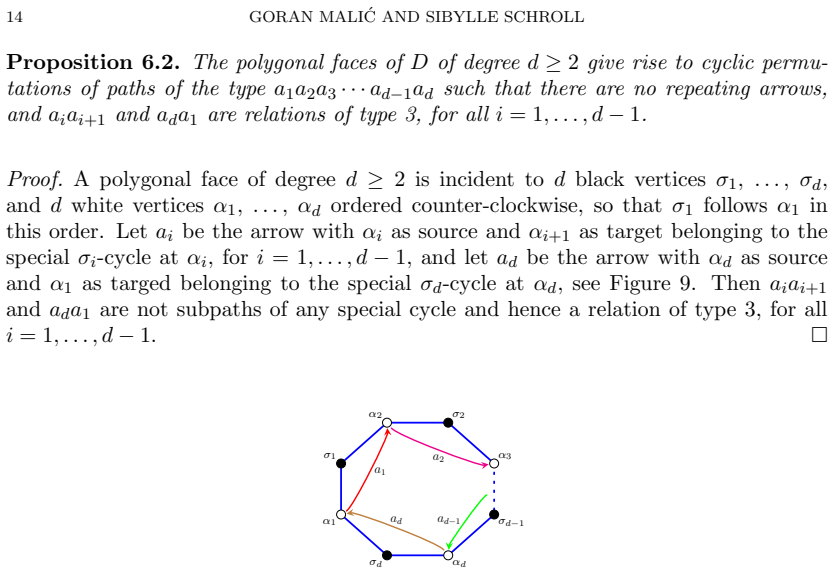
- [Section 6, Proposition 6.2] There is a typo in Proposition 6.2: "targed" should be "target".
- [Remark 4.5] Remark 4.5 refers to "quiver Q_2 without the formal loop arrows as in Figure 5," but Figure 5 illustrates a local vertex configuration, not the quiver of Example 4.4; the intended reference appears to be Figure 6.
- [Theorem 6.3] The statement of Theorem 6.3 says "if D has no vertices and no faces of degree 1," which is ambiguous. From the proof, the intended hypothesis is that D has no black vertices of degree 1 and no faces of degree 1, since formal loops in the quiver and its dual arise precisely from these two sources.
Circularity Check
No circular reduction found; the centre-dimension gap in Proposition 7.6 is an unsupported premise about |L_D|, not a circular derivation.
full rationale
The paper's main derivation chain is not circular. Theorem 7.4 combines the known dimension formula dim_K Λ_D = 2|Q_0| + Σ_{C_i∈S} |C_i|(|C_i|-1), cited to [9], with Lemma 7.2, whose four listed quantities are ordinary passport invariants: numbers of white and black vertices, number of half-edges, and the degree sequence. The conclusion follows from these external facts rather than from the conclusion itself. Although [9] shares an author with the present paper, it is a prior, parameter-free result about general Brauer configuration algebras and does not contain the Galois-invariance claim being proved, so it is independent support rather than a load-bearing self-citation. The centre-dimension part is different and should be flagged as a correctness gap. Proposition 7.6 uses dim_K Z(Λ_D) = 1+|Q_0|+|L_D|, cited to [22], and its proof says 'By lemma 7.2, all the summands are invariants.' Lemma 7.2 does not mention |L_D|, the number of loop arrows, which depends on the cyclic order of half-edges around black vertices. If Galois conjugation can change that cyclic order while preserving the passport, |L_D| is not automatically invariant, and Proposition 7.6 and Theorem 7.8 would be unsupported. This is a real unsupported premise, but it is not a circularity: the paper does not define |L_D| in terms of the centre dimension, does not fit a parameter, and does not reduce the centre claim to a self-citation. The only thematically overlapping self-citation, [17], concerns clean dessins and Brauer graph algebras and is contextual rather than load-bearing for the algebra- and centre-dimension theorems. No step in the derivation is equivalent to its input by construction or by definition, so the circularity score is 0.
Assumptions & free parameters
free parameters (1)
- multiplicity function μ(σ_j) =
1
assumptions (4)
- standard math Belyi's theorem (Theorem 2.4): a smooth projective curve X over C is defined over Qbar if and only if there is a holomorphic covering f:X to CP1 ramified at most over {0,1,infinity}.
- domain assumption Brauer configuration algebra dimension formula dim_K Λ_D = 2|Q0| + sum_{Ci in S} |Ci|(|Ci|-1).
- domain assumption Centre dimension formula dim_K Z(Λ_D) = 1 + |Q0| + |L_D|.
- ad hoc to paper The quantity |L_D|, the number of loop arrows in Q_D, is a Galois invariant.
Cite this review
Pith. "Pith review of Dessins d'enfants and Brauer configuration algebras." pith.science (2026). https://pith.science/paper/MV2N3TQ7
@misc{pith2026190805509,
  author       = {Pith},
  title        = {Pith review of: Dessins d'enfants and Brauer configuration algebras},
  year         = {2026},
  howpublished = {\url{https://pith.science/paper/MV2N3TQ7}},
  note         = {Machine review of arXiv:1908.05509}
}
read the original abstract
In this paper we associate to a dessin d'enfant an associative algebra, called a Brauer configuration algebra. This is an algebra given by quiver and relations induced by the monodromy of the dessin d'enfant. We show that the dimension of the Brauer configuration algebra associated to a dessin d'enfant and the dimension of the centre this algebra are invariant under the action of the absolute Galois group. We give some examples of well-known algebras and their dessins d'enfants. Finally we show that the Brauer configuration algebras of a dessin d'enfant and its dual share the same path algebra.
Figures


Figures from the paper (10 more)




Reference graph
Works this paper leans on
-
[1]
Elements of the representation theory of associative algebras
Assem, Ibrahim; Simson, Daniel; Skowro´ nski, Andrzej. Elements of the representation theory of associative algebras. Vol. 1. Techniques of representation theory. London Mathematical Society Student Texts, 65. Cambridge University Press, Cambridge, 2006
work page 2006
-
[2]
On Galois Extensions of a Maximal Cyclotomic Field
Bely˘ ı, Gennadii V. On Galois Extensions of a Maximal Cyclotomic Field. Math. USSR Izvestija 14 (1980) 247–256
work page 1980
-
[3]
A New Proof of the Three Point Theorem
Bely˘ ı, Gennadii V. A New Proof of the Three Point Theorem. Sb. Math. 193(3-4) (2002) 329–332
work page 2002
-
[4]
Borceux, Francis; Janelidze. George Galois theories. Cambridge University Press, Cambridge, 2001
work page 2001
-
[5]
Indecomposable representations II,Symposia Mathematics Instituto Nazionale di allz
Gabriel, Peter. Indecomposable representations II,Symposia Mathematics Instituto Nazionale di allz. Matematica, Roma, 1973
work page 1973
-
[6]
Introduction to compact Riemann surfaces and dessins d’enfants
Girondo, Ernesto; Gonz´ alez-Diez, Gabino. Introduction to compact Riemann surfaces and dessins d’enfants. London Mathematical Society Student Texts, 79. Cambridge University Press, Cam- bridge, 2012
work page 2012
-
[7]
A new proof of Bely˘ ı’s Theorem
Goldring, Wushi. A new proof of Bely˘ ı’s Theorem. J. Number Theory 135 (2014), 151–154
work page 2014
-
[8]
Multiserial and special multiserial algebras and their represen- tations
Green, Edward L.; Schroll, Sibylle. Multiserial and special multiserial algebras and their represen- tations. Adv. Math. 302 (2016), 1111–1136
work page 2016
Show all 23 references
-
[9]
Brauer configuration algebras: a generalization of Brauer graph algebras
Green, Edward L.; Schroll, Sibylle. Brauer configuration algebras: a generalization of Brauer graph algebras. Bull. Sci. Math. 141 (2017), no. 6, 539–572
2017
-
[10]
The Ext algebra of a Brauer graph algebra
Green, Edward L.; Schroll, Sibylle; Snashall, Nicole; Taillefer, Rachel. The Ext algebra of a Brauer graph algebra. J. Noncommut. Geom. 11 (2017), no. 2, 537–579
2017
-
[11]
Esquisse d’un programme
Grothendieck, Alexandre. Esquisse d’un programme. [Sketch of a program] With an English trans- lation on pp. 243–283. London Math. Soc. Lecture Note Ser., 242, Geometric Galois actions, 1, 5–48, Cambridge Univ. Press, Cambridge, 1997
1997
-
[12]
Indecomposable modules for finite groups
Janusz, Gerald. Indecomposable modules for finite groups. Ann. of Math. (2) 89 (1969) 209–241
1969
-
[13]
Dessins D’enfants on Riemann Surfaces
Jones, Gareth A; Wolfart, J¨ urgen. Dessins D’enfants on Riemann Surfaces. Springer Monographs in Mathematics, Springer, cham, 2016
2016
-
[14]
¨Uber die Transformationen elfter Ordnung der elliptischen Funktionen
Klein, Felix. ¨Uber die Transformationen elfter Ordnung der elliptischen Funktionen. Mathematis- che Annalen 15.3 (1879), 533–555
-
[15]
Graphs on surfaces and their applications
Lando, Sergei K.; Zvonkin, Alexander K. Graphs on surfaces and their applications. With an ap- pendix by Don B. Zagier. Encyclopaedia of Mathematical Sciences, 141. Low-Dimensional Topol- ogy, II. Springer-Verlag, Berlin, 2004
2004
-
[16]
Dessins, their delta-matroids and partial duals
Malic, Goran. Dessins, their delta-matroids and partial duals. Symmetries in graphs, maps, and polytopes, 213–247, Springer Proc. Math. Stat., 159, 2016
2016
-
[17]
Dessins d’enfants, Brauer graph algebras and Galois invariants, arXiv:1902.09876
Malic, Goran; Schroll, Sibylle. Dessins d’enfants, Brauer graph algebras and Galois invariants, arXiv:1902.09876
1902 arXiv
-
[18]
Biserial algebras and graphs
Roggenkamp, Klaus. Biserial algebras and graphs. Algebras and modules, II (Geiranger, 1996), 481–496, CMS Conf. Proc., 24, Amer. Math. Soc., Providence, RI, 1998. 20 GORAN MALI ´C AND SIBYLLE SCHROLL
1996
-
[19]
Quiver representations
Schiffler, Ralf. Quiver representations. CMS Books in Mathematics/Ouvrages de Math´ ematiques de la SMC. Springer, Cham, 2014
2014
-
[20]
The Grothendieck Theory of Dessins D’Enfants
Schneps, Leila (Edt.). The Grothendieck Theory of Dessins D’Enfants. Vol 200 LMS Lecture Note Series, Cambridge University Press, Cambridge, 1994
1994
-
[21]
Geometric Galois Actions 1
Schneps, Leila; Lochak, Pierre. Geometric Galois Actions 1. Around Grothendieck’s Esquisse d’un Programme. Vol 242 LMS Lecture Note Series, Cambridge University Press, Cambridge, 1997
1997
-
[22]
The Dimension of the Center of a Brauer Configuration Algebra
Sierra, Alex. The Dimension of the Center of a Brauer Configuration Algebra. J. Algebra 510 (2018), 289–318
2018
-
[23]
Vol 117 Cambridge Studies in Advanced Mathematics
Szamuely, Tam´ as Galois groups and fundamental groups. Vol 117 Cambridge Studies in Advanced Mathematics. Cambridge University Press, Cambridge, 2009. Department of Computer Science, Smith College, Northampton, MA 01063, USA E-mail address: goranm00@gmail.com Department of Ma...
2009
Reviewed August 14, 2026 · model on record in the stance chip above.
Discussion (0). Continue with ORCID to comment.