The effect of pressure on the splitting in ³He in nematic aerogel
Pith reviewed 2026-06-25 21:41 UTC · model grok-4.3
The pith
The nonlinear dependence of superfluid transition splitting in pure 3He in nematic aerogel lies outside the range predicted by magnetic scattering theory.
A machine-rendered reading of the paper's core claim, the machinery that carries it, and where it could break.
Core claim
The nonlinear dependence of the superfluid transition temperature splitting in pure 3He does not match the range predicted by theory based on magnetic scattering effects; measurements with and without 4He coating on the aerogel strands are performed to isolate whether the nonlinearity arises from pressure-dependent magnetic scattering or from other boundary-condition effects.
What carries the argument
The splitting of the superfluid transition temperature, set by boundary conditions at the aerogel strands with or without 4He coating.
If this is right
- If the nonlinearity remains outside the magnetic-scattering window at all pressures, magnetic scattering cannot be the dominant cause.
- The 4He coating changes which superfluid phases are stable, so any difference in splitting behavior directly implicates the boundary scattering channel.
- Pressure acts as a continuous tuning parameter that should strengthen or weaken magnetic scattering if that mechanism is active.
- Discrepancy that survives the coating test points to non-magnetic boundary conditions such as strand geometry or surface roughness.
Where Pith is reading between the lines
- Similar pressure sweeps in other anisotropic porous media could show whether the mismatch is specific to nematic aerogel or generic to confined 3He.
- If non-magnetic effects dominate, theoretical models will need explicit terms for the aerogel strand orientation distribution rather than only magnetic cross-sections.
- The coated versus uncoated contrast supplies a practical experimental knob for future studies of phase selection in confined superfluids.
Load-bearing premise
That comparing the coated and uncoated cases at different pressures will separate magnetic scattering contributions from other boundary effects.
What would settle it
A data set in which the observed splitting versus pressure in the pure-3He case falls inside the magnetic-scattering band while the coated case lies outside it, or vice versa.
Figures
read the original abstract
Here, we present the results of an investigation of how the pressure affects the splitting of the superfluid transition temperature in $^3$He in anisotropic aerogel. It is well known that boundary conditions significantly influence the properties of superfluid phases in aerogel. When aerogel strands are coated with a $^4$He layer in magnetic field, new phases, such as the polar, polar-distorted A (DA), polar-distorted B (DB), and $\beta$ phases, become energetically favorable. In contrast, without this coating, the system tends to favor phases resembling the bulk A, B, and A$_1$ phases. Our earlier results showed a nonlinear dependence of the superfluid transition temperature splitting in pure $^3$He, but the range of nonlinearity did not match the theoretical predictions based on magnetic scattering effects. To further investigate this discrepancy, we performed measurements of the splitting under varying pressures for both pure $^3$He and with $^4$He coverage of the aerogel strands.
Editorial analysis
A structured set of objections, weighed in public.
Referee Report
Summary. The manuscript reports measurements of the pressure dependence of the superfluid transition temperature splitting in 3He confined in nematic aerogel. It compares results for pure 3He (favoring A-, B-, and A1-like phases) versus 4He-coated strands (favoring polar, DA, DB, and beta phases) to test whether the nonlinear splitting observed in prior work arises from magnetic scattering, given that the nonlinearity range did not match existing magnetic-scattering predictions.
Significance. If the new pure vs. coated data quantitatively demonstrate that the nonlinearity persists independently of the magnetic channel or is removed by coating in a manner consistent with theory, the work would clarify the dominant boundary-condition mechanism controlling phase stability in anisotropic aerogel, with implications for confined superfluid 3He studies.
major comments (2)
- [Abstract] Abstract: the central claim that 'the range of nonlinearity did not match the theoretical predictions based on magnetic scattering effects' is asserted without any data, error bars, sample details, pressure values, or quantitative comparison to theory presented in the manuscript.
- [Abstract] Abstract (paragraph beginning 'Our earlier results showed...'): the assumption that 4He coating cleanly isolates magnetic scattering from other pressure-dependent boundary effects (strand geometry, non-magnetic scattering) is not validated by any control measurements or checks described in the text.
minor comments (1)
- [Abstract] Abstract: 'our earlier results' is referenced without a citation.
Simulated Author's Rebuttal
We thank the referee for the careful review and constructive comments on our manuscript. We address each major comment below.
read point-by-point responses
-
Referee: [Abstract] Abstract: the central claim that 'the range of nonlinearity did not match the theoretical predictions based on magnetic scattering effects' is asserted without any data, error bars, sample details, pressure values, or quantitative comparison to theory presented in the manuscript.
Authors: The statement refers to results from our prior published work, which this manuscript extends by adding new pressure-dependent splitting data on both pure and 4He-coated samples. The current manuscript presents the new measurements and their comparison to theory. To satisfy the concern, we will revise the abstract to explicitly attribute the nonlinearity-range mismatch to the earlier study and add a short quantitative summary (with reference to the prior publication) in the introduction or results section of the present manuscript. revision: yes
-
Referee: [Abstract] Abstract (paragraph beginning 'Our earlier results showed...'): the assumption that 4He coating cleanly isolates magnetic scattering from other pressure-dependent boundary effects (strand geometry, non-magnetic scattering) is not validated by any control measurements or checks described in the text.
Authors: The 4He-coating protocol is a standard technique in the field for suppressing magnetic scattering while leaving the aerogel geometry unchanged. The manuscript does not contain dedicated control experiments that separately quantify every possible pressure-dependent non-magnetic effect. We will add a concise discussion paragraph that states this assumption explicitly, notes its basis in prior literature, and explains how the observed differences (or lack thereof) between the coated and uncoated data sets still allow a meaningful test of the magnetic-scattering hypothesis. revision: partial
Circularity Check
No circularity: experimental measurements with no derivations or fitted predictions
full rationale
This paper is an experimental report on pressure dependence of superfluid transition splitting in 3He in nematic aerogel, comparing pure and 4He-coated samples. No equations, theoretical derivations, or model predictions are presented that could reduce to inputs by construction. Claims rest on direct measurements rather than any self-definitional, fitted-input, or self-citation load-bearing steps. The work is self-contained against external benchmarks with no circular elements identified.
Axiom & Free-Parameter Ledger
axioms (1)
- domain assumption Boundary conditions significantly influence the properties of superfluid phases in aerogel.
Reference graph
Works this paper leans on
-
[1]
In bulk systems, two primary phases emerge at zero magnetic field: the anisotropic A phase with nodal gap structure and the fully gapped isotropic B phase
INTRODUCTION The rich phenomenology of superfluid phases in 3He stems from its triplet Cooper pairing mechanism, which supports multiple quantum states with distinct symmetry properties [1]. In bulk systems, two primary phases emerge at zero magnetic field: the anisotropic A phase with nodal gap structure and the fully gapped isotropic B phase. The introduc...
-
[2]
1 Specular boundary ( 4He coating) When cooling from the normal phase of 3He confined by a nematic aerogel, the superfluid transition to the β phase should occur at a temperature: TP 1 = Tca + TcηH, (1) where H is the magnetic field, Tca is the superfluid transition temperature of 3He in aerogel at H = 0, and η ∼ 10− 3 kOe− 1 is the splitting coefficient [13]. ...
Pith/arXiv arXiv 2026
-
[3]
2 Spin-polarized impurity model (pure 3He) According to [22, 23], the solid 3He coatings on the aerogel strands act as paramagnetic impurities, suppressing the splitting of the superfluid transition temperature. The upper ( Tca1) and lower ( Tca2) critical temperatures are given by: Tca1,2 = Tca ± [ η1,2 − C1,2 tanh(αH ) αH ] H, (4) where η1,2 = η0 1,2 ·Tc...
-
[4]
That is, it considers the effect of deviations from complete disorder of the medium associated with the spin degree of freedom
3 Spatial correlation effects (pure 3He) Unlike the mean-field theories [22, 23], Surovtsev’s theory [26] takes into account spatial correlations of the impurity magnetization. That is, it considers the effect of deviations from complete disorder of the medium associated with the spin degree of freedom. In zero magnetic field, maximal disorder leads to the ma...
-
[5]
SAMPLES AND METHODS The experimental setup replicated our previous work [19, 20, 21], utilizing a nuclear demagnetization cryostat pre-cooled by a dilution refrigerator to achieve temperatures ∼ 1 mK. Central to the measurements was a Stycast-1266 epoxy cell mounted on the cryostat’s top stage, containing both a vibrating wire (VW) resonator and quartz tu...
-
[6]
RESUL TS AND DISCUSSION
-
[7]
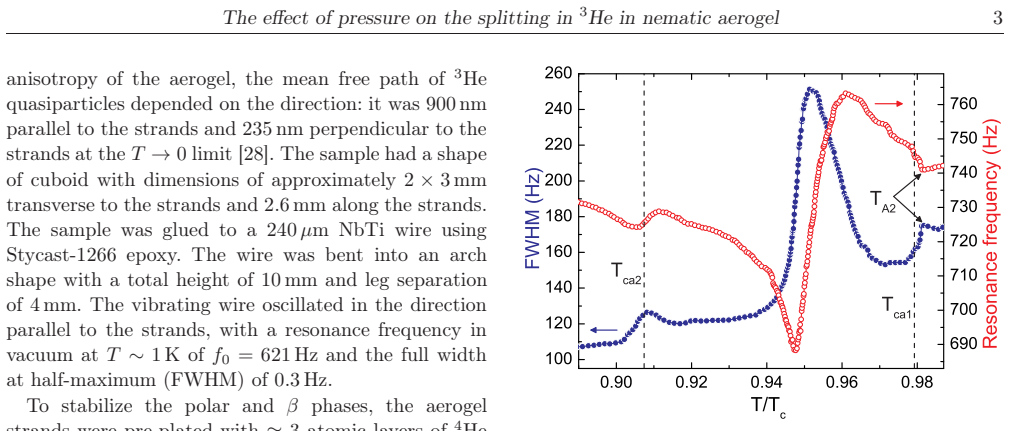
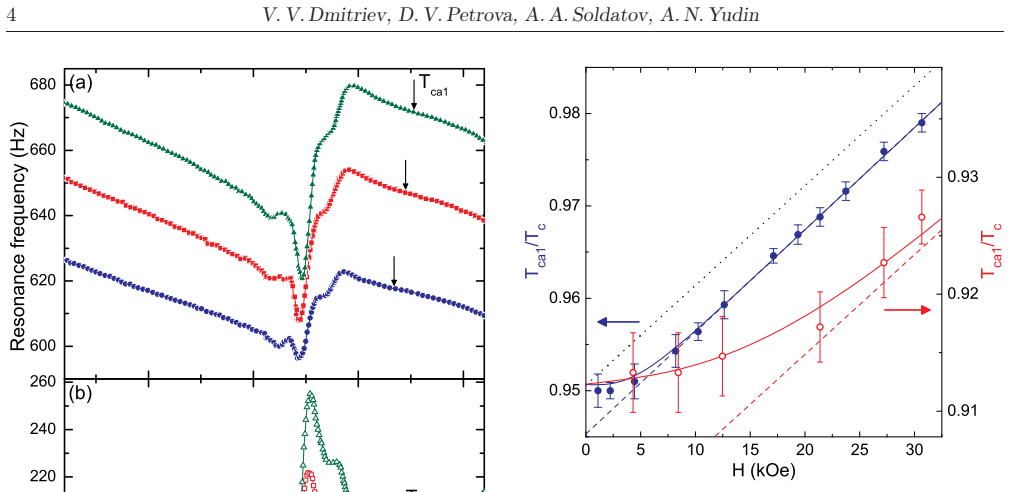
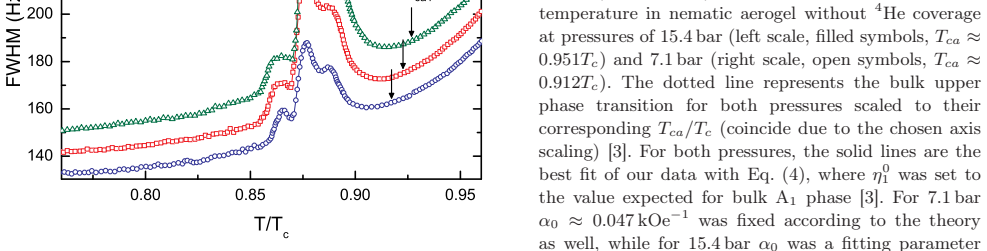
1 In pure 3He To determine the superfluid transition temperature, we measured the temperature dependence of the resonance parameters of the VW resonator in different magnetic fields. Fig. 1 shows the temperature dependence of the resonance frequency (open symbols) /s48/s46/s57/s48 /s48/s46/s57/s50 /s48/s46/s57/s52 /s48/s46/s57/s54 /s48/s46/s57/s56 /s49/s48/s...
-
[8]
951Tc) and 7.1 bar (right scale, open symbols, Tca ≈
-
[9]
The dotted line represents the bulk upper phase transition for both pressures scaled to their corresponding Tca/T c (coincide due to the chosen axis scaling) [3]
912Tc). The dotted line represents the bulk upper phase transition for both pressures scaled to their corresponding Tca/T c (coincide due to the chosen axis scaling) [3]. For both pressures, the solid lines are the best fit of our data with Eq. (4), where η0 1 was set to the value expected for bulk A 1 phase [3]. For 7.1 bar α 0 ≈ 0. 047 kOe− 1 was fixed ac...
-
[10]
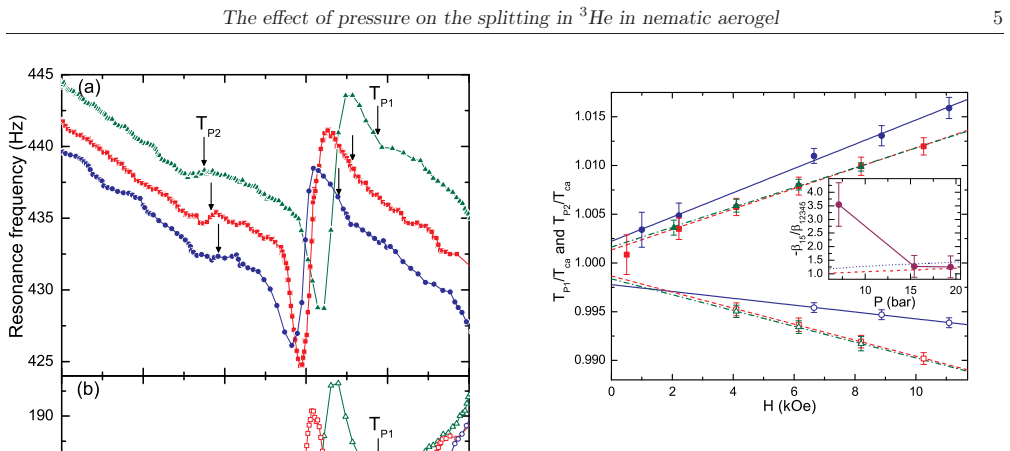
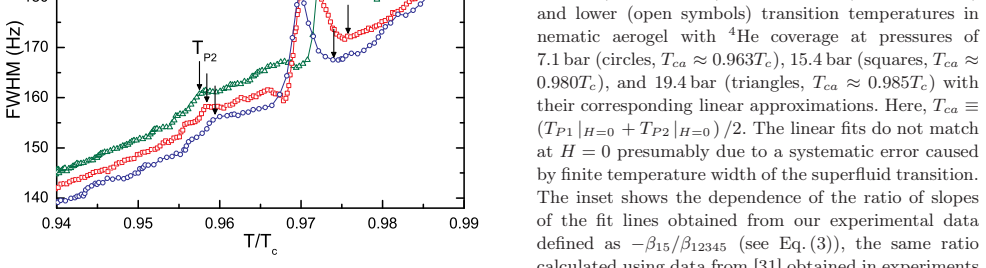
2 With 4He coating Similar measurements of the temperature dependence of the VW resonance parameters were also performed in the aerogel with 4He-coated strands. Fig. 4 shows Письма в ЖЭТФ The effect of pressure on the splitting in 3He in nematic aerogel 5 /s48/s46/s57/s52 /s48/s46/s57/s53 /s48/s46/s57/s54 /s48/s46/s57/s55 /s48/s46/s57/s56 /s48/s46/s57/s57 ...
-
[11]
985Tc) with their corresponding linear approximations
980Tc), and 19.4 bar (triangles, Tca ≈ 0. 985Tc) with their corresponding linear approximations. Here, Tca ≡ (TP 1 |H=0 + TP 2 |H=0 ) / 2. The linear fits do not match at H = 0 presumably due to a systematic error caused by finite temperature width of the superfluid transition. The inset shows the dependence of the ratio of slopes of the fit lines obtained fr...
-
[12]
Our experiments revealed a nonlinear dependence of the upper superfluid transition temperature Tca1 on the magnetic field in the absence of 4He coverage
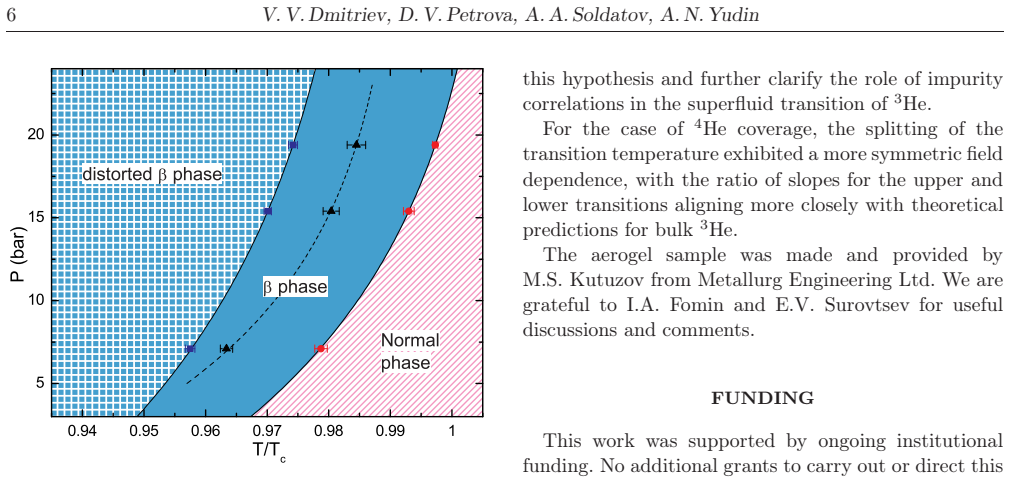
CONCLUSION In this work, we investigated the splitting of the superfluid transition temperature in 3He confined in nematic aerogel under varying pressures, with and without 4He coverage. Our experiments revealed a nonlinear dependence of the upper superfluid transition temperature Tca1 on the magnetic field in the absence of 4He coverage. This nonlinearity sp...
-
[13]
Vollhardt and P
D. Vollhardt and P. W¨ olfle, The Superfluid Phases of Helium 3 (Taylor & Francis, London, 1990)
1990
-
[14]
Ambegaokar and N.D
V. Ambegaokar and N.D. Mermin, Phys. Rev. Lett. 30, 81 (1973)
1973
-
[15]
Israelsson, B.C
U.E. Israelsson, B.C. Crooker, H.M. Bozler, and C.M. Gould, Phys. Rev. Lett. 53, 1943 (1984)
1943
-
[16]
Sagan, P.G.N
D.C. Sagan, P.G.N. de Vegvar, E. Polturak, L. Friedman, S.S. Yan, E.L. Ziercher, and D.M. Lee, Phys. Rev. Lett. 53, 1939 (1984)
1939
-
[17]
Barker, Y
B.I. Barker, Y. Lee, L. Polukhina, D.D. Osheroff, L.W. Hrubesh, and J.F. Poco, Phys. Rev. Lett. 85, 2148 (2000)
2000
-
[18]
Gervais, T.M
G. Gervais, T.M. Haard, R. Nomura, N. Mulders, and W.P. Halperin, Phys. Rev. Lett. 87, 035701 (2001)
2001
-
[19]
Dmitriev, V.V
V.V. Dmitriev, V.V. Zavjalov, D.E. Zmeev, I.V. Kosarev, and N. Mulders, JETP Lett. 76, 321 (2002)
2002
-
[20]
Dmitriev, D.A
V.V. Dmitriev, D.A. Krasnikhin, N. Mulders, A.A. Senin, G.E. Volovik, and A.N. Yudin, JETP Lett. 91, 599 (2010)
2010
-
[21]
Asadchikov, R.Sh
V.E. Asadchikov, R.Sh. Askhadullin, V.V. Volkov, V.V. Dmitriev, N.K. Kitaeva, P.N. Martynov, A.A. Osipov, A.A. Senin, A.A. Soldatov, D.I. Chekrygina, and A.N. Yudin, JETP Letters 101, 556 (2015)
2015
-
[22]
Aoyama and R
K. Aoyama and R. Ikeda, Phys. Rev. B 73, 060504(R) (2006)
2006
-
[23]
Fomin, J
I.A. Fomin, J. Exp. Theor. Phys. 127, 933 (2018). Письма в ЖЭТФ The effect of pressure on the splitting in 3He in nematic aerogel 7
2018
-
[24]
Fomin, J
I.A. Fomin, J. Exp. Theor. Phys. 131, 29 (2020)
2020
-
[25]
Surovtsev, J
E.V. Surovtsev, J. Exp. Theor. Phys. 128, 477 (2019)
2019
-
[26]
Askhadullin, V.V
R.Sh. Askhadullin, V.V. Dmitriev, D.A. Krasnikhin, P.N. Martynov, A.A. Osipov, A.A. Senin, and A.N. Yudin, JETP Lett. 95, 326 (2012)
2012
-
[27]
Dmitriev, A.A
V.V. Dmitriev, A.A. Senin, A.A. Soldatov, E.V. Surovtsev, and A.N. Yudin, J. Exp. Theor. Phys. 119, 1088 (2014)
2014
-
[28]
Dmitriev, A.A
V.V. Dmitriev, A.A. Senin, A.A. Soldatov, and A.N. Yudin, Phys. Rev. Lett. 115, 165304 (2015)
2015
-
[29]
Dmitriev, A.A
V.V. Dmitriev, A.A. Soldatov, and A.N.Yudin, Phys. Rev. Lett. 120, 075301 (2018)
2018
-
[30]
Dmitriev, A.A
V.V. Dmitriev, A.A. Soldatov, and A.N. Yudin, J. Exp. Theor. Phys. 131, 2 (2020)
2020
-
[31]
Dmitriev, M.S
V.V. Dmitriev, M.S. Kutuzov, A.A. Soldatov, and A.N. Yudin, Phys. Rev. Lett. 127, 265301 (2021)
2021
-
[32]
Dmitriev, M.S
V.V. Dmitriev, M.S. Kutuzov, A.A. Soldatov, and A.N. Yudin, Phys. Rev. B 107, 024507 (2023)
2023
-
[33]
Dmitriev, M.S
V.V. Dmitriev, M.S. Kutuzov, D.V. Petrova, A.A. Soldatov, and A.N. Yudin, JETP Lett. 122, 444 (2025)
2025
-
[34]
Sauls and P
J.A. Sauls and P. Sharma, Phys. Rev. B 68, 224502 (2003)
2003
-
[35]
Baramidze and G.A
G.A. Baramidze and G.A. Kharadze, J. Low Temp. Phys. 135, 399 (2004)
2004
-
[36]
Gervais, K
G. Gervais, K. Yawata, N. Mulders, and W.P. Halperin, Phys. Rev. B 66, 054528 (2002)
2002
-
[37]
Choi, A.J
H.C. Choi, A.J. Gray, C.L. Vicente, J.S. Xia, G. Gervais, W.P. Halperin, N. Mulders, and Y.Lee, Phys. Rev. Lett. 93, 145302 (2004)
2004
-
[38]
Mikheeva and E.V
V.S. Mikheeva and E.V. Surovtsev, JETP Lett. 121, 545 (2025)
2025
-
[39]
Fomin, JETP Lett
I.A. Fomin, JETP Lett. 88, 59 (2008)
2008
-
[40]
Dmitriev, M.S
V.V. Dmitriev, M.S. Kutuzov, A.A. Soldatov, and A.N. Yudin, JETP Lett. 110, 734 (2019)
2019
-
[41]
Dmitriev, M.S
V.V. Dmitriev, M.S. Kutuzov, A.A. Soldatov, E.V. Surovtsev, and A.N. Yudin, JETP Lett. 112, 780 (2020)
2020
-
[42]
Surovtsev, JETP Lett
E.V. Surovtsev, JETP Lett. 116, 745 (2022)
2022
-
[43]
Choi, J.P
H. Choi, J.P. Davis, J. Pollanen, T.M. Haard, and W.P. Halperin, Phys. Rev. B 87, 019904 (2013). Письма в ЖЭТФ
2013
discussion (0)
Sign in with ORCID, Apple, or X to comment. Anyone can read and Pith papers without signing in.