A lattice Boltzmann method for Biot's consolidation model of linear poroelasticity
Pith reviewed 2026-05-23 20:22 UTC · model grok-4.3
The pith
A centered coupling scheme enables stable lattice Boltzmann solutions for Biot's poroelastic consolidation model even under strong coupling.
A machine-rendered reading of the paper's core claim, the machinery that carries it, and where it could break.
Core claim
We propose a novel semi-implicit coupling of lattice Boltzmann methods to solve Biot's consolidation model in two dimensions. The single-relaxation-time lattice Boltzmann method for reaction-diffusion equations solves the Darcy flow and is combined with a pseudo-time multi-relaxation-time lattice Boltzmann scheme for quasi-static linear elasticity, with a multi-grid method for efficiency. The centered update scheme for the coupling ensures stability and accuracy in all cases, even for the Biot-Willis coefficient being one, and captures discontinuous solutions from instantaneous loading.
What carries the argument
The centered update scheme incorporating both explicit and semi-implicit contributions to couple the Darcy flow and elasticity equations.
If this is right
- The scheme remains stable when the Biot-Willis coefficient is one.
- It accurately solves Terzaghi's consolidation problem and its two-dimensional extension.
- It captures discontinuous solutions arising from instantaneous loading.
- The multi-grid method for the elasticity scheme achieves quasi-optimal computational cost.
- No additional stabilization or parameter tuning is required for different physical regimes.
Where Pith is reading between the lines
- The method could be extended to three-dimensional problems or heterogeneous media without major changes to the coupling.
- Similar centered couplings might stabilize lattice Boltzmann approaches for other multiphysics systems like thermoelasticity or fluid-structure interaction.
- Testing the scheme on problems with varying permeability or on unstructured grids would reveal its robustness beyond the presented cases.
Load-bearing premise
The combination of the single-relaxation-time discretization for Darcy flow and the pseudo-time multi-relaxation-time scheme for elasticity reproduces the continuous Biot system when linked by the centered update, without needing extra stabilization or tuning.
What would settle it
Simulate Terzaghi's problem with the Biot-Willis coefficient set to one using the centered scheme and check if the solution stays bounded and matches the analytical result or develops growing oscillations.
Figures




read the original abstract
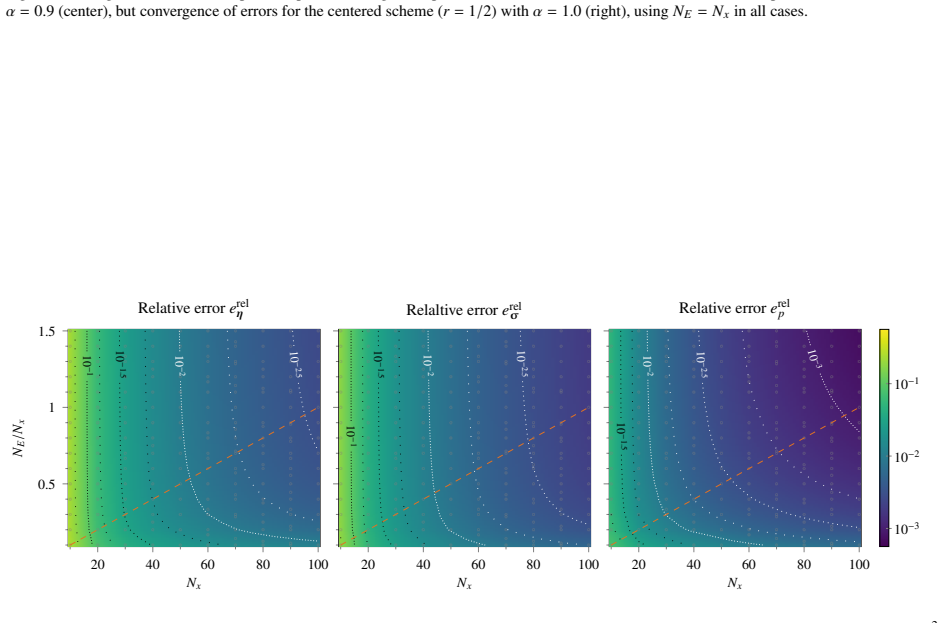
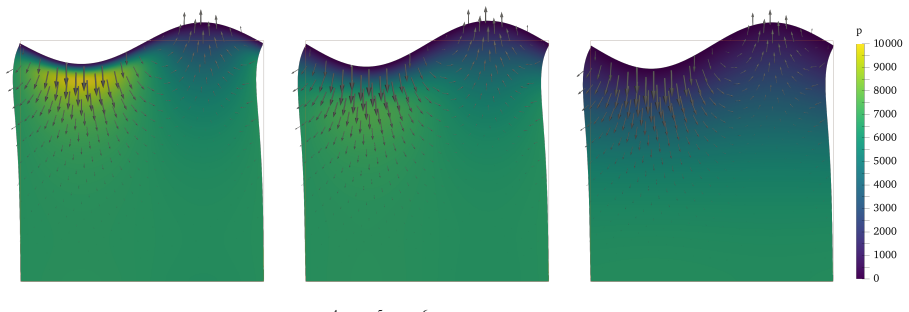
Biot's consolidation model is a classical model for the evolution of deformable porous media saturated by a fluid and has various interdisciplinary applications. While numerical solution methods to solve poroelasticity by typical schemes such as finite differences, finite volumes or finite elements have been intensely studied, lattice Boltzmann methods for poroelasticity have not been developed yet. In this work, we propose a novel semi-implicit coupling of lattice Boltzmann methods to solve Biot's consolidation model in two dimensions. To this end, we use a single-relaxation-time lattice Boltzmann method for reaction-diffusion equations to solve the Darcy flow and combine it with a recent pseudo-time multi-relaxation-time lattice Boltzmann scheme for quasi-static linear elasticity. We employ a multi-grid method for the latter scheme to achieve quasi-optimal computational cost. For the coupling between the equations, we develop a centered update scheme, that incorporates both explicit and semi-implicit contributions. The numerical results demonstrate that naive (explicit or semi-implicit) coupling schemes lead to instabilities when the poroelastic system is strongly coupled. However, the newly developed centered coupling scheme is stable and accurate in all considered cases, even for the Biot--Willis coefficient being one. Furthermore, the numerical results for Terzaghi's consolidation problem and a two-dimensional extension thereof highlight that the scheme is even able to capture discontinuous solutions arising from instantaneous loading.
Editorial analysis
A structured set of objections, weighed in public.
Referee Report
Summary. The manuscript develops a novel semi-implicit centered coupling scheme that combines a single-relaxation-time lattice Boltzmann method for the Darcy flow component with a pseudo-time multi-relaxation-time lattice Boltzmann scheme for quasi-static linear elasticity (accelerated by a multi-grid method) to solve Biot's consolidation model of linear poroelasticity in two dimensions. Numerical experiments on Terzaghi's consolidation problem and a two-dimensional extension demonstrate that the centered scheme remains stable and accurate for strong coupling (including Biot-Willis coefficient equal to one) and captures discontinuous solutions arising from instantaneous loading, in contrast to explicit and semi-implicit couplings that become unstable.
Significance. If the stability and accuracy claims hold under quantitative verification, the work is significant because it introduces the first lattice Boltzmann framework for poroelasticity, a model with broad applications in geomechanics and biomechanics. The centered coupling addresses a documented instability issue in strongly coupled regimes, and the multi-grid acceleration for the elasticity solver is a constructive efficiency feature. The reported ability to handle discontinuous solutions without additional stabilization is a potential strength.
major comments (2)
- [Numerical experiments] Numerical experiments section: the central claim that the centered scheme is 'stable and accurate in all considered cases' and 'able to capture discontinuous solutions' rests on visual or qualitative results for Terzaghi's problem, but the manuscript provides no error tables, L2 or other norms, convergence rates under grid refinement, or direct comparisons against the known analytic solution for the consolidation problem. This absence is load-bearing for the accuracy assertion.
- [Method / Coupling scheme] Coupling scheme description (centered update): while the scheme is stated to incorporate both explicit and semi-implicit contributions and is shown numerically to avoid instabilities when Biot-Willis coefficient equals one, no consistency or stability analysis is supplied to confirm that the discretization faithfully recovers the continuous Biot system across regimes without hidden parameter dependence or additional tuning. The numerical tests alone do not close this gap for the load-bearing claim of faithful reproduction.
minor comments (2)
- [Abstract] The abstract and introduction could more explicitly state the spatial dimension (two dimensions) and list the specific benchmark problems with their analytic references.
- [Method] Notation for the relaxation parameters in the SRT Darcy and MRT elasticity schemes should be unified and defined once in a single table or subsection to improve readability.
Simulated Author's Rebuttal
We thank the referee for their careful reading of the manuscript and for the positive assessment of its potential significance as the first lattice Boltzmann approach to poroelasticity. We address the two major comments below.
read point-by-point responses
-
Referee: [Numerical experiments] Numerical experiments section: the central claim that the centered scheme is 'stable and accurate in all considered cases' and 'able to capture discontinuous solutions' rests on visual or qualitative results for Terzaghi's problem, but the manuscript provides no error tables, L2 or other norms, convergence rates under grid refinement, or direct comparisons against the known analytic solution for the consolidation problem. This absence is load-bearing for the accuracy assertion.
Authors: We agree that quantitative verification would strengthen the accuracy claims. In the revised manuscript we will add tables of L2 errors (and, where appropriate, other norms) for both pressure and displacement against the known analytic solution of Terzaghi's problem, together with convergence rates obtained under successive grid refinement. These additions will also include direct quantitative comparisons that confirm the scheme's ability to capture the discontinuous solutions arising from instantaneous loading. revision: yes
-
Referee: [Method / Coupling scheme] Coupling scheme description (centered update): while the scheme is stated to incorporate both explicit and semi-implicit contributions and is shown numerically to avoid instabilities when Biot-Willis coefficient equals one, no consistency or stability analysis is supplied to confirm that the discretization faithfully recovers the continuous Biot system across regimes without hidden parameter dependence or additional tuning. The numerical tests alone do not close this gap for the load-bearing claim of faithful reproduction.
Authors: The centered update is obtained by symmetrically combining the explicit and semi-implicit contributions of the two lattice Boltzmann solvers so that, in the continuum limit, the discrete coupling terms coincide with those of the continuous Biot system. While the manuscript does not contain a formal consistency or von Neumann stability analysis, the numerical experiments cover the full range of coupling strengths (including the critical case of Biot-Willis coefficient equal to one) and demonstrate stability without any additional tuning parameters. We therefore maintain that the numerical evidence supports the claim of faithful reproduction for the regimes examined in the paper. revision: no
- A rigorous mathematical consistency and stability analysis of the centered coupling scheme
Circularity Check
No significant circularity
full rationale
The paper constructs a novel centered coupling between standard SRT LBM for Darcy flow and a pseudo-time MRT LBM for elasticity, then validates stability and accuracy via direct numerical experiments on Terzaghi's problem and its 2D extension. No derivation step equates a claimed result to its own inputs by definition, no fitted parameter is relabeled as a prediction, and no load-bearing uniqueness or ansatz is imported via self-citation. The central claims remain independent numerical observations on external benchmarks.
Axiom & Free-Parameter Ledger
axioms (1)
- domain assumption The Biot consolidation equations can be split into a Darcy flow component solvable by single-relaxation-time LBM and a quasi-static elasticity component solvable by pseudo-time multi-relaxation-time LBM.
Lean theorems connected to this paper
-
IndisputableMonolith/Foundation/RealityFromDistinction.leanreality_from_one_distinction unclear?
unclearRelation between the paper passage and the cited Recognition theorem.
We propose a novel semi-implicit coupling of lattice Boltzmann methods... centered update scheme... stable... even for the Biot–Willis coefficient being one.
-
IndisputableMonolith/Cost/FunctionalEquation.leanwashburn_uniqueness_aczel unclear?
unclearRelation between the paper passage and the cited Recognition theorem.
single-relaxation-time lattice Boltzmann method for reaction-diffusion equations... pseudo-time multi-relaxation-time lattice Boltzmann scheme for quasi-static linear elasticity
What do these tags mean?
- matches
- The paper's claim is directly supported by a theorem in the formal canon.
- supports
- The theorem supports part of the paper's argument, but the paper may add assumptions or extra steps.
- extends
- The paper goes beyond the formal theorem; the theorem is a base layer rather than the whole result.
- uses
- The paper appears to rely on the theorem as machinery.
- contradicts
- The paper's claim conflicts with a theorem or certificate in the canon.
- unclear
- Pith found a possible connection, but the passage is too broad, indirect, or ambiguous to say the theorem truly supports the claim.
Reference graph
Works this paper leans on
-
[1]
O. Boolakee, M. Geier, L. De Lorenzis, A new lattice Boltzmann scheme for linear elastic solids: periodic problems, Comput. Methods Appl. Mech. Engrg. 404 (2023) 115756. doi:10.1016/j.cma.2022.115756
-
[2]
J. M. Nordbotten, M. A. Celia, Geological Storage of CO2: Modeling Approaches for Large-Scale Simulation, Wiley, 2011. doi:10.1002/ 9781118137086
work page 2011
-
[3]
T. Sharmin, N. R. Khan, M. S. Akram, M. M. Ehsan, A state-of-the-art review on geothermal energy extraction, utilization, and improvement strategies: conventional, hybridized, and enhanced geothermal systems, Internat. J. Thermofluids 18 (2023) 100323. doi:10.1016/j. ijft.2023.100323. 19
work page doi:10.1016/j 2023
-
[4]
H. Alkhateb, A. Al-Ostaz, A. H.-D. Cheng, X. Li, Materials genome for graphene-cement nanocomposites, J. Nanomech. Micromech. 3 (3) (2013) 67–77. doi:10.1061/(ASCE)NM.2153-5477.0000055
-
[5]
M. Vandamme, F.-J. Ulm, Nanoindentation investigation of creep properties of calcium silicate hydrates, Cem. Concr. Res. 52 (2013) 38–52. doi:10.1016/j.cemconres.2013.05.006
-
[6]
A.-R. A. Khaled, K. Vafai, The role of porous media in modeling flow and heat transfer in biological tissues, Internat. J. Heat Mass Transfer 46 (26) (2003) 4989–5003. doi:10.1016/S0017-9310(03)00301-6
-
[7]
P. Causin, G. Guidoboni, A. Harris, D. Prada, R. Sacco, S. Terragni, A poroelastic model for the perfusion of the lamina cribrosa in the optic nerve head, Math.l Biosci. 257 (2014) 33–41. doi:10.1016/j.mbs.2014.08.002
-
[8]
D. Chapelle, J.-F. Gerbeau, J. Sainte-Marie, I. E. Vignon-Clementel, A poroelastic model valid in large strains with applications to perfusion in cardiac modeling, Comput. Mech. 46 (2010) 91–101. doi:10.1007/s00466-009-0452-x
-
[9]
K. Terzaghi, Die Berechnung der Durchlassigkeitsziffer des Tones aus dem Verlauf der hydrodynamischen Spannungsercheinungen, Sitzungs- berichte Akademie der Wissenschaften, Wien Mathematisch-Naturwisseuschaftliche Klasse, Abteilung IIa 132 (1923) 105–124
work page 1923
-
[10]
M. A. Biot, Consolidation settlement under a rectangular load distribution, J. Appl. Phys. 12 (5) (1941) 426–430.doi:10.1063/1.1712921
-
[11]
M. A. Biot, General theory of three-dimensional consolidation, J. Appl. Phys. 12 (2) (1941) 155–164. doi:10.1063/1.1712886
-
[12]
M. A. Biot, Theory of elasticity and consolidation for a porous anisotropic solid, J. Appl. Phys. 26 (2) (1955) 182–185. doi:10.1063/1. 1721956
work page doi:10.1063/1 1955
-
[13]
M. A. Biot, D. G. Willis, The elastic coe fficients of the theory of consolidation, J. Appl. Mech. 15 (1957) 594–601. doi:10.1115/1. 4011606
work page doi:10.1115/1 1957
-
[14]
E. Detournay, A. H.-D. Cheng, Fundamentals of poroelasticity, in: C. Fairhurst (Ed.), Analysis and Design Methods, Pergamon, 1993, pp. 113–171. doi:10.1016/B978-0-08-040615-2.50011-3
-
[15]
Coussy, Poromechanics, Wiley, 2004
O. Coussy, Poromechanics, Wiley, 2004. doi:10.1002/0470092718
-
[16]
G. N. Mercer, S. I. Barry, Flow and deformation in poroelasticity – II Numerical method, Math. Comput. Model. 30 (9) (1999) 31–38. doi:10.1016/S0895-7177(99)00178-8
-
[17]
F. J. Gaspar, F. J. Lisbona, P. N. Vabishchevich, Finite difference schemes for poro-elastic problems, Comput. Meth. Appl. Math. 2 (2) (2002) 132–142. doi:10.2478/cmam-2002-0008
-
[18]
M. Bean, S.-Y . Yi, An immersed interface method for a 1D poroelasticity problem with discontinuous coe fficients, J. Comput. Appl. Math. 272 (2014) 81–96. doi:10.1016/j.cam.2014.05.009
-
[19]
R. W. Lewis, B. A. Schrefler, The Finite Element Method in the Deformation and Consolidation of Porous Media, Wiley, 1987
work page 1987
-
[20]
M. A. Murad, A. F. D. Loula, On stability and convergence of finite element approximations of Biot’s consolidation problem, Internat. J. Numer. Meth. Engrg. 37 (4) (1994) 645–667. doi:10.1002/nme.1620370407
-
[21]
J. M. Nordbotten, Stable cell-centered finite volume discretization for Biot equations, SIAM J. Numer. Anal. 54 (2) (2016) 942–968. doi: 10.1137/15M1014280
-
[22]
I. Sokolova, M. G. Bastisya, H. Hajibeygi, Multiscale finite volume method for finite-volume-based simulation of poroelasticity, J. Comput. Phys. 379 (2019) 309–324. doi:10.1016/j.jcp.2018.11.039
-
[23]
K. M. Terekhov, Cell-centered finite-volume method for heterogeneous anisotropic poromechanics problem, J. Comput. Appl. Math. 365 (2020) 112357. doi:10.1016/j.cam.2019.112357
-
[24]
P. J. Phillips, M. F. Wheeler, A coupling of mixed and discontinuous Galerkin finite-element methods for poroelasticity, Comput. Geosci. 12 (2008) 417–435. doi:10.1007/s10596-008-9082-1
-
[25]
R. Liu, M. F. Wheeler, C. N. Dawson, R. H. Dean, On a coupled discontinuous /continuous Galerkin framework and an adaptive penalty scheme for poroelasticity problems, Comput. Meth. Appl. Mech. Engrg. 198 (41) (2009) 3499–3510.doi:10.1016/j.cma.2009.07.005
-
[26]
M. Wheeler, G. Xue, I. Yotov, Coupling multipoint flux mixed finite element methods with continuous Galerkin methods for poroelasticity, Comput. Geosci. 18 (2014) 57–75. doi:10.1007/s10596-013-9382-y
-
[27]
I. Ambartsumyan, E. Khattatov, I. Yotov, A coupled multipoint stress–multipoint flux mixed finite element method for the Biot system of poroelasticity, Comput. Meth. Appl. Mech. Engrg. 372 (2020) 113407. doi:10.1016/j.cma.2020.113407
-
[28]
J. Choo, S. Lee, Enriched Galerkin finite elements for coupled poromechanics with local mass conservation, Comput. Meth. Appl. Mech. Engrg. 341 (2018) 311–332. doi:10.1016/j.cma.2018.06.022
-
[29]
G. R. McNamara, G. Zanetti, Use of the Boltzmann equation to simulate lattice-gas automata, Phys. Rev. Lett. 61 (1988) 2332–2335. doi:10.1103/PhysRevLett.61.2332
-
[30]
S. Chen, G. D. Doolen, Lattice Boltzmann method for fluid flows, Annu. Rev. Fluid Mech. 30 (1998) 329–364. doi:10.1146/annurev. fluid.30.1.329
-
[31]
P. L. Bhatnagar, E. P. Gross, M. Krook, A model for collision processes in gases. I. Small amplitude processes in charged and neutral one-component systems, Phys. Rev. 94 (1954) 511–525. doi:10.1103/PhysRev.94.511
-
[32]
d’Humières, Multiple-relaxation-time lattice Boltzmann models in three dimensions, Phil
D. d’Humières, Multiple-relaxation-time lattice Boltzmann models in three dimensions, Phil. Trans. R. Soc. A. 360 (2002) 437–451. doi: 10.1098/rsta.2001.0955
-
[33]
M. Geier, M. Schönherr, A. Pasquali, M. Krafczyk, The cumulant lattice Boltzmann equation in three dimensions: Theory and validation, Comput. Math. Appl. 70 (4) (2015) 507–547. doi:10.1016/j.camwa.2015.05.001
- [34]
-
[35]
Oxford University Press, 2019.doi:10.1093/oso/ 9780198787754.001.0001
S. Succi, The Lattice Boltzmann Equation: For Complex States of Flowing Matter, Oxford University Press, 2018. doi:10.1093/oso/ 9780199592357.001.0001
-
[36]
M. Schönherr, K. Kucher, M. Geier, M. Stiebler, S. Freudiger, M. Krafczyk, Multi-thread implementations of the lattice Boltzmann method on non-uniform grids for CPUs and GPUs, Comput. Math. Appl. 61 (12) (2011) 3730–3743. doi:10.1016/j.camwa.2011.04.012
-
[37]
M. Ataei, H. Salehipour, XLB: A di fferentiable massively parallel lattice Boltzmann library in Python, Comput. Phys. Commun. 300 (2024) 109187. doi:10.1016/j.cpc.2024.109187
-
[38]
Wolf-Gladrow, A lattice Boltzmann equation for di ffusion, J
D. Wolf-Gladrow, A lattice Boltzmann equation for di ffusion, J. Stat. Phys. 79 (1995) 1023–1032. doi:10.1007/BF02181215. 20
-
[39]
E. G. Flekkøy, Lattice Bhatnagar-Gross-Krook models for miscible fluids, Phys. Rev. E 47 (1993) 4247–4257. doi:10.1103/PhysRevE. 47.4247
-
[40]
S. Ponce Dawson, S. Chen, G. D. Doolen, Lattice Boltzmann computations for reaction-di ffusion equations, J. Chem. Phys. 98 (2) (1993) 1514–1523. doi:10.1063/1.464316
-
[41]
X. Zhang, A. G. Bengough, J. W. Crawford, I. M. Young, A lattice BGK model for advection and anisotropic dispersion equation, Adv. Water Resour. 25 (1) (2002) 1–8. doi:10.1016/S0309-1708(01)00047-1
-
[42]
I. Ginzburg, Equilibrium-type and link-type lattice Boltzmann models for generic advection and anisotropic-dispersion equation, Adv. Water Resour. 28 (11) (2005) 1171–1195. doi:10.1016/j.advwatres.2005.03.004
-
[43]
B. Shi, B. Deng, R. Du, X. Chen, A new scheme for source term in LBGK model for convection–di ffusion equation, Comput. Math. Appl. 55 (7) (2008) 1568–1575. doi:10.1016/j.camwa.2007.08.016
-
[44]
T. Seta, Implicit temperature-correction-based immersed-boundary thermal lattice Boltzmann method for the simulation of natural convection, Phys. Rev. E 87 (2013) 063304. doi:10.1103/PhysRevE.87.063304
-
[45]
Q. Li, Z. Chai, B. Shi, Lattice Boltzmann model for a class of convection–diffusion equations with variable coefficients, Comput. Math. Appl. 70 (4) (2015) 548–561. doi:10.1016/j.camwa.2015.05.008
-
[46]
Z. Chai, B. Shi, Z. Guo, A multiple-relaxation-time lattice Boltzmann model for general nonlinear anisotropic convection-diffusion equations, J. Sci. Comput. 69 (2016) 355–390. doi:10.1007/s10915-016-0198-5
-
[47]
Z. Chai, B. Shi, Multiple-relaxation-time lattice Boltzmann method for the Navier-Stokes and nonlinear convection-di ffusion equations: Modeling, analysis, and elements, Phys. Rev. E 102 (2020) 023306. doi:10.1103/PhysRevE.102.023306
-
[48]
S. Marconi, B. Chopard, A lattice Boltzmann model for a solid body, Internat. J. Modern Phys. B 17 (1–2) (2003) 153–156. doi:10.1142/ S0217979203017254
work page 2003
-
[49]
G. S. O’Brien, T. Nissen-Meyer, C. J. Bean, A lattice Boltzmann method for elastic wave propagation in a Poisson solid, Bull. Seismol. Soc. Am. 102 (3) (2012) 1224–1234. doi:10.1785/0120110191
-
[50]
J. S. N. Murthy, P. K. Kolluru, V . Kumaran, S. Ansumali, Lattice Boltzmann method for wave propagation in elastic solids, Commun. Comput. Phys. 23 (4) (2018) 1223–1240. doi:10.4208/cicp.OA-2016-0259
-
[51]
M. Escande, P. K. Kolluru, L. M. Cléon, P. Sagaut, Lattice Boltzmann method for wave propagation in elastic solids with a regular lattice: Theoretical analysis and validation (2020). arXiv:2009.06404
-
[52]
E. Faust, A. Schlüter, H. Müller, F. Steinmetz, R. Müller, Dirichlet and Neumann boundary conditions in a lattice Boltzmann method for elastodynamics, Comput. Mech. 73 (2024) 317–339. doi:10.1007/s00466-023-02369-w
-
[53]
A. Schlüter, C. Kuhn, R. Müller, Lattice Boltzmann simulation of antiplane shear loading of a stationary crack, Comput. Mech. 62 (2018) 1059–1069. doi:10.1007/s00466-018-1550-4
-
[54]
A. Schlüter, H. Müller, R. Müller, Boundary conditions in a lattice Boltzmann method for plane strain problems, PAMM 21 (1) (2021) e202100085. doi:10.1002/pamm.202100085
-
[55]
O. Boolakee, M. Geier, L. De Lorenzis, Lattice Boltzmann for linear elastodynamics: periodic problems and Dirichlet boundary conditions (2024). arXiv:2408.01081
-
[56]
X. Yin, G. Yan, T. Li, Direct simulations of the linear elastic displacements field based on a lattice Boltzmann model, Internat. J. Numer. Meth. Engrg. 107 (3) (2016) 234–251. doi:https://doi.org/10.1002/nme.5167
-
[57]
O. Boolakee, M. Geier, L. De Lorenzis, Dirichlet and Neumann boundary conditions for a lattice Boltzmann scheme for linear elastic solids on arbitrary domains, Comput. Methods Appl. Mech. Engrg. 415 (2023) 116225. doi:10.1016/j.cma.2023.116225
-
[58]
J.-L. Auriault, E. Sanchez-Palencia, Etude du comportement macroscopic d’un mileu poreux saturé deformable, J. Mecanique 16 (4) (1977) 575–603
work page 1977
-
[59]
R. E. Showalter, Di ffusion in poro-elastic media, J. Math. Anal. Appl. 251 (1) (2000) 310–340. doi:10.1006/jmaa.2000.7048
-
[60]
P. J. Dellar, An interpretation and derivation of the lattice Boltzmann method using Strang splitting, Comput. Math. Appl. 65 (2) (2013) 129–141. doi:10.1016/j.camwa.2011.08.047
-
[61]
T. Lee, C.-L. Lin, A stable discretization of the lattice Boltzmann equation for simulation of incompressible two-phase flows at high density ratio, J. Comput. Phys. 206 (1) (2005) 16–47. doi:10.1016/j.jcp.2004.12.001
-
[62]
T. Lee, P. F. Fischer, Eliminating parasitic currents in the lattice Boltzmann equation method for nonideal gases, Phys. Rev. E 74 (2006) 046709. doi:10.1103/PhysRevE.74.046709. 21
discussion (0)
Sign in with ORCID, Apple, or X to comment. Anyone can read and Pith papers without signing in.