REVIEW 4 major objections 6 minor 2 cited by
How does feedback affect the star formation histories of galaxies?
T0 review · 4 major / 6 minor · reviewed 2026-08-05 · deepseek-v4-flash
Pith's one-line read One set of equations links star formation history shape to feedback
desk verdict A careful and useful survey of how feedback shapes SFHs across three CAMELS models, but the headline unified equations are in-sample fits to an emulator and should not be treated as validated predictions. read the letter →
The pith
A machine-rendered reading of the paper's core claim, the machinery that carries it, and where it could break.
The reading
What carries the argument
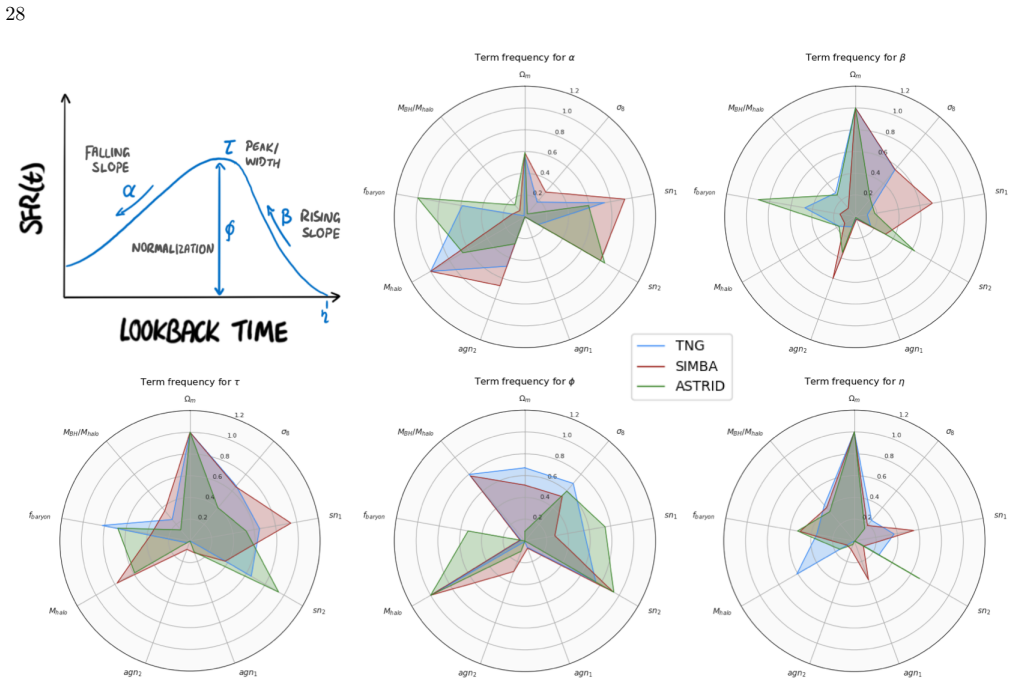
The load-bearing machinery is a double power-law SFH parameterization plus a normalizing-flow emulator. The double power law, SFH(t) = phi * ([(t-eta)/tau]^alpha + [(t-eta)/tau]^(-beta))^(-1), compresses each average SFH into five interpretable numbers. The normalizing flow, trained on the CAMELS LH simulations, generates average SFHs anywhere in parameter space, enabling regression of those five numbers against halo mass, baryon fraction, black hole mass, and feedback scalings. Symbolic regression term frequencies and generalized additive model losses guide which physical variables enter each equation, with a bias toward galaxy state variables over direct feedback parameters.
What would settle it
Recompute average SFHs directly from the CAMELS LH simulation particle data, fit double power laws, and compare the resulting alpha, beta, tau, phi, eta to Eqn 18 on a grid of parameter values; systematic deviations beyond sampling noise would disprove universality. Specifically examine ASTRID galaxies with late-time star-formation tails: if those SFHs are not well described by a double power law, the falling-slope equation is biased.
Extended reading notes
Core claim
The paper's central discovery is a system of empirical equations, Eqn 18, describing the average SFH shape parameters in terms of Omega_m, sigma_8, halo mass, baryon fraction, relative black hole mass, and the CAMELS feedback parameters. The same functional form applies to IllustrisTNG, SIMBA, and ASTRID, with only coefficients changing (Table 2). The rising slope beta depends mainly on Omega_m; the falling slope alpha on halo mass with AGN and baryon terms; the peak/width tau on cosmology, halo mass, baryon fraction, and black hole mass; the normalization phi on halo mass times feedback corrections; and the start time eta on Omega_m. The paper further finds that stellar feedback is the domi
Load-bearing premise
The entire analysis uses SFHs sampled from a machine-learning emulator rather than directly from the simulations, and the emulator is validated only qualitatively against a small single-parameter set; if it is biased, or if the double power-law fails for a substantial fraction of average SFHs, the derived equations and conclusions inherit that distortion.
Editorial extensions
If this is right
- Observed average SFHs could constrain cosmology and stellar feedback strength using Eqn 18 without rerunning simulations.
- The same equation form should apply to other simulation codes, turning cross-model calibration into a coefficient-fitting exercise.
- Because stellar feedback changes black hole growth, SFH-based constraints on stellar and AGN feedback will remain partially degenerate.
- Reparameterizing winds by mass loading and energy per unit SFR makes the three models' SFH responses qualitatively consistent, clarifying interpretations.
Reading between the lines
- Eqn 18 is fitted on emulated SFHs; applying it to other simulation suites like SWIFT-EAGLE or CAMELS-SAM would test whether the shared functional form reflects physical regularity or a property of these three models.
- AGN feedback is almost unconstrained from SFH shape alone, so combining these equations with baryon fraction or black hole mass observations should sharpen late-time feedback constraints.
- The double power-law's poor fit to ASTRID's sustained late-time tails suggests a modified form with an added plateau could alter the predicted falling slopes and the conclusion that ASTRID galaxies quench fastest.
Editorial analysis
A structured set of objections, weighed in public.
Referee Report
Summary. The paper studies how variations in stellar feedback, AGN feedback, and cosmology affect the average star formation histories (SFHs) of galaxies at z~0 in the CAMELS IllustrisTNG, SIMBA, and ASTRID simulations. The authors train normalizing-flow emulators on the CAMELS Latin Hypercube (LH) sets, use the emulators to sample average SFHs, and fit these with a double power-law (Eq. 13) to obtain shape parameters {α, β, τ, φ, η}. They then use random forests, generalized additive models, and symbolic regression to construct a common set of equations (Eq. 18) with model-specific coefficients (Table 2) that relate SFH shape parameters to halo mass, baryon fraction, black hole-to-halo mass ratio, and CAMELS feedback/cosmology parameters. The paper also presents interaction analyses, a reparameterization of supernova feedback in terms of mass/energy loading, an SBI-based proof-of-concept inference of CAMELS parameters from SFHs, and several supplementary observational diagnostics.
Significance. If the central claim holds—that one functional form with model-dependent coefficients describes SFH shape across three different hydrodynamical codes—this would be a useful empirical framework for connecting SFH observations to feedback physics and for interpreting CAMELS parameter-space studies. The paper's strengths include its use of the public CAMELS suite, explicit treatment of galaxy selection and resolution limits, the combination of multiple ML methods, and the extensive diagnostic figures. However, the equations in Eq. 18 are fitted to emulator-sampled SFHs, the emulator validation is only qualitative, and the coefficients carry no reported uncertainties or out-of-sample tests. These gaps are load-bearing for the 'single set of equations' claim, so the result is currently a promising but not fully supported empirical summary.
major comments (4)
- [§3.1, Appendix A (Fig. 19)] All SFHs used to build Eqn. 18 are generated by sampling the trained normalizing flows ('Unless otherwise mentioned, all the SFHs in the following sections are generated by sampling the trained normalizing flows', §3.1). The only comparison to actual simulation outputs is the qualitative 1P validation in Fig. 19, which states 'qualitative agreement' but reports no quantitative coverage, calibration, or held-out error statistic. Since Eqn. 16 minimizes loss on emulator-sampled SFHs, any emulator bias in under-sampled regions of the 6D parameter space propagates directly into the DPL parameters and hence into every coefficient in Table 2. I request a quantitative validation of the emulator against held-out LH boxes and/or the 1P runs, with per-parameter residuals and coverage diagnostics, and a demonstration that the derived Eqn. 18 coefficients are stable when the emulator is retrained or
- [§6.1.1, Eq. (18), Table 2] The central equations are presented without any measure of predictive accuracy. The coefficients in Table 2 have no uncertainties, and the loss defined in Eq. (16) is minimized on the same emulator-generated data used to select the terms. No residual plots, R² values, or held-out predictions are shown for the DPL parameters. The paper even uses the GAM loss as a 'proxy of the Bayes risk' (§3.3.2), but does not compare Eq. 18 against that benchmark. Without out-of-sample validation, the claim that 'a single set of equations ... can describe the SFHs across all three CAMELS models' is supported only by in-sample agreement. Please provide bootstrap/subsample coefficient uncertainties and a held-out evaluation (e.g., fitting coefficients on a training subset and evaluating on a withheld LH subset, or predicting one model's coefficients from another).
- [§3.2, §4.2, §6.1.1] The paper acknowledges that the double power-law 'does not describe a subset of ASTRID SFHs with sustained late-time tails' (§3.2). These ASTRID SFHs are nevertheless included in the fits that determine the ASTRID coefficients in Table 2, where α and τ are the least constrained parameters. Because Eqn. 18 is claimed to hold across all three models, the fraction of average SFHs that are poorly represented by the DPL form must be quantified, and the sensitivity of the derived coefficients to excluding or reparameterizing these cases should be shown. If the DPL failure is non-negligible in ASTRID, the corresponding rows of Table 2 may encode an artifact of the fitting form rather than the feedback response.
- [§6.1.1, Eq. (16), Eq. (18)] The claim of a 'single set of equations' is weakened by the fact that the coefficients are free to vary per model in Eq. (16). If the functional form is the same but every coefficient differs, the statement reduces to 'each model can be fit by a member of a parametric family'. The paper needs to demonstrate what is shared beyond the functional form—for example, that the same terms remain important across models, that coefficients can be predicted from model properties, or that the equations generalize to held-out models/parameters. As written, the evidence for universality is largely the symbolic-regression term frequencies in Fig. 12, which are qualitative and in-sample.
minor comments (6)
- [§3.1, Appendix A] The validation text in Appendix A repeats 'qualitative agreement' twice. Please state explicitly which quantitative metrics were computed (e.g., coverage, calibration, chi-square) and whether any failed.
- [§3.2, Eq. (13)] The text defines α as the falling slope and β as the rising slope, but Figure 1 and Eq. (13) can be misread because the two power-law terms are symmetric. Consider adding a sentence explicitly defining the relation between α, β and the t<τ versus t>τ behavior.
- [§4.3, Eq. (17)] The χ² metric in Eq. (17) has unusual units (SFR² over SFR² integrated over time). Please clarify whether the integrand is intended to be a dimensionless ratio or whether the normalization is meant to produce a time-averaged statistic.
- [§3.3.1] The random forest feature importances in Fig. 13 are shown without error bars or sensitivity checks. Given that they are used as a 'sanity check' for Eq. 18, a bootstrap estimate would strengthen the comparison.
- [§6.1.1, Eq. (18)] The equation for η is written separately with no coefficients in Table 2. For completeness, state explicitly that η = 12.5Ωm − 3 is used for all three models, and whether a coefficient uncertainty was estimated.
- [General] There are several typographical and formatting issues, including 'early rimes' in §6.1.1, inconsistent use of 'Mhalo' (log Mhalo vs Mhalo) in Eq. (18) and Table 2, and missing figure cross-references in the text. A careful proofread is recommended.
Circularity Check
No circularity: Eqn 18 is an explicitly empirical fit, not a first-principles derivation; the real weaknesses are missing out-of-sample validation and qualitative emulator checks, not a definitional loop.
full rationale
The claimed 'derivation' of Eqn 18 is openly empirical: Section 3.3.3 leaves coefficients free and minimizes L = sum_model (Theta_SFH - sum_i c_i,model f(Theta_sfh,i))^2 (Eqn 16) on Theta_SFH parameters obtained by MCMC-fitting the same normalizing-flow-sampled SFHs, and Section 6.1.1 calls the result 'empirical equations.' Fitting a response surface to its own training data is in-sample regression, not circularity; the paper does not present Eqn 18 as a held-out prediction or as a consequence of a self-citation or uniqueness theorem. The normalizing flow itself is anchored to the LH simulations and has an admittedly qualitative 1P validation in Appendix A (Fig 19), and the acknowledged DPL failure for some ASTRID SFHs with late-time tails (Section 3.2) is a stated modeling limitation. The feedback-trend conclusions in Section 4 and the mass/energy-loading reparametrization in Section 6.2 are separate empirical findings. The genuine gap is the absence of a quantitative held-out test of Eqn 18 against direct simulation SFHs; that is a validation/correctness weakness, not a circular step. No load-bearing self-citation or ansatz-smuggling was found.
Assumptions & free parameters
free parameters (1)
- SFH equation coefficients (Table 2) =
Multiple values, e.g., tau_TNG: c1=4.571, c2=0.891, c3=-0.173, c4=0.930, c5=3.236
assumptions (5)
- domain assumption The average SFH of 100 randomly selected galaxies in a box is a stable proxy for the mean SFH in that box and mass range.
- ad hoc to paper The double power-law form (Eqn 13) adequately captures the shape of average SFHs.
- domain assumption Simulation-based inference with normalizing flows trained on the LH datasets provides unbiased SFH samples across the parameter space.
- ad hoc to paper The z=0 values of baryon fraction and black hole-to-halo mass ratio are sufficient state variables to characterize the integrated feedback history relevant to SFH shape.
- domain assumption The CAMELS parameter variations (ASN1, ASN2, AAGN1, AAGN2, Omega_m, sigma_8) span the physically interesting feedback and cosmology space.
Cite this review
Pith. "Pith review of How does feedback affect the star formation histories of galaxies?." pith.science (2026). https://pith.science/paper/MXCGDHLN
@misc{pith2026250821152,
  author       = {Pith},
  title        = {Pith review of: How does feedback affect the star formation histories of galaxies?},
  year         = {2026},
  howpublished = {\url{https://pith.science/paper/MXCGDHLN}},
  note         = {Machine review of arXiv:2508.21152}
}
abstract
Star formation in galaxies is regulated by the interplay of a range of processes that shape the multiphase gas in the interstellar and circumgalactic media. Using the CAMELS suite of cosmological simulations, we study the effects of varying feedback and cosmology on the average star formation histories (SFHs) of galaxies at $z\sim0$ across the IllustrisTNG, SIMBA and ASTRID galaxy formation models. We find that galaxy SFHs in all three models are sensitive to changes in stellar feedback, which affects the efficiency of baryon cycling and the rates at which central black holes grow, while effects of varying AGN feedback depend on model-dependent implementations of black hole seeding, accretion and feedback. We also find strong interaction terms that couple stellar and AGN feedback, usually by regulating the amount of gas available for the central black hole to accrete. Using a double power-law to describe the average SFHs, we derive a general set of equations relating the shape of the SFHs to physical quantities like baryon fraction and black hole mass across all three models. We find that a single set of equations (albeit with different coefficients) can describe the SFHs across all three CAMELS models, with cosmology dominating the SFH at early times, followed by halo accretion, and feedback and baryon cycling at late times. Galaxy SFHs provide a novel, complementary probe to constrain cosmology and feedback, and can connect the observational constraints from current and upcoming galaxy surveys with the physical mechanisms responsible for regulating galaxy growth and quenching.
Figures


Figures from the paper (21 more)




Forward citations
Cited by 2 Pith papers
-
POLAR-II: modeling star formation history of galaxies on the 21-cm signal from Epoch of Reionization
Varying the star formation history of galaxies while keeping total ionizing photons fixed changes the size and warmth of ionized regions, altering the topology of reionization and the 21-cm global signal and power spectrum.
-
Quenching of Star Formation in Massive Galaxies
Massive galaxies quench via either rapid supermassive black hole outflow-driven shutdown or gradual gas exhaustion, virial heating, or preventative feedback, each with distinct signatures.
Reference graph
Works this paper leans on
-
[1]
, " * write output.state after.block = add.period write newline
ENTRY address archivePrefix author booktitle chapter doi edition editor eprint howpublished institution journal key month number organization pages publisher school series title misctitle type volume year version url label extra.label sort.label short.list INTEGERS output.state before.all mid.sentence after.sentence after.block FUNCTION init.state.consts ...
-
[2]
write newline
" write newline "" before.all 'output.state := FUNCTION format.url url empty "" new.block "" url * "" * if FUNCTION format.eprint eprint empty "" archivePrefix empty "" archivePrefix "arXiv" = new.block " " eprint * " " * new.block " " eprint * " " * if if if FUNCTION format.doi doi empty "" " " doi * " " * if FUNCTION format.pid doi empty eprint empty ur...
-
[3]
" nf| N3 t1 Q1 Q1 Q1 T|k_I ǸBDD p 7Tm߾ ; [h:x [._Y2X C| G ;C!
thebibliography [1] 20pt to REFERENCES 6pt =0pt -12pt 10pt plus 3pt =0pt =0pt =1pt plus 1pt =0pt =0pt -12pt =13pt plus 1pt =20pt =13pt plus 1pt \@M =10000 =-1.0em =0pt =0pt 0pt =0pt =1.0em @enumiv\@empty 10000 10000 `\.\@m \@noitemerr \@latex@warning Empty `thebibliography' environment \@ifnextchar \@reference \@latexerr Missing key on reference command E...
arXiv 2021
-
[4]
Abramson , L. E., Gladders , M. D., Dressler , A., et al. 2016, , 832, 7, 10.3847/0004-637X/832/1/7
-
[5]
Angl \'e s-Alc \'a zar , D., Dav \'e , R., Faucher-Gigu \`e re , C.-A., \"O zel , F., & Hopkins , P. F. 2017 a , , 464, 2840, 10.1093/mnras/stw2565
-
[6]
2017 b , , 470, 4698, 10.1093/mnras/stx1517
Angl \'e s-Alc \'a zar , D., Faucher-Gigu \`e re , C.-A., Kere s , D., et al. 2017 b , , 470, 4698, 10.1093/mnras/stx1517
-
[7]
2017 c , , 472, L109, 10.1093/mnrasl/slx161
Angl \'e s-Alc \'a zar , D., Faucher-Gigu \`e re , C.-A., Quataert , E., et al. 2017 c , , 472, L109, 10.1093/mnrasl/slx161
-
[8]
Angl \'e s-Alc \'a zar , D., Quataert , E., Hopkins , P. F., et al. 2021, , 917, 53, 10.3847/1538-4357/ac09e8
Show all 169 references
-
[9]
P., Tollerud , E
Astropy Collaboration , Robitaille , T. P., Tollerud , E. J., et al. 2013, , 558, A33, 10.1051/0004-6361/201322068
2013 doi
-
[10]
M., Sip o cz , B
Astropy Collaboration , Price-Whelan , A. M., Sip o cz , B. M., et al. 2018, , 156, 123, 10.3847/1538-3881/aabc4f
2018 doi
-
[11]
M., Lim , P
Astropy Collaboration , Price-Whelan , A. M., Lim , P. L., et al. 2022, , 935, 167, 10.3847/1538-4357/ac7c74
2022 doi
-
[12]
2023, , 524, 5391, 10.1093/mnras/stad2046
Ayromlou , M., Nelson , D., & Pillepich , A. 2023, , 524, 5391, 10.1093/mnras/stad2046
2023 doi
-
[13]
B., Pirzkal , N., Finkelstein , S
Bagley , M. B., Pirzkal , N., Finkelstein , S. L., et al. 2024, , 965, L6, 10.3847/2041-8213/ad2f31
2024 doi
-
[14]
S., Devriendt , J., Slyz , A., et al
Beckmann , R. S., Devriendt , J., Slyz , A., et al. 2017, , 472, 949, 10.1093/mnras/stx1831
2017 doi
-
[15]
S., Smith , M
Bennett , J. S., Smith , M. C., Fielding , D. B., et al. 2024, arXiv e-prints, arXiv:2410.12909, 10.48550/arXiv.2410.12909
2024 doi
-
[16]
2022, , 512, 3703, 10.1093/mnras/stac648
Bird , S., Ni , Y., Di Matteo , T., et al. 2022, , 512, 3703, 10.1093/mnras/stac648
2022 doi
-
[17]
2014, , 445, 2313, 10.1093/mnras/stu1923
Bird , S., Vogelsberger , M., Haehnelt , M., et al. 2014, , 445, 2313, 10.1093/mnras/stu1923
2014 doi
-
[18]
Bluck , A. F. L., Maiolino , R., Brownson , S., et al. 2022, , 659, A160, 10.1051/0004-6361/202142643
2022 doi
-
[19]
Bluck , A. F. L., Piotrowska , J. M., & Maiolino , R. 2023, , 944, 108, 10.3847/1538-4357/acac7c
2023 doi
-
[20]
1952, , 112, 195, 10.1093/mnras/112.2.195
Bondi , H. 1952, , 112, 195, 10.1093/mnras/112.2.195
1952 doi
-
[21]
M., et al
Borrow , J., Schaller , M., Bah \'e , Y. M., et al. 2023, , 526, 2441, 10.1093/mnras/stad2928
2023 doi
-
[22]
2010, , 718, 1001, 10.1088/0004-637X/718/2/1001
Bouch \'e , N., Dekel , A., Genzel , R., et al. 2010, , 718, 1001, 10.1088/0004-637X/718/2/1001
2010 doi
-
[23]
G., Schaye , J., Frenk , C
Bower , R. G., Schaye , J., Frenk , C. S., et al. 2017, , 465, 32, 10.1093/mnras/stw2735
2017 doi
- [24]
-
[25]
S., et al
Brennan , R., Choi , E., Somerville , R. S., et al. 2018, , 860, 14, 10.3847/1538-4357/aac2c4
2018 doi
-
[26]
2016, in Astrophysics and Space Science Library, Vol
Brooks , A., & Christensen , C. 2016, in Astrophysics and Space Science Library, Vol. 418, Galactic Bulges, ed. E. Laurikainen , R. Peletier , & D. Gadotti , 317, 10.1007/978-3-319-19378-6_12
2016 doi
- [27]
-
[28]
J., Owers , M
Bryant , J. J., Owers , M. S., Robotham , A. S. G., et al. 2015, , 447, 2857, 10.1093/mnras/stu2635
2015 doi
-
[29]
A., Law , D
Bundy , K., Bershady , M. A., Law , D. R., et al. 2015, , 798, 7, 10.1088/0004-637X/798/1/7
2015 doi
-
[30]
R., et al
Busillo , V., Tortora , C., Napolitano , N. R., et al. 2023, , 525, 6191, 10.1093/mnras/stad2691
2023 doi
-
[31]
2023, , 520, 722, 10.1093/mnras/stad171
Byrne , L., Faucher-Gigu \`e re , C.-A., Stern , J., et al. 2023, , 520, 722, 10.1093/mnras/stad171
2023 doi
-
[32]
C., Leja , J., Johnson , B
Carnall , A. C., Leja , J., Johnson , B. D., et al. 2019, , 873, 44, 10.3847/1538-4357/ab04a2
2019 doi
-
[33]
L., Fielding , D
Carr , C., Bryan , G. L., Fielding , D. B., Pandya , V., & Somerville , R. S. 2023, , 949, 21, 10.3847/1538-4357/acc4c7
2023 doi
-
[34]
M., Kartaltepe , J
Casey , C. M., Kartaltepe , J. S., Drakos , N. E., et al. 2023, , 954, 31, 10.3847/1538-4357/acc2bc
2023 doi
- [35]
-
[36]
M., Koo , D
Chen , Z., Faber , S. M., Koo , D. C., et al. 2020, , 897, 102, 10.3847/1538-4357/ab9633
2020 doi
-
[37]
P., Naab , T., Oser , L., & Moster , B
Choi , E., Ostriker , J. P., Naab , T., Oser , L., & Moster , B. P. 2015, , 449, 4105, 10.1093/mnras/stv575
2015 doi
-
[38]
S., Ostriker , J
Choi , E., Somerville , R. S., Ostriker , J. P., Hirschmann , M., & Naab , T. 2024, , 964, 54, 10.3847/1538-4357/ad245a
2024 doi
-
[39]
S., Ostriker , J
Choi , E., Somerville , R. S., Ostriker , J. P., Naab , T., & Hirschmann , M. 2018, , 866, 91, 10.3847/1538-4357/aae076
2018 doi
-
[40]
A., Wyithe , J
Correa , C. A., Wyithe , J. S. B., Schaye , J., & Duffy , A. R. 2015, , 450, 1514, 10.1093/mnras/stv689
2015 doi
-
[41]
A., Schaye , J., Bower , R
Crain , R. A., Schaye , J., Bower , R. G., et al. 2015, , 450, 1937, 10.1093/mnras/stv725
2015 doi
-
[42]
2024, PySR: High-Performance Symbolic Regression in Python and Julia , Astrophysics Source Code Library, record ascl:2409.018
Cranmer , M. 2024, PySR: High-Performance Symbolic Regression in Python and Julia , Astrophysics Source Code Library, record ascl:2409.018
2024
-
[43]
2019, , 486, 2827, 10.1093/mnras/stz937
Dav \'e , R., Angl \'e s-Alc \'a zar , D., Narayanan , D., et al. 2019, , 486, 2827, 10.1093/mnras/stz937
2019 doi
-
[45]
Dav \'e , R., Thompson , R., & Hopkins , P. F. 2016, , 462, 3265, 10.1093/mnras/stw1862
2016 doi
-
[46]
de Santi , N. S. M., Shao , H., Villaescusa-Navarro , F., et al. 2023, , 952, 69, 10.3847/1538-4357/acd1e2
2023 doi
-
[47]
2014, , 444, 2071, 10.1093/mnras/stu1427
Dekel , A., & Mandelker , N. 2014, , 444, 2071, 10.1093/mnras/stu1427
2014 doi
-
[48]
M., Angl \'e s-Alc \'a zar , D., Thiele , L., et al
Delgado , A. M., Angl \'e s-Alc \'a zar , D., Thiele , L., et al. 2023, , 526, 5306, 10.1093/mnras/stad2992
2023 doi
- [49]
-
[50]
B., Macci \`o , A
Di Cintio , A., Brook , C. B., Macci \`o , A. V., et al. 2014, , 437, 415, 10.1093/mnras/stt1891
2014 doi
-
[51]
2008, , 676, 33, 10.1086/524921
Di Matteo , T., Colberg , J., Springel , V., Hernquist , L., & Sijacki , D. 2008, , 676, 33, 10.1086/524921
2008 doi
-
[52]
M., Starkenburg , T
Dickey , C. M., Starkenburg , T. K., Geha , M., et al. 2021, , 915, 53, 10.3847/1538-4357/abc014
2021 doi
-
[53]
E., & Torrey , P
Diemer , B., Sparre , M., Abramson , L. E., & Torrey , P. 2017, , 839, 26, 10.3847/1538-4357/aa68e5
2017 doi
-
[54]
T., McLure , R
Donnan , C. T., McLure , R. J., Dunlop , J. S., et al. 2024, , 533, 3222, 10.1093/mnras/stae2037
2024 doi
-
[56]
A., Macci \`o , A
Dutton , A. A., Macci \`o , A. V., Buck , T., et al. 2019, , 486, 655, 10.1093/mnras/stz889
2019 doi
- [57]
- [58]
-
[59]
Fabian , A. C. 2012, , 50, 455, 10.1146/annurev-astro-081811-125521
2012 doi
-
[60]
L., Bagley , M
Finkelstein , S. L., Bagley , M. B., Ferguson , H. C., et al. 2023, , 946, L13, 10.3847/2041-8213/acade4
2023 doi
-
[61]
L., Bagley , M
Finkelstein , S. L., Bagley , M. B., Arrabal Haro , P., et al. 2025, , 983, L4, 10.3847/2041-8213/adbbd3
2025 doi
-
[62]
2017, , 601, A143, 10.1051/0004-6361/201629478
Fiore , F., Feruglio , C., Shankar , F., et al. 2017, , 601, A143, 10.1051/0004-6361/201629478
2017 doi
-
[63]
R., & Mirocha , J
Furlanetto , S. R., & Mirocha , J. 2022, , 511, 3895, 10.1093/mnras/stac310
2022 doi
-
[64]
2024, , 529, 4896, 10.1093/mnras/stae817
Gebhardt , M., Angl \'e s-Alc \'a zar , D., Borrow , J., et al. 2024, , 529, 4896, 10.1093/mnras/stae817
2024 doi
-
[65]
2023, , 954, L11, 10.3847/2041-8213/acee80
Gelli , V., Salvadori , S., Ferrara , A., Pallottini , A., & Carniani , S. 2023, , 954, L11, 10.3847/2041-8213/acee80
2023 doi
-
[66]
2019, in International Conference on Machine Learning, PMLR, 2404--2414
Greenberg, D., Nonnenmacher, M., & Macke, J. 2019, in International Conference on Machine Learning, PMLR, 2404--2414
2019
-
[67]
A., Kocevski , D
Grogin , N. A., Kocevski , D. D., Faber , S. M., et al. 2011, , 197, 35, 10.1088/0067-0049/197/2/35
2011 doi
-
[68]
2017, , 468, 3935, 10.1093/mnras/stx666
Habouzit , M., Volonteri , M., & Dubois , Y. 2017, , 468, 3935, 10.1093/mnras/stx666
2017 doi
-
[69]
Harris el al., C. R. 2020, Nat, 585, 357, https://doi.org/10.1038/s41586-020-2649-2
2020 doi
-
[70]
J., & Tibshirani, R
Hastie, T. J., & Tibshirani, R. J. 1990, Generalized additive models, Vol. 43 (CRC press)
1990
-
[71]
C., & Hopkins , P
Hayward , C. C., & Hopkins , P. F. 2017, , 465, 1682, 10.1093/mnras/stw2888
2017 doi
-
[72]
M., & Best , P
Heckman , T. M., & Best , P. N. 2023, Galaxies, 11, 21, 10.3390/galaxies11010021
2023 doi
- [73]
-
[74]
F., Cox , T
Hopkins , P. F., Cox , T. J., Kere s , D., & Hernquist , L. 2008, , 175, 390, 10.1086/524363
2008 doi
-
[75]
F., Kere s , D., O \ n orbe , J., et al
Hopkins , P. F., Kere s , D., O \ n orbe , J., et al. 2014, , 445, 581, 10.1093/mnras/stu1738
2014 doi
-
[76]
F., Wetzel , A., Kere s , D., et al
Hopkins , P. F., Wetzel , A., Kere s , D., et al. 2018, , 480, 800, 10.1093/mnras/sty1690
2018 doi
-
[77]
F., Grudic , M
Hopkins , P. F., Grudic , M. Y., Su , K.-Y., et al. 2024, The Open Journal of Astrophysics, 7, 18, 10.21105/astro.2309.13115
2024
-
[78]
2021, , 502, 6010, 10.1093/mnras/stab357
Huang , H.-J., Eifler , T., Mandelbaum , R., et al. 2021, , 502, 6010, 10.1093/mnras/stab357
2021 doi
-
[79]
Hunter, J. D. 2007, Computing in Science & Engineering, 9, 90, 10.1109/MCSE.2007.55
2007 doi
-
[80]
G., Gawiser , E., Faber , S
Iyer , K. G., Gawiser , E., Faber , S. M., et al. 2019, , 879, 116, 10.3847/1538-4357/ab2052
2019 doi
-
[81]
G., Speagle , J
Iyer , K. G., Speagle , J. S., Caplar , N., et al. 2024 a , , 961, 53, 10.3847/1538-4357/acff64
2024 doi
-
[82]
G., Tacchella , S., Genel , S., et al
Iyer , K. G., Tacchella , S., Genel , S., et al. 2020, , 498, 430, 10.1093/mnras/staa2150
2020 doi
-
[83]
G., Yunus , M., O'Neill , C., et al
Iyer , K. G., Yunus , M., O'Neill , C., et al. 2024 b , , 275, 38, 10.3847/1538-4365/ad7c43
2024 doi
-
[84]
2023, , 944, 67, 10.3847/1538-4357/aca8fe
Jo , Y., Genel , S., Wandelt , B., et al. 2023, , 944, 67, 10.3847/1538-4357/aca8fe
2023 doi
-
[85]
E., et al
Kaiser , N., Aussel , H., Burke , B. E., et al. 2002, in Society of Photo-Optical Instrumentation Engineers (SPIE) Conference Series, Vol. 4836, Survey and Other Telescope Technologies and Discoveries, ed. J. A. Tyson & S. Wolff , 154--164, 10.1117/12.457365
2002 doi
- [86]
-
[87]
1998, , 498, 541, 10.1086/305588
Kennicutt , Robert C., J. 1998, , 498, 541, 10.1086/305588
1998 doi
-
[88]
H., & Dav \'e , R
Kere s , D., Katz , N., Weinberg , D. H., & Dav \'e , R. 2005, , 363, 2, 10.1111/j.1365-2966.2005.09451.x
2005
-
[89]
S., Sorini , D., Lee , K.-G., & Dav \'e , R
Khrykin , I. S., Sorini , D., Lee , K.-G., & Dav \'e , R. 2024, , 529, 537, 10.1093/mnras/stae525
2024 doi
-
[90]
M., Faber , S
Koekemoer , A. M., Faber , S. M., Ferguson , H. C., et al. 2011, , 197, 36, 10.1088/0067-0049/197/2/36
2011 doi
-
[91]
Kolmogorov, A. N. 1957, On the representation of continuous functions of many variables by superposition of continuous functions of one variable and addition
1957
-
[92]
Kormendy , J., & Ho , L. C. 2013, , 51, 511, 10.1146/annurev-astro-082708-101811
2013 doi
-
[93]
2023, , 526, 6103, 10.1093/mnras/stad2540
Kugel , R., Schaye , J., Schaller , M., et al. 2023, , 526, 6103, 10.1093/mnras/stad2540
2023 doi
-
[94]
Lagos , C. d. P., Bravo , M., Tobar , R., et al. 2024, , 10.1093/mnras/stae1024
2024 doi
- [95]
-
[96]
C., Johnson , B
Leja , J., Carnall , A. C., Johnson , B. D., Conroy , C., & Speagle , J. S. 2019, , 876, 3, 10.3847/1538-4357/ab133c
2019 doi
-
[97]
L., Ruszkowski , M., et al
Li , Y., Bryan , G. L., Ruszkowski , M., et al. 2015, , 811, 73, 10.1088/0004-637X/811/2/73
2015 doi
- [98]
-
[99]
2024, arXiv preprint arXiv:2404.19756
Liu, Z., Wang, Y., Vaidya, S., et al. 2024, arXiv preprint arXiv:2404.19756
2024 arXiv
- [100]
-
[101]
C., Starkenburg , T., Ho , M., et al
Lovell , C. C., Starkenburg , T., Ho , M., et al. 2024, arXiv e-prints, arXiv:2411.13960, 10.48550/arXiv.2411.13960
2024 doi
-
[102]
J., Lu , Z., Katz , N., & Weinberg , M
Lu , Y., Mo , H. J., Lu , Z., Katz , N., & Weinberg , M. D. 2014, , 443, 1252, 10.1093/mnras/stu1200
2014 doi
-
[103]
V., Vogelsberger , M., Torrey , P., & Springel , V
Marinacci , F., Sales , L. V., Vogelsberger , M., Torrey , P., & Springel , V. 2019, , 489, 4233, 10.1093/mnras/stz2391
2019 doi
-
[104]
G., Salcido , J., Schaye , J., et al
McCarthy , I. G., Salcido , J., Schaye , J., et al. 2023, , 526, 5494, 10.1093/mnras/stad3107
2023 doi
- [105]
-
[106]
P., Paprocki, M., et al
Meurer, A., Smith, C. P., Paprocki, M., et al. 2017, PeerJ Computer Science, 3, e103
2017
-
[107]
2022, , 933, 133, 10.3847/1538-4357/ac70c6
Moser , E., Battaglia , N., Nagai , D., et al. 2022, , 933, 133, 10.3847/1538-4357/ac70c6
2022 doi
-
[108]
L., Kere s , D., Faucher-Gigu \`e re , C.-A., et al
Muratov , A. L., Kere s , D., Faucher-Gigu \`e re , C.-A., et al. 2015, , 454, 2691, 10.1093/mnras/stv2126
2015 doi
-
[109]
Naab , T., & Ostriker , J. P. 2017, , 55, 59, 10.1146/annurev-astro-081913-040019
2017 doi
-
[110]
2015, , 448, 59, 10.1093/mnras/stv017
Nelson , D., Genel , S., Vogelsberger , M., et al. 2015, , 448, 59, 10.1093/mnras/stv017
2015 doi
-
[111]
2023, , 959, 136, 10.3847/1538-4357/ad022a
Ni , Y., Genel , S., Angl \'e s-Alc \'a zar , D., et al. 2023, , 959, 136, 10.3847/1538-4357/ad022a
2023 doi
-
[112]
S., et al
O \ n orbe , J., Boylan-Kolchin , M., Bullock , J. S., et al. 2015, , 454, 2092, 10.1093/mnras/stv2072
2015 doi
-
[113]
D., Davies , J
Oppenheimer , B. D., Davies , J. J., Crain , R. A., et al. 2020, , 491, 2939, 10.1093/mnras/stz3124
2020 doi
-
[114]
A., Weiner , B., Charlot , S., & Gardner , J
Pacifici , C., Kassin , S. A., Weiner , B., Charlot , S., & Gardner , J. P. 2013, , 762, L15, 10.1088/2041-8205/762/1/L15
2013 doi
-
[115]
A., Weiner , B
Pacifici , C., Kassin , S. A., Weiner , B. J., et al. 2016, , 832, 79, 10.3847/0004-637X/832/1/79
2016 doi
-
[116]
J., et al
Pandey , S., Lehman , K., Baxter , E. J., et al. 2023, , 525, 1779, 10.1093/mnras/stad2268
2023 doi
-
[117]
S., Angl \'e s-Alc \'a zar , D., et al
Pandya , V., Somerville , R. S., Angl \'e s-Alc \'a zar , D., et al. 2020, , 905, 4, 10.3847/1538-4357/abc3c1
2020 doi
-
[118]
B., Angl \'e s-Alc \'a zar , D., et al
Pandya , V., Fielding , D. B., Angl \'e s-Alc \'a zar , D., et al. 2021, , 508, 2979, 10.1093/mnras/stab2714
2021 doi
-
[119]
B., Bryan , G
Pandya , V., Fielding , D. B., Bryan , G. L., et al. 2023, , 956, 118, 10.3847/1538-4357/acf3ea
2023 doi
-
[120]
L., Ferguson , H
Papovich , C., Finkelstein , S. L., Ferguson , H. C., Lotz , J. M., & Giavalisco , M. 2011, , 412, 1123, 10.1111/j.1365-2966.2010.17965.x
2011
-
[121]
2019, Advances in neural information processing systems, 32
Paszke, A., Gross, S., Massa, F., et al. 2019, Advances in neural information processing systems, 32
2019
-
[122]
2011, the Journal of machine Learning research, 12, 2825
Pedregosa, F., Varoquaux, G., Gramfort, A., et al. 2011, the Journal of machine Learning research, 12, 2825
2011
-
[123]
A., Genel , S., Villaescusa-Navarro , F., et al
Perez , L. A., Genel , S., Villaescusa-Navarro , F., et al. 2023, , 954, 11, 10.3847/1538-4357/accd52
2023 doi
-
[124]
2018, , 473, 4077, 10.1093/mnras/stx2656
Pillepich , A., Springel , V., Nelson , D., et al. 2018, , 473, 4077, 10.1093/mnras/stx2656
2018 doi
-
[125]
2012, , 421, 3464, 10.1111/j.1365-2966.2012.20571.x
Pontzen , A., & Governato , F. 2012, , 421, 3464, 10.1111/j.1365-2966.2012.20571.x
2012
- [126]
-
[127]
C., van der Velden, E., Celles, S., et al
Price, D. C., van der Velden, E., Celles, S., et al. 2018, Journal of Open Source Software, 3, 1115, 10.21105/joss.01115
2018 doi
-
[128]
R., Behroozi , P., & Faber , S
Rodr \' guez-Puebla , A., Primack , J. R., Behroozi , P., & Faber , S. M. 2016, , 455, 2592, 10.1093/mnras/stv2513
2016 doi
-
[129]
Rupke , D. S. N. 2018, Galaxies, 6, 138, 10.3390/galaxies6040138
2018 doi
-
[130]
2022, , 60, 319, 10.1146/annurev-astro-021022-043545
Saintonge , A., & Catinella , B. 2022, , 60, 319, 10.1146/annurev-astro-021022-043545
2022 doi
-
[131]
F., Kennicutt , R
S \'a nchez , S. F., Kennicutt , R. C., Gil de Paz , A., et al. 2012, , 538, A8, 10.1051/0004-6361/201117353
2012 doi
- [132]
-
[133]
M., et al
Schaye , J., Dalla Vecchia , C., Booth , C. M., et al. 2010, , 402, 1536, 10.1111/j.1365-2966.2009.16029.x
2010
-
[134]
2007, , 172, 1, 10.1086/516585
Scoville , N., Aussel , H., Brusa , M., et al. 2007, , 172, 1, 10.1086/516585
2007 doi
-
[135]
A., Kravtsov , A
Semenov , V. A., Kravtsov , A. V., & Gnedin , N. Y. 2017, , 845, 133, 10.3847/1538-4357/aa8096
2017 doi
-
[137]
2018 b , pyGAM: Generalized Additive Models in Python , v0.4.1, Zenodo, 10.5281/zenodo.1208724
---. 2018 b , pyGAM: Generalized Additive Models in Python , v0.4.1, Zenodo, 10.5281/zenodo.1208724
2018 doi
-
[138]
2020, , 492, 2418, 10.1093/mnras/stz2909
Sharma , M., & Theuns , T. 2020, , 492, 2418, 10.1093/mnras/stz2909
2020 doi
-
[139]
G., & Semenov , V
Shin , E.-j., Tacchella , S., Kim , J.-h., Iyer , K. G., & Semenov , V. A. 2023, , 947, 61, 10.3847/1538-4357/acc251
2023 doi
-
[140]
2024, arXiv e-prints, arXiv:2409.19066, 10.48550/arXiv.2409.19066
Siudek , M., Pucha , R., Mezcua , M., et al. 2024, arXiv e-prints, arXiv:2409.19066, 10.48550/arXiv.2409.19066
2024 doi
-
[141]
S., & Dav \'e , R
Somerville , R. S., & Dav \'e , R. 2015, , 53, 51, 10.1146/annurev-astro-082812-140951
2015 doi
-
[142]
2022, , 516, 883, 10.1093/mnras/stac2214
Sorini , D., Dav \'e , R., Cui , W., & Appleby , S. 2022, , 516, 883, 10.1093/mnras/stac2214
2022 doi
-
[143]
2003, , 339, 289, 10.1046/j.1365-8711.2003.06206.x
Springel , V., & Hernquist , L. 2003, , 339, 289, 10.1046/j.1365-8711.2003.06206.x
2003
-
[144]
P., Kim , C.-G., Bryan , G
Steinwandel , U. P., Kim , C.-G., Bryan , G. L., et al. 2024, , 960, 100, 10.3847/1538-4357/ad09e1
2024 doi
-
[145]
F., Bryan , G
Su , K.-Y., Hopkins , P. F., Bryan , G. L., et al. 2021, , 507, 175, 10.1093/mnras/stab2021
2021 doi
-
[146]
J., & Johnson , B
Tacchella , S., Bose , S., Conroy , C., Eisenstein , D. J., & Johnson , B. D. 2018, , 868, 92, 10.3847/1538-4357/aae8e0
2018 doi
-
[147]
M., et al
Tacchella , S., Dekel , A., Carollo , C. M., et al. 2016, , 457, 2790, 10.1093/mnras/stw131
2016 doi
-
[148]
C., & Caplar , N
Tacchella , S., Forbes , J. C., & Caplar , N. 2020, , 497, 698, 10.1093/mnras/staa1838
2020 doi
-
[149]
Tacchella , S., Trenti , M., & Carollo , C. M. 2013, , 768, L37, 10.1088/2041-8205/768/2/L37
2013 doi
-
[150]
A., Bell , E
Terrazas , B. A., Bell , E. F., Pillepich , A., et al. 2020, , 493, 1888, 10.1093/mnras/staa374
2020 doi
- [151]
-
[152]
T., Burkhart , B., Tonnesen , S., et al
Tillman , M. T., Burkhart , B., Tonnesen , S., et al. 2023 a , , 945, L17, 10.3847/2041-8213/acb7f1
2023 doi
-
[153]
2023 b , , 166, 228, 10.3847/1538-3881/ad02f5
---. 2023 b , , 166, 228, 10.3847/1538-3881/ad02f5
2023 doi
-
[154]
M., Haas , M
van de Voort , F., Schaye , J., Booth , C. M., Haas , M. R., & Dalla Vecchia , C. 2011, , 414, 2458, 10.1111/j.1365-2966.2011.18565.x
2011
-
[155]
2016, , 223, 29, 10.3847/0067-0049/223/2/29
van der Wel , A., Noeske , K., Bezanson , R., et al. 2016, , 223, 29, 10.3847/0067-0049/223/2/29
2016 doi
-
[156]
2021, , 915, 71, 10.3847/1538-4357/abf7ba
Villaescusa-Navarro , F., Angl \'e s-Alc \'a zar , D., Genel , S., et al. 2021, , 915, 71, 10.3847/1538-4357/abf7ba
2021 doi
-
[157]
2022, , 259, 61, 10.3847/1538-4365/ac5ab0
Villaescusa-Navarro , F., Genel , S., Angl \'e s-Alc \'a zar , D., et al. 2022, , 259, 61, 10.3847/1538-4365/ac5ab0
2022 doi
- [158]
-
[159]
E., et al
Virtanen, P., Gommers, R., Oliphant, T. E., et al. 2020, Nature Methods, 17, 261, 10.1038/s41592-019-0686-2
2020 doi
-
[160]
M., Bryan , G
Voit , G. M., Bryan , G. L., Balogh , M. L., & Bower , R. G. 2002, , 576, 601, 10.1086/341864
2002 doi
-
[161]
M., Carr , C., Fielding , D
Voit , G. M., Carr , C., Fielding , D. B., et al. 2024 a , , 976, 151, 10.3847/1538-4357/ad81d5
2024 doi
-
[162]
M., Oppenheimer , B
Voit , G. M., Oppenheimer , B. D., Bell , E. F., Terrazas , B., & Donahue , M. 2024 b , , 960, 28, 10.3847/1538-4357/ad0039
2024 doi
-
[163]
M., Pandya , V., Fielding , D
Voit , G. M., Pandya , V., Fielding , D. B., et al. 2024 c , , 976, 150, 10.3847/1538-4357/ad81d6
2024 doi
-
[164]
2003, , 582, 559, 10.1086/344675
Volonteri , M., Haardt , F., & Madau , P. 2003, , 582, 559, 10.1086/344675
2003 doi
-
[165]
R., Kauffmann , O
Weaver , J. R., Kauffmann , O. B., Ilbert , O., et al. 2022, , 258, 11, 10.3847/1538-4365/ac3078
2022 doi
-
[166]
H., & Tinker , J
Wechsler , R. H., & Tinker , J. L. 2018, , 56, 435, 10.1146/annurev-astro-081817-051756
2018 doi
-
[167]
2017, , 465, 3291, 10.1093/mnras/stw2944
Weinberger , R., Springel , V., Hernquist , L., et al. 2017, , 465, 3291, 10.1093/mnras/stw2944
2017 doi
-
[168]
2018, , 479, 4056, 10.1093/mnras/sty1733
Weinberger , R., Springel , V., Pakmor , R., et al. 2018, , 479, 4056, 10.1093/mnras/sty1733
2018 doi
-
[169]
J., Lagos , C
Wright , R. J., Lagos , C. d. P., Power , C., & Mitchell , P. D. 2020, , 498, 1668, 10.1093/mnras/staa2359
2020 doi
- [170]
-
[171]
2018, Galaxies, 6, 114, 10.3390/galaxies6040114
Zhang , D. 2018, Galaxies, 6, 114, 10.3390/galaxies6040114
2018 doi
-
[172]
2020, , 499, 768, 10.1093/mnras/staa2607
Zinger , E., Pillepich , A., Nelson , D., et al. 2020, , 499, 768, 10.1093/mnras/staa2607
2020 doi
Reviewed August 5, 2026 · model on record in the stance chip above.
Discussion (0). Sign in to comment.