REVIEW 3 major objections 2 minor 89 references
The coronal temperature of NGC 4388 and NGC 2110 measured with INTEGRAL
T0 review · 3 major / 2 minor · reviewed 2026-08-14 · deepseek-v4-flash
Pith's one-line read Two Seyfert coronae are measured at 75–80 keV, placing them in the pair-thermostat regime.
desk verdict Clean spectral measurement that gives NGC 2110 a credible coronal temperature and revises an inflated earlier value; the main caveat is an untested assumption that the high-energy cutoff is constant across 13 years of INTEGRAL and snapshot data. read the letter →
The pith
A machine-rendered reading of the paper's core claim, the machinery that carries it, and where it could break.
The reading
What carries the argument
The analysis rests on the thermal Comptonisation model compps (Poutanen & Svensson 1996), which computes the spectrum produced when soft disc photons are upscattered by a hot electron plasma; fitting the electron temperature $k T_{\rm e}$ and the Compton parameter $y=4\tau\,k T_{\rm e}/m_{\rm e}c^{2}$ (used instead of $\tau$ to reduce the known temperature–optical-depth degeneracy) yields the coronal parameters under an assumed spherical geometry. The load-bearing data are the INTEGRAL/IBIS spectra accumulated from 2003 to 2015, whose coverage up to 300 keV makes the high-energy turnover visible; the turnover is modelled both as an exponential cutoff and as the intrinsically sharper Comptonisation rollover. The compactness–temperature diagram ($\ell$ vs $\Theta_{\rm e}=k T_{\rm e}/m_{\rm e}c^{2}$), with the pair runaway line of Fabian et al. (2015), is used to interpret the measured temperatures.
What would settle it
Split the INTEGRAL data into epochs matching the XMM–Newton and NuSTAR snapshots and fit the cutoff freely in each epoch; if the derived cutoffs move outside the reported 90% confidence ranges ($200^{+75}_{-40}$ keV for NGC 4388, $320^{+100}_{-60}$ keV for NGC 2110), the time-averaged temperature is an artefact of spectral variability and the pair-thermostat interpretation fails.
Extended reading notes
Core claim
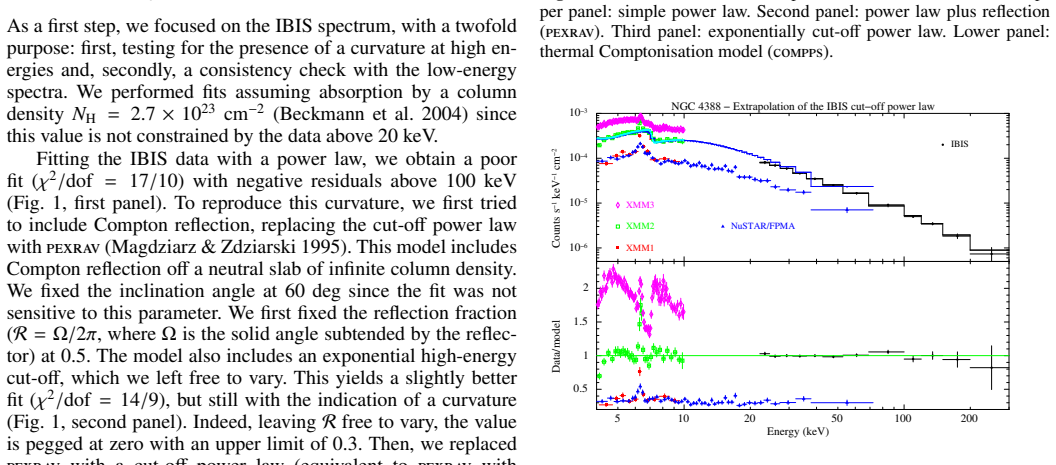
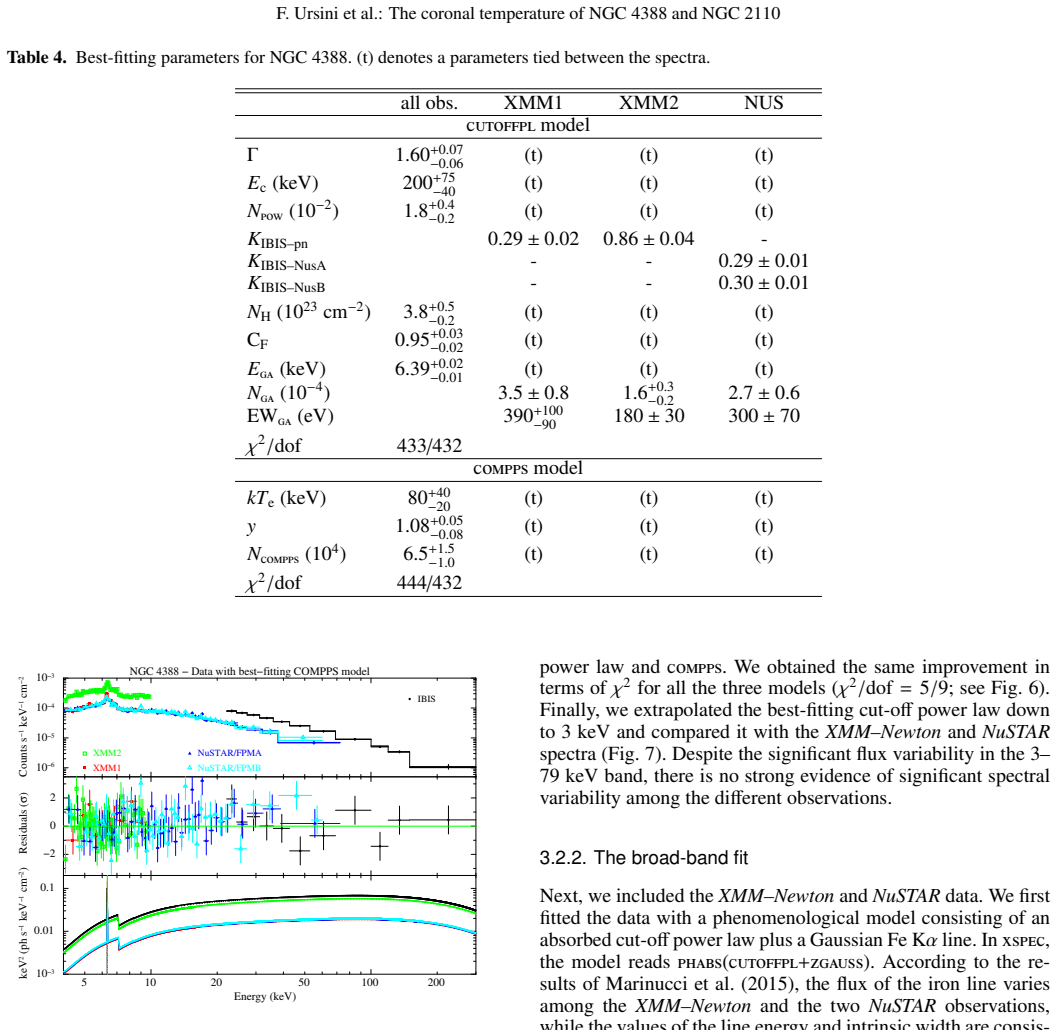
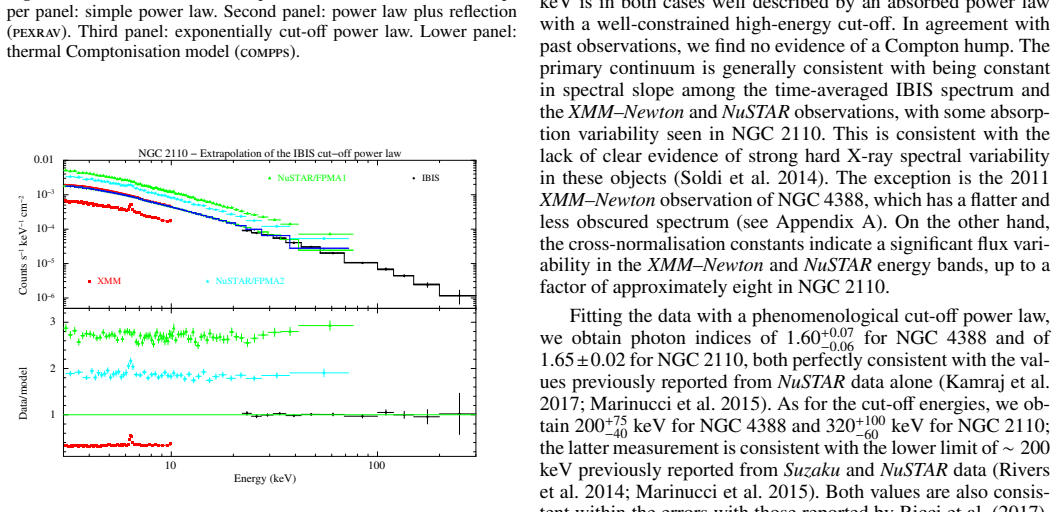
Joint fitting of the time-averaged INTEGRAL/IBIS spectrum (20–300 keV) with archival XMM–Newton and NuSTAR spectra shows that both sources are well described by an absorbed cutoff power law with no Compton reflection component. The high-energy cutoff is measured at $E_{\rm c}=200^{+75}_{-40}$ keV for NGC 4388 and $E_{\rm c}=320^{+100}_{-60}$ keV for NGC 2110. Replacing the phenomenological cutoff with the thermal Comptonisation model compps in spherical geometry gives coronal temperatures of $k T_{\rm e}=80^{+40}_{-20}$ keV (NGC 4388) and $k T_{\rm e}=75^{+20}_{-15}$ keV (NGC 2110), with optical depths $\tau \simeq 1.7$ and $\tau \simeq 2.1$. The derived temperatures and luminosities place both objects below the pair runaway line in the compactness–temperature plane, supporting the pair-thermostat scenario in which electron–positron pair production regulates the coronal temperature.
Load-bearing premise
The analysis assumes the intrinsic photon index and high-energy cutoff stayed constant across the 2003–2015 INTEGRAL average and the XMM–Newton and NuSTAR snapshots, so the measured cutoff represents a single physical corona.
Editorial extensions
If this is right
- Assuming a coronal radius of about 10 gravitational radii, both sources lie below the pair runaway line in the $\ell$–$\Theta_{\rm e}$ plane, so pair production can cap the coronal temperature as the pair-thermostat model predicts.
- The lack of a Compton reflection hump alongside strong Fe K$\alpha$ lines indicates the line arises in Compton-thin material rather than from a disc reflection continuum.
- The measured cutoffs of 200 and 320 keV are high relative to the typical INTEGRAL cutoff (mean ~128 keV), and they place both sources in the small group of AGNs with coronal temperatures above 70 keV that are measured to better than about 50 per cent uncertainty.
- Within the epochs used, the primary continuum slope is consistent with being constant across the 2003–2015 INTEGRAL average and the XMM–Newton/NuSTAR snapshots, with the 2011 XMM observation of NGC 4388 as a distinct flatter state.
Reading between the lines
- If the pair-thermostat picture is right, the coronal temperature of these two sources should remain near 75–80 keV while their luminosity varies by a factor of several; a direct test would be to split the INTEGRAL data into high- and low-flux epochs and measure $k T_{\rm e}$ in each.
- The two galaxies have very different Eddington ratios (~0.23 and ~0.01) yet nearly identical coronal temperatures; this hints that $k T_{\rm e}$ is not driven by accretion rate in this regime, a correlation that a larger sample of sources with measured black hole masses could test.
- Because Fedorova et al. (2011) suggested the cutoff in NGC 4388 varies between about 80–100 keV and above 320 keV, the time-averaged 200 keV cutoff may be a blend of states; if so, the single-temperature corona would need to be replaced by a distribution of temperatures, and the pair-thermostat interpretation would need to be revisited.
Signed reviews
Editorial analysis
A structured set of objections, weighed in public.
Referee Report
Summary. This paper presents a spectral analysis of the hard X-ray (20-300 keV) INTEGRAL/IBIS time-averaged spectra of the Seyfert galaxies NGC 4388 and NGC 2110, combined with archival XMM-Newton and NuSTAR snapshots. The authors fit the broad-band spectra with xspec using an absorbed cutoff power law plus a Fe Kα line, obtaining well-constrained high-energy cutoffs Ec = 200+75-40 keV for NGC 4388 and Ec = 320+100-60 keV for NGC 2110, with no significant Compton reflection component (R < 0.12 and R < 0.02). Replacing the power law with the thermal Comptonisation model compps in spherical geometry yields coronal temperatures kTe = 80+40-20 keV (NGC 4388) and kTe = 75+20-15 keV (NGC 2110), with Compton parameters y ~ 1.1-1.2 corresponding to optical depths of roughly 1.7 and 2.1. The authors then estimate bolometric luminosities, compute the compactness parameter l = Lσ_T/(R m_e c^3) assuming R = 10 R_g, and argue that both objects fall below the pair runaway line in the l - Θ_e plane, consistent with the pair thermostat scenario.
Significance. If the measurements are correct, this work adds two well-constrained coronal temperature and optical depth measurements to the AGN sample, demonstrating the importance of high signal-to-noise data above 100 keV. The spectral analysis is statistically careful, the reduced spectra are made available, and the paper explicitly compares with and reconciles previous INTEGRAL, NuSTAR, Suzaku, and BeppoSAX results. The main quantitative conclusion (kTe ~ 75-80 keV) is, however, dependent on the assumption that a single cutoff energy describes both the 13-year INTEGRAL average and the short XMM/NuSTAR snapshots, and the pair-thermostat interpretation depends on an assumed coronal radius and bolometric correction. These dependencies are acknowledged in part but deserve further testing.
major comments (3)
- [Secs. 3.1.2 and 3.2.2] The high-energy cutoff Ec (and the equivalent kTe in the compps model) is tied across the time-averaged IBIS spectrum and the individual XMM-Newton and NuSTAR snapshots, and the paper does not test whether Ec varies between epochs. The cross-normalization constants imply flux variations of factors ~3 for NGC 4388 and ~8 for NGC 2110, and Fedorova et al. (2011) reported possible cutoff variations in NGC 4388 between 80-100 keV and >320 keV. If the cutoff varies with flux or time, the reported Ec and kTe are flux-weighted effective values rather than a single physical coronal temperature. I recommend allowing Ec (or kTe) to vary among the spectra in the joint fit, or splitting the IBIS data into temporal subsets, to demonstrate that the cutoff is stable; otherwise the central claim of a measured coronal temperature is not fully supported.
- [Sec. 4] The pair-thermostat consistency check depends on the assumed corona radius through l = Lσ_T/(R m_e c^3), and the paper assumes R = 10 R_g with a bolometric correction from Marconi et al. (2004). The resulting compactness differs by a factor of about 26 between the two sources, and for NGC 2110 l ~ 0.5 at R = 10 R_g, which is far below the pair runaway line. This makes the statement of 'consistency with the pair thermostat' relatively weak; the authors should explicitly discuss the sensitivity of the compactness and of the conclusion to the assumed radius and luminosity, and present the result as an illustrative consistency check rather than a quantitative confirmation.
- [Sec. 3.1.2 and Appendix A] The 2011 XMM-Newton observation (XMM3) of NGC 4388 is excluded from the joint fit because it likely represents a different spectral state (flatter photon index and lower column density), yet this epoch is included in the IBIS time average used in the same joint fit. The authors should clarify whether this exclusion is consistent with their assumption of a single cutoff across the full 2003-2015 IBIS average, or whether the inclusion of the 2011 state could bias the time-averaged cutoff and hence the derived kTe.
minor comments (2)
- [Sec. 3.1.2] The cross-normalization constants in Tables 4 and 5 (e.g., K_IBIS-pn, K_IBIS-NusA) are not fully defined in the text; a sentence explaining that they are multiplicative factors between the IBIS and XMM/NuSTAR normalizations would improve readability.
- [Sec. 4] The unabsorbed 0.1-200 keV luminosity used in the compactness calculation is not reported; giving this value (with its uncertainty) would make the l - Θ_e placement reproducible.
Circularity Check
No circularity: coronal temperatures are fit parameters from independent X-ray spectra, and the pair-thermostat comparison uses external theory with an assumed radius.
full rationale
The paper's central results, kTe = 80(+40,-20) keV for NGC 4388 and kTe = 75(+20,-15) keV for NGC 2110, are free parameters of thermal Comptonisation (compps) fits to a combination of INTEGRAL/IBIS, XMM-Newton, and NuSTAR data. The high-energy cutoff energies from the cutoff power-law fits are likewise directly constrained by the observed spectral turnover; they are not derived from, nor do they presuppose, the pair-thermostat conclusion. The compactness-temperature comparison is an independent interpretive step: compactness is computed from the fitted luminosity and an assumed coronal radius (R = 10 gravitational radii), and the pair-runaway/thermostat curve is taken from external theoretical work (Fabian et al. 2015, Svensson 1984, Zdziarski 1985). No equation in the paper reduces one claimed result to another by construction, and no fitted parameter is renamed as a prediction. The only self-citation, Ursini et al. (2015), appears in the introduction as a general reference and is not load-bearing. The concern raised in the skeptic headline, that the joint fits tie the cutoff across a time-averaged INTEGRAL spectrum and shorter snapshots, is a statistical/modeling caveat about possible cutoff variability, not an instance of circularity; in fact the paper itself flags Fedorova et al. (2011) variability, showing the assumption is at least acknowledged rather than hidden. Because the measurements come directly from the data and the theoretical comparison is external and not tuned, the derivation is self-contained and no circular step is present.
Assumptions & free parameters
free parameters (2)
- Seed photon temperature =
100 eV (fixed)
- Coronal radius in gravitational radii =
10 (assumed)
assumptions (5)
- domain assumption The compps model with spherical geometry (geom=0) describes the corona.
- domain assumption The seed photon temperature is fixed at 100 eV.
- ad hoc to paper The 2011 XMM3 observation of NGC 4388 represents a different spectral state and is excluded from the joint fit.
- domain assumption A single photon index and cutoff apply across all epochs, with only normalization varying.
- standard math Standard abundances and photoelectric cross-sections apply.
Cite this review
Pith. "Pith review of The coronal temperature of NGC 4388 and NGC 2110 measured with INTEGRAL." pith.science (2026). https://pith.science/paper/MXSQSTAE
@misc{pith2026190803112,
  author       = {Pith},
  title        = {Pith review of: The coronal temperature of NGC 4388 and NGC 2110 measured with INTEGRAL},
  year         = {2026},
  howpublished = {\url{https://pith.science/paper/MXSQSTAE}},
  note         = {Machine review of arXiv:1908.03112}
}
abstract
We aim to measure the physical properties of the hot X-ray corona of two active galactic nuclei, NGC 4388 and NGC 2110. We analysed the hard X-ray (20-300 keV) INTEGRAL spectrum in conjunction with archival XMM-Newton and NuSTAR data. The X-ray spectrum of both sources is phenomenologically well described by an absorbed cut-off power law. In agreement with previous results, we find no evidence of a Compton reflection component in these sources. We obtain a high-energy cut-off of $200^{+75}_{-40}$ keV for NGC 4388 and $320^{+100}_{-60}$ keV for NGC 2110. A fit with a thermal Comptonisation model yields a coronal temperature of $80^{+45}_{-20}$ keV and $75^{+20}_{-15}$ keV, respectively, and an optical depth of approximately two, assuming a spherical geometry. The coronal temperature and luminosity of both sources are consistent with pair production that acts as a thermostat for the thermal plasma. These results emphasise the importance of good signal-to-noise X-ray data above 100 keV to probe the high-energy emission of AGNs.
Figures


Figures from the paper (5 more)



Reference graph
Works this paper leans on
-
[1]
& Grevesse , N
Anders , E. & Grevesse , N. 1989, , 53, 197
1989
-
[2]
Arnaud , K. A. 1996, in Astronomical Society of the Pacific Conference Series, Vol. 101, Astronomical Data Analysis Software and Systems V, ed. G. H. Jacoby & J. Barnes , 17
1996
-
[3]
A., et al
Balokovi \'c , M., Brightman , M., Harrison , F. A., et al. 2018, , 854, 42
2018
-
[4]
H., Tueller , J., Markwardt , C
Baumgartner , W. H., Tueller , J., Markwardt , C. B., et al. 2013, , 207, 19
2013
-
[5]
& Do Cao , O
Beckmann , V. & Do Cao , O. 2010, in Eighth Integral Workshop. The Restless Gamma-ray Universe (INTEGRAL 2010), 81
2010
-
[6]
2004, , 614, 641
Beckmann , V., Gehrels , N., Favre , P., et al. 2004, , 614, 641
2004
-
[7]
& Shrader , C
Beckmann , V. & Shrader , C. R. 2012, Active Galactic Nuclei (Weinheim, Germany: Wiley-VCH)
2012
-
[8]
D., Laor , A., et al
Behar , E., Baldi , R. D., Laor , A., et al. 2015, , 451, 517
2015
Show all 89 references
-
[9]
D., Smith , K
Behar , E., Vogel , S., Baldi , R. D., Smith , K. L., & Mushotzky , R. F. 2018, , 478, 399
2018
-
[10]
2006, , 448, 499
Bianchi , S., Guainazzi , M., & Chiaberge , M. 2006, , 448, 499
2006
-
[11]
2005, , 357, 599
Bianchi , S., Matt , G., Nicastro , F., Porquet , D., & Dubau , J. 2005, , 357, 599
2005
-
[12]
J., Bazzano , A., Bassani , L., et al
Bird , A. J., Bazzano , A., Bassani , L., et al. 2010, , 186, 1
2010
-
[13]
J., Malizia , A., Bazzano , A., et al
Bird , A. J., Malizia , A., Bazzano , A., et al. 2007, , 170, 175
2007
-
[14]
Broderick , J. W. & Fender , R. P. 2011, , 417, 184
2011
-
[15]
Buisson , D. J. K., Fabian , A. C., & Lohfink , A. M. 2018, , 481, 4419
2018
-
[16]
D., Papadakis , I
Caballero-Garcia , M. D., Papadakis , I. E., Nicastro , F., & Ajello , M. 2012, , 537, A87
2012
-
[17]
2012, , 420, 2087
de Rosa , A., Panessa , F., Bassani , L., et al. 2012, , 420, 2087
2012
-
[18]
R., Riffel , R
Diniz , M. R., Riffel , R. A., Storchi-Bergmann , T., & Winge , C. 2015, , 453, 1727
2015
-
[19]
2004, , 615, L25
Elvis , M., Risaliti , G., Nicastro , F., et al. 2004, , 615, L25
2004
-
[20]
A., Lee , J
Evans , D. A., Lee , J. C., Kamenetska , M., et al. 2006, , 653, 1121
2006
-
[21]
A., Lee , J
Evans , D. A., Lee , J. C., Turner , T. J., Weaver , K. A., & Marshall , H. L. 2007, , 671, 1345
2007
-
[22]
C., Lohfink , A., Belmont , R., Malzac , J., & Coppi , P
Fabian , A. C., Lohfink , A., Belmont , R., Malzac , J., & Coppi , P. 2017, , 467, 2566
2017
-
[23]
C., Lohfink , A., Kara , E., et al
Fabian , A. C., Lohfink , A., Kara , E., et al. 2015, , 451, 4375
2015
-
[24]
S., & Simpson , C
Falcke , H., Wilson , A. S., & Simpson , C. 1998, , 502, 199
1998
-
[25]
Fanaroff , B. L. & Riley , J. M. 1974, , 167, 31P
1974
-
[26]
V., Beckmann , V., Neronov , A., & Soldi , S
Fedorova , E. V., Beckmann , V., Neronov , A., & Soldi , S. 2011, , 417, 1140
2011
-
[27]
2018, in Society of Photo-Optical Instrumentation Engineers (SPIE) Conference Series, Vol
Fuschino , F., Campana , R., Caroli , E., et al. 2018, in Society of Photo-Optical Instrumentation Engineers (SPIE) Conference Series, Vol. 10699, Space Telescopes and Instrumentation 2018: Ultraviolet to Gamma Ray, 106995Z
2018
-
[28]
F., Baum , S
Gallimore , J. F., Baum , S. A., O'Dea , C. P., Pedlar , A., & Brinks , E. 1999, , 524, 684
1999
-
[29]
& Panessa , F
Giroletti , M. & Panessa , F. 2009, , 706, L260
2009
-
[30]
2003, , 411, L223
Goldwurm , A., David , P., Foschini , L., et al. 2003, , 411, L223
2003
-
[31]
1997, , 476, 620
Haardt , F., Maraschi , L., & Ghisellini , G. 1997, , 476, 620
1997
-
[32]
Ho , L. C. 2002, , 564, 120
2002
-
[33]
& Doi , A
Inoue , Y. & Doi , A. 2018, , 869, 114
2018
-
[34]
S., Fabian , A
Iwasawa , K., Wilson , A. S., Fabian , A. C., & Young , A. J. 2003, , 345, 369
2003
-
[35]
A., Balokovi \'c , M., Lohfink , A., & Brightman , M
Kamraj , N., Harrison , F. A., Balokovi \'c , M., Lohfink , A., & Brightman , M. 2018, , 866, 124
2018
-
[36]
A., Brightman , M., & Balokovi \'c , M
Kamraj , N., Rivers , E., Harrison , F. A., Brightman , M., & Balokovi \'c , M. 2017, , 843, 89
2017
-
[37]
A., Lohfink , A., et al
Kara , E., Garc \' a , J. A., Lohfink , A., et al. 2017, , 468, 3489
2017
-
[38]
Y., Braatz , J
Kuo , C. Y., Braatz , J. A., Condon , J. J., et al. 2011, , 727, 20
2011
-
[39]
2019, arXiv e-prints [ [arXiv] 1904.04784 ]
Lanzuisi , G., Gilli , R., Cappi , M., et al. 2019, arXiv e-prints [ [arXiv] 1904.04784 ]
2019 arXiv
-
[40]
& Behar , E
Laor , A. & Behar , E. 2008, , 390, 847
2008
-
[41]
P., Lavocat , P., et al
Lebrun , F., Leray , J. P., Lavocat , P., et al. 2003, , 411, L141
2003
-
[42]
Y., Hoffman , G
Lu , N. Y., Hoffman , G. L., Groff , T., Roos , T., & Lamphier , C. 1993, , 88, 383
1993
-
[43]
2016, , 458, 2454
Lubi \'n ski , P., Beckmann , V., Gibaud , L., et al. 2016, , 458, 2454
2016
-
[44]
K., Harrison , F., Broadway , D., et al
Madsen , K. K., Harrison , F., Broadway , D., et al. 2018, in Society of Photo-Optical Instrumentation Engineers (SPIE) Conference Series, Vol. 10699, Space Telescopes and Instrumentation 2018: Ultraviolet to Gamma Ray, 106996M
2018
-
[45]
& Zdziarski , A
Magdziarz , P. & Zdziarski , A. A. 1995, , 273, 837
1995
-
[46]
1999, , 342, L41
Malaguti , G., Bassani , L., Cappi , M., et al. 1999, , 342, L41
1999
-
[47]
2014, , 782, L25
Malizia, A., Molina, M., Bassani, L., et al. 2014, , 782, L25
2014
-
[48]
M., & Poutanen , J
Malzac , J., Beloborodov , A. M., & Poutanen , J. 2001, , 326, 417
2001
-
[49]
2004, , 351, 169
Marconi , A., Risaliti , G., Gilli , R., et al. 2004, , 351, 169
2004
-
[50]
2015, , 447, 160
Marinucci , A., Matt , G., Bianchi , S., et al. 2015, , 447, 160
2015
-
[51]
2015, , 447, 3029
Matt , G., Balokovi \'c , M., Marinucci , A., et al. 2015, , 447, 3029
2015
-
[52]
2014, , 439, 3016
Matt , G., Marinucci , A., Guainazzi , M., et al. 2014, , 439, 3016
2014
-
[53]
A., et al
Matt , G., Piro , L., Antonelli , L. A., et al. 1994, , 292, L13
1994
-
[54]
O., et al
Middei , R., Bianchi , S., Petrucci , P. O., et al. 2019, , 483, 4695
2019
-
[55]
2013, , 433, 1687
Molina , M., Bassani , L., Malizia , A., et al. 2013, , 433, 1687
2013
-
[56]
2009, , 399, 1293
Molina , M., Bassani , L., Malizia , A., et al. 2009, , 399, 1293
2009
-
[57]
G., Wilson , A
Mundell , C. G., Wilson , A. S., Ulvestad , J. S., & Roy , A. L. 2000, , 529, 816
2000
-
[58]
Nied \'z wiecki , A., Szanecki , M., & Zdziarski , A. A. 2019, , 485, 2942
2019
-
[59]
D., Laor , A., et al
Panessa , F., Baldi , R. D., Laor , A., et al. 2019, Nature Astronomy, 3, 387
2019
-
[60]
2007, , 467, 519
Panessa , F., Barcons , X., Bassani , L., et al. 2007, , 467, 519
2007
-
[61]
2008, , 483, 151
Panessa , F., Bassani , L., de Rosa , A., et al. 2008, , 483, 151
2008
-
[62]
C., Matt , G., Cappi , M., et al
Perola , G. C., Matt , G., Cappi , M., et al. 2002, , 389, 802
2002
-
[63]
O., Haardt , F., Maraschi , L., et al
Petrucci , P. O., Haardt , F., Maraschi , L., et al. 2001, , 556, 716
2001
-
[64]
O., Haardt , F., Maraschi , L., et al
Petrucci , P. O., Haardt , F., Maraschi , L., et al. 2000, , 540, 131
2000
-
[65]
2013, , 549, A73
Petrucci , P.-O., Paltani , S., Malzac , J., et al. 2013, , 549, A73
2013
-
[66]
2004, , 351, 161
Piconcelli , E., Jimenez-Bail \'o n , E., Guainazzi , M., et al. 2004, , 351, 161
2004
-
[67]
& Svensson , R
Poutanen , J. & Svensson , R. 1996, , 470, 249
1996
-
[68]
& Laor , A
Raginski , I. & Laor , A. 2016, , 459, 2082
2016
-
[69]
N., Nandra , K., George , I
Reeves , J. N., Nandra , K., George , I. M., et al. 2004, , 602, 648
2004
-
[70]
J., et al
Ricci , C., Trakhtenbrot , B., Koss , M. J., et al. 2017, , 233, 17
2017
-
[71]
2002, , 386, 379
Risaliti , G. 2002, , 386, 379
2002
-
[72]
2014, , 786, 126
Rivers , E., Markowitz , A., Rothschild , R., et al. 2014, , 786, 126
2014
-
[73]
2007, , 658, 815
Sikora , M., Stawarz , ., & Lasota , J.-P. 2007, , 658, 815
2007
-
[74]
H., et al
Soldi , S., Beckmann , V., Baumgartner , W. H., et al. 2014, , 563, A57
2014
-
[75]
E., Poutanen , J., Svensson , R., Sikora , M., & Begelman , M
Stern , B. E., Poutanen , J., Svensson , R., Sikora , M., & Begelman , M. C. 1995, , 449, L13
1995
-
[76]
1984, , 209, 175
Svensson , R. 1984, , 209, 175
1984
-
[77]
N., et al
Tombesi , F., Cappi , M., Reeves , J. N., et al. 2010, , 521, A57
2010
-
[78]
Tortosa , A., Bianchi , S., Marinucci , A., Matt , G., & Petrucci , P. O. 2018, , 614, A37
2018
-
[79]
2017, , 466, 4193
Tortosa , A., Marinucci , A., Matt , G., et al. 2017, , 466, 4193
2017
-
[80]
J., Reeves , J
Turner , T. J., Reeves , J. N., Braito , V., & Costa , M. 2018, , 476, 1258
2018
-
[81]
2003, , 411, L131
Ubertini , P., Lebrun , F., Di Cocco , G., et al. 2003, , 411, L131
2003
-
[82]
Ulvestad , J. S. & Wilson , A. S. 1983, , 264, L7
1983
-
[83]
2015, , 452, 3266
Ursini , F., Marinucci , A., Matt , G., et al. 2015, , 452, 3266
2015
-
[84]
A., Ferland , G
Verner , D. A., Ferland , G. J., Korista , K. T., & Yakovlev , D. G. 1996, , 465, 487
1996
-
[85]
Zdziarski , A. A. 1985, , 289, 514
1985
-
[86]
A., Lubi \'n ski , P., Gilfanov , M., & Revnivtsev , M
Zdziarski , A. A., Lubi \'n ski , P., Gilfanov , M., & Revnivtsev , M. 2003, , 342, 355
2003
-
[87]
A., Poutanen , J., & Johnson , W
Zdziarski , A. A., Poutanen , J., & Johnson , W. N. 2000, , 542, 703
2000
-
[88]
, " * write output.state after.block = add.period write newline
ENTRY address archiveprefix author booktitle chapter edition editor howpublished institution eprint journal key month note number organization pages publisher school series title type volume year label extra.label sort.label short.list INTEGERS output.state before.all mid.sent...
-
[89]
write newline
" write newline "" before.all 'output.state := FUNCTION n.dashify 't := "" t empty not t #1 #1 substring "-" = t #1 #2 substring "--" = not "--" * t #2 global.max substring 't := t #1 #1 substring "-" = "-" * t #2 global.max substring 't := while if t #1 #1 substring * t #2 gl...
Reviewed August 14, 2026 · model on record in the stance chip above.
Discussion (0). Continue with ORCID to comment.