REVIEW 3 major objections 5 minor 133 references
Elemental Abundances in M31: First Alpha and Iron Abundance Measurements in M31's Giant Stellar Stream
T0 review · 3 major / 5 minor · reviewed 2026-08-14 · deepseek-v4-flash
Pith's one-line read The first spectral-synthesis measurements of iron and alpha abundances in M31's giant stellar stream show that its progenitor was more massive and formed stars more efficiently than M31's surviving dwarf galaxies.
desk verdict A credible first abundance measurement in M31's GSS that is transparent about its cuts and biases, but the key alpha-knee is read off 21 stars without a significance test, and the dSph comparison rests on an unpublished offset. read the letter →
The pith
A machine-rendered reading of the paper's core claim, the machinery that carries it, and where it could break.
The reading
What carries the argument
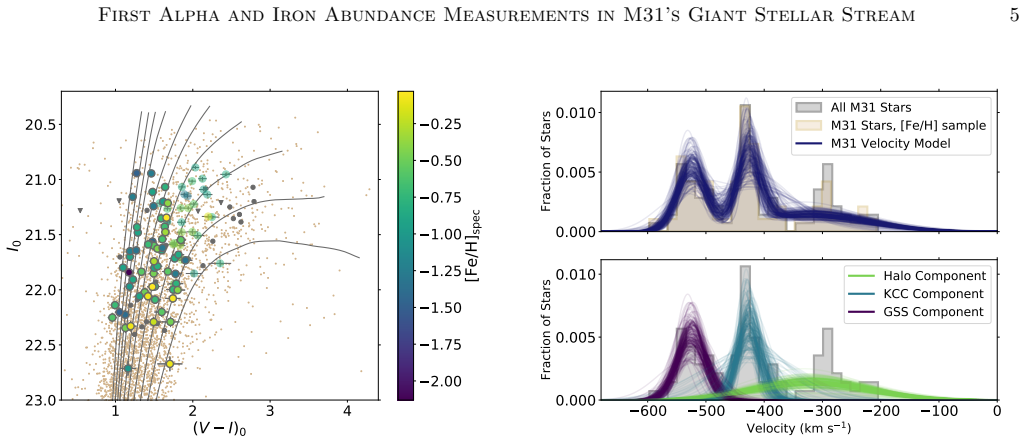
The central tool is spectral synthesis: each observed spectrum is compared against a large grid of synthetic spectra to fit effective temperature and $[Fe/H]$ simultaneously from many weak and blended iron lines; with those parameters held fixed, $[\alpha/Fe]$ is then fit from lines of Mg, Si, Ca, and Ti. Because the fit uses the whole spectrum rather than a couple of strong lines such as the calcium triplet, it returns iron abundances at the claimed precision near $0.2\,\mathrm{dex}$ from spectra with signal-to-noise around 15 per angstrom, and it remains accurate for $[Fe/H]$ at lower signal-to-noise than needed for $[\alpha/Fe]$. The component-level analysis assigns each star a probability of belonging to the stream, the kinematically cold component, or the halo using a Gaussian mixture velocity model, then iterates those probabilities together with the abundance distributions until convergence, producing probabilistic $[Fe/H]$ and $[\alpha/Fe]$ distribution functions for each component.
What would settle it
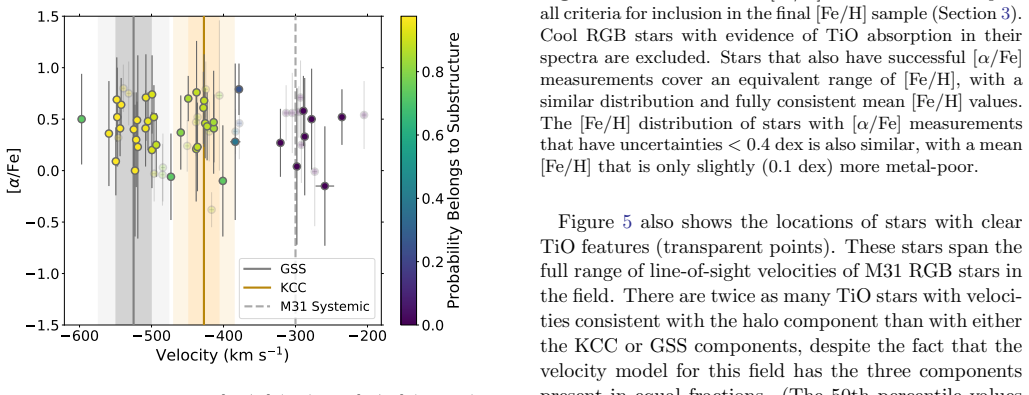
Measure $[Fe/H]$ and $[\alpha/Fe]$ for the 29 TiO-bearing red giants in this field using synthetic spectra that include TiO bands, or obtain infrared spectra where those bands do not contaminate, and recompute the component distributions. If the halo's recovered mean $[Fe/H]$ rises to the stream's value, the central comparison fails; if the halo remains more metal-poor after the correction, the progenitor-mass inference survives.
Extended reading notes
Core claim
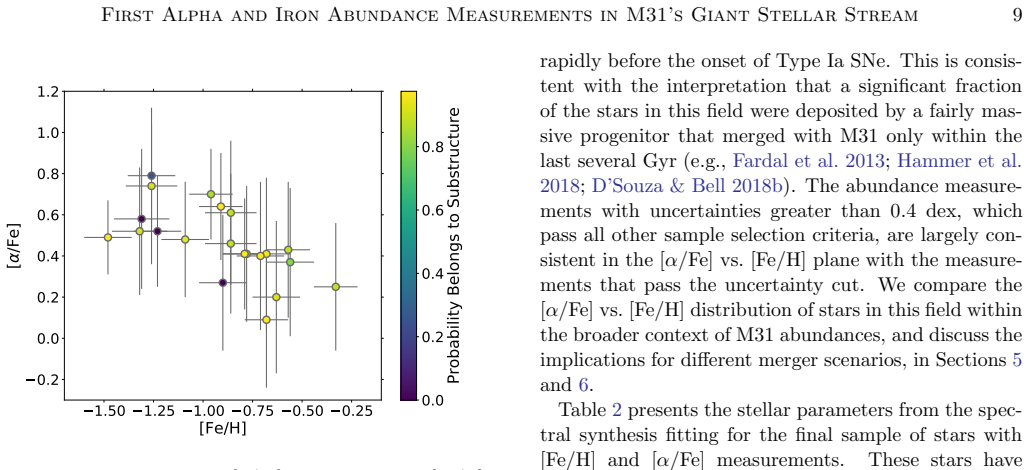
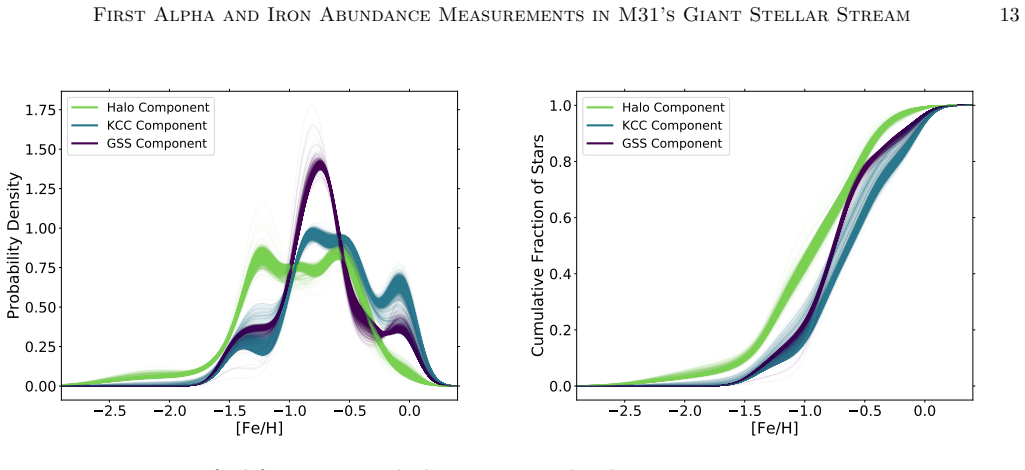
On its own terms, the paper establishes that the giant stellar stream field contains a stellar population unlike M31's surviving low-mass satellites: it is $\alpha$-enhanced at $[Fe/H] \lesssim -0.9\,\mathrm{dex}$, shows a decline in $[\alpha/Fe]$ toward higher metallicity, and has a median $[Fe/H]$ near $-0.75$ for the stream component. The probabilistic distributions built from the field's velocity model show that the stream and the second kinematically cold component (KCC) of unknown origin have nearly identical $[Fe/H]$ and $[\alpha/Fe]$ distributions, while the underlying hot halo appears more metal-poor. Comparing with published abundances for M31 dwarf galaxies, the paper argues that the stream's progenitor was more massive and had a higher star-formation efficiency than the surviving dwarf spheroidals and the dwarf ellipticals, consistent with the $1\text{--}5\times10^9\,M_\odot$ progenitor range of minor-merger simulations; using the Local Group mass–metallicity relation, it estimates a progenitor stellar mass of at least roughly $0.5\text{--}2\times10^9\,M_\odot$. The paper also finds these abundances hard to reconcile with a major merger that would have supplied a $\sim10^{10}\,M_\odot$ progenitor, unless the stream stars were stripped from the outer, metal-poor parts of that galaxy.
Load-bearing premise
The load-bearing premise is that the relative abundance distributions of the stream, the cold component, and the halo remain interpretable after cool, metal-rich stars with TiO absorption are removed from the sample; because about twice as many of those stars match the halo as match the stream or the cold component, the halo's metallicity distribution is biased low, and correcting that bias could erase the difference between halo and stream that the comparison depends on.
Editorial extensions
If this is right
- The stream's progenitor must have been massive enough to enrich to $[Fe/H]\sim-0.9$ before Type Ia supernovae set in, which under the Local Group mass–metallicity relation implies a stellar mass of at least $0.5\text{--}2\times10^9\,M_\odot$.
- The nearly identical $[Fe/H]$ and $[\alpha/Fe]$ distributions of the stream and the kinematically cold component strengthen the case that both features are debris from the same accretion event rather than an unrelated stellar disk population.
- The metal-rich position of the $[\alpha/Fe]$ 'knee' implies rapid early enrichment followed by shutdown, with star formation in the progenitor largely ended by about 6 Gyr ago even if the merger with M31 happened within the last roughly 1 Gyr.
- The measured abundances make a major merger that built the entire stream from a $\sim10^{10}\,M_\odot$ galaxy unlikely unless the observed stars were stripped from the progenitor's outskirts, a scenario that would predict a metallicity gradient along the stream.
Reading between the lines
- A direct test would be to recover abundances for the excluded cool, metal-rich TiO stars: if their inclusion raises the halo's mean metallicity to the stream level, the claimed halo-versus-stream difference would disappear, so the comparison rests on a bias that can be measured.
- If the kinematically cold component is a previous wrap of the same stream, as the abundance similarity suggests, the ~100 km/s velocity offset between the two features becomes a direct constraint on the merger orbit, and matching that offset in a simulation would validate the connection.
- Extending the same measurements to more fields along the stream would test whether the inferred progenitor mass is an artifact of a single 17 kpc field, for example by checking for a metallicity gradient that a massive, disk-like progenitor would imprint.
- The paper's link between the $[\alpha/Fe]$ knee position and progenitor mass, if confirmed with larger samples, could turn the knee into a practical diagnostic for the masses of tidal streams around other galaxies.
Signed reviews
Editorial analysis
A structured set of objections, weighed in public.
Referee Report
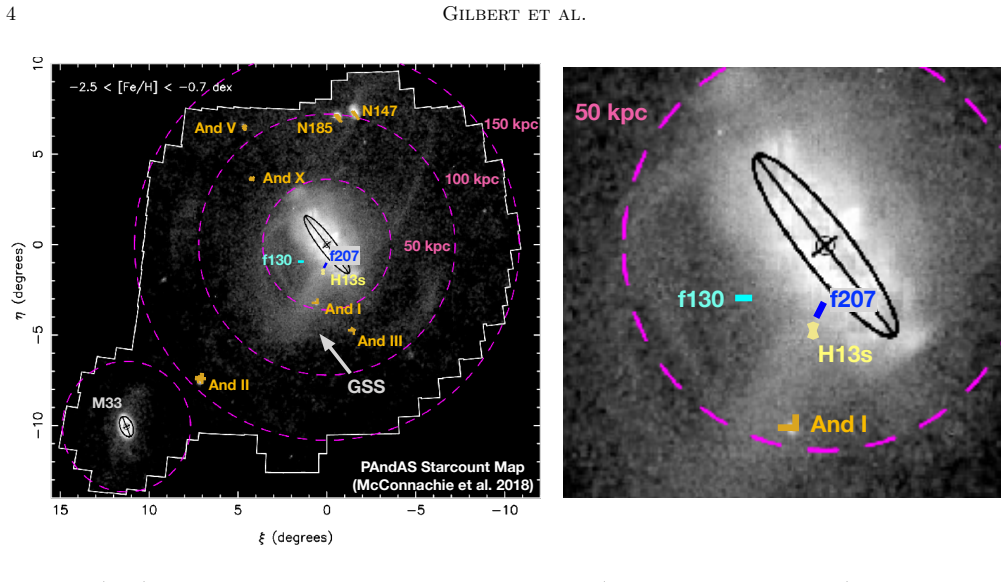
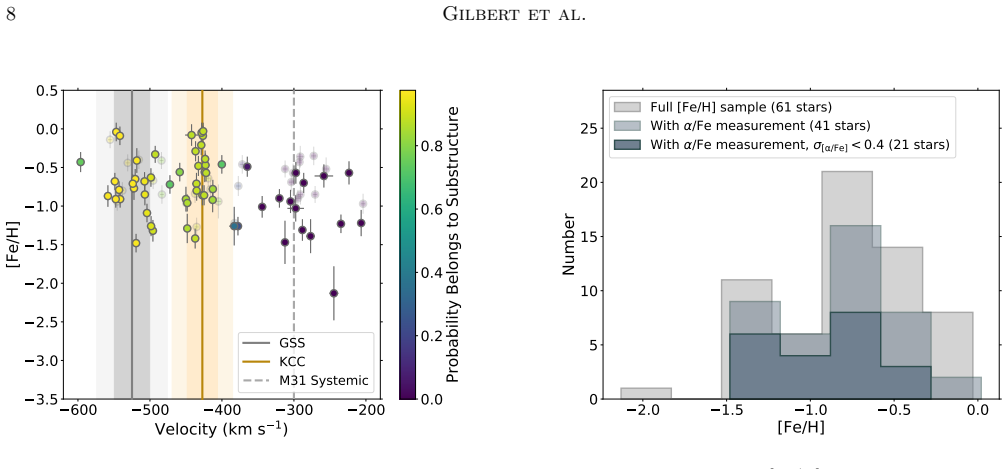
Summary. This paper presents DEIMOS medium-resolution spectroscopy of 112 M31 red giant stars in a field on the giant stellar stream at a projected radius of 17 kpc. Using spectral synthesis, the authors derive [Fe/H] for 61 stars and [α/Fe] for 21 stars after quality cuts, including exclusion of cool RGB stars with TiO absorption. They assign component membership probabilities using a previously published Gaussian Mixture velocity model and construct probabilistic abundance distributions for the giant stellar stream (GSS), a second kinematically cold component (KCC) of unknown origin, and the kinematically hot halo. The paper finds that the field is relatively metal-rich with more than half of stars at [Fe/H] > −1.0, that [α/Fe] is enhanced at low metallicity and declines above [Fe/H] ~ −0.9, that the GSS and KCC have similar abundance distributions, and that the halo appears more metal-poor. The authors interpret these measurements as evidence that the GSS progenitor was more massive and experienced a higher star-formation efficiency than M31's surviving dwarf spheroidals and the dwarf ellipticals NGC 147 and NGC 185, with a stellar mass of roughly 0.5–2 × 10^9 Msun under a minor-merger interpretation.
Significance. If the abundance trends hold, this is the first spectral-synthesis measurement of [α/Fe] in M31 tidal debris and provides a genuinely new constraint on the GSS progenitor and the minor-versus-major merger debate. The paper is transparent about known biases, propagates the velocity-model uncertainty by drawing 2000 MCMC parameter sets, tests the iterative MDF procedure for convergence, and makes the full abundance table available in machine-readable form, which enables independent reanalysis. The central physical inference, however, rests on a small sample of 21 [α/Fe] measurements, on an unpublished cross-calibration offset for the dSph comparison, and on a component comparison that is acknowledged to be biased by the exclusion of TiO stars; these points need quantitative support before the conclusions can be considered robust.
major comments (3)
- [Section 3, Figure 7] The claimed 'knee' in [α/Fe] versus [Fe/H] at [Fe/H] ~ −0.9 and the decline above it, which drive the efficient-star-formation and massive-progenitor conclusions, are read visually from 21 points with no significance test or fitted model. With per-point uncertainties of 0.2–0.4 dex, the trend could plausibly be consistent with a constant [α/Fe] at the high-metallicity end or be driven by a few low-metallicity high-α stars. Please add a quantitative assessment, for example a two-segment fit with a break location and confidence interval, or a bootstrap/permutation test for the decline, and report its significance.
- [Section 4.3, Figure 10, Abstract] The statement that the halo component is more metal-poor than the GSS and KCC is not robust to the exclusion of TiO stars. There are 14 TiO stars with velocities consistent with the halo versus 8 for the GSS and 7 for the KCC, and the paper itself notes that the true halo MDF may contain more metal-rich stars. Because this bias is quantified only qualitatively, the reported percentiles in Table 1 and the abstract's component comparison rest on an unquantified selection effect. Please provide a sensitivity analysis that, for example, assigns photometric metallicities to the excluded TiO stars and recomputes the component MDFs, and state whether the halo-versus-GSS/KCC separation survives.
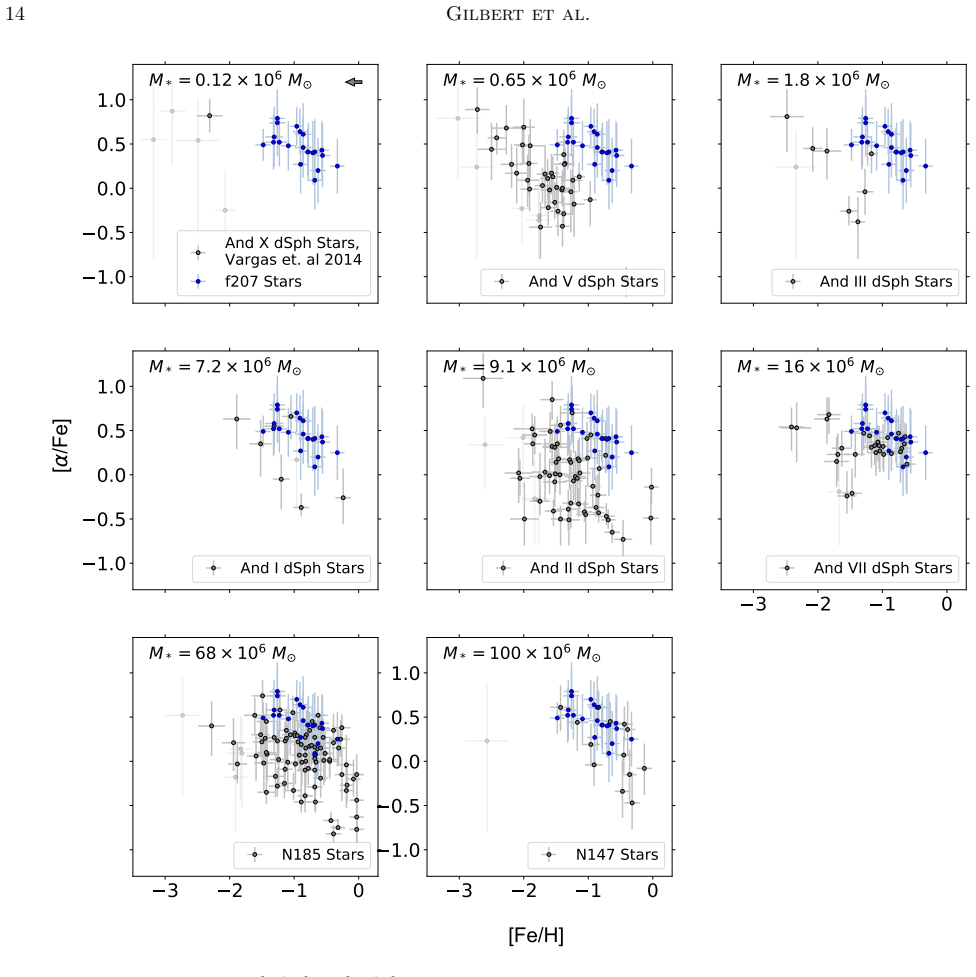
- [Section 5, Figure 11] The comparison with M31 dwarf spheroidals and the conclusion that the GSS is more metal-rich than surviving satellites rely on a [Fe/H] offset of 0.2–0.3 dex calibrated with stars in common to Vargas et al. (2014a), cited as E. Kirby et al. in prep. This unpublished offset is load-bearing: a different offset would change the position of the dSph sequences in Figure 11 and could weaken or reverse the claimed metallicity difference, which is central to the star-formation-efficiency interpretation. Please provide the cross-calibration details (number of stars, scatter, and how the offset was applied) or avoid making the comparison quantitative until that calibration is published.
minor comments (5)
- [Section 1.1, paragraph 2] The phrase 'may have been been formed' contains a duplicated word and should be corrected.
- [Section 2.1, paragraph 8] The detection of TiO features at λλ ~ 7050–7250 Å is described without stating the spectral resolution or the quantitative criterion used to classify a star as a TiO star; please specify the threshold.
- [Figure 11] The arrow indicating the systematic [Fe/H] offset between this work and Vargas et al. (2014a) is drawn only in the And X panel; it would be clearer to indicate the offset in each panel or state in the legend that it applies to all panels.
- [Section 6.1] The citation 'Leethochawalit et al., submitted' should be updated to the published reference or the journal's format for submitted papers.
- [Table 2] The table note indicates that the full table will be published in machine-readable format, but no online link or data availability statement is included in the arXiv version; please ensure the machine-readable table is accessible with the submission.
Circularity Check
No significant circularity: the abundance measurements are direct spectral-synthesis outputs, and the kinematic decomposition relies on an external velocity-only model rather than on the abundance data.
full rationale
The paper's central abundances are measured directly by fitting individual spectra against pre-existing synthetic spectral grids (Kirby et al. 2008, 2010; Kirby 2011), with retrieval validation by Vargas et al. (2014a). These are not fitted parameters renamed as predictions. The kinematic decomposition uses the previously published Gaussian Mixture Model of Gilbert et al. (2018), which was fit to velocities alone and is external to the abundance measurements; the present paper does not fit that model to [Fe/H] or [alpha/Fe]. The iterative probabilistic abundance distribution calculation (Equations 1-4) is a self-consistent weighting scheme: velocity-only distributions are computed first, and the paper shows that including abundance information changes the component distributions only mildly (Figure 8), so the conclusions that the halo is more metal-poor and that the GSS and KCC have similar abundance distributions are not manufactured by the iteration. The progenitor mass estimate uses the external Kirby et al. (2013) mass-metallicity relation. The claimed 'knee' at [Fe/H] ~ -0.9 is read directly from the measured [alpha/Fe]-vs-[Fe/H] distribution; its lack of a formal significance test is a statistical robustness concern, not a circularity. No equation or claim in the paper reduces a predicted quantity to a fitted input or to a self-citation by construction.
Assumptions & free parameters
free parameters (2)
- Vargas-Kirby [Fe/H] offset =
0.2-0.3 dex (reported range)
- [alpha/Fe] uncertainty cut =
0.4 dex
assumptions (4)
- domain assumption The Gilbert et al. (2018) Gaussian mixture velocity model correctly describes the kinematic structure of this field (GSS, KCC, and halo components).
- domain assumption The spectral synthesis grids and fitting method of Kirby et al. (2008, 2010) recover accurate [Fe/H] and [alpha/Fe] for the SNRs in this sample.
- domain assumption The Local Group dwarf galaxy mass-metallicity relation of Kirby et al. (2013) applies to the GSS progenitor.
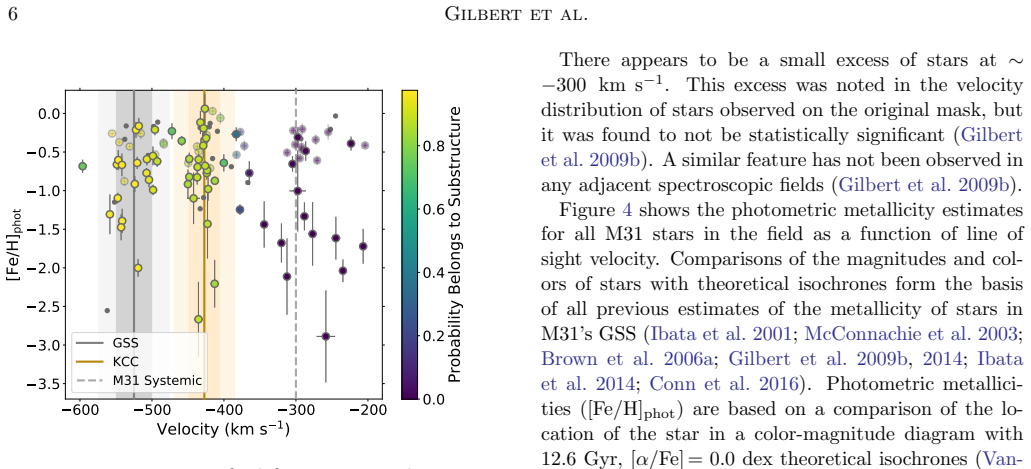
- domain assumption The photometric [Fe/H]phot estimates from isochrone fitting are reliable enough to characterize stars with failed or excluded spectroscopic measurements.
Cite this review
Pith. "Pith review of Elemental Abundances in M31: First Alpha and Iron Abundance Measurements in M31's Giant Stellar Stream." pith.science (2026). https://pith.science/paper/MY4LP6HK
@misc{pith2026190804429,
  author       = {Pith},
  title        = {Pith review of: Elemental Abundances in M31: First Alpha and Iron Abundance Measurements in M31's Giant Stellar Stream},
  year         = {2026},
  howpublished = {\url{https://pith.science/paper/MY4LP6HK}},
  note         = {Machine review of arXiv:1908.04429}
}
abstract
We present the first measurements of [Fe/H] and [$\alpha$/Fe] abundances, obtained using spectral synthesis modeling, for red giant branch stars in M31's giant stellar stream. The spectroscopic observations, obtained at a projected distance of 17 kpc from M31's center, yielded 61 stars with [Fe/H] measurements, including 21 stars with [$\alpha$/Fe] measurements, from 112 targets identified as M31 stars. The [Fe/H] measurements confirm the expectation from photometric metallicity estimates that stars in this region of M31's halo are relatively metal-rich compared to stars in the MW's inner halo: more than half the stars in the field, including those not associated with kinematically identified substructure, have [Fe/H] abundances $> -1.0$. The stars in this field are $\alpha$-enhanced at lower metallicities, while [$\alpha$/Fe] decreases with increasing [Fe/H] above metallicities of [Fe/H] $\gtrsim -0.9$. Three kinematical components have been previously identified in this field: the giant stellar stream, a second kinematically cold feature of unknown origin, and M31's kinematically hot halo. We compare probabilistic [Fe/H] and [$\alpha$/Fe] distribution functions for each of the components. The giant stellar stream and the second kinematically cold feature have very similar abundance distributions, while the halo component is more metal-poor. Although the current sample sizes are small, a comparison of the abundances of stars in the giant stellar stream field with abundances of M31 halo and dSph stars from the literature indicate that the progenitor of the stream was likely more massive, and experienced a higher efficiency of star formation, than M31's existing dSphs or the dEs NGC147 and NGC185.
Figures
Figures from the paper (9 more)




Reference graph
Works this paper leans on
-
[1]
, " * write output.state after.block = add.period write newline
ENTRY address archivePrefix author booktitle chapter doi edition editor eprint howpublished institution journal key month note number organization pages publisher school series title misctitle type volume year version url label extra.label sort.label short.list INTEGERS output.state before.all mid.sentence after.sentence after.block FUNCTION init.state.co...
-
[2]
write newline
" write newline "" before.all 'output.state := FUNCTION format.doi doi empty "" "doi:" doi * if FUNCTION format.url url empty "" new.block "" url * "" * if FUNCTION format.eprint eprint empty "" archivePrefix empty "" archivePrefix ":" * if eprint field.or.null * if FUNCTION format.pid eprint empty format.doi format.eprint if FUNCTION n.dashify 't := "" t...
-
[3]
`y+ EIGw֠
thebibliography [1] 20pt to REFERENCES 6pt =0pt 10pt plus 3pt =0pt =0pt =1pt plus 1pt =0pt =0pt -12pt =13pt plus 1pt =20pt =13pt plus 1pt \@M =10000 =-1.0em =0pt =0pt 0pt =0pt =1.0em @enumiv\@empty 10000 10000 `\.\@m \@noitemerr \@latex@warning Empty `thebibliography' environment \@ifnextchar \@reference \@latexerr Missing key on reference command Each re...
2016
-
[4]
E., & Da Costa , G
Armandroff , T. E., & Da Costa , G. S. 1991, , 101, 1329
1991
-
[5]
P., Tollerud , E
Astropy Collaboration , Robitaille , T. P., Tollerud , E. J., et al. 2013, , 558, A33
2013
-
[6]
M., Sip o cz , B
Astropy Collaboration , Price-Whelan , A. M., Sip o cz , B. M., et al. 2018, , 156, 123
2018
-
[7]
S., Christlieb , N., Beers , T
Barklem , P. S., Christlieb , N., Beers , T. C., et al. 2005, , 439, 129
2005
-
[8]
2008, , 383, 183
Battaglia , G., Irwin , M., Tolstoy , E., et al. 2008, , 383, 183
2008
Show all 133 references
-
[9]
W., Koposov , S
Belokurov , V., Erkal , D., Evans , N. W., Koposov , S. E., & Deason , A. J. 2018, , 478, 611
2018
-
[10]
J., Ferguson , A
Bernard , E. J., Ferguson , A. M. N., Barker , M. K., et al. 2012, , 420, 2625
2012
-
[11]
J., Ferguson , A
Bernard , E. J., Ferguson , A. M. N., Richardson , J. C., et al. 2015, , 446, 2789
2015
-
[12]
2007, , 668, 949
Besla , G., Kallivayalil , N., Hernquist , L., et al. 2007, , 668, 949
2007
-
[13]
2012, , 421, 2109
---. 2012, , 421, 2109
2012
-
[14]
M., Smith , E., Ferguson , H
Brown , T. M., Smith , E., Ferguson , H. C., et al. 2006 a , , 652, 323
2006
-
[15]
M., Smith , E., Guhathakurta , P., et al
Brown , T. M., Smith , E., Guhathakurta , P., et al. 2006 b , , 636, L89
2006
-
[16]
M., Beaton , R., Chiba , M., et al
Brown , T. M., Beaton , R., Chiba , M., et al. 2008, , 685, L121
2008
-
[17]
S., & Johnston , K
Bullock , J. S., & Johnston , K. V. 2005, , 635, 931
2005
-
[18]
2004, , 416, 1117
Cayrel , R., Depagne , E., Spite , M., et al. 2004, , 416, 1117
2004
-
[19]
C., Ibata , R., Lewis , G
Chapman , S. C., Ibata , R., Lewis , G. F., et al. 2006, , 653, 255
2006
-
[20]
C., Ibata , R., Irwin , M., et al
Chapman , S. C., Ibata , R., Irwin , M., et al. 2008, , 390, 1437
2008
-
[21]
G., Christlieb , N., McWilliam , A., et al
Cohen , J. G., Christlieb , N., McWilliam , A., et al. 2008, , 672, 320
2008
-
[22]
G., & Huang , W
Cohen , J. G., & Huang , W. 2010, , 719, 931
2010
-
[23]
R., McMonigal , B., Bate , N
Conn , A. R., McMonigal , B., Bate , N. F., et al. 2016, , 458, 3282
2016
-
[24]
P., Cole , S., Frenk , C
Cooper , A. P., Cole , S., Frenk , C. S., et al. 2010, , 406, 744
2010
-
[25]
C., Newman , J
Cooper , M. C., Newman , J. A., Davis , M., Finkbeiner , D. P., & Gerke , B. F. 2012, Astrophysics Source Code Library, 3003
2012
-
[26]
Da Costa , G. S. 2016, , 455, 199
2016
-
[27]
de Boer , T. J. L., Belokurov , V., Beers , T. C., & Lee , Y. S. 2014, , 443, 658
2014
-
[28]
de Boer , T. J. L., Tolstoy , E., Hill , V., et al. 2012, , 544, A73
2012
-
[29]
J., Belokurov , V., & Weisz , D
Deason , A. J., Belokurov , V., & Weisz , D. R. 2015, , 448, L77
2015
-
[30]
J., Mao , Y.-Y., & Wechsler , R
Deason , A. J., Mao , Y.-Y., & Wechsler , R. H. 2016, , 821, 5
2016
-
[31]
D., et al
Di Matteo , P., Haywood , M., Lehnert , M. D., et al. 2018, arXiv e-prints, arXiv:1812.08232
2018 arXiv
-
[32]
E., Guhathakurta , P., Fardal , M
Dorman , C. E., Guhathakurta , P., Fardal , M. A., et al. 2012, , 752, 147
2012
-
[33]
E., Widrow , L
Dorman , C. E., Widrow , L. M., Guhathakurta , P., et al. 2013, , 779, 103
2013
-
[34]
E., Guhathakurta , P., Seth , A
Dorman , C. E., Guhathakurta , P., Seth , A. C., et al. 2015, , 803, 24
2015
-
[35]
D'Souza , R., & Bell , E. F. 2018 a , , 474, 5300
2018
-
[36]
2018 b , Nature Astronomy, 2, 737
---. 2018 b , Nature Astronomy, 2, 737
2018
-
[37]
N., Gilbert , K
Escala , I., Kirby , E. N., Gilbert , K. M., Cunningham , E. C., & Wojno , J. 2019, , 878, 42
2019
-
[38]
M., Phillips , A
Faber , S. M., Phillips , A. C., Kibrick , R. I., et al. 2003, in Presented at the Society of Photo-Optical Instrumentation Engineers (SPIE) Conference, Vol. 4841, Instrument Design and Performance for Optical/Infrared Ground-based Telescopes. Edited by Iye, Masanori; Moorwood...
2003
-
[39]
A., Babul , A., Geehan , J
Fardal , M. A., Babul , A., Geehan , J. J., & Guhathakurta , P. 2006, , 366, 1012
2006
-
[40]
A., Babul , A., Guhathakurta , P., Gilbert , K
Fardal , M. A., Babul , A., Guhathakurta , P., Gilbert , K. M., & Dodge , C. 2008, , 682, L33
2008
-
[41]
A., Guhathakurta , P., Babul , A., & McConnachie , A
Fardal , M. A., Guhathakurta , P., Babul , A., & McConnachie , A. W. 2007, , 380, 15
2007
-
[42]
A., Guhathakurta , P., Gilbert , K
Fardal , M. A., Guhathakurta , P., Gilbert , K. M., et al. 2012, , 423, 3134
2012
-
[43]
A., Weinberg , M
Fardal , M. A., Weinberg , M. D., Babul , A., et al. 2013, , 434, 2779
2013
-
[44]
J., et al
Fattahi , A., Belokurov , V., Deason , A. J., et al. 2019, , 484, 4471
2019
-
[45]
S., Johnston , K
Font , A. S., Johnston , K. V., Guhathakurta , P., Majewski , S. R., & Rich , R. M. 2006, , 131, 1436
2006
-
[46]
2016, The Journal of Open Source Software, 24, doi:10.21105/joss.00024
Foreman-Mackey, D. 2016, The Journal of Open Source Software, 24, doi:10.21105/joss.00024. http://dx.doi.org/10.5281/zenodo.45906
2016 doi
-
[47]
W., Lang , D., & Goodman , J
Foreman-Mackey , D., Hogg , D. W., Lang , D., & Goodman , J. 2013 a , , 125, 306
2013
-
[48]
2013 b , emcee: The MCMC Hammer , Astrophysics Source Code Library, Astrophysics Source Code Library, ascl:1303.002
Foreman-Mackey , D., Conley , A., Meierjurgen Farr , W., et al. 2013 b , emcee: The MCMC Hammer , Astrophysics Source Code Library, Astrophysics Source Code Library, ascl:1303.002
2013
-
[49]
2016 a , corner.py: corner.py v1.0.2, Zenodo, doi:10.5281/zenodo.45906
Foreman-Mackey, D., Vousden, W., Price-Whelan, A., et al. 2016 a , corner.py: corner.py v1.0.2, Zenodo, doi:10.5281/zenodo.45906. http://dx.doi.org/10.5281/zenodo.45906
2016 doi
-
[50]
2016 b , corner.py: corner.py v2.0.0, Zenodo, doi:10.5281/zenodo.53155
---. 2016 b , corner.py: corner.py v2.0.0, Zenodo, doi:10.5281/zenodo.53155. https://doi.org/10.5281/zenodo.53155
2016 doi
-
[51]
2010, Astronomische Nachrichten, 331, 474
Frebel , A. 2010, Astronomische Nachrichten, 331, 474
2010
-
[52]
M., Font , A
Gilbert , K. M., Font , A. S., Johnston , K. V., & Guhathakurta , P. 2009 a , , 701, 776
2009
-
[53]
M., Guhathakurta , P., Kalirai , J
Gilbert , K. M., Guhathakurta , P., Kalirai , J. S., et al. 2006, , 652, 1188
2006
-
[54]
M., Fardal , M., Kalirai , J
Gilbert , K. M., Fardal , M., Kalirai , J. S., et al. 2007, , 668, 245
2007
-
[55]
M., Guhathakurta , P., Kollipara , P., et al
Gilbert , K. M., Guhathakurta , P., Kollipara , P., et al. 2009 b , , 705, 1275
2009
-
[56]
M., Guhathakurta , P., Beaton , R
Gilbert , K. M., Guhathakurta , P., Beaton , R. L., et al. 2012, , 760, 76
2012
-
[57]
M., Kalirai , J
Gilbert , K. M., Kalirai , J. S., Guhathakurta , P., et al. 2014, , 796, 76
2014
-
[58]
M., Tollerud , E., Beaton , R
Gilbert , K. M., Tollerud , E., Beaton , R. L., et al. 2018, , 852, 128
2018
-
[59]
Gilmore , G., & Wyse , R. F. G. 1991, , 367, L55
1991
-
[60]
Gilmore , G., & Wyse , R. F. G. 1998, , 116, 748
1998
-
[61]
C., Gilbert , K
Guhathakurta , P., Ostheimer , J. C., Gilbert , K. M., et al. 2005, ArXiv Astrophysics e-prints, astro-ph/0502366
2005 arXiv
-
[62]
B., Wang , J
Hammer , F., Yang , Y. B., Wang , J. L., et al. 2018, , 475, 2754
2018
-
[63]
2017, , 845, 162
Hasselquist , S., Shetrone , M., Smith , V., et al. 2017, , 845, 162
2017
-
[64]
D., et al
Haywood , M., Di Matteo , P., Lehnert , M. D., et al. 2018, , 863, 113
2018
-
[65]
H., et al
Helmi , A., Babusiaux , C., Koppelman , H. H., et al. 2018, , 563, 85
2018
-
[66]
J., Tolstoy , E., et al
Helmi , A., Irwin , M. J., Tolstoy , E., et al. 2006, , 651, L121
2006
-
[67]
J., et al
Ho , N., Geha , M., Tollerud , E. J., et al. 2015, , 798, 77
2015
-
[68]
Hunter , J. D. 2007, Computing in Science and Engineering, 9, 90
2007
-
[69]
Ibata , R., Chapman , S., Ferguson , A. M. N., et al. 2004, , 351, 117
2004
-
[70]
Ibata , R., Irwin , M., Lewis , G., Ferguson , A. M. N., & Tanvir , N. 2001, , 412, 49
2001
-
[71]
F., Irwin , M., et al
Ibata , R., Martin , N. F., Irwin , M., et al. 2007, , 671, 1591
2007
-
[72]
A., Gilmore , G., & Irwin , M
Ibata , R. A., Gilmore , G., & Irwin , M. J. 1994, , 370, 194
1994
-
[73]
A., Lewis , G
Ibata , R. A., Lewis , G. F., McConnachie , A. W., et al. 2014, , 780, 128
2014
-
[74]
J., Ferguson , A
Irwin , M. J., Ferguson , A. M. N., Ibata , R. A., Lewis , G. F., & Tanvir , N. R. 2005, , 628, L105
2005
-
[75]
V., Bullock , J
Johnston , K. V., Bullock , J. S., Sharma , S., et al. 2008, , 689, 936
2008
-
[76]
S., Guhathakurta , P., Gilbert , K
Kalirai , J. S., Guhathakurta , P., Gilbert , K. M., et al. 2006 a , , 641, 268
2006
-
[77]
S., Gilbert , K
Kalirai , J. S., Gilbert , K. M., Guhathakurta , P., et al. 2006 b , , 648, 389
2006
-
[78]
S., Zucker , D
Kalirai , J. S., Zucker , D. B., Guhathakurta , P., et al. 2009, , 705, 1043
2009
-
[79]
Kirby , E. N. 2011, Publications of the Astronomical Society of the Pacific, 123, 531
2011
-
[80]
N., Cohen , J
Kirby , E. N., Cohen , J. G., Guhathakurta , P., et al. 2013, , 779, 102
2013
-
[81]
N., Guhathakurta , P., Bolte , M., Sneden , C., & Geha , M
Kirby , E. N., Guhathakurta , P., Bolte , M., Sneden , C., & Geha , M. C. 2009, , 705, 328
2009
-
[82]
N., Guhathakurta , P., & Sneden , C
Kirby , E. N., Guhathakurta , P., & Sneden , C. 2008, , 682, 1217
2008
-
[83]
N., Guhathakurta , P., Simon , J
Kirby , E. N., Guhathakurta , P., Simon , J. D., et al. 2010, , 191, 352
2010
-
[84]
N., Guo , M., Zhang , A
Kirby , E. N., Guo , M., Zhang , A. J., et al. 2015, , 801, 125
2015
-
[85]
2014, , 66, L10
Kirihara , T., Miki , Y., & Mori , M. 2014, , 66, L10
2014
-
[86]
Kirihara , T., Miki , Y., Mori , M., Kawaguchi , T., & Rich , R. M. 2017, , 464, 3509
2017
-
[87]
M., Reitzel , D
Koch , A., Rich , R. M., Reitzel , D. B., et al. 2008, , 689, 958
2008
-
[88]
K., Bolte , M., Johnson , J
Lai , D. K., Bolte , M., Johnson , J. A., et al. 2008, , 681, 1524
2008
-
[89]
Landolt , A. U. 1992, , 104, 340
1992
-
[90]
Lapenna , E., Mucciarelli , A., Origlia , L., & Ferraro , F. R. 2012, , 761, 33
2012
-
[91]
M., Johnston , K
Lee , D. M., Johnston , K. V., Sen , B., & Jessop , W. 2015, , 802, 48
2015
-
[92]
K., & Koch , A
Lianou , S., Grebel , E. K., & Koch , A. 2011, , 531, A152
2011
-
[93]
T., Schiavon , R
Mackereth , J. T., Schiavon , R. P., Pfeffer , J., et al. 2019, , 482, 3426
2019
-
[94]
R., Skrutskie , M
Majewski , S. R., Skrutskie , M. F., Weinberg , M. D., & Ostheimer , J. C. 2003, , 599, 1082
2003
-
[95]
R., Hasselquist , S., okas , E
Majewski , S. R., Hasselquist , S., okas , E. L., et al. 2013, , 777, L13
2013
-
[96]
R., Schiavon , R
Majewski , S. R., Schiavon , R. P., Frinchaboy , P. M., et al. 2017, , 154, 94
2017
-
[97]
M., & Cole , A
Manning , E. M., & Cole , A. A. 2017, , 471, 4194
2017
-
[98]
W., & Morrison , H
Mateo , M., Olszewski , E. W., & Morrison , H. L. 1998, , 508, L55
1998
-
[99]
McConnachie , A. W. 2012, , 144, 4
2012
-
[100]
W., Irwin , M
McConnachie , A. W., Irwin , M. J., Ibata , R. A., et al. 2003, , 343, 1335
2003
-
[101]
2009, , 461, 66
---. 2009, , 461, 66
2009
-
[102]
W., Ibata , R., Martin , N., et al
McConnachie , A. W., Ibata , R., Martin , N., et al. 2018, , 868, 55
2018
-
[103]
A., Grand , R
Monachesi , A., G \'o mez , F. A., Grand , R. J. J., et al. 2019, , 485, 2589
2019
-
[104]
Mori , M., & Rich , R. M. 2008, , 674, L77
2008
-
[105]
2017, , 605, A46
Mucciarelli , A., Bellazzini , M., Ibata , R., et al. 2017, , 605, A46
2017
-
[106]
C., Vasiliev , E., Iorio , G., Evans , N
Myeong , G. C., Vasiliev , E., Iorio , G., Evans , N. W., & Belokurov , V. 2019, arXiv e-prints, arXiv:1904.03185
2019 arXiv
-
[107]
A., Cooper , M
Newman , J. A., Cooper , M. C., Davis , M., et al. 2013, , 208, 5
2013
-
[108]
L., Hasselquist , S., Hayes , C
Nidever , D. L., Hasselquist , S., Hayes , C. R., et al. 2019, arXiv e-prints, arXiv:1901.03448
2019
-
[109]
2008, , 480, 379
Pomp \'e ia , L., Hill , V., Spite , M., et al. 2008, , 480, 379
2008
-
[110]
W., Bullock , J
Purcell , C. W., Bullock , J. S., & Kazantzidis , S. 2010, , 404, 1711
2010
-
[111]
C., Ferguson , A
Richardson , J. C., Ferguson , A. M. N., Mackey , A. D., et al. 2009, , 396, 1842
2009
-
[112]
Roederer , I. U. 2009, , 137, 272
2009
-
[113]
2014, , 442, 160
Sadoun , R., Mohayaee , R., & Colin , J. 2014, , 442, 160
2014
-
[114]
D., C \^o t \'e , P., & Sargent , W
Shetrone , M. D., C \^o t \'e , P., & Sargent , W. L. W. 2001, , 548, 592
2001
-
[115]
D., & Geha , M
Simon , J. D., & Geha , M. 2007, , 670, 313
2007
-
[116]
T., Majewski , S
Sohn , S. T., Majewski , S. R., Mu \ n oz , R. R., et al. 2007, , 663, 960
2007
-
[117]
2010, , 708, 1168
Tanaka , M., Chiba , M., Komiyama , Y., et al. 2010, , 708, 1168
2010
-
[118]
B., Scannapieco , C., Beers , T
Tissera , P. B., Scannapieco , C., Beers , T. C., & Carollo , D. 2013, , 432, 3391
2013
-
[119]
J., Beaton , R
Tollerud , E. J., Beaton , R. L., Geha , M. C., et al. 2012, , 752, 45
2012
-
[120]
J., Cole , A
Tolstoy , E., Irwin , M. J., Cole , A. A., et al. 2001, , 327, 918
2001
-
[121]
P., Alves , D
van der Marel , R. P., Alves , D. R., Hardy , E., & Suntzeff , N. B. 2002, , 124, 2639
2002
-
[122]
Van der Swaelmen , M., Hill , V., Primas , F., & Cole , A. A. 2013, , 560, A44
2013
-
[123]
C., & Varoquaux , G
van der Walt , S., Colbert , S. C., & Varoquaux , G. 2011, Computing in Science and Engineering, 13, 22
2011
-
[124]
A., Bergbusch , P
VandenBerg , D. A., Bergbusch , P. A., & Dowler , P. D. 2006, , 162, 375
2006
-
[125]
C., Geha , M
Vargas , L. C., Geha , M. C., & Tollerud , E. J. 2014 a , , 790, 73
2014
-
[126]
C., Gilbert , K
Vargas , L. C., Gilbert , K. M., Geha , M., et al. 2014 b , , 797, L2
2014
-
[127]
A., Irwin , M., Shetrone , M
Venn , K. A., Irwin , M., Shetrone , M. D., et al. 2004, , 128, 1177
2004
-
[128]
R., Dolphin , A
Weisz , D. R., Dolphin , A. E., Skillman , E. D., et al. 2014 a , , 789, 147
2014
-
[129]
R., Skillman , E
Weisz , D. R., Skillman , E. D., Hidalgo , S. L., et al. 2014 b , , 789, 24
2014
-
[130]
C., Sneden , C., & Truran , Jr., J
Wheeler , J. C., Sneden , C., & Truran , Jr., J. W. 1989, , 27, 279
1989
-
[131]
F., Dolphin , A
Williams , B. F., Dolphin , A. E., Dalcanton , J. J., et al. 2017, , 846, 145
2017
-
[132]
2008, , 390, 1453
Woo , J., Courteau , S., & Dekel , A. 2008, , 390, 1453
2008
-
[133]
J., Kent , S., et al
Yanny , B., Newberg , H. J., Kent , S., et al. 2000, , 540, 825
2000
Reviewed August 14, 2026 · model on record in the stance chip above.
Discussion (0). Continue with ORCID to comment.