Optimizing Chilled Water Systems with Cooling Towers via Virtual Power Metrics and Extremum-Seeking Control
Pith reviewed 2026-05-19 14:55 UTC · model grok-4.3
The pith
An extremum-seeking controller for cooling tower fans minimizes total chilled water plant power with virtual power meters.
A machine-rendered reading of the paper's core claim, the machinery that carries it, and where it could break.
Core claim
The central discovery is that extremum-seeking control applied solely to cooling tower fan speed, fed by virtual power estimates, can converge on the minimum total plant power consumption and deliver approximately 15% energy savings compared to conventional control in summer conditions across different locations.
What carries the argument
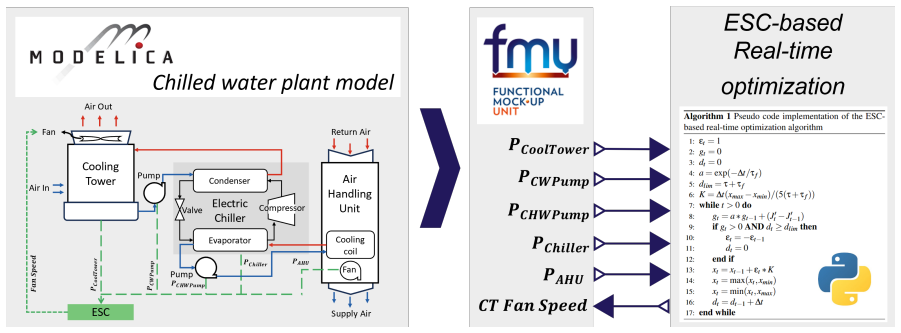
Extremum-seeking control that perturbs fan speed to estimate the power gradient and drives the system toward the optimum, enabled by virtual power meters constructed from available sensor data.
Load-bearing premise
Changing only the cooling tower fan speed is sufficient to reach and track the true minimum of the entire plant's power consumption, with other components and loads either fixed or accurately represented in the model.
What would settle it
Running the controller on an actual chilled water plant and measuring whether total power drops to the level predicted by the extremum-seeking algorithm as outdoor conditions vary.
Figures




read the original abstract
This paper presents an extremum seeking control (ESC) method for cooling tower fans to minimize overall power consumption of a chilled water plant system. Simulation studies across different climate locations demonstrate energy savings of approximately 15% compared to conventional control during summer conditions. This paper also proposes a virtual power meter (VPM) to enable use of the strategy in systems that lack physical power meters. Validation tests for the VPMs against physical meters showed good accuracy with a correlation of 96.11% and a normalized error of 5.11%. Coupled with the VPM, the proposed ESC control solution can be implemented on systems using typically available sensor measurements without the need for additional instrumentation.
Editorial analysis
A structured set of objections, weighed in public.
Referee Report
Summary. The paper proposes an extremum-seeking control (ESC) strategy to optimize cooling-tower fan speed for minimizing total chilled-water-plant power consumption. Simulation studies across climate locations report approximately 15% energy savings versus conventional control in summer conditions. A virtual power meter (VPM) is introduced and validated open-loop against physical meters, achieving 96.11% correlation and 5.11% normalized error, to enable deployment without additional instrumentation.
Significance. If the underlying simulation faithfully reproduces the steady-state power map and the VPM error does not degrade ESC gradient estimates, the approach would provide a practical, sensor-light method for HVAC energy optimization with measurable savings. The combination of standard ESC structure with a validated VPM is a modest but useful engineering contribution for systems lacking power metering.
major comments (2)
- [Simulation studies] Simulation studies section: the 15% summer savings and ESC convergence claims rest on the assumption that varying only cooling-tower fan speed produces a unique, trackable minimum in total plant power while all other loads, setpoints, and disturbances remain fixed or perfectly known; the manuscript provides no quantitative sensitivity analysis on heat-transfer coefficients, pump curves, or unmodeled dynamics that would shift this minimum.
- [VPM validation] VPM validation subsection: the reported 96.11% correlation and 5.11% normalized error are obtained in open-loop tests against physical meters; it is not shown whether this error level preserves the sign and magnitude of the dither-based gradient estimates inside the ESC loop, which is load-bearing for the closed-loop savings claim.
minor comments (2)
- [Abstract] The abstract states 'approximately 15%' savings but does not specify the number of independent climate cases, disturbance profiles, or model fidelity metrics; adding these details would strengthen the claim.
- [Method] Notation for the VPM output and its integration into the ESC demodulation block should be defined explicitly with an equation reference.
Simulated Author's Rebuttal
We thank the referee for the constructive feedback on our manuscript. We respond to each major comment below and indicate planned revisions to address the concerns raised.
read point-by-point responses
-
Referee: [Simulation studies] Simulation studies section: the 15% summer savings and ESC convergence claims rest on the assumption that varying only cooling-tower fan speed produces a unique, trackable minimum in total plant power while all other loads, setpoints, and disturbances remain fixed or perfectly known; the manuscript provides no quantitative sensitivity analysis on heat-transfer coefficients, pump curves, or unmodeled dynamics that would shift this minimum.
Authors: We agree that the current manuscript lacks a quantitative sensitivity analysis on parameters such as heat-transfer coefficients, pump curves, and unmodeled dynamics. In the revised version, we will add a dedicated sensitivity study (new subsection in the simulation studies section) that perturbs these parameters within realistic ranges and reports the resulting shifts in the location and trackability of the total plant power minimum. This will directly support the robustness of the reported 15% savings and ESC convergence under the stated assumptions. revision: yes
-
Referee: [VPM validation] VPM validation subsection: the reported 96.11% correlation and 5.11% normalized error are obtained in open-loop tests against physical meters; it is not shown whether this error level preserves the sign and magnitude of the dither-based gradient estimates inside the ESC loop, which is load-bearing for the closed-loop savings claim.
Authors: The referee is correct that the VPM accuracy metrics are from open-loop validation only. To close this gap, the revised manuscript will include new closed-loop simulation results in which the observed VPM error statistics are injected into the ESC feedback path. We will show that the dither-based gradient estimates retain the correct sign and adequate magnitude for convergence to the power minimum, thereby confirming that the reported error level does not undermine the closed-loop energy savings. revision: yes
Circularity Check
No significant circularity in derivation chain
full rationale
The paper applies standard extremum-seeking control to minimize total plant power via cooling-tower fan speed in a simulation model, with virtual power meters validated directly against independent physical meters (96.11% correlation, 5.11% normalized error). Neither the reported 15% summer savings nor the ESC convergence claims reduce by construction to any fitted parameter, self-defined quantity, or self-citation chain inside the paper; the simulation results and meter comparisons constitute external benchmarks rather than tautological renamings or load-bearing self-references. The derivation therefore remains self-contained against the stated physical model and real-meter validation.
Axiom & Free-Parameter Ledger
axioms (2)
- standard math Extremum-seeking control converges to the minimum of the plant power map when the dither signal and adaptation gains satisfy standard persistence-of-excitation conditions.
- domain assumption The virtual power meter mapping from available sensor readings to power is stationary and can be validated on a representative subset of operating conditions.
invented entities (1)
-
Virtual Power Meter (VPM)
independent evidence
Lean theorems connected to this paper
-
IndisputableMonolith/Cost/FunctionalEquation.leanwashburn_uniqueness_aczel unclear?
unclearRelation between the paper passage and the cited Recognition theorem.
Cost function J = P_CW_Pump + P_CHW_Pump + P_Chiller + P_CoolTower + P_AHU (Eq. 3); relay-based ESC perturbs fan speed to track minimum of total plant power.
-
IndisputableMonolith/Foundation/BranchSelection.leanbranch_selection unclear?
unclearRelation between the paper passage and the cited Recognition theorem.
Simulation shows ~15% summer savings and VPM validation (R²=0.9611, NRMSE=0.0511).
What do these tags mean?
- matches
- The paper's claim is directly supported by a theorem in the formal canon.
- supports
- The theorem supports part of the paper's argument, but the paper may add assumptions or extra steps.
- extends
- The paper goes beyond the formal theorem; the theorem is a base layer rather than the whole result.
- uses
- The paper appears to rely on the theorem as machinery.
- contradicts
- The paper's claim conflicts with a theorem or certificate in the canon.
- unclear
- Pith found a possible connection, but the passage is too broad, indirect, or ambiguous to say the theorem truly supports the claim.
Reference graph
Works this paper leans on
-
[1]
Michael F. Modest. Radiative Heat Transfer. 1993
work page 1993
-
[2]
Pierre Ineichen and Richard Perez and Robert Seals. The importance of correct albedo determination for adequately modeling energy received by tilted surfaces. Solar Energy. 1987
work page 1987
-
[3]
Michael Wetter and Wangda Zuo and Thierry S. Nouidui and Xiufen Pang. Modelica Buildings library. Journal of Building Performance Simulation. 2013
work page 2013
-
[4]
Timothy I. Salsbury and Trevor Terrill and James Goddard and Min Gyung Yu and Tim Yoder and Xiaoli Duane , title =. American Control Conference , year =
- [5]
-
[6]
Modeling and optimization of a chiller plant
Mark Hydeman and G Zhou. Modeling and optimization of a chiller plant. ASHRAE Journal. 2007
work page 2007
-
[7]
Modeling and optimization of a chiller plant
Xiupeng Wei and Guanglin Xu and Andrew Kusiak. Modeling and optimization of a chiller plant. Energy. 2014
work page 2014
-
[8]
Bin Hu and Yaoyu Li and Feng Cao and Ziwen Xing. Extremum seeking control of COP optimization for air-source transcritical CO2 heat pump water heater system. Applied Energy. 2015
work page 2015
-
[9]
Building Performance Modeling Conference and SimBuild , year =
Milica Grahovac and Paul Ehrlich and Jianjun Hu and Michael Wetter , title =. Building Performance Modeling Conference and SimBuild , year =
-
[10]
Improved cooling tower control of legacy chiller plants by optimizing the condenser water set point
Sen Huang and Wangda Zuo and Michael D.Sohn. Improved cooling tower control of legacy chiller plants by optimizing the condenser water set point. Building and Environment. 2017
work page 2017
-
[11]
Gang Wang and Saeed Ghoddousi and Li Ding and Li Song. Investigation of different cooling tower fan control strategies using COP of actual chillers and calibrated models of actual cooling towers and fans. Energy and Buildings. 2022
work page 2022
-
[12]
Jiajun Liao and Xie Xie and Hala Nemer and David E. Claridge and Charles H. Culp. A simplified methodology to optimize the cooling tower approach temperature control schedule in a cooling system. Energy Conversion and Management. 2019
work page 2019
-
[13]
Johnson Controls® Central Plant Optimization™ 10 Application Note , howpublished =
-
[14]
Optimum design and operation of an HVAC cooling tower for energy and water conservation , author=. Energies , volume=. 2017 , publisher=
work page 2017
-
[15]
Optimization of water-cooled chiller system with load-based speed control , author=. Applied Energy , volume=. 2008 , publisher=
work page 2008
-
[16]
Cooling tower fan control for energy efficiency , author=. Energy engineering , volume=. 2002 , publisher=
work page 2002
-
[17]
Technology and Innovation Pathways for Zero-carbon-ready Buildings by 2030 , institution =. 2022 , note =
work page 2030
-
[18]
Chilled water plant optimization by resetting the condenser water temperature , author=. Energy Engineering , volume=. 2010 , publisher=
work page 2010
-
[19]
Energy and Buildings , volume=
A longitudinal analysis of energy consumption data from a high-performance building in the tropics , author=. Energy and Buildings , volume=. 2020 , publisher=
work page 2020
-
[20]
Energy and Buildings , volume=
Energy performance assessment of HVAC commissioning using long-term monitoring data: A case study of the newly built office building in South Korea , author=. Energy and Buildings , volume=. 2019 , publisher=
work page 2019
-
[21]
Renewable and Sustainable Energy Reviews , volume=
Model selection for continuous commissioning of HVAC-systems in office buildings: A review , author=. Renewable and Sustainable Energy Reviews , volume=. 2017 , publisher=
work page 2017
-
[22]
Advanced and Complex Energy Systems Monitoring and Control: A Review on Available Technologies and Their Application Criteria , author=. Sensors , volume=. 2022 , publisher=
work page 2022
-
[23]
Energy and Buildings , volume=
Building energy performance monitoring through the lens of data quality: A review , author=. Energy and Buildings , volume=. 2023 , publisher=
work page 2023
-
[24]
Energy and Buildings , volume=
Development of Sankey diagrams to visualize real HVAC performance , author=. Energy and Buildings , volume=. 2017 , publisher=
work page 2017
-
[25]
Renewable and Sustainable Energy Reviews , volume=
Visualisation in energy eco-feedback systems: A systematic review of good practice , author=. Renewable and Sustainable Energy Reviews , volume=. 2022 , publisher=
work page 2022
-
[26]
Energy and buildings , volume=
Real-time, appliance-level electricity use feedback system: How to engage users? , author=. Energy and buildings , volume=. 2014 , publisher=
work page 2014
-
[27]
2021 Systems and Information Engineering Design Symposium (SIEDS) , pages=
Developing a Dashboard for High Occupancy Buildings , author=. 2021 Systems and Information Engineering Design Symposium (SIEDS) , pages=. 2021 , organization=
work page 2021
-
[28]
Proceedings of Building Simulation 2015: 14th Conference of IBPSA , volume =
Justin C Deblois and William O Collinge and Melissa M Bilec and Laura A Schaefer , title =. Proceedings of Building Simulation 2015: 14th Conference of IBPSA , volume =. doi:https://doi.org/10.26868/25222708.2015.2150 , year =
-
[29]
Proceedings of the 2011 Building Simulation Conference , year =
O’Neill, Zheng and Shashanka, Madhusudana and Pang, Xiufeng , title =. Proceedings of the 2011 Building Simulation Conference , year =
work page 2011
-
[30]
Building energy simulation and monitoring: a review of graphical data representation , author=. Energies , volume=. 2022 , publisher=
work page 2022
-
[31]
Cooling Tower PID Control v61 – Attributes , year =
-
[32]
An autonomic cycle of data analysis tasks for the supervision of HVAC systems of smart building , author=. Energies , volume=. 2020 , publisher=
work page 2020
-
[33]
Jérémy Lerond and Aowabin Rahman and Jian Zhang and Michael Rosenberg , title =. 2023 , publisher =. doi:10.21105/joss.04876 , url =
-
[34]
ASHRAE Guideline 36-2021: High-Performance Sequences of Operation for HVAC Systems , organization =. 2021 , address =
work page 2021
-
[35]
Renewable and Sustainable Energy Reviews , volume=
A review of unsupervised statistical learning and visual analytics techniques applied to performance analysis of non-residential buildings , author=. Renewable and Sustainable Energy Reviews , volume=. 2018 , publisher=
work page 2018
- [36]
-
[37]
A review of data-driven fault detection and diagnostics for building HVAC systems , author=. Applied Energy , volume=. 2023 , publisher=
work page 2023
-
[38]
Zhongfan Zhao, Yaoyu Li, Timothy I. Salsbury and John M. House , title =. Science and Technology for the Built Environment , volume =. 2022 , publisher =
work page 2022
-
[39]
Faulkner and Julia Ho and Chengnan Shi and Chengliang Fan and Nasim Ildiri and Wangda Zuo , title =
Cary A. Faulkner and Julia Ho and Chengnan Shi and Chengliang Fan and Nasim Ildiri and Wangda Zuo , title =. Science and Technology for the Built Environment , volume =. 2024 , publisher =
work page 2024
- [40]
-
[41]
Ahn, B.C. and Mitchell, J.W. , title =. Energy and Buildings , volume =. 2001 , pages =
work page 2001
-
[42]
Automation in Construction , volume=
Data analytics to improve building performance: A critical review , author=. Automation in Construction , volume=. 2019 , publisher=
work page 2019
discussion (0)
Sign in with ORCID, Apple, or X to comment. Anyone can read and Pith papers without signing in.