Multi-messenger View of White Dwarf Tidal Disruption Events by Intermediate-Mass Black Holes: I. Gravitational Waves and Disk Photon and Neutrino Emissions
Reviewed by Pith T0 review T1 audit T2 compute T3 formal T4 kernel 2026-07-08 21:09 UTCglm-5.2pith:MZ3PT7YOrecord.jsonopen to challenge →
The pith
White dwarf disruptions around middleweight black holes emit X-rays, neutrinos, and GWs
A machine-rendered reading of the paper's core claim, the machinery that carries it, and where it could break.
Core claim
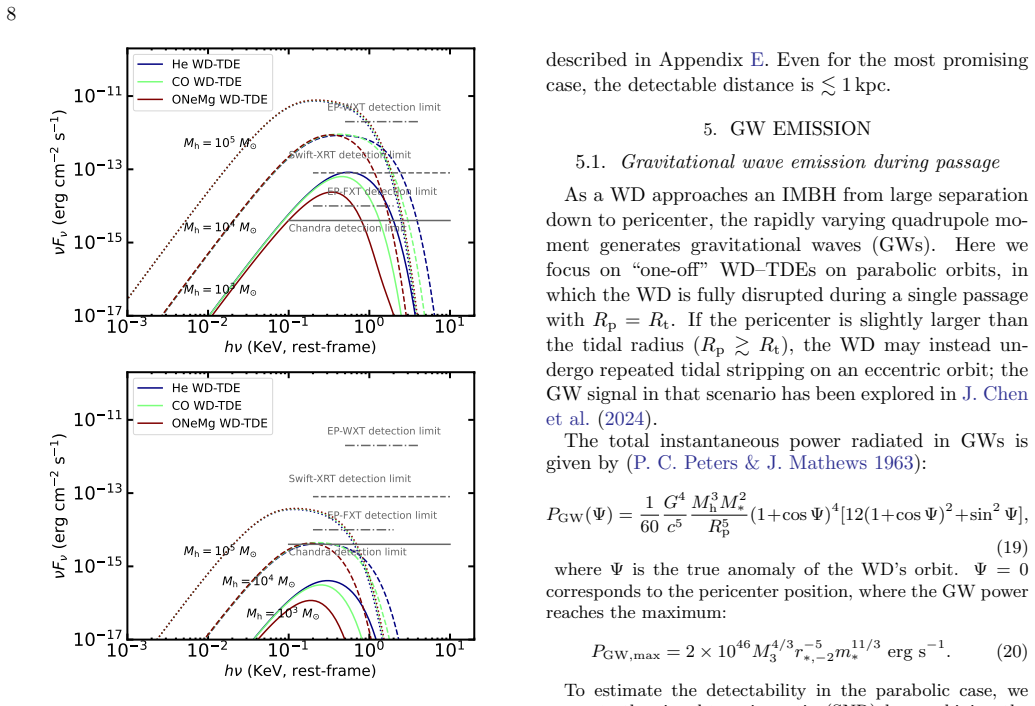
The central finding is that WD-TDE disks around IMBHs occupy a previously unexplored accretion regime — intermediate between typical super-Eddington TDE disks and the hyper-accreting neutrino-dominated disks of gamma-ray burst engines. In this regime, the disk is advection-dominated across a broad range of accretion rates, producing thermal X-ray emission that saturates near a few times the Eddington luminosity and is nearly insensitive to the fallback rate. Neutrino cooling, while never dominating the global energy budget, becomes non-negligible at the highest accretion rates and can reach 10^47 erg/s for the most extreme ONeMg WD disruptions. The combination of a 0.1 to 1 Hz GW burst from,
What carries the argument
The pair-nuclear accretion disk (PNAD) model: a steady, vertically integrated disk structure that simultaneously treats advection-dominated cooling, electron-positron pair production at T > 10^9 K, pair-annihilation neutrino emission, nuclear burning of WD-composition material (triple-alpha, carbon fusion, oxygen fusion), magnetic pressure from MRI saturation, and wind-driven mass loss with a power-law inflow rate profile. The multi-messenger outputs are derived from this single disk structure: thermal X-ray spectra from radiative diffusion, MeV neutrino spectra from pair annihilation, GW burst from the quadrupole moment during pericenter passage, and GW from rigid-body disk precession under
If this is right
- WD-TDEs become a predicted source class for proposed decihertz GW detectors (DECIGO, BBO, ALIA), with detection horizons of 10^3 to 10^4 Mpc for 10^3 solar mass IMBHs and even further for 10^4 solar mass IMBHs, enabling cosmological-scale IMBH surveys.
- A GW detection would provide a pre-EM alert: because the GW burst occurs during the disruptive passage while the disk forms and brightens over 10 to 1000 seconds, a GW trigger could enable rapid X-ray follow-up to catch the earliest disk formation phase.
- The near-Eddington saturation of the thermal luminosity means WD-TDE disk emission is relatively standardizable: the luminosity depends weakly on the accretion rate, so X-ray observations could constrain the IMBH mass directly from the Eddington scaling.
- The thermal disk spectrum's peak energy and shape are sensitive to the disk outer radius and IMBH spin, offering a way to measure these parameters with soft X-ray spectroscopy if the thermal component can be isolated from jet emission.
- MeV neutrino non-detections for extragalactic WD-TDE candidates can place upper limits on the inner-disk temperature and accretion rate, constraining the PNAD model even without a positive detection.
Where Pith is reading between the lines
- If the accretion rate does not track the fallback rate — for instance if circularization is slow and the disk builds up mass before draining — the disk structure and all derived multi-messenger signals would change. A time-delayed accretion profile could produce a brighter, harder neutrino burst at later times than predicted by the steady-state model, potentially shifting the neutrino detection wi
- The nuclear burning channel, though energetically negligible in this model, processes WD-composition material into heavier elements within the disk. If disk winds carry this processed material outward, the wind composition could imprint spectral signatures (emission lines, continuum features) that serve as a diagnostic of both the WD composition and the disk temperature profile — an observational
- The GW precession signal's extreme sensitivity to disk size (P_prec proportional to R_out^{-14}) means that if the disk forms more compactly or more extendedly than assumed, the precession GW frequency and power could shift by orders of magnitude. Early-time disk size is therefore the dominant uncertainty for this secondary GW channel.
- If a magnetically arrested disk (MAD) state forms in the innermost region — which the authors defer to their companion paper — the jet power and geometry could differ substantially from the simple 0.01 times the fallback accretion rate times c-squared estimate used here, potentially altering the multi-messenger power budget and the relative timing of EM, neutrino, and GW signals.
Load-bearing premise
The entire disk model assumes that the debris circularizes and forms a disk rapidly enough that the accretion rate closely follows the fallback rate of returning stellar material. The paper itself notes that a single stream self-intersection dissipates only a small fraction of the energy needed for circularization, and that disk formation in TDEs remains an unsolved problem. If circularization is slow or inefficient, the disk structure, the thermal X-ray luminosity, the neutr
What would settle it
If future radiation-magnetohydrodynamic simulations show that WD-TDE debris does not circularize within the fallback timescale, or that the accretion rate is suppressed or delayed relative to the fallback rate by more than a factor of a few, then the predicted disk temperatures, the 0.1 to 1 keV X-ray peak, the MeV neutrino luminosities, and the EM luminosity near Eddington would all be significantly altered, undermining the multi-messenger predictions.
Figures




read the original abstract
White dwarf (WD) tidal disruption events (TDEs) provide a unique window onto intermediate-mass black holes (IMBHs). We present a multi-messenger view of these systems in two papers. In this paper, we develop an accretion-disk model for WD--TDEs in which the bound debris accretes at extremely super-Eddington rates, $\sim 10^5$--$10^9$ times higher than in typical (main-sequence) TDEs. The model includes magnetic pressure, nuclear-burning heating, wind mass loss, and neutrino production via $e^{\pm}$ pair annihilation. At such high accretion rates, the gas and radiation temperatures of the inner flow can reach $T\gtrsim 10^9\,\mathrm{K}$, enabling prolific pair production and MeV neutrino emission. We find that the disk is predominantly advection dominated over a broad range of accretion rates, while disk winds can partially cool the flow and reduce the inner temperature. The predicted thermal EM emission is nearly insensitive to the fallback rate in the super-Eddington regime: the luminosity only mildly exceeds the IMBH Eddington luminosity and the spectrum peaks at $\sim 0.1$--$1\,\mathrm{keV}$, implying detectability with current X-ray facilities such as Einstein Probe. For low-mass IMBHs ($\sim 10^3\,M_{\odot}$), the disk can also produce a burst of MeV neutrinos with luminosities up to $\sim 10^{47}\,\mathrm{erg\,s^{-1}}$ for ONeMg WD--TDEs, although detectability with current neutrino detectors (e.g., Super-Kamiokande and JUNO) is limited to Galactic distances. Finally, we estimate the GW burst produced during the final passage prior to disruption, which peaks at $\sim 0.1$--$1\,\mathrm{Hz}$, placing WD--TDEs in the target band of proposed decihertz detectors and motivating coordinated GW+EM+neutrino searches. We also present a first exploration of GWs from a precessing WD--TDE disk; this signal is much weaker, with a detection horizon $\lesssim 1\,\mathrm{Mpc}$ for these missions.
Editorial analysis
A structured set of objections, weighed in public.
Referee Report
Summary. This paper develops a steady-state, vertically integrated accretion disk model for white dwarf tidal disruption events (WD-TDEs) by intermediate-mass black holes (IMBHs). The model incorporates viscous heating, advection, radiative diffusion, wind mass loss, nuclear burning, magnetic pressure, and neutrino cooling via pair annihilation. The authors find that the disk is predominantly advection-dominated, producing thermal EM emission mildly exceeding Eddington luminosity and peaking at 0.1–1 keV. They also compute MeV neutrino emission from pair annihilation and estimate GW signals from both the disruptive pericenter passage and disk precession. The paper concludes that WD-TDEs are multi-messenger sources for future coordinated searches involving decihertz GW detectors, X-ray facilities, and MeV neutrino detectors. The model is constructed from standard conservation equations with external benchmarks (e.g., Itoh et al. 1989 for neutrino rates), and the EM luminosity scaling is a standard slim-disk result rather than a circular definition.
Significance. The paper provides a timely and comprehensive first look at the multi-messenger phenomenology of WD-TDE disks, motivated by the recent EP250702a/GRB 250702BDE candidate. The derivation of analytic disk scalings in the advection-dominated regime (Appendix D), the incorporation of pair-production physics via a simplified fitting formula validated against Itoh et al. (1989) (Appendix C), and the falsifiable neutrino detectability predictions for JUNO, Hyper-K, and IceCube-Gen2 (Appendix E) are concrete strengths. The GW burst and precessing-disk signal estimates provide specific, testable predictions for proposed decihertz missions. The model occupies an interesting intermediate regime between standard TDE disks and GRB hyper-accretion flows (NDAFs), which is a genuinely useful contribution to the literature.
major comments (3)
- The abstract states neutrino luminosities 'up to ~10^47 erg/s for ONeMg WD-TDEs,' but Figure 10's caption reports the peak value for M_h = 10^3 M_sun ONeMg WD-TDEs as Ė_ν ≃ 2.5×10^45 erg/s, and the y-axis of Figure 10 extends only to 10^46. Section 6 gives yet another value: 'Ė_ν ≃ 10^46 erg/s.' These three mutually inconsistent numbers (10^47, 10^46, 2.5×10^45) for the same quantity must be reconciled. The factor of ~40 discrepancy between the abstract and Figure 10 directly affects the neutrino detectability conclusion, since at 2.5×10^45 erg/s the already-marginal Galactic detection horizon would shrink further. The authors should identify which value is correct, correct the others, and verify that the detectability analysis in Section 4.2 and Appendix E uses the correct luminosity.
- The steady-state disk model assumes Ṁ_acc ≈ Ṁ_fb (Section 2, end), which requires rapid and efficient circularization. The paper itself acknowledges in Section 7.1 that a single stream self-intersection dissipates only a small fraction of the required energy (Eq. 41 vs. GM_h/(2R_c)), and states that 'disk formation in TDEs remains an open problem.' While Section 7.2 provides a disk evolution calculation (Eq. 42, Figures 18–19) that partially addresses this by showing Ṁ_acc tracks Ṁ_fb when the disk has already formed near R_c, the gap between 'circularization is uncertain' and 'we assume rapid circularization' is not fully bridged. The authors should more clearly delineate the regime of validity: for what circularization timescale does Ṁ_acc ≈ Ṁ_fb hold, and how would delayed circularization quantitatively affect the multi-messenger predictions?
- The wind mass-loss prescription (Appendix A.5) uses Ṁ_in ∝ R^s with s ~ 0.2–1 and a wind energy coefficient K, both treated as free parameters. The sensitivity of the neutrino luminosity to s is shown in Figure 11 (upper panel), but the sensitivity to K is not explored. Since K directly sets the ratio Q_w/Q_vis ≃ sK/3, and winds can reduce the inner-disk temperature and hence neutrino production, the absence of a K-sensitivity study leaves an unquantified systematic on the neutrino luminosity claim. The authors should either show the K-dependence or explain why it is subdominant.
minor comments (7)
- Section 4.1: The blackbody spectrum calculation (Eq. 15) uses a face-on geometry and neglects thick-disk and GR effects. This is acknowledged, but the reader would benefit from a brief quantitative estimate of how much the observed spectrum could change at high inclination or with relativistic beaming.
- Figure 10: The y-axis label 'E (erg s^-1)' should be 'Ė_ν (erg s^-1)' for clarity, and the axis range (up to 10^46) appears inconsistent with the abstract's claim of 10^47.
- Section 5.2, Eq. (38): The regularization of δ(f−f_prec)^2 → δ(f−f_prec)·T_obs is stated but the choice of T_obs ~ t_fb should be justified more carefully, since the disk may persist longer than the fallback time.
- Appendix A.4: The nuclear burning treatment considers only the dominant reactions (triple-alpha for He, carbon/oxygen fusion for CO/ONeMg) and ignores photodisintegration for ONeMg. The authors note this is confined to a small radius, but a quantitative bound on the error incurred would strengthen the claim that Q_nuc is negligible.
- The term 'Pair-Nuclear Accretion Disk (PNAD)' is introduced in Section 3 but is not used consistently thereafter; some sections refer simply to 'the disk.' Consider using PNAD consistently or dropping the acronym.
- Several references appear to be from 2025–2026 (e.g., Li et al. 2026, Wang et al. 2026, Cheng et al. 2025). The referee assumes these are genuine preprints, but the authors should verify all citation details are complete.
- Figure 17: The neutrino power history is shown alongside EM and GW, but the neutrino curve appears to use the 10^46 value from Section 6 rather than the 10^47 from the abstract or the 2.5×10^45 from Figure 10. This should be made consistent once the correct value is identified.
Simulated Author's Rebuttal
We thank the referee for a careful and constructive report. The referee identifies three major issues: (1) an internal inconsistency in the neutrino luminosity values quoted across the abstract, Section 6, and Figure 10; (2) insufficient delineation of the regime of validity for the steady-state assumption of rapid circularization; and (3) the absence of a sensitivity study for the wind energy coefficient K. We agree that all three points require attention. The first is a genuine error in the manuscript that we will correct. The second and third call for additional discussion and analysis that we will incorporate in the revised manuscript. Below we address each point in turn.
read point-by-point responses
-
Referee: The abstract states neutrino luminosities 'up to ~10^47 erg/s for ONeMg WD-TDEs,' but Figure 10's caption reports the peak value for M_h = 10^3 M_sun ONeMg WD-TDEs as Ė_ν ≃ 2.5×10^45 erg/s, and the y-axis of Figure 10 extends only to 10^46. Section 6 gives yet another value: 'Ė_ν ≃ 10^46 erg/s.' These three mutually inconsistent numbers (10^47, 10^46, 2.5×10^45) for the same quantity must be reconciled. The factor of ~40 discrepancy between the abstract and Figure 10 directly affects the neutrino detectability conclusion, since at 2.5×10^45 erg/s the already-marginal Galactic detection horizon would shrink further. The authors should identify which value is correct, correct the others, and verify that the detectability analysis in Section 4.2 and Appendix E uses the correct luminosity.
Authors: The referee is correct that these three numbers are mutually inconsistent, and we are grateful for the careful reading that caught this. We have re-examined the calculation and confirmed that the correct peak neutrino luminosity for the ONeMg WD-TDE with M_h = 10^3 M_sun is Ė_ν ≃ 2.5 × 10^45 erg/s, as stated in the Figure 10 caption. The value 10^47 erg/s in the abstract is an error: it appears to have arisen from an early draft in which the neutrino luminosity was estimated using a different (and since-corrected) temperature scaling for the inner disk. The value 10^46 erg/s quoted in Section 6 is also incorrect and likely resulted from rounding up the already-inflated abstract value. We will revise the abstract, Section 6, and the conclusion (Section 8) to consistently quote Ė_ν ≃ 2.5 × 10^45 erg/s as the peak value for the most optimistic case (ONeMg WD, M_h = 10^3 M_sun). The detectability analysis in Section 4.2 and Appendix E was in fact carried out using the correct luminosity (2.5 × 10^45 erg/s) and the corresponding spectra shown in Figure 12; the conclusion that detection is limited to Galactic distances (≲1 kpc) is therefore already based on the correct value and does not need to be revised. We will also update Figure 10's y-axis range to extend to 10^46 so that the peak value is clearly visible. We emphasize that the qualitative conclusion—that MeV neutrino detectability is limited to very nearby events—remains unchanged, but we agree that the quantitative claim in the abstract was overstated by approximately a factor of 40 and will be corrected. revision: yes
-
Referee: The steady-state disk model assumes Ṁ_acc ≈ Ṁ_fb (Section 2, end), which requires rapid and efficient circularization. The paper itself acknowledges in Section 7.1 that a single stream self-intersection dissipates only a small fraction of the required energy (Eq. 41 vs. GM_h/(2R_c)), and states that 'disk formation in TDEs remains an open problem.' While Section 7.2 provides a disk evolution calculation (Eq. 42, Figures 18–19) that partially addresses this by showing Ṁ_acc tracks Ṁ_fb when the disk has already formed near R_c, the gap between 'circularization is uncertain' and 'we assume rapid circularization' is not fully bridged. The authors should more clearly delineate the regime of validity: for what circularization timescale does Ṁ_acc ≈ Ṁ_fb hold, and how would delayed circularization quantitatively affect the multi-messenger predictions?
Authors: We agree that the manuscript does not sufficiently delineate the regime of validity for the steady-state assumption, and we will revise the text to address this more clearly. The key point is the following: the assumption Ṁ_acc ≃ Ṁ_fb holds when the viscous timescale at the circularization radius R_c is short compared to the fallback timescale t_fb, i.e., t_ν(R_c) ≪ t_fb. For the WD-TDE parameters considered here (M_h ~ 10^3–10^4 M_sun, WD masses 0.2–1.4 M_sun), t_fb ranges from ~10^2 to ~10^4 s (Equation 6), while t_ν(R_c) ~ α^{-1} (GM_h/R_c^3)^{-1/2} (H/R)^{-2} is typically ~10–10^3 s for α ~ 0.1 and H/R ~ 0.3–1 in the super-Eddington regime. Thus the condition t_ν ≪ t_fb is satisfied for the bulk of the super-Eddington phase, particularly for the most extreme (ONeMg) cases where t_fb is shortest and the disk is thickest. The disk evolution calculation in Section 7.2 (Equation 42, Figures 18–19) confirms this: once a disk has formed near R_c, the accretion rate closely tracks the fallback rate. However, the referee is correct that the gap between 'a disk has formed near R_c' and 'circularization is complete' is not fully bridged. The circularization timescale itself is uncertain and depends on the efficiency of stream–stream and stream–disk collisions, which we discuss in Section 7.1 but do not model from first principles. If circularization is delayed (t_circ ≳ t_fb), the early-time accretion rate would be suppressed relative to the fallback rate, delaying and potentially reducing the peak EM and neutrino emission. The GW burst signal from the disruptive passage itself is unaffected, but the precessing-disk GW signal would be delayed. We will add a dedicated paragraph in Section 2 (or at the end of Section 7.1) that: (i) states the condition t_ν(R_c) ≪ t_fb quantitit revision: partial
-
Referee: The wind mass-loss prescription (Appendix A.5) uses Ṁ_in ∝ R^s with s ~ 0.2–1 and a wind energy coefficient K, both treated as free parameters. The sensitivity of the neutrino luminosity to s is shown in Figure 11 (upper panel), but the sensitivity to K is not explored. Since K directly sets the ratio Q_w/Q_vis ≃ sK/3, and winds can reduce the inner-disk temperature and hence neutrino production, the absence of a K-sensitivity study leaves an unquantified systematic on the neutrino luminosity claim. The authors should either show the K-dependence or explain why it is subdominant.
Authors: The referee raises a valid point. We did explore the sensitivity to the winds-index s (Figure 11, upper panel) but did not separately vary the wind energy coefficient K. We will address this in the revised manuscript. Physically, K enters the wind cooling rate as Q_w ≃ (sK/3) Q_vis (Equation A12), so increasing K has a qualitatively similar effect to increasing s: both enhance wind cooling, reduce the inner-disk temperature, and thereby suppress neutrino production. However, there is an important subtlety: K also affects the mass inflow profile indirectly, because stronger wind cooling reduces H/R and hence the viscous transport rate. In practice, for the fiducial values s = 0.2 and K = 1 adopted in the manuscript, the wind cooling fraction is Q_w/Q_vis ≃ 0.07, which is already subdominant to advection. Increasing K to, say, K = 3 would raise this to ~0.2, which would modestly reduce the inner-disk temperature (by roughly 10–15% based on the scaling T ∝ (1 - sK/3)^{-1/8} in Equation D24) and correspondingly reduce the neutrino luminosity by a factor of a few (given the steep temperature dependence of pair-annihilation emissivity, ṋ_νν ∝ T^{4.5–9}). This is a non-negligible systematic but is smaller than the variation already shown in Figure 11 from varying s (which also changes the mass inflow profile and thus has a larger effect). We will add a K-sensitivity panel to Figure 11 (or a new figure) showing the neutrino luminosity for K = 0.5, 1, and 3 at fixed s = 0.2, and we will add a brief discussion in Section 4.2 quantifying the resulting systematic uncertainty on the neutrino luminosity claim. We expect this will confirm that the qualitative conclusions are robust but will provide the quantitative bracketing the referee requests. revision: yes
Circularity Check
No significant circularity found; derivation chain is self-contained with external benchmarks
full rationale
The paper's derivation chain is built from standard physics equations and external references, with no load-bearing circular reductions. The disk structure (Section 3) is computed from energy balance Q+ = Q- (Eq. 12) using standard α-viscosity (Shakura & Sunyaev 1973), standard pressure components (Eq. A5), standard opacity (Poutanen 2017), and neutrino rates from Itoh et al. (1989) — all external. The EM luminosity scaling L ≈ 2 ln(R_out/R_in) L_Edd (Eq. D26) is derived analytically in Appendix D from the advection-dominated limit and is explicitly compared to the standard slim-disk result of Watarai & Fukue (1999). The neutrino luminosity (Eq. 16) is computed by integrating the Itoh et al. fitting formula (Eq. A9) over the numerically solved disk temperature profile — not fitted to the prediction target. The GW burst formulas use Peters & Mathews (1963) and Berry & Gair (2010), both external. The GW precession signal uses Lense-Thirring torques (Eq. 25) and standard quadrupole radiation. The key assumption M_acc ≈ M_fb (Section 2) is validated in Section 7.2 by solving independent coupled conservation equations (Eq. 42) with simulated fallback rates from Guillochon & Ramirez-Ruiz (2013), an external source. Self-citations (Chen et al. 2022, 2023, 2024, 2026; Chen & Shen 2018, 2021) appear for context — candidate identification, stream-intersection physics, prior GW work — but none are load-bearing for the central disk model or multi-messenger predictions of this paper. The neutrino luminosity numerical inconsistency noted by the skeptic (10^47 in abstract vs 2.5×10^45 in Figure 10 caption) is an internal error, not a circularity. Score 1 reflects minor self-citations that do not undermine the independence of the central derivation.
Axiom & Free-Parameter Ledger
free parameters (5)
- alpha (viscosity parameter) =
0.1
- s (wind mass-loss index) =
0.2
- K (wind energy coefficient) =
1
- xi (advection parameter) =
1
- a_bullet (IMBH spin) =
0.95
axioms (4)
- domain assumption Rapid circularization: The disk accretion rate closely tracks the fallback rate (M_acc ≈ M_fb).
- domain assumption Steady-state, vertically integrated disk structure is a valid approximation.
- domain assumption Disk precesses as a rigid body due to Lense-Thirring torques.
- domain assumption Standard alpha-viscosity prescription is valid at extreme super-Eddington rates.
invented entities (1)
-
Pair-Nuclear Accretion Disk (PNAD)
no independent evidence
discussion (0)
Sign in with ORCID, Apple, or X to comment. Anyone can read and Pith papers without signing in.