REVIEW 2 major objections 1 minor 34 references
A Pilot Study to Verify the RR Lyrae Candidates with Vera C. Rubin Observatory Early Alerts
T0 review · 2 major / 1 minor · reviewed 2026-06-26 · grok-4.3
Pith's one-line read Rubin Observatory early alerts verify 32 RR Lyrae candidates as genuine using multiband light curves.
desk verdict Rubin early alerts confirm 32 of 40 RR Lyrae candidates via visual light-curve checks, but the method stays qualitative and the sample is tiny. read the letter →
The pith
A machine-rendered reading of the paper's core claim, the machinery that carries it, and where it could break.
The reading
What carries the argument
Multiband light curves extracted from early alerts, inspected for characteristic RR Lyrae variability patterns to confirm or reject candidates.
What would settle it
Independent spectroscopic observations or full-survey photometry showing that most of the 32 light-curve-verified objects lack the expected radial-velocity or period-amplitude properties of RR Lyrae stars.
Extended reading notes
Core claim
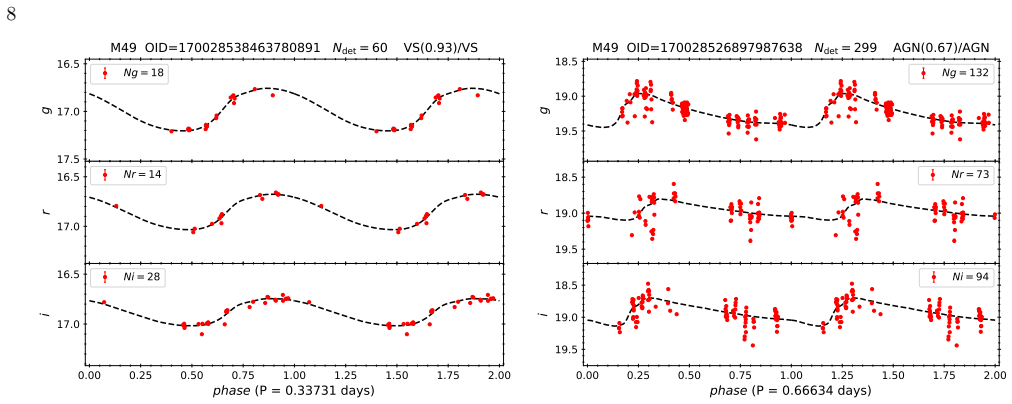
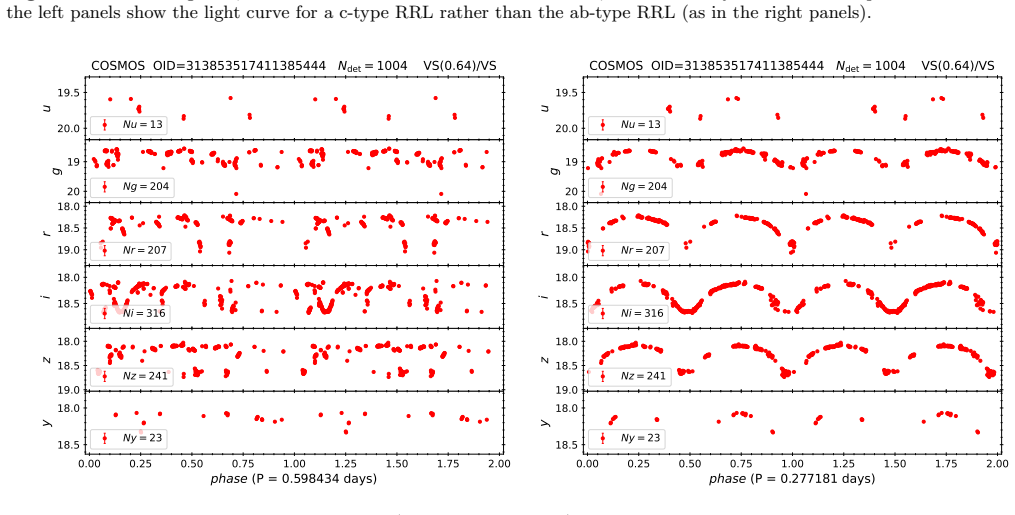
The paper shows that multiband light curves derived from Rubin-LSST early alerts verify 32 RR Lyrae candidates as genuine while identifying contaminants, with ALeRCE and Lasair brokers achieving roughly 70 percent and 40 percent true variable classification rates on the sample and 20 percent of alerts turning out to be other variable types.
Load-bearing premise
The alert-derived multiband light curves alone provide sufficient information to reliably distinguish genuine RR Lyrae from contaminants without additional photometric or spectroscopic follow-up.
Editorial extensions
If this is right
- 32 candidates receive confirmation as RR Lyrae on the basis of their extracted light curves.
- Community brokers miss some genuine variables that alert light curves can still identify.
- 20 percent of the alert sample consists of non-RR Lyrae variable stars.
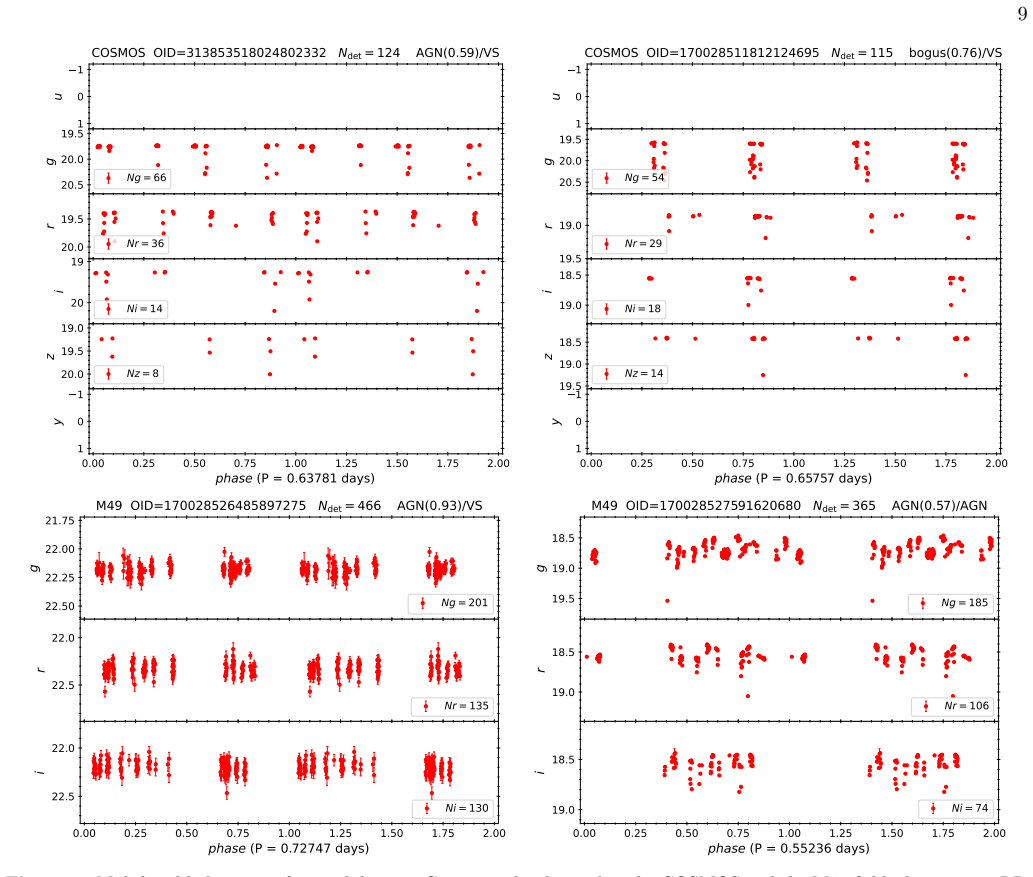
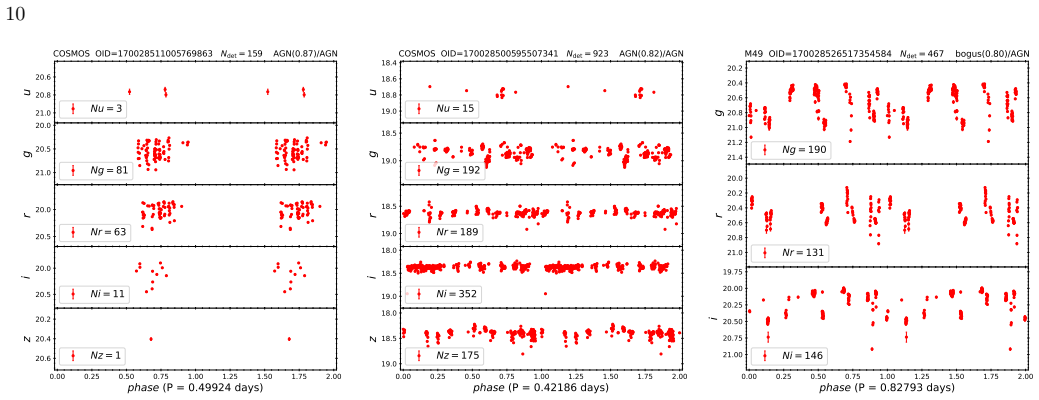
- Eight candidates display light curves inconsistent with RR Lyrae, including AGN and eclipsing binaries.
- Some cataloged candidates yield no alerts, implying either misclassification or unavailable template images.
Reading between the lines
- Alert-based verification could scale to screen larger variable-star catalogs once full survey operations begin.
- The method may reduce the volume of dedicated follow-up needed for initial candidate vetting.
- Missing alerts for some candidates highlight the role of template-image availability in difference-image pipelines.
- The same crossmatch-and-inspect approach could apply to verification of other periodic variable classes.
Signed reviews
Editorial analysis
A structured set of objections, weighed in public.
Referee Report
Summary. The paper reports a pilot study cross-matching faint RR Lyrae candidates from Pan-STARRS1, DES, and NGVS catalogs against Vera C. Rubin Observatory early alerts in deep-drilling fields and the M49 field. After excluding low-detection alerts, 40 objects remain; multiband alert light curves are inspected to classify 32 as genuine RR Lyrae (some missed by ALeRCE and Lasair brokers), while 8 are deemed non-RR Lyrae (including two AGN and two eclipsing binaries). The work also notes a handful of catalogued candidates lacking alerts, possibly due to missing templates, and compares broker true-positive rates (~70% ALeRCE, ~40% Lasair).
Significance. If the verification procedure can be made reproducible, the study supplies a concrete early demonstration that Rubin alert streams can recover and vet RR Lyrae candidates from existing catalogs, quantifies broker performance on a small but clean sample, and flags the practical impact of difference-imaging template availability. These are useful benchmarks for LSST-era variable-star pipelines even though the sample size precludes broad statistical conclusions.
major comments (2)
- [Abstract] Abstract (verification paragraph): the central claim that 32 of 40 alerts are verified as genuine RR Lyrae rests on the statement that they “show typical RR Lyrae light curves,” yet no quantitative criteria (Lomb-Scargle FAP threshold, minimum epochs per band, Fourier coefficients, template-fit χ², or period/amplitude consistency rules) are supplied. Without these, the 80 % verification fraction and the 20 % non-RR Lyrae fraction cannot be independently assessed or reproduced.
- [Abstract] Abstract (non-detection paragraph): the observation that some known candidates produce no alerts is attributed to possible missing templates, but the text provides neither the total number of such candidates examined nor an estimate of how template incompleteness biases the recovered sample or the reported verification statistics.
minor comments (1)
- [Abstract] The abstract would be clearer if it stated the exact number of deep-drilling fields and the M49 field coordinates or visit counts used for the cross-match.
Simulated Author's Rebuttal
We thank the referee for the constructive comments on our pilot study. We address each major comment below and indicate where revisions will be made.
read point-by-point responses
-
Referee: [Abstract] Abstract (verification paragraph): the central claim that 32 of 40 alerts are verified as genuine RR Lyrae rests on the statement that they “show typical RR Lyrae light curves,” yet no quantitative criteria (Lomb-Scargle FAP threshold, minimum epochs per band, Fourier coefficients, template-fit χ², or period/amplitude consistency rules) are supplied. Without these, the 80 % verification fraction and the 20 % non-RR Lyrae fraction cannot be independently assessed or reproduced.
Authors: Classification was performed via visual inspection of multiband light curves for characteristic RR Lyrae morphology (asymmetric sawtooth shapes, periods ~0.2-1 d, amplitudes 0.2-1.5 mag) and consistency across bands. No automated quantitative metrics were applied in this small pilot. We will revise the text to explicitly describe these qualitative criteria and acknowledge the absence of reproducible thresholds as a limitation of the current work. revision: partial
-
Referee: [Abstract] Abstract (non-detection paragraph): the observation that some known candidates produce no alerts is attributed to possible missing templates, but the text provides neither the total number of such candidates examined nor an estimate of how template incompleteness biases the recovered sample or the reported verification statistics.
Authors: We will revise the abstract and main text to report the exact number of catalogued candidates examined in the fields. A quantitative bias estimate from template incompleteness cannot be provided because template availability is dynamic and incompletely documented for the early-alert period; we will note this as an unquantified caveat. revision: partial
- Quantitative estimate of how template incompleteness biases the recovered sample or the reported verification statistics
Circularity Check
No circularity: purely observational cross-match and visual classification
full rationale
The paper reports a catalog cross-match between existing RR Lyrae candidate lists and Rubin early alerts, followed by extraction of multiband light curves and qualitative visual inspection to confirm 32 objects show typical RR Lyrae shapes. No equations, fitted parameters, model derivations, or predictions appear in the provided text. The central claim rests on direct comparison to external catalogs and observed light-curve morphology, with no self-referential reduction or load-bearing self-citation. This is standard observational verification and is self-contained against external benchmarks.
Assumptions & free parameters
assumptions (1)
- domain assumption Standard astronomical assumptions on positional cross-matching accuracy and on the uniqueness of RR Lyrae light-curve shapes in multiband photometry.
Cite this review
Pith. "Pith review of A Pilot Study to Verify the RR Lyrae Candidates with Vera C. Rubin Observatory Early Alerts." pith.science (2026). https://pith.science/paper/MZU2EX6N
@misc{pith2026260618572,
  author       = {Pith},
  title        = {Pith review of: A Pilot Study to Verify the RR Lyrae Candidates with Vera C. Rubin Observatory Early Alerts},
  year         = {2026},
  howpublished = {\url{https://pith.science/paper/MZU2EX6N}},
  note         = {Machine review of arXiv:2606.18572}
}
abstract
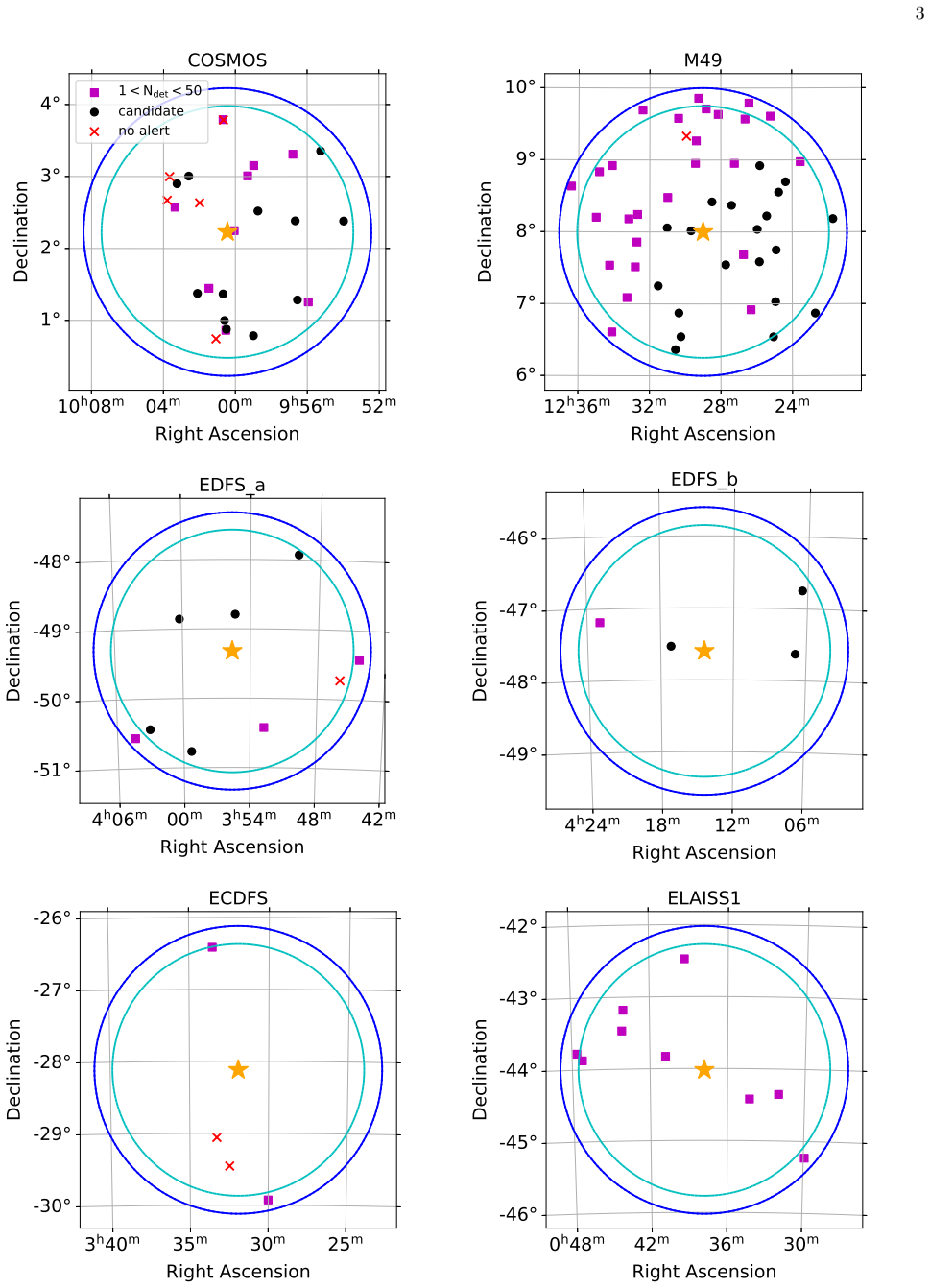
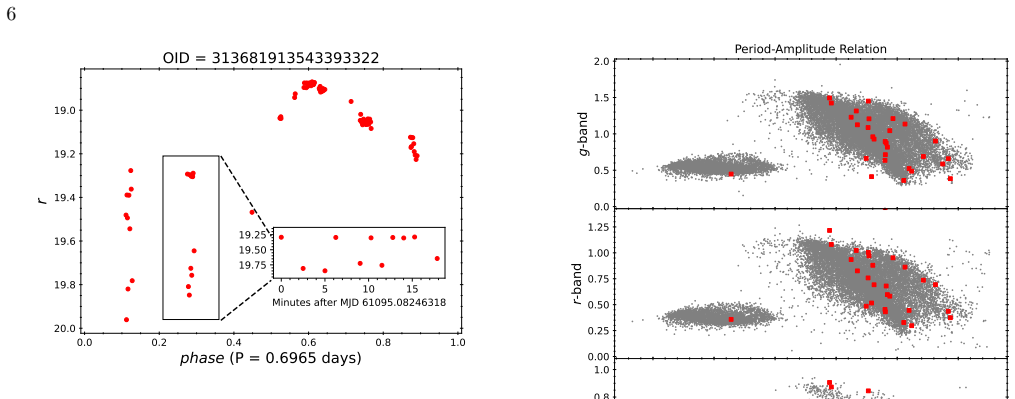
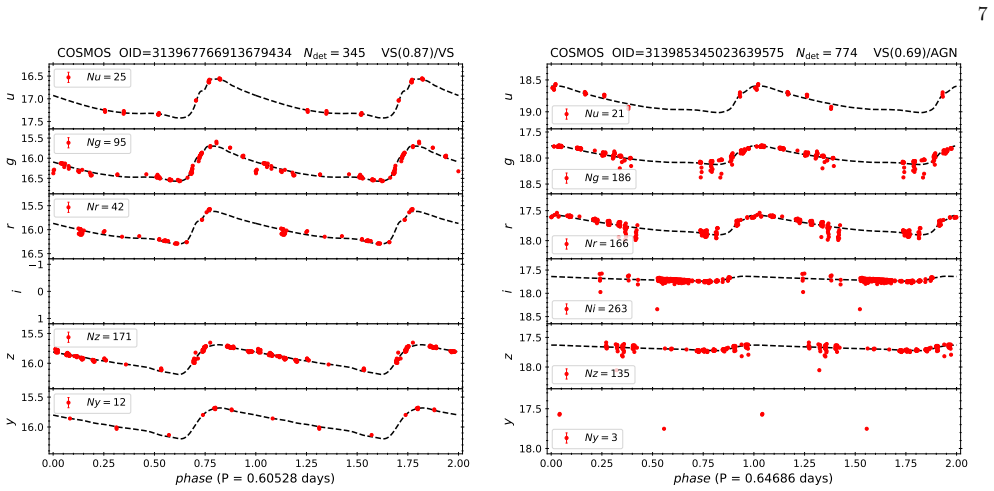
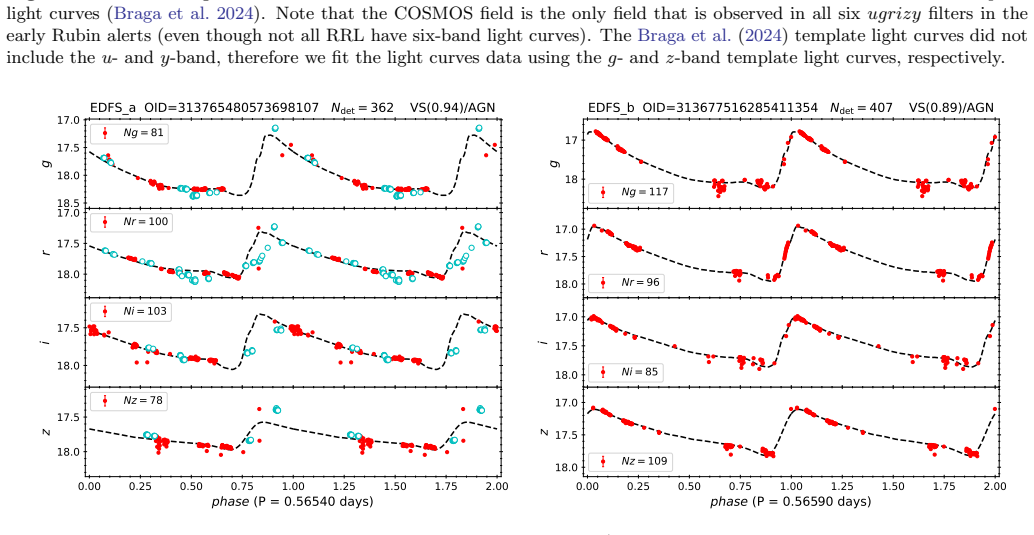
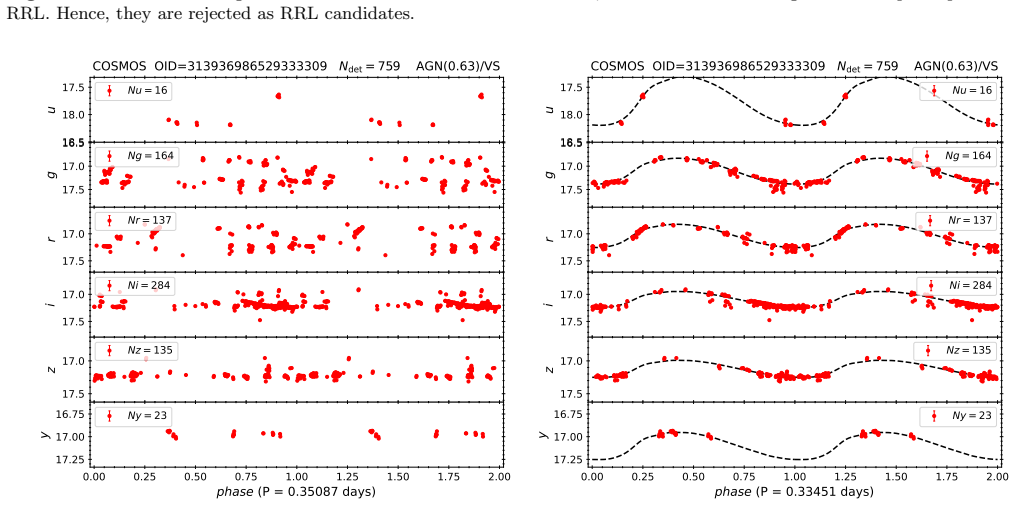
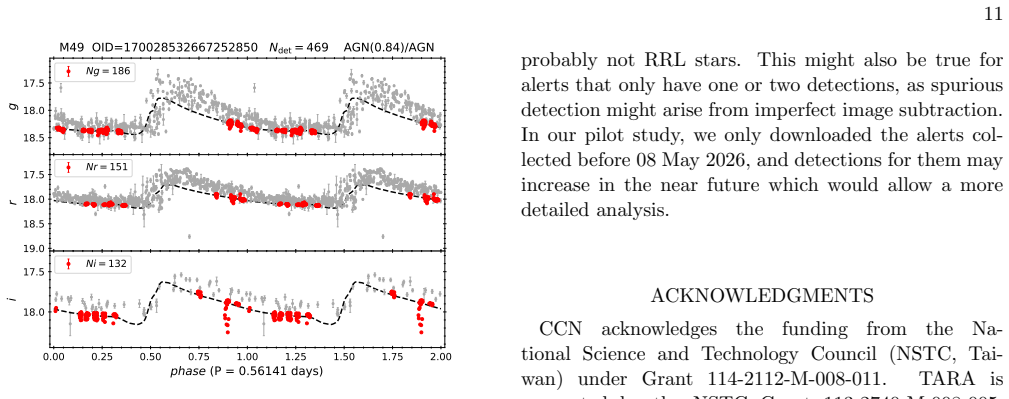
We present a pilot study using the Vera C. Rubin Observatory early alerts to verify RR Lyrae candidates in the Pan-STARRS1, the Dark Energy Survey, and the Next-Generation Virgo Cluster Survey RR Lyrae catalogs. RR Lyrae candidates fainter than 16 mag in the $g$-band in these catalogs were crossmatched with the alerts observed in several deep drilling fields and the M49 field. After excluding alerts with a low number of detections, there are 40 alerts associated with the RR Lyrae candidates. The multiband Rubin-LSST light curves extracted from the alerts verify 32 variables as genuine RR Lyrae, although several were not classified as variable stars in the ALeRCE and Lasair community alert brokers. While ALeRCE and Lasair provide $\sim70\%$ and $\sim40\%$ true variable classification, respectively, we find that $20\%$ of the alert sample are non-RR Lyrae variables. The remaining eight candidate variables do not show typical RR Lyrae light curves and include two active galactic nuclei and two eclipsing binaries. Additionally, we have also found a small number of known variable candidates with no alerts, which would suggest that they are either not RR Lyrae variables or the template images are not yet available for their difference image analysis.
Figures
Figures from the paper (7 more)
Reference graph
Works this paper leans on
-
[1]
2026, A&A, 705, A247, doi: 10.1051/0004-6361/202556258 Astropy Collaboration, Robitaille, T
Ar´ evalo, P., S´ anchez-S´ aez, P., Sotomayor, B., et al. 2026, A&A, 705, A247, doi: 10.1051/0004-6361/202556258 Astropy Collaboration, Robitaille, T. P., Tollerud, E. J., et al. 2013, A&A, 558, A33, doi: 10.1051/0004-6361/201322068 Astropy Collaboration, Price-Whelan, A. M., Sip˝ ocz, B. M., et al. 2018, AJ, 156, 123, doi: 10.3847/1538-3881/aabc4f Astro...
-
[2]
Beaton, R. L., Bono, G., Braga, V. F., et al. 2018, SSRv, 214, 113, doi: 10.1007/s11214-018-0542-1
-
[3]
Bellm, E. C., Kulkarni, S. R., Graham, M. J., et al. 2019, PASP, 131, 018002, doi: 10.1088/1538-3873/aaecbe
-
[4]
2020, Journal of Astrophysics and Astronomy, 41, 23, doi: 10.1007/s12036-020-09640-z —
Bhardwaj, A. 2020, Journal of Astrophysics and Astronomy, 41, 23, doi: 10.1007/s12036-020-09640-z —. 2022, Universe, 8, 122, doi: 10.3390/universe8020122
-
[5]
Bianco, F. B., Ivezi´ c,ˇZ., Jones, R. L., et al. 2022, ApJS, 258, 1, doi: 10.3847/1538-4365/ac3e72
-
[6]
F., Monelli, M., Dall’Ora, M., et al
Braga, V. F., Monelli, M., Dall’Ora, M., et al. 2024, A&A, 689, A349, doi: 10.1051/0004-6361/202450971
-
[7]
M., Mendes de Oliveira, C., Krabbe, A
Cardoso, N. M., Mendes de Oliveira, C., Krabbe, A. C., et al. 2026, AJ, 171, 290, doi: 10.3847/1538-3881/ae4fb1
-
[8]
2021, AJ, 162, 231, doi: 10.3847/1538-3881/ac0ef1
Carrasco-Davis, R., Reyes, E., Valenzuela, C., et al. 2021, AJ, 162, 231, doi: 10.3847/1538-3881/ac0ef1
Show all 34 references
-
[9]
A., Cheung, S.-H., et al
Chan, H.-S., Villar, V. A., Cheung, S.-H., et al. 2022, ApJ, 932, 118, doi: 10.3847/1538-4357/ac69d4
2022 doi
-
[10]
2023, MNRAS, 525, 3075, doi: 10.1093/mnras/stad2296
Chen, A., Li, Z., Wang, Y., et al. 2023, MNRAS, 525, 3075, doi: 10.1093/mnras/stad2296
2023 doi
-
[11]
2020, ApJS, 249, 18, doi: 10.3847/1538-4365/ab9cae
Chen, X., Wang, S., Deng, L., et al. 2020, ApJS, 249, 18, doi: 10.3847/1538-4365/ab9cae
2020 doi
-
[12]
2023, A&A, 674, A18, doi: 10.1051/0004-6361/202243964
Clementini, G., Ripepi, V., Garofalo, A., et al. 2023, A&A, 674, A18, doi: 10.1051/0004-6361/202243964
2023 doi
-
[13]
J., Catelan, M., Djorgovski, S
Drake, A. J., Catelan, M., Djorgovski, S. G., et al. 2013, ApJ, 763, 32, doi: 10.1088/0004-637X/763/1/32
2013 doi
-
[14]
J., Graham, M
Drake, A. J., Graham, M. J., Djorgovski, S. G., et al. 2014, ApJS, 213, 9, doi: 10.1088/0067-0049/213/1/9
2014 doi
-
[15]
W., et al
Feng, Y., Guhathakurta, P., Peng, E. W., et al. 2026, ApJ, 998, 157, doi: 10.3847/1538-4357/ae313b —. 2024, ApJ, 966, 159, doi: 10.3847/1538-4357/ad2ae7 F¨ orster, F., Cabrera-Vives, G., Castillo-Navarrete, E., et al. 2021, AJ, 161, 242, doi: 10.3847/1538-3881/abe9bc
2026 doi
-
[16]
J., Kulkarni, S
Graham, M. J., Kulkarni, S. R., Bellm, E. C., et al. 2019, PASP, 131, 078001, doi: 10.1088/1538-3873/ab006c
2019 doi
-
[17]
P., Bechtol, K., Bellm, E
Guy, L. P., Bechtol, K., Bellm, E. C., et al. 2025, RTN-011: Rubin Observatory Plans for an Early Science Program, Tech. rep., NSF-DOE Vera C. Rubin Observatory, doi: 10.71929/RUBIN/2584021
2025 doi
-
[18]
G., Rix, H.-W., et al
Hernitschek, N., Cohen, J. G., Rix, H.-W., et al. 2018, ApJ, 859, 31, doi: 10.3847/1538-4357/aabfbb
2018 doi
-
[19]
Huang, K.-W., & Koposov, S. E. 2022, MNRAS, 510, 3575, doi: 10.1093/mnras/stab3654
2022 doi
-
[20]
2021, MNRAS, 502, 5686, doi: 10.1093/mnras/stab005 Ivezi´ c,ˇZ., Kahn, S
Iorio, G., & Belokurov, V. 2021, MNRAS, 502, 5686, doi: 10.1093/mnras/stab005 Ivezi´ c,ˇZ., Kahn, S. M., Tyson, J. A., et al. 2019, ApJ, 873, 111, doi: 10.3847/1538-4357/ab042c Juri´ c, M., Axelrod, T. S., Becker, A. C., et al. 2023, LSE-163: Data Products Definition Document,...
2021 doi
-
[21]
M., et al
Lucey, M., Mateu, C., Price-Whelan, A. M., et al. 2026, AJ, 171, 249, doi: 10.3847/1538-3881/ae4aaa
2026 doi
-
[22]
E., Mu˜ noz, R
Medina, G. E., Mu˜ noz, R. R., Carlin, J. L., et al. 2024, MNRAS, 531, 4762, doi: 10.1093/mnras/stae1137
2024 doi
-
[23]
G., Minniti, D., Capuzzo-Dolcetta, R., et al
Navarro, M. G., Minniti, D., Capuzzo-Dolcetta, R., et al. 2021, A&A, 646, A45, doi: 10.1051/0004-6361/202038463
2021 doi
- [24]
-
[25]
M., Becker, A
Oluseyi, H. M., Becker, A. C., Culliton, C., et al. 2012, AJ, 144, 9, doi: 10.1088/0004-6256/144/1/9 S´ anchez-S´ aez, P., Reyes, I., Valenzuela, C., et al. 2021, AJ, 161, 141, doi: 10.3847/1538-3881/abd5c1 S´ anchez-S´ aez, P., Arredondo, J., Bayo, A., et al. 2023, A&A, 675, ...
2012 doi
-
[26]
S., et al
Sesar, B., Ivezi´ c,ˇZ., Stuart, J. S., et al. 2013, AJ, 146, 21, doi: 10.1088/0004-6256/146/2/21
2013 doi
-
[27]
2017, AJ, 153, 204, doi: 10.3847/1538-3881/aa661b SLAC National Accelerator Laboratory, & NSF-DOE Vera C
Sesar, B., Hernitschek, N., Mitrovi´ c, S., et al. 2017, AJ, 153, 204, doi: 10.3847/1538-3881/aa661b SLAC National Accelerator Laboratory, & NSF-DOE Vera C. Rubin Observatory. 2025, The LSST Camera (LSSTCam), SLAC National Accelerator Laboratory (SLAC), Menlo Park, CA (United ...
2017 doi
-
[28]
M., Long, J
Stringer, K. M., Long, J. P., Macri, L. M., et al. 2019, AJ, 158, 16, doi: 10.3847/1538-3881/ab1f46
2019 doi
-
[29]
M., Drlica-Wagner, A., Macri, L., et al
Stringer, K. M., Drlica-Wagner, A., Macri, L., et al. 2021, ApJ, 911, 109, doi: 10.3847/1538-4357/abe873 Vera C Rubin Observatory Team, Acero Cuellar, T.,
2021 doi
-
[30]
2026, arXiv e-prints, arXiv:2603.23786
Acosta, E., et al. 2026, arXiv e-prints, arXiv:2603.23786. https://arxiv.org/abs/2603.23786
2026
-
[31]
W., Xue, X
Wang, F., Zhang, H. W., Xue, X. X., et al. 2022, MNRAS, 513, 1958, doi: 10.1093/mnras/stac874
2022 doi
-
[32]
D., Francis, G
Williams, R. D., Francis, G. P., Lawrence, A., et al. 2024, RAS Techniques and Instruments, 3, 362, doi: 10.1093/rasti/rzae024
2024 doi
-
[33]
Young, D. R. 2023, Sherlock. Contextual classification of astronomical transient sources, doi: 10.5281/zenodo.8038057. https://zenodo.org/doi/10.5281/zenodo.8038057
2023 doi
-
[34]
K., et al
Zinn, R., Horowitz, B., Vivas, A. K., et al. 2014, ApJ, 781, 22, doi: 10.1088/0004-637X/781/1/22
2014 doi
Reviewed June 26, 2026 · model on record in the stance chip above.
Discussion (0). Continue with ORCID to comment.