On a class of modified Cayley--Magnus methods
Pith reviewed 2026-06-26 19:44 UTC · model grok-4.3
The pith
Modified Cayley-Magnus methods integrate non-autonomous linear ODEs on quadratic matrix Lie groups by solving sequences of sparse linear systems rather than evaluating matrix exponentials.
A machine-rendered reading of the paper's core claim, the machinery that carries it, and where it could break.
Core claim
The central claim is that a class of modified Cayley-Magnus integrators can be constructed for linear ODEs with sparse coefficients in quadratic matrix Lie groups; these integrators achieve high order by solving only sparse linear systems and automatically respect boundedness for problems originating from unbounded operators.
What carries the argument
The modified Cayley-Magnus expansion, which expresses the numerical step as the solution of a sequence of linear systems derived from a Cayley transformation of the Magnus series, preserving sparsity and Lie-group structure without explicit matrix exponentials.
Load-bearing premise
The coefficient matrix remains sparse at every instant and stays inside a quadratic matrix Lie group so that the modified Cayley transformation can be applied while preserving the required algebraic structure.
What would settle it
A numerical test on a sparse matrix from a quadratic Lie group where the new fourth-order scheme fails to achieve the expected order or produces an unbounded solution when the exact solution is bounded.
Figures
read the original abstract
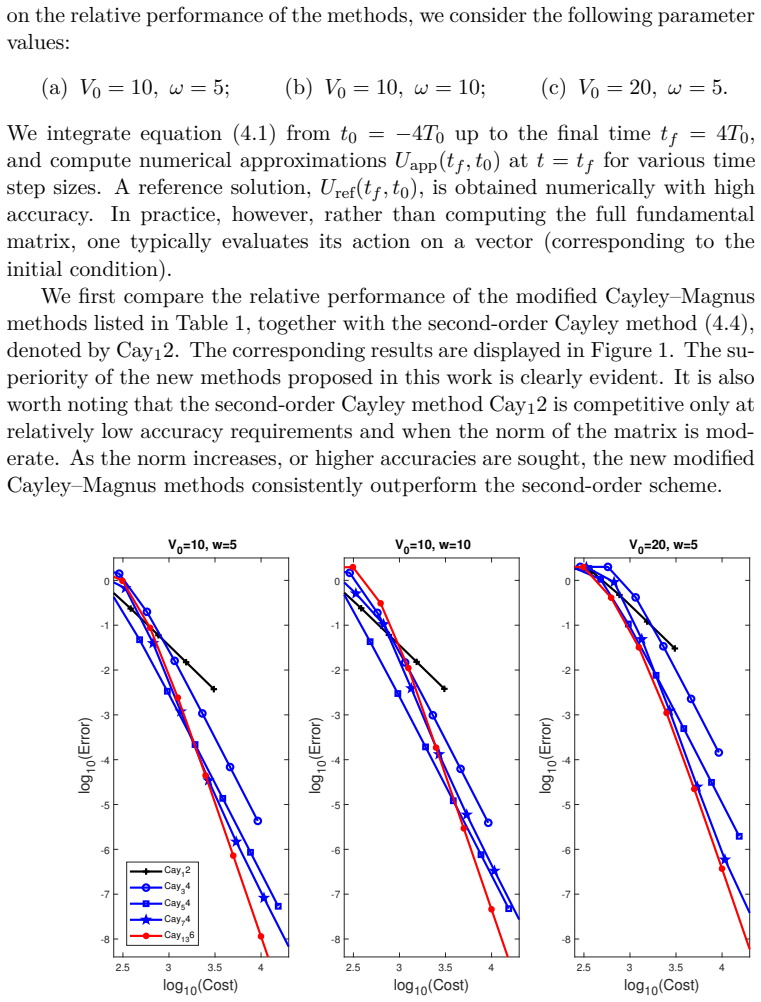
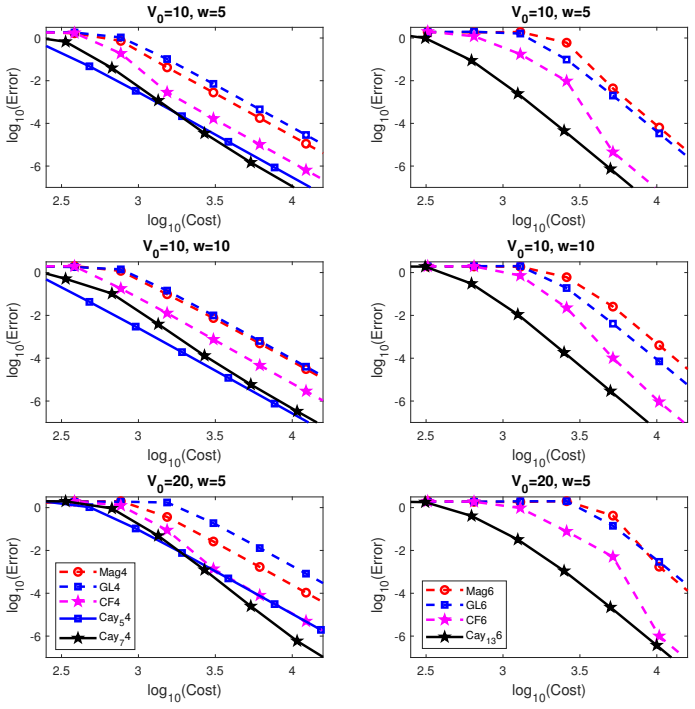
We introduce a new class of numerical integrators for the time integration of non-autonomous linear ordinary differential equations whose coefficient matrix is sparse and evolves within a quadratic matrix Lie group. In contrast to standard Lie group integrators, the proposed methods avoid the evaluation of matrix exponentials acting on vectors and instead rely on solving a sequence of linear systems with sparse coefficient matrices. Moreover, they are well suited for problems arising from unbounded operators, as they inherently produce bounded solutions. We construct optimised schemes of orders four and six and assess their performance on a representative numerical example, demonstrating clear advantages over existing Lie-group integrators.
Editorial analysis
A structured set of objections, weighed in public.
Referee Report
Summary. The paper introduces a class of modified Cayley-Magnus integrators for non-autonomous linear ODEs whose coefficient matrix lies in a quadratic matrix Lie group and is sparse. The methods replace matrix-exponential actions with solves of linear systems having sparse coefficient matrices. Optimized order-4 and order-6 schemes are constructed; the authors assert that the integrators inherently produce bounded solutions and are therefore well suited to discretizations of unbounded operators. Performance is illustrated on a single representative numerical example that shows advantages relative to existing Lie-group methods.
Significance. If the algebraic construction is correct and a general boundedness result can be established, the approach would supply a practical alternative to exponential-based Lie-group integrators for problems whose spatial discretizations yield sparse quadratic-Lie-group matrices. The avoidance of matrix exponentials and the preservation of the quadratic structure are potentially valuable for large-scale or stiff problems. The single numerical example is suggestive but does not yet establish the broader utility.
major comments (3)
- [Abstract, §1, §5] The central claim that the methods 'inherently produce bounded solutions' and are therefore well suited for unbounded operators (abstract and §1) rests on algebraic preservation of the quadratic Lie-group structure when A(t) exactly satisfies the defining relation. No theorem is supplied that guarantees uniform boundedness of the numerical solution operator when the underlying spatial operator is unbounded (e.g., differential operators on successively refined grids). The claim therefore reduces to observed behavior in the single example of §5 rather than a proven property of the integrator.
- [§3] §3 (construction of the order-4 and order-6 schemes): the manuscript states that the schemes achieve the claimed orders, yet supplies neither the order conditions nor an error analysis that would confirm the orders independently of the numerical example. Without these derivations the optimality statements cannot be verified.
- [§4] §4 (stability/boundedness discussion): the text asserts that the linear-system formulation automatically yields bounded solutions for unbounded operators, but no a-priori estimate or discrete stability result is given that would hold uniformly with respect to the spatial discretization parameter. This gap directly affects the load-bearing claim about suitability for unbounded operators.
minor comments (2)
- [§2] Notation for the quadratic Lie-group condition and the modified Cayley transform should be introduced once with a clear reference to the defining equation rather than repeated inline.
- [§5] The numerical example in §5 would benefit from a table reporting both error and CPU time against a standard Magnus or Cayley method at several tolerances, to make the claimed advantages quantitative.
Simulated Author's Rebuttal
We thank the referee for the careful reading and constructive comments on our manuscript. We agree that the theoretical support for boundedness claims and the explicit derivation of order conditions require strengthening. We respond to each major comment below.
read point-by-point responses
-
Referee: [Abstract, §1, §5] The central claim that the methods 'inherently produce bounded solutions' and are therefore well suited for unbounded operators (abstract and §1) rests on algebraic preservation of the quadratic Lie-group structure when A(t) exactly satisfies the defining relation. No theorem is supplied that guarantees uniform boundedness of the numerical solution operator when the underlying spatial operator is unbounded (e.g., differential operators on successively refined grids). The claim therefore reduces to observed behavior in the single example of §5 rather than a proven property of the integrator.
Authors: We agree that no general theorem is supplied establishing uniform boundedness of the numerical solution independent of the spatial discretization parameter. The manuscript's claim of 'inherent' boundedness is based on exact algebraic preservation of the quadratic Lie-group structure (when the coefficient satisfies the defining relation), which for the relevant groups implies that the solution matrix remains bounded in the group norm. However, when the underlying operator is unbounded, uniformity with respect to mesh refinement would require additional analysis of the discrete operators. We will revise the abstract, §1 and §5 to clarify this distinction, tone down the claim to reflect structure preservation rather than a proven uniform bound, and note that the single example provides supporting evidence but does not constitute a general proof. revision: partial
-
Referee: [§3] §3 (construction of the order-4 and order-6 schemes): the manuscript states that the schemes achieve the claimed orders, yet supplies neither the order conditions nor an error analysis that would confirm the orders independently of the numerical example. Without these derivations the optimality statements cannot be verified.
Authors: The order conditions were derived by substituting the modified Cayley-Magnus ansatz into the Magnus expansion and equating coefficients of the resulting series up to the target order, followed by numerical optimization of the free parameters. These derivations were omitted for brevity. We will add the explicit order conditions (and a brief outline of the derivation) for the order-4 and order-6 schemes in a new subsection of §3, allowing independent verification without relying solely on the numerical example. revision: yes
-
Referee: [§4] §4 (stability/boundedness discussion): the text asserts that the linear-system formulation automatically yields bounded solutions for unbounded operators, but no a-priori estimate or discrete stability result is given that would hold uniformly with respect to the spatial discretization parameter. This gap directly affects the load-bearing claim about suitability for unbounded operators.
Authors: We acknowledge that §4 contains no a-priori estimate or discrete stability result that is uniform in the discretization parameter. The discussion rests on the observation that the linear systems preserve the quadratic structure at each step, thereby keeping the numerical solution in the Lie group. A uniform bound would require additional estimates relating the discrete and continuous operators. We will revise §4 to include a remark acknowledging this limitation and indicating it as future work, while retaining the structure-preservation argument and the supporting numerical evidence. revision: yes
Circularity Check
No circularity: algebraic construction of integrators is self-contained
full rationale
The paper constructs modified Cayley-Magnus integrators for linear ODEs on quadratic matrix Lie groups by replacing matrix exponentials with linear solves. This is a direct algebraic design choice, not a reduction of any claimed prediction or result to fitted parameters or prior self-citations. The abstract states the methods 'inherently produce bounded solutions' as a property of the Cayley-based construction, but no equations or theorems are quoted that equate an output quantity to an input by definition. Performance is assessed on a representative example, which constitutes external validation rather than a self-referential fit. No load-bearing step matches any enumerated circularity pattern.
Axiom & Free-Parameter Ledger
Reference graph
Works this paper leans on
-
[1]
W.A.Al-Salam, OntheproductoftwoLegendrepolynomials,Mathematica Scandinavica4(1956), 239–242. 18
1956
-
[2]
Alvermann and H
A. Alvermann and H. Fehske, High-order commutator-free exponential time-propagation of driven quantum systems,J. Comput. Phys.230 (2011), 5930–5956
2011
-
[3]
Blanes, F
S. Blanes, F. Casas, and A. Murua, Splitting methods for differential equa- tions,Acta Numerica33(2024), 1–161
2024
-
[4]
Blanes, F
S. Blanes, F. Casas, J.A. Oteo and J. Ros, Magnus and Fer expansions for matrix differential equations: the convergence problem,J. Phys. A: Math. Gen.31(1998), 259–268
1998
-
[5]
Blanes, F
S. Blanes, F. Casas, J.A. Oteo and J. Ros, The Magnus and expansion and some of its applications,Physics Reports470(2009), 151–238
2009
-
[6]
Blanes, F
S. Blanes, F. Casas and J. Ros, Improved high order integrators based on Magnus expansion,BIT40(2000), 434–450
2000
-
[7]
Blanes, F
S. Blanes, F. Casas, and M. Thalhammer, High-order commutator-free quasi-Magnus exponential integrators for non-autonomous linear evolution equations,Comp. Phys. Comm.220(2017),243–262
2017
-
[8]
Blanes and P
S. Blanes and P. Moan, Fourth- and sixth-order commutator-free Mag- nus integrators for linear and non-linear dynamical systems,Appl. Numer. Math.56(2006), 1519–1537
2006
-
[9]
C. Bonhomme, S. Pozza, N. Van Buggenhout, A new fast numeri- cal method for the generalized Rosen–Zener model, arXiv:2311.04144v1 (2023)
arXiv 2023
-
[10]
Celledoni, A
E. Celledoni, A. Iserles, Approximating the exponential from a Lie algebra to a Lie group,Math. Comput.69(2000), 1457–1480
2000
-
[11]
Diele, L
F. Diele, L. Lopez, R. Peluso, The Cayley transform in the numerical solution of unitary differential systems,Adv. Comput. Math.8(1998) 317– 334
1998
-
[12]
Faou,Geometric Numerical Integration and Schrödinger Equations, Eu- ropean Mathematical Society (2012)
E. Faou,Geometric Numerical Integration and Schrödinger Equations, Eu- ropean Mathematical Society (2012)
2012
-
[13]
Marques, A
A Gómez-Pueyo, M.A.L. Marques, A. Rubio, A. Castro, Propagators for the time-dependent Kohn–Sham equations: Multistep, Runge–Kutta, ex- ponential Runge–Kutta, and commutator free Magnus methods,J. Chem. Theory Comput.14(2018), 3040–3052
2018
-
[14]
Hochbruck and A
M. Hochbruck and A. Ostermann, Exponential integrators,Acta Numerica 19(2010), 209–286
2010
-
[15]
Iserles,A First Course in the Numerical Analysis of Differential Equa- tions(2nd ed.), Cambridge University Press, 2009
A. Iserles,A First Course in the Numerical Analysis of Differential Equa- tions(2nd ed.), Cambridge University Press, 2009
2009
-
[16]
Iserles, On Cayley-transform methods for the discretization of Lie-group equations,Found
A. Iserles, On Cayley-transform methods for the discretization of Lie-group equations,Found. Comput. Maths1(2001) 129–160. 19
2001
-
[17]
A. Iserles, Mathematical foundations of spectral methods for time- dependent PDEs, arXiv:2402.16744v1 (2024)
arXiv 2024
-
[18]
Iserles, Stable Spectral Methods for Time-Dependent Problems and the Preservation of Structure,Found
A. Iserles, Stable Spectral Methods for Time-Dependent Problems and the Preservation of Structure,Found. Comput. Math.25(2025) 683–723
2025
-
[19]
Iserles, H
A. Iserles, H. Z. Munthe-Kaas, S. P. Nørsett and A. Zanna, Lie-group methods,Acta Numerica9(2000), 215–365
2000
-
[20]
Iserles, S.P
A. Iserles, S.P. Nørsett, On the solution of linear differential equations in Lie groups,Phil. Trans. R. Soc. A357(1999) 983–1019
1999
-
[21]
Iserles, A
A. Iserles, A. Zanna, On the dimension of certain graded Lie algebras arising in geometric integration of differential equations,LMS J. Comput. Maths3(2000), 44–75
2000
-
[22]
E. S. Kyoseva, N. V. Vitanov, and B. W. Shore, Physical realization of coupled Hilbert-space mirrors for quantum-state engineering,J. Modern Opt.54(2007), 2237–2257
2007
-
[23]
Magnus, On the exponential solution of differential equations for a linear operator,Comm
W. Magnus, On the exponential solution of differential equations for a linear operator,Comm. Pure & Appl. Math.7(1954), 649–673
1954
-
[24]
Marthinsen, B
A. Marthinsen, B. Owren, Quadrature methods based on the Cayley trans- form,Appl. Numer. Math.39(2001), 403–413
2001
-
[25]
Maslovskaya, C
S. Maslovskaya, C. Offen, S. Ober-Blöbaum, P. Singh and B. Wembe, Commutator-free Cayley methods,J. Comput. Appl. Math.477(2026) 117–184
2026
-
[26]
Munthe-Kaas and B
H. Munthe-Kaas and B. Owren, Computations in a free Lie algebra,Philos. Trans. Roy. Soc. London Ser. A357(1999) 957–981
1999
-
[27]
Postnikov,Lie Groups and Lie Algebras
M. Postnikov,Lie Groups and Lie Algebras. Semester V,“Mir”, Moscow, 1986
1986
-
[28]
Rosen and C
N. Rosen and C. Zener, Double Stern–Gerlach experiment and related collision phenomena,Phys. Rev.40(1932), 502
1932
-
[29]
J. M. Sanz-Serna and M. P. Calvo,Numerical Hamiltonian Problems, Chapman & Hall (1994)
1994
-
[30]
Sofroniou and G
M. Sofroniou and G. Spaletta, Derivation of symmetric composition con- stants for symmetric integrators,Optim. Method. Softw.20(2005), pp. 597–613
2005
-
[31]
Tancogne-Dejeanet al., Octopus, a computational framework for ex- ploring light-driven phenomena and quantum dynamics in extended and finite systems,J
N. Tancogne-Dejeanet al., Octopus, a computational framework for ex- ploring light-driven phenomena and quantum dynamics in extended and finite systems,J. Chem. Phys.152(2020), 124119
2020
- [32]
-
[33]
On the numerical solution of isospectral flows
A. Zanna, "On the numerical solution of isospectral flows", PhD disserta- tion, University of Cambridge (1998). A Exact solution in terms of one-dimensional inte- grals and quadratures We present a complete and constructive proof of the fact that the transition matrixP(h)in (2.1), associated with the exact solution of (1.2), can be ap- proximated up to or...
1998
discussion (0)
Sign in with ORCID, Apple, or X to comment. Anyone can read and Pith papers without signing in.