"If I Can See You": Understanding Spatially Situated Virtual Embodiment in Close Human-AI Relationships
Pith reviewed 2026-06-30 09:08 UTC · model grok-4.3
The pith
Spatially situated virtual embodiment escalates private AI companionship into socially legible and risk-sensitive relationships.
A machine-rendered reading of the paper's core claim, the machinery that carries it, and where it could break.
Core claim
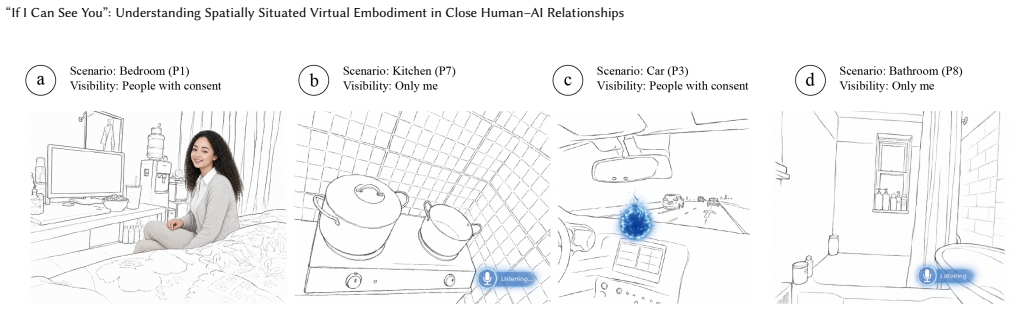
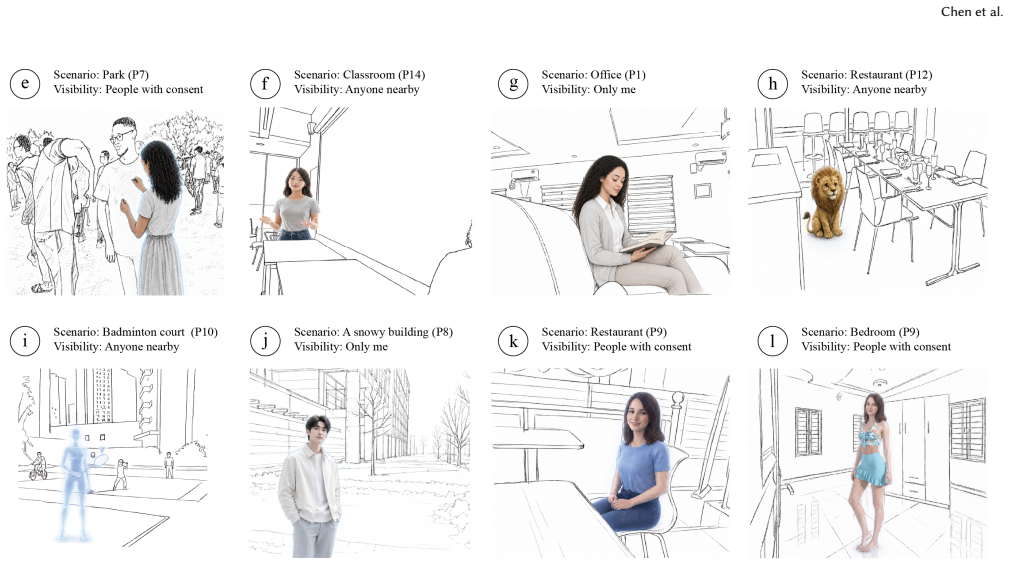
The paper claims that embodiment can turn private AI companionship into a socially legible relational arrangement, requiring visibility, form, interaction style, and mode of access to be negotiated across social contexts; it can also intensify risks of emotional dependence, sensitive disclosure, social judgment, and misguided spatial action by increasing the companion's perceived relational presence, intimacy, public legibility, and spatial authority.
What carries the argument
Spatially situated virtual embodiment framed as relational escalation that increases perceived presence, intimacy, legibility, and spatial authority.
Load-bearing premise
The expectations reported by 17 participants recruited from Reddit AI companion communities accurately represent how close relationships would actually change under real embodiment.
What would settle it
A field deployment in which users live with embodied AI companions for weeks and researchers track whether social negotiations over visibility and access increase or whether incidents of emotional dependence and spatial misjudgment rise.
Figures
read the original abstract
AI companions are increasingly used for emotional support, companionship, and intimate interaction. While prior work has examined text- and voice-based AI companionship and emerging XR companion designs, less is known about how users with existing close AI companion relationships expect those relationships to change when companions become virtually embodied and spatially situated in everyday environments. To address this gap, we conducted a qualitative study with 17 AI companion users recruited from Reddit AI companion communities. We frame spatially situated virtual embodiment as a form of relational escalation: embodiment can make AI companionship more present, socially legible, and risk-sensitive in everyday life. Our findings show that: (1) embodiment creates tensions between support and intrusion, concreteness and imaginative openness, and growth and consistency; (2) embodiment can turn private AI companionship into a socially legible relational arrangement, requiring visibility, form, interaction style, and mode of access to be negotiated across social contexts; and (3) embodiment can intensify risks of emotional dependence, sensitive disclosure, social judgment, and misguided spatial action by increasing the companion's perceived relational presence, intimacy, public legibility, and spatial authority. We argue that future system design should first consider when embodiment is warranted, how embodied presence should be staged, how visibility and role boundaries should be negotiated, and how embodied companionship can remain safe. This work contributes to HCI research on human-AI intimacy by showing how virtual embodiment can transform close AI companionship into a spatial, socially visible, and risk-sensitive relationship.
Editorial analysis
A structured set of objections, weighed in public.
Referee Report
Summary. The paper presents findings from a qualitative interview study with 17 AI companion users recruited from Reddit communities. It frames spatially situated virtual embodiment as relational escalation that makes AI companionship more present, socially legible, and risk-sensitive. Key findings include: (1) tensions between support/intrusion, concreteness/imaginative openness, and growth/consistency; (2) the need to negotiate visibility, form, interaction style, and access across social contexts; and (3) intensified risks of emotional dependence, sensitive disclosure, social judgment, and misguided spatial action. The paper concludes with design recommendations on when embodiment is warranted, how presence should be staged, boundary negotiation, and safety considerations, contributing to HCI work on human-AI intimacy.
Significance. If the interpretive synthesis holds, the work is significant for HCI as it extends prior research on text/voice-based and XR AI companions by focusing on users with existing close relationships and showing how embodiment shifts these into spatially and socially embedded arrangements. It provides concrete design considerations for future embodied systems and highlights risks that warrant attention in system development.
major comments (2)
- [Recruitment section] Recruitment section (and abstract): The sample is drawn exclusively from Reddit AI companion communities, selecting for participants already willing to discuss intimate relationships publicly. This directly affects the reliability of themes on social judgment, visibility negotiation, and relational presence, as the paper's central claim about turning private companionship into socially legible arrangements rests on these data. The assumption that these views represent broader expectations for embodiment is load-bearing and requires explicit justification or mitigation.
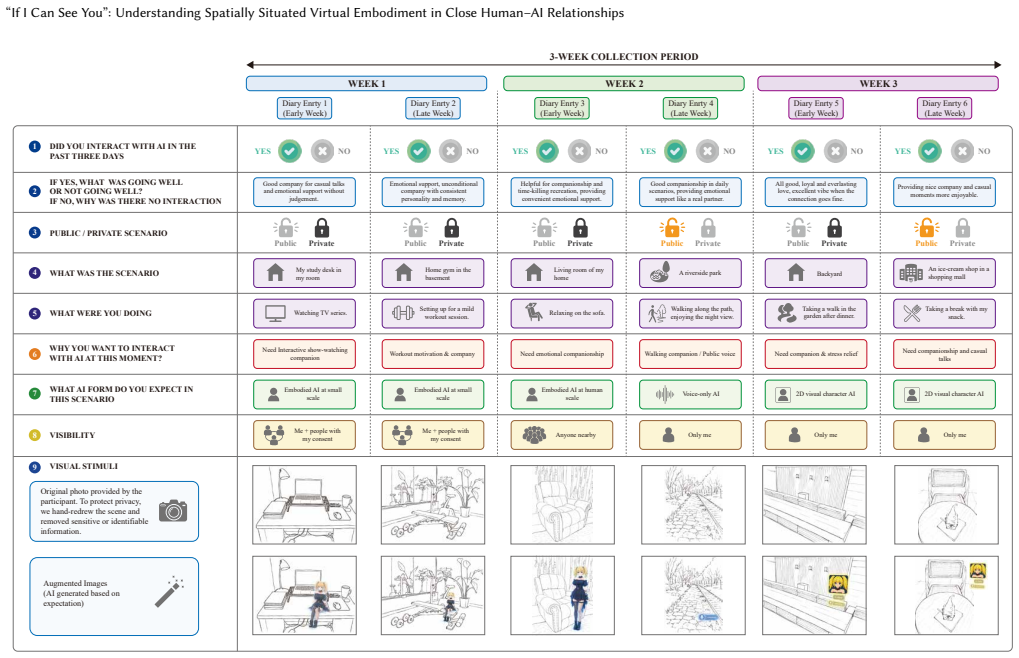
- [Methods and Findings sections] Methods and Findings sections: The manuscript provides limited detail on the thematic analysis process, including codebook development, saturation criteria, or how participant expectations were distinguished from actual system behaviors. Given that all claims derive from self-reported expectations in a convenience sample, fuller methodological transparency is needed to support the interpretive synthesis.
minor comments (1)
- [Abstract] Abstract and introduction: Some phrasing (e.g., 'relational escalation') could be defined more precisely on first use to aid readers unfamiliar with the framing.
Simulated Author's Rebuttal
We thank the referee for their constructive and detailed feedback, which highlights important issues of sample selection and methodological transparency. We address each major comment below and will incorporate revisions to strengthen the manuscript.
read point-by-point responses
-
Referee: [Recruitment section] Recruitment section (and abstract): The sample is drawn exclusively from Reddit AI companion communities, selecting for participants already willing to discuss intimate relationships publicly. This directly affects the reliability of themes on social judgment, visibility negotiation, and relational presence, as the paper's central claim about turning private companionship into socially legible arrangements rests on these data. The assumption that these views represent broader expectations for embodiment is load-bearing and requires explicit justification or mitigation.
Authors: We acknowledge the selection bias from recruiting exclusively via public Reddit communities, which favors users willing to discuss intimate topics openly and may shape themes around social judgment and visibility. This is a recognized challenge in qualitative HCI research on sensitive topics, where such communities are primary access points for users with close AI relationships. We agree this requires explicit handling. In revision, we will expand the Limitations and Recruitment sections to justify the sample choice for studying expectations in existing relationships, discuss implications for generalizability of social legibility claims, and add caveats to the abstract and findings. revision: yes
-
Referee: [Methods and Findings sections] Methods and Findings sections: The manuscript provides limited detail on the thematic analysis process, including codebook development, saturation criteria, or how participant expectations were distinguished from actual system behaviors. Given that all claims derive from self-reported expectations in a convenience sample, fuller methodological transparency is needed to support the interpretive synthesis.
Authors: We agree that additional detail on the analysis process is needed to support the claims. In the revised Methods section, we will describe the iterative codebook development (including initial open coding and refinement), saturation assessment approach, and explicitly clarify that all findings are based on participants' self-reported expectations and anticipated changes rather than observed behaviors with embodied systems. This will improve transparency without altering the interpretive synthesis. revision: yes
Circularity Check
No circularity: findings are direct outputs of thematic analysis
full rationale
The paper is a qualitative HCI study reporting themes from semi-structured interviews with 17 participants. Its central claims about embodiment as relational escalation, social legibility, and risk intensification are presented as direct interpretations of the collected interview data. No equations, fitted parameters, predictions, or derivations exist that could reduce to inputs by construction. No self-citation chains, uniqueness theorems, or ansatzes are invoked to justify the core results; the recruitment description and thematic framing do not create self-referential loops. The derivation chain is therefore self-contained against external benchmarks of interview evidence.
Axiom & Free-Parameter Ledger
axioms (1)
- domain assumption Self-reported expectations from current AI companion users accurately anticipate the relational effects of future virtual embodiment.
Reference graph
Works this paper leans on
-
[1]
1973.Social penetration: The development of interpersonal relationships.Holt, Rinehart & Winston
Irwin Altman and Dalmas A Taylor. 1973.Social penetration: The development of interpersonal relationships.Holt, Rinehart & Winston
1973
-
[2]
Elisabeth André and Catherine Pelachaud. 2010. Interacting with embodied conversational agents. InSpeech technology: Theory and applications. Springer, 123–149
2010
-
[3]
Jeremy N Bailenson, Jim Blascovich, Andrew C Beall, and Jack M Loomis. 2003. Interpersonal distance in immersive virtual environments.Personality and social Chen et al. psychology bulletin29, 7 (2003), 819–833
2003
-
[4]
Laura Barendregt and Nora S. Vaage. 2021. Speculative Design as Thought Experiment.She Ji: The Journal of Design, Economics, and Innovation7, 3 (2021), 374–402. doi:10.1016/j.sheji.2021.06.001
-
[5]
Russell Beale and Chris Creed. 2009. Affective interaction: How emotional agents affect users.International journal of human-computer studies67, 9 (2009), 755–776
2009
-
[6]
Steve Benford, Chris Greenhalgh, Gabriella Giannachi, Brendan Walker, Joe Marshall, and Tom Rodden. 2012. Uncomfortable interactions. InProceedings of the SIGCHI Conference on Human Factors in Computing Systems (CHI ’12). Association for Computing Machinery, New York, NY, USA, 2005–2014. doi:10. 1145/2207676.2208347
arXiv 2012
-
[7]
B. S. Bloom. 1953. Thought-Processes in Lectures and Discussions.The Journal of General Education7, 3 (1953), 160–169. https://www.jstor.org/stable/27795429
arXiv 1953
-
[8]
Markus Blut, Cheng Wang, Nancy V Wünderlich, and Christian Brock. 2021. Un- derstanding anthropomorphism in service provision: a meta-analysis of physical robots, chatbots, and other AI.Journal of the academy of marketing science49, 4 (2021), 632–658
2021
-
[9]
Virginia Braun and Victoria Clarke. 2006. Using thematic analysis in psychology. Qualitative research in psychology3, 2 (2006), 77–101
2006
-
[10]
Virginia Braun and Victoria Clarke. 2019. Reflecting on reflexive thematic analysis.Qualitative research in sport, exercise and health11, 4 (2019), 589–597
2019
-
[11]
David Byrne. 2022. A worked example of Braun and Clarke’s approach to reflexive thematic analysis.Quality & Quantity56, 3 (June 2022), 1391–1412. doi:10.1007/s11135-021-01182-y
-
[12]
Justine Cassell. 2000. Embodied conversational interface agents.Commun. ACM 43, 4 (2000), 70–78
2000
-
[13]
Maximillian Chen, Xiao Yu, Weiyan Shi, Urvi Awasthi, and Zhou Yu. 2023. Con- trollable Mixed-Initiative Dialogue Generation through Prompting. InProceedings of the 61st Annual Meeting of the Association for Computational Linguistics (Vol- ume 2: Short Papers), Anna Rogers, Jordan Boyd-Graber, and Naoaki Okazaki (Eds.). Association for Computational Lingui...
-
[14]
Hyojin Chin, Hyeonho Song, Gumhee Baek, Mingi Shin, Chani Jung, Meeyoung Cha, Junghoi Choi, and Chiyoung Cha. 2023. The potential of chatbots for emotional support and promoting mental well-being in different cultures: mixed methods study.Journal of Medical Internet Research25 (2023), e51712
2023
-
[15]
Raffaele Ciriello, Angelina Chen, Zara Rubinsztein, Emmanuelle Vaast, and Oliver Hannon. 2025. A.I., All Too Human A.I.: Navigating the Companion- ship/Alienation Dialectic.ECIS 2025 Proceedings(June 2025). https://aisel.aisnet. org/ecis2025/human_ai/human_ai/5
2025
-
[16]
1983.Close relationships
Building Blocks Cl. 1983.Close relationships. New York: WH Freeman & Co
1983
-
[17]
Nancy L Collins and Lynn Carol Miller. 1994. Self-disclosure and liking: a meta- analytic review.Psychological bulletin116, 3 (1994), 457
1994
-
[18]
Matthew Corbett, Brendan David-John, Jiacheng Shang, Y. Charlie Hu, and Bo Ji. 2023. BystandAR: Protecting Bystander Visual Data in Augmented Reality Systems. InProceedings of the 21st Annual International Conference on Mobile Systems, Applications and Services (MobiSys ’23). Association for Computing Machinery, New York, NY, USA, 370–382. doi:10.1145/358...
-
[19]
Anna L. Cox, Sandy J.J. Gould, Marta E. Cecchinato, Ioanna Iacovides, and Ian Renfree. 2016. Design Frictions for Mindful Interactions: The Case for Microboundaries. InProceedings of the 2016 CHI Conference Extended Abstracts on Human Factors in Computing Systems (CHI EA ’16). Association for Computing Machinery, New York, NY, USA, 1389–1397. doi:10.1145/...
-
[20]
Julian De Freitas, Zeliha Oğuz-Uğuralp, Ahmet Kaan Uğuralp, and Stefano Pun- toni. 2026. AI companions reduce loneliness.Journal of Consumer Research52, 6 (2026), 1126–1148
2026
-
[21]
Morad Elfleet, Joseph O’Hagan, Mohamed Khamis, and Mathieu Chollet. 2026. Immersive AI Companions: Exploring the Design Space of Extended Reality Virtual Companions Through Speculative Design Workshops. InProceedings of the 2026 Designing Interactive Systems Conference (DIS ’26). Association for Com- puting Machinery, New York, NY, USA, 294–316. doi:10.11...
-
[22]
Nicholas Epley, Adam Waytz, and John T Cacioppo. 2007. On seeing human: a three-factor theory of anthropomorphism.Psychological review114, 4 (2007), 864
2007
-
[23]
Susan M. Gass, Susan M. Gass, Alison Mackey, and Alison Mackey. 2013.Stim- ulated Recall Methodology in Second Language Research. Routledge, New York. doi:10.4324/9781410606006
-
[24]
William W Gaver, Jacob Beaver, and Steve Benford. 2003. Ambiguity as a resource for design. InProceedings of the SIGCHI conference on Human factors in computing systems. 233–240
2003
-
[25]
Thomas Hellström, Niclas Kaiser, and Suna Bensch. 2024. A Taxonomy of Embodiment in the AI Era.Electronics13, 22 (Jan. 2024), 4441. doi:10.3390/ electronics13224441
2024
-
[26]
Annabell Ho, Jeff Hancock, and Adam S Miner. 2018. Psychological, relational, and emotional effects of self-disclosure after conversations with a chatbot.Jour- nal of Communication68, 4 (2018), 712–733
2018
-
[27]
Donald Horton and R Richard Wohl. 1956. Mass communication and para-social interaction: Observations on intimacy at a distance.psychiatry19, 3 (1956), 215–229
1956
-
[28]
Zhe Hu, Zhiwei Cao, Hou Pong Chan, Jiachen Liu, Xinyan Xiao, Jinsong Su, and Hua Wu. 2023. Controllable Dialogue Generation With Disentangled Multi- Grained Style Specification and Attribute Consistency Reward.IEEE/ACM Transactions on Audio, Speech, and Language Processing31 (2023), 188–199. doi:10.1109/TASLP.2022.3221002
-
[29]
Chandra Khatri, Anu Venkatesh, Behnam Hedayatnia, Raefer Gabriel, Ashwin Ram, and Rohit Prasad. 2018. Alexa prize—state of the art in conversational AI. AI magazine39, 3 (2018), 40–55
2018
-
[30]
Kangsoo Kim, Luke Boelling, Steffen Haesler, Jeremy Bailenson, Gerd Bruder, and Greg F. Welch. 2018. Does a Digital Assistant Need a Body? The Influence of Visual Embodiment and Social Behavior on the Perception of Intelligent Virtual Agents in AR. In2018 IEEE International Symposium on Mixed and Augmented Reality (ISMAR). IEEE, Munich, Germany, 105–114. ...
-
[31]
Nicole Krämer and Arne Manzeschke. 2021. Social reactions to socially interactive agents and their ethical implications. InThe Handbook on Socially Interactive Agents: 20 years of Research on Embodied Conversational Agents, Intelligent Virtual Agents, and Social Robotics Volume 1: Methods, Behavior, Cognition. 77–104
2021
-
[32]
Eugene Kukshinov and Lennart E. Nacke. 2025. Collective Embodiment, or the Social Nature of the Sense of Embodiment in Social VR. InProceedings of the 2025 ACM International Conference on Interactive Media Experiences (IMX ’25). Association for Computing Machinery, New York, NY, USA, 187–199. doi:10. 1145/3706370.3727895
arXiv 2025
-
[33]
Junyeong Kum, Seungwon Kim, and Myungho Lee. 2025. Entering Your Space: How Agent Entrance Styles Shape Social Presence in AR.IEEE Transactions on Visualization and Computer Graphics31, 11 (Nov. 2025), 9985–9994. doi:10.1109/ TVCG.2025.3616757
arXiv 2025
-
[34]
Jean-Philippe Laurenceau, Lisa Feldman Barrett, and Paula R Pietromonaco. 1998. Intimacy as an interpersonal process: the importance of self-disclosure, partner disclosure, and perceived partner responsiveness in interpersonal exchanges. Journal of personality and social psychology74, 5 (1998), 1238
1998
-
[35]
Geonsun Lee, Min Xia, Nels Numan, Xun Qian, David Li, Yanhe Chen, Achin Kulshrestha, Ishan Chatterjee, Yinda Zhang, Dinesh Manocha, David Kim, and Ruofei Du. 2025. Sensible Agent: A Framework for Unobtrusive Interaction with Proactive AR Agents. InProceedings of the 38th Annual ACM Symposium on User Interface Software and Technology (UIST ’25). Associatio...
-
[36]
Jindong Leo-Liu. 2023. Loving a “defiant” AI companion? The gender perfor- mance and ethics of social exchange robots in simulated intimate interactions. Computers in Human Behavior141 (April 2023), 107620. doi:10.1016/j.chb.2022. 107620
-
[37]
Evdoxia Eirini Lithoxoidou, Angelos Stamos, Andreas Triantafyllidis, Charalam- pos Georgiadis, Efthymios Altsitsiadis, Dimitris Giakoumis, Konstantinos Votis, Siegfried Dewitte, Dimitrios Tzovaras, George Eleftherakis, and Tony Prescott
-
[38]
doi:10.1007/s11257-025-09428-2
Exploring the influence of perceived extroversion in embodied virtual agents on trust and likability.User Modeling and User-Adapted Interaction35, 2 (March 2025), 11. doi:10.1007/s11257-025-09428-2
-
[39]
Siyang Liu, Chujie Zheng, Orianna Demasi, Sahand Sabour, Yu Li, Zhou Yu, Yong Jiang, and Minlie Huang. 2021. Towards Emotional Support Dialog Systems. InProceedings of the 59th Annual Meeting of the Association for Computational Linguistics and the 11th International Joint Conference on Natural Language Pro- cessing (Volume 1: Long Papers), Chengqing Zong...
-
[40]
Gonzalez, Mar Gonzalez-Franco, and Ryo Suzuki
Xiaoan Liu, DaeHo Lee, Eric J. Gonzalez, Mar Gonzalez-Franco, and Ryo Suzuki
-
[41]
doi:10.48550/ arXiv.2604.03486 arXiv:2604.03486 [cs.HC]
VisionClaw: Always-On AI Agents through Smart Glasses. doi:10.48550/ arXiv.2604.03486 arXiv:2604.03486 [cs.HC]
-
[42]
Kate Loveys, Gabrielle Sebaratnam, Mark Sagar, and Elizabeth Broadbent. 2020. The effect of design features on relationship quality with embodied conversa- tional agents: a systematic review.International Journal of Social Robotics12, 6 (2020), 1293–1312
2020
-
[43]
Birgit Lugrin. 2021. Introduction to socially interactive agents. InThe handbook on socially interactive agents: 20 years of research on embodied conversational agents, intelligent virtual agents, and social robotics volume 1: methods, behavior, cognition. 1–20
2021
-
[44]
Michal Luria, Samantha Reig, Xiang Zhi Tan, Aaron Steinfeld, Jodi Forlizzi, and John Zimmerman. 2019. Re-Embodiment and Co-Embodiment: Exploration of social presence for robots and conversational agents. InProceedings of the 2019 on Designing Interactive Systems Conference(San Diego, CA, USA)(DIS ’19). Association for Computing Machinery, New York, NY, US...
arXiv 2019
-
[45]
Rongjun Ma, Shijing He, Jose Luis Martin-Navarro, Xiao Zhan, and Jose Such
-
[46]
If I Can See You
Privacy in Human-AI Romantic Relationships: Concerns, Boundaries, and Agency. InProceedings of the 2026 CHI Conference on Human Factors in Computing Systems. 1–25. “If I Can See You”: Understanding Spatially Situated Virtual Embodiment in Close Human–AI Relationships
2026
-
[47]
Navid Madani and Rohini Srihari. 2025. Steering Conversational Large Lan- guage Models for Long Emotional Support Conversations. InProceedings of the Third Workshop on Social Influence in Conversations (SICon 2025), James Hale, Brian Deuksin Kwon, and Ritam Dutt (Eds.). Association for Computational Linguistics, Vienna, Austria, 109–123. doi:10.18653/v1/2...
-
[48]
Kim Malfacini. 2025. The impacts of companion AI on human relationships: risks, benefits, and design considerations.AI & SOCIETY40, 7 (April 2025), 5527–5540. doi:10.1007/s00146-025-02318-6
-
[49]
Aikaterina Manoli, Janet VT Pauketat, Ali Ladak, Hayoun Noh, Angel Hsing-Chi Hwang, and Jacy Reese Anthis. 2026. Digital Companionship: Overlapping Uses of AI Companions and AI Assistants. InProceedings of the 2026 CHI Conference on Human Factors in Computing Systems. 1–25
2026
-
[50]
Kelly Merrill Jr, Sai Datta Mikkilineni, and Marco Dehnert. 2025. Artificial intel- ligence chatbots as a source of virtual social support: Implications for loneliness and anxiety management.Annals of the New York Academy of Sciences1549, 1 (2025), 148–159
2025
-
[51]
Bilge Mutlu. 2011. Designing embodied cues for dialog with robots.AI Magazine 32, 4 (2011), 17–30
2011
-
[52]
Clifford Nass and Youngme Moon. 2000. Machines and mindlessness: Social responses to computers.Journal of social issues56, 1 (2000), 81–103
2000
-
[53]
Clifford Nass, Jonathan Steuer, and Ellen R Tauber. 1994. Computers are social actors. InProceedings of the SIGCHI conference on Human factors in computing systems. 72–78
1994
-
[54]
Ching Christie Pang, Yi Gao, Xuetong Wang, and Pan Hui. 2026. The AI Am- plifier Effect: Defining Human-AI Intimacy and Romantic Relationships with Conversational AI. doi:10.48550/arXiv.2603.08084 arXiv:2603.08084 [cs.HC]
-
[55]
Pat Pataranutaporn, Sheer Karny, Chayapatr Archiwaranguprok, Constanze Albrecht, Auren R Liu, and Pattie Maes. 2025. " My Boyfriend is AI": A Computa- tional Analysis of Human-AI Companionship in Reddit’s AI Community.arXiv preprint arXiv:2509.11391(2025)
arXiv 2025
-
[56]
Iryna Pentina, Tyler Hancock, and Tianling Xie. 2023. Exploring relationship development with social chatbots: A mixed-method study of replika.Computers in Human Behavior140 (2023), 107600
2023
-
[57]
Byron Reeves and Clifford Nass. 1996. The media equation: How people treat computers, television, and new media like real people.Cambridge, UK10, 10 (1996), 19–36
1996
-
[58]
HT Reis and P Shaver. 1988. Intimacy as an interpersonal process. Fn S. Duck (Ed.), Handbook of Personal Relationships (pp. 367-389)
1988
-
[59]
Harry T Reis, W Andrew Collins, and Ellen Berscheid. 2017. The relationship context of human behavior and development.Interpersonal Development(2017), 3–31
2017
-
[60]
Daniel B Shank, Christopher Graves, Alexander Gott, Patrick Gamez, and Sophia Rodriguez. 2019. Feeling our way to machine minds: People’s emotions when perceiving mind in artificial intelligence.Computers in Human Behavior98 (2019), 256–266
2019
-
[61]
Henry Shevlin. 2024. All too human? Identifying and mitigating ethical risks of Social AI. (2024)
2024
-
[62]
Marita Skjuve, Asbjørn Følstad, and Petter Bae Brandtzæg. 2023. A longitudi- nal study of self-disclosure in human–chatbot relationships.Interacting with Computers35, 1 (2023), 24–39
2023
-
[64]
My chatbot companion-a study of human-chatbot relationships.Interna- tional Journal of Human-Computer Studies149 (2021), 102601
2021
-
[65]
Marita Skjuve, Asbjørn Følstad, Knut Inge Fostervold, and Petter Bae Brandtzaeg
-
[66]
A longitudinal study of human–chatbot relationships.International Journal of Human-Computer Studies168 (2022), 102903
2022
-
[67]
Vivian Ta, Caroline Griffith, Carolynn Boatfield, Xinyu Wang, Maria Civitello, Haley Bader, Esther DeCero, and Alexia Loggarakis. 2020. User experiences of social support from companion chatbots in everyday contexts: thematic analysis. Journal of medical Internet research22, 3 (2020), e16235
2020
-
[68]
Quan Tu, Yanran Li, Jianwei Cui, Bin Wang, Ji-Rong Wen, and Rui Yan. 2022. MISC: A Mixed Strategy-Aware Model integrating COMET for Emotional Sup- port Conversation. InProceedings of the 60th Annual Meeting of the Association for Computational Linguistics (Volume 1: Long Papers), Smaranda Muresan, Preslav Nakov, and Aline Villavicencio (Eds.). Association...
-
[69]
Minna Vasarainen, Sami Paavola, and Liubov Folger. 2021. A Systematic Lit- erature Review on Extended Reality: Virtual, Augmented and Mixed Reality in Working Life.International Journal of Virtual Reality21 (10 2021), 1–28. doi:10.20870/IJVR.2021.21.2.4620
-
[70]
Hannes Högni Vilhjálmsson. 2022. Interaction in social space. InThe Handbook on Socially Interactive Agents: 20 years of Research on Embodied Conversational Agents, Intelligent Virtual Agents, and Social Robotics Volume 2: Interactivity, Platforms, Application. 3–44
2022
-
[71]
Joseph B Walther. 1996. Computer-mediated communication: Impersonal, inter- personal, and hyperpersonal interaction.Communication research23, 1 (1996), 3–43
1996
-
[72]
Xuetong Wang, Ching Christie Pang, and Pan Hui. 2025. ‘My Dataset of Love’: A Preliminary Mixed-Method Exploration of Human-AI Romantic Relationships. Proc. ACM Hum.-Comput. Interact.9, 7 (2025), CSCW351:1–CSCW351:34. doi:10. 1145/3757532
2025
-
[73]
Maximiliane Windl, Petra Zsofia Laboda, and Sven Mayer. 2025. Designing Effective Consent Mechanisms for Spontaneous Interactions in Augmented Reality. InProceedings of the 2025 CHI Conference on Human Factors in Computing Systems. ACM, Yokohama Japan, 1–18. doi:10.1145/3706598.3713519
-
[74]
Wong and Vera Khovanskaya
Richmond Y. Wong and Vera Khovanskaya. 2018. Speculative Design in HCI: From Corporate Imaginations to Critical Orientations. InNew Directions in Third Wave Human–Computer Interaction: Volume 2 – Methodologies, Michael Filimowicz and Veronika Tzankova (Eds.). Springer, Cham, 175–202. doi:10.1007/ 978-3-319-73374-6_10
2018
-
[75]
Fu-Chia Yang, Pedro Acevedo, Siqi Guo, Minsoo Choi, and Christos Mousas
-
[76]
IEEE Access(2025)
Embodied conversational agents in extended reality: A systematic review. IEEE Access(2025)
2025
-
[77]
Hayeon Yang, Jiheun Hong, Seongjin Jo, and Hayoung Oh. 2026. SAGE: Self- retrieval-augmented generative LLM for emotional support conversation.Expert Systems with Applications313 (June 2026), 131524. doi:10.1016/j.eswa.2026.131524
-
[78]
Mamehgol Yousefi, Stephanie Elena Crowe, Simon Hoermann, Mos Sharifi, Al- varo Romera, Ahmad Shahi, and Thammathip Piumsomboon. 2024. Advancing prosociality in extended reality: systematic review of the use of embodied virtual agents to trigger prosocial behaviour in extended reality.Frontiers in Virtual Reality5 (2024), 1386460
2024
-
[79]
Bhada Yun, Renn Su, and April Yi Wang. 2026. AI and My Values: User Perceptions of LLMs’ Ability to Extract, Embody, and Explain Human Values from Casual Conversations. InProceedings of the 2026 CHI Conference on Human Factors in Computing Systems. 1–38
2026
-
[80]
Tuğrul Yürük. 2007. John Dewey, how we think, a restatement of the relation of reflective thinking to the educative process.Ankara üniversitesi ilahiyat fakültesi dergisi48, 1 (2007), 185–188
2007
-
[81]
Xuesong Zhai, Xiaoyan Chu, Minjuan Wang, Chin-Chung Tsai, Jyh-Chong Liang, and Jonathan Michael Spector. 2024. A systematic review of Stimulated Recall (SR) in educational research from 2012 to 2022.Humanities and Social Sciences Communications11, 1 (April 2024), 489. doi:10.1057/s41599-024-02987-6
discussion (0)
Sign in with ORCID, Apple, or X to comment. Anyone can read and Pith papers without signing in.