REVIEW 3 major objections 3 minor 15 references
Near-Field Sensing Enabled Predictive Beamforming: Fundamentals, Framework, and Opportunities
T0 review · 3 major / 3 minor · reviewed 2026-08-07 · deepseek-v4-flash
Pith's one-line read Near-field sensing can deliver angle, distance, radial velocity, and transverse velocity from a single echo, letting predictive beamforming track arbitrary user trajectories without any state evolution model.
desk verdict The kinematic update equation in Section III-A is dimensionally inconsistent, and the case study lacks the quantitative evidence needed to support the framework's claims. read the letter →
The pith
A machine-rendered reading of the paper's core claim, the machinery that carries it, and where it could break.
The reading
What carries the argument
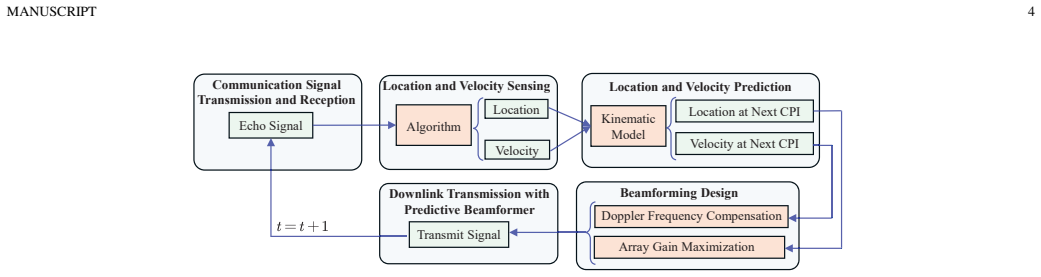
The mechanism that carries the argument is the near-field phase structure across an extremely large antenna array. Spherical wavefronts arriving from the same angle but different distances have different curvatures, so distance becomes observable alongside angle; non-uniform Doppler shifts across the aperture make transverse velocity observable alongside radial velocity. The paper formalizes this transition through the root Cramer-Rao bound (RCRB): as target distance grows, the RCRB for distance and transverse velocity rises while the RCRB for angle and radial velocity falls, showing a smooth degeneration into far-field sensing. This phase structure feeds the NFPB loop: echo signal, full-dimensional mobility estimate, kinematic prediction, array gain maximization with Doppler compensation, and the resulting predictive beamforming vector.
What would settle it
Run the NFPB loop with a 256-element array at 30 GHz, a target near the Rayleigh distance moving transversely at 20 m/s, and SNR at 0 dB; estimate angle, distance, radial velocity, and transverse velocity from the echo, propagate one coherent processing interval, and check whether the predicted angle error stays below the beam's half-power beamwidth. If it misses more than a few percent of the time in a multipath-rich environment, the prior-knowledge-free claim fails in that regime.
Extended reading notes
Core claim
The central discovery offered is that near-field propagation turns predictive beamforming into a fully observable prediction problem rather than a model-dependent extrapolation problem. Because spherical waves make phase curvature distance-dependent, angle and distance can be estimated jointly; because Doppler shifts are non-uniform across the array, radial and transverse velocity can be estimated jointly. Feeding these four estimates into the paper's kinematic update, $r' = r + v_r \Delta T$ and $\theta' = \theta + v_\theta \Delta T$, yields the predicted polar position for the next coherent processing interval, and the beamforming vector is designed to focus at that predicted location while compensating the predicted Doppler. The paper calls the resulting framework near-field predictive beamforming (NFPB) and claims two advantages over far-field predictive beamforming: prediction without prior trajectory knowledge, and system design that is lower complexity and re-usable when scenarios change. The included case study with a Kalman-filter-based tracker shows accurate position and velocity tracking of a trajectory with changing radius, without any state evolution model.
Load-bearing premise
The framework presupposes that a single line-of-sight echo supports reliable joint estimation of angle, distance, radial velocity, and transverse velocity within one coherent processing interval; if multipath, noise, or model mismatch degrades any of these estimates, the kinematic prediction and the beamforming design lose accuracy, and the paper's own case study does not quantify these estimation errors.
Editorial extensions
If this is right
- Near-field predictive beamforming can eliminate dedicated pilot overhead for channel estimation and dedicated uplink feedback, freeing coherent time for data transmission.
- The framework applies to users following arbitrary trajectories because it needs no pre-derived state evolution model; urban V2I, UAV, and industrial IoT links are named as direct beneficiaries.
- Because the full mobility state is measured at each coherent processing interval, the same system design carries over when the scenario changes, reducing redesign effort.
- For three-dimensional motion such as UAVs, spherical waves in 3D space provide azimuth, elevation, and distance, extending the same principle to 3D localization and velocity sensing.
- With accurate full-dimensional tracking, the beam can follow the intended user tightly, which the paper argues strengthens physical-layer security against eavesdropping and jamming.
Reading between the lines
- A consequence the authors leave implicit: NFPB's model-free advantage depends on a resolvable line-of-sight echo, so in rich scattering the four-parameter estimation can degrade; their listed RIS-aided direction is one way to restore that condition.
- Because the framework measures transverse velocity directly, it effectively yields angular-rate information; fusing that with map or inertial data during brief non-line-of-sight outages is a natural extension the paper does not develop.
- All four mobility parameters are estimated per coherent processing interval, so neighboring base stations could exchange these state estimates for cooperative scheduling; the paper mentions coordination in V2X networks but does not specify a protocol.
- A direct test: compare NFPB's achieved beam gain against far-field predictive beamforming that is given a perfectly known state evolution model; on arbitrary trajectories NFPB should match or exceed it while avoiding the overhead of model derivation.
Editorial analysis
A structured set of objections, weighed in public.
Referee Report
Summary. The paper proposes a near-field predictive beamforming (NFPB) framework for high-mobility wireless networks. It argues that the spherical wavefronts and non-uniform Doppler shifts in the near-field enable, for the first time, joint estimation of angle, distance, radial velocity, and transverse velocity, which in turn allows predictive beamforming without a predefined trajectory state-evolution model. The paper reviews the relevant near-field sensing fundamentals, presents a five-step NFPB framework with a kinematic prediction model, discusses estimation-, filtering-, and learning-based implementation approaches, and provides a simulation-style case study with qualitative tracking plots. It then lists several research opportunities (industrial IoT, V2X, high-speed scenarios, RIS, flexible antennas, UAV, and physical-layer security).
Significance. If the central claims were established, the framework would be a meaningful conceptual advance: it would remove the need for trajectory-specific state evolution models in predictive beamforming and eliminate dedicated feedback/pilot overhead, with potential impact on 6G ISAC design. The paper usefully synthesizes the physical rationale for near-field full-dimensional sensing and articulates a clear comparison with far-field sensing. However, the paper's own validation is limited to a qualitative case study, and the kinematic model contains a dimensional inconsistency that undermines the framework's technical foundation. The significance is therefore conditional on substantial revision and quantitative validation.
major comments (3)
- [Section III-A, Eq. (1)] The kinematic update for the polar angle is dimensionally inconsistent: the equation θ′ = θ + vθ ΔT adds a quantity with units of meters (vθ in m/s times ΔT in s) to an angle in radians. The correct polar-coordinate update is θ′ = θ + (vθ ΔT)/r, or equivalently an update performed in Cartesian coordinates. Since this model is the basis for the prediction step of the entire NFPB framework, the error is load-bearing and must be corrected.
- [Section III-A] The claim of 'Prior-Knowledge-Free Prediction' is overstated. The kinematic model assumes that vr and vθ remain constant across consecutive CPIs, which is itself a specific prior (a constant-polar-velocity model). A target moving with constant Cartesian velocity generally has time-varying radial and transverse velocities, so the framework does not support 'arbitrary trajectories' as claimed. The case study in Section III-C does not exercise a maneuvering trajectory, so it provides no evidence that the framework generalizes beyond its implicit constant-velocity prior.
- [Section III-C] The case study presents only qualitative plots (Figs. 3 and 4) with no quantitative tracking-error metrics (e.g., RMSE or bias), no comparison with a far-field baseline or with a state-evolution-model-based method, and no evaluation of the resulting communication performance (e.g., achievable rate or beamforming gain). Additionally, the beamforming vector used in the case study is never formally defined or derived. These omissions mean that the claimed benefits of NFPB—prior-knowledge-free prediction, low complexity, and generalizability—are not substantiated by the presented results.
minor comments (3)
- [Section IV-B heading] The heading 'NFPB for V2X Netwroks' contains a typo; it should read 'Networks'.
- [Section III-A, step 4] The phrase 'frequency shits' should be 'frequency shifts'.
- [References] References [9] and [10] are the authors' own prior works and are central to the implementation methods; the paper should clarify, for each, the extent to which the case study re-uses those methods versus providing new results.
Circularity Check
No significant circularity: the near-field sensing foundation is grounded in external references and the case study applies a filter rather than reusing a fitted output as a prediction.
full rationale
The paper does not derive a result from an input that already contains that result. The physical claims that near-field spherical waves enable angle-distance estimation and that non-uniform Doppler enables radial-transverse velocity estimation are cited to external works ([7], [8]); only the specific velocity-projection algorithms are attributed to the authors' prior papers [9] and [10]. Those prior papers are published works with their own derivations, so citing them is normal evidence, not circularity. The kinematic model in Section III-A (r' = r + v_r ΔT, θ' = θ + v_θ ΔT, with v'_r ≈ v_r and v'_θ ≈ v_θ) is stated as an approximation for a short CPI, not fitted to the data displayed in the case study. The case study adopts a Kalman-filter-based approach and compares its state estimates with ground truth; no parameter is fitted to that ground truth and then reported as a prediction. The 'prior-knowledge-free' label is stronger than the derivation supports, since the constant-velocity kinematic model is itself a prior, and the printed θ-update appears dimensionally inconsistent; however, these are claim-strength and correctness concerns, not instances of a prediction reducing by construction to its inputs. No equation in the paper is equivalent to its input by definition.
Assumptions & free parameters
assumptions (4)
- domain assumption Spherical-wave near-field channel model with non-uniform phase across the array.
- domain assumption Non-uniform Doppler frequencies across the array aperture.
- ad hoc to paper Constant mobility status within one CPI and between consecutive CPIs (r' = r + vr ΔT, θ' = θ + vθ ΔT).
- domain assumption Line-of-sight, single-user downlink echo signal model.
Cite this review
Pith. "Pith review of Near-Field Sensing Enabled Predictive Beamforming: Fundamentals, Framework, and Opportunities." pith.science (2026). https://pith.science/paper/N2TAUQGE
@misc{pith2026250609225,
  author       = {Pith},
  title        = {Pith review of: Near-Field Sensing Enabled Predictive Beamforming: Fundamentals, Framework, and Opportunities},
  year         = {2026},
  howpublished = {\url{https://pith.science/paper/N2TAUQGE}},
  note         = {Machine review of arXiv:2506.09225}
}
read the original abstract
The article proposes a novel near-field predictive beamforming framework for high-mobility wireless networks. Specifically, due to the spherical waves and non-uniform Doppler frequencies brought by the near-field region, the new ability of full-dimensional location and velocity sensing is characterized. Building on this foundation, the near-field predictive beamforming framework is proposed to proactively design beamformers for mobility users following arbitrary trajectories. Compared to the conventional far-field counterpart, the near-field predictive beamforming stands out due to: i) Prior-Knowledge-Free Prediction, and ii) Low-Complexity and Generalizable System Design. To realize these advantages, the implementation methods are discussed, followed by a case study confirming the benefits of the proposed framework. Finally, the article highlights promising research opportunities inspired by the proposed framework.
Figures


Figures from the paper (1 more)

Reference graph
Works this paper leans on
-
[9]
Near-field velocity sensing and predictive beamform- ing,
Z. Wang et al. , “Near-field velocity sensing and predictive beamform- ing,” IEEE Trans. V eh. Technol. , vol. 74, no. 1, pp. 1806–1810, Sept. 2025
work page 2025
-
[10]
Near-field sensing enabled predictive beamforming: From estimation to tracking,
H. Jiang et al. , “Near-field sensing enabled predictive beamforming: From estimation to tracking,” 2024. [Online] . Available: https://arxiv.org/abs/2408.02027
arXiv 2024
-
[1]
Near-field communications: A tutorial review,
Y . Liu et al., “Near-field communications: A tutorial review,” IEEE Open J. Commun. Soc. , vol. 4, pp. 1999–2049, Aug. 2023
work page 1999
-
[2]
Joint design of communication and sensing for beyond 5G and 6G systems,
T. Wild et al. , “Joint design of communication and sensing for beyond 5G and 6G systems,” IEEE Access, vol. 9, pp. 30 845–30 857, Feb. 2021
work page 2021
-
[3]
Radar-assisted predictive beamforming for vehicular li nks: Communication served by sensing,
F. Liu et al., “Radar-assisted predictive beamforming for vehicular li nks: Communication served by sensing,” IEEE Trans. Wireless Commun. , vol. 19, no. 11, pp. 7704–7719, Aug. 2020
work page 2020
-
[4]
W. Y uan et al. , “Integrated sensing and communication-assisted orthog- onal time frequency space transmission for vehicular netwo rks,” IEEE J. Sel. Topics Signal Process. , vol. 15, no. 6, pp. 1515–1528, Nov. 2021
work page 2021
-
[5]
Integrated sensing and communications: Toward dual- functional wireless networks for 6G and beyond,
F. Liu et al. , “Integrated sensing and communications: Toward dual- functional wireless networks for 6G and beyond,” IEEE J. Sel. Areas Commun., vol. 40, no. 6, pp. 1728–1767, Mar. 2022
work page 2022
-
[6]
Hierarchical beam training for extremely large-scale MIMO: From far-field to near-field,
Y . Lu et al. , “Hierarchical beam training for extremely large-scale MIMO: From far-field to near-field,” IEEE Trans. Commun. , vol. 72, no. 4, pp. 2247–2259, Apr. 2024
work page 2024
Show all 15 references
-
[7]
Near-field MIMO communications for 6G: Fundamentals, challenges, potentials, and future directions,
M. Cui et al., “Near-field MIMO communications for 6G: Fundamentals, challenges, potentials, and future directions,” IEEE Commun. Mag. , vol. 61, no. 1, pp. 40–46, Sept. 2023
2023
-
[8]
Performance bounds for velocity estimation with extremely large aperture arrays,
C. Giovannetti et al. , “Performance bounds for velocity estimation with extremely large aperture arrays,” IEEE Wireless Commun. Lett. , vol. 13, no. 12, pp. 3513–3517, Oct. 2024
2024
-
[11]
Near-field channel estimation and localization: Recent developments, cooperative integration, and future direct ions,
S. Y ang et al. , “Near-field channel estimation and localization: Recent developments, cooperative integration, and future direct ions,” IEEE Signal Process. Mag. , vol. 42, no. 1, pp. 60–73, Mar. 2025
2025
-
[12]
Fast near-field beam training for extremely large- scale array,
Y . Zhang et al. , “Fast near-field beam training for extremely large- scale array,” IEEE Wireless Communications Letters , vol. 11, no. 12, pp. 2625–2629, Oct. 2022
2022
-
[13]
Learning-based predictive beamforming for integrated sensing and communication in vehicular networks,
C. Liu et al. , “Learning-based predictive beamforming for integrated sensing and communication in vehicular networks,” IEEE J. Sel. Areas Commun., vol. 40, no. 8, pp. 2317–2334, Jun. 2022
2022
-
[14]
Bayesian predictive beamforming for vehicular net- works: A low-overhead joint radar-communication approach ,
W. Y uan et al. , “Bayesian predictive beamforming for vehicular net- works: A low-overhead joint radar-communication approach ,” IEEE Trans. Wireless Commun. , vol. 20, no. 3, pp. 1442–1456, Nov. 2021
2021
-
[15]
6D motion parameters estimation in monostatic integrate d sensing and communications system,
H. Luo et al., “6D motion parameters estimation in monostatic integrate d sensing and communications system,” IEEE Trans. Commun. , early access, 2025, doi:10.1109/TCOMM.2025.3534577. Hao Jiang (Graduate Student Member, IEEE) is currently a Ph.D. studen t at Queen Mary Univers...
2025
Reviewed August 7, 2026 · model on record in the stance chip above.
Discussion (0). Continue with ORCID to comment.