REVIEW 3 major objections 5 minor 67 references
The origin of large amplitude oscillations of dust particles in a plasma sheath
T0 review · 3 major / 5 minor · reviewed 2026-08-14 · deepseek-v4-flash
Pith's one-line read Delayed charging, not random noise, drives centimeter-scale dust oscillations in a plasma sheath.
desk verdict Genuinely new single-particle oscillation data with a plausible delayed-charging fit, but the quantitative charge profile depends on an unmeasured sheath field; deserves careful review. read the letter →
The pith
A machine-rendered reading of the paper's core claim, the machinery that carries it, and where it could break.
The reading
What carries the argument
The load-bearing machinery is the delayed-charging oscillator: the vertical equation of motion $m_p\ddot z = -m_p\gamma\dot z - m_p g + E(z)Q(z,t)$ coupled to the exponential charge relaxation $\dot Q = -\nu (Q - Q_{\rm eq}(z))$. The electric field $E(z)$ is taken from the Child-Langmuir sheath law, and the equilibrium charge $Q_{\rm eq}(z)$ is a cubic profile whose slope is positive at the equilibrium position and whose constants are fixed by force balance and the measured small-oscillation frequency. The energy-injection mechanism is the phase lag between position and charge: near the levitation point, the delayed charge makes the electrostatic force larger than the conservative value on the downward half of the cycle and smaller on the upward half, so the closed path encloses nonzero work. The paper also uses the linear stability criterion of reference [15]—the effective damping constant becomes negative when the charge gradient and charging rate satisfy a specific inequality—to connect the onset threshold to the nonlinear model.
What would settle it
Measure the sheath potential profile independently, for example with laser-induced fluorescence or an emissive probe, and recompute $E(z)$; if the true field removes the positive slope $Q'_{\rm eq}(0)$ near the levitation point, the delayed-charging energy source vanishes, and if the trajectory fit then requires a charging rate inconsistent with a direct measurement of the charge relaxation, the central claim is disproved.
Extended reading notes
Core claim
The central claim is that the large-amplitude, highly regular oscillations are a self-excited nonlinear oscillator powered by delayed charging. In the model, the vertical position $z(t)$ obeys $m_p \ddot z = -m_p \gamma \dot z - m_p g + E(z) Q(z,t)$ while the charge relaxes as $\dot Q = -\nu (Q - Q_{\rm eq}(z))$. Because $Q_{\rm eq}(z)$ increases with height near the equilibrium point, a particle moving upward carries less charge than the local equilibrium and a particle moving downward carries more; the phase lag converts this into a net upward "kick" each cycle that overcomes neutral-gas drag and sustains amplitudes over 1 cm. The authors fit this model to trajectories averaged over hundreds of cycles and obtain $\nu = 1133 \pm 50~\mathrm{s}^{-1}$, corresponding to a charging time $\nu^{-1} \approx 880~\mu\mathrm{s}$, and show that the same model reproduces the harmonic-rich spectrum of the motion. They also show that stochastic sheath-boundary or charge fluctuations would produce amplitude variability and require unrealistically large fluctuations, whereas the observed motion is steady for minutes.
Load-bearing premise
The load-bearing premise is the assumed Child-Langmuir shape of the electric field in the sheath: the positive charge gradient that powers the instability is inferred by dividing measured forces by this model field, so a different field profile would change the inferred charge and the fitted charging rate.
Editorial extensions
If this is right
- A single oscillating grain can be used to measure the local electrostatic force and equilibrium charge gradient in a sheath, quantities that are otherwise difficult to access.
- The fitted charging rate $\nu = 1133 \pm 50~\mathrm{s}^{-1}$ gives a direct experimental estimate of the particle charging time ($\nu^{-1} \approx 880~\mu\mathrm{s}$) in a low-pressure plasma.
- Because the particle leaves the sheath for part of each cycle, the model predicts the strong anharmonicity and the harmonic-rich spectrum seen in the data, including the free-fall portion of the motion.
- The threshold behavior—oscillations appear only below a pressure-dependent onset—follows from the competition between neutral-gas damping and delayed-charging negative damping, so the same model can predict when a given plasma condition will produce spontaneous oscillations.
- The mechanism provides a single-particle basis for previously observed collective phenomena such as recurrent melting and recrystallization in dusty plasma crystals.
Reading between the lines
- Beyond the paper, the same delayed-charging oscillator should show a predictable dependence on particle size: smaller particles have lower charge and faster charging, so the onset pressure and saturation amplitude should scale with $\nu$ and $Q_{\rm eq}'(0)$; a systematic size sweep would test this.
- Beyond the paper, an independent measurement of the sheath potential, for example by laser-induced fluorescence or an emissive probe, would break the current degeneracy between $E(z)$ and $Q_{\rm eq}(z)$; the authors note that the charge profile cannot be decoupled from the assumed field.
- Beyond the paper, the energy injected per cycle could be quantified as an effective negative damping or effective temperature for the grain, which might connect single-particle oscillations to the fluctuation theorems already observed in strongly coupled dusty plasmas.
- Beyond the paper, the amplitude saturation is set by the flattening of the charge profile at the sheath edge, predicting that the maximum observable amplitude should scale with sheath thickness and therefore with pressure, which is testable in the same setup.
Signed reviews
Editorial analysis
A structured set of objections, weighed in public.
Referee Report
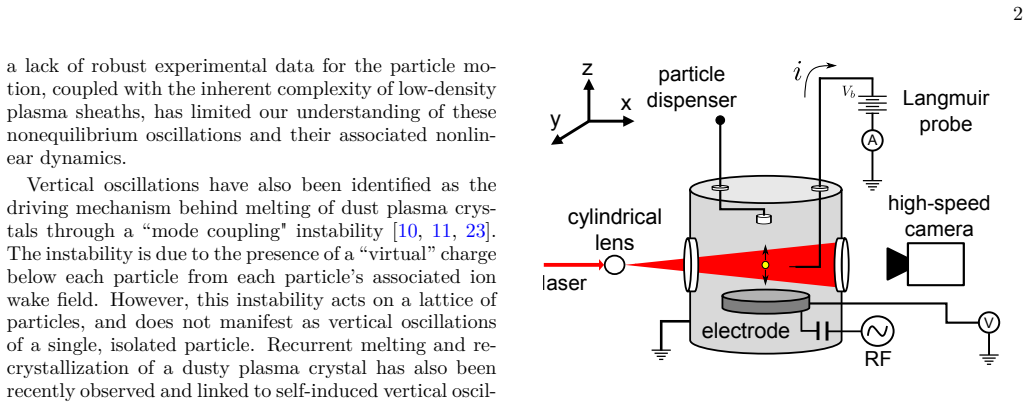
Summary. Using high-speed imaging of single micrometer particles in a GEC rf reference cell, the authors document spontaneous vertical oscillations with peak-to-peak amplitudes up to about 1 cm, much larger and more regular than previous reports. They rule out stochastic plasma or charge fluctuations using Langmuir probe spectra and stochastic simulations, and rule out ion-drag negative damping by order-of-magnitude estimates. From 400-cycle averaged trajectories they extract the vertical electrostatic force and, dividing by a Child-Langmuir sheath field, infer an equilibrium charge profile Qeq(z) with a positive slope at the levitation position. They then solve a delayed-charging model in which the charge relaxes toward Qeq(z) at rate ν, and show that the model reproduces the observed trajectory and harmonic spectrum, yielding ν = 1133 ± 50 s^-1. They conclude that delayed charging is the origin of the large-amplitude oscillations.
Significance. If the mechanism is confirmed, this is a useful and significant contribution: it offers a quantitative route to the dust charging frequency, a parameter that is difficult to access experimentally, and it provides a concrete explanation for cm-scale, stable single-particle oscillations and the collective phenomena built on them. The experimental strengths are the long stable single-particle time series, the 400-cycle averaging used to extract forces, the explicit null tests of stochastic and ion-drag mechanisms, and a simple numerical model that captures the strongly anharmonic motion and its harmonics. The central caveat is that the equilibrium charge profile is not measured independently of the assumed electric field; the authors acknowledge this, but the step is load-bearing for the delayed-charging conclusion.
major comments (3)
- [§IVB, Eq. (15), Fig. 15] The central extraction of Qeq(z) is not independent of the assumed electric field. The measured quantity in Eq. (13) is Fe(z,t)=E(z)Q(z,t), and the equilibrium charge profile shown in Fig. 15c is obtained by dividing Fe by the Child-Langmuir field of Eq. (15). Consequently, the positive gradient Q'eq(0) ≈ 20,000 e/mm that drives the delayed-charging instability in Eq. (20) is an inference, not a measured property. The authors acknowledge this in Sec. V, but the point is load-bearing: Eq. (26) shows that Q1, and hence the sign and magnitude of Q'eq(0), is determined by the assumed field parameters, and the collisional shaded band in Fig. 15 tests only one family of ion-dominated profiles with E(zs)=0 rather than providing an independent validation of E(z). If the true sheath field is flatter near z=0 or extends differently beyond zs, the inferred positive charge gradient is not established and delayed charging is not uniquely forced.
- [§IVD, Eqs. (21)-(26), Fig. 18] The fitted charging rate ν = 1133 ± 50 s^-1 is obtained by fitting the model embodied in Eqs. (21)-(24) to the trajectory, but both the fitted frequency and the required charge gradient are conditioned on the assumed E(z) and on the ad-hoc cubic form for Qeq(z) in Eq. (24). A flatter or differently shaped sheath field would change the inferred Q'eq(0) and therefore the energy input term in Eq. (20), and would also change the fitted value of ν. A sensitivity analysis over a physically plausible family of E(z) profiles, including the collisional solutions of Eqs. (16)-(17) with independent constraints on the sheath potential, is needed to show that the delayed-charging conclusion is robust rather than an artifact of the Child-Langmuir assumption.
- [§IVD, Fig. 18c] The statement that the model captures the entire shape of the Fourier spectrum 'with no adjustable parameters' overstates what the fitting procedure establishes. The parameter ν is fitted, the functional form of Qeq(z) is assumed in Eq. (24), and the phase offset is adjusted during the fit. The agreement in Fig. 18c is therefore a consistency check for the delayed-charging model, not an independent validation, and the manuscript should distinguish explicitly between fitted parameters and parameter-free predictions.
minor comments (5)
- [Eq. (1)] The expression 'expe[φb−φp]' appears to contain a typesetting error; it should be exp[e(φb−φp)/(kBTe)].
- [Eq. (12)] The Coulomb logarithm in Eq. (12) has unmatched parentheses; please check and correct the formula.
- [Fig. 10 caption] The caption says the derivatives of the I-φb characteristics are shown 'in (b)', but the panel to which this refers appears to be (a).
- [Sec. IIIB] The phrase 'pm 1-2V' should read '±1–2 V'.
- [Sec. IVD] Please reconcile 'only ν is a truly adjustable parameter' with the later claim of 'no adjustable parameters' in the Fourier-spectrum discussion; after ν is fixed the spectrum is a prediction, but the current wording invites confusion.
Circularity Check
One fitted parameter and a data-constrained charge profile are presented as parameter-free predictions; the central mechanism is conditionally supported, not circularly forced.
-
fitted input called prediction
[Sec. IVD ('Delayed charging'), discussion of Fig. 18, after the description of the Mathematica fit.]
"We fit the data by solving Eqs. 13 and 22 with initial conditions z(0) = 7 mm, ż(0) = 0 mm/s, and Q(0) = -30,000e using built-in routines in Mathematica, then fit the solution with a few cycles of the experimental data once the solution has reached a steady-state value (usually after t≈ 30 s). ... The model is able to quantitatively capture the entire shape of the Fourier spectrum with no adjustable parameters."
ν is the only adjustable parameter and is fitted to the experimental time series. The plotted Fourier spectrum is the transform of that same steady-state oscillation. Because ν controls the charge lag, it directly sets the harmonic content and amplitude envelope of the simulated trajectory; therefore the spectral 'prediction' is not independent of the fit. The phrase 'with no adjustable parameters' is true only in the sense that no second parameter is tuned to the spectrum—the spectrum is generated by the already-fitted model evaluated on the same data.
-
self definitional
[Sec. IVB, Eq. 15 and Fig. 15; Sec. IVD, Eqs. 24-26 and Fig. 18a.]
"By dividing the electrostatic force by the electric field, we arrive at an estimate of the particle charge. ... The positive slope of the charge near the equilibrium position, dQ/dz > 0, is an important feature that will be discussed in Sec. IVD. ... Based on our measurements of the particle charge from Fig. 15b, we choose a simple cubic function for the equilibrium charge ... The values of Q0 and Q1 are constrained by the two equilibrium conditions ... Using these conditions, and solving for Q0 and Q1 results in ..."
Fe(z)=E(z)Qeq(z) is the measured quantity; Qeq(z) is obtained by dividing by the assumed Child-Langmuir field E(z), not measured independently. Eq. 26 then fixes Q0 and Q1 so that the model Qeq reproduces, at z=0, exactly the measured force balance (mpg=E(0)Qeq(0)) and exactly the measured curvature (from ω0 in Eq. 14). Hence Q′eq(0), the quantity that delayed charging requires to be positive, is algebraically the same as the input data combined with the assumed field's logarithmic slope; its agreement with Fig. 15c at z=0 is by construction. The paper's own caveat—'Without experimental characterization of spatial distribution of the sheath potential, measurements of the particle charge can not be decoupled from the model of E(z)'—makes this input-dependence explicit.
full rationale
No load-bearing self-citation is present: the delayed-charging mechanism and stability condition are taken from Nunomura et al. and Ivlev et al., not from the authors' own prior work; the earlier Gogia & Burton paper supplies the experimental observations but not the mechanism. The central claim also has external anchors: the inferred charge magnitude is compared with OML-theory estimates, and the fitted charging rate ν=1133±50 s⁻¹ is compared with Basha & Abbas theoretical charging times. Thus the derivation is not entirely self-referential. However, two steps are partly circular: the 'no adjustable parameters' Fourier-spectrum statement follows a fit of ν to the same time series, and the positive charge gradient required by delayed charging is inferred from the same oscillation data under the assumed E(z) and then built into the model via Eq. 26. These make the confirmation of the model weaker than claimed, but they do not force the entire conclusion by definition. The unmeasured sheath field is a genuine limitation and a model-dependence risk, but the paper explicitly acknowledges it, so it is not by itself a circularity.
Assumptions & free parameters
free parameters (2)
- Charging frequency nu =
1133 +/- 50 s^-1
- Equilibrium charge profile Qeq(z) coefficients Q0 and Q1 =
Qeq(0)/e about -35,000; Q'eq(0)/e about 20,000 per mm
assumptions (4)
- domain assumption Child-Langmuir law gives the sheath electric field E(z) in Eqs. 15 and 23.
- domain assumption Charge relaxation follows dQ/dt = -nu (Q - Qeq(z)) in Eq. 22.
- ad hoc to paper Equilibrium charge Qeq(z) is cubic inside the sheath and saturates outside it in Eq. 24.
- domain assumption Only gravity, Epstein drag, and electrostatic force matter; ion drag is negligible.
Cite this review
Pith. "Pith review of The origin of large amplitude oscillations of dust particles in a plasma sheath." pith.science (2026). https://pith.science/paper/N3W4SOS7
@misc{pith2026190803138,
  author       = {Pith},
  title        = {Pith review of: The origin of large amplitude oscillations of dust particles in a plasma sheath},
  year         = {2026},
  howpublished = {\url{https://pith.science/paper/N3W4SOS7}},
  note         = {Machine review of arXiv:1908.03138}
}
read the original abstract
Micron-size charged particles can be easily levitated in low-density plasma environments. At low pressures, suspended particles have been observed to spontaneously oscillate around an equilibrium position. In systems of many particles, these oscillations can catalyze a variety of nonequilibrium, collective behaviors. Here, we report spontaneous oscillations of single particles that remain stable for minutes with striking regularity in amplitude and frequency. The oscillation amplitude can also exceed 1 cm, nearly an order of magnitude larger than previously observed. Using an integrated experimental and numerical approach, we show how the motion of an individual particle can be used to extract the electrostatic force and equilibrium charge variation in the plasma sheath. Additionally, using a delayed-charging model, we are able to accurately capture the nonlinear dynamics of the particle motion, and estimate the particle's equilibrium charging time in the plasma environment.
Figures


Figures from the paper (13 more)


Reference graph
Works this paper leans on
-
[1]
L. Boufendi and A. Bouchoule, Industrial developments of scientific insights in dusty plasmas, Plasma Sources Sci. Technol.11, A211 (2002)
work page 2002
-
[2]
R. L. Merlino, Dusty plasmas and applications in space and industry, Plasma Phys. Appl.81, 73 (2006)
work page 2006
-
[3]
J.-E. Wahlund, M. André, A. Eriksson, M. Lundberg, M. Morooka, M. Shafiq, T. Averkamp, D. Gurnett, G. Hospodarsky, W. Kurth, K. S. Jacobsen, A. Pedersen, W. Farrell, S. Ratynskaia, and N. Piskunov, Detection of dusty plasma near the e-ring of saturn, Planet. Space Sci. 57, 1795 (2009)
work page 2009
-
[4]
J. Méndez Harper, C. Helling, and J. Dufek, Triboelec- trification of kcl and zns particles in approximated ex- oplanet environments, The Astrophysical Journal867, 123 (2018)
work page 2018
-
[5]
is used forλD as a rough approximation. A more sophisticated model [47, 48, 51, 52] builds on thisapproachbyconsideringscatteringoutsidetheDebye sphere and shifted Maxwellian ion velocity distributions. The result is a decrease in the ion drag force by a fac- tor of≈2. However, assuming the Barnes et al. [50] model above (Eqs. 11 and 12), we estimate the ...
work page 2000
-
[6]
J. Méndez Harper, C. Cimarelli, J. Dufek, D. Gaudin, and R. J. Thomas, Inferring compressible fluid dynamics from vent discharges during volcanic eruptions, Geophys. Res. Lett.45, 7226 (2018)
work page 2018
-
[7]
J. Méndez Harper, P. Steffes, J. Dufek, and A. Akins, The effect of electrostatic charge on the propagation of gps (l-band) signals through volcanic plumes, Journal of Geophysical Research: Atmospheres124, 2260 (2019)
work page 2019
-
[8]
Möhlmann, Plasma crystal: Coulomb crystallization in a dusty plasma, Phys
H.Thomas, G.E.Morfill, V.Demmel, J.Goree, B.Feuer- bacher, and D. Möhlmann, Plasma crystal: Coulomb crystallization in a dusty plasma, Phys. Rev. Lett.73, 652 (1994)
work page 1994
Show all 67 references
-
[9]
Chu and I
J. Chu and I. Lin, Direct observation of coulomb crystals and liquids in strongly coupled rf dusty plasmas, Phys. Rev. Lett.72, 4009 (1994)
1994
-
[10]
Piel and A
A. Piel and A. Melzer, Dynamical processes in complex plasmas, Plasma Phys. Control. Fusion44, R1 (2001)
2001
-
[11]
Cou´’edel, V
L. Cou´’edel, V. Nosenko, A. V. Ivlev, S. K. Zhdanov, H. M. Thomas, and G. E. Morfill, Direct observation of mode-coupling instability in two-dimensional plasma crystals, Phys. Rev. Lett.104, 195001 (2010)
2010
-
[12]
B.Liu, J.Goree,andY.Feng,Modecouplingforphonons in a single-layer dusty plasma crystal, Phys. Rev. Lett. 105, 085004 (2010)
2010
-
[13]
Gogia and J
G. Gogia and J. C. Burton, Emergent bistability and switching in a nonequilibrium crystal, Phys. Rev. Lett. 119, 178004 (2017)
2017
-
[14]
C.-S. Wong, J. Goree, Z. Haralson, and B. Liu, Strongly coupledplasmasobeythefluctuationtheoremforentropy production, Nature Phys.14, 21 (2018)
2018
-
[15]
Nunomura, T
S. Nunomura, T. Misawa, N. Ohno, and S. Takamura, Instability of dust particles in a coulomb crystal due to delayed charging, Phys. Rev. Lett.83, 1970 (1999)
1999
-
[16]
A. V. Ivlev, U. Konopka, and G. Morfill, Influence of charge variation on particle oscillations in the plasma sheath, Phys. Rev. E62, 2739 (2000)
2000
-
[17]
Takamura, T
S. Takamura, T. Misawa, and N. Ohno, Dynamic behav- iors of dust particles in the plasmaâĂ“sheath boundary, Phys. Plasmas8, 1886 (2001)
2001
-
[18]
A. A. Samarian, B. W. James, S. V. Vladimirov, and N. F. Cramer, Self-excited vertical oscillations in an rf- discharge dusty plasma, Phys. Rev. E64, 025402 (2001)
2001
-
[19]
Vaulina, A
O. Vaulina, A. Samarian, A. Nefedov, and V. Fortov, Self-excited motion of dust particles in a inhomogeneous plasma, Phys. Lett. A289, 240 (2001)
2001
-
[20]
D. P. Resendes and G. Sorasio, Dynamics of dust parti- cles in plasma sheaths, Phys. Plasmas9, 2988 (2002)
2002
-
[21]
Sorasio, D
G. Sorasio, D. P. Resendes, and P. K. Shukla, Induced oscillations of dust grains in a plasma sheath under low pressures, Phys. Lett. A293, 67 (2002)
2002
-
[22]
Sorasio, R
G. Sorasio, R. A. Fonseca, and D. P. Resendes, Dust grainoscillationinplasmasheathsunderlowpressures,in Dust Plasma Interaction in Space, edited by P. K. Shukla (Nova Science Publishers, 2002) 1st ed., pp. 37–70
2002
-
[23]
Pustylnik, N
M. Pustylnik, N. Ohno, S. Takamura, and R. Smirnov, Modification of the damping rate of the oscillations of a dust particle levitating in a plasma due to the delayed charging effect, Phys. Rev. E74, 046402 (2006)
2006
-
[24]
S. K. Zhdanov, A. V. Ivlev, and G. E. Morfill, Mode- coupling instability of two-dimensional plasma crystals, Phys. Plasmas16, 083706 (2009)
2009
-
[25]
Gogia and J
G. Gogia and J. C. Burton, Minimal model for noise- induced intermittent dynamics in a many-body system, arXiv preprint arXiv:1901.10567 (2019)
2019 arXiv
-
[26]
A. V. Ivlev, J. Bartnick, M. Heinen, C.-R. Du, 17 V. Nosenko, and H. Löwen, Statistical mechanics where newtonâĂŹs third law is broken, Phys. Rev. X5, 011035 (2015)
2015
-
[27]
C. A. Schneider, W. S. Rasband, and K. W. Eliceiri, Nih image to imagej: 25 years of image analysis, Nature methods 9, 671 (2012)
2012
-
[28]
Carstensen, F
J. Carstensen, F. Haase, H. Jung, B. Tadsen, S. Groth, F. Greiner, and A. Piel, Probing the plasma sheath by the continuous mass loss of microparticles, IEEE Trans. Plasma Sci.41, 764 (2013)
2013
-
[29]
Kohlmann, F
N. Kohlmann, F. Wieben, O. H. Asnaz, D. Block, and F. Greiner, High-precision in-situ size measurements of single microparticles in an rf plasma, Phys. Plasmas26, 053701 (2019)
2019
-
[30]
Allan et al., soft-matter/trackpy: Trackpy, Version 0.4.2 (accessed September 1, 2019)
D. Allan et al., soft-matter/trackpy: Trackpy, Version 0.4.2 (accessed September 1, 2019)
2019
-
[31]
Godyak, R
V. Godyak, R. Piejak, and B. Alexandrovich, Measure- ment of electron energy distribution in low-pressure rf discharges, Plasma Sources Sci. Technol.1, 36 (1992)
1992
-
[32]
P. J. Ryan, J. W. Bradley, and M. D. Bowden, Compar- ison of langmuir probe and laser thomson scattering for plasma density and electron temperature measurements in hipims plasma, Physics of Plasmas26, 040702 (2019)
2019
-
[33]
Demidov, S
V. Demidov, S. V. Ratynskaia, and K. Rypdal, Electric probes for plasmas: The link between theory and instru- ment, Review of scientific instruments73, 3409 (2002)
2002
-
[34]
F. F. Chen, Langmuir probe diagnostics, inIEEE-ICOPS Meeting, Jeju, Korea, Vol. 2 (2003)
2003
-
[35]
R. L. Merlino, Understanding langmuir probe current- voltage characteristics, Am. J. Phys.75, 1078 (2007)
2007
-
[36]
F. F. Chen, Langmuir probes in rf plasma: surprising validity of oml theory, Plasma Sources Sci. Technol.18, 035012 (2009)
2009
-
[37]
F.F.Chen, J.D.Evans,andD.Arnush,Afloatingpoten- tial method for measuring ion density, Physics of Plasmas 9, 1449 (2002)
2002
-
[38]
Wiesemann, A short introduction to plasma physics, arXiv preprint arXiv:1404.0509 (2014)
K. Wiesemann, A short introduction to plasma physics, arXiv preprint arXiv:1404.0509 (2014)
2014 arXiv
-
[39]
S.A.KhrapakandA.G.Khrapak,Modifiedfrostformula for the mobilities of positive ions in their parent gases, AIP Advances9, 095008 (2019)
2019
-
[40]
M. A. Lieberman and A. J. Lichtenberg, Principles of Plasma Discharges and Material Processing (Wiley– Interscience, New York, 1994)
1994
-
[41]
Melzer and J
A. Melzer and J. Goree, Fundamentals of dusty plasmas, in Low Temperature Plasmas: Fundamentals, Technolo- gies and Techniques , edited by R. Hippler, H. Kersten, M. Schmidt, and K. H. Schoenbach (Wiley, 2008) 2nd ed., pp. 157–206
2008
-
[42]
Nitter, T
T. Nitter, T. K. Aslaksen, F. Melandso, and O. Havnes, Levitation and dynamics of a collection of dust particles in a fully ionized plasma sheath, IEEE T. Plasma Sci. 22, 159 (1994)
1994
-
[43]
H. Jung, F. Greiner, O. H. Asnaz, J. Carstensen, and A. Piel, Exploring the wake of a dust particle by a contin- uously approaching test grain, Phys. Plasmas22, 053702 (2015)
2015
-
[44]
C. Zafiu, A. Melzer, and A. Piel, Measurement of the ion drag force on falling dust particles and its relation to the void formation in complex (dusty) plasmas, Phys. Plasmas 10, 1278 (2003)
2003
-
[45]
A. V. Ivlev, S. K. Zhdanov, S. A. Khrapak, and G. E. Morfill, Ion drag force in dusty plasmas, Plasma Phys. Control. Fusion46, B267 (2004)
2004
-
[46]
I. L. Semenov, A. G. Zagorodny, and I. V. Krivtsun, Ion drag force on a dust grain in a weakly ionized collisional plasma, Phys. Plasmas20, 013701 (2013)
2013
-
[47]
Nitter, Levitation of dust in rf and dc glow discharges, Plasma Sources Sci
T. Nitter, Levitation of dust in rf and dc glow discharges, Plasma Sources Sci. Technol.5, 93 (1996)
1996
-
[48]
Melzer, Forces and trapping of dust particles, in Physics of Dusty Plasmas (Springer Nature, Switzerland AG, 2019) pp
A. Melzer, Forces and trapping of dust particles, in Physics of Dusty Plasmas (Springer Nature, Switzerland AG, 2019) pp. 31–57
2019
-
[49]
S. A. Khrapak, A. V. Ivlev, S. K. Zhdanov, , and G. E. Morfill, Hybrid approach to the ion drag force, Phys. Plasmas 12, 042308 (2005)
2005
-
[50]
Patacchini and I
L. Patacchini and I. H. Hutchinson, Fully self-consistent ion-drag-force calculations for dust in collisional plas- mas with an external electric field, Phys. Rev. Lett.101, 025001 (2008)
2008
-
[51]
Barnes, J
S. Barnes, J. H. Keller, J. C. Forster, J. A. O’Neill, and D. K. Coultas, Transport of dust particles in glow- discharge plasmas, Phys. Rev. Lett.68, 313 (1992)
1992
-
[52]
I. H. Hutchinson, Collisionless ion drag force on a spher- ical grain, Plasma Phys. Control. Fusion48, 185 (2006)
2006
-
[53]
S. A. Khrapak, A. V. Ivlev, G. E. Morfill, and H. M. Thomas, Ion drag force in complex plasmas, Phys. Rev. E 66, 046414 (2002)
2002
-
[54]
Faudot, J
E. Faudot, J. Ledig, J. Moritz, S. Heuraux, N. Lemoine, and S. Devaux, Experimental measurements of the rf sheath thickness with a cylindrical langmuir probe, Phys. Plasmas 26, 083503 (2019)
2019
-
[55]
Wang and A
S.-B. Wang and A. E. Wendt, Sheath thickness evalua- tion for collisionless or weakly collisional bounded plas- mas, IEEE Trans. Plasma Sci.27, 1358 (1999)
1999
-
[56]
V. Land, L. S. Matthews, T. W. Hyde, and D. Bolser, Fluid modeling of void closure in microgravity noble gas complex plasmas, Phys. Rev. E81, 056402 (2010)
2010
-
[57]
Douglass, V
A. Douglass, V. Land, L. Matthews, and T. Hyde, Dust particle charge in plasma with ion flow and electron depletion near plasma boundaries, Phys. Plasmas 18, 083706 (2011)
2011
-
[58]
Douglass, V
A. Douglass, V. Land, K. Qiao, L. Matthews, and T. Hyde, Determination of the levitation limits of dust particles within the sheath in complex plasma experi- ments, Phys. Plasmas19, 013707 (2012)
2012
-
[59]
T. E. Sheridan and J. Goree, Collisional plasma sheath model, Phys. Plasmas3, 2796 (1991)
1991
-
[60]
M. S. Benilov, The childâĂ“langmuir law and analyti- cal theory of collisionless to collision-dominated sheaths, Plasma Sources Sci. Technol.18, 014005 (2009)
2009
-
[61]
P. A. Miller and M. E. Riley, Dynamics of collisionless rf plasma sheaths, J. Appl. Phys.82, 3689 (1997)
1997
-
[62]
Naggary, D
S. Naggary, D. Engel, L. Kroll, and R. P. Brinkmann, Bridging childâĂ“langmuir and warren: exact and ap- proximate solutions for the unipolar sheath of interme- diate pressure, Plasma Sources Sci. Technol.28, 015003 (2019)
2019
-
[63]
S. G. Ingram and N. St. J. Braithwaite, Ion and electron energy analysis at a surface in an rf discharge, J. Phys. D: Appl. Phys.21, 1496 (1988)
1988
-
[64]
Mussenbrock and R
T. Mussenbrock and R. P. Brinkmann, Nonlinear elec- tron resonance heating in capacitive radio frequency dis- charges, Appl. Phys. Lett.88, 151503 (2006)
2006
-
[65]
Czarnetzki, Analytical model for the radio-frequency sheath, Phys
U. Czarnetzki, Analytical model for the radio-frequency sheath, Phys. Rev. E88, 063101 (2013)
2013
-
[66]
Ivlev, R
A. Ivlev, R. Sütterlin, V. Steinberg, M. Zuzic, and G. Morfill, Nonlinear vertical oscillations of a particle 18 in a sheath of a rf discharge, Phys. Rev. Lett.85, 4060 (2000)
2000
-
[67]
T. S. Basha and A. Abbas, Charging times for dust par- ticles in plasma, Euro. J. Phys.10, 151 (1989)
1989
Reviewed August 14, 2026 · model on record in the stance chip above.
Discussion (0). Continue with ORCID to comment.