Clues to inside-out quenching in quiescent galaxies at 1.2lesssim zlesssim2.2: Age, Fe-, and Mg-abundance gradients from JWST-SUSPENSE
Pith reviewed 2026-05-18 15:51 UTC · model grok-4.3
The pith
Distant quiescent galaxies have older cores with flat iron abundances, suggesting inside-out quenching.
A machine-rendered reading of the paper's core claim, the machinery that carries it, and where it could break.
Core claim
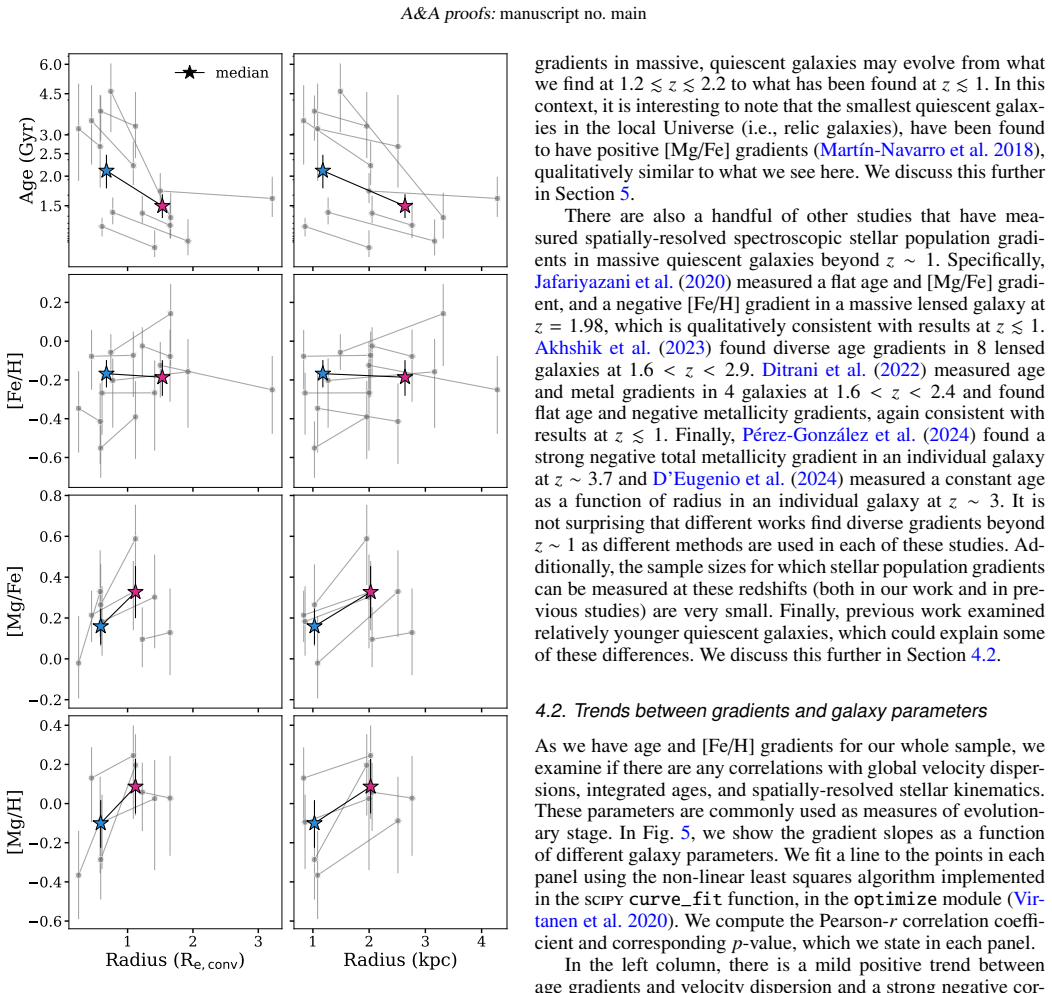
By fitting full-spectrum models to NIRSpec-MSA spectroscopy, the galaxies exhibit negative age gradients and flat [Fe/H] gradients, with tentative positive [Mg/H] and [Mg/Fe] gradients. This indicates that galaxy cores are older and perhaps Mg-deficient compared to their outskirts, consistent with inside-out quenching where cores form faster and quench more efficiently.
What carries the argument
Full-spectrum fitting of ultra-deep NIRSpec-MSA spectroscopy to extract radial gradients in stellar age, [Fe/H], [Mg/H], and [Mg/Fe].
If this is right
- Galaxy cores formed faster and quenched earlier than the outskirts.
- Age gradients show a positive trend with rotational support.
- Marginal trends exist between [Fe/H] gradients and both velocity dispersions and galaxy ages.
- These high-redshift patterns differ from those in lower-redshift quiescent galaxies, which show flat age gradients and negative metallicity gradients.
Where Pith is reading between the lines
- Rapid gas expulsion could explain the magnesium-deficient cores as a central quenching mechanism.
- Minor mergers may contribute to younger stellar populations in the outskirts.
- Progenitor bias could affect the observed gradients as the galaxy population evolves over time.
Load-bearing premise
The full-spectrum fitting procedure accurately breaks the age-metallicity degeneracy and recovers unbiased radial gradients despite potential effects from dust or model assumptions.
What would settle it
Independent measurements using different spectral models or direct comparison to color gradients from photometry that fail to recover the same age and abundance patterns would challenge the reported gradients.
Figures




read the original abstract
[Abridged] Spatially resolved stellar populations of massive quiescent galaxies at cosmic noon provide powerful insights into quenching and assembly mechanisms. Previous photometric studies have revealed that the cores of these galaxies are redder than their outskirts. However, spectroscopy is needed to break the age-metallicity degeneracy and uncover the driver of colour gradients. We derive age and elemental abundance gradients for eight distant ($1.2 \lesssim z \lesssim 2.2$), massive ($10.3\lesssim\log({\rm M}_*/{\rm M}_\odot)\lesssim 11.1$) quiescent galaxies by fitting full-spectrum models to ultra-deep NIRSpec-MSA spectroscopy from the JWST-SUSPENSE survey. We find that these galaxies have negative age and flat [Fe/H] gradients, and tentative indications of positive [Mg/H] and [Mg/Fe] gradients. These results suggest that galaxy cores are older and perhaps also Mg deficient compared to galaxy outskirts. The age gradients may indicate inside-out quenching, while Mg-deficient cores could suggest rapid gas expulsion as the central quenching mechanism. Thus, galaxy cores may have formed faster and quenched more efficiently than their outskirts. However, our [Fe/H] and [Mg/Fe] gradients are still puzzling, and further investigation is required to understand the nature of [Mg/H] gradients in massive galaxies at these redshifts. Our results contrast with those of lower-$z$ studies, which find flat age and [Mg/Fe] gradients and negative metallicity gradients. Additionally, we find a positive trend between age gradients and rotational support and marginal trends between [Fe/H] gradients and velocity dispersions and ages. We discuss our findings in the context of galaxy growth scenarios, including minor mergers and progenitor bias. With this work, we present the first stellar population gradients from NIRSpec-MSA spectroscopy in the current largest sample of distant quiescent galaxies.
Editorial analysis
A structured set of objections, weighed in public.
Referee Report
Summary. The manuscript derives age, [Fe/H], [Mg/H], and [Mg/Fe] gradients for eight massive quiescent galaxies at 1.2 ≲ z ≲ 2.2 using full-spectrum fitting to ultra-deep JWST NIRSpec-MSA spectra from the SUSPENSE survey. It reports negative age gradients, flat [Fe/H] gradients, and tentative positive [Mg/H] and [Mg/Fe] gradients, interpreting these as evidence that galaxy cores are older and Mg-deficient relative to outskirts, consistent with inside-out quenching. The results contrast with lower-redshift studies and are discussed in the context of minor mergers, progenitor bias, and a positive trend between age gradients and rotational support.
Significance. If the gradients prove robust, this provides the first spectroscopic stellar population gradients from NIRSpec-MSA for a sample of distant quiescent galaxies, offering new constraints on quenching and assembly at cosmic noon. The contrast with local trends and the link to rotational support are valuable for distinguishing formation scenarios. The use of ultra-deep spectroscopy on a statistically useful sample of eight galaxies is a clear strength.
major comments (2)
- [Methods (spectral fitting)] Methods section (fitting procedure): No mock-recovery tests or simulated spectra are reported to quantify biases in recovered age and abundance gradients at the observed S/N, wavelength coverage, and radial binning. This is load-bearing for the central claim because the negative age gradients and tentative [Mg/Fe] trends rest on the assumption that the SSP templates, dust parameterization, and IMF assumptions do not introduce systematic offsets that alias into the solutions.
- [Results] Results section: Gradients are presented without per-galaxy uncertainties or error bars, and no explicit tests of model systematics (template libraries, dust, IMF) are shown. This undermines assessment of the statistical significance of the reported positive trend between age gradients and rotational support and the tentative [Mg/H] and [Mg/Fe] trends.
minor comments (2)
- [Abstract] Abstract: The phrasing 'perhaps also Mg deficient' is vague; tie it explicitly to the measured [Mg/H] and [Mg/Fe] gradient values and their uncertainties.
- [Figures and Methods] Figure captions and text: Add more detail on how radial bins were chosen and the S/N thresholds applied, as these are listed among the free parameters.
Simulated Author's Rebuttal
We thank the referee for their detailed and constructive report. We are pleased that the referee recognizes the significance of our results on stellar population gradients in high-redshift quiescent galaxies. Below we address the major comments point by point, and we will incorporate revisions to strengthen the manuscript.
read point-by-point responses
-
Referee: [Methods (spectral fitting)] Methods section (fitting procedure): No mock-recovery tests or simulated spectra are reported to quantify biases in recovered age and abundance gradients at the observed S/N, wavelength coverage, and radial binning. This is load-bearing for the central claim because the negative age gradients and tentative [Mg/Fe] trends rest on the assumption that the SSP templates, dust parameterization, and IMF assumptions do not introduce systematic offsets that alias into the solutions.
Authors: We agree that quantifying potential biases through mock-recovery tests is crucial for validating our gradient measurements. Although our spectral fitting methodology is based on established techniques and has been cross-checked with multiple indicators in the current analysis, we did not include explicit mock tests in the submitted manuscript. In the revised version, we will add a dedicated subsection to the Methods section describing mock-recovery experiments. These will use simulated spectra generated with known input age and abundance gradients, convolved with the observed S/N, wavelength coverage, and radial binning from the SUSPENSE data. This will allow us to assess any systematic offsets arising from SSP templates, dust parameterization, or IMF assumptions, directly addressing the robustness of the negative age gradients and [Mg/Fe] trends. revision: yes
-
Referee: [Results] Results section: Gradients are presented without per-galaxy uncertainties or error bars, and no explicit tests of model systematics (template libraries, dust, IMF) are shown. This undermines assessment of the statistical significance of the reported positive trend between age gradients and rotational support and the tentative [Mg/H] and [Mg/Fe] trends.
Authors: We acknowledge that presenting per-galaxy uncertainties and systematic tests would enhance the interpretability of our results. The original manuscript reports the gradients but does not include individual error bars for each galaxy or comprehensive model variation tests. We will revise the Results section to include per-galaxy uncertainties on the age, [Fe/H], [Mg/H], and [Mg/Fe] gradients, obtained from the fitting posteriors. Furthermore, we will add explicit tests of model systematics by varying the template libraries, dust attenuation parameters, and IMF assumptions, and present the resulting variations in the gradients. These additions will support the assessment of the positive trend between age gradients and rotational support, as well as the tentative [Mg/H] and [Mg/Fe] trends, by demonstrating their robustness against modeling choices. revision: yes
Circularity Check
Direct spectral fitting produces gradients as measurements, not derivations reducing to inputs
full rationale
The paper obtains its central results (negative age gradients, flat [Fe/H] gradients, tentative positive [Mg/H] and [Mg/Fe] gradients) by applying full-spectrum fitting directly to the observed NIRSpec-MSA spectra of the eight galaxies. This is an empirical extraction step from data rather than a theoretical chain that reduces to fitted parameters by construction or relies on self-citations for uniqueness. The abstract explicitly contrasts the findings with lower-redshift studies as an external benchmark, and no load-bearing steps invoke self-definitional relations, renamed predictions, or ansatzes imported via prior author work. The derivation remains self-contained against the input spectra and fitting procedure.
Axiom & Free-Parameter Ledger
free parameters (1)
- radial binning and S/N thresholds
axioms (1)
- domain assumption Stellar population synthesis models accurately predict observed spectra across the relevant age and metallicity range without unaccounted systematics
discussion (0)
Sign in with ORCID, Apple, or X to comment. Anyone can read and Pith papers without signing in.