REVIEW 2 major objections 5 minor 1 cited by
Mathematical description of continuous time and space replicator-mutator equations for quadratic fitness landscapes
T0 review · 2 major / 5 minor · reviewed 2026-08-11 · deepseek-v4-flash
Pith's one-line read This paper derives closed-form solutions for the continuous-time replicator-mutator equation with quadratic fitness and Gaussian mutation, proving that Gaussian populations remain Gaussian and reducing the dynamics to exactly solvable…
desk verdict A useful and mostly careful derivation of explicit solutions for the quadratic replicator-mutator equation, but the advertised quantitative predictions all rest on an unproven burn-in assumption about the initial covariance. read the letter →
The pith
A machine-rendered reading of the paper's core claim, the machinery that carries it, and where it could break.
The reading
What carries the argument
The load-bearing mechanism is Gaussian closure: because the quadratic fitness function and linear mutation generator make the log-density a quadratic form, a Gaussian initial condition remains Gaussian, reducing the infinite-dimensional PDE to the three moment ODEs of Lemma 3.4. The covariance ODE is a matrix Riccati equation solved by linearising it into a $2n\times 2n$ Hamiltonian system; its steady state is the geometric mean of $\Sigma$ and $(A^{\top}\Gamma^{-1}A)^{-1}$. Once $C=C_\infty$, the mean ODE becomes linear with decay matrix $(1-s)(\Sigma Q)^{1/2}$, and the pseudoinverse $A^{-}=(\Gamma^{-1/2}A)^{+}\Gamma^{-1/2}$ projects optimal features into trait space throughout the formulas.
What would settle it
Take the one-dimensional model $A=1$, $\Gamma=\gamma^2$, $\Sigma=\sigma^2$, choose $C_0$ far from $\sigma\gamma$, and evolve the full PDE or a particle simulation while tracking $m(t)$, $C(t)$, and $P(t)$. Compare the long-time lag and the exponential growth rate with the predictions of (3.32)-(3.37) evaluated at $C_0=C_\infty$; if the fixed lag or the extinction threshold fails to appear after any burn-in time in some parameter regime, the paper's central claim is false.
Extended reading notes
Core claim
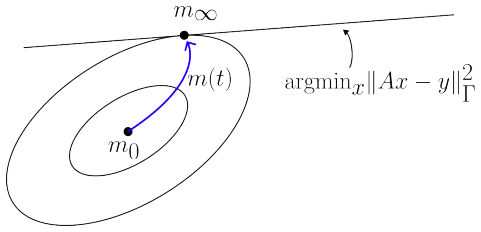
The paper's central discovery is Gaussian closure for the unnormalised replicator-mutator equation (3.1) with payoff (3.3): if the initial trait distribution is multivariate Gaussian, then $q(t)=P(t)N(m(t),C(t))$ for all times, with the moment ODEs in (3.7). For the covariance it gives an explicit solution to the Riccati equation in Lemma 3.14, whose steady state $C_\infty$ is the geometric mean of the mutation covariance $\Sigma$ and the inverse penalty matrix $Q^{-1}=(A^{\top}\Gamma^{-1}A)^{-1}$. Under the steady-covariance assumption $C_0=C_\infty$, the mean obeys linear dynamics with explicit solution (3.32), and the residual $m(t)-A^{-}y(t)$ becomes a convolution of the optimal feature's velocity with an exponential kernel, yielding the fixed-lag formula $(\Sigma Q)^{-1/2}A^{-}v_y$. Inserting these into the mass equation gives exact exponential growth rates and extinction thresholds.
Load-bearing premise
The explicit mean and mass formulas in Lemma 3.18 require the covariance to have already converged to its steady state, and the paper asserts without proof that generic initial covariances behave the same after a burn-in time. If that extrapolation fails for some parameters, the paper's quantitative predictions about lag and extinction do not follow from the derived equations.
Editorial extensions
If this is right
- With Gaussian initial data, the replicator-mutator model is exactly solvable, so predictions about mean, covariance, and population size can be computed in closed form for any parameter set.
- For a fixed optimum, the population survives if and only if $K\ge (1-s)\|\Pi_{(\operatorname{im}\Gamma^{-1/2}A)^\perp}\Gamma^{-1/2}y\|^2 + \operatorname{trace}((Q\Sigma)^{1/2})$; otherwise it decays exponentially to zero.
- For an optimum moving at constant velocity, the population mean lags behind by the fixed amount $(\Sigma Q)^{-1/2}A^{-}v_y$, and extinction is governed by an explicit rate involving that lag.
- The flying-kite effect follows from the mean ODE being preconditioned by the population covariance: adaptation initially proceeds along directions of largest variance rather than straight toward the optimum.
- Survival of the flattest is reduced to comparing $\operatorname{trace}((Q\Sigma)^{1/2})$ to fitness-peak height $K$; a flatter, lower peak can outcompete a high sharp peak when mutation is strong.
Reading between the lines
- Editorial inference: the burn-in statement in Section 3.4, if made quantitative, would imply a convergence-time bound to the steady covariance; a numerical check for non-commuting $\Sigma$ and $Q$ would be the natural next test.
- Editorial inference: the mean dynamics' interpretation as a Kalman-Bucy filter suggests the closed-form lag and extinction formulas could transfer to misspecified filtering and data assimilation problems where the observation model is known to be wrong.
- Editorial inference: the algebraic survival condition for a single quadratic landscape might extend to piecewise-quadratic multimodal landscapes by comparing local quadratic approximations, predicting which peak wins in a mutation-dominated regime.
- Editorial inference: the fixed-lag formula gives a sharp, testable prediction for individual-based simulations: after the covariance has equilibrated, the mean should trail a uniformly moving optimum by exactly $(\Sigma Q)^{-1/2}A^{-}v_y$ in trait space.
Editorial analysis
A structured set of objections, weighed in public.
Referee Report
Summary. The paper studies a continuous-time, continuous-trait replicator-mutator equation (3.1) with a quadratic fitness payoff (3.3), Gaussian mutation, and Gaussian initial data. It claims that the population remains an unnormalised Gaussian, with mean, covariance, and total mass satisfying the ODE system (3.7). The authors solve the covariance Riccati equation explicitly (Lemma 3.14) and provide an explicit mean evolution under the assumption C0=C∞ (Lemma 3.18). These results are then used to quantify the flying kite effect, survival of the flattest, and the population's lag/extinction when tracking fixed, moving, oscillating, and random optima. The paper also points out connections to Kalman-Bucy filtering and Tikhonov regularisation.
Significance. If correct, the explicit covariance solution and the geometric-mean interpretation of the asymptotic covariance are valuable contributions, and the formulas for exponential growth/decay rates in terms of the model parameters (K, s, Σ, Γ, A) are useful for understanding mutation-selection balance without simulation. The connection to filtering and inverse problems is insightful. However, the mean-evolution formulas and all quantitative evolutionary predictions in Section 4 are proven only in the steady-covariance case; the claimed extension to arbitrary initial covariance is unproven, so the advertised 'exact' extinction thresholds and fixed-lag formulas are not fully established. The Gaussianity-preservation proof is also sketchy. These issues are fixable but currently limit the paper's central claims.
major comments (2)
- [Section 3.4 (before Lemma 3.18)] The paper states that the explicit mean formulas derived under C0=C∞ 'hold in the more general case where C0 ≠ C∞' after a burn-in time, but no proof or quantitative bound is supplied. For C0 ≠ C∞, the mean equation is ṁ = -(1-s)C(t)A^TΓ^{-1}(Am - A^-y(t)) with C(t) evolving according to the Riccati equation, so the simplification ṁ = -α(ΣQ)^{1/2}(m - A^-y(t)) is not valid. Lemma 4.2, Lemma 4.3, Section 4.5, and Section 4.6 all use this unproven extension to derive exact extinction thresholds and fixed-lag formulas. The central quantitative claims of the paper are therefore conditional on an assumption. Please either prove the extension (e.g., by showing the difference between the true mean and the C0=C∞ formula decays to zero with explicit bounds) or restrict the statements to the C0=C∞ case and clearly mark the general case as conjectural/empirical.
- [Lemma 3.4, proof] The Gaussianity-preservation proof uses an Euler-discretisation argument: after one Euler step log q is quadratic, and taking h→0 'proves' log q(t,·) is quadratic. This is not a rigorous limit: the Euler scheme for the nonlinear PDE (3.1) does not converge without further estimates, and the fitness π_q^t depends on q(t,·), so the argument does not establish that the true solution remains an unnormalised Gaussian. Since the moment equations (3.7) are derived by postulating a Gaussian form, this is a load-bearing gap. A rigorous proof could be obtained by direct substitution of the Gaussian ansatz with (m,C,P) satisfying (3.7) into (3.1) and appealing to uniqueness, or by a Feynman-Kac representation with a quadratic potential; please provide such an argument.
minor comments (5)
- [Lemma 3.7 and Lemma 3.9] The symbol r appears in the definition of M(t) without being defined; from the proof it must be r=1, so please remove r or define it explicitly.
- [Section 4.6] The text calls the estimator 'biased' because of the logarithm, but the asymptotic growth rate of log P(t) is exactly K - σ/γ(1+a²/2σ²) by the ergodicity of D²; the 'bias' refers to comparing E[log P] with log E[P], which is not the quantity used for the extinction criterion. This wording is confusing and should be clarified.
- [Abstract and Introduction] The abstract claims results 'without the need for numerical in-silico simulations', but Section 4 contains numerous simulations; consider rephrasing to 'without reliance on simulations' or 'supplemented by illustrative simulations'.
- [Section 2, first paragraph] There is a typo 'Shashahani' for 'Shahshahani'; also the reference 'F A95' appears misformatted and should be 'Fujiwara and Amari'.
- [Text near Figure 4.1] The phrase 'volution of the replicator-mutator equation' contains a typo; 'volution' should be 'evolution'.
Circularity Check
No circular reduction found; Section 4 predictions are explicitly conditional on C0=C∞ and an unproven 'burn-in' extrapolation, which is a rigor gap rather than circularity.
full rationale
Lemma 3.4 derives the moment ODEs (3.7) by computing d/dt log q for a Gaussian density and matching quadratic coefficients; this is a direct derivation from the PDE, not an assumption of the target conclusion. Lemma 3.14 solves the covariance Riccati equation through the standard D(t)E(t)^{-1} factorization and the simultaneous diagonalization of ΣQ, then identifies C∞ as a geometric mean; the covariance results are independent of the later evolutionary predictions. Lemma 3.18 is explicitly conditional: when C0=C∞, the mean ODE becomes linear and formulas (3.32)-(3.33) follow by variation of constants. Section 4's quantitative statements (extinction threshold, fixed lag, oscillating and random optimum rates) all rely on these C0=C∞ formulas. The paper's informal claim that the same statements hold for arbitrary C0 after a 'burn-in' time is an unproven extrapolation; this is a conditionality/rigor gap, not a circular reduction, because the relevant formulas are not assumed in proving the mean dynamics. Citations to [BW23] and [PW24] are to published, parameter-free technical lemmas and background connections; they are used as tools and do not smuggle in the paper's intended conclusions. No fitted parameter is renamed as a prediction, and no uniqueness theorem is imported from the authors' prior work to forbid alternatives. Accordingly, no specific circular step can be exhibited; the score of 2 reflects only minor, non-load-bearing self-citation.
Assumptions & free parameters
free parameters (5)
- s (conformity coefficient) =
s ∈ (-∞,1] (model input, not fitted)
- K (baseline reproductive capacity) =
K (model input, not fitted)
- Σ (mutation noise covariance) =
SPD matrix (model input, not fitted)
- Γ (selection penalty matrix) =
SPD matrix (model input, not fitted)
- C0 (initial covariance) =
SPD matrix (initial condition, not fitted)
assumptions (5)
- domain assumption Initial trait distribution is an unnormalized multivariate Gaussian: q0 = P0 N(m0, C0).
- standard math The matrices Σ (symmetric positive definite) and Q = A^T Γ^{-1}A (symmetric positive semidefinite) make ΣQ diagonalisable with nonnegative eigenvalues.
- ad hoc to paper Mean evolution formulas derived for C0=C∞ remain valid for arbitrary C0 'in spirit' after an initial burn-in time.
- ad hoc to paper Two populations in separate quadratic fitness 'universes' can be compared to model survival of the flattest on a shared bimodal landscape.
- ad hoc to paper The ergodic mean of the squared tracking error can be used as a biased estimator of the expected log population growth rate for a randomly fluctuating optimum.
Cite this review
Pith. "Pith review of Mathematical description of continuous time and space replicator-mutator equations for quadratic fitness landscapes." pith.science (2026). https://pith.science/paper/N4GC5IK4
@misc{pith2026241208178,
  author       = {Pith},
  title        = {Pith review of: Mathematical description of continuous time and space replicator-mutator equations for quadratic fitness landscapes},
  year         = {2026},
  howpublished = {\url{https://pith.science/paper/N4GC5IK4}},
  note         = {Machine review of arXiv:2412.08178}
}
read the original abstract
The replicator-mutator equation is a model for populations of individuals carrying different traits, with a fitness function mediating their ability to replicate, and a stochastic model for mutation. We derive analytical solutions for the replicator-mutator equation in continuous time and for continuous traits for a quadratic fitness function. Using these results we can explain and quantify (without the need for numerical in-silico simulations) a series of evolutionary phenomena, in particular the flying kite effect, survival of the flattest, and the ability of a population to sustain itself while tracking an optimal feature which may be fixed, moving with bounded velocity in trait space, oscillating, or randomly fluctuating.
Figures


Figures from the paper (4 more)


Forward citations
Cited by 1 Pith paper
-
Connections between sequential Bayesian inference and evolutionary dynamics
A continuous-time Crow-Kimura replicator-mutator equation with a non-local fitness function is shown to converge, in a weak pointwise sense, to a modified Zakai equation from nonlinear filtering, with the classical Za...
Reference graph
Works this paper leans on
-
[1]
The geometry of population genetics
E Akin. The geometry of population genetics. Lec. Notes in Biomath. , 31, 1979
work page 1979
-
[2]
Tsuyoshi Ando, Chi-Kwong Li, and Roy Mathias. Geometric means. Linear algebra and its applications , 385:305--334, 2004
work page 2004
-
[3]
Analysis of a certain class of replicator equations
Malcolm R Adams and Andrew T Sornborger. Analysis of a certain class of replicator equations. Journal of mathematical biology , 54(3):357--384, 2007
work page 2007
-
[4]
The fundamental theorem of natural selection
John C Baez. The fundamental theorem of natural selection. Entropy , 23(11):1436, 2021
work page 2021
-
[5]
The moore--penrose pseudoinverse: A tutorial review of the theory
Jo \ a o Carlos Alves Barata and Mahir Saleh Hussein. The moore--penrose pseudoinverse: A tutorial review of the theory. Brazilian Journal of Physics , 42:146--165, 2012
work page 2012
-
[6]
Filtering for stochastic processes with applications to guidance , volume 326
Richard S Bucy and Peter D Joseph. Filtering for stochastic processes with applications to guidance , volume 326. American Mathematical Soc., 2005
work page 2005
-
[7]
Reinhard B \"u rger and Russell Lande. On the distribution of the mean and variance of a quantitative trait under mutation-selection-drift balance. Genetics , 138(3):901--912, 1994
work page 1994
-
[8]
Evolution and extinction in a changing environment: a quantitative-genetic analysis
Reinhard B \"u rger and Michael Lynch. Evolution and extinction in a changing environment: a quantitative-genetic analysis. Evolution , 49(1):151--163, 1995
work page 1995
Show all 63 references
-
[9]
Adaptation and extinction in changing environments
Reinhard B \"u rger and Michael Lynch. Adaptation and extinction in changing environments. Environmental stress, adaptation and evolution , pages 209--239, 1997
1997
-
[10]
Dynamical aspects of evolutionary stability
Immanuel M Bomze. Dynamical aspects of evolutionary stability. Monatshefte f \"u r Mathematik , 110:189--206, 1990
1990
-
[11]
Relative entropy in biological systems
John C Baez and Blake S Pollard. Relative entropy in biological systems. Entropy , 18(2):46, 2016
2016
-
[12]
A localization technique for ensemble kalman filters
Kay Bergemann and Sebastian Reich. A localization technique for ensemble kalman filters. Quarterly Journal of the Royal Meteorological Society: A journal of the atmospheric sciences, applied meteorology and physical oceanography , 136(648):701--707, 2010
2010
-
[13]
Continuous time limit of the stochastic ensemble kalman inversion: strong convergence analysis
Dirk Bl \"o mker, Claudia Schillings, Philipp Wacker, and Simon Weissmann. Continuous time limit of the stochastic ensemble kalman inversion: strong convergence analysis. SIAM Journal on Numerical Analysis , 60(6):3181--3215, 2022
2022
-
[14]
Global theory of the riccati equation
Richard S Bucy. Global theory of the riccati equation. Journal of computer and system sciences , 1(4):349--361, 1967
1967
-
[15]
Complete deterministic dynamics and spectral decomposition of the linear ensemble kalman inversion
Leon Bungert and Philipp Wacker. Complete deterministic dynamics and spectral decomposition of the linear ensemble kalman inversion. SIAM/ASA Journal on Uncertainty Quantification , 11(1):320--357, 2023
2023
-
[16]
Giraffe captive and wild body proportion measurements
Douglas Cavener. Giraffe captive and wild body proportion measurements. https://scholarsphere.psu.edu/resources/99e88c1b-1cdf-4949-beeb-a9151b1a5554, 2023
2023
-
[17]
Robust filtering
Laurent E Calvet, Veronika Czellar, and Elvezio Ronchetti. Robust filtering. Journal of the American Statistical Association , 110(512):1591--1606, 2015
2015
-
[18]
The Quasispecies Equation and Classical Population Models , volume 102 of Probability Theory and Stochastic Modelling
Raphaël Cerf and Joseba Dalmau. The Quasispecies Equation and Classical Population Models , volume 102 of Probability Theory and Stochastic Modelling . Springer International Publishing, Cham, 2022
2022
-
[19]
Tenenbaum, and E \" o rs Szathm \' a ry
D \' a niel Cz \' e gel, Hamza Giaffar, Joshua B. Tenenbaum, and E \" o rs Szathm \' a ry. Bayes and Darwin: How replicator populations implement Bayesian computations . BioEssays , 44(4):1--11, 2022
2022
-
[20]
Genetic constraints on adaptation to a changing environment
Luis-Miguel Chevin. Genetic constraints on adaptation to a changing environment. Evolution , 67(3):708--721, 2013
2013
-
[21]
Stability of the replicator equation for a single species with a multi-dimensional continuous trait space
Ross Cressman, Josef Hofbauer, and Frank Riedel. Stability of the replicator equation for a single species with a multi-dimensional continuous trait space. Journal of Theoretical Biology , 239(2):273--288, 2006
2006
-
[22]
Crow and M
J.F. Crow and M. Kimura. An introduction to Population Genetics Theory . Harper and Row, 1970
1970
-
[23]
Long-time behavior of a pde replicator equation for multilevel selection in group-structured populations
Daniel B Cooney and Yoichiro Mori. Long-time behavior of a pde replicator equation for multilevel selection in group-structured populations. Journal of Mathematical Biology , 85(2):12, 2022
2022
-
[24]
Chalub, L \' e onard Monsaingeon, Ana Margarida Ribeiro, and Max O
Fabio A.C.C. Chalub, L \' e onard Monsaingeon, Ana Margarida Ribeiro, and Max O. Souza. Gradient Flow Formulations of Discrete and Continuous Evolutionary Models: A Unifying Perspective . Acta Applicandae Mathematicae , 171(1):1--68, 2021
2021
-
[25]
The replicator equation and other game dynamics
Ross Cressman and Yi Tao. The replicator equation and other game dynamics. Proceedings of the National Academy of Sciences , 111(supplement\_3):10810--10817, 2014
2014
-
[26]
Molecular quasi-species
Manfred Eigen, John McCaskill, and Peter Schuster. Molecular quasi-species. The Journal of Physical Chemistry , 92(24):6881--6891, 1988
1988
-
[27]
The ensemble kalman filter: Theoretical formulation and practical implementation
Geir Evensen. The ensemble kalman filter: Theoretical formulation and practical implementation. Ocean dynamics , 53:343--367, 2003
2003
-
[28]
Gradient systems in view of information geometry
Akio Fujiwara and Shun-ichi Amari. Gradient systems in view of information geometry. Physica D: Nonlinear Phenomena , 80(3):317--327, 1995
1995
-
[29]
The ess and replicator equation in matrix games under time constraints
J \'o zsef Garay, Ross Cressman, Tam \'a s F M \'o ri, and Tam \'a s Varga. The ess and replicator equation in matrix games under time constraints. Journal of mathematical biology , 76:1951--1973, 2018
1951
-
[30]
Demographic and genetic constraints on evolution
Richard Gomulkiewicz and David Houle. Demographic and genetic constraints on evolution. The American Naturalist , 174(6):E218--E229, 2009
2009
-
[31]
Mathematical Properties of a Class of Integro -differential Models from Population Genetics
Marie-Eve Gil, Francois Hamel, Guillaume Martin, and Lionel Roques. Mathematical Properties of a Class of Integro -differential Models from Population Genetics . SIAM Journal on Applied Mathematics , 77(4):1536--1561, January 2017
2017
-
[32]
Interacting langevin diffusions: Gradient structure and ensemble kalman sampler
Alfredo Garbuno-Inigo, Franca Hoffmann, Wuchen Li, and Andrew M Stuart. Interacting langevin diffusions: Gradient structure and ensemble kalman sampler. SIAM Journal on Applied Dynamical Systems , 19(1):412--441, 2020
2020
-
[33]
Information geometry and evolutionary game theory
Marc Harper. Information geometry and evolutionary game theory. arXiv preprint arXiv:0911.1383 , 2009
2009 arXiv
-
[34]
The replicator equation as an inference dynamic
Marc Harper. The replicator equation as an inference dynamic. arXiv preprint arXiv:0911.1763 , 2009
2009 arXiv
-
[35]
The selection mutation equation
Josef Hofbauer. The selection mutation equation . Journal of Mathematical Biology , 23(1):41--53, 1985
1985
-
[36]
Stability of the g-matrix in a population experiencing pleiotropic mutation, stabilizing selection, and genetic drift
Adam G Jones, Stevan J Arnold, and Reinhard B \"u rger. Stability of the g-matrix in a population experiencing pleiotropic mutation, stabilizing selection, and genetic drift. Evolution , 57(8):1747--1760, 2003
2003
-
[37]
Evolution and stability of the g-matrix on a landscape with a moving optimum
Adam G Jones, Stevan J Arnold, and Reinhard Burger. Evolution and stability of the g-matrix on a landscape with a moving optimum. Evolution , 58(8):1639--1654, 2004
2004
-
[38]
Contributions to the theory of optimal control
Rudolf Emil Kalman et al. Contributions to the theory of optimal control. Bol. soc. mat. mexicana , 5(2):102--119, 1960
1960
-
[39]
A stochastic model concerning the maintenance of genetic variability in quantitative characters
M Kimura. A stochastic model concerning the maintenance of genetic variability in quantitative characters. Proceedings of the National Academy of Sciences , 54(3):731--736, September 1965
1965
-
[40]
Rapid evolution of quantitative traits: theoretical perspectives
Michael Kopp and Sebastian Matuszewski. Rapid evolution of quantitative traits: theoretical perspectives. Evolutionary Applications , 7(1):169--191, 2014. \_eprint: https://onlinelibrary.wiley.com/doi/pdf/10.1111/eva.12127
2014 doi
-
[41]
Phenotypic lag and population extinction in the moving-optimum model: insights from a small-jumps limit
Michael Kopp, Elma Nassar, and Etienne Pardoux. Phenotypic lag and population extinction in the moving-optimum model: insights from a small-jumps limit. Journal of Mathematical Biology , 77:1431--1458, 2018
2018
-
[42]
Quantitative genetic analysis of multivariate evolution, applied to brain: body size allometry
Russell Lande. Quantitative genetic analysis of multivariate evolution, applied to brain: body size allometry. Evolution , pages 402--416, 1979
1979
-
[43]
A schur method for solving algebraic riccati equations
Alan Laub. A schur method for solving algebraic riccati equations. IEEE Transactions on automatic control , 24(6):913--921, 1979
1979
-
[44]
Homophilic replicator equations
Bryce Morsky, Ross Cressman, and CT Bauch. Homophilic replicator equations. Journal of Mathematical Biology , 75:309--325, 2017
2017
-
[45]
Filtering complex turbulent systems
Andrew J Majda and John Harlim. Filtering complex turbulent systems . Cambridge University Press, 2012
2012
-
[46]
Fisher's geometric model with a moving optimum
Sebastian Matuszewski, Joachim Hermisson, and Michael Kopp. Fisher's geometric model with a moving optimum . Evolution , 68(9):2571--2588, 2014
2014
-
[47]
Catch me if you can: adaptation from standing genetic variation to a moving phenotypic optimum
Sebastian Matuszewski, Joachim Hermisson, and Michael Kopp. Catch me if you can: adaptation from standing genetic variation to a moving phenotypic optimum. Genetics , 200(4):1255--1274, 2015
2015
-
[48]
A differential geometric approach to the geometric mean of symmetric positive-definite matrices
Maher Moakher. A differential geometric approach to the geometric mean of symmetric positive-definite matrices. SIAM journal on matrix analysis and applications , 26(3):735--747, 2005
2005
-
[49]
Random processes in genetics
Patrick Alfred Pierce Moran. Random processes in genetics. In Mathematical proceedings of the cambridge philosophical society , volume 54, pages 60--71. Cambridge University Press, 1958
1958
-
[50]
Geometric operator mean induced from the riccati equation
NOBORU Nakamura. Geometric operator mean induced from the riccati equation. Scientiae Mathematicae Japonicae , 66(1):83--88, 2007
2007
-
[51]
Evolutionary dynamics on infinite strategy spaces
J \"o rg Oechssler and Frank Riedel. Evolutionary dynamics on infinite strategy spaces. Economic theory , 17:141--162, 2001
2001
-
[52]
Connections between sequential Bayesian inference and evolutionary dynamics
Sahani Pathiraja and Philipp Wacker. Connections between sequential Bayesian inference and evolutionary dynamics . arXiv preprint arXiv.2411.16366 , 2024
2024 arXiv
-
[53]
Adaptive radiation along genetic lines of least resistance
Dolph Schluter. Adaptive radiation along genetic lines of least resistance. Evolution , 50(5):1766--1774, 1996
1996
-
[54]
Closed-form solution of non-symmetric algebraic riccati matrix equation
Akbar Shirilord and Mehdi Dehghan. Closed-form solution of non-symmetric algebraic riccati matrix equation. Applied Mathematics Letters , 131:108040, 2022
2022
-
[55]
Simple quasispecies models for the survival-of-the-flattest effect: The role of space
Josep Sardany \'e s, Santiago F Elena, and Ricard V Sol \'e . Simple quasispecies models for the survival-of-the-flattest effect: The role of space. Journal of Theoretical Biology , 250(3):560--568, 2008
2008
-
[56]
Dynamics of bayesian updating with dependent data and misspecified models
Cosma Rohilla Shalizi. Dynamics of bayesian updating with dependent data and misspecified models . Electronic Journal of Statistics , 3:1039--1074, 2009
2009
-
[57]
Replicator dynamics
Peter Schuster and Karl Sigmund. Replicator dynamics. Journal of theoretical biology , 100(3):533--538, 1983
1983
-
[58]
Immune networks modeled by replicator equations
Peter F Stadler, Peter Schuster, and Alan S Perelson. Immune networks modeled by replicator equations. Journal of Mathematical Biology , 33:111--137, 1994
1994
-
[59]
Inverse problems: a bayesian perspective
Andrew M Stuart. Inverse problems: a bayesian perspective. Acta numerica , 19:451--559, 2010
2010
-
[60]
Discrete-time kalman filter error bounds in the presence of misspecified measurements
Ron Teichner and Ron Meir. Discrete-time kalman filter error bounds in the presence of misspecified measurements. In 2023 European Control Conference (ECC) , pages 1--7. IEEE, 2023
2023
-
[61]
Markovian Switching of Mutation Rates in Evolutionary Network Dynamics , May 2020
Andrew Vlasic. Markovian Switching of Mutation Rates in Evolutionary Network Dynamics , May 2020. arXiv:2005.00900 [math, q-bio]
2020 arXiv
-
[62]
Interpretations arising from wrightian and malthusian fitness under strong frequency dependent selection
Bin Wu, Chaitanya S Gokhale, Matthijs van Veelen, Long Wang, and Arne Traulsen. Interpretations arising from wrightian and malthusian fitness under strong frequency dependent selection. Ecology and Evolution , 3(5):1276--1280, 2013
2013
-
[63]
Evolution of digital organisms at high mutation rates leads to survival of the flattest
Claus O Wilke, Jia Lan Wang, Charles Ofria, Richard E Lenski, and Christoph Adami. Evolution of digital organisms at high mutation rates leads to survival of the flattest. Nature , 412(6844):331--333, 2001
2001
Reviewed August 11, 2026 · model on record in the stance chip above.
Discussion (0). Continue with ORCID to comment.