REVIEW 3 major objections 3 minor 64 references
Limitations of Nyquist Criteria in the Discretization of 2D Electromagnetic Integral Equations at High Frequency: Spectral Insights into Pollution Effects
T0 review · 3 major / 3 minor · reviewed 2026-08-07 · deepseek-v4-flash
Pith's one-line read The boundary element method can suffer its own numerical pollution at high frequency.
desk verdict A real and interesting BEM pollution result for fixed unknowns per wavelength, but the headline (ka)^{1/3} current-error rate rests on a shaky mode count; the qualitative finding survives and deserves a serious referee. read the letter →
The pith
A machine-rendered reading of the paper's core claim, the machinery that carries it, and where it could break.
The reading
What carries the argument
The central object is the spectral relative error between continuous integral operators and their Galerkin discretizations on a uniform circular mesh. Its two components are the projection error (from the basis's finite bandwidth) and the aliasing error (from the periodic summation of the continuous operator's eigenvalues across the discrete spectrum). The paper tracks how the aliasing error accumulates in sums and products of operators, and how that accumulation depends on the operator-specific eigenvalue asymptotics in the hyperbolic (q << ka), transition (q ~ ka), and elliptic (q >> ka) spectral regions. The hypersingular operator N_k has eigenvalues decaying as (ka)^{-1/3} in the transition region, which makes its aliasing error grow as (ka)^{1/3}; this growth is what drives the TE-EFIE pollution.
What would settle it
A direct numerical check could compute the TE-EFIE current error at fixed n_λ over a wide range of ka (e.g., ka from 100 to 4000) on a circle and fit the slope of log r_L2 versus log(ka); if the slope departs from 1/3 and instead saturates or follows a (ka)^{1/3} times a logarithmic factor, the mode-counting assumption and the resulting rate would be falsified.
Extended reading notes
Core claim
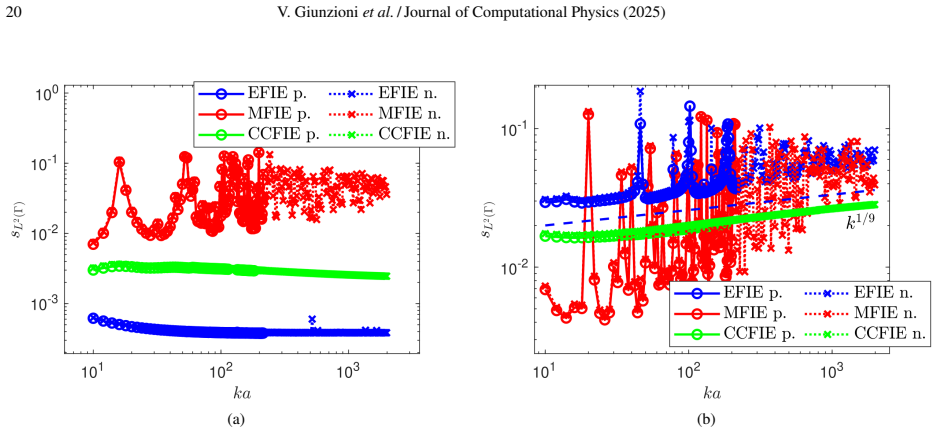
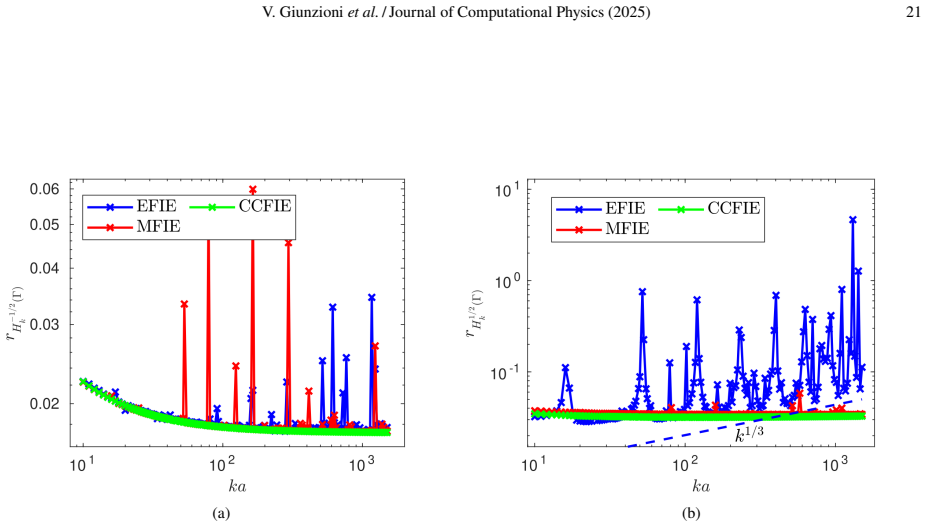
For a perfectly conducting circular cylinder, the paper derives closed-form expressions for the spectral, current, and scattering errors of BEM-discretized integral equations. It finds that in the high-frequency regime, where the number of unknowns per wavelength is kept fixed, the aliasing spectral error of the hypersingular operator grows as (ka)^{1/3} in the transition region (indices q near ka). This growth transfers to the current and scattering errors of the TE-EFIE, which increase asymptotically as (ka)^{1/3}. The same spectral aliasing mechanism, acting through products of discretized operator matrices, causes the TE-CCFIE, despite its frequency-bounded solution operator, to also exhibit an error that increases at a rate at most (ka)^{1/3}. An ideal spectral filter that truncates the hypersingular operator's eigenvalues beyond q_lim = floor((n_λ - 1 - ε)ka) eliminates the growing aliasing component and yields bounded, frequency-independent errors for the filtered TE-EFIE and TE-CCFIE.
Load-bearing premise
The derivation of the (ka)^{1/3} current-error growth assumes that the number of hypersingular-operator eigenvalues whose modulus decays as (ka)^{-1/3} scales as ka itself, i.e., that there are O(ka) modes in the transition region; this counting of modes is stated without proof.
Editorial extensions
If this is right
- The TE-EFIE at fixed points per wavelength is not quasi-optimal in the high-frequency limit; its current error grows as (ka)^{1/3} away from resonances.
- The well-conditioned TE-CCFIE does not fully escape pollution: discretizing operator compositions as products of matrices reintroduces the aliasing error growth, so its current and scattering errors increase at a rate between constant and (ka)^{1/3}.
- Spectral filtering of the hypersingular operator, zeroing eigenvalues beyond a cutoff that scales with ka, restores bounded current and scattering errors for both the TE-EFIE and TE-CCFIE.
- The scattering error of the filtered TE-EFIE goes to zero in the high-frequency limit because the aliasing error is exactly null in the hyperbolic and transition regions after filtering.
- The analysis provides a quantitative explanation for the resonance peaks seen in TE-EFIE and TE-CCFIE current errors, attributing them to aliasing contributions at resonant modes of the hypersingular operator.
Reading between the lines
- The same spectral aliasing mechanism should degrade higher-order or spline BEM discretizations of the hypersingular operator, though the growth rate might be modified by the basis's spectral decay; the paper's pyramid basis (with Fourier coefficients decaying as F_q ~ (sin(pi q/N)/(pi q/N))^2) is the concrete case analyzed.
- The (ka)^{1/3} growth rate is tied to the Airy-type transition asymptotics of Bessel functions; a boundary layer of width O((ka)^{1/3}) in mode index would imply a different aggregate error, so the counting of O(ka) modes in the transition region is the step a reader should scrutinize.
- A practical, geometry-agnostic filtering scheme would need a local approximation of the cutoff q_lim; the paper's ideal filter relies on the exact spectral decomposition of the circle, so an extension to non-canonical scatterers would test the mechanism's generality.
- The filtering idea could be implemented through modified Green's functions that suppress the high-order eigenmodes of the hypersingular operator without explicit diagonalization, which would connect to existing operator-filtering approaches.
Editorial analysis
A structured set of objections, weighed in public.
Referee Report
Summary. The paper analyzes the spectral behavior of Galerkin boundary element discretizations of two-dimensional electromagnetic integral equations on a circular perfectly conducting cylinder in the high-frequency regime with a fixed number of unknowns per wavelength. Using closed-form expressions for the eigenvalues of the continuous boundary integral operators and their matrix counterparts (Eqs. (22)-(27)), it derives high-frequency asymptotics for the spectral, current, and scattering errors of the EFIE, MFIE, and Calderón-combined (CCFIE) formulations in both TM and TE polarizations. The main claims are that the TE-EFIE exhibits a pollution effect with current error growing as O((ka)^{1/3}), that the well-conditioned TE-CCFIE nevertheless suffers from error growth due to the discretization of operator products, and that an ideal spectral filter on the hypersingular operator restores frequency-bounded errors. Numerical experiments with n_λ = 4 and 8 points per wavelength are presented for the circular cylinder.
Significance. The paper addresses an important practical question: whether BEM with a fixed points-per-wavelength rule of thumb remains accurate at high frequency. The proposed spectral machinery is transparent and gives closed-form, parameter-free expressions for the errors, and the filtering strategy is a concrete, falsifiable proposal. If the quantitative claims are correct, the paper would establish a new form of pollution in a well-conditioned integral equation and offer a cure. The paper is also honest about the cylindrical restriction. However, the central quantitative claim of O((ka)^{1/3}) growth rests on a single unsupported mode-counting assertion in Section 4.2, and the numerical scattering results reported in Section 7.3 (approximate (ka)^{1/9} growth) do not support the predicted exponent. The qualitative mechanism and the filtering benefit appear credible and are the strongest parts of the paper.
major comments (3)
- [Section 4.2] The last paragraph of Section 4.2 asserts that 'the number of eigenvalues of N_k decaying in modulo as (ka)^{-1/3} is proportional to the frequency.' This assertion is the key step that converts the spectral error growth of the hypersingular operator into the claimed current-error rate r_L2(Γ) = O((ka)^{1/3}) via Eq. (81). It is, however, not supported by the asymptotic expansions the paper itself uses in Section 3.2.2. From Eqs. (39)-(42), the modulus |λ_N,q| is O((ka)^{-1/3}) only in the transition layer |q - ka| = O((ka)^{1/3}) around the turning point; for q well below ka, Eq. (35) gives |λ_N,q| = O(1), and for q well above ka, Eq. (51) gives |λ_N,q| ~ q/(2ka). Hence the number of modes with |λ_N,q| ~ (ka)^{-1/3} is O((ka)^{1/3}), not O(ka). Recomputing the sums in (81) with M = O((ka)^{1/3}) gives a numerator of order O((ka)^{1/3}) and a denominator of order O(1), so r_L2(Γ) = O((ka)^{1/6}), not O((ka)^{1/3}). The same correction propagates to the rates claimed for r_H^s and r_H^s_k in the same paragraph and to the scattering-error prediction O((ka)^{1/3}) in Section 5.2; for the scattering measure of Eq. (105), the revised leading-order rate would be O(1). The authors must either provide a derivation of the stronger O(ka) mode count or revise the predicted exponents and the associated numerical comparisons.
- [Section 7.3] Section 7.3 reports that the scattering error of the TE-EFIE and TE-CCFIE increases 'at a rate approximately equal to (ka)^{1/9}, compatible with the expectation of O((ka)^{1/3}) (Section 5.2).' A fitted exponent of 1/9 is not compatible with a predicted exponent of 1/3; in an asymptotic analysis the fitted slope should approach the predicted value as the frequency increases. This discrepancy is a direct indicator that the asymptotic rates in Sections 4.2 and 5.2 are not confirmed by the numerical experiments, and it is not resolved by the narrative in Section 7.3. The authors should fit the current and scattering error slopes over a wide range of ka and compare them with the theoretical rates; if the theory is corrected as in the previous comment, the numerical results may in fact be consistent with a lower exponent, which should be stated honestly.
- [Section 4.2] The phrase 'spectral shape invariance in frequency' is introduced in Section 4.2 without definition and is used as the justification for the O(ka) mode count. Since this assertion is load-bearing for the central quantitative claims, a precise formulation of the invariance (for example, in terms of the scaled variable (q - ka)/(ka)^{1/3}) and a derivation of the resulting mode count are required. Alternatively, the paper could compute the mode count directly from the uniform asymptotic expansions cited in Eqs. (39)-(42).
minor comments (3)
- [Eqs. (39)-(42)] The symbols Σ_α, Σ_β, Σ_γ, and Σ_δ are introduced as 'real quantities' without explicit definitions; please provide their definitions or point to the corresponding equations in the cited reference [1].
- [Abstract] The abstract promises 'rigorous spectral analysis'; the manuscript should align this wording with the level of derivation provided, particularly for the mode-counting step in Section 4.2.
- [Section 7.3] The statement that the measured rate 'approximately equal to (ka)^{1/9}' is 'compatible with the expectation of O((ka)^{1/3})' is logically misleading; a quantitative comparison with a fitted exponent and a stated frequency range would be more informative.
Circularity Check
No circular reduction; the spectral derivation is self-contained, with numerical validation as an internal consistency check rather than an independent calibration.
full rationale
The derivation chain is self-contained and non-circular. The discrete eigenvalues in Eq. (27) follow exactly from the circulant structure of the Galerkin matrices on a uniform circular mesh, with F_q defined in Eq. (28); the spectral relative error (29)-(31), the composition rules (32)-(33), and the current and scattering error coefficients (78)-(80), (99)-(102) are algebraic consequences of those definitions, not fitted quantities. The high-frequency asymptotics in Section 3 use standard Bessel and Hankel expansions, and Section 4.2 carries those rates through the sums in (81)-(83). No parameter is fitted to the numerical results; the Calderón shift constant 0.4 is imported from prior literature and mainly affects CCFIE conditioning, not the TE-EFIE rate. The numerical comparisons in Section 7 are consistency checks: the 'predicted' curves evaluate the exact alias-sum formula (27), while the 'numerical' curves come from an independent MoM implementation, so agreement verifies the spectral model rather than calibrating a free constant. Self-citations (preliminary results [33], CCFIO stabilization [3,22], filtering [48]) are background or independently verifiable, e.g., the numerical conditioning results in Fig. 7. The potential concern about the O(ka) count of transition modes in Section 4.2, whose standard Airy-type width would be O((ka)^{1/3}), and the reported (ka)^{1/9} scattering increase in Section 7.3, bear on asymptotic correctness rather than on circularity; they do not arise from a parameter fit and do not reduce any prediction to its input.
Assumptions & free parameters
free parameters (2)
- Calderón complex wavenumber shift coefficient =
0.4 in k̃ = k - j 0.4 k^{1/3} a^{-2/3}
- Filter cutoff margin ε =
small positive, ε > 0
assumptions (4)
- standard math The operators S, D, D*, N on a circle are simultaneously diagonalized by Fourier modes, with eigenvalues (22)-(24).
- domain assumption The discrete BEM matrix eigenvalues are exactly given by the aliasing formula (27), assuming exact quadrature.
- standard math The high-frequency behavior of the operator eigenvalues in the three spectral regions is governed by the cited Bessel function asymptotics.
- ad hoc to paper Spectral shape invariance in frequency for the lossless TE-EFIE: the number of eigenvalues of N_k decaying in modulus as (ka)^{-1/3} is proportional to ka.
invented entities (1)
-
Ideally filtered hypersingular operator N_k^F
Cite this review
Pith. "Pith review of Limitations of Nyquist Criteria in the Discretization of 2D Electromagnetic Integral Equations at High Frequency: Spectral Insights into Pollution Effects." pith.science (2026). https://pith.science/paper/N5Q3QS66
@misc{pith2026250520942,
  author       = {Pith},
  title        = {Pith review of: Limitations of Nyquist Criteria in the Discretization of 2D Electromagnetic Integral Equations at High Frequency: Spectral Insights into Pollution Effects},
  year         = {2026},
  howpublished = {\url{https://pith.science/paper/N5Q3QS66}},
  note         = {Machine review of arXiv:2505.20942}
}
read the original abstract
The use of boundary integral equations in modeling boundary value problems-such as elastic, acoustic, or electromagnetic ones-is well established in the literature and widespread in practical applications. These equations are typically solved numerically using boundary element methods (BEMs), which generally provide accurate and reliable solutions. When the frequency of the wave phenomenon under study increases, the discretization of the problem is typically chosen to maintain a fixed number of unknowns per wavelength. Under these conditions, the BEM over finite-dimensional subspaces of piecewise polynomial basis functions is commonly believed to provide a bounded solution accuracy. If proven, this would constitute a significant advantage of the BEM with respect to finite element and finite difference time domain methods, which, in contrast, are affected by numerical pollution. In this work, we conduct a rigorous spectral analysis of some of the most commonly used boundary integral operators and examine the impact of the BEM discretization on the solution accuracy of widely used integral equations modeling two-dimensional electromagnetic scattering from a perfectly electrically conducting cylinder. We consider both ill-conditioned and well-conditioned equations, the latter being characterized by solution operators bounded independently of frequency. Our analysis, which is capable of tracking the effects of BEM discretization on compositions and sums of different operators, reveals a form of pollution that affects, in different measures, equations of both kinds. After elucidating the mechanism by which the BEM discretization impacts accuracy, we propose a solution strategy that can cure the pollution problem thus evidenced. The defining strength of the proposed theoretical model lies in its capacity to deliver deep insight into the root causes of the phenomenon.
Figures


Figures from the paper (8 more)




Reference graph
Works this paper leans on
-
[1]
Stegun.Handbook of Mathematical Functions: With Formulas, Graphs, and Mathematical Tables, volume 55
Milton Abramowitz and Irene A. Stegun.Handbook of Mathematical Functions: With Formulas, Graphs, and Mathematical Tables, volume 55. Courier Corporation, 1964
work page 1964
- [2]
-
[3]
Onthehighfrequencybehaviorandstabilizationofapreconditionedandresonance-freeformulation
F.P.Andriulli,I.Bogaert,andK.Cools. Onthehighfrequencybehaviorandstabilizationofapreconditionedandresonance-freeformulation. In2015 International Conference onElectromagnetics in Advanced Applications (ICEAA), pages 1321–1324, Torino, Italy, September 2015. IEEE. ISBN 978-1-4799-7806-9. doi: 10.1109/ICEAA.2015.7297331
-
[4]
X. Antoine and M. Darbas. Integral equations and iterative schemes for acoustic scattering problems. 2016
work page 2016
-
[5]
X. Antoine, M. Darbas, and Y.Y. Lu. An improved surface radiation condition for high-frequency acoustic scattering problems.Computer Methods in Applied Mechanics and Engineering, 195(33-36):4060–4074, July 2006. ISSN 00457825. doi: 10.1016/j.cma.2005.07.010
-
[6]
A. K. Aziz, R. B. Kellogg, and A. B. Stephens. A two point boundary value problem with a rapidly oscillating solution.Numerische Mathematik, 53(1-2):107–121, January 1988. ISSN 0029-599X, 0945-3245. doi: 10.1007/BF01395880
-
[7]
I. Babuška and J. M. Melenk. The partition of unity method.International Journal for Numerical Methods in Engineering, 40(4):727–758, February 1997. ISSN 0029-5981, 1097-0207. doi: 10.1002/(SICI)1097-0207(19970228)40:4<727::AID-NME86>3.0.CO;2-N
-
[8]
I. Babuska, F. Ihlenburg, E.T. Paik, and S.A. Sauter. A Generalized Finite Element Method for solving the Helmholtz equation in two dimensions with minimal pollution. 1995
work page 1995
Show all 64 references
-
[9]
I.Babuška,F.Ihlenburg,T.Strouboulis,andS.K.Gangaraj. AposteriorierrorestimationforfiniteelementsolutionsofHelmholtz’equation— Part II: Estimation of the pollution error.International Journal for Numerical Methods in Engineering, 40(21):3883–3900, November 1997. ISSN 0029-5981,...
1997 doi
-
[10]
Babuška and S.A
I.M. Babuška and S.A. Sauter. Is the pollution effect of the FEM avoidable for the Helmholtz equation considering high wave numbers? SIAMJournalonNumericalAnalysis,34(6):2392–2423,December1997. ISSN0036-1429,1095-7170. doi: 10.1137/S0036142994269186
-
[11]
Arefinedgalerkinerrorandstabilityanalysisforhighlyindefinitevariationalproblems.SIAMJournalonNumerical Analysis, 45(1):37–53, January 2007
L.BanjaiandS.Sauter. Arefinedgalerkinerrorandstabilityanalysisforhighlyindefinitevariationalproblems.SIAMJournalonNumerical Analysis, 45(1):37–53, January 2007. ISSN 0036-1429, 1095-7170. doi: 10.1137/060654177
2007 doi
-
[12]
Barucq, A
H. Barucq, A. Bendali, M. Fares, V. Mattesi, and S. Tordeux. A symmetric Trefftz-DG formulation based on a local boundary element methodforthesolutionoftheHelmholtzequation.JournalofComputationalPhysics,330:1069–1092,February2017. ISSN00219991. doi: 10.1016/j.jcp.2016.09.062
-
[13]
On accuracy conditions for the numerical computation of waves.Journal of Computational Physics, 59(3):396–404, July 1985
A Bayliss, C.I Goldstein, and E Turkel. On accuracy conditions for the numerical computation of waves.Journal of Computational Physics, 59(3):396–404, July 1985. ISSN 00219991. doi: 10.1016/0021-9991(85)90119-6
1985 doi
-
[14]
Betcke, E
T. Betcke, E. Van ’T Wout, and P. Gélat. Computationally efficient boundary element methods for high-frequency Helmholtz problems in unbounded domains. In D. Lahaye, J. Tang, and K. Vuik, editors,Modern Solvers for Helmholtz Problems, pages 215–243. Springer International Publ...
2025 doi
-
[15]
F.Boeykens,H.Rogier,J.VanHese,J.Sercu,andT.Boonen. Rigorousanalysisofinternalresonancesin3-DhybridFE-BIEformulationsby means of the Poincaré–Steklov operator.IEEE Transactions on Microwave Theory and Techniques, 61(10):3503–3513, October 2013. ISSN 0018-9480, 1557-9670. doi: 1...
2013
-
[16]
Boubendir and C
Y. Boubendir and C. Turc. Well-conditioned boundary integral equation formulations for the solution of high-frequency electromagnetic scattering problems.Computers & Mathematics with Applications, 67(10):1772–1805, June 2014. ISSN 08981221. doi: 10.1016/j.camwa. 2014.04.003
2014 doi
-
[17]
Buffa and S
A. Buffa and S. Sauter. On the acoustic single layer potential: Stabilization and Fourier analysis.SIAM Journal on Scientific Computing, 28 (5):1974–1999, January 2006. ISSN 1064-8275, 1095-7197. doi: 10.1137/040615110
1974 doi
-
[18]
Journal of Computational Physics, 341:429–446, July 2017
S.Chaillat,M.Darbas,andF.LeLouër.Fastiterativeboundaryelementmethodsforhigh-frequencyscatteringproblemsin3Delastodynamics. Journal of Computational Physics, 341:429–446, July 2017. ISSN 00219991. doi: 10.1016/j.jcp.2017.04.020
2017 doi
-
[19]
S. N. Chandler-Wilde and D. P. Hewett. Wavenumber-explicit continuity and coercivity estimates in acoustic scattering by planar screens. Integral Equations and Operator Theory, 82(3):423–449, July 2015. ISSN 0378-620X, 1420-8989. doi: 10.1007/s00020-015-2233-6
2015 doi
-
[20]
IEEE Press, New York, 1995
Weng Cho Chew.Waves and Fields in Inhomogeneous Media. IEEE Press, New York, 1995. ISBN 978-0-470-54705-2
1995
-
[21]
ISSN 0025-5718, 1088-6842
S.H.Christiansen.DiscreteFredholmpropertiesandconvergenceestimatesfortheelectricfieldintegralequation.MathematicsofComputation, 73(245):143–167, July 2003. ISSN 0025-5718, 1088-6842. doi: 10.1090/S0025-5718-03-01581-3
2003 doi
-
[22]
Onthefastdirectsolution of a preconditioned electromagnetic integral equation, April 2022
D.Consoli,C.Henry,A.Dély,L.Rahmouni,J.E.OrtizG.,T.L.Chhim,S.B.Adrian,A.Merlini,andF.P.Andriulli. Onthefastdirectsolution of a preconditioned electromagnetic integral equation, April 2022
2022
-
[23]
Darbas.Préconditionneurs Analytiques de Type Calderon Pour Les Formulations Intégrales Des Problèmes de Diffraction d’ondes
M. Darbas.Préconditionneurs Analytiques de Type Calderon Pour Les Formulations Intégrales Des Problèmes de Diffraction d’ondes. PhD thesis, Toulouse, INSA, 2004
2004
-
[24]
M. Darbas. Generalized combined field integral equations for the iterative solution of the three-dimensional Maxwell equations.Applied Mathematics Letters, 19(8):834–839, August 2006. ISSN 08939659. doi: 10.1016/j.aml.2005.11.005
2006 doi
-
[25]
Erroranalysisof2-DMoMforMFIE/EFIE/CFIEbasedonthecircularcylinder.IEEETransactionsonAntennas and Propagation, 53(1):321–331, January 2005
C.P.DavisandK.F.Warnick. Erroranalysisof2-DMoMforMFIE/EFIE/CFIEbasedonthecircularcylinder.IEEETransactionsonAntennas and Propagation, 53(1):321–331, January 2005. ISSN 0018-926X. doi: 10.1109/TAP.2004.838791
2005
-
[26]
Davis and K.F
C.P. Davis and K.F. Warnick. On the physical interpretation of the Sobolev norm in error estimation. 20(2), 2005
2005
-
[27]
DispersionandpollutionoftheFEMsolutionfortheHelmholtzequationinone,twoandthree dimensions.InternationalJournal forNumericalMethodsinEngineering, 46(4):471–499, October1999
A.Deraemaeker,I.Babuska,andP.Bouillard. DispersionandpollutionoftheFEMsolutionfortheHelmholtzequationinone,twoandthree dimensions.InternationalJournal forNumericalMethodsinEngineering, 46(4):471–499, October1999. ISSN 0029-5981, 1097-0207. doi: 10.1002/(SICI)1097-0207(19991010...
-
[28]
Domínguez, I
V. Domínguez, I. G. Graham, and V. P. Smyshlyaev. A hybrid numerical-asymptotic boundary integral method for high-frequency acoustic scattering.Numerische Mathematik, 106(3):471–510, May 2007. ISSN 0029-599X, 0945-3245. doi: 10.1007/s00211-007-0071-4
2007 doi
-
[29]
Franca, C
Leopoldo P. Franca, C. Farhat, A.P. Macedo, and M. Lesoinne. Residual-free bubbles for the Helmholtz equation.International Jour- nal for Numerical Methods in Engineering, 40(21):4003–4009, November 1997. ISSN 0029-5981, 1097-0207. doi: 10.1002/(SICI) 1097-0207(19971115)40:21<...
1997 doi
-
[30]
Galkowski
J. Galkowski. Lower bounds for piecewise polynomial approximations of oscillatory functions.Journal of Approximation Theory, 305: 106100, January 2025. ISSN 00219045. doi: 10.1016/j.jat.2024.106100
2025
-
[31]
Galkowski and E.A
J. Galkowski and E.A. Spence. Does the Helmholtz boundary element method suffer from the pollution effect?, September 2022
2022
-
[32]
Helmholtz boundary integral methods and the pollution effect
J Galkowski, M Rachh, and E A Spence. Helmholtz boundary integral methods and the pollution effect
-
[33]
Giunzioni, A
V. Giunzioni, A. Merlini, and F.P. Andriulli. On a high-frequency analysis of some relevant integral equations in electromagnetics. In2024 InternationalConferenceonElectromagneticsinAdvancedApplications(ICEAA),pages821–824,Lisbon,Portugal,September2024.IEEE. ISBN 9798350360974...
-
[34]
I. G. Graham, M. Löhndorf, J. M. Melenk, and E. A. Spence. When is the error in the h-BEM for solving the Helmholtz equation bounded independently of k?BIT Numerical Mathematics, 55(1):171–214, March 2015. ISSN 0006-3835, 1572-9125. doi: 10.1007/ s10543-014-0501-5
2015
-
[35]
Gustafsson
M. Gustafsson. Degrees of freedom for radiating systems.IEEE Transactions on Antennas and Propagation, 73(2):1028–1038, February
-
[36]
Harrington.Field Computation by Moment Methods
Roger F. Harrington.Field Computation by Moment Methods. Wiley, May 1993. ISBN 978-0-7803-1014-8
1993
-
[37]
Hsiao and R.E
G.C. Hsiao and R.E. Kleinman. Error analysis in numerical solution of acoustic integral equations.International Journal for Numerical Methods in Engineering, 37(17):2921–2933, September 1994. ISSN 0029-5981, 1097-0207. doi: 10.1002/nme.1620371705
1994 doi
-
[38]
Number164inAppliedMathematicalSciences.Springer,Berlin,
GeorgeC.HsiaoandWolfgangL.Wendland.BoundaryIntegralEquations. Number164inAppliedMathematicalSciences.Springer,Berlin,
-
[39]
Ihlenburg and I
F. Ihlenburg and I. Babuška. Dispersion analysis and error estimation of Galerkin finite element methods for the Helmholtz equation. International Journal for Numerical Methods in Engineering, 38(22):3745–3774, November 1995. ISSN 0029-5981, 1097-0207. doi: 10.1002/nme.1620382203
1995 doi
-
[40]
Ihlenburg and I
F. Ihlenburg and I. Babuška. Finite element solution of the Helmholtz equation with high wave number part i: The h-version of the FEM. Computers & Mathematics with Applications, 30(9):9–37, November 1995. ISSN 08981221. doi: 10.1016/0898-1221(95)00144-N
1995 doi
-
[41]
Ihlenburg and I
F. Ihlenburg and I. Babuska. Finite element solution of the Helmholtz equation with high wave number part ii: The h-p version of the FEM. SIAM Journal on Numerical Analysis, 34(1):315–358, February 1997. ISSN 0036-1429, 1095-7170. doi: 10.1137/S0036142994272337
1997 doi
-
[42]
Wiley, New York, 3rd ed edition, 1999
John David Jackson.Classical Electrodynamics. Wiley, New York, 3rd ed edition, 1999. ISBN 978-0-471-30932-1
1999
-
[43]
IEEE Press, Piscataway, NJ, 2nd ed edition, 2015
Jian-Ming Jin.Theory and Computation of Electromagnetic Fields. IEEE Press, Piscataway, NJ, 2nd ed edition, 2015. ISBN 978-1-119- 10804-7 978-1-119-10808-5
2015
-
[44]
Löhndorf and J.M
M. Löhndorf and J.M. Melenk. Wavenumber-explicit hp-BEM for high frequency scattering.SIAM Journal on Numerical Analysis, 49(6): 2340–2363, January 2011. ISSN 0036-1429, 1095-7170. doi: 10.1137/100786034
2011 doi
-
[45]
Sixboundaryelementsperwavelength: Isthatenough?JournalofComputationalAcoustics, 10(01):25–51, March2002
S.Marburg. Sixboundaryelementsperwavelength: Isthatenough?JournalofComputationalAcoustics, 10(01):25–51, March2002. ISSN 0218-396X, 1793-6489. doi: 10.1142/S0218396X02001401
-
[46]
S. Marburg. Numerical damping in the acoustic boundary element method.Acta Acustica united with Acustica, 102(3):415–418, May 2016. ISSN 16101928. doi: 10.3813/AAA.918958
2016 doi
-
[47]
S. Marburg. A pollution effect in the boundary element method for acoustic problems.Journal of Theoretical and Computational Acoustics, 26(02):1850018, June 2018. ISSN 2591-7285, 2591-7811. doi: 10.1142/S2591728518500184. 26 V. Giunzioniet al./Journal of Computational Physics (2025)
2025 doi
-
[48]
Masciocchi, E
M.E. Masciocchi, E. Citraro, A. Dély, L. Rahmouni, A. Merlini, and F.P. Andriulli. On some operator filtering strategies based on suitably modified Green’s functions, July 2023
2023
-
[49]
J. R. Mautz and R. F. Harrington. H-field, E-field, and combined-field solutions for conducting bodies of revolution.Archiv Elektronik und Uebertragungstechnik, 32:157–164, April 1978
1978
-
[50]
MappingpropertiesofcombinedfieldHelmholtzboundaryintegraloperators.SIAMJournalonMathematicalAnalysis,44(4): 2599–2636, January 2012
J.M.Melenk. MappingpropertiesofcombinedfieldHelmholtzboundaryintegraloperators.SIAMJournalonMathematicalAnalysis,44(4): 2599–2636, January 2012. ISSN 0036-1410, 1095-7154. doi: 10.1137/100784072
2012 doi
-
[51]
CambridgeUniv
FrankW.J.OlverandNationalInstituteofStandardsandTechnology,editors.NISTHandbookofMathematicalFunctions. CambridgeUniv. Press [u.a.], Cambridge, 2010. ISBN 978-0-521-19225-5 978-0-521-14063-8
2010
-
[52]
Peterson, S
A.F. Peterson, S. Ray, and R. Mittra.Computational Methods for Electromagnetics. IEEE/OUP Series on Electromagnetic Wave Theory. IEEE Press ; Oxford University Press, New York : Oxford, 1998. ISBN 978-0-7803-1122-0
1998
-
[53]
C.E. Shannon. Communication in the presence of noise.Proceedings of the IRE, 37(1):10–21, January 1949. ISSN 0096-8390. doi: 10.1109/JRPROC.1949.232969
1949
-
[54]
Steinbach.Numerical Approximation Methods for Elliptic Boundary Value Problems: Finite and Boundary Elements
O. Steinbach.Numerical Approximation Methods for Elliptic Boundary Value Problems: Finite and Boundary Elements. Springer, New York, 2008. ISBN 978-0-387-31312-2 978-0-387-68805-3
2008
-
[55]
Thompson and P.M
L.L. Thompson and P.M. Pinsky. A Galerkin least-squares finite element method for the two-dimensional Helmholtz equation.International JournalforNumericalMethodsinEngineering,38(3):371–397,February1995.ISSN0029-5981,1097-0207.doi: 10.1002/nme.1620380303
-
[56]
Wang and Y.S
K. Wang and Y.S. Wong. Pollution-free finite difference schemes for non-homogeneous Helmholtz equation.International Journal of Numerical Analysis and Modeling, 11(4):787–815, 2014
2014
-
[57]
Warnick and Weng Cho Chew.Numerical Analysis for Electromagnetic Integral Equations
Karl F. Warnick and Weng Cho Chew.Numerical Analysis for Electromagnetic Integral Equations. Artech House, Boston, 2008. ISBN 978-1-59693-333-0
2008
-
[58]
Warnick and W.C
K.E. Warnick and W.C. Chew. Accuracy of the method of moments for scattering by a cylinder.IEEE Transactions on Microwave Theory and Techniques, 48(10):1652–1660, October 2000. ISSN 00189480. doi: 10.1109/22.873892
-
[59]
Onthespectrumoftheelectricfieldintegralequationandtheconvergenceofthemomentmethod.International Journal for Numerical Methods in Engineering, 51(1):31–56, May 2001
K.F.WarnickandW.C.Chew. Onthespectrumoftheelectricfieldintegralequationandtheconvergenceofthemomentmethod.International Journal for Numerical Methods in Engineering, 51(1):31–56, May 2001. ISSN 0029-5981, 1097-0207. doi: 10.1002/nme.144
2001 doi
-
[60]
Hermann Weyl. Das asymptotische Verteilungsgesetz der Eigenwerte linearer partieller Differentialgleichungen (mit einer Anwendung auf die Theorie der Hohlraumstrahlung).Mathematische Annalen, 71(4):441–479, December 1912. ISSN 0025-5831, 1432-1807. doi: 10.1007/BF01456804
1912 doi
-
[61]
Zworski.Semiclassical Analysis
M. Zworski.Semiclassical Analysis. Number v. 138 in Graduate Studies in Mathematics. American Mathematical Society, Providence, R.I,
-
[2008]
ISBN 978-3-540-15284-2 978-3-540-68545-6
-
[2012]
ISBN 978-0-8218-8320-4
-
[2025]
doi: 10.1109/TAP.2024.3524437
ISSN 0018-926X, 1558-2221. doi: 10.1109/TAP.2024.3524437
2024
Reviewed August 7, 2026 · model on record in the stance chip above.
Discussion (0). Sign in to comment.