REVIEW 2 major objections 5 minor 41 references
Structured Illumination Scanning Thermography (SISTER)
T0 review · 2 major / 5 minor · reviewed 2026-07-11 · grok-4.5
Pith's one-line read Static structured light plus sample motion equals temporal heat modulation, so continuous scanning recovers full coded thermograms without repeated excitation or stitching.
desk verdict Clean Galilean + semigroup equivalence that turns static spatial codes into lock-in-style temporal modulation, with working DSDR and real cast-specimen data; velocity calibration is the only real operational soft spot. read the letter →
The pith
A machine-rendered reading of the paper's core claim, the machinery that carries it, and where it could break.
The reading
What carries the argument
The Galilean-scanning operator that turns a fixed spatial pattern P(x) into the material-frame source P(X + v t), which commutes with the diffusion semigroup and yields the transfer function H(k, v) = 1/(α k^{2} + i k v). Dynamic-to-static data reconstruction then inverts the laboratory-to-material map to recover the stationary response.
What would settle it
Deliberately introduce a known few-percent velocity error between stage and reconstruction algorithm and check whether the late-time artificial peaks documented in the paper's Fig. 6 reappear; if they do not appear when velocity is perfect and do appear under mismatch, the claim of artifact-free continuous imaging stands or falls with velocity knowledge.
Extended reading notes
Core claim
Sample motion under static structured illumination is mathematically equivalent to conventional temporal modulation of the heat source. The Galilean transformation converts each spatial Fourier component into a temporal harmonic ω = v k; the resulting transfer function is identical to that of lock-in thermography, so a simple coordinate remapping (dynamic-to-static reconstruction) recovers complete stationary coded thermograms from continuous scanning data.
Load-bearing premise
The velocity used for reconstruction must match the true, constant scanning speed exactly; any mismatch leaves residual motion that creates artificial temperature fluctuations.
Editorial analysis
A structured set of objections, weighed in public.
Referee Report
Summary. The manuscript introduces structured illumination scanning thermography (SISTER), which replaces electronic temporal modulation of a heat source with continuous sample motion under a static spatially structured illumination pattern. Using the Markov semigroup property of the heat equation and a Galilean map x = X + vt, the authors show that a fixed spatial pattern P(x) becomes an equivalent temporal excitation S_v P, yielding the transfer function H(k,v) = 1/(αk^{2} + i k v) identical to conventional lock-in thermography at ω = v k. A dynamic-to-static data reconstruction (DSDR) algorithm maps laboratory-frame IR frames back to the material frame. Finite-element simulations and experiments on a cast-metal specimen with calibrated flat-bottom holes and a BAM logo pattern demonstrate continuous, stitch-free reconstruction, CNR trends with scanning velocity and Gaussian width, and improved defect visibility for chirp- and Legendre-coded spatial patterns relative to single-spot linear scanning, especially after PPT and PCA post-processing.
Significance. If the equivalence and reconstruction hold as claimed, SISTER supplies a practical route to large-area, continuous photothermal NDT without the long acquisition times of multi-cycle lock-in or the stitching artifacts of tiled pulsed thermography. The theoretical core is clean: the transfer-function identity follows directly from translation invariance of the Laplacian and the mild solution of the linear heat equation, without free parameters fitted to produce the claimed H(k,v). The experimental demonstration on an industrially relevant cast specimen with known FBH depths, together with systematic CNR tables versus velocity and σ, gives concrete support for industrial applicability. The framework also unifies several classical coding schemes (lock-in, chirp, Legendre, Barker) as stationary spatial patterns, which is a useful conceptual contribution for scanning thermography.
major comments (2)
- Section IV.B and Fig. 6 document that even small mismatches between true stage velocity and the velocity assumed in DSDR leave residual translation in the material frame and produce artificial temperature fluctuations that grow at late times. The abstract and conclusion claim that SISTER "effectively eliminat[es] stitching artifacts" and enables continuous large-area inspection; those claims are only as strong as the velocity knowledge. The paper should quantify the velocity-error tolerance (e.g., maximum fractional Δv/v for which residual motion remains below a stated temperature or CNR threshold) and state the calibration procedure used in the experiments, so that the operational limit of the method is clear.
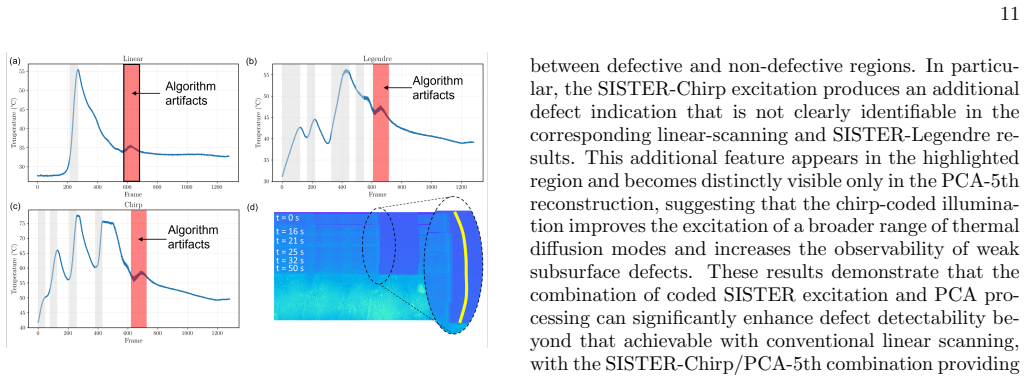
- Abstract and Section IV claim that SISTER "significantly improves ... signal-to-noise ratio and detection capability." Tables II and III report CNR versus velocity and Gaussian width for SISTER alone; Fig. 7 shows qualitative PPT/PCA comparisons among linear, Legendre, and chirp patterns. A direct quantitative CNR (or equivalent) comparison of SISTER-coded reconstructions against conventional pulsed thermography (Fig. 3) and against single-spot LST+DSDR on the same defects and depths is missing. Without that baseline, the magnitude of the claimed SNR/detection improvement remains incompletely supported.
minor comments (5)
- Eq. (29) and the surrounding text cite CNR with a placeholder "[?]"; the reference should be completed (e.g., Usamentiaga et al. or the standard NDT definition already listed as [41]).
- Table I maps temporal parameters to spatial ones; the camera sampling-interval row is written as max(1/f_c, Δx/v), which is dimensionally an interval, but the corresponding spatial-resolution row uses max(Δx, v/f_c). A short clarifying sentence would avoid confusion between temporal sampling and spatial resolution.
- In the simulation heat-source definitions (Eqs. 20–23) the offsets are written as +5v, +8v, +10v; units of the numerical coefficients (mm or s) should be stated explicitly so that the equivalent modulation periods are unambiguous.
- Figure 1(d) caption lists Barker-coded excitation among the spatial patterns, but the experimental section only reports linear, chirp, and Legendre codes. Either add a brief Barker result or adjust the caption to match the data shown.
- Scattered typographical issues: "Hille–Yosida" is fine, but "path-parameterized" and a few hyphenation inconsistencies appear; also "tobs" vs. "t_obs" notation should be uniform.
Circularity Check
No significant circularity: the SISTER equivalence is a direct Galilean coordinate change of the linear heat equation, not a fit or self-citation reduction.
full rationale
The load-bearing claim (Secs. II.A–C, Eqs. 1–17) starts from the standard heat equation, invokes the Markov semigroup mild solution, introduces the Galilean map x = X + vt that turns a static pattern P(x) into the temporal source S_v P, and uses translation invariance of the Laplacian to obtain the transfer function H(k,v) = 1/(\alpha k^{2} + i k v) identical to conventional lock-in. This is pure linear PDE algebra; no free parameters are fitted to data and then re-labeled as predictions, no uniqueness theorem is imported from the authors’ prior work, and no ansatz is smuggled via citation. Dynamic-to-static reconstruction is simply the inverse coordinate map. CNR tables and velocity/width studies are empirical characterizations of the implemented system, not circular forecasts. Self-citations appear in the broader photothermal literature but are not used to force the central identity. The derivation is therefore self-contained against external benchmarks and exhibits no reduction of outputs to inputs by construction.
Assumptions & free parameters
free parameters (3)
- scanning velocity v =
10 mm/s (nominal)
- Gaussian beam width σ =
1.75 mm (experiment); 1 mm (some simulations)
- spatial coding pattern (bit string / peak spacing)
assumptions (5)
- domain assumption Heat conduction obeys the linear diffusion equation ∂T/∂t = α ∇²T + Q with constant diffusivity α.
- standard math The diffusion operator generates a strongly continuous Markov semigroup P(t) = exp(t A) (Hille–Yosida).
- standard math The Laplacian is translation-invariant, so the diffusion semigroup commutes with the scanning (translation) operator.
- domain assumption Sample motion is pure rigid translation at constant known velocity (Galilean frame change x = X + v t).
- domain assumption Optical absorption and surface heat flux can be treated as a prescribed surface source Q without significant optical penetration or nonlinear effects.
invented entities (1)
-
SISTER framework (structured illumination + continuous scanning + DSDR)
independent evidence
Cite this review
Pith. "Pith review of Structured Illumination Scanning Thermography (SISTER)." pith.science (2026). https://pith.science/paper/N6FQE2HF
@misc{pith2026260705565,
  author       = {Pith},
  title        = {Pith review of: Structured Illumination Scanning Thermography (SISTER)},
  year         = {2026},
  howpublished = {\url{https://pith.science/paper/N6FQE2HF}},
  note         = {Machine review of arXiv:2607.05565}
}
read the original abstract
Conventional non-invasive photothermal imaging techniques are fundamentally constrained by the diffusive nature of heat transport, which causes severe energy dissipation during subsurface reconstruction. Although modulation-based approaches partially mitigate this limitation by encoding depth information into phase delay and amplitude attenuation, they remain inherently restricted by repeated temporal excitation, long acquisition times, and stitching artifacts in large-area inspection. In this work, we propose a structured illumination scanning thermography (SISTER) framework that replaces conventional temporal modulation with continuous spatial scanning under static structured illumination. The key theoretical insight is that heat diffusion is governed by a Markov semigroup, while sample motion transforms static spatial illumination into an equivalent temporal excitation through a Galilean coordinate transformation. This formulation enables dynamic-to-static reconstruction without repeated temporal modulation and provides a unified interpretation of spatial scanning and conventional signal modulation. A scanning system is integrated to implement the proposed framework together with a dynamic-to-static reconstruction algorithm for continuous subsurface defect inspection. Both numerical simulations and experimental results demonstrate that the proposed method significantly improves spatial continuity, signal-to-noise ratio, and detection capability while effectively eliminating stitching artifacts and reducing acquisition complexity. The proposed SISTER framework establishes a unified theoretical foundation for scanning photothermal imaging and provides a practical paradigm for high-efficiency, large-scale industrial non-destructive testing.
Figures


Figures from the paper (4 more)



Reference graph
Works this paper leans on
-
[1]
P. Zhu, H. Zhang, S. Sfarra, F. Sarasini, R. Usamenti- aga, G. Steenackers, C. Ibarra-Castanedo, X. Maldague, A comprehensive evaluation of the low-velocity impact be- haviour of intraply hybrid flax/basalt composites using infrared thermography and terahertz time-domain spec- troscopy techniques, NDT & E Int., 154, 103361 (2025)
2025
-
[2]
P. Zhu, Z. Wei, A. Osman, C. Ibarra-Castanedo, A. Mandelis, X. Maldague, H. Zhang,Real-Time Super- Resolution Imaging System Based on Zero-Shot Learning for Infrared Nondestructive Testing, IEEE Tran. Instrum. Meas., 75, 4500409 (2025)
2025
-
[3]
D. L. Balageas, J. C. Krapez, P. Cielo,Pulsed photother- mal modeling of layered material, J. Appl. Phys., 59, 348- 357 (1986)
1986
-
[4]
P. Zhu, H. Zhang, S. Sfarra, F. Sarasini, C. Ibarra- Castanedo, X. Maldague, A. Mandelis,Thermal Diffu- sivity Measurement Based on Thermal / Cooling Exci- tation: Theory and Experiments, IEEE Trans. Instrum. 13 Meas., 2026. https://doi.org/10.1109/TIM.2026.3699727
-
[5]
P. Zhu, H. Zhang, S. Sfarra, F. Sarasini, R. Usamenti- aga, G. Steenackers, C. Ibarra-Castanedo, X. Maldague, Thermal Diffusivity Characterization of Impacted Com- posites Using Evaporative Cryocooling Excitation and In- verse Physics-Informed Neural Networks, IEEE Trans. Instrum. Meas., 75, 6003011 (2026)
2026
-
[6]
Ricci, R
M. Ricci, R. Zito, S. Laureti,Pseudo-noise pulse- compression thermography: A powerful tool for time- domain thermography analysis, NDT & E Int., 148, 103218 (2024)
2024
-
[7]
Laureti, P
S. Laureti, P. Bison, G. Ferrarini, R. Zito, M. Ricci,Si- multaneous multi-frequency lock-in thermography: A new flexible and effective active thermography scheme, NDT & E Int., 146, 103144 (2024)
2024
-
[8]
Q. Yi, H. Malekmohammadi, G. Y. Tian, S. Laureti, M. Ricci,Quantitative evaluation of crack depths on thin aluminum plate using eddy current pulse-compression thermography, IEEE Trans. Ind. Inform., 16, 3963-3973 (2019)
2019
Show all 41 references
-
[9]
P. Zhu, R. Wang, K. Sivagurunathan, S. Sfarra, F. Sarasini, C. Ibarra-Castanedo, X. Maldague, H. Zhang, A. Mandelis,Frequency multiplexed photothermal correla- tion tomography for non-destructive evaluation of man- ufactured materials, Int. J. Extrem. Manuf., 7, 035601 (2025)
2025
-
[10]
P. Zhu, H. Zhang, S. Sfarra, F. Sarasini, Z. Ding, C. Ibarra-Castanedo, X. Maldague,A novel IR-SRGAN as- sisted super-resolution evaluation of photothermal coher- ence tomography for impact damage in toughened thermo- plastic CFRP laminates under room and low temperature, Comp...
2026
-
[11]
P. Zhu, H. Zhang, S. Sfarra, F. Sarasini, R. Usamenti- aga, V. Vavilov, C. Ibarra-Castanedo, X. Maldague,En- hancing resistance to low-velocity impact of electrospun- manufactured interlayer-strengthened CFRP by using in- frared thermography, NDT & E Int., 144, 103083 (2024)
2024
-
[12]
Burgholzer, L
P. Burgholzer, L. Gahleitner, G. Mayr,Linkding diffusive fields to virtual waves as their propagative duals, Phys. Rev. Applied, 24, 044094 (2025)
2025
-
[13]
Gahleitner, G
L. Gahleitner, G. Mayr, P. Burgholzer, U. Cakmak, Three-dimensional defect reconstruction in carbon fiber- reinforced composites with temporally non-uniform pulsed thermography data, NDT & E Int., 154, 103363 (2025)
2025
-
[14]
Gahleitner, G
L. Gahleitner, G. Thummerer, B. Plank, J. Wiedemann, G. Mayr, C. H¨ uhne, P. Burgholzer, U. Cakmak,Pho- tothermal defect imaging in hybrid fiber metal laminates using the vitual wave concept, J. Appl. Phys., 135, 074903 (2024)
2024
-
[15]
Zhang, C
D. Zhang, C. Li, C. Zhang, M. N. Slipchenko, G. Eakins, J. X. Cheng,Depth-resolved mid-infrared photothermal imaging of living cells and organisms with submicrometer spatial resolution, Sci. Adv., 2 e1600521 (2016)
2016
-
[16]
Jiang, P
G. Jiang, P. Zhu, Y. Gai, et al.,Non-invasive inspection for a hand-bound book of the 19th century: Numerical simulations and experimental analysis of infrared, tera- hertz, and ultrasonic methods, Infrared Phys. Technol., 140, 105353 (2024)
2024
-
[17]
Jiang, P
G. Jiang, P. Zhu, S. Sfarra, et al.,Faster R-CNN-CA and thermophysical properties of materials: An ancient mar- quetry inspection based on infrared and terahertz tech- niques, Infrared Phys. Technol., 142, 105563 (2024)
2024
-
[18]
Cheng, M
L. Cheng, M. Kersemans,Dual-IRT-GAN: A defect- aware deep adversarial network to perform super- resolution tasks in infrared thermographic inspection, Compos. Part B-Eng., 247, 110309 (2022)
2022
-
[19]
P. Zhu, H. Zhang, S. Sfarra, F. Sarasini, X. Maldague, A. Mandelis,Three-dimensional wide-bandwidth quantum energy truncation terahertz coherence tomography, Phys. Rev. Lett., (2026). https://doi.org/10.1103/spsr-xr47
2026 doi
-
[20]
Holmes, B
C. Holmes, B. W. Drinkwater, P. D. Wilcox,Post- processing of the full matrix of ultrasonic transmit-receive array data for non-destructive evaluation, NDT & E Int., 38, 701-711 (2005)
2005
-
[21]
P. Zhu, Z. Wei, S. Sfarra, R. Usamentiaga, G. Steenack- ers, A. Mandelis, X. Maldague, H. Zhang,THz- Super-Resolution Generative Adversarial Network: Deep- Learning-Based Super-Resolution Imaging Using Tera- hertz Time-Domain Spectroscopy, IEEE Trans. Ind. In- form., 21, 6660-...
2025
-
[22]
Maldague, S
X. Maldague, S. Marinetti,Pulse phase infrared thermog- raphy, J. Appl. Phys., 79, 2694-2698 (1996)
1996
-
[23]
Lecompagnon, S
J. Lecompagnon, S. Ahmadi, P. Hirsch, C. Rupprecht, M. Ziegler,Thermographic detection of internal defects using 2D photothermal super resolution reconstruction with se- quential laser heating, J. Appl. Phys., 131, 185107 (2022)
2022
-
[24]
Tabatabaei, A
N. Tabatabaei, A. Mandelis,Thermal Coherence Tomog- raphy Using Match Filter Binary Phase Coded Diffusion Waves, Phys. Rev. Lett., 107, 165901 (2011)
2011
-
[25]
Mandelis, L
A. Mandelis, L. Nicolaides, Y. Chen,Structure and the Reflectionless/Refractionless Nature of Parabolic Diffusion-Wave Fields, Phys. Rev. Lett., 87, 020801 (2001)
2001
-
[26]
Ibarra-Castanedo, J
C. Ibarra-Castanedo, J. M. Piau, S. Guilbert, N. P. Avde- lidis, M. Genest, A. Bendada, X. P. V. Maldague,Com- parative study of active thermography techniques for the nondestructive evaluation of honeycomb structures, Res. Nondestruct. Eval., 20, 1-31 (2009)
2009
-
[27]
Ibarra-Castanedo, D
C. Ibarra-Castanedo, D. Gonz´ alez, M. Klein, S. Vallerand, X. Maldague,Infrared image processing and data analysis, Infrared Phys. Technol., 46, 75-83 (2004)
2004
-
[29]
Mandelis, D
A. Mandelis, D. Thapa,Generalized Fourier-Laplace pho- tothermal spectroscopy of optically absorbing media gen- erated by arbitrary optical-excitation waveforms, Phys. Rev. Applied, 23, 054034 (2025)
2025
-
[30]
Thapa, P
D. Thapa, P. Tavakolian, G. Zhou, et al.,Three- dimensional thermophotonic super-resolution imaging by spatiotemporal diffusion reversal method, Sci. Adv., 9, eadi1899 (2023)
2023
-
[31]
Ahmadi, G
S. Ahmadi, G. Thummerer, S. Breitwieser, et al.,Multi- dimensional Reconstruction of Internal Defects in Addi- tively Manufactured Steel Using Photothermal Super Res- olution Combined With Virtual Wave-Based Image Pro- cessing, IEEE Trans. Ind. Inform., 17, 7368-7378 (2021)
2021
-
[32]
L. M. Wilcox, M. Bonmarin, K. M. Donnell,Effect of Signal Modulation on Active Microwave Thermography, IEEE Trans. Instrum. Meas., 73, 7005314 (2024)
2024
-
[33]
K. Tian, J. Peng, Q. Zhang, F. Zhang, J. Lee,Laser arrays scanning thermography with optimized excitation signals for efficient rail defect detection, NDT & E Int., 156, 103461 (2025)
2025
-
[34]
Schmid, J
S. Schmid, J. Reinhardt, C. U. Grosse,Spatial and tem- poral deep learning for defect detection with lock-in ther- mography, NDT & E Int., 143, 103063 (2024). 14
2024
-
[35]
P. Zhu, D. Wu, Y. Wang, Z. Miao,Defect detectability based on square wave lock-in thermography, Appl. Opt., 61, 6134-6143 (2022)
2022
-
[36]
Hedayatrasa, G
S. Hedayatrasa, G. Poelman, J. Segers, W. V. Paopegem, M. Kersemans,Novel discrete frequency-phase modulated excitation waveform for enhanced depth resolvability of thermal wave radar, Mech. Syst. Signal Process., 132, 512-522 (2019)
2019
-
[37]
Tabatabaei, A
N. Tabatabaei, A. Mandelis,Thermal-wave radar: A novel subsurface imaging modality with extended depth- resolution dynamic range, Rev. Sci. Instrum., 80, 034902 (2009)
2009
-
[38]
F. Wang, Y. Wang, J. Liu, Y. Wang,The feature recogni- tion of CFRP subsurface defects using low-energy chirp- pulsed radar thermography, IEEE Trans. Ind. Inform., 16, 5160-5168 (2019)
2019
-
[39]
Hedayatrasa, W
S. Hedayatrasa, W. V. Paepegem, M. Kersemans, Diffusion-compensated correlation analysis of frequency- modulated thermal signal for quantitative infrared ther- mography, Mech. Syst. Signal Process., 197, 110373 (2023)
2023
-
[40]
Ibarra-Castanedo, P
C. Ibarra-Castanedo, P. Servais, M. Klein, T. Boulanger, A. Kinard, S. Hoffait, X. P. V. Maldague,Detection and Characterization of Artificial Porosity and Impact Dam- age in Aerospace Carbon Fiber Composites by Pulsed and Line Scan Thermography, Appl. Sci., 13, 6135 (2023)
2023
-
[41]
Usamentiaga, C
R. Usamentiaga, C. Ibarra-Castanedo, X. Maldague, More than Fifty Shades of Grey: Quantitative Charac- terization of Defects and Interpretation Using SNR and CNR, NDT & E Int., 145, 103133 (2024)
2024
-
[42]
Rajic,Principal component thermography for flaw contrast enhancement and flaw depth characterisation in composite structures, Compos
N. Rajic,Principal component thermography for flaw contrast enhancement and flaw depth characterisation in composite structures, Compos. Struct., 58, 521-528 (2002)
2002
Reviewed July 11, 2026 · model on record in the stance chip above.
Discussion (0). Sign in to comment.