REVIEW 4 major objections 5 minor 21 references
Kinetic ionization and recombination coefficients in the dense semiclassical plasmas on the basis of the effective interaction potential
T0 review · 4 major / 5 minor · reviewed 2026-08-14 · deepseek-v4-flash
Pith's one-line read This paper claims that in dense semiclassical hydrogen plasma the ionization coefficient falls while the recombination coefficient rises as density or coupling increases.
desk verdict A straightforward application of an established potential undercut by a load-bearing contradiction about how the capture cross section was calculated. read the letter →
The pith
A machine-rendered reading of the paper's core claim, the machinery that carries it, and where it could break.
The reading
What carries the argument
The central machinery is the effective interaction potential (1), which combines Debye screening at large distances with quantum diffraction at short distances and remains finite at zero separation, together with two cross-section routes: the phase-function method for electron-impact ionization (used in eq. (6)) and the perturbation-theory Bohr-Lindhard method for electron capture (used in eq. (7)). The potential fixes the electron-ion interaction energy that drives both rates; the cross sections are averaged over the Maxwell momentum distribution to yield the ionization and recombination coefficients.
What would settle it
A direct calculation or measurement of the electron-impact ionization and electron-ion recombination rate coefficients for hydrogen at fixed temperature, e.g., $T \approx 10^4$ K, across densities spanning $r_s \lesssim 1$, using a full quantum scattering treatment of the same effective potential, would settle the trend: if the ionization coefficient does not decrease, or the recombination coefficient does not increase, with rising density and coupling, the paper's central claim fails.
Extended reading notes
Core claim
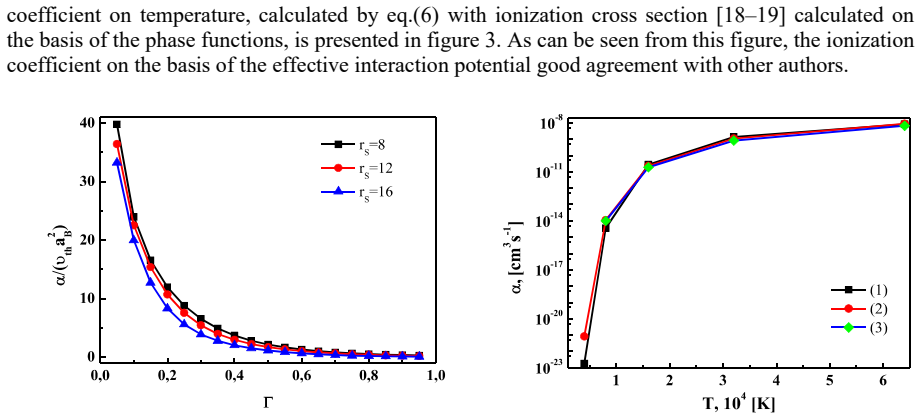
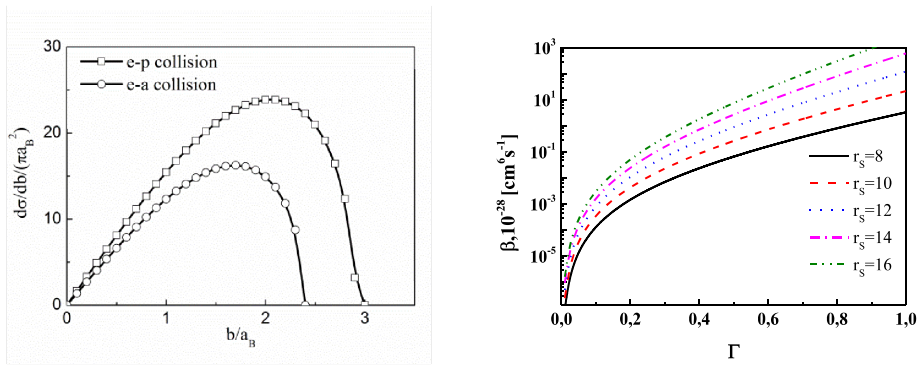
The central claim is that, for dense semiclassical hydrogen plasma, the electron-impact ionization coefficient $K_i$ decreases as the density or the coupling parameter $\Gamma$ increases, while the recombination coefficient $K_r$ increases. The paper derives these coefficients by inserting the effective electron-ion interaction potential (1), which is finite at short range from quantum diffraction and Debye-like at long range from static screening, into the phase-function ionization cross section and into a perturbative Bohr-Lindhard electron-capture cross section, and then integrating over the Maxwell distribution of electron momenta. It reports that the computed ionization coefficients reproduce earlier published ionization data (figure 3), and that the recombination coefficient grows when the density parameter decreases, because weaker screening strengthens the electron-ion attraction.
Load-bearing premise
The results stand on the assumption that the effective potential (1), taken from the paper's earlier references, and the perturbation-theory electron-capture cross section of Ref. [13] accurately describe electron-ion interactions in dense semiclassical hydrogen plasma; if either is wrong, the computed trends and coefficients are unsupported.
Editorial extensions
If this is right
- At higher density and coupling, dense semiclassical hydrogen plasma retains fewer free electrons at a given temperature, shifting its composition toward neutral atoms.
- The same effective potential and cross-section scheme can be applied to hydrogen-like ions by changing the ion charge $Z$, ionization energy, and reduced mass.
- Lower density weakens screening, strengthens electron-ion attraction, and raises the recombination coefficient, opposite to the density trend of the ionization coefficient.
- The computed ionization coefficients matching earlier data (figure 3) supports using the effective potential in kinetic models where ideal-plasma rates would be inaccurate.
Reading between the lines
- If the monotonic trends survive more exact scattering treatments, collisional-radiative models of dense plasma should use density-dependent rate coefficients; ideal-plasma rates would overestimate ionization and underestimate recombination in compressed matter.
- The paper never checks that $K_i$ and $K_r$ satisfy detailed balance with the Saha equation for the same potential; verifying that identity would test whether the two independent cross-section schemes are mutually consistent.
- The introduction says electron trajectories are computed numerically while the conclusion says they are rectilinear; re-deriving the capture cross section with the numerical trajectories is a concrete way to test the recombination results.
- The same potential could be used to estimate the rate of $\mathrm{H}^-$ formation by polarization capture, since the paper's capture cross sections describe electrons bound to hydrogen atoms and protons; strong recombination at high coupling would make negative-ion populations a relevant correction.
Signed reviews
Editorial analysis
A structured set of objections, weighed in public.
Referee Report
Summary. The paper computes ionization and recombination rate coefficients for dense semiclassical hydrogen plasmas using an effective electron-ion interaction potential that combines Debye screening at large distances with quantum diffraction effects at short distances. The ionization cross section is obtained by a phase-function method and the electron-capture cross section by a Bohr-Lindhard treatment; these are then inserted into standard kinetic formulas (5)-(7). The central reported trends are that the ionization coefficient decreases with increasing density or coupling parameter, while the recombination coefficient increases. The authors claim agreement with earlier published ionization coefficients (Figure 3).
Significance. If the underlying cross sections and effective potential are correctly specified, the paper would provide useful kinetic data for dense semiclassical plasmas relevant to laser-produced plasmas and astrophysical environments. The use of a single effective interaction potential for both elastic and inelastic processes is a coherent framework, and the paper correctly identifies that the recombination coefficient is governed by the electron-capture cross section. The manuscript also has strengths: it applies previously established kinetic formulas without introducing new free parameters, and it presents a comparison with published data, even though the comparison is not quantified. The significance is moderate because the central results depend entirely on cross-section inputs that are currently not shown.
major comments (4)
- [Section 2, Eq. (1)] The effective potential is cited as Eq. (1), but the formula is not printed in the manuscript; similarly Eqs. (2)-(7) appear only as numbered placeholders. Without the explicit form of the potential, the Debye length, diffraction parameter, and reduced mass definitions, the numerical results cannot be reproduced or even checked dimensionally. The authors must include the full equations in the revised manuscript.
- [Section 1 vs. Section 4 and Figure 5 caption] There is a direct contradiction about how the electron-capture cross section was computed. Section 1 states that the authors used the approach of Ref. [13] with 'numerical simulation of the equations of electron motion near proton,' whereas Section 4 and the Figure 5 caption state that 'the motion of an electron was considered on the basis of perturbation theory (rectilinear trajectories).' This is load-bearing because the recombination coefficient trend in Figure 5 is obtained from this cross section, and the rectilinear approximation is least reliable precisely in the strong-coupling regime (r_s <= 1) where the claimed increase occurs. The authors must state unambiguously which trajectories were used and provide the corresponding cross-section formula.
- [Section 3, Figure 3] The statement that the ionization coefficient is in 'good agreement with other authors' is not quantified. The figure compares curve 1 with Refs. [20] and [21], but no numerical values, error bars, or relative differences are given, so the reader cannot assess the quality of the agreement. The authors should provide a quantitative comparison, for example the ratio of the coefficients at selected temperatures.
- [Section 3, Eqs. (5)-(7)] The ionization and recombination coefficients are computed from cross sections that are not shown: the phase-function ionization cross section from Refs. [18-19] and the electron-capture cross section from Ref. [13] are referred to but not reproduced. Since the central numerical results are entirely determined by these cross sections, the authors must include their explicit expressions (or give a self-contained derivation) so that the results are reproducible.
minor comments (5)
- [Abstract] The phrase 'method phase function' should be 'phase-function method' for grammatical correctness.
- [Section 2] The dimensionless parameters r_s, Gamma, and a are introduced without a clear display of their definitions; since the equations are missing, the definitions of these variables should be written out explicitly.
- [Figure 2 and Figure 5] The captions do not state the fixed values of the other thermodynamic parameters (e.g., temperature or density) for each curve, making it difficult to interpret the plotted trends.
- [References] Reference [6] lists a volume and page ('57 230') but not the year in the visible text, and reference [13] should have a full title for completeness.
- [Section 4] The conclusion repeats the density-dependence claims but does not mention the uncertainty arising from the unresolved trajectory issue; a brief note on the range of validity of the rectilinear approximation would help the reader.
Circularity Check
No circularity: the kinetic coefficients are computed from standard kinetic integrals over adopted cross sections, with no parameter fitted to the target results.
full rationale
The paper's derivation chain is a straightforward model application rather than a closed loop. Equation (6) evaluates the ionization coefficient as a Maxwellian average of an ionization cross section, and equation (7) evaluates the recombination coefficient as the corresponding average using the electron-capture cross section. The inputs are the adopted effective interaction potential, the phase-function ionization cross section, and the Bohr-Lindhard capture cross section from prior work. No parameter is fitted to the ionization or recombination coefficients, and no equation defines the predicted trends in terms of the effective potential by construction. The ionization coefficient is externally checked in Fig. 3 against published data [20,21], so the central ionization result is not validated only by self-citation. The recombination coefficient is not externally benchmarked and depends on the authors' earlier capture model [13], but reliance on a prior model is not circular unless the target result is written into that model, which is not shown here. The manuscript's contradictory statements about numerical versus rectilinear electron trajectories (Sec. 1 says numerical simulation, Sec. 4 and Fig. 5 say perturbation theory with rectilinear trajectories) are a serious reproducibility and correctness concern, but they are not a self-definitional reduction; an ambiguous or even wrong model is not the same as a prediction that is equivalent to its input by construction. Accordingly, the circularity score is 0.
Assumptions & free parameters
assumptions (4)
- domain assumption The effective interaction potential (1) from Refs. [5-14] models electron-ion interactions in dense semiclassical plasmas.
- domain assumption Standard kinetic equations (5)-(7) with a Maxwell momentum distribution apply to this nonideal plasma.
- domain assumption The Bohr-Lindhard and perturbation-theory capture cross section from Ref. [13] is valid in the strong-coupling regime.
- domain assumption The phase-function method for ionization cross sections [18,19] is applicable in this regime.
Cite this review
Pith. "Pith review of Kinetic ionization and recombination coefficients in the dense semiclassical plasmas on the basis of the effective interaction potential." pith.science (2026). https://pith.science/paper/NAGTQCI7
@misc{pith2026190809522,
  author       = {Pith},
  title        = {Pith review of: Kinetic ionization and recombination coefficients in the dense semiclassical plasmas on the basis of the effective interaction potential},
  year         = {2026},
  howpublished = {\url{https://pith.science/paper/NAGTQCI7}},
  note         = {Machine review of arXiv:1908.09522}
}
abstract
In this paper, the ionization and recombination coefficients of dense semiclassical hydrogen plasma on the basis of the effective interaction potential have been investigated. For this goal the Bohr$-$Lindhard method and method phase function have been applied to obtain the electron capture and ionization cross sections. The electron capture cross section has been calculated in the framework of the perturbation theory. The effective interaction potential, which takes into account the screening effects at large distances and quantum diffraction effects at short distances, was used. The results of the investigation show the behaviour of the calculated kinetic coefficients with a change in the plasma parameters: the ionization coefficient decreases with increasing density and (or) coupling parameter while the recombination coefficient increases.
Figures

Reference graph
Works this paper leans on
-
[13]
Seisembayeva M M, Dzhumagulova K N and Ramazanov T S 2016 Nukleonika 61(2) 201
work page 2016
-
[20]
Shah M B, Elliott D S and Gilbody H B 1987 J. Phys. B. 20 3501
work page 1987
-
[21]
Biberman L M, Vorobiev V S, Yakubov I T 1982 Kinetics of a Nonequilibrium Low- temperature Plasma (Moscow: Nauka) p 375
work page 1982
-
[1]
Farid N, Harilal S S, Ding H, and Hassanein A 2013 Phys. Plasmas 20 073114
work page 2013
-
[2]
Rosmej F B 2001 EPL 55 472
work page 2001
-
[3]
Annaloro J, Morel V, Bultel A and Omaly P 2012 Phys. Plasmas 19 073515
work page 2012
-
[4]
Johnsen R 2012 Phil. Trans. R. Soc. A 370 5109
work page 2012
-
[5]
Dzhumagulova K N, Shalenov E O and Ramazanov T S 2015 Phys. Plasmas 22 082120
work page 2015
Show all 21 references
-
[6]
Plasma Phys
Dzhumagulova K N, Shalenov E O, Ramazanov T S and Gabdullina G L 2015 Contrib. Plasma Phys. 57 230
2015
-
[7]
Plasmas 24 012101
Shalenov E O, Dzhumagulova K N and Ramazanov T S 2017 Phys. Plasmas 24 012101
2017
-
[8]
Plasma Phys
Shalenov E O, Rosmej S, Reinholz H, Röpke G, Dzhumagulova K N and Ramazanov T S 2017 Contrib. Plasma Phys. 57 486
2017
-
[9]
Plasmas 25 082706
Shalenov E O, Dzhumagulova K N, Ramazanov T S, Röpke G and Reinholz H 2018 Phys. Plasmas 25 082706
2018
-
[10]
Shalenov E O, Dzhumagulova K N, Ramazanov T S and Gabdullina G L 2016 Int. J. Math. Phys. 7 131
2016
-
[11]
45th EPS Conference on Plasma Physics
Shalenov E O, Dzhumagulova K N, Ramazanov T S, Reinholz H and Röpke G 2018 Conference Proceedings “45th EPS Conference on Plasma Physics” (Prague) vol 42A (Belfast: EPS) p 561
2018
-
[12]
45th EPS Conference on Plasma Physics
Shalenov E O, Seisembayeva M M, Dzhumagulova K N and Ramazanov T S 2018 Conference Proceedings “45th EPS Conference on Plasma Physics” (Prague) vol 42A (Belfast: EPS) p 557
2018
-
[14]
Plasmas 9 3758
Ramazanov T S and Dzhumagulova K N 2002 Phys. Plasmas 9 3758
2002
-
[15]
Plasmas 5 1485
Bornath T, Schlanges M and Prenzel R 1998 Phys. Plasmas 5 1485
1998
-
[16]
Biberman L M, Vorobev V S and Iakubov I T 1987 Kinetics of Nonequilibrium Low- temperature Plasmas (New York: Consultants Bureau) p 484
1987
-
[17]
Kremp D, Schalges M and Kraeft W D 2005 Quantum Statistics of Nonideal Plasmas (Berlin: Springer) p 536
2005
-
[18]
Shalenov E O, Dzhumagulova K N, Ramazanov T S and Dzhumagulov M N 2017 Rec. Contr. Phys. 62(3) 26
2017
-
[19]
Baimbetov F B and Kudyshev Z A 2009J. Phys. A: Math. Theor. 42(21) 214034
Reviewed August 14, 2026 · model on record in the stance chip above.
Discussion (0). Continue with ORCID to comment.