REVIEW 2 major objections 5 minor 50 references
Chromatic Effects Across the Roman Focal Plane: Implications for Supernova Photometry and Measurements of Cosmological Parameters
T0 review · 2 major / 5 minor · reviewed 2026-07-13 · grok-4.5
Pith's one-line read Uncorrected detector-to-detector filter wavelength shifts on Roman would bias dark-energy parameters beyond statistical errors; the absolute 0.06% calibration floor does not.
desk verdict Solid, mission-relevant quantification: uncorrected Roman FPA chromatic shifts alone can exceed the statistical floor on w0–wa; the 20% characterization requirement is the usable takeaway. read the letter →
The pith
A machine-rendered reading of the paper's core claim, the machinery that carries it, and where it could break.
The reading
What carries the argument
SCA-specific filter transmission curves obtained by a linear edge-to-edge mapping of the measured TVAC red and blue edges onto the reference SCA-2 bandpass, applied inside end-to-end SNANA simulations of the Sundial HLTDS cadence.
What would settle it
Apply the same SCA-specific curves to an independent high-SNR stellar sample (or an early on-orbit standard-star campaign) and check whether the predicted color-dependent magnitude offsets match the observed photometry at the few-millimag level across the focal plane.
Extended reading notes
Core claim
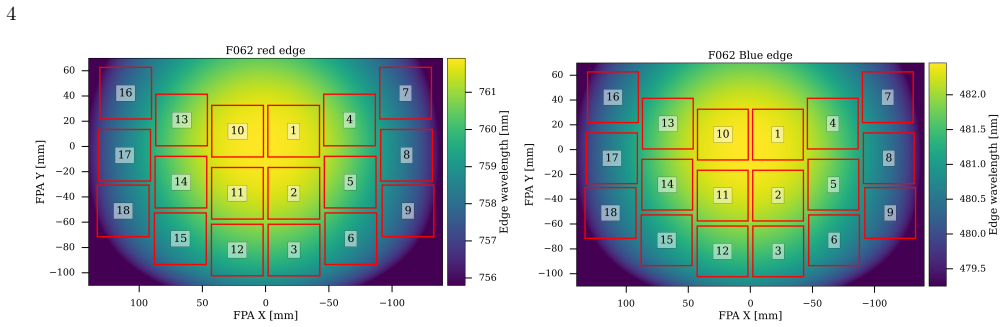
If left uncorrected, the measured FPA-dependent wavelength shifts (ranging roughly +6 to -80 Å across the 18 SCAs) introduce a redshift-dependent distance-modulus bias that propagates to Δw0 ≈ -0.066 and Δwa ≈ 0.236, exceeding the forecast statistical uncertainties of 0.025 and 0.114 and rendering the survey systematics-limited. Detector-specific filter curves recover unbiased constraints, and characterization of the shifts to within ~20% keeps the bias below the statistical noise floor; the coherent 0.06% absolute-calibration residual is already subdominant.
Load-bearing premise
The assumption that a simple linear stretch of the two measured filter edges fully captures every SCA's true transmission, including unmodeled ripple and higher-order coating variations.
Editorial analysis
A structured set of objections, weighed in public.
Referee Report
Summary. The paper quantifies how wavelength-dependent filter transmission variations across Roman's 18 SCAs affect SN Ia photometry and cosmology for the HLTDS. Using controlled SNANA/Pippin simulations with identical seeds, SALT3-NIR light-curve fits, BBC bias corrections, and wfit cosmology, the authors compare a nominal (no-shift) case against FPA-dependent shifts (linear edge-to-edge maps of TVAC-measured red/blue edges relative to SCA 2) and coherent 0.06% absolute-wavelength offsets. Uncorrected FPA shifts produce a redshift-dependent distance-modulus bias that yields Δw0 ≈ −0.066 and Δwa ≈ 0.236 (CMB prior), exceeding the forecast statistical errors σstat,w0 = 0.025 and σstat,wa = 0.114. Detector-specific filter curves recover unbiased cosmology; a half-shift test shows near-linear scaling, implying that the FPA shifts must be known to ~20% to keep the systematic below the statistical floor. Coherent 0.06% offsets produce negligible bias (Δwa ≈ −0.0004).
Significance. Calibration systematics dominate modern SN Ia cosmology, and Roman's Stage-IV dark-energy goals make a quantitative assessment of FPA chromatic effects essential before launch. The work supplies a concrete, falsifiable requirement (characterize FPA wavelength shifts to ~20%) and demonstrates that the already-achieved pre-launch 0.06% absolute edge-wavelength precision is sufficient for the coherent residual. Strengths include the controlled identical-seed simulation design that isolates the transmission change, the half-shift scaling test, public SNANA/Pippin configuration files and detector-specific transmission curves, and an explicit path to on-orbit validation with stellar photometry. If the numerical results hold, the paper will be a required reference for the Roman SN cosmology pipeline and for the mission's systematic-error budget.
major comments (2)
- Abstract vs. body sign inconsistency on Δwa: the abstract states Δwa = −0.236 while Table 2 and §3.3 report Δwa = +0.236 (and the abstract's Δw0 ~ −0.06 is consistent with Table 2's −0.066). The definition ΔX = X(nominal) − X(shifted) is given in Eqs. (9)–(11); the abstract must be brought into agreement with the body so that the central numerical claim is unambiguous.
- §2.2, Eqs. (1)–(3): the linear edge-to-edge map that matches only the red and blue 50% edges of SCA 2 is the load-bearing model of FPA-dependent transmission. The text itself notes that a full transmission model requires additional field dependence of the ripple and higher-order coating variations that are not yet included. Because the half-shift test (Table 2) already shows near-linear scaling of the cosmological bias, a short quantitative bound or sensitivity test on residual ripple (even a simple estimate of the mmag-level impact) would strengthen the claim that the 20% characterization requirement remains robust once the full optical model is available.
minor comments (5)
- Figure 4 caption and surrounding text: the best-fit cosmology line is described as a 'simple Roman-only sample MCMC' while the main cosmology results use wfit with BBC and a CMB prior; a one-sentence clarification of the difference would avoid confusion.
- Table 1 column headers and the COH-FIXED impact column: the sign convention for 'impact [mmag]' (nominal − shifted) should be stated explicitly so that positive/negative values can be compared directly with Figures 6–7.
- §2.4: the statement that SNANA supports at most 62 filters and that 9 unique SCA pairs reduce the set to 54 is useful; a brief note on whether the pairing is exact or approximate (and whether any residual SCA-to-SCA difference remains) would help reproducibility.
- §3.1 / Figure 7: the filter-dropout redshifts (z ~ 1.0, 1.8, 2.4) are correctly identified as the source of the >50 mmag outliers; a short remark that these outliers are excluded from the linear slope fits (as done for the Tripp components) would make the analysis chain fully transparent.
- References: Switzer et al. (2025) is the key laboratory source; ensure the citation is complete and that the GitHub optical-model link remains accessible for readers.
Circularity Check
No significant circularity: forward simulation of laboratory-measured filter edges through an independent SNANA/BBC/wfit pipeline; outputs are not forced by construction from the inputs.
full rationale
The paper's derivation chain is a controlled forward model: TVAC-measured edge wavelengths (Switzer et al. 2025) are converted via a linear map (Eqs. 1–3) into per-SCA transmission curves, applied to identical-seed SNANA light-curve simulations of the Sundial HLTDS cadence, then processed through SALT3 fitting, BBC bias corrections, and wfit cosmology. The reported Δw0 ≈ −0.066 and Δwa ≈ 0.236 (and the 20 % characterization requirement from the half-shift test) are numerical outputs of that pipeline, not quantities that were fitted and then re-used as inputs, nor quantities that are definitionally identical to the input edge shifts. Self-citations (K25, Rose et al. 2025, Paulin in prep, Switzer et al. 2025) supply the observing strategy, simulation infrastructure, and laboratory filter data; none of them is a uniqueness theorem or ansatz that forces the cosmological bias result. The linear edge-to-edge approximation is an acknowledged modeling choice (Section 2.2 notes that ripple/higher-order coating variations remain unmodeled), not a circular redefinition. No step reduces a claimed prediction to its own inputs by construction.
Assumptions & free parameters
free parameters (3)
- per-SCA linear slope m and intercept C
- 0.06% absolute edge-wavelength uncertainty
- SALT3-NIR stretch and color population parameters
assumptions (4)
- ad hoc to paper A linear transformation of the SCA-2 bandpass that matches only the red and blue 50% edges fully represents the true SCA-dependent transmission (including ripple).
- domain assumption Spectroscopic redshifts are known perfectly and there is no core-collapse or peculiar-Ia contamination.
- domain assumption The SALT3-NIR spectral model remains valid when the observed-frame filters are shifted by tens of angstroms.
- domain assumption Water-ice accumulation and temporal evolution of the coatings can be ignored for the present bias estimate.
Cite this review
Pith. "Pith review of Chromatic Effects Across the Roman Focal Plane: Implications for Supernova Photometry and Measurements of Cosmological Parameters." pith.science (2026). https://pith.science/paper/NAMXPKSX
@misc{pith2026260708886,
  author       = {Pith},
  title        = {Pith review of: Chromatic Effects Across the Roman Focal Plane: Implications for Supernova Photometry and Measurements of Cosmological Parameters},
  year         = {2026},
  howpublished = {\url{https://pith.science/paper/NAMXPKSX}},
  note         = {Machine review of arXiv:2607.08886}
}
abstract
Calibration uncertainties are the leading systematics in cosmological analyses using Type Ia supernovae (SNe Ia). For the \textit{Nancy Grace Roman Space Telescope (Roman)}, we quantify the impact of chromatic effects on SNe Ia photometry and derived cosmological parameters, using simulated light curves from the High-Latitude Time Domain Survey. We investigate two sources of wavelength-dependent bias: focal plane array (FPA)-dependent wavelength shifts arising from spatial variations across \textit{Roman's} 18 detectors, and coherent wavelength shifts corresponding to the measured $0.06\%$ uncertainty in absolute filter wavelength calibration. Using simulated SNe Ia light curves, we find that the FPA-dependent shifts -- which range from +6 to -80 $\rm \AA$ introduce a redshift-dependent distance modulus bias that, if left uncorrected, propagates to $\Delta w_0 \sim -0.06$ and $\Delta w_a = -0.236$, which are larger than the forecast statistical uncertainties of $\sigma_{\rm stat, w_0} = 0.025$ and $\sigma_{\rm stat, w_a} = 0.114$, rendering the survey systematics-limited. We probe the impact of chromatic effects by employing detector-specific filter curves that recover unbiased cosmological constraints; to remain below the statistical noise floor, FPA wavelength shifts must be characterized to within 20\%. In contrast, a coherent 0.06\% offset in filter wavelength calibration -- ranging from -3 to -11 $\rm \AA$ -- produces negligible redshift-dependent bias, with a minimal spread in $w_a$ ($\Delta w_a = -0.0004, \sigma_{w_{a,\rm sys}} = 0.114)$, demonstrating that the achieved pre-launch calibration precision is sufficient for this systematic to remain subdominant. Our results establish that chromatic effects are a required component of SN Ia cosmology with \textit{Roman}.
Figures


Figures from the paper (8 more)


Reference graph
Works this paper leans on
-
[1]
G., Aguilar, J., Ahlen, S., et al
Adame, A. G., Aguilar, J., Ahlen, S., et al. 2025, JCAP, 2025, 012, doi: 10.1088/1475-7516/2025/04/012
-
[2]
2019, arXiv e-prints, arXiv:1902.05569, doi: 10.48550/arXiv.1902.05569
Akeson, R., Armus, L., Bachelet, E., et al. 2019, arXiv e-prints, arXiv:1902.05569, doi: 10.48550/arXiv.1902.05569
-
[3]
2026, AJ, 171, 129, doi: 10.3847/1538-3881/ae3714 Astropy Collaboration, Price-Whelan, A
Aldoroty, L., Scolnic, D., Kannawadi, A., et al. 2026, AJ, 171, 129, doi: 10.3847/1538-3881/ae3714 Astropy Collaboration, Price-Whelan, A. M., Sip˝ ocz, B. M., et al. 2018, AJ, 156, 123, doi: 10.3847/1538-3881/aabc4f
-
[4]
2014, A&A, 568, A22, doi: 10.1051/0004-6361/201423413
Betoule, M., Kessler, R., Guy, J., et al. 2014, A&A, 568, A22, doi: 10.1051/0004-6361/201423413
-
[5]
C., Gordon, K
Bohlin, R. C., Gordon, K. D., & Tremblay, P.-E. 2014, PASP, 126, 711
2014
-
[6]
Brout, D., Hinton, S. R., & Scolnic, D. 2021, ApJL, 912, L26, doi: 10.3847/2041-8213/abf4db
-
[7]
2022, ApJ, 938, 111, doi: 10.3847/1538-4357/ac8bcc
Brout, D., Taylor, G., Scolnic, D., et al. 2022, ApJ, 938, 111, doi: 10.3847/1538-4357/ac8bcc
-
[8]
Burke, D. L., Rykoff, E. S., Allam, S., et al. 2018, AJ, 155, 41, doi: 10.3847/1538-3881/aa9f22 DES Collaboration, Abbott, T. M. C., Acevedo, M., et al. 2024, ApJL, 973, L14, doi: 10.3847/2041-8213/ad6f9f
Show all 50 references
-
[9]
Fitzpatrick, E. L. 1999, PASP, 111, 63, doi: 10.1086/316293
1999 doi
-
[10]
2007, A&A, 466, 11, doi: 10.1051/0004-6361:20066930
Guy, J., Astier, P., Baumont, S., et al. 2007, A&A, 466, 11, doi: 10.1051/0004-6361:20066930
2007 doi
-
[11]
2020, The Journal of Open Source Software, 5, 2122, doi: 10.21105/joss.02122
Hinton, S., & Brout, D. 2020, The Journal of Open Source Software, 5, 2122, doi: 10.21105/joss.02122
2020 doi
-
[12]
Hinton, S. R. 2016, The Journal of Open Source Software, 1, 00045, doi: 10.21105/joss.00045
2016 doi
-
[13]
2012, ApJ, 752, 79, doi: 10.1088/0004-637X/752/2/79
Hlozek, R., Kunz, M., Bassett, B., et al. 2012, ApJ, 752, 79, doi: 10.1088/0004-637X/752/2/79
2012 doi
-
[14]
J., et al
Hounsell, R., Scolnic, D., Foley, R. J., et al. 2018, ApJ, 867, 23, doi: 10.3847/1538-4357/aac08b
2018 doi
-
[15]
Hunter, J. D. 2007, Computing in Science & Engineering, 9, 90, doi: 10.1109/MCSE.2007.55
2007 doi
-
[16]
O., Scolnic, D
Jones, D. O., Scolnic, D. M., Foley, R. J., et al. 2019, ApJ, 881, 19, doi: 10.3847/1538-4357/ab2bec
2019 doi
-
[17]
2025, arXiv e-prints, arXiv:2506.04402, doi: 10.48550/arXiv.2506.04402
Kessler, R., Hounsell, R., Joshi, B., et al. 2025, arXiv e-prints, arXiv:2506.04402, doi: 10.48550/arXiv.2506.04402
2025 doi
-
[18]
2017, ApJ, 836, 56, doi: 10.3847/1538-4357/836/1/56
Kessler, R., & Scolnic, D. 2017, ApJ, 836, 56, doi: 10.3847/1538-4357/836/1/56
2017 doi
-
[19]
2023, The Astrophysical Journal Letters, 952, L8, doi: 10.3847/2041-8213/ace34d
Kessler, R., Vincenzi, M., & Armstrong, P. 2023, The Astrophysical Journal Letters, 952, L8, doi: 10.3847/2041-8213/ace34d
2023 doi
-
[20]
P., Cinabro, D., et al
Kessler, R., Bernstein, J. P., Cinabro, D., et al. 2009, PASP, 121, 1028, doi: 10.1086/605984
2009 doi
-
[21]
A., & Hlozek, R
Kunz, M., Bassett, B. A., & Hlozek, R. A. 2007, PhRvD, 75, 103508, doi: 10.1103/PhysRevD.75.103508
2007 doi
-
[22]
2019, MNRAS, 485, 5329, doi: 10.1093/mnras/stz619
Lasker, J., Kessler, R., Scolnic, D., et al. 2019, MNRAS, 485, 5329, doi: 10.1093/mnras/stz619
2019 doi
-
[23]
G., Murakami, Y
Marlin, E. G., Murakami, Y. S., Brout, D., et al. 2025, arXiv e-prints, arXiv:2512.21903, doi: 10.48550/arXiv.2512.21903
2025 doi
-
[24]
P., Kessler, R., et al
Marriner, J., Bernstein, J. P., Kessler, R., et al. 2011, ApJ, 740, 72, doi: 10.1088/0004-637X/740/2/72
2011 doi
-
[25]
J., Bennett, C., et al
Mosby, G., Rauscher, B. J., Bennett, C., et al. 2020, Journal of Astronomical Telescopes, Instruments, and Systems, 6, 046001, doi: 10.1117/1.JATIS.6.4.046001
2020 doi
-
[26]
Oke, J. B. 1974, ApJS, 27, 21, doi: 10.1086/190287
1974 doi
-
[27]
2025, MNRAS, 544, 3799, doi: 10.1093/mnras/staf1833
OpenUniverse, LSST Dark Energy Science Collaboration, Roman HLIS Project Infrastructure, et al. 2025, MNRAS, 544, 3799, doi: 10.1093/mnras/staf1833
2025 doi
-
[28]
1999, ApJ, 517, 565, doi: 10.1086/307221
Perlmutter, S., Aldering, G., Goldhaber, G., et al. 1999, ApJ, 517, 565, doi: 10.1086/307221
1999 doi
-
[29]
Pickles, A. J. 1998, PASP, 110, 863, doi: 10.1086/316197
1998 doi
-
[30]
Pierel, J. D. R., Jones, D. O., Kenworthy, W. D., et al. 2022, ApJ, 939, 11, doi: 10.3847/1538-4357/ac93f9
2022 doi
-
[31]
2023, ApJ, 945, 84, doi: 10.3847/1538-4357/aca273
Popovic, B., Brout, D., Kessler, R., & Scolnic, D. 2023, ApJ, 945, 84, doi: 10.3847/1538-4357/aca273
2023 doi
-
[32]
2021, ApJ, 913, 49, doi: 10.3847/1538-4357/abf14f
Popovic, B., Brout, D., Kessler, R., Scolnic, D., & Lu, L. 2021, ApJ, 913, 49, doi: 10.3847/1538-4357/abf14f
2021 doi
-
[33]
2025, A&A, 694, A5, doi: 10.1051/0004-6361/202450391
Popovic, B., Rigault, M., Smith, M., et al. 2025, A&A, 694, A5, doi: 10.1051/0004-6361/202450391
2025 doi
-
[34]
G., Filippenko, A
Riess, A. G., Filippenko, A. V., Challis, P., et al. 1998, AJ, 116, 1009, doi: 10.1086/300499
1998 doi
- [35]
-
[36]
M., Vincenzi, M., Hounsell, R., et al
Rose, B. M., Vincenzi, M., Hounsell, R., et al. 2025, ApJ, 988, 65, doi: 10.3847/1538-4357/ade1d6
2025 doi
-
[37]
2025, ApJ, 986, 231, doi: 10.3847/1538-4357/adc0a5
Rubin, D., Aldering, G., Betoule, M., et al. 2025, ApJ, 986, 231, doi: 10.3847/1538-4357/adc0a5
2025 doi
-
[38]
F., Finkbeiner, D
Schlafly, E. F., Finkbeiner, D. P., Juri´ c, M., et al. 2012, ApJ, 756, 158, doi: 10.1088/0004-637X/756/2/158
2012 doi
-
[39]
J., Finkbeiner, D
Schlegel, D. J., Finkbeiner, D. P., & Davis, M. 1998, ApJ, 500, 525, doi: 10.1086/305772
1998 doi
-
[40]
2015, ApJ, 815, 117, doi: 10.1088/0004-637X/815/2/117
Scolnic, D., Casertano, S., Riess, A., et al. 2015, ApJ, 815, 117, doi: 10.1088/0004-637X/815/2/117
2015 doi
-
[41]
M., Jones, D
Scolnic, D. M., Jones, D. O., Rest, A., et al. 2018, ApJ, 859, 101, doi: 10.3847/1538-4357/aab9bb
2018 doi
- [42]
- [43]
-
[44]
R., Bray, E., Will, S
Switzer, E. R., Bray, E., Will, S. D., et al. 2025, ApOpt, 64, 10525, doi: 10.1364/AO.569503
2025 doi
-
[45]
E., et al
Taylor, G., Lidman, C., Tucker, B. E., et al. 2021, Monthly Notices of the Royal Astronomical Society, 504, 4111–4122, doi: 10.1093/mnras/stab962
2021 doi
-
[46]
O., Popovic, B., et al
Taylor, G., Jones, D. O., Popovic, B., et al. 2023, MNRAS, 520, 5209, doi: 10.1093/mnras/stad320
2023 doi
-
[47]
2024, The Dark Energy Survey Supernova Program: Cosmological Analysis and Systematic Uncertainties
Vincenzi, M., Brout, D., Armstrong, P., et al. 2024, The Dark Energy Survey Supernova Program: Cosmological Analysis and Systematic Uncertainties. https://arxiv.org/abs/2401.02945
2024 arXiv
-
[48]
E., et al
Virtanen, P., Gommers, R., Oliphant, T. E., et al. 2020, Nature Methods, 17, 261, doi: 10.1038/s41592-019-0686-2
2020 doi
-
[49]
2008, Phys
Wang, Y. 2008, Phys. Rev. D, 77, 123525
2008
-
[50]
2025, Nancy Grace Roman Space Telescope: Wide Field Instrument Calibration Touchstone Field Recommendations, Tech
Williams, B., Bellini, A., Walth, G., et al. 2025, Nancy Grace Roman Space Telescope: Wide Field Instrument Calibration Touchstone Field Recommendations, Tech. rep. https://roman.gsfc.nasa.gov/science/calibration/ WFI Touchstone Fields RevA 2025-03-31.pdf
2025
Reviewed July 13, 2026 · model on record in the stance chip above.
Discussion (0). Sign in to comment.