REVIEW 3 major objections 4 minor 21 references
Cluster automorphism group of braid varieties
T0 review · 3 major / 4 minor · reviewed 2026-08-07 · deepseek-v4-flash
Pith's one-line read For every braid variety, the cluster automorphism group is an algebraic torus whose action on the cluster variables is given explicitly by the inverse of an extended exchange matrix with determinant $\pm 1$.
desk verdict Useful new determinant theorem and explicit automorphism group action for braid variety cluster structures, but the main proof leans on one under-justified combinatorial exclusion that a referee should demand be closed. read the letter →
The pith
A machine-rendered reading of the paper's core claim, the machinery that carries it, and where it could break.
The reading
What carries the argument
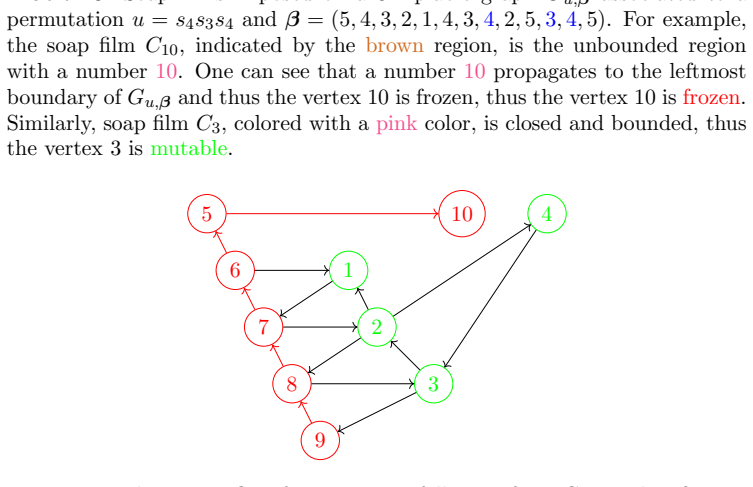
The load-bearing object is the extended exchange matrix $\tilde{B}_{u,\beta} = H_{u,\beta} + D_{u,\beta}$. Here $H_{u,\beta}$ is the half-arrow matrix of the 3D plabic graph of $(u,\beta)$---the planar projection of a spatial graph whose bridges and regions encode the cluster seed---recording arrows between quiver vertices with half-integer weights when both endpoints are frozen. The boundary correction matrix $D_{u,\beta}$ has entries $(\partial(C_i), \partial(C_j))$ measuring how the soap films $C_i, C_j$ (the regions attached to the bridges) cover the $n-1$ boundary regions, paired by a symmetric bilinear form built from the negative half Cartan matrix of type $A_{n-1}$. The proof of Theorem 3.7 shows by induction on the length of $\beta$ that adding $D_{u,\beta}$ cancels every half-integer and forces the determinant to be exactly $(-1)^{m+f}$. The inverse matrix $A_{u,\beta}$ then carries the application: its last $f$ columns are the kernel basis whose entries become exponents in the torus action.
What would settle it
Compute $\partial(C_j)$ for every soap film in the 3D plabic graph of a braid pair $(u,\beta)$: finding a film whose boundary vector contains a consecutive triple $(0,1,0)$ or $(1,0,1)$ at the crossing added in Case A would refute Lemma 3.15 and with it the induction in Theorem 3.7. Alternatively, compute $\det \tilde{B}_{u,\beta}$ for any positive braid word and check that it is not $(-1)^{m+f}$; the theorem predicts this value in all cases.
Extended reading notes
Core claim
On the paper's own terms, the discovery is that for every braid variety $X_{u,\beta}$ the cluster automorphism group $\operatorname{Aut}(\mathcal{A}(Q_{u,\beta}))$---the group of algebra automorphisms that send every cluster variable to a nonzero scalar multiple of itself---is an algebraic torus $(\mathbb{C}^\times)^f$, where $f$ is the number of frozen vertices of the quiver built from the 3D plabic graph of $(u,\beta)$. The action is explicit: if $A_{u,\beta} = \tilde{B}_{u,\beta}^{-1}$ and $\operatorname{col}_j(A_{u,\beta}) = (a_{1,m+j}, \ldots, a_{m+f,m+j})$ for $m+1 \le j \le m+f$, then the torus acts on an initial seed by $x_i \mapsto \prod_{j=1}^f t_j^{a_{i,m+j}}\, x_i$. The determinant identity $\det \tilde{B}_{u,\beta} = (-1)^{m+f}$ is the load-bearing fact: it guarantees that the last $f$ columns of the inverse form an integer basis of the kernel of the exchange matrix, which Proposition 5.1 of [13] identifies with the automorphism group.
Load-bearing premise
The proof assumes that when a crossing is added to the braid word, a soap film never has the boundary pattern $(0,1,0)$ or $(1,0,1)$ at that spot; the paper relies on a cited fact for this, and if such a pattern occurred the reflection step could produce boundary entries $2$ or $-1$, breaking the induction.
Editorial extensions
If this is right
- The cluster automorphism group of every braid variety is an algebraic torus of dimension equal to the number of frozen vertices of the 3D plabic quiver.
- The torus action on the braid variety is monomial, with exponents read off from the last $f$ columns of $A_{u,\beta}$, so it can be computed directly from the graph.
- The inductive factorization of $A_{u,\beta}$ in Lemma 4.5 gives a row-and-column-operation recipe for the automorphism group without passing through the whole mutation class.
- For $u = \mathrm{id}$ the torus is $(\mathbb{C}^\times)^l$ and coincides with the known action, while for general $u$ the dimension $f$ can exceed $n-1$, so the automorphism group is genuinely larger than the standard flag action.
- The observed sign phenomenon---nonzero entries of $A_{u,\beta}$ all sharing one sign---holds in the running examples but fails in Example 4.8, so it is not a general theorem; the paper poses the problem of describing the nonzero entries combinatorially.
Reading between the lines
- A testable extension is to scan the same matrix construction over all braid words up to a fixed length and map exactly where the sign phenomenon fails; the paper's examples suggest it may persist for double Bott–Samelson-type quivers but not for quivers with mixed arrows.
- Because the argument only uses the really-full-rank property of the quiver and the graph combinatorics, the inverse-matrix recipe for the automorphism group should transfer to any ice quiver arising from a 3D plabic graph, not necessarily from a braid variety.
- The explicit monomial action makes the fixed loci of the torus computable, which could be used to test the cluster deep locus and no mysterious point predictions on braid varieties mentioned in the introduction.
Editorial analysis
A structured set of objections, weighed in public.
Referee Report
Summary. The paper defines an (m+f) x (m+f) integer matrix \tilde B_{u,beta} for each braid variety X_{u,beta}, obtained by adding a boundary correction matrix D_{u,beta} to the half-arrow matrix H_{u,beta} of the 3D plabic graph. The main theorem (Theorem 3.7) states that this matrix has integer entries and determinant (-1)^{m+f}, and the paper proves it by induction over the braid word, splitting into a Case A where the first letter of beta removes a simple reflection from u and a Case B where it does not. From the determinant statement and Lam-Speyer's Proposition 5.1, the paper derives that the cluster automorphism group Aut(A(Q_{u,beta})) is an algebraic torus (C*)^f and gives an explicit action on the initial seed x_i in Corollary 4.3. The last section computes several examples, exhibits a 'sign phenomenon' for the inverse matrix A_{u,beta}, and gives a counterexample to that phenomenon.
Significance. If the proof is completed, the paper provides a concrete, computable description of the cluster automorphism group for braid varieties, complementing the general framework of Lam-Speyer and giving a practical way to compute the torus action on cluster variables. The matrix construction is well adapted to 3D plabic graphs and the examples are computed in detail, including verification by Sage in one case and use of Galashin's program in others. The inductive factorization of the inverse matrix A_{u,beta} in Lemma 4.5 is a useful structural addition. The main limitation is that two load-bearing local statements in the proof of Theorem 3.7 are not fully demonstrated in the text, so the determinant theorem and its corollaries are not yet fully self-contained.
major comments (3)
- [Section 3.2, Lemma 3.15] The proof of Lemma 3.15 excludes exactly the triples (1,0,1) and (0,1,0) in the boundary vector on the grounds that they 'do not happen due to the fact that we choose a positive distinguished subexpression for u inside beta, see [17]' (page 14). This exclusion is load-bearing for Case A of Theorem 3.7: without it, applying R_i to a boundary vector with a 1 at position i would produce entries 2 or -1, contradicting that boundary maps take values in {0,1} and invalidating the equality D_{u,beta}=D_{u',beta'} used in the induction. The property is not a general fact about all 3D plabic graphs, since Example 3.10 contains the boundary vector (0,1,0). The authors should either prove the forbidden-pattern statement from the positive distinguished subexpression property within the paper, or quote and verify the precise statement in [17] that implies it. As written, the determinant theorem is not fully self-contained.
- [Section 3.2, Lemma 3.18] The displayed identity H'_{y',x'} = H_{y,x} + H_{m+1,x}D_{m+1,y} - D_{m+1,x}H_{m+1,y} is justified only as a 'direct computation' from Figure 5, with the intermediate algebra involving the multiplicities a_x,b_x,c_x,d_x omitted. This identity is used to derive equation (3) in the proof of Theorem 3.7 and hence controls the determinant sign in Case B; a sign error in this computation would change the final determinant value (-1)^{m+f}. The authors should include the coordinate calculation, or at least a table of the seven cases with the corresponding values of the four multiplicities, so that the identity can be verified by the reader.
- [Definition 2.4 and Lemma 4.2] There is a mismatch in the shape of the exchange matrix that affects the proof of the main application. Definition 2.4 defines \tilde B(Q) as an (m+f) x m matrix, while the proof of Lemma 4.2 and the multiplication map in Corollary 4.3 require \tilde B(Q) to be an m x (m+f) matrix after identifying its rows with the mutable part of \tilde B_{u,beta}. As written, the expression \tilde B(Q)v for v in Z^{m+f} is not defined under Definition 2.4. This is fixable by a transposition or by explicitly defining \tilde B(Q) to be the first m rows of \tilde B_{u,beta}, but it should be corrected because Lemma 4.2 is the bridge between the determinant theorem and the description of the cluster automorphism group.
minor comments (4)
- [Remark 2.16] In Remark 2.16, 'C_{m+1}, ..., C_{m+f} corresponds to a mutable vertex' should read 'frozen vertex'; this typo is confusing in a passage that is supposed to fix the vertex labeling.
- [Lemma 3.19, Case 2] In Case 2 of Lemma 3.19, the string 'a2+1' should be 'a_{i+2}', and the boundary vectors should be displayed with consistent indexing; the same typo appears in the surrounding cases.
- [Example 4.7] In the displayed action for Example 4.7, the expression for x1 contains the factor t_3^{-1} twice; the matrix row for x1 indicates the intended action includes each of t_1^{-1}, t_2^{-1}, t_3^{-1}, t_4^{-1}, t_5^{-1} exactly once.
- [Introduction] The Introduction relies on the unpublished manuscripts [1] and [4] for the statement that the extended exchange matrices from [2] and [17] are the same. The authors should clarify whether any of the paper's main claims depend on these forthcoming works, and if so, state the precise assertions that are being used.
Circularity Check
No material circularity: the determinant theorem is an inductive proof using external cluster-structure background, with only a minor non-load-bearing self-citation.
full rationale
The paper's central claim (Theorem 3.7) is proved by induction on positive braid words, and the proof does not reduce to its own inputs. In Case A, the boundary-map comparison is Lemma 3.15, whose excluded patterns (0,1,0) and (1,0,1) are attributed to the external positive-distinguished-subexpression theory in [17] (Galashin–Lam–Sherman-Bennett–Speyer), not to the present author's work; whether that external assertion is fully proved is a verification concern, not a circularity. In Case B, the row/column operation argument uses explicit local computations (Lemmas 3.16–3.21) and matrix identities such as Lemma 3.21, which do not presuppose the determinant value. The cluster automorphism group description (Corollary 4.3) rests on Lam–Speyer's Proposition 5.1, an external theorem about cluster algebras, together with Lemma 4.2, which is a direct linear-algebra argument using the invertibility of tilde-B. The only self-citation is [4] (Casals–Kim–Weng, 'In preparation'), used in an introductory remark asserting that the present matrix construction is essentially the same as the (pi,j) matrix from [2]; this remark is not used in any proof and is not load-bearing. No fitted parameter is relabeled as a prediction, and no claimed output is equivalent by definition to an input. The main unresolved items, such as the unstated 'direct computation' in Lemma 3.18 and the cited pattern exclusion in Lemma 3.15, are correctness/verification gaps rather than circularity.
Assumptions & free parameters
assumptions (5)
- domain assumption The coordinate ring of the braid variety X_{u,beta} is a cluster algebra with initial seed from the 3D plabic graph Q_{u,beta} (Theorem 2.21).
- standard math Opposite quivers give isomorphic cluster algebras (Remark 2.22).
- domain assumption The positive distinguished subexpression for u inside beta implies certain boundary configurations never occur (Lemma 3.15).
- domain assumption Proposition 5.1 of [13] describes the cluster automorphism group of a really full rank quiver as the kernel of the exchange matrix map (used in Corollary 4.3).
- domain assumption The really full rank property of Q_{u,beta} (Remark 3.8, also in [2,17]).
Cite this review
Pith. "Pith review of Cluster automorphism group of braid varieties." pith.science (2026). https://pith.science/paper/NAVO64PD
@misc{pith2026250514889,
  author       = {Pith},
  title        = {Pith review of: Cluster automorphism group of braid varieties},
  year         = {2026},
  howpublished = {\url{https://pith.science/paper/NAVO64PD}},
  note         = {Machine review of arXiv:2505.14889}
}
read the original abstract
The cluster automorphism group of a cluster variety was defined by Gekhtman--Shapiro--Vainshtein, and later studied by Lam--Speyer. Braid varieties are interesting affine algebraic varieties indexed by positive braid words. It was proved recently that braid varieties are cluster varieties. In this paper, we propose a description of the cluster automorphism group and its action on braid varieties, and compute several examples.
Figures


Figures from the paper (3 more)


Reference graph
Works this paper leans on
-
[17]
Braid variety cluster struc- tures, I: 3D plabic graphs
Pavel Galashin, Thomas Lam, Melissa Sherman-Bennett, and David Speyer. Braid variety cluster struc- tures, I: 3D plabic graphs. arXiv preprint arXiv:2210.04778 , 2022
arXiv 2022
-
[1]
Comparing braid variety cluster structures, In preparation
Roger Casals, Pavel Galashin, Mikhail Gorsky, Linhui Shen, Melissa Sherman-Bennett, and Jos´ e Simental. Comparing braid variety cluster structures, In preparation
-
[2]
Cluster structures on braid varieties
Roger Casals, Eugene Gorsky, Mikhail Gorsky, Ian Le, Linhui Shen, and Jos´ e Simental. Cluster structures on braid varieties. Journal of the American Mathematical Society , 2024
work page 2024
-
[3]
Algebraic weaves and braid varieties
Roger Casals, Eugene Gorsky, Mikhail Gorsky, and Jos´ e Simental. Algebraic weaves and braid varieties. American Journal of Mathematics , 146(6):1469–1576, 2024
work page 2024
-
[4]
Demazure weaves from 3D plabic graph, In preparation
Roger Casals, Soyeon Kim, and Daping Weng. Demazure weaves from 3D plabic graph, In preparation. preparation
-
[5]
Cluster deep loci and mirror symmetry
Marco Castronovo, Mikhail Gorsky, Jos´ e Simental, and David E Speyer. Cluster deep loci and mirror symmetry. arXiv preprint arXiv:2402.16970 , 2024
work page Pith review arXiv 2024
-
[6]
On some geometric aspects of Bruhat orderings
Vinay V Deodhar. On some geometric aspects of Bruhat orderings. I. A finer decomposition of Bruhat cells. Inventiones mathematicae, 79(3):499–511, 1985
work page 1985
-
[7]
Sergey Fomin and Andrei Zelevinsky. Cluster algebras. I. Foundations. J. Amer. Math. Soc. , 15(2):497– 529, 2002
work page 2002
Show all 21 references
-
[8]
Quasi-homomorphisms of cluster algebras
Chris Fraser. Quasi-homomorphisms of cluster algebras. Adv. in Appl. Math. , 81:40–77, 2016
2016
-
[9]
Sage code for braid variety cluster structures
Pavel Galashin. Sage code for braid variety cluster structures. https://www.math.ucla.edu/ galashin/DoubleBraidCluster/tutorial.html, 2022
2022
-
[10]
Positroid varieties and cluster algebras
Pavel Galashin and Thomas Lam. Positroid varieties and cluster algebras. Ann. Sci. ´Ec. Norm. Sup´ er. (4), 56(3):859–884, 2023
2023
-
[11]
Positroids, knots, andq, t-Catalan numbers
Pavel Galashin and Thomas Lam. Positroids, knots, andq, t-Catalan numbers. Duke Mathematical Journal, 173(11):2117–2195, 2024
2024
-
[12]
Braid variety cluster structures, II: general type
Pavel Galashin, Thomas Lam, and Melissa Sherman-Bennett. Braid variety cluster structures, II: general type. arXiv preprint arXiv:2301.07268 , 2023
2023
-
[13]
Cohomology of cluster varieties, I: Locally acyclic case
Thomas Lam and David E Speyer. Cohomology of cluster varieties, I: Locally acyclic case. Algebra & Number Theory, 16(1):179–230, 2022
2022
-
[14]
Grassmannians and cluster algebras
Jeanne Scott. Grassmannians and cluster algebras. Proc. London Math. Soc. (3) , 92(2):345–380, 2006
2006
-
[15]
Cluster structures in Schubert varieties in the Grassmannian
Khrystyna Serhiyenko, Melissa Sherman-Bennett, and Lauren Williams. Cluster structures in Schubert varieties in the Grassmannian. Proceedings of the London Mathematical Society , 119(6):1694–1744, 2019
2019
-
[16]
Cluster algebras: an introduction
Lauren Williams. Cluster algebras: an introduction. Bulletin of the American Mathematical Society , 51(1):1–26, 2014
2014
-
[18]
Michael Gekhtman, Michael Shapiro, and Alek Vainshtein.Cluster algebras and Poisson geometry. Number
-
[19]
Cluster algebra structures on poisson nilpotent algebras
KR Goodearl and MT Yakimov. Cluster algebra structures on poisson nilpotent algebras. arXiv preprint arXiv:1801.01963, 2018
2018 arXiv
-
[20]
Legendrian loops and cluster modular groups
James Hughes. Legendrian loops and cluster modular groups. arXiv preprint arXiv:2403.12951 , 2024. Department of Mathematics, University of California at Davis, One Shields A venue, Davis CA 95616 Email address : syxkim@ucdavis.edu
2024 arXiv
-
[167]
American Mathematical Soc., 2010
2010
Reviewed August 7, 2026 · model on record in the stance chip above.
Discussion (0). Continue with ORCID to comment.