A Study on the Multi-axial Fatigue Failure Behavior of Notched Composite Laminates
Pith reviewed 2026-05-24 16:58 UTC · model grok-4.3
The pith
Damage progression under multi-axial fatigue in notched composites differs substantially from the quasi-static case.
A machine-rendered reading of the paper's core claim, the machinery that carries it, and where it could break.
Core claim
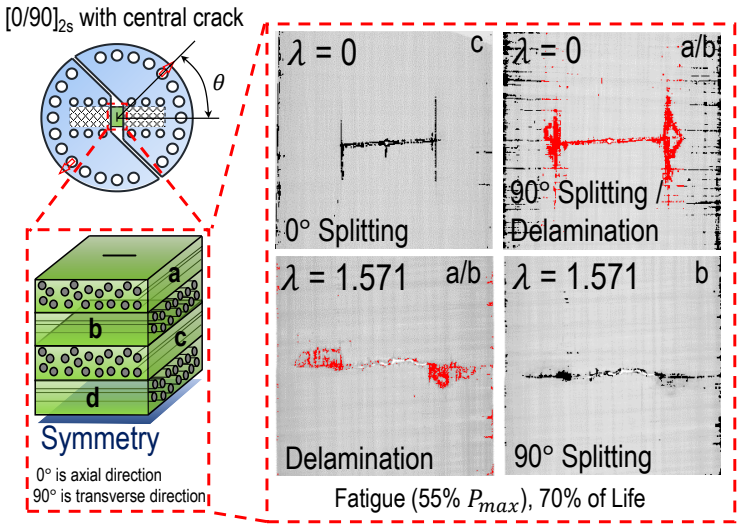
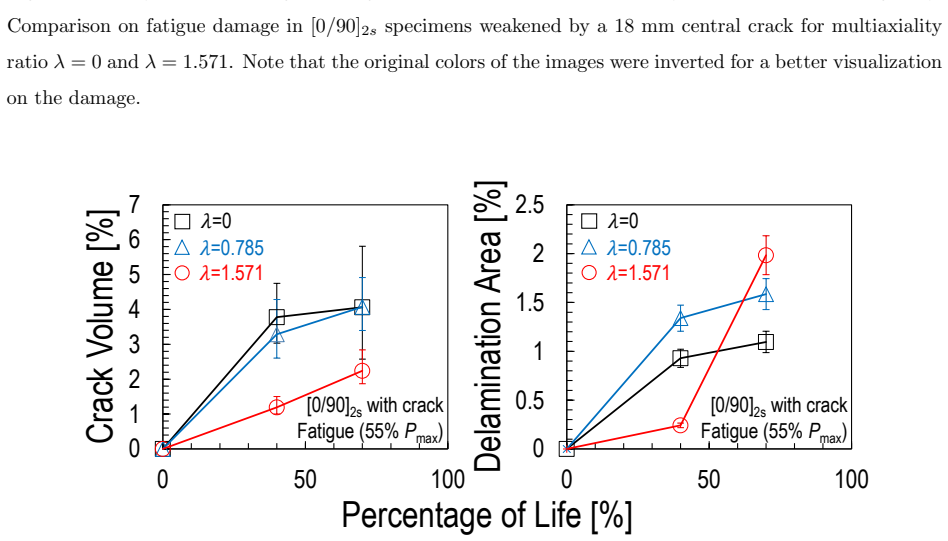
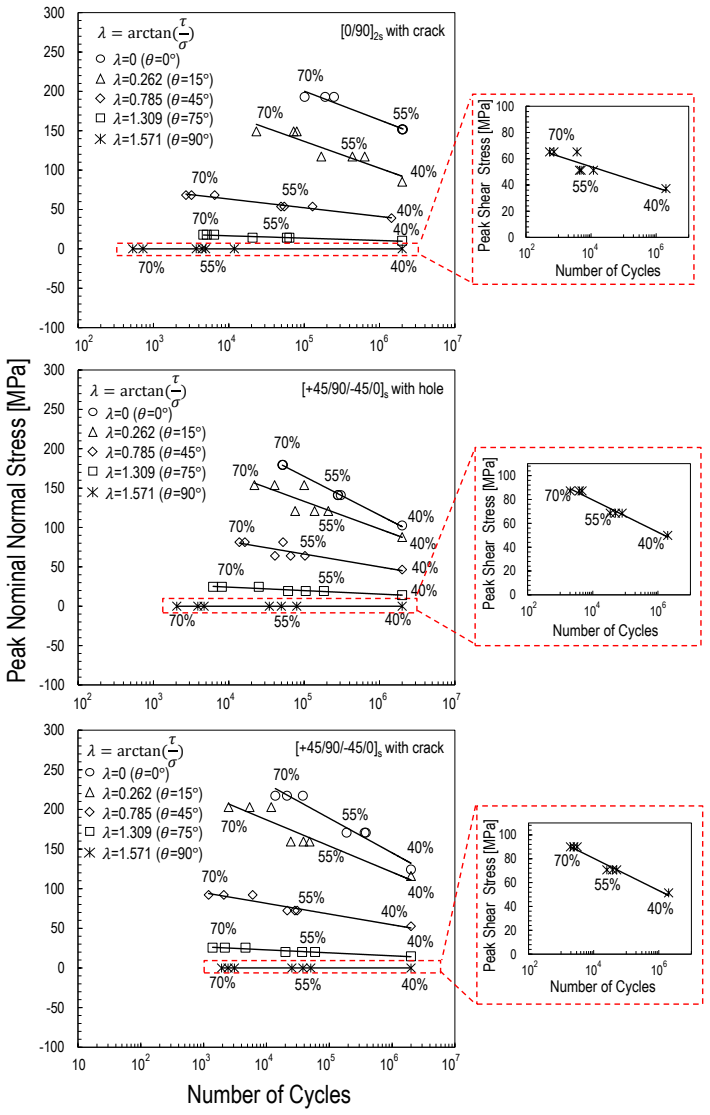
Investigation of the S-N curves and stiffness degradation, and the analysis of the damage mechanisms via micro-computed tomography clarified the effects of the multi-axiality ratio and the notch configuration. Furthermore, it allowed to conclude that damage progression under fatigue loading can be substantially different compared to the quasi-static case. Future efforts in the formulation of efficient fatigue models will need to account for the transition in damaging behavior in the context of the type of applied load, the evolution of the local multi-axiality ratio, the structure size and geometry, and stacking sequence.
What carries the argument
Micro-computed tomography imaging of damage mechanisms combined with S-N curves and stiffness degradation, evaluated across multi-axiality ratios and notch configurations in two laminate layups.
If this is right
- Fatigue models must incorporate a transition in damaging behavior when the load changes from quasi-static to cyclic.
- The evolution of the local multi-axiality ratio during loading affects which damage mechanisms dominate.
- Structure size, geometry, and stacking sequence must be treated as variables that can shift the fatigue damage path.
- The reported S-N data and CT images supply calibration and validation targets for such models.
Where Pith is reading between the lines
- Design allowables for notched regions may need separate static and fatigue values rather than a single knockdown factor.
- Size-effect studies performed only under static loading may not predict fatigue notch sensitivity correctly.
- Extending the same CT-based comparison to other fiber architectures could test whether the transition is universal.
Load-bearing premise
The tested laminate layups, notch geometries, and specific multi-axial loading ratios are representative enough that the observed difference in damage progression generalizes beyond these particular specimens and test conditions.
What would settle it
Observation of identical damage sequences and locations in additional layups or loading ratios when the same peak multi-axial stresses are applied statically versus cyclically would falsify the claim of substantial difference.
Figures





read the original abstract
Composite structures must endure a great variety of multi-axial stress states during their lifespan while guaranteeing their structural integrity and functional performance. Understanding the fatigue behavior of these materials, especially in the presence of notches that are ubiquitous in structural design, lies at the hearth of this study which presents a comprehensive investigation of the fracturing behavior of notched quasi-isotropic [+45/90/$-$45/0]$_{s}$ and cross-ply [0/90]$_{2s}$ laminates under multi-axial quasi-static and fatigue loading. The investigation of the S-N curves and stiffness degradation, and the analysis of the damage mechanisms via micro-computed tomography clarified the effects of the multi-axiality ratio and the notch configuration. Furthermore, it allowed to conclude that damage progression under fatigue loading can be substantially different compared to the quasi-static case. Future efforts in the formulation of efficient fatigue models will need to account for the transition in damaging behavior in the context of the type of applied load, the evolution of the local multi-axiality ratio, the structure size and geometry, and stacking sequence. By providing important data for model calibration and validation, this study represents a first step towards this important goal.
Editorial analysis
A structured set of objections, weighed in public.
Referee Report
Summary. The paper presents an experimental investigation into the multi-axial fatigue failure behavior of notched composite laminates, specifically quasi-isotropic [+45/90/-45/0]s and cross-ply [0/90]2s layups. It employs S-N curves, stiffness degradation monitoring, and micro-computed tomography to compare damage under quasi-static versus fatigue loading, concluding that damage progression can be substantially different in the fatigue case and providing data for future model calibration.
Significance. If the observations hold, the work supplies useful experimental data on how multi-axiality ratio, notch configuration, and load type affect damage mechanisms in notched composites. The micro-CT analysis strengthens the mechanistic insights, and the modest existential claim is directly tied to the reported contrasts. This supports the need for fatigue models to incorporate load-type transitions.
minor comments (3)
- [Abstract] Abstract: 'lies at the hearth of this study' is a typographical error and should read 'heart'.
- [Methods/Results] The manuscript would benefit from explicit statements of sample sizes, number of replicates per condition, and any statistical measures used to support the S-N curve and stiffness degradation trends.
- [Figures] Figure captions and axis labels should be checked for consistency with the multi-axiality ratios and notch geometries described in the text.
Simulated Author's Rebuttal
We thank the referee for the positive assessment of our work and the recommendation for minor revision. The referee's summary accurately captures the experimental focus on multi-axial fatigue versus quasi-static damage in the two laminate types, the use of S-N curves, stiffness monitoring, and micro-CT, as well as the implications for future modeling.
Circularity Check
Purely observational experimental study; no derivations or models present
full rationale
The paper reports experimental S-N curves, stiffness degradation measurements, and micro-CT damage observations for two specific laminate layups under multi-axial quasi-static and fatigue loading. No equations, fitted parameters, predictive models, or derivation chains appear in the abstract or described content. Conclusions are limited to direct observational contrasts (damage progression 'can be substantially different'), with no reduction of any claim to its own inputs by construction, self-citation, or renaming. This matches the default expectation of no circularity for non-modeling experimental work.
Axiom & Free-Parameter Ledger
axioms (1)
- domain assumption Standard assumptions in composite laminate testing including uniform ply properties, accurate multi-axial load application, and micro-CT resolution sufficient to capture dominant damage modes.
Lean theorems connected to this paper
-
IndisputableMonolith/Cost/FunctionalEquation.leanwashburn_uniqueness_aczel unclear?
unclearRelation between the paper passage and the cited Recognition theorem.
damage progression under fatigue loading can be substantially different compared to the quasi-static case
-
IndisputableMonolith/Foundation/ArithmeticFromLogic.leanLogicNat recovery unclear?
unclearRelation between the paper passage and the cited Recognition theorem.
The investigation of the S-N curves and stiffness degradation, and the analysis of the damage mechanisms via micro-computed tomography
What do these tags mean?
- matches
- The paper's claim is directly supported by a theorem in the formal canon.
- supports
- The theorem supports part of the paper's argument, but the paper may add assumptions or extra steps.
- extends
- The paper goes beyond the formal theorem; the theorem is a base layer rather than the whole result.
- uses
- The paper appears to rely on the theorem as machinery.
- contradicts
- The paper's claim conflicts with a theorem or certificate in the canon.
- unclear
- Pith found a possible connection, but the passage is too broad, indirect, or ambiguous to say the theorem truly supports the claim.
Reference graph
Works this paper leans on
-
[1]
Advanced Composite Materials for Aerospace Engineering: Processing, Properties and Applications
Rana S, Fangueiro R. Advanced Composite Materials for Aerospace Engineering: Processing, Properties and Applications. Woodhead Publishing, 2016
work page 2016
-
[2]
Composite Materials for Aircraft Structures
Baker A, Dutton S, Kelly D. Composite Materials for Aircraft Structures. American Institute of Aeronautics and Astronautics, 2004
work page 2004
-
[3]
Automotive Applications of Composite Materials
Kaiser R. Automotive Applications of Composite Materials. National Technical Information Service, 1978
work page 1978
-
[4]
Advanced Composite Materials for Automotive Applications: Structural In- tegrity and Crashworthiness
Elmarakbi A. Advanced Composite Materials for Automotive Applications: Structural In- tegrity and Crashworthiness. Wiley, 2013. 14
work page 2013
-
[5]
Durability gap analysis for fiber-reinforced polymer composites in civil infras- tructure
Karbhari VM, Chin J, Hunston D, Benmokrane B, Juska T, Morgan R, Lesko JJ, Sorathia U, Reynaud AD. Durability gap analysis for fiber-reinforced polymer composites in civil infras- tructure. J Compos Constr 2003;7(3):238-47
work page 2003
-
[6]
Brandt AM. Fibre reinforced cement-based (FRC) composites after over 40 years of develop- ment in building and civil engineering. Compos Struct 2008;86:3-9
work page 2008
-
[7]
Ceccato C, Salviato M, Pellegrino C, Cusatis G. Simulation of concrete failure and fiber reinforced polymer fracture in confined columns with different cross sectional shape. Int J Solids Struct 2017;108:216-29
work page 2017
-
[8]
Carloni C, Focacci F. FRP-masonry interfacial debonding: An energy balance approach to determine the influence of the mortar joints. Eue J Mech A-Solid 2016;55:122-33
work page 2016
-
[9]
Masonry arches strengthened with composite unbonded ten- dons
D’Ambrisi A, Feo L, Focacci F. Masonry arches strengthened with composite unbonded ten- dons. Compos Struct 2013;98:323-29
work page 2013
-
[10]
Materials for wind turbine blades: An overview
Mishnaevsky L, Branner K, Petersen HN, Beauson J, McGugan M, Sørensen BF. Materials for wind turbine blades: An overview. Materials 2017;10(11):1285
work page 2017
-
[11]
Structural Analysis of Composite Wind Turbine Blades
Chortis DI. Structural Analysis of Composite Wind Turbine Blades. Springer, 2013
work page 2013
-
[12]
Static and fatigue failure of glass fibre reinforced polyester resins under complex stress conditions
Owen MJ, Found MS. Static and fatigue failure of glass fibre reinforced polyester resins under complex stress conditions. Faraday Discuss Chem Soc 1972;2:77-89
work page 1972
-
[13]
Owen MJ, Griffiths JR. Evaluation of biaxial stress failure surfaces for a glass fabric reinforced polyester resin under static and fatigue loading. J Mater Sci 1978;13:1521-37
work page 1978
-
[14]
Biaxial strength behaviour of glass reinforced polyester resins
Owen MJ, Rice DJ. Biaxial strength behaviour of glass reinforced polyester resins. Composite Materials: Testing and Design, ASTM STP 787 EB, 1982, 124-44
work page 1982
-
[15]
Biaxial strength behaviour of glass fabric-reinforced polyester resins
Owen MJ, Rice DJ. Biaxial strength behaviour of glass fabric-reinforced polyester resins. Composites 1981;12(1):13-25
work page 1981
-
[16]
Biaxial static and fatigue strength of glass mat and fabric reinforced polyester resins
Owen MJ, Rice DJ, Griffiths JR, Found MS. Biaxial static and fatigue strength of glass mat and fabric reinforced polyester resins. In: Proceedings of 35th Annual Technical Conference, Reinforced Plastics/Composite Institute, The Society of the Plastics Industry, 1980, 23-E:1-8
work page 1980
-
[17]
Biaxial fatigue of composites with short and long fibres
Owen MJ. Biaxial fatigue of composites with short and long fibres. In: Proceeding of 3rd Risø International Symposium on Metallurgy and Materials Science, 1982. p.101-112
work page 1982
-
[18]
Static and fatigue tests of woven glass fabric composite under biaxial tension-torsion loading
Amijima S, Fujii T, Hamaguchi M. Static and fatigue tests of woven glass fabric composite under biaxial tension-torsion loading. Composites 1991;22:281-89
work page 1991
-
[19]
Fujii T, Amijima S, Lin F and Sagami T. Study on strength and nonlinear stress-strain response of plain woven glass fiber laminates under biaxial loading. J Compos Mater 1992;26:2493-510
work page 1992
-
[20]
Amijima S. Fujii T, Sagami T. Nonlinear behavior of plain woven GFRP under repeated biaxial tension/torsion loading. J Energ Resour-ASME 1991;113(4):235-40
work page 1991
-
[21]
Fatigue behavior of a plain-woven glass fabric laminate under tension/torsion biaxial loading
Fujii T, Lin F. Fatigue behavior of a plain-woven glass fabric laminate under tension/torsion biaxial loading. J Compos Mater 1995;29:573-90
work page 1995
-
[22]
Fujii T, Shina T, Okubo K. Fatigue notch sensitivity of glass woven fabric composite having a circular hole under tension/torsion biaxial loading. J Compos Mater 1994;28(3):234-51
work page 1994
-
[23]
Takemura K, Fujii T. Fatigue strength and damage progression in a circular-hole-notched GRP composite under combined tension/torsion loading. Compos Sci Technol 1994;52:519-26
work page 1994
-
[24]
Takemura K, Fujii T. Fracture mechanics evaluation of progressive fatigue damage in a circular-hole-notched GRP composite under combined tension/torsion loading. Compos Sci Technol 1994;52:527-34
work page 1994
-
[25]
Fatigue of composite materials: damage mechanisms and fatigue life diagrams
Talreja R. Fatigue of composite materials: damage mechanisms and fatigue life diagrams. Proc Roy Soc Lond A 1981;378:46175
work page 1981
-
[26]
Damage and Failure of Composite Materials
Talreja R, Singh CV. Damage and Failure of Composite Materials. Cambridge University Press, 2012
work page 2012
-
[27]
Biaxial fatigue of fiber-reinforced composites at cryogenic temperature
Wang SS, Chim ES-M, Socie DF. Biaxial fatigue of fiber-reinforced composites at cryogenic temperature. Part I: Fatigue fracture life and damage mechanisms. J Eng Mater Technol 1982;104:128-36
work page 1982
-
[28]
Wang SS, Chim ES-M, Socie DF. Stiffness degradation of fiber-reinforced composites under uniaxial tensile, pure torsional, and biaxial fatigue at cryogenic temperature. Composite Ma- terials: Testing and Design, ASTM STP 787 EB, 1982, 287-301. 15
work page 1982
-
[29]
Smith EW, Pascoe KJ, Biaxial fatigue of glass-fibre reinforced composite. Part 1: fatigue and fracture. In: Brwon M, Miller KJ, editors. Biaxial and multi-axial fatigue EFG 3. Mechanical Engineering Publications, 1989. p.396-412
work page 1989
-
[30]
Static and cyclic biaxial bending of CFRP panels
Chen AS, Matthews FL. Static and cyclic biaxial bending of CFRP panels. Compos Sci Technol 1994;52:267-73
work page 1994
-
[31]
Damage propagation in non-crimp fabrics under bi-axial static and fatigue loading
Adden S, Horst P. Damage propagation in non-crimp fabrics under bi-axial static and fatigue loading. Compos Sci Technol 2006;66(5):626-33
work page 2006
-
[32]
On the investigation of the biaxial fatigue behaviour of unidirec- tional composites
Quaresimin M, Carraro PA. On the investigation of the biaxial fatigue behaviour of unidirec- tional composites. Compos Part B 2013;54:200-8
work page 2013
-
[33]
Quaresimin M, Carraro PA, Mikkelsen LP, Lucato N, Vivian L, Brondsted P, Sørensen BF, Varna J, Talreja R. Damage evolution under cyclic multi-axial stress state: A comparative analysis between glass/epoxy laminates and tubes. Compos Part B 2014;61:282-90
work page 2014
-
[34]
Quaresimin M, Carraro PA, Damage initiation and evolution in glass/epoxy tubes subjected to combined tensiontorsion fatigue loading. Int J Fatigue 2014;63:26-35
work page 2014
-
[35]
Fatigue behaviour of glass/epoxy laminates in the presence of voids
Maragoni L, Carraro PA, Peron M, Quaresimin M. Fatigue behaviour of glass/epoxy laminates in the presence of voids. Int J Fatigue 2017;95:18-28
work page 2017
-
[36]
Early stage damage in off-axis plies under fatigue loading
Quaresimin M, Carraro PA, Maragoni L. Early stage damage in off-axis plies under fatigue loading. Compos Sci Technol 2016;128:147-54
work page 2016
-
[37]
Effect of voids on the crack formation in a [+45/−45/0]s laminate under cyclic axial tension
Maragoni L, Carraro PA, Quaresimin M. Effect of voids on the crack formation in a [+45/−45/0]s laminate under cyclic axial tension. Compos Part A-Appl S 2016;91:493-500
work page 2016
-
[38]
Fatigue behaviour of composites under different loading modes
Sims DF, Brogdon VH. Fatigue behaviour of composites under different loading modes. Fatigue of filamentary materials. ASTM STP 636, 1977, 185205
work page 1977
-
[39]
Strength theories of filamentary structures
Tsai SW. Strength theories of filamentary structures. In: Schwartz RT, Schwartz HS, editors. Fundamental aspects of fibre reinforced plastic Composites. NewYork: Wiley Interscience,
-
[40]
Biaxial fatigue loading of notched composites
Francis PH, Walrath DE, Sims DF, Weed DN. Biaxial fatigue loading of notched composites. J Compos Mater 1977;11:488-501
work page 1977
-
[41]
Tsai SW, Wu EM, A General Theory of Strength for Anisotropic Materials. J Compos Mater 1971;5:58-80
work page 1971
-
[42]
Combined bending torsional fatigue of woven rowing GRP
Aboul Wafa MN, Hamdy AH, El-Midany AA. Combined bending torsional fatigue of woven rowing GRP. J Eng Mater Technol (Trans ASME) 1997;119:1815
work page 1997
-
[43]
Kawai M, Yajima S, Hachinohe A, Takano Y. Off-axis fatigue behaviour of unidirec- tional carbon fiber-reinforced composites at room and high temperatures. J Compos Mater 2001;35(7):54576
work page 2001
-
[44]
Fatigue strength prediction under multiaxial stress
Philippidis TP, Vassilopoulos AP. Fatigue strength prediction under multiaxial stress. J Com- pos Mater 1999;33(17):157899
work page 1999
-
[45]
Fatigue behaviour and life assessment of composite lam- inates under multiaxial loadings
Quaresimin M, Susmel L, Talreja R. Fatigue behaviour and life assessment of composite lam- inates under multiaxial loadings. Int J Fatigue 2010;32(1):2-16
work page 2010
-
[46]
Analysis of multiple off-axis ply cracks in composite laminates
Singh CV, Talreja R. Analysis of multiple off-axis ply cracks in composite laminates. Int J Solids Struct 2008;45(16):4574-89
work page 2008
-
[47]
Mechanics of matrix cracking in brittle-matrix fibre-reinforced composites
McCartney LN. Mechanics of matrix cracking in brittle-matrix fibre-reinforced composites. Proc Roy Soc Lond A 1987;409(1837):329-50
work page 1987
-
[48]
McCartney LN. New theoretical model of stress transfer between fibre and matrix in a uniax- ially fibre-reinforced composite. Proc Roy Soc Lond A 1989;425(1868):215-44
work page 1989
-
[49]
McCartney LN. Analytical models of stress transfer in unidirectional composites and cross-ply laminates, and their application to the prediction of matrix/transverse cracking. In: : Reddy JN., Reifsnider K, editors. Local mechanics concepts for composite material systems. Springer,
-
[50]
McCartney LN. Theory of stress transfer in a 0 ◦ − 90◦ − 0◦ cross-ply laminate containing a parallel array of transverse cracks. J Mech Phys Solids 1992;40(1):27-68
work page 1992
-
[51]
Comparison of models for transverse ply cracks in composite laminates
McCartney LN, Schoeppner GA, Becker W. Comparison of models for transverse ply cracks in composite laminates. Compos Sci Technol 200060(12-13):2347-59
-
[52]
Physically based damage models for laminated composites
McCartney LN. Physically based damage models for laminated composites. In: Proceedings of the Institution of Mechanical Engineers, Part L: Journal of Materials: Design and Appli- cations. 2003, 217(3), p.163-199. 16
work page 2003
-
[53]
Constitutive relationships for laminates with ply cracks in in-plane loading
Lundmark P, Varna J. Constitutive relationships for laminates with ply cracks in in-plane loading. Int J Damage Mech 200514(3):235-59
-
[54]
Crack face sliding effect on stiffness of laminates with ply cracks
Lundmark P, Varna J. Crack face sliding effect on stiffness of laminates with ply cracks. Compos Sci Technol 2006;66(10):1444-54
work page 2006
-
[55]
A stiffness degradation model for cracked multidirectional lami- nates with cracks in multiple layers
Carraro PA, Quaresimin M. A stiffness degradation model for cracked multidirectional lami- nates with cracks in multiple layers. Int J Solids Struct 2015;58:34-51
work page 2015
-
[56]
Prediction of the crack density evolution in multidi- rectional laminates under fatigue loadings
Carraro PA, Maragoni L, Quaresimin M. Prediction of the crack density evolution in multidi- rectional laminates under fatigue loadings. Compos Sci Technol 2017;145:24-39
work page 2017
-
[57]
Mitsubishi Chemical Carbon Fiber and Composites, Sacramento, California, USA http://www.mccfc.com/
-
[58]
Vacmobiles, Auckland, New Zealand https://www.vacmobiles.com/
-
[59]
ASTM D3039/D3039M-17 - Standard Test Method for Tensile Properties of Polymer Matrix Composite Materials
-
[60]
Failure mechanisms of a notched CFRP laminate under multi-axial loading
Tan JLY, Deshpande VS, Fleck NA. Failure mechanisms of a notched CFRP laminate under multi-axial loading. Compos Part A-Appl S 2015;77:56-66
work page 2015
-
[61]
Ncorr: open-source 2D digital image correlation matlab software
Blaber J, Adair B, Antoniou A. Ncorr: open-source 2D digital image correlation matlab software. Exp Mech 2015;55(6):1105-22
work page 2015
-
[62]
Adaptation of open source 2D DIC software Ncorr for solid mechan- ics applications
Harilal R, Ramji M. Adaptation of open source 2D DIC software Ncorr for solid mechan- ics applications. In: Proceedings of 9th International Symposium on Advanced Science and Technology in Experimental Mechanics, New Delhi, November, 2014
work page 2014
-
[63]
North Star Imaging, California, USA https://4nsi.com/
-
[64]
2D and 3D imaging of fatigue failure mechanisms of 3D woven composites
Yu B, Bradley BS, Soutis C, Hogg PJ, Withers PJ. 2D and 3D imaging of fatigue failure mechanisms of 3D woven composites. Compos Part A- Appl S 2015;77:37-49
work page 2015
-
[65]
Nexon-Pearson OJ, Hallet SR. An experimental investigation into quasi-static and fatigue damage development into bolted hole specimen. Compos Part B 2015;77:462-73
work page 2015
-
[66]
ImageJ, USA https://imagej.nih.gov/ij/
-
[67]
Characterization of the in-situ non-linear shear response of laminated fiber-reinforced composites
Ng WH, Salvi AG, Waas AM. Characterization of the in-situ non-linear shear response of laminated fiber-reinforced composites. Compos Sci Technol 2010;70:1126-34
work page 2010
-
[68]
Spectral stiffness microplane model for damage and fracture of textile composites
Salviato M, Ashari SE, Cusatis G. Spectral stiffness microplane model for damage and fracture of textile composites. Compos Struct 2016;137:170-84
work page 2016
-
[69]
Kirane K, Salviato M, Baˇ zant ZP. Microplane triad model for simple and accurate prediction of orthotropic elastic constants of woven fabric composites. J Compos Mater 2015;50(9):1247-60
work page 2015
-
[70]
Stability of Structures: Elastic, Inelastic, Fracture and Damage Theo- ries
Baˇ zant ZP, Cedolin L. Stability of Structures: Elastic, Inelastic, Fracture and Damage Theo- ries. New York: Dover Publications, 2003
work page 2003
-
[71]
Salviato M, Chau VT, Li W, Baˇ zant ZP, Cusatis G. Direct testing of gradual postpeak of fracture specimens of fiber composites stabilized by enhanced grip stiffness and mass. J Appl Mech 2016;83(11):111003
work page 2016
-
[72]
Salviato M, Chau VT, Li W, Baˇ zant ZP, Cusatis G. USA Patent NO.US20180259431A1, Grips For A Linear Fracture Testing Machine And Method of Designing Same
-
[73]
Xu X, Wisnom MR, Mahadik Y, Hallett SR. An experimental investigation in size effects in quasi-isotropic carbon epoxy laminates with sharp and blunt notches. Compos Sci Technol 2014;100:220-7
work page 2014
-
[74]
Fracture and size effect in concrete and other quasi-brittle materials
Baˇ zant ZP, Planas J. Fracture and size effect in concrete and other quasi-brittle materials. Boca Raton:CRC Press, 1998
work page 1998
-
[75]
Salviato M, Kirane K, Ashari SE, Baˇ zant ZP. Experimental and numerical investigation of intra-laminar energy dissipation and size effect in two-dimensional textile composites. Compos Sci Technol 2016;135:67-75
work page 2016
-
[76]
Size effect in blunt fracture: concrete, rock, metal
Baˇ zant ZP. Size effect in blunt fracture: concrete, rock, metal. J Eng Mech-ASCE 1984;110(4):518-35
work page 1984
-
[77]
Baˇ zant ZP, Kazemi MT. Determination of fracture energy, process zone length and brittleness number from size effect, with application to rock and concrete. Int J Fracture 1990;44:111-31
work page 1990
-
[78]
Failure and scaling of graphene nanocomposites
Mefford CH, Qiao Y, Salviato M. Failure and scaling of graphene nanocomposites. Compos Struct 2017;176:961-72
work page 2017
-
[79]
Qiao Y, Salviato M, Study of the fracturing behavior of thermoset polymer nanocomposites via cohesive zone modeling. Compos Struct 2019;220:127-47. 17
work page 2019
-
[80]
Strength and cohesive behavior of thermoset polymers at the microscale: a size-effect study
Qiao Y, Salviato M. Strength and cohesive behavior of thermoset polymers at the microscale: a size-effect study. Eng Fract Mech 2019;213:100-17
work page 2019
discussion (0)
Sign in with ORCID, Apple, or X to comment. Anyone can read and Pith papers without signing in.