REVIEW 3 major objections 6 minor 1 cited by
Reproducibility of machine learning analyses of 21 cm reionization maps
T0 review · 3 major / 6 minor · reviewed 2026-08-11 · deepseek-v4-flash
Pith's one-line read A CNN trained on 21 cm reionization maps can score near-perfectly on slices from boxes it already saw while failing on fresh simulation boxes, meaning it has memorized the boxes rather than learned the physics.
desk verdict Valuable cautionary study showing CNN box-memorization in 21 cm inference, but the diagnosis is stronger than the evidence without an identifiability baseline. read the letter →
The pith
A machine-rendered reading of the paper's core claim, the machinery that carries it, and where it could break.
The reading
What carries the argument
The central object is the CNN architecture taken from Hassan et al. (2020): four convolutional blocks (two convolutional layers, batch normalisation, ReLU) joined by max pooling, followed by three fully connected blocks, trained with mean-squared error and the Adam optimiser. The argument is carried by the R2 score measured under two testing protocols: slices from boxes represented in the training set versus slices from newly simulated boxes, and by a control scan in which the fraction P/120 of slices per box shared between training and testing is varied. That shared-slice fraction is the mechanism of memorization: when the network sees many slices from one box, it can identify the box through its shared density field and simply return the box's parameter labels, which produces inflated same-box R2 but fails at P=0, the regime relevant to real observations.
What would settle it
Take a fixed set of new simulation boxes and compare the CNN against a non-neural baseline that uses explicit summaries of the same slices, such as a power-spectrum and bispectrum measurement fed into a Gaussian process emulator. If the baseline also fails to recover the six parameters from single slices, the poor new-box R2 is a property of the inference problem rather than evidence of memorization; if the baseline succeeds, the CNN's failure is confirmed as a learning failure. A second decisive test is to train the CNN with exactly one slice per box and check whether new-box R2 stays high.
Extended reading notes
Core claim
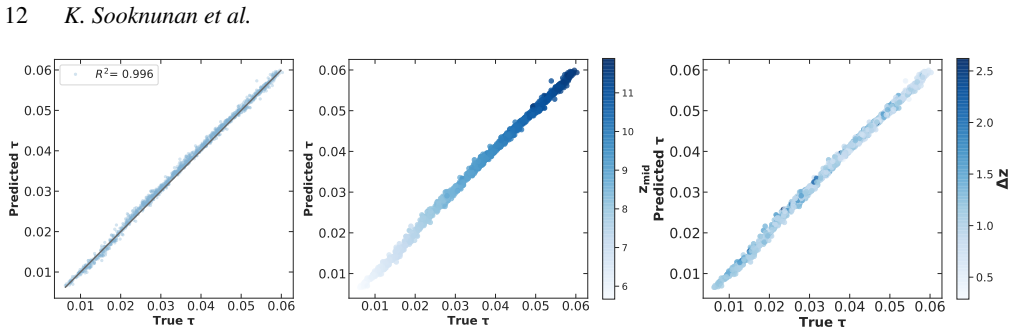
The central discovery, stated on the paper's own terms, is that CNNs trained on 21 cm brightness-temperature maps frequently learn box-level memorization rather than a transferable mapping from image features to parameters. The evidence chain is: reproducing the network architecture of Hassan et al. (2020) on 30,000 Simfast21 boxes; showing same-box test R2 of about 0.994 for six parameters; showing new-box R2 values of -1.276, -1.157, -0.236, -0.094, 0.433 and 0.511 across the six parameters; and demonstrating that R2 rises as the fraction of slices per box shared with the training set increases. The paper also finds that some targets generalise: the neutral fraction and the CMB optical depth remain recoverable on new boxes, while the reionization duration fails because the training set samples it poorly. The interpretation is that a network which appears to perform excellently can be silently exploiting artificial properties of the training set, placing responsibility on users to test generalization on completely new simulations before trusting CNN-based parameter inference.
Load-bearing premise
The load-bearing premise is that a single 2D slice of a 150 Mpc simulation box contains enough information to determine all six astrophysical and cosmological parameters; if that inference problem is ill-posed, a network could fail on new boxes even while learning real physics.
Editorial extensions
If this is right
- A reported R2 above 0.99 on a held-out test set is not evidence of generalisation when training and test slices share simulation boxes; new-box performance must be reported separately.
- Targets like the neutral fraction and the CMB optical depth appear learnable across new boxes, while parameters such as h, sigma8 and fesc do not, so claims about those parameters should be treated cautiously.
- Providing the network with a cube of slices across redshift improves new-box recovery of some parameters, suggesting that temporal evolution carries much of the usable information.
- A network trained and tested under the common shared-box protocol is not ready for real 21 cm observations, because real data correspond to P=0.
- Users of CNN-based inference in 21 cm cosmology need to check the training-set simulation statistics and add out-of-distribution tests before drawing physical conclusions.
Reading between the lines
- If the single-slice inference problem is fundamentally ill-posed, the same-box R2 could be inflated by correlations between the density field and the parameters even without memorization; a summary-statistic baseline on the same new boxes would separate those cases.
- The redshift-cube improvement in Section 9 may be driven as much by adding extra constraints as by the network learning physics; ablating single redshift slices would show which slices carry the recoverable signal.
- The same shared-box diagnostic could be applied to other image-based cosmological inference pipelines, since any training set that draws multiple views from a single realisation carries the same memorization risk.
- A practical discipline suggested by the paper is to train with at most one slice per simulation realisation, or to generate enough independent boxes that shared density fields cannot be a shortcut.
Signed reviews
Editorial analysis
A structured set of objections, weighed in public.
Referee Report
Summary. This paper presents an empirical benchmark of a convolutional neural network used for 21 cm reionization parameter inference. The authors reproduce the architecture of Hassan et al. (2020), train it on 30,000 Simfast21 simulations, and compare performance when test slices come from boxes already represented in training versus from freshly simulated boxes. They find that a six-parameter regression (Ωm, h, σ8, fesc, Cion, Dion) achieves an average R2 ≈ 0.994 on shared-box test slices but near-zero or negative R2 for four of the six parameters on new boxes. A controlled experiment (Sec. 6) varies the fraction P/120 of slices per box shared between training and test at fixed total training size, and shows a monotonic rise in average R2 with P/120. The paper also studies recovery of the neutral fraction, reionization midpoint, duration, and CMB optical depth, with and without redshift-stacked inputs. It concludes that the CNN often memorizes box-specific features rather than learning physical mappings, so that current architectures are not suitable for real 21 cm data.
Significance. The paper is a timely and valuable cautionary contribution to a field where ML-based inference from 21 cm maps is being adopted rapidly. Its central empirical findings are stark and well controlled: the near-perfect shared-box R2 and the collapse to near-zero/negative R2 on new simulation boxes, complemented by the P/120 trend that isolates the effect of shared-box information at fixed training-set size. The authors ship the code, which supports reproducibility. If the conclusions hold, the paper should motivate the community to adopt stricter train/test separation protocols (new simulation boxes, not just new slices) and to test the robustness of published CNN-based parameter inference. The main qualifications are that the evidence comes from a single architecture and from single training runs, and that the memorization diagnosis would be strengthened by an explicit identifiability argument or baseline estimator.
major comments (3)
- [Sec. 5.2 / Sec. 6, Figs. 7 and 8] The R2 collapse in Fig. 7 is interpreted in Sec. 5.2 as direct evidence that the network 'has instead learnt to associate slices with individual boxes.' This interpretation presumes that a well-trained network could in principle recover all six parameters from a single 2D slice of a 150 Mpc Simfast21 box. If the single-slice problem is not identifiable, then a perfect network would also fail on new boxes, and the high same-box R2 would reflect box-specific correlations rather than a failure to learn physics. The P/120 experiment in Fig. 8 provides controlled evidence for memorization, because same-box test performance rises with the fraction of training slices per box at fixed total training size. However, the paper does not explicitly explain why this trend rules out the identifiability alternative; a reader must supply that argument. Please add a brief identifiability discussion and, ideally, a simple baseline estimator (e.g., linear regression on power-spectrum or topology summary statistics, or a nearest-neighbour predictor) to quantify the new-box performance achievable without memorization.
- [Secs. 7–9, Table 1] The 3D case studies (Secs. 7–9) feed datacubes of shape (200,200,20) into the network, but Table 1 specifies an input shape of (200,200,1). The paper does not state whether the first convolutional layer was changed to accept 20 input channels, whether 3D convolutions were used, or how the redshift/line-of-sight dimension was handled. Because the paper's stated purpose is reproducibility, this architecture detail is essential and should be specified explicitly (or the table amended for the 3D runs).
- [General / Fig. 8] Every configuration in the paper is trained once, and Fig. 8 is reported without error bars. The main qualitative conclusions are probably robust given the size of the R2 differences, but the paper should at least state that single runs are used and provide some estimate of the expected variability (e.g., from a few random seeds for a subset of configurations, or from multiple data splits). Without this, a reader cannot assess whether the monotonic trend in Fig. 8 and the exact positions of the orange/red points are stable.
minor comments (6)
- [Abstract] The abstract states the paper applies networks to '21cmFast and Simfast21 simulations,' but the full text only uses Simfast21; please correct the abstract or clarify that 21cmFast refers to the original papers being reproduced.
- [Sec. 2.3 / Sec. 7.1] Sec. 2.3 says each simulation had 21 boxes, while Sec. 7.1 refers to 20 redshift boxes; the counting should be made consistent.
- [Sec. 2.3] The text mentions 'minor adjustments to the code' to vary Cion and Dion, but the exact modifications are not described. Since the code is available, a brief description or pointer would improve reproducibility.
- [Sec. 9 / Fig. 12] The claim that the network is 'able to infer four out of six parameters' is somewhat strong given the R2 values in Fig. 12 (e.g., σ8 R2 = 0.283, Dion R2 = 0.494); please temper the wording or define a threshold for 'able to infer.'
- [Abstract / Conclusions] The paper generalizes from a single CNN architecture (Network I of Hassan et al. 2020) to 'CNNs often learn...' in the abstract; consider qualifying the claim as 'the tested CNN' or 'at least one widely used architecture.'
- [Throughout] Minor typos include 'criterea' (Sec. 7.1), 'refered' (Sec. 3.1), and 'telecopes' (Sec. 2).
Circularity Check
No significant circularity: the central claim is established by external benchmarks on freshly simulated boxes, not by fitted parameters, self-citations, or definitional reductions.
full rationale
This is an empirical benchmarking study, and its central claim—that CNNs trained on 21 cm maps often memorize simulation boxes rather than the underlying reionization physics (Abstract; Sec. 10)—is established by comparing network outputs to ground truth on simulations that were held out from training. The same-box/new-box comparison in Sec. 5.2 (Figs. 6 and 7) is an external test relative to the trained model: the new boxes are freshly simulated with different initial seeds, and no network parameter is fitted to those new-box labels. The P/120 experiment in Sec. 6 (Fig. 8) is also an empirical measurement, not a fitted prediction: R2 is computed on held-out slices and is not determined by construction from P/120, even though the shared-box design deliberately makes memorization visible. The architecture and preprocessing follow Hassan et al. (2020) and Mangena et al. (2020), but those are external references and are not used to justify the new conclusion; the new result is the degradation on unseen boxes. The acknowledged limitations—for example, the tau label not being the true CMB optical depth (Sec. 8.1) and the poor sampling of Delta z (Sec. 7.2)—are internal caveats that reduce the strength of some sub-claims but are not circular. A legitimate scientific concern is that no identifiability analysis or baseline estimator is given to show that all six parameters can be recovered from a single 2D slice (Sec. 5.2), but this is a correctness or interpretability concern, not a circularity: the paper does not define the target in terms of the network output, nor does it rename a fit as a prediction. No self-citation chain is load-bearing.
Assumptions & free parameters
assumptions (5)
- domain assumption Simfast21 semi-numerical simulations provide a valid and sufficiently diverse proxy for the 21 cm signal during reionization.
- domain assumption A single 2D slice from a 150 Mpc box contains enough information to infer the six astrophysical and cosmological parameters in principle.
- domain assumption The chosen CNN architecture (Hassan et al. 2020 Network I) is representative of CNNs used for 21 cm parameter inference.
- domain assumption Differences in reionization morphology are independent of the random seed used to generate the initial density field, so "new boxes" are a fair generalization test.
- domain assumption The spin-temperature saturated regime approximation (Ts >> Tcmb) does not affect the robustness conclusions.
Cite this review
Pith. "Pith review of Reproducibility of machine learning analyses of 21 cm reionization maps." pith.science (2026). https://pith.science/paper/NBEHTYSC
@misc{pith2026241215893,
  author       = {Pith},
  title        = {Pith review of: Reproducibility of machine learning analyses of 21 cm reionization maps},
  year         = {2026},
  howpublished = {\url{https://pith.science/paper/NBEHTYSC}},
  note         = {Machine review of arXiv:2412.15893}
}
read the original abstract
Machine learning (ML) methods have become popular for parameter inference in cosmology, although their reliance on specific training data can cause difficulties when applied across different data sets. By reproducing and testing networks previously used in the field, and applied to 21cmFast and Simfast21 simulations, we show that convolutional neural networks (CNNs) often learn to identify features of individual simulation boxes rather than the underlying physics, limiting their applicability to real observations. We examine the prediction of the neutral fraction and astrophysical parameters from 21 cm maps and find that networks typically fail to generalise to unseen simulations. We explore a number of case studies to highlight factors that improve or degrade network performance. These results emphasise the responsibility on users to ensure ML models are applied correctly in 21 cm cosmology.
Figures


Figures from the paper (7 more)



Forward citations
Cited by 1 Pith paper
-
Machine Learning and the SKA for Cosmic Dawn and the Epoch of Reionization
A multi-author overview of machine-learning algorithms proposed for instrument modelling, data analysis, simulation and inference in SKA Cosmic Dawn and Epoch of Reionization science.
Reference graph
Works this paper leans on
-
[1]
Towards cosmological inference on unlabeled out-of-distribution HI observational data
Andrianomena S., Hassan S., 2024, @doi [arXiv e-prints] 10.48550/arXiv.2411.10515 , https://ui.adsabs.harvard.edu/abs/2024arXiv241110515A p. arXiv:2411.10515
work page Pith review arXiv doi:10.48550/arxiv.2411.10515 2024
-
[2]
Atek H., et al., 2024, @doi [ ] 10.1038/s41586-024-07043-6 , https://ui.adsabs.harvard.edu/abs/2024Natur.626..975A 626, 975
-
[3]
Baek, S. Di Matteo, P. Semelin, B. Combes, F. Revaz, Y. 2009, @doi [A&A] 10.1051/0004-6361:200810757 , 495, 389
-
[4]
D., Davies F
Becker G. D., Davies F. B., Furlanetto S. R., Malkan M. A., Boera E., Douglass C., 2018, , 863, 92
2018
-
[5]
Bevins H. T. J., Handley W. J., Fialkov A., de Lera Acedo E., Javid K., 2021, @doi [ ] 10.1093/mnras/stab2737 , https://ui.adsabs.harvard.edu/abs/2021MNRAS.508.2923B 508, 2923
-
[6]
Bianco M., Giri S. K., Iliev I. T., Mellema G., 2021, @doi [ ] 10.1093/mnras/stab1518 , https://ui.adsabs.harvard.edu/abs/2021MNRAS.505.3982B 505, 3982
-
[7]
K., Prelogovi \'c D., Chen T., Mertens F
Bianco M., Giri S. K., Prelogovi \'c D., Chen T., Mertens F. G., Tolley E., Mesinger A., Kneib J.-P., 2024, @doi [ ] 10.1093/mnras/stae257 , https://ui.adsabs.harvard.edu/abs/2024MNRAS.528.5212B 528, 5212
-
[8]
S., La Plante P., Aguirre J
Billings T. S., La Plante P., Aguirre J. E., 2021, PASP, https://ui.adsabs.harvard.edu/abs/2021arXiv210314563B 133, 044001
2021
Show all 91 references
-
[9]
Bosman S. E. I., et al., 2022, @doi [ ] 10.1093/mnras/stac1046 , https://ui.adsabs.harvard.edu/abs/2022MNRAS.514...55B 514, 55
2022 doi
-
[10]
L., Green J
Braun R., Bourke T. L., Green J. A., Keane E., Wagg J., 2015, in , Vol. 215, PoS(AASKA14). Giardini Naxos, Italy
2015
-
[11]
G., Prelogovi \'c D., Qin Y., Trotta R., 2024, @doi [ ] 10.1093/mnras/stad3849 , https://ui.adsabs.harvard.edu/abs/2024MNRAS.527.9833B 527, 9833
Breitman D., Mesinger A., Murray S. G., Prelogovi \'c D., Qin Y., Trotta R., 2024, @doi [ ] 10.1093/mnras/stad3849 , https://ui.adsabs.harvard.edu/abs/2024MNRAS.527.9833B 527, 9833
2024 doi
-
[12]
H., Portillo S
Bye C. H., Portillo S. K. N., Fialkov A., 2022, @doi [ ] 10.3847/1538-4357/ac6424 , https://ui.adsabs.harvard.edu/abs/2022ApJ...930...79B 930, 79
2022 doi
- [13]
-
[15]
Choudhury M., Datta A., Chakraborty A., 2020, @doi [ ] 10.1093/mnras/stz3107 , https://ui.adsabs.harvard.edu/abs/2020MNRAS.491.4031C 491, 4031
2020 doi
-
[16]
R., 2021, @doi [ ] 10.1093/mnras/stab180 , https://ui.adsabs.harvard.edu/abs/2021MNRAS.502.2815C 502, 2815
Choudhury M., Chatterjee A., Datta A., Choudhury T. R., 2021, @doi [ ] 10.1093/mnras/stab180 , https://ui.adsabs.harvard.edu/abs/2021MNRAS.502.2815C 502, 2815
2021 doi
-
[17]
Choudhury M., Datta A., Majumdar S., 2022, @doi [ ] 10.1093/mnras/stac736 , https://ui.adsabs.harvard.edu/abs/2022MNRAS.512.5010C 512, 5010
2022 doi
-
[18]
L., Boser B., Denker J
Cun Y. L., Boser B., Denker J. S., Howard R. E., Habbard W., Jackel L. D., Henderson D., 1990, Morgan Kaufmann Publishers Inc., San Francisco, CA, USA, Chapt. Handwritten Digit Recognition with a Back-propagation Network, pp 396--404, http://dl.acm.org/citation.cfm?id=109230.109279
1990
-
[19]
Curtis-Lake E., et al., 2023, @doi [Nature Astronomy] 10.1038/s41550-023-01918-w , https://ui.adsabs.harvard.edu/abs/2023NatAs...7..622C 7, 622
2023 doi
-
[20]
R., et al., 2017, @doi [ ] 10.1088/1538-3873/129/974/045001 , https://ui.adsabs.harvard.edu/abs/2017PASP..129d5001D 129, 045001
DeBoer D. R., et al., 2017, @doi [ ] 10.1088/1538-3873/129/974/045001 , https://ui.adsabs.harvard.edu/abs/2017PASP..129d5001D 129, 045001
2017 doi
-
[21]
Doussot A., Eames E., Semelin B., 2019, @doi [ ] 10.1093/mnras/stz2429 , https://ui.adsabs.harvard.edu/abs/2019MNRAS.490..371D 490, 371
2019 doi
-
[22]
P., Whitler L., Topping M
Endsley R., Stark D. P., Whitler L., Topping M. W., Chen Z., Plat A., Chisholm J., Charlot S., 2023, @doi [ ] 10.1093/mnras/stad1919 , https://ui.adsabs.harvard.edu/abs/2023MNRAS.524.2312E 524, 2312
2023 doi
-
[23]
Endsley R., et al., 2024, @doi [ ] 10.1093/mnras/stae1857 , https://ui.adsabs.harvard.edu/abs/2024MNRAS.533.1111E 533, 1111
2024 doi
-
[24]
Fan X., et al., 2006, , 131, 1203
2006
-
[25]
B., 1958, @doi [Proc
Field G. B., 1958, @doi [Proc. of the IRE] 10.1109/JRPROC.1958.286741 , https://ui.adsabs.harvard.edu/abs/1958PIRE...46..240F 46, 240
1958
-
[26]
B., 1959, @doi [ ] 10.1086/146653 , https://ui.adsabs.harvard.edu/abs/1959ApJ...129..536F 129, 536
Field G. B., 1959, @doi [ ] 10.1086/146653 , https://ui.adsabs.harvard.edu/abs/1959ApJ...129..536F 129, 536
1959 doi
-
[27]
L., et al., 2023, @doi [ ] 10.3847/2041-8213/acade4 , https://ui.adsabs.harvard.edu/abs/2023ApJ...946L..13F 946, L13
Finkelstein S. L., et al., 2023, @doi [ ] 10.3847/2041-8213/acade4 , https://ui.adsabs.harvard.edu/abs/2023ApJ...946L..13F 946, L13
2023 doi
-
[28]
R., Zaldarriaga M., Hernquist L., 2004, @doi [ ] 10.1086/423025 , https://ui.adsabs.harvard.edu/abs/2004ApJ...613....1F 613, 1
Furlanetto S. R., Zaldarriaga M., Hernquist L., 2004, @doi [ ] 10.1086/423025 , https://ui.adsabs.harvard.edu/abs/2004ApJ...613....1F 613, 1
2004 doi
-
[29]
R., Oh S
Furlanetto S. R., Oh S. P., Briggs F. H., 2006, @doi [ ] 10.1016/j.physrep.2006.08.002 , https://ui.adsabs.harvard.edu/abs/2006PhR...433..181F 433, 181
2006 doi
-
[30]
R., Datta K
Ghara R., Choudhury T. R., Datta K. K., 2015, @doi [Monthly Notices of the Royal Astronomical Society] 10.1093/mnras/stu2512 , 447, 1806
2015 doi
-
[31]
Gillet N., Mesinger A., Greig B., Liu A., Ucci G., 2019, @doi [ ] 10.1093/mnras/stz010 , https://ui.adsabs.harvard.edu/abs/2019MNRAS.484..282G 484, 282
2019 doi
-
[32]
W., Titterington M., eds, Proceedings of Machine Learning Research Vol
Glorot X., Bengio Y., 2010, in Teh Y. W., Titterington M., eds, Proceedings of Machine Learning Research Vol. 9, Proceedings of the Thirteenth International Conference on Artificial Intelligence and Statistics. PMLR, Chia Laguna Resort, Sardinia, Italy, pp 249--256, https://pr...
2010
- [33]
-
[34]
The MIT Press
Goodfellow I., Bengio Y., Courville A., 2016, Deep Learning. The MIT Press
2016
-
[35]
Greig B., Mesinger A., 2015, @doi [ ] 10.1093/mnras/stv571 , https://ui.adsabs.harvard.edu/abs/2015MNRAS.449.4246G 449, 4246
2015 doi
-
[36]
Greig B., Mesinger A., 2017a, @doi [ ] 10.1093/mnras/stw3026 , https://ui.adsabs.harvard.edu/abs/2017MNRAS.465.4838G 465, 4838
-
[37]
Greig B., Mesinger A., 2017b, @doi [ ] 10.1093/mnras/stx2118 , https://ui.adsabs.harvard.edu/abs/2017MNRAS.472.2651G 472, 2651
-
[38]
Harikane Y., et al., 2023, @doi [ ] 10.3847/1538-4365/acaaa9 , https://ui.adsabs.harvard.edu/abs/2023ApJS..265....5H 265, 5
2023 doi
-
[39]
G., 2016, @doi [ ] 10.1093/mnras/stv3001 , https://ui.adsabs.harvard.edu/abs/2016MNRAS.457.1550H 457, 1550
Hassan S., Dav \'e R., Finlator K., Santos M. G., 2016, @doi [ ] 10.1093/mnras/stv3001 , https://ui.adsabs.harvard.edu/abs/2016MNRAS.457.1550H 457, 1550
2016 doi
-
[40]
Hassan S., Andrianomena S., Doughty C., 2020, @doi [ ] 10.1093/mnras/staa1151 , https://ui.adsabs.harvard.edu/abs/2020MNRAS.494.5761H 494, 5761
2020 doi
- [41]
-
[42]
Hutter A., 2018, @doi [ ] 10.1093/mnras/sty683 , https://ui.adsabs.harvard.edu/abs/2018MNRAS.477.1549H 477, 1549
2018 doi
-
[44]
T., Mellema G., Ahn K., Shapiro P
Iliev I. T., Mellema G., Ahn K., Shapiro P. R., Mao Y., Pen U.-L., 2014, @doi [ ] 10.1093/mnras/stt2497 , https://ui.adsabs.harvard.edu/abs/2014MNRAS.439..725I 439, 725
2014 doi
-
[45]
Iliev I., Santos M., Mesinger A., Majumdar S., Mellema G., 2015, in Advancing Astrophysics with the Square Kilometre Array (AASKA14). p. 7 ( @eprint arXiv 1501.04213 )
2015 arXiv
-
[46]
C., Weinberger L
Keating L. C., Weinberger L. H., Kulkarni G., Haehnelt M. G., Chardin J., Aubert D., 2020, @doi [ ] 10.1093/mnras/stz3083 , https://ui.adsabs.harvard.edu/abs/2020MNRAS.491.1736K 491, 1736
2020 doi
-
[47]
R., Gaikwad P., 2016, @doi [ ] 10.1093/mnras/stw192 , https://ui.adsabs.harvard.edu/abs/2016MNRAS.457.4051K 457, 4051
Khaire V., Srianand R., Choudhury T. R., Gaikwad P., 2016, @doi [ ] 10.1093/mnras/stw192 , https://ui.adsabs.harvard.edu/abs/2016MNRAS.457.4051K 457, 4051
2016 doi
- [48]
-
[49]
C., Haehnelt M
Kulkarni G., Keating L. C., Haehnelt M. G., Bosman S. E. I., Puchwein E., Chardin J., Aubert D., 2019, , 485, L24
2019
-
[50]
E., Park I., 2020, @doi [Journal of Korean Physical Society] 10.3938/jkps.77.49 , https://ui.adsabs.harvard.edu/abs/2020JKPS...77...49K 77, 49
Kwon Y., Hong S. E., Park I., 2020, @doi [Journal of Korean Physical Society] 10.3938/jkps.77.49 , https://ui.adsabs.harvard.edu/abs/2020JKPS...77...49K 77, 49
2020 doi
-
[51]
La Plante P., Ntampaka M., 2019, @doi [ ] 10.3847/1538-4357/ab2983 , https://ui.adsabs.harvard.edu/abs/2019ApJ...880..110L 880, 110
2019 doi
-
[52]
Convolutional Networks for Images, Speech, and Time Series, pp 255--258, http://dl.acm.org/citation.cfm?id=303568.303704
LeCun Y., Bengio Y., 1998, MIT Press, Cambridge, MA, USA, Chapt. Convolutional Networks for Images, Speech, and Time Series, pp 255--258, http://dl.acm.org/citation.cfm?id=303568.303704
1998
-
[53]
R., 2020, @doi [ ] 10.1088/1538-3873/ab5bfd , https://ui.adsabs.harvard.edu/abs/2020PASP..132f2001L 132, 062001
Liu A., Shaw J. R., 2020, @doi [ ] 10.1088/1538-3873/ab5bfd , https://ui.adsabs.harvard.edu/abs/2020PASP..132f2001L 132, 062001
2020 doi
-
[54]
J., 1997, @doi [ ] 10.1086/303549 , https://ui.adsabs.harvard.edu/abs/1997ApJ...475..429M 475, 429
Madau P., Meiksin A., Rees M. J., 1997, @doi [ ] 10.1086/303549 , https://ui.adsabs.harvard.edu/abs/1997ApJ...475..429M 475, 429
1997 doi
-
[55]
R., Mondal R., Watkinson C
Majumdar S., Pritchard J. R., Mondal R., Watkinson C. A., Bharadwaj S., Mellema G., 2018, @doi [ ] 10.1093/mnras/sty535 , https://ui.adsabs.harvard.edu/abs/2018MNRAS.476.4007M 476, 4007
2018 doi
-
[56]
L., Lancaster L., Villaescusa-Navarro F., Melchior P., Ho S., Perreault-Levasseur L., Spergel D
Makinen T. L., Lancaster L., Villaescusa-Navarro F., Melchior P., Ho S., Perreault-Levasseur L., Spergel D. N., 2021, @doi [ ] 10.1088/1475-7516/2021/04/081 , https://ui.adsabs.harvard.edu/abs/2021JCAP...04..081M 2021, 081
2021 doi
-
[57]
G., 2020, @doi [ ] 10.1093/mnras/staa750 , https://ui.adsabs.harvard.edu/abs/2020MNRAS.494..600M 494, 600
Mangena T., Hassan S., Santos M. G., 2020, @doi [ ] 10.1093/mnras/staa750 , https://ui.adsabs.harvard.edu/abs/2020MNRAS.494..600M 494, 600
2020 doi
-
[58]
McQuinn M., Lidz A., Zahn O., Dutta S., Hernquist L., Zaldarriaga M., 2007, @doi [Monthly Notices of the Royal Astronomical Society] 10.1111/j.1365-2966.2007.11489.x , 377, 1043
2007
-
[59]
T., Pen U.-L., Shapiro P
Mellema G., Iliev I. T., Pen U.-L., Shapiro P. R., 2006, @doi [Monthly Notices of the Royal Astronomical Society] 10.1111/j.1365-2966.2006.10919.x , 372, 679
2006
-
[60]
G., Bobin J., Carucci I
Mertens F. G., Bobin J., Carucci I. P., 2024, @doi [ ] 10.1093/mnras/stad3430 , https://ui.adsabs.harvard.edu/abs/2024MNRAS.527.3517M 527, 3517
2024 doi
-
[61]
Mesinger A., Furlanetto S., 2007, @doi [ ] 10.1086/521806 , 669, 663
2007 doi
-
[62]
Mesinger A., Greig B., Sobacchi E., 2016, @doi [ ] 10.1093/mnras/stw831 , https://ui.adsabs.harvard.edu/abs/2016MNRAS.459.2342M 459, 2342
2016 doi
-
[63]
G., Finlator K., 2019, @doi [ ] 10.1093/mnras/stz2171 , https://ui.adsabs.harvard.edu/abs/2019MNRAS.489.5594M 489, 5594
Molaro M., Dav \'e R., Hassan S., Santos M. G., Finlator K., 2019, @doi [ ] 10.1093/mnras/stz2171 , https://ui.adsabs.harvard.edu/abs/2019MNRAS.489.5594M 489, 5594
2019 doi
-
[64]
P., et al., 2022, @doi [ ] 10.3847/2041-8213/ac9b22 , https://ui.adsabs.harvard.edu/abs/2022ApJ...940L..14N 940, L14
Naidu R. P., et al., 2022, @doi [ ] 10.3847/2041-8213/ac9b22 , https://ui.adsabs.harvard.edu/abs/2022ApJ...940L..14N 940, L14
2022 doi
-
[65]
Neutsch S., Heneka C., Br \"u ggen M., 2022, @doi [ ] 10.1093/mnras/stac218 , https://ui.adsabs.harvard.edu/abs/2022MNRAS.511.3446N 511, 3446
2022 doi
-
[66]
Ni S., Li Y., Gao L.-Y., Zhang X., 2022, @doi [ ] 10.3847/1538-4357/ac7a34 , https://ui.adsabs.harvard.edu/abs/2022ApJ...934...83N 934, 83
2022 doi
-
[67]
Planck Collaboration 2020, , 641, A6
2020
-
[68]
C., et al., 2014, @doi [ ] 10.1088/0004-637X/782/2/66 , https://ui.adsabs.harvard.edu/abs/2014ApJ...782...66P 782, 66
Pober J. C., et al., 2014, @doi [ ] 10.1088/0004-637X/782/2/66 , https://ui.adsabs.harvard.edu/abs/2014ApJ...782...66P 782, 66
2014 doi
-
[69]
Prelogovi \'c D., Mesinger A., Murray S., Fiameni G., Gillet N., 2022, @doi [ ] 10.1093/mnras/stab3215 , https://ui.adsabs.harvard.edu/abs/2022MNRAS.509.3852P 509, 3852
2022 doi
-
[70]
R., Loeb A., 2012, @doi [Reports on Progress in Physics] 10.1088/0034-4885/75/8/086901 , https://ui.adsabs.harvard.edu/abs/2012RPPh...75h6901P 75, 086901
Pritchard J. R., Loeb A., 2012, @doi [Reports on Progress in Physics] 10.1088/0034-4885/75/8/086901 , https://ui.adsabs.harvard.edu/abs/2012RPPh...75h6901P 75, 086901
2012 doi
-
[71]
G., Kadota K., Asorey J., Park I., 2022, @doi [ ] 10.1088/1475-7516/2022/01/020 , https://ui.adsabs.harvard.edu/abs/2022JCAP...01..020S 2022, 020
Sabiu C. G., Kadota K., Asorey J., Park I., 2022, @doi [ ] 10.1088/1475-7516/2022/01/020 , https://ui.adsabs.harvard.edu/abs/2022JCAP...01..020S 2022, 020
2022 doi
-
[72]
B., Mishra-Sharma S., Youn T., 2024, @doi [arXiv e-prints] 10.48550/arXiv.2407.21097 , https://ui.adsabs.harvard.edu/abs/2024arXiv240721097S p
Sabti N., Reddy R., Mu \ n oz J. B., Mishra-Sharma S., Youn T., 2024, @doi [arXiv e-prints] 10.48550/arXiv.2407.21097 , https://ui.adsabs.harvard.edu/abs/2024arXiv240721097S p. arXiv:2407.21097
-
[73]
G., Amblard A., Pritchard J., Trac H., Cen R., Cooray A., 2008, @doi [ ] 10.1086/592487 , https://ui.adsabs.harvard.edu/abs/2008ApJ...689....1S 689, 1
Santos M. G., Amblard A., Pritchard J., Trac H., Cen R., Cooray A., 2008, @doi [ ] 10.1086/592487 , https://ui.adsabs.harvard.edu/abs/2008ApJ...689....1S 689, 1
2008 doi
-
[74]
Saxena A., et al., 2024, @doi [ ] 10.1051/0004-6361/202347132 , https://ui.adsabs.harvard.edu/abs/2024A&A...684A..84S 684, A84
2024 doi
-
[75]
Schmidhuber J., 2014, preprint, https://ui.adsabs.harvard.edu/\#abs/2014arXiv1404.7828S (arXiv:1404.7828)
2014 arXiv
-
[76]
J., Pritchard J
Schmit C. J., Pritchard J. R., 2018, @doi [ ] 10.1093/mnras/stx3292 , https://ui.adsabs.harvard.edu/abs/2018MNRAS.475.1213S 475, 1213
2018 doi
-
[77]
Shimabukuro H., Semelin B., 2017, @doi [ ] 10.1093/mnras/stx734 , https://ui.adsabs.harvard.edu/abs/2017MNRAS.468.3869S 468, 3869
2017 doi
-
[78]
Shimabukuro H., Yoshiura S., Takahashi K., Yokoyama S., Ichiki K., 2016, @doi [ ] 10.1093/mnras/stw482 , https://ui.adsabs.harvard.edu/abs/2016MNRAS.458.3003S 458, 3003
2016 doi
-
[79]
Shimabukuro H., Mao Y., Tan J., 2022, @doi [Research in Astronomy and Astrophysics] 10.1088/1674-4527/ac4ca3 , https://ui.adsabs.harvard.edu/abs/2022RAA....22c5027S 22, 035027
2022 doi
-
[80]
Shin M.-S., Trac H., Cen R., 2008, @doi [The Astrophysical Journal] 10.1086/588247 , 681, 756
2008 doi
-
[81]
Sikder S., Barkana R., Reis I., Fialkov A., 2024, @doi [ ] 10.1093/mnras/stad3699 , https://ui.adsabs.harvard.edu/abs/2024MNRAS.527.9977S 527, 9977
2024 doi
-
[82]
Simonyan K., Zisserman A., 2014, preprint, https://ui.adsabs.harvard.edu/abs/2014arXiv1409.1556S (arXiv:1409.1556)
2014 arXiv
-
[83]
M., et al., 2009, @doi [Monthly Notices of the Royal Astronomical Society] 10.1111/j.1365-2966.2008.14206.x , 393, 32
Thomas R. M., et al., 2009, @doi [Monthly Notices of the Royal Astronomical Society] 10.1111/j.1365-2966.2008.14206.x , 393, 32
2009
-
[84]
K., Majumdar S., Kamran M., Choudhury M., 2022, @doi [ ] 10.1088/1475-7516/2022/04/045 , https://ui.adsabs.harvard.edu/abs/2022JCAP...04..045T 2022, 045
Tiwari H., Shaw A. K., Majumdar S., Kamran M., Choudhury M., 2022, @doi [ ] 10.1088/1475-7516/2022/04/045 , https://ui.adsabs.harvard.edu/abs/2022JCAP...04..045T 2022, 045
2022 doi
-
[85]
M., et al., 2016, @doi [ ] 10.3847/0004-637X/818/2/139 , https://ui.adsabs.harvard.edu/abs/2016ApJ...818..139T 818, 139
Trott C. M., et al., 2016, @doi [ ] 10.3847/0004-637X/818/2/139 , https://ui.adsabs.harvard.edu/abs/2016ApJ...818..139T 818, 139
2016 doi
-
[86]
Umeda H., Ouchi M., Nakajima K., Harikane Y., Ono Y., Xu Y., Isobe Y., Zhang Y., 2024, @doi [ ] 10.3847/1538-4357/ad554e , https://ui.adsabs.harvard.edu/abs/2024ApJ...971..124U 971, 124
2024 doi
-
[87]
Villanueva-Domingo P., Villaescusa-Navarro F., 2021, @doi [ ] 10.3847/1538-4357/abd245 , https://ui.adsabs.harvard.edu/abs/2021ApJ...907...44V 907, 44
2021 doi
-
[88]
R., 2007, @doi [The Astrophysical Journal] 10.1086/509597 , 654, 12
Zahn O., Lidz A., McQuinn M., Dutta S., Hernquist L., Zaldarriaga M., Furlanetto S. R., 2007, @doi [The Astrophysical Journal] 10.1086/509597 , 654, 12
2007 doi
-
[89]
E., 2011, @doi [ ] 10.1111/j.1365-2966.2011.18439.x , https://ui.adsabs.harvard.edu/abs/2011MNRAS.414..727Z 414, 727
Zahn O., Mesinger A., McQuinn M., Trac H., Cen R., Hernquist L. E., 2011, @doi [ ] 10.1111/j.1365-2966.2011.18439.x , https://ui.adsabs.harvard.edu/abs/2011MNRAS.414..727Z 414, 727
2011
-
[90]
B., 1970, , https://ui.adsabs.harvard.edu/abs/1970A&A.....5...84Z 5, 84
Zel'dovich Y. B., 1970, , https://ui.adsabs.harvard.edu/abs/1970A&A.....5...84Z 5, 84
1970
-
[91]
D., 2022, @doi [ ] 10.3847/1538-4357/ac457d , https://ui.adsabs.harvard.edu/abs/2022ApJ...926..151Z 926, 151
Zhao X., Mao Y., Cheng C., Wandelt B. D., 2022, @doi [ ] 10.3847/1538-4357/ac457d , https://ui.adsabs.harvard.edu/abs/2022ApJ...926..151Z 926, 151
2022 doi
-
[93]
L., 2022, @doi [Publications of the Astronomical Society of the Pacific] 10.1088/1538-3873/ac5f5d , 134, 044001
Zhou Y., Plante P. L., 2022, @doi [Publications of the Astronomical Society of the Pacific] 10.1088/1538-3873/ac5f5d , 134, 044001
2022 doi
-
[94]
P., et al., 2013, @doi [ ] 10.1051/0004-6361/201220873 , https://ui.adsabs.harvard.edu/abs/2013A&A...556A...2V 556, A2
van Haarlem M. P., et al., 2013, @doi [ ] 10.1051/0004-6361/201220873 , https://ui.adsabs.harvard.edu/abs/2013A&A...556A...2V 556, A2
2013 doi
Reviewed August 11, 2026 · model on record in the stance chip above.
Discussion (0). Continue with ORCID to comment.