Two-dimensional beam compression for sub-femtosecond electron beam generation
Pith reviewed 2026-06-27 07:49 UTC · model grok-4.3
The pith
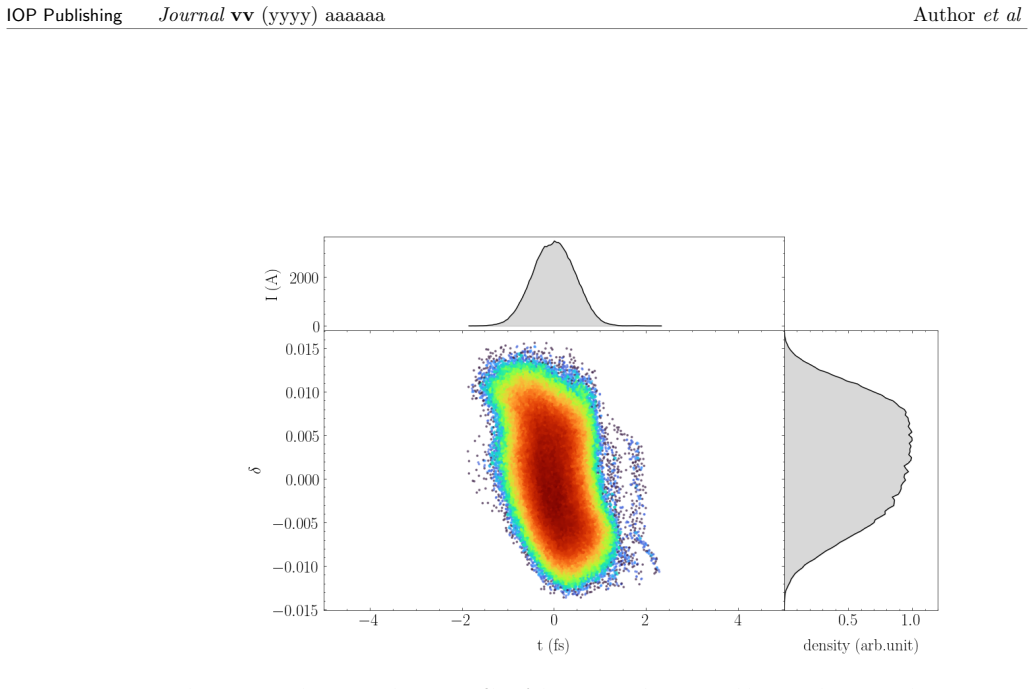
Dispersive optics convert transverse emittance into 0.45 fs electron bunches at 200 MeV.
A machine-rendered reading of the paper's core claim, the machinery that carries it, and where it could break.
Core claim
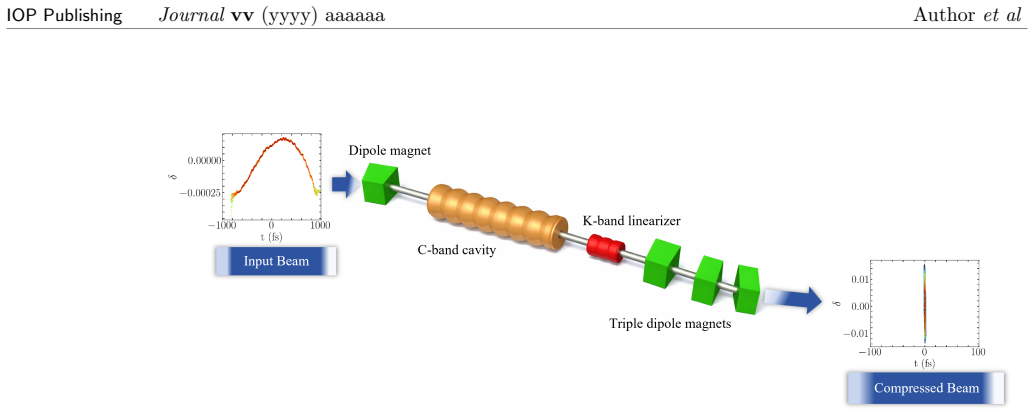
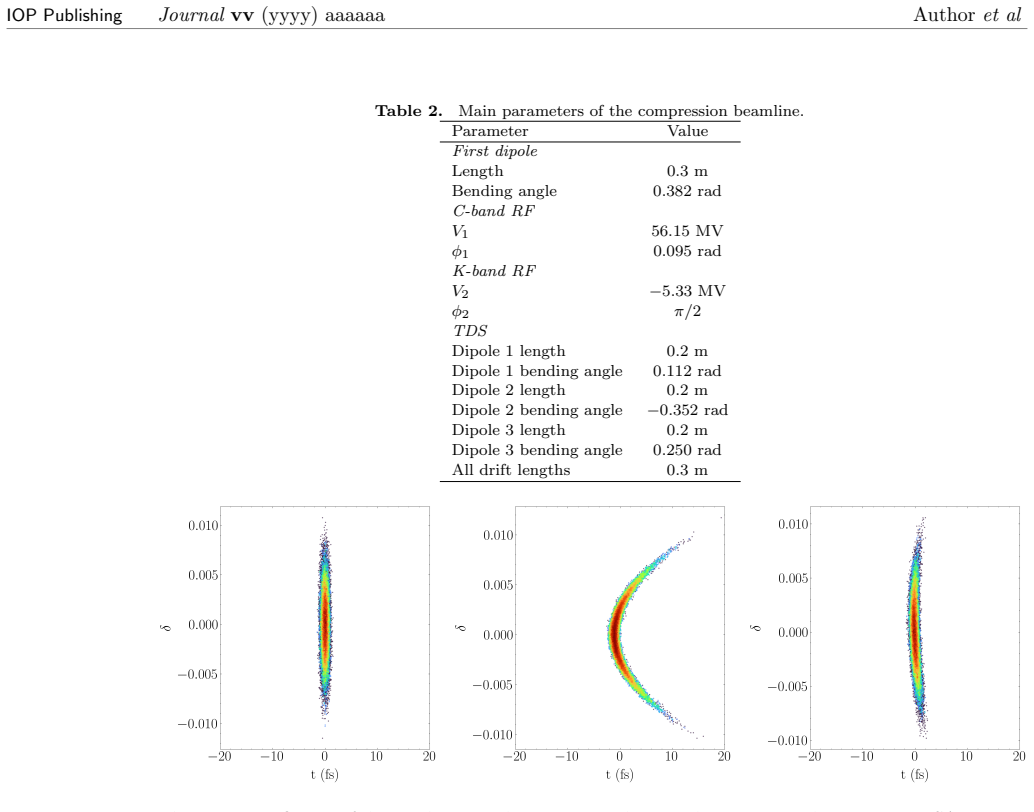
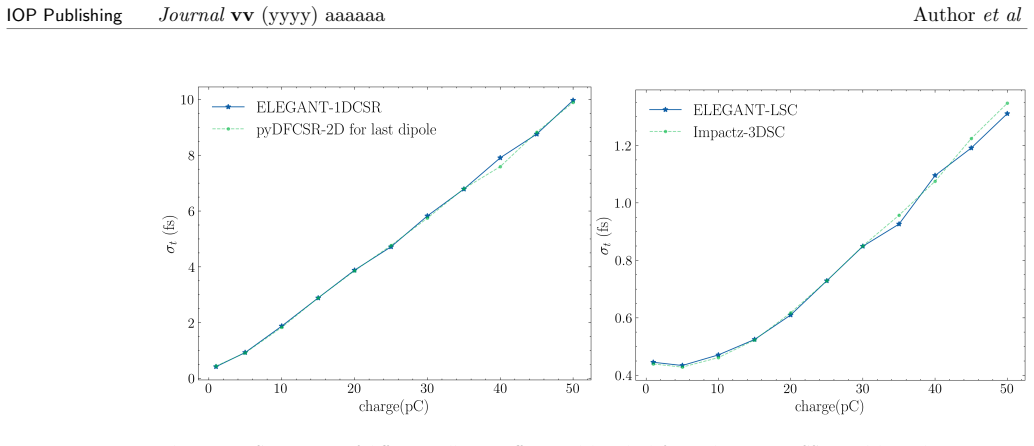
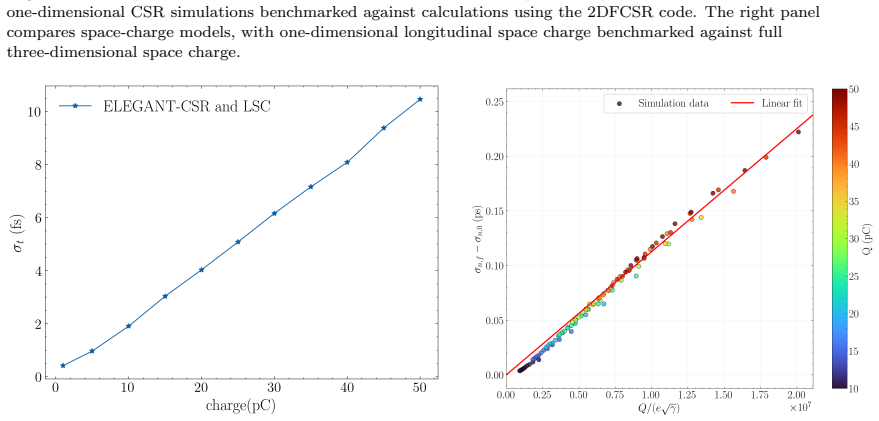
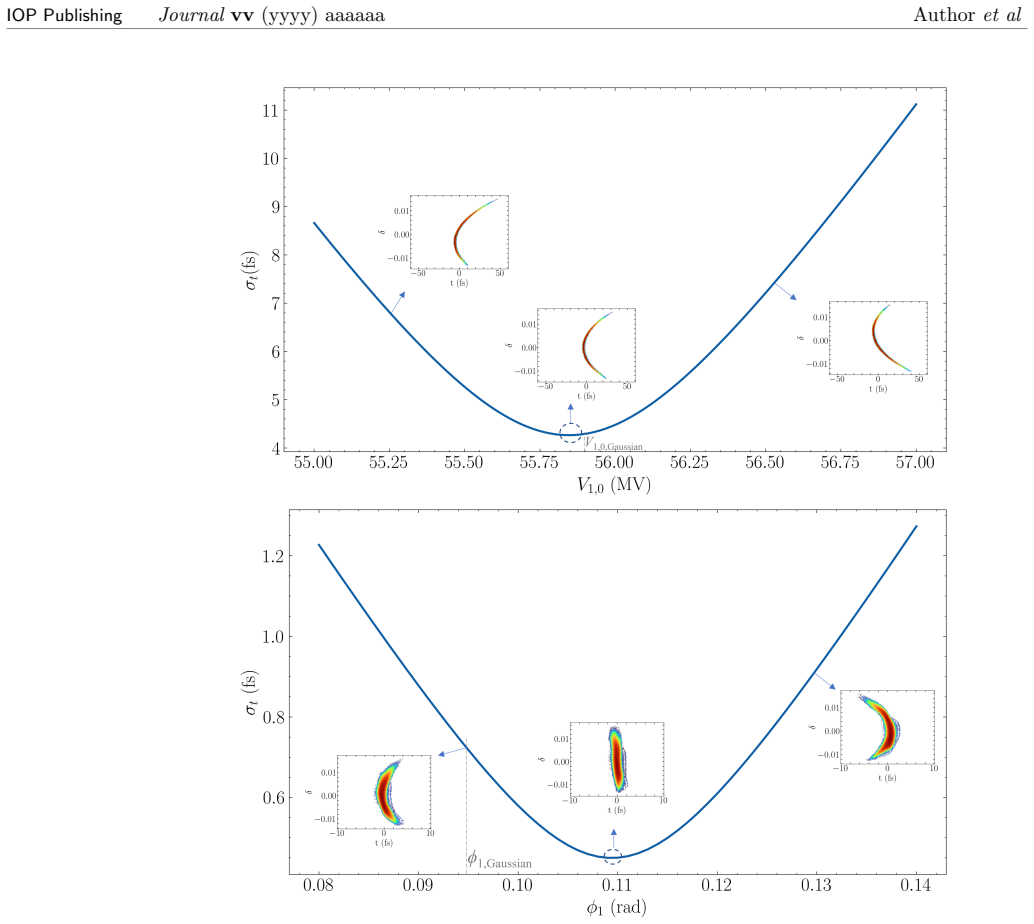
The paper establishes that a two-dimensional beam-compression scheme based on transverse-longitudinal coupling, in which dispersive beam optics convert the small transverse emittance of modern electron beams into an ultrashort longitudinal duration, can produce 200 MeV pC-level bunches with 0.45 fs rms duration after dominant longitudinal and energy-spread contributions are cancelled. The compressed bunch length is then governed primarily by transverse beam quality and collective-effect growth. Particle tracking and start-to-end simulations confirm this performance, and a scaling law shows collective-induced degradation increases approximately linearly with bunch charge while decreasing with
What carries the argument
Two-dimensional beam-compression scheme based on transverse-longitudinal coupling, where dispersive optics transform transverse emittance into longitudinal shortness.
If this is right
- Sub-femtosecond performance at 200 MeV with pC charge and 3.5 kA peak current is achievable in a realistic beamline.
- Collective-effect degradation of bunch length scales linearly with charge and inversely with energy in the relevant range.
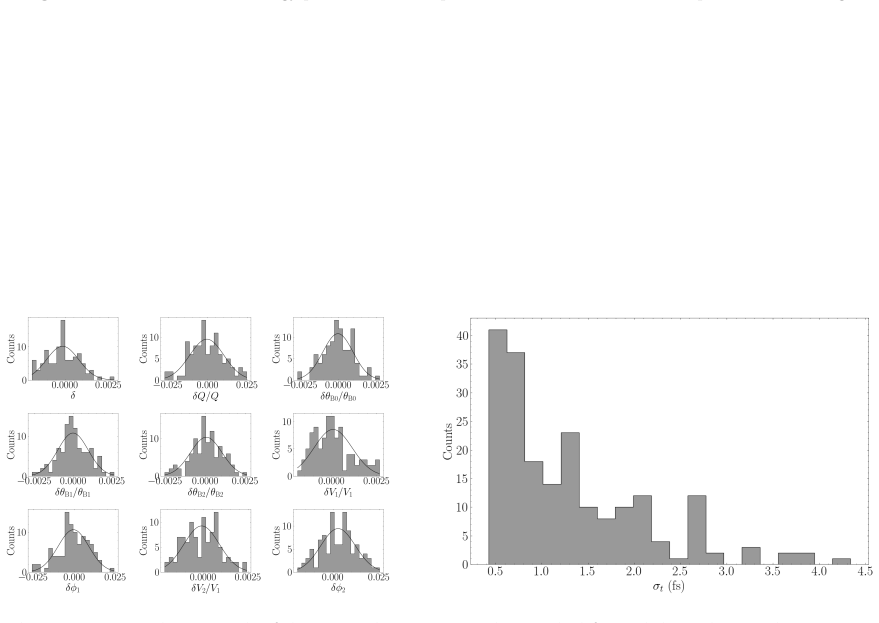
- Sub-femtosecond duration is maintained under most jitter conditions according to linear analysis and simulations.
- The scheme provides a route to compact high-energy attosecond electron sources for ultrafast dynamics and radiation generation.
Where Pith is reading between the lines
- Adapting the dispersive optics to existing accelerator facilities could test whether the emittance-conversion limit holds in practice.
- Further reduction in transverse emittance would directly improve the achievable duration without requiring higher beam energies.
- The linear scaling with charge and energy may help optimize designs for other compression or radiation-source beamlines.
Load-bearing premise
The assumption that dominant longitudinal and energy-spread contributions can be cancelled in a realistic beamline so the final duration is set primarily by transverse beam quality and collective effects.
What would settle it
A measurement showing that after attempted cancellation of longitudinal and energy-spread terms, the rms bunch duration substantially exceeds the value set by transverse emittance plus collective growth alone.
Figures
read the original abstract
Sub-femtosecond electron beams are powerful probes of ultrafast electronic, atomic, and nuclear dynamics, and promising drivers for ultrashort radiation generation from the extreme-ultraviolet to gamma-ray regimes. However, producing such beams at hundred-MeV energies with pC-level charge remains challenging. Here we propose a two-dimensional beam-compression scheme based on transverse--longitudinal coupling, in which dispersive beam optics convert the small transverse emittance of modern electron beams into an ultrashort longitudinal duration. Linear analysis and particle tracking show that, after the dominant longitudinal and energy-spread contributions are cancelled, the compressed bunch length is governed primarily by transverse beam quality and collective-effect growth. We further derive and verify a scaling law showing that, in the relevant parameter range, collective-effect-induced bunch-length degradation increases approximately linearly with bunch charge and decreases with beam energy. Start-to-end simulations of a realistic injector-to-compressor beamline produce a 200 MeV, pC-level bunch with an rms duration of 0.45 fs and a peak current of about 3.5 kA. Jitter studies indicate that sub-femtosecond performance is maintained for most error seeds. These results suggest a feasible route toward compact, high-energy attosecond electron beam sources and may provide a basis for future sub-femtosecond radiation sources based on undulator emission or inverse Compton scattering.
Editorial analysis
A structured set of objections, weighed in public.
Referee Report
Summary. The paper proposes a two-dimensional beam-compression scheme based on transverse-longitudinal coupling to generate sub-femtosecond electron beams at ~200 MeV with pC charge. Linear analysis and particle tracking indicate that after dominant longitudinal and energy-spread contributions are cancelled, the compressed bunch length is governed primarily by transverse beam quality and collective-effect growth. A scaling law is derived showing collective degradation increases linearly with charge and decreases with energy; start-to-end simulations of a realistic injector-to-compressor beamline achieve 0.45 fs rms duration and ~3.5 kA peak current, with jitter studies indicating sub-femtosecond performance for most error seeds.
Significance. If the results hold, the work provides a concrete route toward compact high-energy attosecond electron sources, with potential applications in ultrafast probes and radiation generation from EUV to gamma rays. Strengths include the combination of linear analysis, explicit derivation and verification of the collective-effect scaling law, and comprehensive start-to-end tracking that incorporates realistic beamline elements and jitter. These elements supply both analytical insight and numerical demonstration without evident parameter fitting in the scaling relation.
major comments (2)
- [Start-to-end simulations] Start-to-end simulations section: The central claim that the 0.45 fs rms duration is set primarily by transverse emittance and collective growth after cancellation of longitudinal/energy-spread terms lacks a quantitative breakdown (e.g., separate contributions or residual values) of those cancelled terms in the final distribution; without this, the dominance assertion central to the abstract cannot be directly verified from the reported data.
- [Jitter studies] Jitter studies: The statement that sub-femtosecond performance is maintained for most error seeds is load-bearing for the robustness conclusion, yet no ensemble statistics (fraction of seeds below 1 fs, rms spread of achieved durations, or explicit error-seed distribution) are provided to support the 'most' qualifier.
minor comments (2)
- [Scaling law derivation] Scaling law: The approximate linear dependence on charge is stated, but the explicit functional form or the equation in which the scaling is first derived is not referenced, reducing traceability.
- [Figures] Figure captions: Several captions omit key simulation parameters (e.g., exact charge, energy, or optics settings) used for the plotted cases, hindering direct comparison with the text.
Simulated Author's Rebuttal
We thank the referee for the constructive comments and positive assessment of the work. We agree that the manuscript would benefit from additional quantitative details on the bunch-length contributions and jitter statistics. We will incorporate these in the revised version.
read point-by-point responses
-
Referee: [Start-to-end simulations] Start-to-end simulations section: The central claim that the 0.45 fs rms duration is set primarily by transverse emittance and collective growth after cancellation of longitudinal/energy-spread terms lacks a quantitative breakdown (e.g., separate contributions or residual values) of those cancelled terms in the final distribution; without this, the dominance assertion central to the abstract cannot be directly verified from the reported data.
Authors: We agree that a quantitative breakdown is needed to verify the dominance claim. In the revised manuscript we will add a table (or supplementary figure) that decomposes the final rms bunch length into the four contributions: (i) residual longitudinal chirp after cancellation, (ii) residual energy-spread term, (iii) transverse-emittance contribution via the 2D coupling, and (iv) collective-effect growth. The values will be extracted directly from the start-to-end particle distributions at the compressor exit, confirming that the first two residuals are sub-dominant relative to (iii) and (iv). revision: yes
-
Referee: [Jitter studies] Jitter studies: The statement that sub-femtosecond performance is maintained for most error seeds is load-bearing for the robustness conclusion, yet no ensemble statistics (fraction of seeds below 1 fs, rms spread of achieved durations, or explicit error-seed distribution) are provided to support the 'most' qualifier.
Authors: We acknowledge that the current text lacks the requested ensemble metrics. In the revision we will report: (a) the fraction of the 100 error seeds that yield rms duration <1 fs, (b) the rms spread of the achieved durations across the ensemble, and (c) a brief description or histogram of the error-seed distribution (e.g., rms values for RF phase, amplitude, and magnet strength errors). These statistics will be added to the jitter-studies subsection and will directly support the statement that sub-femtosecond performance holds for most seeds. revision: yes
Circularity Check
No significant circularity
full rationale
The paper's central results rest on linear analysis, derived scaling laws for collective effects, particle tracking, and start-to-end simulations of an injector-to-compressor beamline. These produce the reported 0.45 fs rms duration and 3.5 kA peak current without any quoted step in which a prediction reduces by construction to a fitted parameter, a self-citation chain, or an ansatz smuggled via prior work. The assumption that longitudinal and energy-spread terms can be cancelled is presented as an explicit design choice verified numerically, not as a definitional tautology. No load-bearing uniqueness theorem or renaming of known results appears. The derivation chain is therefore self-contained against external simulation benchmarks.
Axiom & Free-Parameter Ledger
Reference graph
Works this paper leans on
-
[1]
Zhou C, Bai Y, Song L, Zeng Y, Xu Y, Zhang D, Lu X, Leng Y, Liu J, Tian Y, Li R and Xu Z 2021 Direct mapping of attosecond electron dynamicsNature Photonics15216–221
2021
-
[2]
Morimoto Y 2023 Attosecond electron-beam technology: a review of recent progress Microscopy722–17
2023
-
[3]
Zhu X-L, Liu W-Y, Chen M, Weng S-M, He F, Assmann R, Sheng Z-M and Zhang J 2021 Generation of 100-MeV attosecond electron bunches with terawatt few-cycle laser pulsesPhys. Rev. Appl.15044039
2021
-
[4]
Cheng Y, Gu Q and Feng C 2026 Multidimensional phase-space manipulation for attosecond electron bunch compressionPhys. Rev. Accel. Beams(doi:10.1103/3t5l-mz61)
-
[5]
Filippetto D, Musumeci P, Li R K, Siwick B J, Otto M R, Centurion M and Nunes J P F 2022 Ultrafast electron diffraction: Visualizing dynamic states of matterRev. Mod. Phys.94045004
2022
-
[6]
Wu Y, Gargiulo S, Carbone F, Keitel C H and P´ alffy A 2022 Dynamical control of nuclear isomer depletion via electron vortex beamsPhys. Rev. Lett.128162501
2022
-
[7]
Gargiulo S, Madan I and Carbone F 2022 Nuclear excitation by electron capture in excited ionsPhys. Rev. Lett.128212502 13 IOP PublishingJournalvv(yyyy) aaaaaa Authoret al
2022
-
[8]
Deng X J, Huang W H, Li Z Z and Tang C X 2021 Harmonic generation and bunch compression based on transverse-longitudinal couplingNucl. Instrum. Methods Phys. Res. A 1019165859 (doi: 10.1016/j.nima.2021.165859)
-
[9]
Feng C and Zhao Z 2017 A storage ring based free-electron laser for generating ultrashort coherent EUV and x-ray radiationScientific Reports74724
2017
-
[10]
Jiang B, Feng C, Li C, Bai Z, Wan W, Xiang D, Gu Q, Wang K, Zhang Q, Huang D and Chen S 2022 A synchrotron-based kilowatt-level radiation source for EUV lithographyScientific Reports123325
2022
-
[11]
Li C, Feng C and Jiang B 2020 Extremely bright coherent synchrotron radiation production in a diffraction-limited storage ring using an angular dispersion-induced microbunching scheme Phys. Rev. Accel. Beams23110701
2020
-
[12]
Liu W, Zhao Y, Li X, Wang S, Jiao Y and Feng C 2025 Method for reversing the laser modulation in a storage ringPhys. Rev. Accel. Beams28060703 (doi: 10.1103/rlt4-8bn9)
-
[13]
Borland M 2000ELEGANT: A flexible SDDS-compliant code for accelerator simulation Argonne National Laboratory Technical Report (doi: 10.2172/761286)
-
[14]
Tang J, Huang Z and Stupakov G 2024 DFCSR: a fast calculation of 2D/3D coherent synchrotron radiation in relativistic beams presented at the ICFA Advanced Beam Dynamics Workshop (FLS’23), Luzern, Switzerland, unpublished
2024
-
[15]
Qiang J, Ryne R D, Habib S and Decyk V 2000 An object-oriented parallel particle-in-cell code for beam dynamics simulation in linear acceleratorsJ. Comput. Phys.163434–451
2000
-
[16]
Jiao Y, Cui X, Huang X and Xu G 2014 Generic conditions for suppressing the coherent synchrotron radiation induced emittance growth in a two-dipole achromatPhys. Rev. ST Accel. Beams17060701
2014
-
[17]
Liu W, Zeng F and Jiao Y 2025 Modified coherent synchrotron radiation point-kick model with self-consistent consideration of bunch length varyingPhys. Rev. Accel. Beams28024402
2025
-
[18]
Jiang S, Liu S, Lu Z, Liu X, Li X and Yang R 2026 Analysis of multipole field reduction in C-band photocathode RF gunNucl. Instrum. Methods Phys. Res. A1085171277 (doi: 10.1016/j.nima.2026.171277)
-
[19]
Floettmann K 1997ASTRA: A space charge tracking algorithmavailable at: http://www.desy.de/~mpyflo/ 14
discussion (0)
Sign in with ORCID, Apple, or X to comment. Anyone can read and Pith papers without signing in.