REVIEW 3 major objections 5 minor 31 references
From green mutation to $\mathrm{X}$-evolution: flows and foliations on cluster complexes
T0 review · 3 major / 5 minor · reviewed 2026-08-10 · deepseek-v4-flash
Pith's one-line read For every point X in a cluster complex, the X-evolution flow defines a piecewise linear one-dimensional foliation whose only sink is X and only source is X[1].
desk verdict A genuinely new continuous flow/foliation on cluster complexes, with a solid core and compressed Dynkin/Euclidean proofs; the stress-test concern about Lemma 3.12 does not land. read the letter →
The pith
A machine-rendered reading of the paper's core claim, the machinery that carries it, and where it could break.
The reading
What carries the argument
The load-bearing object is the $X$-evolving triangle, a triangle $X \to W \to U \to X[1]$ with $\mathrm{Ext}^1(U,W)=0$ and no indecomposable summand shared between $W$ and $U$. For a cell $V$, the downward version takes $U$ to be the right minimal $V$-approximation of $X[1]$; the flow then sends a point in the cell along the vector $W-U$, or along the trivial rays to $X$ or $X[1]$. The key mechanism is that these local vectors are constant on parallel classes inside each cell and agree at codimension-one walls up to the required gluing condition, so local leaves assemble into global leaves. The irreducible-extension functors $\Psi^{\mathrm{down}}_X$ and $\Psi^{\mathrm{up}}_X$ give a trace that is constant on leaves and connects the foliation to Calabi-Yau reduction.
What would settle it
Trace an $X$-leaf through a cell-crossing in the cluster category of a Euclidean quiver with $X$ in the vector-bundle component: if the leaf is a closed circle, Theorem 6.9's semi-compactness claim is false. More generally, if any nontrivial point other than $X$ or $X[1]$ has zero downward flow in a category satisfying Condition (*), the singularity analysis of Lemma 3.13 fails.
Extended reading notes
Core claim
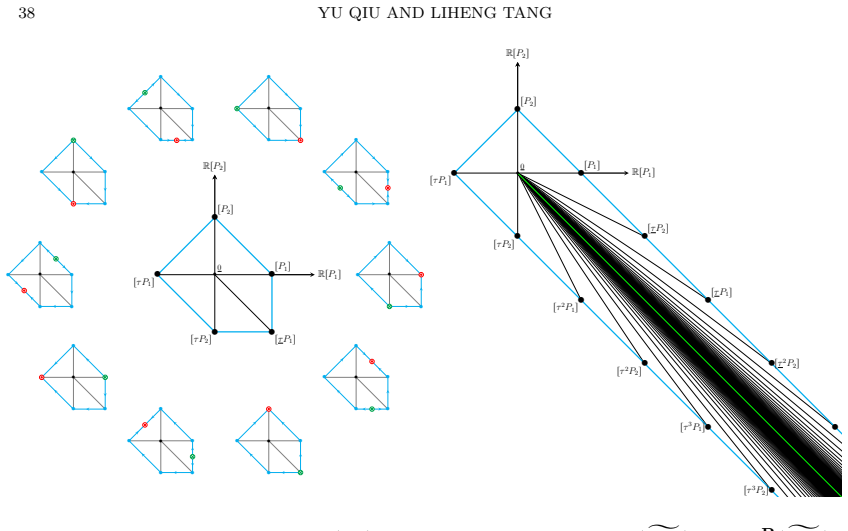
Working in a 2-Calabi-Yau triangulated category $\mathcal{C}$ that admits cluster-tilting sets and satisfies the condition that every rigid object is part of a partial cluster tilting set, the paper fixes a point $X$ in the cluster complex $\mathrm{Cpx}(\mathcal{C})$. Around each cell it forms the downward $X$-evolving triangle $X \to W \to U \to X[1]$, where $U$ is the right minimal approximation of $X[1]$ by the cell, and defines the local flow direction $W-U$, with the two trivial branches $X-V$ and $V-X[1]$. These local directions are compatible across shared faces, so the leaves glue into a piecewise linear one-dimensional foliation with $X$ as its unique sink and $X[1]$ as its unique source. The paper proves this $X$-foliation exists for every point $X$, shows that the orientation of the exchange graph it induces is exactly green mutation when $X$ is generic, and proves compact or semi-compact behaviour in the Dynkin and Euclidean cases, leading to the homotopy-type and fundamental-group conclusions.
Load-bearing premise
Condition (*) — that every rigid object in $\mathcal{C}$ is a partial cluster tilting set — is the load-bearing premise: it guarantees that $X$-evolving triangles exist and are unique for every cell, and the main theorems are only proved for categories with this finiteness property.
Editorial extensions
If this is right
- Every cluster complex carries, for each point $X$, a piecewise linear one-dimensional foliation with only two singularities, so the entire complex is a union of flow lines from $X[1]$ to $X$.
- For a generic point $X$ in a top cell, the cell-crossings of the downward flow orient the unoriented cluster exchange graph exactly as green mutation with respect to $X[1]$, so green mutation is a discrete shadow of a continuous flow.
- For a Dynkin quiver $Q$, the $X$-foliation is compact and induces $\mathrm{Cpx}(\mathcal{C}(Q)) \simeq \Sigma\,\mathrm{Cpx}(\mathcal{C}(Q\setminus 0))$, giving inductively that the cluster complex is homotopy equivalent to an $(n-1)$-sphere.
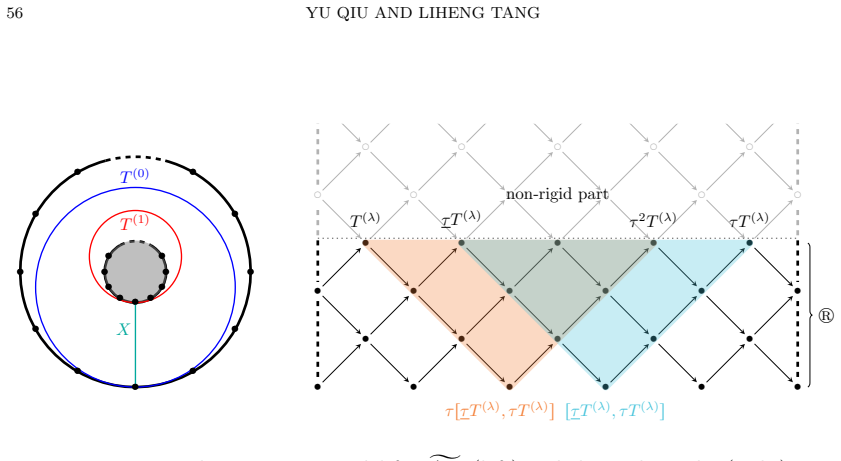
- For a Euclidean quiver, the $X$-foliation is compact for rigid regular simple $X$ and semi-compact for the affine type A cases outside tubes, and the cluster complex is contractible.
- For Dynkin and Euclidean quivers, the fundamental group of the cluster exchange graph is generated by squares and pentagons.
Reading between the lines
- Editorial inference: since the green-mutation theorem only uses sign-coherence and tropical duality, the same flow construction should refine green mutations in skew-symmetrizable cluster algebras, not only in 2-Calabi-Yau categorifications.
- Editorial inference: compactness of an $X$-foliation amounts to a deformation retraction of the cluster complex minus the source onto the sink, so the flow gives a visual certificate for the homotopy type; tracing representative leaves in finite examples is a direct way to test the conjectured compactness beyond Dynkin type.
- Editorial inference: the leaf-wise invariant trace maps the cluster complex minus its two singularities to the Calabi-Yau reduction; in semi-compact cases this should yield a filtration of the complex by trace value, offering an inductive tool for homotopy computations in other tame or wild settings.
Editorial analysis
A structured set of objections, weighed in public.
Referee Report
Summary. The paper introduces, for any point X in the cluster complex Cpx(C) of a 2-Calabi-Yau category C, an X-evolution flow and an associated one-dimensional piecewise linear X-foliation with singularities X and X[1]. It further claims that these flows refine Keller's green mutation, that for Dynkin and Euclidean quivers the foliations are compact or semi-compact for suitable X, and that these facts imply known homotopy-type results for cluster complexes and the generation of the fundamental group of the cluster exchange graph by squares and pentagons. The main technical steps are the construction of downward/upward X-evolving triangles, a family of flows for arbitrary points obtained by linear combination, the gluing of local leaves into a global foliation, and interval-decreasing arguments in Auslander–Reiten theory in the Dynkin/Euclidean cases.
Significance. If the main results are correct, the paper provides a genuinely new continuous dynamical structure on cluster complexes, unifying discrete mutation phenomena and giving a uniform route to the homotopy type of cluster complexes in the Dynkin and Euclidean cases. The categorical framework is carefully set up, the statements are precise, and the paper contains many detailed examples (A2, A3, D4, affine A) that illustrate the constructions. The application to fundamental groups generated by squares and pentagons is a natural and attractive consequence. However, the central construction of the flow for an arbitrary point X is not rigorously established as written, and since Theorem 4.2 depends directly on that construction, the paper cannot be accepted in its present form.
major comments (3)
- [Section 3.3, Lemma 3.12, Eq. (3.18)] The proof of well-definedness of Evo^Ó_X for arbitrary points X is not valid. In (3.18), the claimed point Y is defined as Y = (P - N)/c, where P is a convex combination of the X_{i0} and W_j and N is a convex combination of the U_j and X_{i1}[1]. The coefficients of Y sum to 1, but they are not all nonnegative: when c > 0 the coefficients of the U_j and X_{i1}[1] terms are negative, and when c < 0 the coefficients of the X_{i0} and W_j terms are negative. Therefore Y is generally an affine combination, not a point of the simplex (3.15). For a concrete instance, in the A2 cluster category write the five indecomposables as a_0,...,a_4 with compatible pairs {a_i,a_{i+2}} and {a_i,a_{i+3}}, take X = 0.2a_0 + 0.8a_2 and V = 0.5a_0 + 0.5a_3; then I0 = {0}, I1 = {2}, c = -0.6, and (3.18) gives Y = -1/3 a_0 + 4/3 a_3, which is not a point of the cluster complex. Consequently the proof does not show that V + t Evo^Ó_X(V) remains in Cpx(C) for small t > 0. Since Lemma 3.12 is the foundation for the local flow used in Theorem 4.2 and Lemma 4.1, the central foliation theorem is not proven. The argument may be repairable by a separate tangent-cone or controlled-trajectory argument, but such an argument is absent.
- [Section 4.1, Theorem 4.2] The proof of Theorem 4.2 is only one short paragraph and relies entirely on Lemma 3.12 for the definition of the flow and on Lemma 4.1 for the gluing of local leaves. Because Lemma 3.12 is not established for all points, the conclusion that 'the X-evolution flow induces a piecewise linear foliation' is not justified. The statement of Theorem 4.2 may be true, but the present proof is incomplete at a load-bearing point. Please either repair Lemma 3.12 or reformulate Theorem 4.2 under hypotheses for which well-definedness is proven.
- [Appendix B.2, Lemma B.4(3°)] In the proof of compactness for Euclidean quivers with X a rigid regular simple, the assertion 'It is similar to 1° that 3° holds' is too terse. Lemma B.4(3°) is a key step in the interval-decreasing argument that shows leaves enter Starp(X), and the claimed similarity is not immediate because the roles of the two sections and the vector-bundle interval are different. Please expand this step so that the reader can verify it without reconstructing the entire tube geometry.
minor comments (5)
- [Section 2.4, Definition 2.5] The phrase 'clique complex for the compatibility relation on the ground set' should specify whether the ground set is the set of isomorphism classes of rigid indecomposables or a chosen representative set; this matters for the realization of points such as X = sum c_i X_i.
- [Section 3.2, Definition 3.9] In (3.5), the symbols W and U are used both for objects and for points of the cluster complex associated with those objects; please make the convention explicit, as in Convention 3.1, to avoid confusion in formulas such as W - V.
- [Section 3.1, Definition/Lemma 3.2] The word 'proofed' appears twice in the proof of the second set of equivalences; it should be 'proved'.
- [Section 5.2] There is a typo 'Grothedieck' for 'Grothendieck' in the sentence about K_0 groups.
- [References] Several reference entries contain typographical errors, including 'combinactorics', 'Cambrigde', 'djoimension', and 'isomorphc'; a careful proofreading of the bibliography is recommended.
Circularity Check
No circularity: the X-evolution flow and foliation are derived from internal triangle data and previously published independent tools; self-citations are background, and the flagged Lemma 3.12 issue is a proof-gap concern, not circularity.
full rationale
The central construction is Definition 3.9/3.11: Evo_X is a linear combination of Evo_{X_i}, and each Evo_{X_i} is defined from a downward X_i-evolving triangle (Definition/Lemma 3.2) via approximation theory, not from the foliation it is supposed to produce. Lemma 3.12 attempts to prove well-definedness from Ext-vanishing and the partial-cluster property of (3.15); Lemma 3.13 proves uniqueness of the singularities. Theorem 4.2 then glues local leaves using Lemma 4.1, whose proof uses only the flow equations. The compact/semi-compact conclusions for Dynkin and Euclidean quivers are obtained in Appendix B by interval-decreasing arguments (Lemmas B.1, B.4, B.5), not by assuming the homotopy statements they imply; the applications to sphericity/contractibility and to pi_1 of exchange graphs are therefore derived, not imported. Heavy self-citation appears for background tools: [Qy2, Thm 1.1] and [Qy5] are used to interpret green mutation as backward simple tilting, and [KQ1,KQ2] supply exchange-graph covering facts. These are prior published results with independent proofs; the paper's Theorem 5.10 compares its flow orientation with that known orientation via g/c-vector identities and sign-coherence, rather than defining the orientation to be the flow. No fitted parameter is renamed as a prediction, and no equation of the paper is equivalent by construction to its conclusion. The skeptical objection about Lemma 3.12 concerns the case c<0 in (3.18), where the asserted point Y may fail to have nonnegative simplicial coordinates; that is a potential correctness gap in the written proof, but it is not a circularity, since the issue is whether a claimed proof step holds, not whether the theorem's content was assumed. Condition (*) is explicitly stated as a restriction and does not smuggle in the target theorem.
Assumptions & free parameters
assumptions (5)
- domain assumption C is a 2-Calabi-Yau triangulated category with Serre functor S and S ≅ [2], admitting a cluster tilting object.
- domain assumption Condition (*): any rigid object in C is a partial cluster tilting set.
- standard math Sign-coherence and tropical duality of c-vectors and g-vectors, as in Section 5.2.
- standard math Calabi-Yau reduction correspondence Cpx(CzX) ≅ Link(X) from Iyama-Yoshino.
- standard math Standard interval and Hom-vanishing facts in AR quivers of Dynkin and Euclidean quivers, equations (A.9) to (A.11).
Cite this review
Pith. "Pith review of From green mutation to $\mathrm{X}$-evolution: flows and foliations on cluster complexes." pith.science (2026). https://pith.science/paper/NCM64VUC
@misc{pith2026250115756,
  author       = {Pith},
  title        = {Pith review of: From green mutation to $\mathrmX$-evolution: flows and foliations on cluster complexes},
  year         = {2026},
  howpublished = {\url{https://pith.science/paper/NCM64VUC}},
  note         = {Machine review of arXiv:2501.15756}
}
abstract
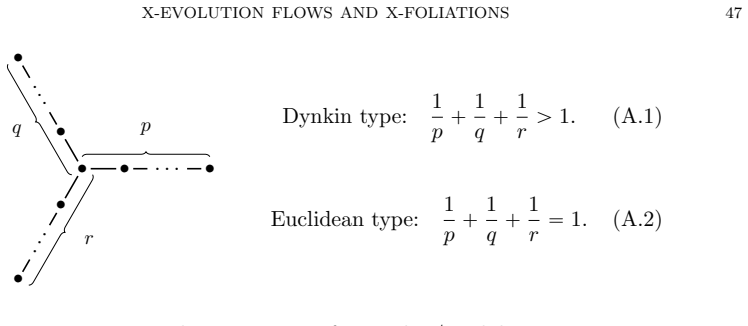
For any point $\mathrm{X}$ in the cluster complex $\mathrm{Cpx}(\mathcal{C})$ of a 2-Calabi-Yau category $\mathcal{C}$, we introduce $\mathrm{X}$-evolution flow on $\mathrm{Cpx}(\mathcal{C})$. We show that such a flow induces a piecewise linear one-dimensional $\mathrm{X}$-foliation with two singularities, the unique sink $\mathrm{X}$ and the unique source $\mathrm{X}[1]$. Moreover, we show that evolution flows on cluster complexes are continuous refinement/generalization of green mutations on cluster exchange graphs. For the cluster category of a Dynkin or Euclidean quiver $Q$, we prove that the $\mathrm{X}$-foliation is compact or semi-compact, for various choices of $\mathrm{X}$. As an application, we show that $\mathrm{Cpx}(\mathcal{C})$ is spherical (Dynkin case) or contractible (Euclidean case). As a byproduct, we show that the fundamental group of the cluster exchange graph of $Q$ is generated by squares and pentagons.
Figures


Figures from the paper (23 more)






Reference graph
Works this paper leans on
-
[1]
M. Auslander S.O. Smalo Projective modules over artin algebras J. Algebra 66 1980 61 122
work page 1980
-
[2]
S. Brenner M.C.R. Bluter Generalizations of the Bernstein-Gelfand-Ponomarev reflection functors (Proc. Second Internat. Conf., Carleton Univ., Ottawa, Ont., 1979) Lecture Notes in Math., Springer 832 1980 103 169
work page 1979
-
[3]
Tilting theory and cluster combinatorics
A.B. Buan, B.R. Marsh, M. Reineke, I. Reiten G. Todorov Tilting theory and cluster combinactorics Adv. Math. 204 2006 572 618 (arXiv:math/0402054)
work page Pith review arXiv 2006
-
[4]
X.-W. Chen H. Krause Introduction to coherent sheaves on weighted projective lines (arXiv:0911.4473)
-
[5]
R. Dehy B. Keller On the combinactorics of rigid objects in 2-Calabi-Yau categories \ Int. Math. Res. Notices 9 2008 rnn029 rnn029 , doi: 10.1093/imrn/rnn029
-
[6]
B. Farb D. Margalit A primer on mapping class groups Princeton University Press 2012
work page 2012
- [7]
- [8]
Show all 31 references
-
[9]
R. Gobel J. Trilifaj Approximations and Endomorphism Algebras of Modules De Gruyter Expositions in Mathematics 41 2006 94 111 https://doi.org/10.1515/9783110199727.94
2006 doi
-
[10]
Happel Triangulated categories in the representation theory of finite dimension algebras Cambrigde University Press 1988 43 56
D. Happel Triangulated categories in the representation theory of finite dimension algebras Cambrigde University Press 1988 43 56
1988
-
[11]
Harer The virtual cohomological djoimension of the mapping class group of an orientable surface Invent
J. Harer The virtual cohomological djoimension of the mapping class group of an orientable surface Invent. Math. 84 1986 157 176
1986
-
[12]
Hatcher On triangulations of surfaces Topology Appl
A. Hatcher On triangulations of surfaces Topology Appl. 40 1991 189 194
1991
-
[13]
Igusa, K
K. Igusa, K. Orr, G. Todorov J. Weyman Cluster complexes via semi-invariants Compos. Math. 145 2009 1001 1034 . (arXiv:0708.0798)
2009 arXiv
-
[14]
O. Iyama Y. Yoshino Mutation in triangulated categories and rigid Cohen-Macaulay modules Invent. Math. 172 2008 117 168 (arXiv:math/0607736)
2008 arXiv
-
[15]
Keller On triangulated orbit categories Doc
B. Keller On triangulated orbit categories Doc. Math. 10 2005 551 581 (arXiv:math/0503240)
2005 arXiv
-
[16]
Keller On cluster theory and quantum dilogarithm identities EMS Series of Congress Reports 2011 85 116 (arXiv:1102.4148)
B. Keller On cluster theory and quantum dilogarithm identities EMS Series of Congress Reports 2011 85 116 (arXiv:1102.4148)
2011 arXiv
-
[17]
Keller Cluster algebras and derived categories (arXiv:1202.4161v4)
B. Keller Cluster algebras and derived categories (arXiv:1202.4161v4)
-
[18]
Keller I
B. Keller I. Reiten Cluster-tilted algebras are Gorenstein and stably Calabi-Yau Adv. Math. 211(1) 2007 123 151 (arXiv:math/0512471)
2007 arXiv
-
[19]
A. King Y. Qiu Exchange graphs and Ext quivers Adv. Math. 285 2015 (arXiv:1109.2924)
2015 arXiv
-
[20]
A. King Y. Qiu Cluster exchange groupoids and framed quadratic differentials Invent. Math. 2019 (arXiv:1805.00030)
2019 arXiv
-
[21]
Lenzing I
H. Lenzing I. Reiten Hereditary Noetherian categories of positive Euler characteristic. Math. Z. 254 2006 133 171
2006
-
[22]
Nakanishi Cluster algebra and scattering diagrams
T. Nakanishi Cluster algebra and scattering diagrams. Part II: Cluster patterns and scattering diagrams 2023 (arXiv:2103.16309)
2023 arXiv
-
[23]
Nakanishi A
T. Nakanishi A. Zelevinsky On tropical dualities in cluster algebra Comtemp. Math. 565 2012 217 226 (arXiv:1101.3736v3)
2012 arXiv
-
[24]
Plamondon Cluster algebras via cluster categories with infinite-dimensional morphism spaces
P-G. Plamondon Cluster algebras via cluster categories with infinite-dimensional morphism spaces. Compositio Mathematica. 147(6) 2011 1921 1954 (arXiv:1004.0830)
2011 arXiv
-
[25]
Qiu Stability conditions and quantum dilogarithm identities for Dynkin quivers Adv
Y. Qiu Stability conditions and quantum dilogarithm identities for Dynkin quivers Adv. Math. 269 2015 220 264 (arXiv:1111.1010)
2015 arXiv
-
[26]
C-sortable words as green mutation sequences Proc. Lond. Math. Soc. 111 2015 1052 1070 (arXiv:1205.0034)
2015 arXiv
-
[27]
Qiu Decorated marked surfaces: Spherical twists versus braid twists Math
Y. Qiu Decorated marked surfaces: Spherical twists versus braid twists Math. Ann. 365 2016 595 633 (arXiv:1407.0806)
2016 arXiv
-
[28]
Qiu Moduli spaces of quadratic differentials: Abel-Jacobi map and deformation arXiv:2403.10265
Y. Qiu Moduli spaces of quadratic differentials: Abel-Jacobi map and deformation arXiv:2403.10265
-
[29]
Qiu Decorated marked surfaces (part B): topological realizations Math
Y. Qiu Decorated marked surfaces (part B): topological realizations Math. Z. 288 2017 39 53
2017
-
[30]
Y. Qiu J. Woolf Contractible stability spaces and faithful braid group actions Geom. Topol. 22 2018 3701 3760 (arXiv:1407.5986)
2018 arXiv
-
[31]
Y. Qiu Y. Zhou Cluster categories for marked surfaces: punctured case Compos. Math. 153 2017 1779 1819 (arXiv:1311.0010v3)
2017 arXiv
Reviewed August 10, 2026 · model on record in the stance chip above.
Discussion (0). Continue with ORCID to comment.