REVIEW 2 major objections 2 minor 77 references
Generation of strongly localized skin solitons in non-Hermitian waveguide arrays with the Kerr effect
T0 review · 2 major / 2 minor · reviewed 2026-07-02 · grok-4.3
Pith's one-line read Kerr nonlinearity and the non-Hermitian skin effect together generate stable skin solitons localized at the edge of waveguide arrays.
desk verdict The symbolic regression formula for the soliton existence boundary is the main new claim but needs validation details to hold up, while the NHSE extension to nonlinear skin solitons is a reasonable incremental step. read the letter →
The pith
A machine-rendered reading of the paper's core claim, the machinery that carries it, and where it could break.
The reading
What carries the argument
The non-Hermitian skin effect in interplay with Kerr nonlinearity, which supports stable localized solitons and supplies the mechanism for edge compression of bulk modes.
What would settle it
Direct numerical integration of the discrete lattice equations that either confirms or refutes the persistence of stable solitons for parameter values lying just inside versus just outside the analytically predicted existence boundary.
Extended reading notes
Core claim
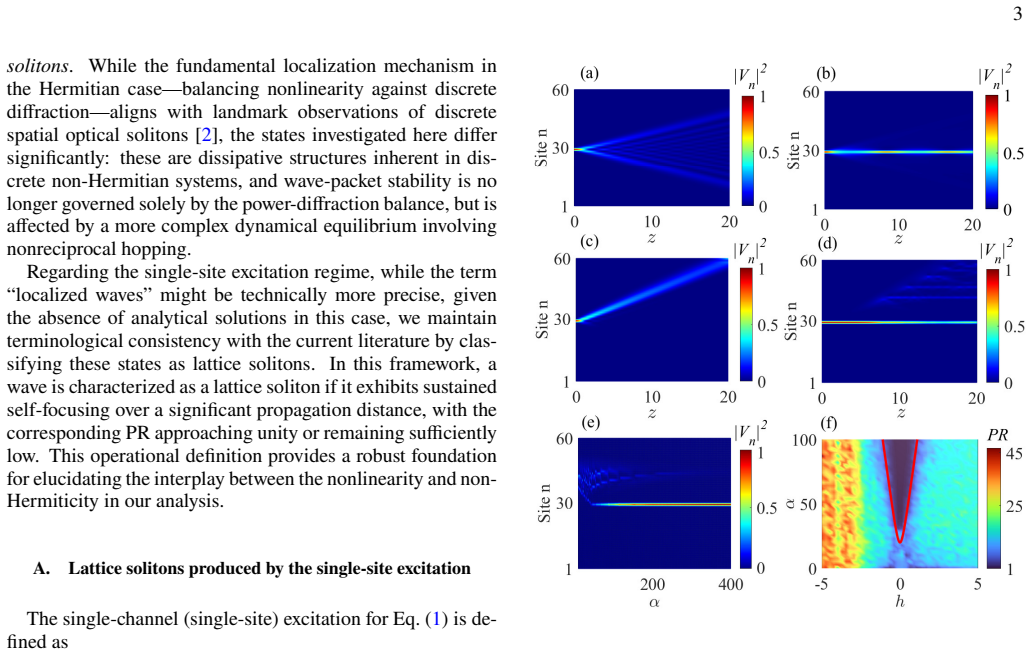
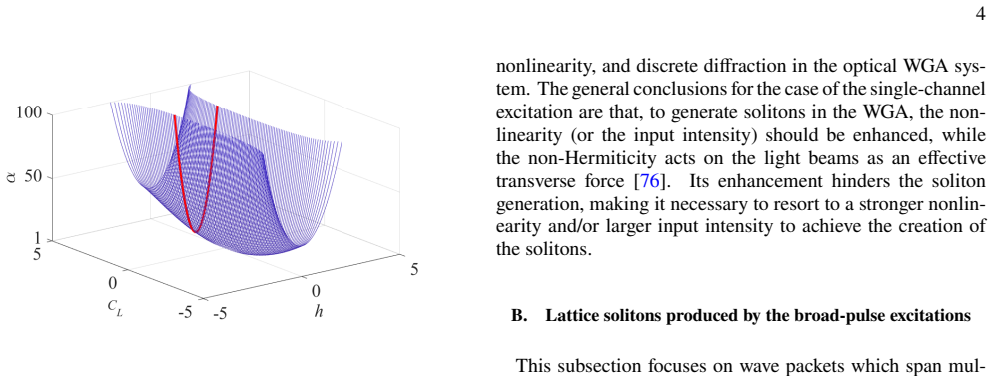
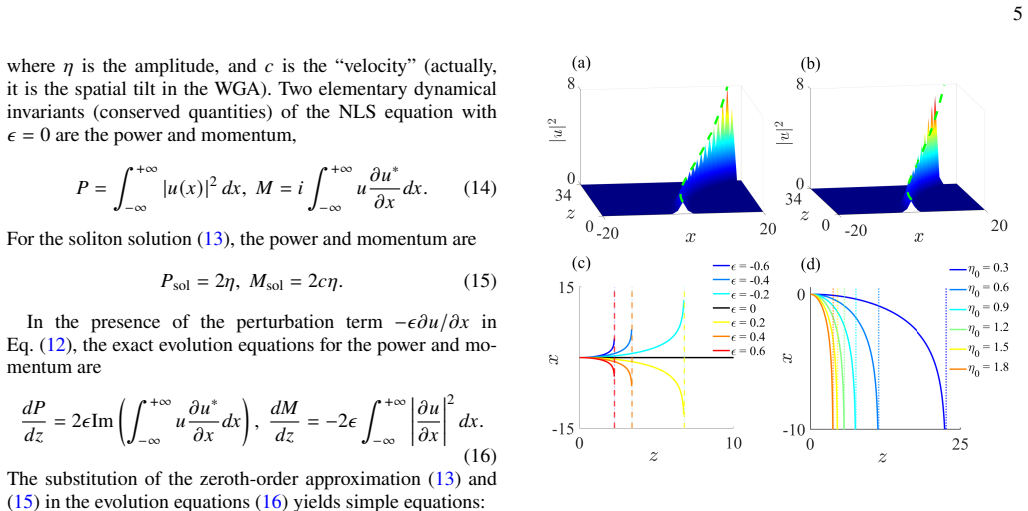
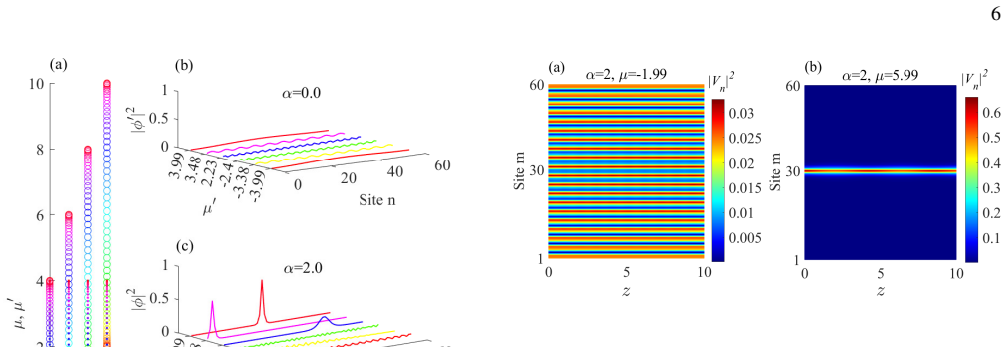
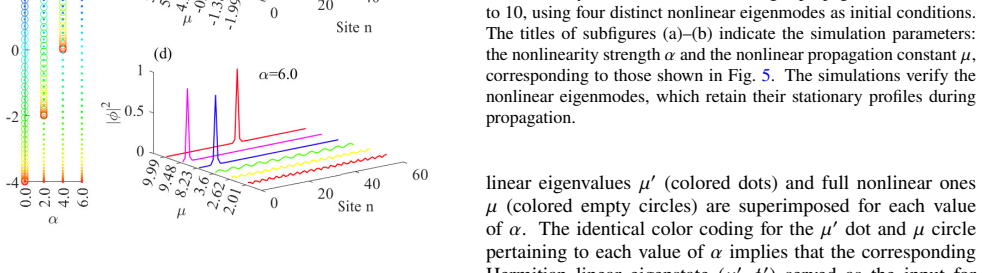
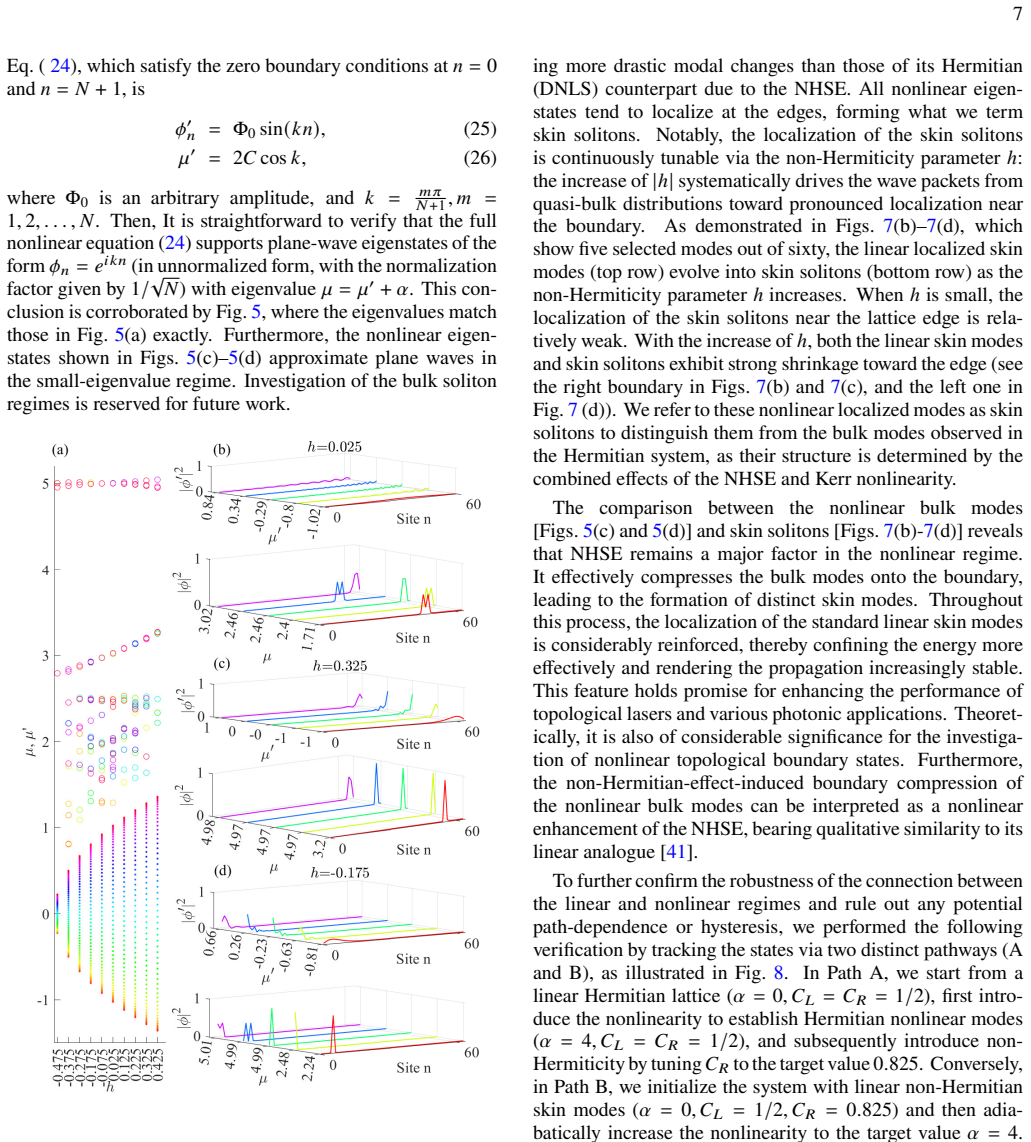
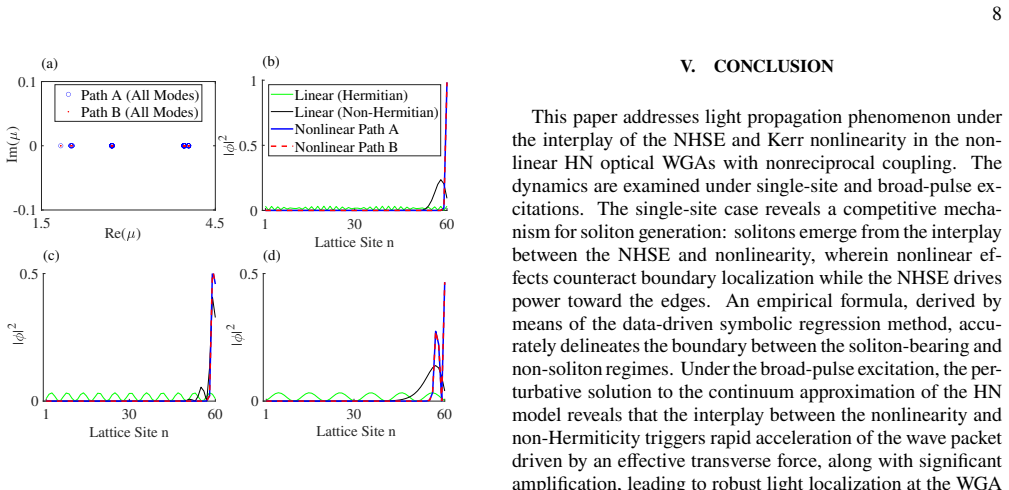
Single-channel excitation creates stable solitons supported by the interplay of the Kerr nonlinearity and non-Hermitian skin effect. An analytical formula defining the soliton existence boundary is obtained by the symbolic-regression method. For broad-pulse excitation, perturbed soliton solutions are derived in the continuum approximation and show that the skin effect accelerates propagation toward the boundary, ultimately causing tight localization at the edge. Stationary nonlinear bulk modes in the Hermitian regime become compressed toward the edge under non-reciprocality, which is identified as the nonlinear extension of the non-Hermitian skin effect.
Load-bearing premise
The symbolic-regression procedure produces a physically valid closed-form expression for the existence boundary rather than an overfit artifact, and the continuum approximation remains accurate for the broad-pulse dynamics in the discrete lattice.
Editorial extensions
If this is right
- Single-channel initial conditions reliably produce stable solitons localized by the skin effect.
- The existence region of these solitons is delimited by an explicit analytical formula obtained from symbolic regression.
- Broad pulses experience accelerated motion to the array edge and form tightly localized states.
- Nonlinear bulk modes are compressed toward the edge once non-reciprocal couplings are introduced.
- Near-edge skin solitons appear as stationary solutions in the non-Hermitian regime.
Reading between the lines
- The derived boundary formula could be used to predict the minimal nonlinearity strength needed for edge localization in similar discrete non-Hermitian lattices.
- The observed acceleration of broad pulses suggests that non-Hermitian couplings might serve as a passive mechanism for routing optical power to boundaries without external modulation.
- The nonlinear skin-effect compression of bulk modes may extend to other conservative nonlinearities, offering a route to edge-mode engineering in photonic arrays.
- Testing the same initial conditions in a continuum non-Hermitian nonlinear Schrödinger equation would check whether the localization persists without lattice discreteness.
Signed reviews
Editorial analysis
A structured set of objections, weighed in public.
Referee Report
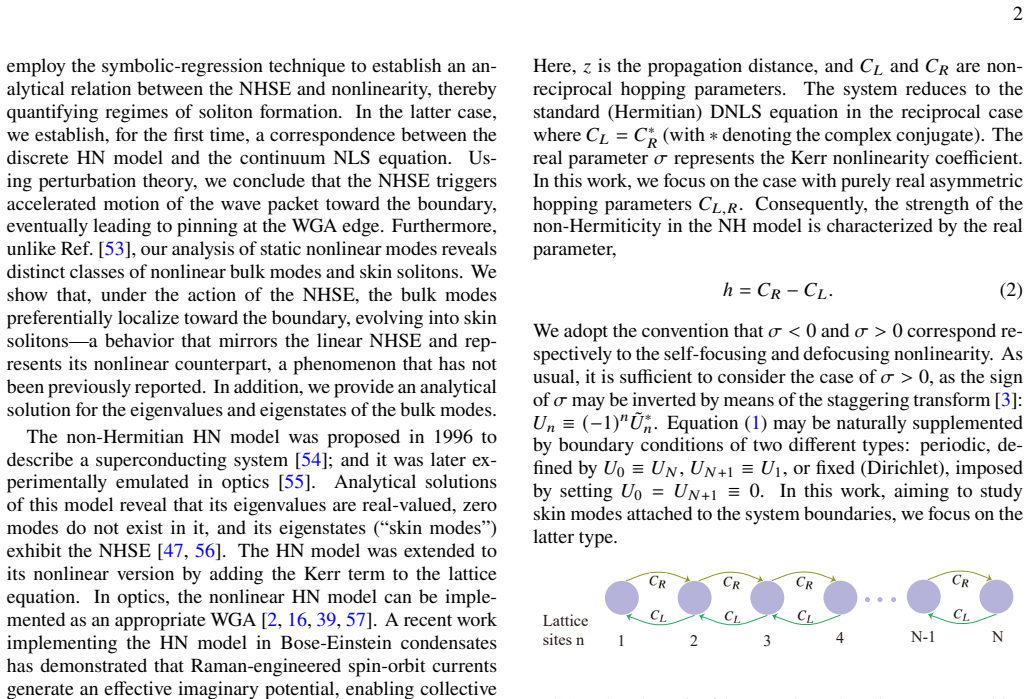
Summary. The manuscript studies nonlinear light propagation in non-Hermitian waveguide arrays with Kerr nonlinearity. Single-channel excitation is shown to produce stable solitons via the interplay of Kerr nonlinearity and the non-Hermitian skin effect (NHSE); an analytical expression for the soliton existence boundary is obtained by symbolic regression. For broad-pulse initial conditions, perturbed soliton solutions are derived in the continuum approximation and stated to be corroborated by numerics, with NHSE driving edge localization. Stationary solutions are also identified: nonlinear bulk modes in the Hermitian limit that become compressed toward the edge under non-reciprocality, and near-edge skin solitons in the non-Hermitian regime.
Significance. If the symbolic-regression formula proves robust and the numerical validations hold, the work supplies concrete analytical and numerical results on nonlinear extensions of the NHSE in both discrete and continuum settings. The explicit formula for the existence boundary and the demonstration of NHSE-driven localization constitute potentially useful benchmarks for experiments in non-Hermitian nonlinear optics.
major comments (2)
- [single-channel excitation / symbolic regression section] The central analytical result—the closed-form expression for the soliton existence boundary—is obtained exclusively via symbolic regression. No information is provided on the regression search space, regularization, cross-validation procedure, or quantitative error metrics evaluated on independent parameter points outside the training set. Without these, it is impossible to determine whether the formula is a physically interpretable relation or an overfit artifact whose agreement with the reported trajectories is circular (§ on single-channel excitation and symbolic regression).
- [broad-pulse excitation / continuum approximation] The claim that the continuum approximation remains accurate for broad-pulse dynamics rests on numerical corroboration, yet the manuscript does not report quantitative measures (e.g., L2 error between continuum solution and discrete lattice evolution, or dependence on lattice spacing) that would confirm the approximation's validity across the parameter range used for the existence boundary.
minor comments (2)
- Notation for the non-reciprocal coupling parameters and the Kerr coefficient should be introduced once with explicit definitions before being used in multiple sections.
- Figure captions for the soliton profiles should state the precise values of the non-Hermitian parameter and nonlinearity strength used in each panel.
Simulated Author's Rebuttal
We thank the referee for the constructive and detailed report. We address each major comment below and will revise the manuscript to incorporate the requested clarifications and quantitative validations.
read point-by-point responses
-
Referee: [single-channel excitation / symbolic regression section] The central analytical result—the closed-form expression for the soliton existence boundary—is obtained exclusively via symbolic regression. No information is provided on the regression search space, regularization, cross-validation procedure, or quantitative error metrics evaluated on independent parameter points outside the training set. Without these, it is impossible to determine whether the formula is a physically interpretable relation or an overfit artifact whose agreement with the reported trajectories is circular (§ on single-channel excitation and symbolic regression).
Authors: We agree that additional methodological details are required to establish the robustness of the symbolic-regression result. In the revised manuscript we will expand the relevant section to specify the search space of operators and functions, any regularization employed, the cross-validation protocol, and quantitative error metrics (e.g., RMSE) evaluated on an independent test set of parameter points. These additions will demonstrate that the formula is not an overfitting artifact and that the numerical trajectories used for comparison were generated independently of the regression training data. revision: yes
-
Referee: [broad-pulse excitation / continuum approximation] The claim that the continuum approximation remains accurate for broad-pulse dynamics rests on numerical corroboration, yet the manuscript does not report quantitative measures (e.g., L2 error between continuum solution and discrete lattice evolution, or dependence on lattice spacing) that would confirm the approximation's validity across the parameter range used for the existence boundary.
Authors: We concur that quantitative error measures are necessary to substantiate the continuum approximation. In the revision we will add explicit L2-error comparisons between the continuum solutions and discrete-lattice simulations, together with the dependence of this error on lattice spacing, evaluated across the parameter regime of the existence boundary. These metrics will replace the current visual corroboration and confirm the approximation's accuracy. revision: yes
Circularity Check
No significant circularity detected; derivations are self-contained
full rationale
The paper's central results—an analytical formula for the soliton existence boundary obtained via symbolic regression and perturbed soliton solutions in the continuum limit—are derived from numerical simulations and analytical approximations respectively, with explicit numerical corroboration stated for the latter. No quoted equations or steps reduce by construction to their own inputs, fitted parameters renamed as predictions, or load-bearing self-citations. The symbolic-regression step is a data-driven fitting procedure presented as yielding a closed-form expression, but without evidence in the text of it being tautological or statistically forced on the same trajectories used for validation. The overall derivation chain therefore remains independent of the target claims.
Assumptions & free parameters
Cite this review
Pith. "Pith review of Generation of strongly localized skin solitons in non-Hermitian waveguide arrays with the Kerr effect." pith.science (2026). https://pith.science/paper/NDNXZ3A6
@misc{pith2026260700618,
  author       = {Pith},
  title        = {Pith review of: Generation of strongly localized skin solitons in non-Hermitian waveguide arrays with the Kerr effect},
  year         = {2026},
  howpublished = {\url{https://pith.science/paper/NDNXZ3A6}},
  note         = {Machine review of arXiv:2607.00618}
}
read the original abstract
We address two distinct nonlinear propagation problems in nonlinear optical waveguide arrays (WGAs) with non-reciprocal (non-Hermitian) couplings. First, we investigate the light propagation launched by initial excitations of two different types. The single-channel excitation creates stable solitons supported by the interplay of the Kerr nonlinearity and non-Hermitian skin effect (NHSE). In this case, we derive, by means of the symbolic-regression method, an analytical formula defining the soliton existence boundary. For the broad-pulse excitation, we produce perturbed soliton solutions analytically in the continuum approximation, which is accurately corroborated by numerical results. We thus conclude that NHSE accelerates the propagation of the broad soliton towards the boundary, ultimately causing tight localization at the edge, which is a hallmark of the NHSE in the continuum limit. Second, we identify stationary solitons in the system -- specifically, nonlinear bulk modes in the Hermitian regime and near-edge skin solitons in the non-Hermitian one. The nonlinear bulk modes are compressed toward the edge of the WGA under the action of the non-reciprocality, which is the nonlinear extension of NHSE.
Figures
Figures from the paper (5 more)
Reference graph
Works this paper leans on
-
[1]
Coupling of optical fibers and scattering in fibers*,
A. L. Jones, “Coupling of optical fibers and scattering in fibers*,” J. Opt. Soc. Am.55, 261 (1965)
work page 1965
-
[2]
Discrete spatial optical solitons in waveguide ar- rays,
H. Eisenberg, Y. Silberberg, R. Morandotti, A. Boyd, and J. Aitchison, “Discrete spatial optical solitons in waveguide ar- rays,” Phys. Rev. Lett.81, 3383 (1998)
work page 1998
-
[3]
P. G. Kevrekidis and R. Carretero-Gonz ´alez,The discrete non- linear schr¨odinger equation: Mathematical analysis, numerical computations and physical perspectives, Springer tracts in mod- ern physics No. 232 (Springer, Berlin [London], 2009)
work page 2009
-
[4]
Discrete optics in femtosecond-laser- written photonic structures,
A. Szameit and S. Nolte, “Discrete optics in femtosecond-laser- written photonic structures,” J. Phys. B43, 163001 (2010)
work page 2010
-
[5]
Topological gap solitons in equidistant Lithium Niobate waveguide arrays,
A. V. Gorbach, “Topological gap solitons in equidistant Lithium Niobate waveguide arrays,” Low Temp. Phys.51, 737 (2025)
work page 2025
-
[6]
Non-Bloch band theory of non-Hermitian systems,
K. Yokomizo and S. Murakami, “Non-Bloch band theory of non-Hermitian systems,” Phys. Rev. Lett.123, 066404 (2019). 9
work page 2019
-
[7]
T. Ozawa, H. M. Price, A. Amo, N. Goldman, M. Hafezi, L. Lu, M. C. Rechtsman, D. Schuster, J. Simon, O. Zilberberg, and I. Carusotto, “Topological photonics,” Rev. Mod. Phys.91, 015006 (2019)
work page 2019
-
[8]
Roadmap on topological photonics,
H. Price, Y. Chong, A. Khanikaev, H. Schomerus, L. J. Maczewsky, M. Kremer, M. Heinrich, A. Szameit, O. Zilber- berg, Y. Yang, B. Zhang, A. Al` u, R. Thomale, I. Carusotto, P. St-Jean, A. Amo, A. Dutt, L. Yuan, S. Fan, X. Yin, C. Peng, T. Ozawa, and A. Blanco-Redondo, “Roadmap on topological photonics,” J. Phys. Photonics4, 032501 (2022)
work page 2022
Show all 77 references
-
[9]
Advances and applications on non-Hermitian topological photonics,
Q. Yan, B. Zhao, R. Zhou, R. Ma, Q. Lyu, S. Chu, X. Hu, and Q. Gong, “Advances and applications on non-Hermitian topological photonics,” Nanophotonics12, 2247 (2023)
2023
-
[10]
Artificial gauge fields in photonics,
W. Song, Y. Yang, Z. Lin, X. Liu, S. Wu, C. Chen, Y. Ke, C. Lee, W. Liu, S. Zhu, Y. Kivshar, T. Li, and S. Zhang, “Artificial gauge fields in photonics,” Nat Rev Phys7, 606 (2025)
2025
-
[11]
A review on non-Hermitian skin effect,
X. Zhang, T. Zhang, M.-H. Lu, and Y.-F. Chen, “A review on non-Hermitian skin effect,” Adv. Phys.: X7, 2109431 (2022)
2022
-
[12]
Topo- logical funneling of light,
S. Weidemann, M. Kremer, T. Helbig, T. Hofmann, A. Stegmaier, M. Greiter, R. Thomale, and A. Szameit, “Topo- logical funneling of light,” Science368, 311 (2020)
2020
-
[13]
Mobility transition from ballistic to diffusive transport in non-Hermitian lattices,
T. Eichelkraut, R. Heilmann, S. Weimann, S. St¨ utzer, F. Dreisow, D. N. Christodoulides, S. Nolte, and A. Szameit, “Mobility transition from ballistic to diffusive transport in non-Hermitian lattices,” Nat. Commun.4, 2533 (2013)
2013
-
[14]
Non-Hermitian tight-binding network engineering,
S. Longhi, “Non-Hermitian tight-binding network engineering,” Phys. Rev. A93, 022102 (2016)
2016
-
[15]
Topologi- cal framework for directional amplification in driven-dissipative cavity arrays,
C. C. Wanjura, M. Brunelli, and A. Nunnenkamp, “Topologi- cal framework for directional amplification in driven-dissipative cavity arrays,” Nat. Commun.11, 3149 (2020)
2020
-
[16]
Controlling light transport in non-Hermitian waveguide arrays,
C. Hou, H. Triki, and Q. Zhou, “Controlling light transport in non-Hermitian waveguide arrays,” Opt. Express33, 40423 (2025)
2025
-
[17]
Spawning rings of exceptional points out of Dirac cones,
B. Zhen, C. W. Hsu, Y. Igarashi, L. Lu, I. Kaminer, A. Pick, S.-L. Chua, J. D. Joannopoulos, and M. Solja ˇci´c, “Spawning rings of exceptional points out of Dirac cones,” Nature525, 354 (2015)
2015
-
[18]
Experimental realization of a Weyl exceptional ring,
A. Cerjan, S. Huang, M. Wang, K. P. Chen, Y. Chong, and M. C. Rechtsman, “Experimental realization of a Weyl exceptional ring,” Nat. Photon.13, 623 (2019)
2019
-
[19]
Exceptional points in optics and pho- tonics,
M.-A. Miri and A. Al` u, “Exceptional points in optics and pho- tonics,” Science363, eaar7709 (2019)
2019
-
[20]
Photonic Floquet topological insulators,
M. C. Rechtsman, J. M. Zeuner, Y. Plotnik, Y. Lumer, D. Podol- sky, F. Dreisow, S. Nolte, M. Segev, and A. Szameit, “Photonic Floquet topological insulators,” Nature496, 196 (2013)
2013
-
[21]
Nonlinear tuning of PT sym- metry and non-Hermitian topological states,
S. Xia, D. Kaltsas, D. Song, I. Komis, J. Xu, A. Szameit, H. Bul- jan, K. G. Makris, and Z. Chen, “Nonlinear tuning of PT sym- metry and non-Hermitian topological states,” Science372, 72 (2021)
2021
-
[22]
Eigenvalue control and switching by fission of multisoliton bound states in planar waveguides,
V. A. Aleshkevich, Y. V. Kartashov, A. S. Zelenina, V. A. Vysloukh, J. P. Torres, and L. Torner, “Eigenvalue control and switching by fission of multisoliton bound states in planar waveguides,” Opt. Lett.29, 483 (2004)
2004
-
[23]
Spa- tiotemporal optical solitons,
B. A. Malomed, D. Mihalache, F. Wise, and L. Torner, “Spa- tiotemporal optical solitons,” J. Opt. B: Quantum Semiclass. Opt.7, R53 (2005)
2005
-
[24]
Surface gap solitons,
Y. V. Kartashov, V. A. Vysloukh, and L. Torner, “Surface gap solitons,” Phys. Rev. Lett.96, 073901 (2006)
2006
-
[25]
Gap solitons on a ring,
Y. V. Kartashov, B. A. Malomed, V. A. Vysloukh, and L. Torner, “Gap solitons on a ring,” Opt. Lett.33, 2949 (2008)
2008
-
[26]
Solitons in nonlinear lattices,
Y. V. Kartashov, B. A. Malomed, and L. Torner, “Solitons in nonlinear lattices,” Rev. Mod. Phys.83, 247 (2011)
2011
-
[27]
Multidimensional solitons: well-established results and novel findings,
B. A. Malomed, “Multidimensional solitons: well-established results and novel findings,” Eur. Phys. J. Spec. Top.225, 2507 (2016)
2016
-
[28]
Frontiers in multidimensional self-trapping of non- linear fields and matter,
Y. V. Kartashov, G. E. Astrakharchik, B. A. Malomed, and L. Torner, “Frontiers in multidimensional self-trapping of non- linear fields and matter,” Nat Rev Phys1, 185 (2019)
2019
-
[29]
Nonlinear topological photonics,
D. Smirnova, D. Leykam, Y. Chong, and Y. Kivshar, “Nonlinear topological photonics,” Appl. Phys. Rev.7, 021306 (2020)
2020
-
[30]
Non-Hermitian and topological pho- tonics: optics at an exceptional point,
M. Parto, Y. G. N. Liu, B. Bahari, M. Khajavikhan, and D. N. Christodoulides, “Non-Hermitian and topological pho- tonics: optics at an exceptional point,” Nanophotonics10, 403 (2020)
2020
-
[31]
A second wave of topological phenomena in photonics and acoustics,
X. Zhang, F. Zangeneh-Nejad, Z.-G. Chen, M.-H. Lu, and J. Christensen, “A second wave of topological phenomena in photonics and acoustics,” Nature618, 687 (2023)
2023
-
[32]
Nonlinearity-induced transition in the nonlinear Su-Schrieffer-Heeger model and a nonlinear higher-order topo- logical system,
M. Ezawa, “Nonlinearity-induced transition in the nonlinear Su-Schrieffer-Heeger model and a nonlinear higher-order topo- logical system,” Phys. Rev. B104, 235420 (2021)
2021
-
[33]
Skin solitons,
I. Komis, Z. H. Musslimani, and K. G. Makris, “Skin solitons,” Opt. Lett.48, 6525 (2023)
2023
-
[34]
Quantized nonlinear Thouless pumping,
M. J¨ urgensen, S. Mukherjee, and M. C. Rechtsman, “Quantized nonlinear Thouless pumping,” Nature596, 63 (2021)
2021
-
[35]
Quantization and its breakdown in a Hubbard–Thouless pump,
A.-S. Walter, Z. Zhu, M. G ¨achter, J. Minguzzi, S. Roschinski, K. Sandholzer, K. Viebahn, and T. Esslinger, “Quantization and its breakdown in a Hubbard–Thouless pump,” Nat. Phys. 19, 1471 (2023)
2023
-
[36]
Self- induced topological protection in nonlinear circuit arrays,
Y. Hadad, J. C. Soric, A. B. Khanikaev, and A. Al` u, “Self- induced topological protection in nonlinear circuit arrays,” Nat Electron1, 178 (2018)
2018
-
[37]
Observation of Floquet solitons in a topological bandgap,
S. Mukherjee and M. C. Rechtsman, “Observation of Floquet solitons in a topological bandgap,” Science368, 856 (2020)
2020
-
[38]
Topological solitons in arrays of modelocked lasers,
A. Y. Zykin, D. V. Skryabin, and Y. V. Kartashov, “Topological solitons in arrays of modelocked lasers,” Opt. Lett.46, 2123 (2021)
2021
-
[39]
Theory of topological corner state laser in Kagome waveguide arrays,
H. Zhong, Y. V. Kartashov, A. Szameit, Y. Li, C. Liu, and Y. Zhang, “Theory of topological corner state laser in Kagome waveguide arrays,” APL Photonics6(2021)
2021
-
[40]
Topological temporally mode-locked laser,
C. R. Leefmans, M. Parto, J. Williams, G. H. Y. Li, A. Dutt, F. Nori, and A. Marandi, “Topological temporally mode-locked laser,” Nat. Phys.20, 852 (2024)
2024
-
[41]
Edge states and topological invariants of non-Hermitian systems,
S. Yao and Z. Wang, “Edge states and topological invariants of non-Hermitian systems,” Phys. Rev. Lett.121, 086803 (2018)
2018
-
[42]
Non-Hermitian skin effect and chiral damping in open quantum systems,
F. Song, S. Yao, and Z. Wang, “Non-Hermitian skin effect and chiral damping in open quantum systems,” Phys. Rev. Lett.123, 170401 (2019)
2019
-
[43]
Universal non-Hermitian skin effect in two and higher dimensions,
K. Zhang, Z. Yang, and C. Fang, “Universal non-Hermitian skin effect in two and higher dimensions,” Nat. Commun.13, 2496 (2022)
2022
-
[44]
The non- Hermitian skin effect: A perspective,
J. T. Gohsrich, A. Banerjee, and F. K. Kunst, “The non- Hermitian skin effect: A perspective,” EPL150, 60001 (2025)
2025
-
[45]
Deterministic bulk-boundary correspondences for skin and edge modes in a general two-band non-Hermitian system,
C. Hou, L. Li, S. Chen, Y. Liu, L. Yuan, Y. Zhang, and Z. Ni, “Deterministic bulk-boundary correspondences for skin and edge modes in a general two-band non-Hermitian system,” Phys. Rev. Research4, 043222 (2022)
2022
-
[46]
Topological edge states in one-dimensional non-Hermitian Su- Schrieffer-Heeger systems of finite lattice size: analytical solu- tions and exceptional points,
C. Hou, L. Li, G. Wu, Y. Ruan, S. Chen, and F. Baronio, “Topological edge states in one-dimensional non-Hermitian Su- Schrieffer-Heeger systems of finite lattice size: analytical solu- tions and exceptional points,” Phys. Rev. B108, 085425 (2023)
2023
-
[47]
Non-Hermitian skin effects in two- and three- dimensional intertwined tight-binding lattices,
C. Hou, G. Wu, L. Li, A. Basit, Y. Wei, S. Chen, P. Grelu, and Z. Ni, “Non-Hermitian skin effects in two- and three- dimensional intertwined tight-binding lattices,” Phys. Rev. B 109, 205135 (2024)
2024
-
[48]
Dual bulk-boundary correspondence in a nonreciprocal spin- orbit coupled zigzag lattice,
L. Li, C. Hou, G. Wu, Y. Ruan, S. Chen, L. Yuan, and Z. Ni, “Dual bulk-boundary correspondence in a nonreciprocal spin- orbit coupled zigzag lattice,” Phys. Rev. B110, L041103 (2024)
2024
-
[49]
Exact solutions disentangle higher-order topology in two-dimensional non-Hermitian lattices,
L. Li, Y. Wei, G. Wu, Y. Ruan, S. Chen, C. H. Lee, and 10 Z. Ni, “Exact solutions disentangle higher-order topology in two-dimensional non-Hermitian lattices,” Phys. Rev. B111, 075132 (2025)
2025
-
[50]
Non-Hermitian topological lattice photonics: an analytic per- spective,
S. Chen, A. Basit, L. Li, C. Hou, Y. Ruan, Y. Wei, and Z. Ni, “Non-Hermitian topological lattice photonics: an analytic per- spective,” Adv. Photonics Res.6, 2500083 (2025)
2025
- [51]
-
[52]
Nonlinear non-Hermitian skin effect and skin soli- tons in temporal photonic feedforward lattices,
S. Wang, B. Wang, C. Liu, C. Qin, L. Zhao, W. Liu, S. Longhi, and P. Lu, “Nonlinear non-Hermitian skin effect and skin soli- tons in temporal photonic feedforward lattices,” Phys. Rev. Lett. 134(2025)
2025
-
[53]
Skin modes in a nonlinear Hatano-Nelson model,
B. Many Manda, R. Carretero-Gonz ´alez, P. G. Kevrekidis, and V. Achilleos, “Skin modes in a nonlinear Hatano-Nelson model,” Phys. Rev. B109, 094308 (2024)
2024
-
[54]
Localization transitions in non- Hermitian quantum mechanics,
N. Hatano and D. R. Nelson, “Localization transitions in non- Hermitian quantum mechanics,” Phys. Rev. Lett.77, 570 (1996)
1996
-
[55]
Complex skin modes in non-Hermitian coupled laser arrays,
Y. G. N. Liu, Y. Wei, O. Hemmatyar, G. G. Pyrialakos, P. S. Jung, D. N. Christodoulides, and M. Khajavikhan, “Complex skin modes in non-Hermitian coupled laser arrays,” Light Sci Appl11, 336 (2022)
2022
-
[56]
Exact solution of non-Hermitian systems with generalized boundary conditions: size-dependent boundary effect and fragility of the skin effect,
C.-X. Guo, C.-H. Liu, X.-M. Zhao, Y. Liu, and S. Chen, “Exact solution of non-Hermitian systems with generalized boundary conditions: size-dependent boundary effect and fragility of the skin effect,” Phys. Rev. Lett.127, 116801 (2021)
2021
-
[57]
Quantum walk classical simulation with slot waveguide array for sensing,
Q. Ma, Y. Wang, F. Qi, Z. Liu, and W. Zheng, “Quantum walk classical simulation with slot waveguide array for sensing,” J. Opt.19, 105801 (2017)
2017
-
[58]
Imag- inary gauge potentials in a non-Hermitian spin-orbit coupled quantum gas,
J. Tao, E. Mercado-Gutierrez, M. Zhao, and I. Spielman, “Imag- inary gauge potentials in a non-Hermitian spin-orbit coupled quantum gas,” Phys. Rev. Lett.136, 113401 (2026)
2026
-
[59]
Dynamic signatures of non-Hermitian skin effect and topology in ultracold atoms,
Q. Liang, D. Xie, Z. Dong, H. Li, H. Li, B. Gadway, W. Yi, and B. Yan, “Dynamic signatures of non-Hermitian skin effect and topology in ultracold atoms,” Phys. Rev. Lett.129, 070401 (2022)
2022
-
[60]
Soliton dynamics in the discrete nonlinear Schr¨odinger equation,
B. Malomed and M. I. Weinstein, “Soliton dynamics in the discrete nonlinear Schr¨odinger equation,” Phys. Lett. A220, 91 (1996)
1996
-
[61]
Discrete solitons in optics,
F. Lederer, G. I. Stegeman, D. N. Christodoulides, G. Assanto, M. Segev, and Y. Silberberg, “Discrete solitons in optics,” Phys. Rep.463, 1 (2008)
2008
-
[62]
Discrete gap solitons in waveguide arrays with alternating spacings,
R. A. Vicencio and M. Johansson, “Discrete gap solitons in waveguide arrays with alternating spacings,” Phys. Rev. A79, 065801 (2009)
2009
-
[63]
M. F. S. Ferreira,Dissipative Optical Solitons(Springer Nature Switzerland, Cham, 2022)
2022
-
[64]
Lump solutions and extreme waves for a variable coefficient Kadomtsev-Petviashvili equation in fluid mechanics,
C. Hou, B. Wang, H. Triki, and Q. Zhou, “Lump solutions and extreme waves for a variable coefficient Kadomtsev-Petviashvili equation in fluid mechanics,” Phys. Lett. A556, 130813 (2025)
2025
-
[65]
Versatile rogue waves in scalar, vector, and multidimen- sional nonlinear systems,
S. Chen, F. Baronio, J. M. Soto-Crespo, P. Grelu, and D. Miha- lache, “Versatile rogue waves in scalar, vector, and multidimen- sional nonlinear systems,” J. Phys. A: Math. Theor.50, 463001 (2017)
2017
-
[66]
Modulation instability-rogue wave correspon- dence hidden in integrable systems,
S. Chen, L. Bu, C. Pan, C. Hou, F. Baronio, P. Grelu, and N. Akhmediev, “Modulation instability-rogue wave correspon- dence hidden in integrable systems,” Commun. Phys.5(2022), 10.1038/s42005-022-01076-x
2022 doi
-
[67]
Discretiz- ing light behaviour in linear and nonlinear waveguide lattices,
D. N. Christodoulides, F. Lederer, and Y. Silberberg, “Discretiz- ing light behaviour in linear and nonlinear waveguide lattices,” Nature424, 817 (2003)
2003
-
[68]
Long-range interaction in waveguide lattices,
A. Szameit, T. Pertsch, S. Nolte, A. T¨ unnermann, and F. Led- erer, “Long-range interaction in waveguide lattices,” Phys. Rev. A77, 043804 (2008)
2008
-
[69]
Waveguide-lattice-based architecture for multichannel optical transformations,
N. Skryabin, I. Dyakonov, M. Y. Saygin, and S. Kulik, “Waveguide-lattice-based architecture for multichannel optical transformations,” Opt. Express29, 26058 (2021)
2021
-
[70]
A tunable narrow single-mode bandpass filter using graphene nanoribbons for THz applications,
G. Mohammadi, A. A. Orouji, and M. Danaie, “A tunable narrow single-mode bandpass filter using graphene nanoribbons for THz applications,” Sci. Rep.14, 21217 (2024)
2024
-
[71]
Programmable quantum circuits in a large-scale photonic waveguide array,
Y. Yang, R. J. Chapman, A. Youssry, B. Haylock, F. Lenzini, M. Lobino, and A. Peruzzo, “Programmable quantum circuits in a large-scale photonic waveguide array,” Npj Quantum Inf. 11, 19 (2025)
2025
-
[72]
Observation of a topological transition in the bulk of a non-Hermitian system,
J. M. Zeuner, M. C. Rechtsman, Y. Plotnik, Y. Lumer, S. Nolte, M. S. Rudner, M. Segev, and A. Szameit, “Observation of a topological transition in the bulk of a non-Hermitian system,” Phys. Rev. Lett.115, 040402 (2015)
2015
-
[73]
Aharonov–Bohm photonic cages in waveguide and coupled resonator lattices by synthetic magnetic fields,
S. Longhi, “Aharonov–Bohm photonic cages in waveguide and coupled resonator lattices by synthetic magnetic fields,” Opt. Lett.39, 5892 (2014)
2014
-
[74]
Tunable nonreciprocal quantum transport through a dissipative Aharonov-Bohm ring in ultracold atoms,
W. Gou, T. Chen, D. Xie, T. Xiao, T.-S. Deng, B. Gadway, W. Yi, and B. Yan, “Tunable nonreciprocal quantum transport through a dissipative Aharonov-Bohm ring in ultracold atoms,” Phys. Rev. Lett.124, 070402 (2020)
2020
-
[75]
Machine-guided discovery of a real-world rogue wave model,
D. H ¨afner, J. Gemmrich, and M. Jochum, “Machine-guided discovery of a real-world rogue wave model,” Proc. Natl. Acad. Sci. U.S.A.120, e2306275120 (2023)
2023
-
[76]
A. E. Gill,Atmosphere-ocean dynamics, International geo- physics series (Academic Press, New York, 1982)
1982
-
[77]
Nonlinear skin breathing modes in one- dimensional nonreciprocal mechanical lattices,
B. M. Manda, “Nonlinear skin breathing modes in one- dimensional nonreciprocal mechanical lattices,” arXiv (2025), 10.48550/arXiv.2512.17483
2025 doi
Reviewed July 2, 2026 · model on record in the stance chip above.
Discussion (0). Continue with ORCID to comment.