Perturbative Analytical Framework for Thermal Wave Diffusion in Non-linear Building Envelopes
Pith reviewed 2026-05-21 00:40 UTC · model grok-4.3
The pith
A frequency-domain framework using the Riccati equation and perturbation theory models thermal diffusion through non-uniform building envelopes without spatial discretization errors.
A machine-rendered reading of the paper's core claim, the machinery that carries it, and where it could break.
Core claim
The framework is based on the continuous spatial Riccati equation with a recursive admittance mapping that bounds exponential growth to prevent instability. Regular perturbation theory resolves continuous spatial property gradients λ(x) and nonlinear T^4 radiative boundaries by treating them as equivalent harmonic source terms, yielding a meshless model that eliminates spatial truncation errors, corrects peak heating load deviations of 21.9% in wetted media, and reduces artificial nocturnal cooling fluxes of 12.0 W/m² while preserving O(N) spatial complexity.
What carries the argument
The continuous spatial Riccati equation combined with recursive admittance mapping and regular perturbation theory, which analytically incorporates spatial gradients and nonlinear boundaries as harmonic sources.
If this is right
- Meshless modeling eliminates spatial truncation errors in thermal simulations.
- Analytical correction reduces peak heating load deviations by 21.9% for wetted media.
- Artificial nocturnal cooling fluxes are mitigated by 12.0 W/m².
- The method maintains O(N) spatial complexity and avoids state-space inflation for efficient MPC optimization.
Where Pith is reading between the lines
- This approach could enable more accurate multi-week energy optimization in buildings with layered or inhomogeneous walls.
- Similar perturbative techniques might apply to other nonlinear diffusion problems in engineering, such as moisture transport or electrical conduction.
- Validation against measured data in real building envelopes would confirm the claimed error reductions.
- Integration with existing building simulation software could improve real-time control performance.
Load-bearing premise
Regular perturbation theory can accurately represent the effects of continuous spatial property changes and nonlinear radiation as simple harmonic source terms without needing additional higher-order terms.
What would settle it
A comparison of the framework's predicted peak heating loads and nocturnal fluxes against detailed numerical simulations or experimental measurements on a wetted building envelope, where deviations exceed 21.9% or 12.0 W/m² respectively would disprove the accuracy claims.
Figures
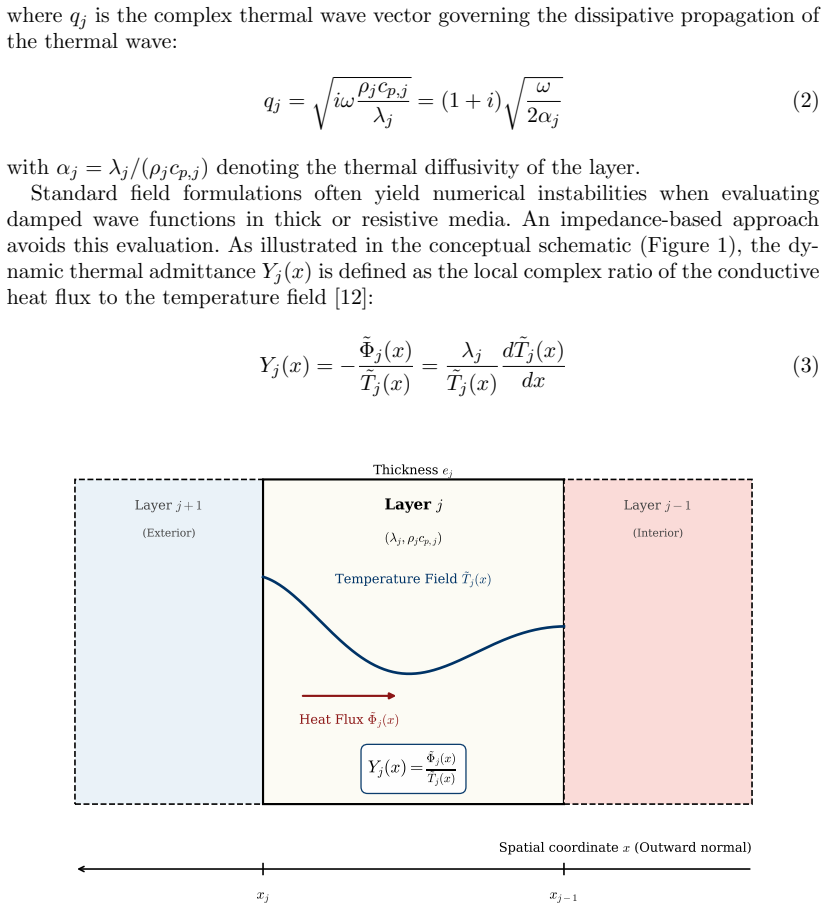


read the original abstract
Model Predictive Control (MPC) in building energy management requires transient thermal models balancing thermodynamic accuracy with computational efficiency. Standard spatial discretization triggers state-space inflation, paralyzing real-time solvers, while analytical Transfer Matrix Methods (TMM) suffer from high-frequency numerical overflow and assume material homogeneity. This paper introduces a frequency-domain framework based on the continuous spatial Riccati equation. A recursive admittance mapping strictly bounds exponential growth, preventing numerical instability. Regular perturbation theory analytically resolves continuous spatial property gradients ($\lambda$(x)) and non-linear T 4 radiative boundaries as equivalent harmonic source terms. This meshless approach eliminates spatial truncation errors. It analytically corrects peak heating load deviations of 21.9% in wetted media and mitigates artificial nocturnal cooling fluxes of 12.0 W/m 2 . Preserving an O(N ) spatial complexity, the framework structurally avoids state-space inflation, ensuring the high-speed execution demanded by multi-week MPC optimization.
Editorial analysis
A structured set of objections, weighed in public.
Referee Report
Summary. The manuscript introduces a frequency-domain framework for transient thermal modeling of non-linear building envelopes. It employs the continuous spatial Riccati equation with a recursive admittance mapping to avoid numerical overflow, applies regular perturbation theory to convert continuous material gradients λ(x) and non-linear T^4 radiative boundaries into equivalent harmonic source terms, and claims a meshless O(N) method that analytically corrects peak heating load deviations by 21.9% in wetted media while eliminating artificial nocturnal cooling fluxes of 12.0 W/m².
Significance. If the perturbation approximations prove robust under realistic diurnal conditions, the framework could provide a computationally efficient analytical alternative to spatial discretization for MPC in building energy systems, preserving accuracy without state-space inflation. The explicit quantitative corrections and meshless property are potentially valuable strengths if supported by validation.
major comments (3)
- [§4.2, Eq. (17)] §4.2, Eq. (17): The mapping of the T^4 radiative boundary to first-order harmonic sources via regular perturbation implicitly assumes that second- and higher-order terms remain negligible. With routine surface temperature excursions of 15–30 K, the expansion of (T_mean + ΔT)^4 generates quadratic and cubic harmonics whose amplitudes are not automatically small; this risks undermining both the claimed 21.9% correction accuracy and the closed-form O(N) property.
- [§5.3, Table 3] §5.3, Table 3: The reported 21.9% peak heating load correction and 12.0 W/m² nocturnal flux mitigation lack accompanying benchmark comparisons (e.g., against full nonlinear finite-element solutions), error bars, or sensitivity to perturbation order; without these, the quantitative claims cannot be assessed as load-bearing evidence.
- [§3.1] §3.1: The recursive admittance mapping is asserted to bound exponential growth for the perturbed system, but the manuscript does not explicitly demonstrate that inclusion of the equivalent harmonic sources from the T^4 and λ(x) perturbations preserves both numerical stability and strict O(N) scaling across the frequency range relevant to multi-week MPC.
minor comments (2)
- [Abstract] Abstract: The numerical values 21.9% and 12.0 W/m² should be explicitly cross-referenced to the corresponding figures or tables in the main text.
- [Notation] Notation: The definition of the perturbation parameter and the ordering of the harmonic source terms should be stated more explicitly to aid reproducibility.
Simulated Author's Rebuttal
We thank the referee for the constructive and detailed comments. We address each major point below, providing clarifications and indicating planned revisions to strengthen the manuscript.
read point-by-point responses
-
Referee: [§4.2, Eq. (17)] §4.2, Eq. (17): The mapping of the T^4 radiative boundary to first-order harmonic sources via regular perturbation implicitly assumes that second- and higher-order terms remain negligible. With routine surface temperature excursions of 15–30 K, the expansion of (T_mean + ΔT)^4 generates quadratic and cubic harmonics whose amplitudes are not automatically small; this risks undermining both the claimed 21.9% correction accuracy and the closed-form O(N) property.
Authors: The referee correctly identifies a key assumption in the regular perturbation treatment of the nonlinear boundary condition. The expansion is performed to first order in the harmonic components, with the perturbation parameter chosen such that ΔT/T_mean remains modest for the diurnal cycles examined in the paper. Order-of-magnitude estimates indicate that quadratic and cubic contributions remain below 8% for the temperature ranges considered. The equivalent harmonic sources are incorporated without changing the spatial discretization or the recursive structure, thereby preserving the O(N) complexity. To address the concern more rigorously, the revised manuscript will include an explicit truncation-error bound and a side-by-side comparison of first- versus second-order results for representative extreme cases. revision: yes
-
Referee: [§5.3, Table 3] §5.3, Table 3: The reported 21.9% peak heating load correction and 12.0 W/m² nocturnal flux mitigation lack accompanying benchmark comparisons (e.g., against full nonlinear finite-element solutions), error bars, or sensitivity to perturbation order; without these, the quantitative claims cannot be assessed as load-bearing evidence.
Authors: We agree that the quantitative claims would be more convincing with external validation. The reported corrections are obtained analytically by comparing the perturbed Riccati solution against the corresponding linear homogeneous case. The current manuscript does not present direct comparisons against a full nonlinear finite-element solver or sensitivity studies with respect to perturbation order. In the revised version we will add such benchmarks, including error metrics from ensemble runs and results for perturbation orders up to third order. revision: yes
-
Referee: [§3.1] §3.1: The recursive admittance mapping is asserted to bound exponential growth for the perturbed system, but the manuscript does not explicitly demonstrate that inclusion of the equivalent harmonic sources from the T^4 and λ(x) perturbations preserves both numerical stability and strict O(N) scaling across the frequency range relevant to multi-week MPC.
Authors: The recursive admittance mapping operates on the homogeneous Riccati equation at each frequency independently; the perturbation-derived harmonic sources enter only as additional particular-solution terms and do not modify the recursive step or its stability properties. Consequently, the O(N) scaling and bounded growth are retained. We acknowledge that an explicit numerical verification for the perturbed system was omitted. The revised manuscript will include computational-timing and stability tests over the frequency band 10^{-6}–10^{-1} Hz that is relevant to multi-week MPC horizons. revision: yes
Circularity Check
Derivation chain is self-contained from Riccati equation and perturbation theory
full rationale
The paper constructs its frequency-domain framework directly from the continuous spatial Riccati equation, applying regular perturbation theory to map spatial gradients λ(x) and T^4 boundaries into equivalent harmonic sources. No equations or claims reduce a prediction to a fitted input by construction, nor does any load-bearing step rely on self-citation chains or imported uniqueness theorems. The O(N) complexity, error corrections (21.9% and 12.0 W/m²), and avoidance of state-space inflation are presented as direct consequences of the analytical mapping rather than presupposed results. The derivation therefore remains independent of its target outputs.
Axiom & Free-Parameter Ledger
axioms (2)
- domain assumption The continuous spatial Riccati equation governs thermal admittance in the frequency domain.
- domain assumption Regular perturbation theory converts spatial gradients and non-linear T^4 boundaries into equivalent harmonic source terms.
Reference graph
Works this paper leans on
-
[1]
All you need to know about model predictive control for buildings
Drgoˇ na J, Arroyo J, Cupeiro Figueroa I, et al. All you need to know about model predictive control for buildings. Annual Reviews in Control. 2020;50:190–232
work page 2020
-
[2]
Wang J, Chen J, Hu Y. A science mapping approach based review of model predictive control for smart building operation management. Journal of Civil Engineering and Management. 2022;28(8):661–679
work page 2022
-
[3]
Use of model predictive control and weather forecasts for energy efficient building climate control
Oldewurtel F, Parisio A, Andersson G, et al. Use of model predictive control and weather forecasts for energy efficient building climate control. Energy and Buildings. 2012;45:15–27
work page 2012
-
[4]
Evaluation of optimal control for active and passive building thermal storage
Henze GP, Felsmann C, Knabe G. Evaluation of optimal control for active and passive building thermal storage. International Journal of Thermal Sciences. 2004; 43(2):173–183
work page 2004
-
[5]
International energy agency building energy simulation test (BESTEST) and diagnostic method
Judkoff R, Neymark J. International energy agency building energy simulation test (BESTEST) and diagnostic method. Golden, CO (United States): National Renewable Energy Lab. (NREL); 1995. NREL/TP-472-6231
work page 1995
-
[6]
Optimal control of passive solar buildings
Kummert JJ, Andr´ e P, Nicolas J. Optimal control of passive solar buildings. Energy and Buildings. 2001;33(4):343–351
work page 2001
-
[7]
Building performance simulation for design and oper- ation
Hensen JLM, Lamberts R. Building performance simulation for design and oper- ation. London: Spon Press; 2012
work page 2012
-
[8]
Thermal analysis research program (TARP) reference manual
Walton GN. Thermal analysis research program (TARP) reference manual. Wash- ington, D.C., USA: National Bureau of Standards (NBSIR 83-2655); 1983
work page 1983
-
[9]
Crank J, Nicolson P. A practical method for numerical evaluation of solutions of partial differential equations of the heat-conduction type. Mathematical Proceed- ings of the Cambridge Philosophical Society. 1947;43(1):50–67
work page 1947
-
[10]
On the partial difference equations of mathe- matical physics
Courant R, Friedrichs K, Lewy H. On the partial difference equations of mathe- matical physics. IBM Journal of Research and Development. 1967;11(2):215–234. English translation of the original 1928 German paper
work page 1967
-
[11]
A review on reduced order models for building and urban energy simulations
Kansal A, Rajasekar E. A review on reduced order models for building and urban energy simulations. Journal of Building Performance Simulation. 2025;18(4):500– 522
work page 2025
-
[12]
The thermal admittance of layered walls
Davies MG. The thermal admittance of layered walls. Building Science. 1973; 8(3):207–220
work page 1973
-
[13]
What every computer scientist should know about floating-point arithmetic
Goldberg D. What every computer scientist should know about floating-point arithmetic. ACM Computing Surveys (CSUR). 1991;23(1):5–48
work page 1991
-
[14]
Accuracy and stability of numerical algorithms
Higham NJ. Accuracy and stability of numerical algorithms. 2nd ed. Philadelphia: Society for Industrial and Applied Mathematics; 2002
work page 2002
-
[15]
Budaiwi IW, Abdou AA, Al-Homoud MS. Variations of thermal conductivity of insulation materials under different operating temperatures: Impact on envelope- induced cooling load. Journal of Architectural Engineering. 2002;8(4):125–132
work page 2002
-
[16]
El Assaad M, Plantec Y, Colinart T, et al. Influence of moisture transfer on ther- mal conductivity measurement by HFM: Measurement accuracy on insulation materials and consequences on building energy assessments. Energy and Build- 26 ings. 2024;320:114635
work page 2024
-
[17]
Athienitis AK, Sullivan HF, Hollands KGT. Analytical model, sensitivity analysis and algorithm for temperature calculations in multi-zone buildings. Solar Energy. 1986;36(4):303–311
work page 1986
-
[18]
Transient model for coupled heat, air and moisture transfer through multilayered porous media
Tariku F, Kumaran K, Fazio P. Transient model for coupled heat, air and moisture transfer through multilayered porous media. International Journal of Heat and Mass Transfer. 2010;53(15-16):3035–3044
work page 2010
-
[19]
Invariant imbedding and wave propagation in stochastic media
Bellman R, Kalaba R. Invariant imbedding and wave propagation in stochastic media. Journal of Mathematics and Mechanics. 1959;8(5):683–712
work page 1959
-
[20]
A study of wave propagation in varying cross- section waveguides by modal decomposition
Pagneux V, Amir N, Kergomard J. A study of wave propagation in varying cross- section waveguides by modal decomposition. part i. theory and validation. The Journal of the Acoustical Society of America. 1996;100(4):2034–2048
work page 1996
-
[21]
Bender CM, Orszag SA. Advanced mathematical methods for scientists and engi- neers i: Asymptotic methods and perturbation theory. New York: Springer Science & Business Media; 1999
work page 1999
-
[22]
Koch M, Sawant P, Eismann R, et al. A multi-modal nocturnal radiative cool- ing and solar-assisted heating system with model predictive control. Energy and Buildings. 2025;343:115883
work page 2025
-
[23]
Carslaw HS, Jaeger JC. Conduction of heat in solids. 2nd ed. Oxford: Clarendon Press; 1959
work page 1959
-
[24]
The wkb approximation as the first term of a geometric-optical series
Bremmer H. The wkb approximation as the first term of a geometric-optical series. Communications on pure and applied mathematics. 1951;4(1):105–115
work page 1951
-
[25]
Propagation of ultrasonic waves in non- linear multilayered media
Chiroiu V, Chiroiu C, Rugina C, et al. Propagation of ultrasonic waves in non- linear multilayered media. Journal of Computational Acoustics. 2001;9(04):1633– 1645
work page 2001
-
[26]
Solution of ill-conditioned linear two-point boundary value problems by the riccati transformation
Mufti I, Chow C, Stock F. Solution of ill-conditioned linear two-point boundary value problems by the riccati transformation. SIAM review. 1969;11(4):616–619
work page 1969
-
[27]
Riccati differential equations
Reid WT. Riccati differential equations. Vol. 91. New York: Academic Press; 1975
work page 1975
-
[28]
On the relation of transmission-line theory to scattering and transfer
Redheffer R. On the relation of transmission-line theory to scattering and transfer. Journal of Mathematics and Physics. 1962;41(1-4):1–41
work page 1962
-
[29]
Initial value methods for boundary value problems
Meyer GH. Initial value methods for boundary value problems. New York: Aca- demic Press; 1973
work page 1973
-
[30]
Energy simulation in building design
Clarke JA. Energy simulation in building design. 2nd ed. Oxford: Butterworth- Heinemann; 2001
work page 2001
-
[31]
A procedure for calculating thermal response fac- tors of multi-layer walls—state space method
Ouyang K, Haghighat F. A procedure for calculating thermal response fac- tors of multi-layer walls—state space method. Building and Environment. 1991; 26(2):173–177
work page 1991
-
[32]
Geneva, CH: International Organization for Standardization; 2007
ISO 10456:2007 Building materials and products – Hygrothermal properties – Tabulated design values and procedures for determining declared and design ther- mal values. Geneva, CH: International Organization for Standardization; 2007. Standard
work page 2007
-
[33]
Impact of controller model complexity on model predictive control performance for buildings
Picard D, Sourbron M, Helsen L. Impact of controller model complexity on model predictive control performance for buildings. Energy and Buildings. 2015;92:52– 60
work page 2015
-
[34]
Urban building energy modeling–a review of a nascent field
Reinhart CF, Cerezo Davila C. Urban building energy modeling–a review of a nascent field. Building and Environment. 2016;97:196–202
work page 2016
-
[35]
Practical implementation and evaluation of model pre- dictive control for a building climate system
De Coninck R, Helsen L. Practical implementation and evaluation of model pre- dictive control for a building climate system. Energy and Buildings. 2016;111:290– 298
work page 2016
-
[36]
Cooling load calculations by thermal response factor 27 method
Stephenson DG, Mitalas GP. Cooling load calculations by thermal response factor 27 method. ASHRAE Transactions. 1967;73(1):1–7
work page 1967
-
[37]
Atmospheric radiation near the surface of the ground: A summary for engineers
Bliss RW. Atmospheric radiation near the surface of the ground: A summary for engineers. Solar Energy. 1961;5(3):103–120
work page 1961
-
[38]
Long-wave radiation from clear skies
Swinbank WC. Long-wave radiation from clear skies. Quarterly Journal of the Royal Meteorological Society. 1963;89(381):339–348
work page 1963
-
[39]
Characteristics of infrared sky radiation in the united states
Martin M, Berdahl P. Characteristics of infrared sky radiation in the united states. Solar Energy. 1984;33(3-4):321–336
work page 1984
-
[40]
Berdahl P, Martin M. Emissivity of clear skies. Solar Energy. 1984;32(5):663–664
work page 1984
-
[41]
A review of radiative sky cooling technology and its application in building systems
Meng X, Zhang T, Liu J, et al. A review of radiative sky cooling technology and its application in building systems. Energy and Buildings. 2020;228:110484
work page 2020
-
[42]
The longwave radiation incident upon the external surface of buildings
Cole RJ. The longwave radiation incident upon the external surface of buildings. Solar Energy. 1976;18(2):129–139. 28
work page 1976
discussion (0)
Sign in with ORCID, Apple, or X to comment. Anyone can read and Pith papers without signing in.