REVIEW 3 major objections 5 minor 102 references
The spatial extension of extended narrow line regions in MaNGA AGN
T0 review · 3 major / 5 minor · reviewed 2026-08-14 · deepseek-v4-flash
Pith's one-line read A single power law links the size of AGN-ionized gas to [O III] luminosity across four orders of magnitude.
desk verdict A genuinely useful IFU-based ENLR sample, but the headline 0.42 slope needs a clear statement that the quasar isophotal threshold is rest-frame. read the letter →
The pith
A machine-rendered reading of the paper's core claim, the machinery that carries it, and where it could break.
The reading
What carries the argument
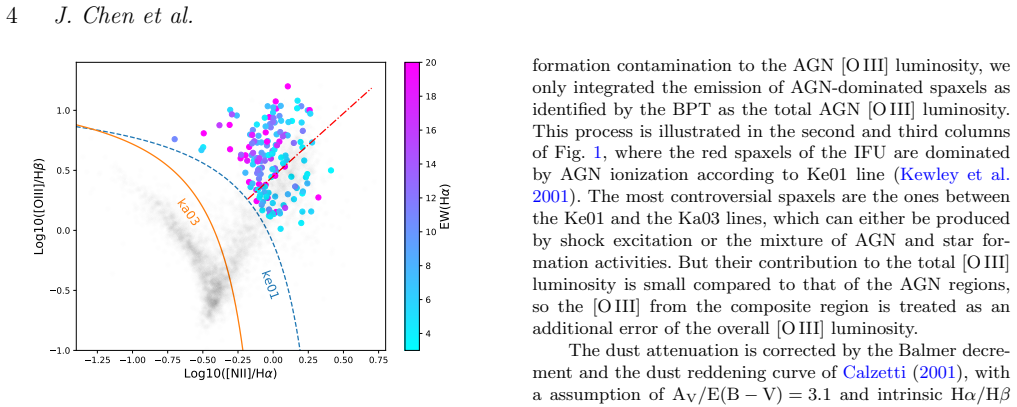
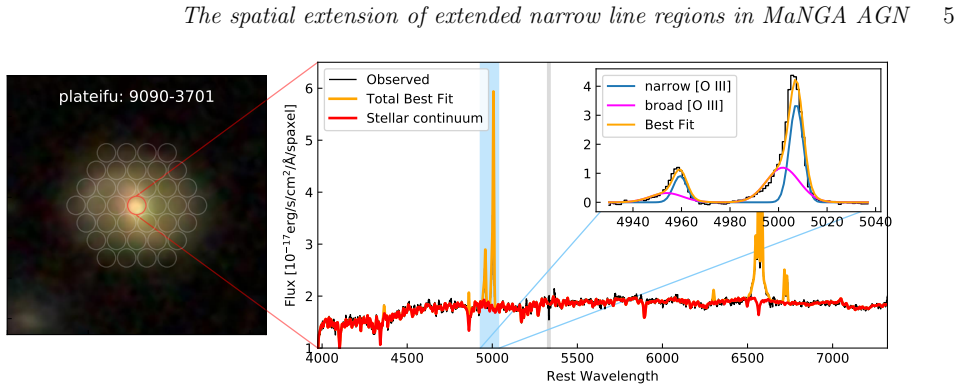
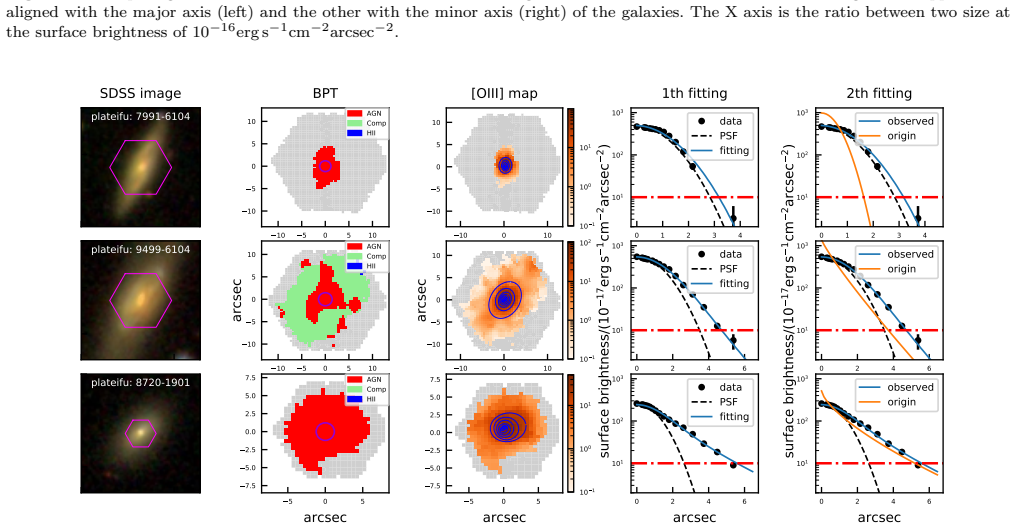
The argument runs on three linked tools: spatially resolved BPT classification using the Kewley et al. (2001) boundary to select AGN-dominated spaxels; summing the dust-corrected [O III] flux of those spaxels as the AGN luminosity; and fitting the [O III] surface-brightness profile with a Sersic law, with and without convolution by the MaNGA PSF, to read off R16. The threshold-based radius is the same quantity the quasar studies used, which is what makes the four-dex combination possible.
What would settle it
Re-measure the quasar sizes at the rest-frame equivalent of $10^{-16}\,\mathrm{erg\,s^{-1}\,cm^{-2}\,arcsec^{-2}}$ by multiplying observed surface brightness by $(1+z)^4$, then re-fit the combined sample; if the slope moves by more than the quoted $0.02$ uncertainty, the claimed universal relation is an artifact of the threshold mismatch.
Extended reading notes
Core claim
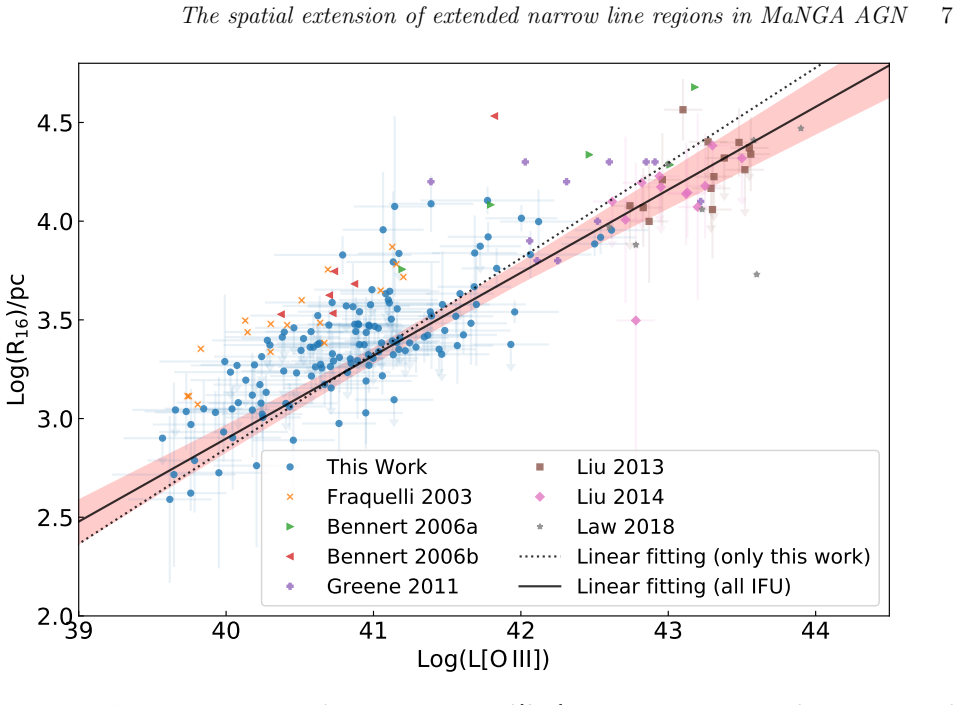
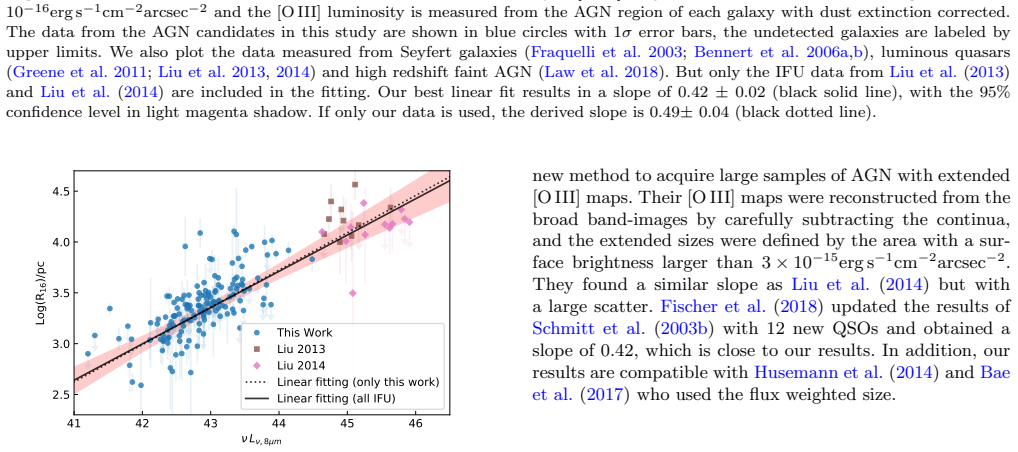
The central claim is that the ENLR size, defined as the radius at the $10^{-16}\,\mathrm{erg\,s^{-1}\,cm^{-2}\,arcsec^{-2}}$ [O III] surface-brightness isophote, is a single power-law function of AGN [O III] luminosity: $\log(R/\mathrm{pc}) = (0.42\pm0.02)\log(L_{\mathrm{[O\,III]}}/\mathrm{erg\,s^{-1}}) - (13.97\pm0.95)$. The relationship holds over four dex when the MaNGA Seyferts are combined with IFU quasar measurements, and the slope is insensitive to whether radio-loud AGN or galaxies with detected outflows are present. This supports the picture of an ENLR as a population of photoionized clouds in pressure equilibrium with the radiation field, rather than gas mechanically transported by jets.
Load-bearing premise
The fit assumes that measuring sizes at the same observed-frame surface brightness of $10^{-16}\,\mathrm{erg\,s^{-1}\,cm^{-2}\,arcsec^{-2}}$ is equivalent for the nearby MaNGA galaxies and the higher-redshift quasars; if the threshold was not converted to rest frame, the quasar sizes sit at a different intrinsic brightness and the combined slope could be biased.
Editorial extensions
If this is right
- The 0.42 slope implies ENLR sizes scale roughly as $L^{0.4}$, a scaling that standard photoionization and the Dempsey & Zakamska cloud-population model can both accommodate.
- The MaNGA-only slope of $0.49\pm0.04$ is consistent with the combined slope, suggesting the same physical scaling connects nearby Seyferts and luminous quasars.
- Radio-loud AGN, nine of the 152 galaxies, lie on the same relation, so jets are not the dominant driver of ENLR size in this luminosity range.
- Because PSF-smearing corrections change measured sizes by up to about 50 percent for marginally resolved sources, PSF-corrected sizes are essential when comparing IFU surveys.
- If the relation is universal, the spatial extent of ionized gas alone can serve as a rough luminosity indicator for AGN whose broad lines are hidden.
Reading between the lines
- If the surface-brightness threshold was left in observed frame, the quasar R16 values are measured at a fainter intrinsic brightness than the MaNGA values; correcting with $(1+z)^4$ and refitting would test whether the 0.42 slope survives.
- The same method applied to JWST/NIRSpec IFU observations at $z\sim1\text{--}3$ could test whether the relation holds at higher redshift or turns over.
- Combining ENLR sizes with molecular-gas maps would test whether the $n_c\propto r^{-2}$ cloud distribution assumed by the model is physically present.
Signed reviews
Editorial analysis
A structured set of objections, weighed in public.
Referee Report
Summary. The paper measures the size-luminosity relation of extended narrow line regions (ENLRs) in a sample of 152 MaNGA AGN selected via spatially resolved BPT diagnostics. ENLR sizes are defined by a 10^-16 erg/s/cm^2/arcsec^2 [O III] surface brightness isophote (R16), measured from PSF-deconvolved Sersic fits to the [O III] surface brightness profiles. By combining the MaNGA Seyferts with IFU quasar data from Liu et al. (2013, 2014), the authors fit a log-linear relation, log(R16/pc) = (0.42 +/- 0.02) log(L[O III]/erg/s) - (13.97 +/- 0.95), over four orders of magnitude in luminosity (Eq. 2, Fig. 6). They interpret the slope with the Dempsey & Zakamska (2018) photoionized cloud model and argue that outflows and jets are not required to explain the ENLR extension in low-luminosity Seyferts.
Significance. If the central result holds, it provides a well-calibrated ENLR size-luminosity relation over a much wider luminosity range than previous studies, connecting local Seyferts to luminous quasars with a uniform IFU-based size definition. The analysis has notable strengths: Monte Carlo radius uncertainties, PSF-deconvolved Sersic profile fitting, dust correction via the Balmer decrement, and a Bayesian regression method (Kelly 2007) are used, and the code is publicly available. The main caveats concern the rest-frame versus observed-frame threshold convention and the treatment of unresolved galaxies/upper limits; these issues are testable and should be clarified before the quoted slope is taken at face value.
major comments (3)
- [Section 3.3 and Section 4] The paper never states whether the 10^-16 erg/s/cm^2/arcsec^2 surface brightness threshold is defined in the rest frame or the observed frame. Section 3.3 notes that cosmological dimming scales surface brightness by (1+z)^4 and says this is important for high-redshift comparisons, but Section 4 does not specify that the Liu et al. (2013, 2014) profiles were converted to rest frame before measuring R16. For z ~ 0.5-1 quasars the dimming factor is 5-16, so an observed-frame threshold would make the quasar R16 values larger than a rest-frame threshold would, which would flatten the combined slope relative to the MaNGA-only value of 0.49 +/- 0.04. Please state the convention explicitly, verify what Liu et al. actually quote, and re-fit with the threshold consistently defined (or demonstrate that the two conventions give the same result at the relevant redshifts).
- [Section 3.4 and Section 4] The treatment of unresolved galaxies and upper limits is unspecified. The text says that galaxies whose PSF-deconvolved fit fails are assigned upper limits from the non-deconvolved fit, and Fig. 6 plots upper limits, but the fit description says 'Based on all the valid IFU observations' without stating whether upper limits are included as censored data in the Kelly (2007) regression. Table 1 contains many entries with resolved=False. If these points are omitted, the low-luminosity end of the fit is biased toward resolved ENLRs; if they are included as detections, the slope is biased downward. Please specify the censoring scheme, report the fit with and without upper limits, and state how many galaxies required extrapolation of the Sersic profile beyond the data to reach R16.
- [Section 5 and Figure 8] The agreement with the Dempsey & Zakamska (2018) model is presented as support, but the model has two free parameters (cloud mass mc and covering factor Omega) that are adjusted to match the data. The 'best' model in Fig. 8 is therefore a two-parameter fit to the same relation, not an a priori prediction, so the comparison is illustrative rather than a strong test. Please either provide a formal model comparison that accounts for the fitted parameters, or soften the Abstract/Conclusions wording to 'consistent with' rather than 'supports'.
minor comments (5)
- [Table 1] Several entries list log L[O III] uncertainties larger than 10 dex (e.g., 8483-12703, 9502-9101, 9893-6102); these values are unphysical and should be corrected or explained.
- [Section 5] The sentence 'Both the number of radio-loud AGN in our sample and their ENLR sizes These results suggest...' is grammatically incomplete; please rewrite.
- [Figure 5 caption and Section 3.4] '1th fitting' and '2th fitting' should be '1st fitting' and '2nd fitting'.
- [Section 3.3] The warning about cosmological dimming is placed in the MaNGA methods section, but the relevant application is to the quasar sample; please expand it where the combined fit is described and state the numerical correction used for each source.
- [Figure 6] Please state explicitly how many galaxies are included in each fit (MaNGA-only and combined) and make clear in the figure/legend which points are detections and which are upper limits.
Circularity Check
The central size-luminosity fit is an independent empirical measurement; only the Dempsey & Zakamska model comparison in Fig. 8 is a mildly circular 'prediction' with free parameters tuned to the data.
-
fitted input called prediction
[Section 5, Fig. 8 and caption]
"Model predictions of Dempsey & Zakamska (2018) are superimposed on our data points. ... If the surface brightness cut at 10−16erg s−1cm−2arcsec−2 is adapted, the model fits our data well as shown in Fig. 8. The model takes the masses of clouds (mc) and their covering factor (Ω) as free parameters. A cloud mass of 10 7M⊙ with a covering factor of 3 × 10⁻³ fits our data well as the black solid line in Fig. 7."
The curves labeled 'Prediction' in Fig. 8 are computed using two free parameters, cloud mass mc and covering factor Ω, which Section 5 states are chosen so that the model 'fits our data well'; the figure caption itself calls the curve the 'best fitting model.' Thus the model-data agreement displayed as a 'Prediction' is a retrodiction with fitted parameters, not an independent first-principles derivation. This is not load-bearing for the paper's central result: Eq. (2) is obtained by a Kelly (2007) Bayesian fit to the measured R16 and [O III] luminosities, with no DZ18 parameter entering that fit. It is a mild circularity in presentation, and DZ18 is a self-citation by coauthor Dempsey, but the measured size-luminosity relation stands on independent data.
full rationale
Equation (2) and Figure 6 are produced by a Bayesian log-linear fit to the authors' MaNGA R16 and [O III] luminosities combined with Liu et al. (2013, 2014) IFU data; no Dempsey & Zakamska (2018) parameter enters this fit, and R16 is not defined in terms of L[O III]. The size-luminosity correlation is therefore an empirical measurement, not a consequence of the model. The only circular element is the interpretive comparison in Section 5/Fig. 8: curves labeled 'Prediction' use two free parameters explicitly chosen to match the data, so their agreement is a fit rather than an independent prediction. This is illustrative and does not feed back into Eq. (2). The Section 3.3 caveat about cosmological dimming is a real calibration ambiguity for combining MaNGA and quasar samples, but ambiguity about observed- vs rest-frame thresholds is a correctness concern, not a circular reduction of the fitted relation. Overall, there is no significant load-bearing circularity.
Assumptions & free parameters
free parameters (6)
- Surface brightness threshold =
10^-16 erg/s/cm^2/arcsec^2
- Size-luminosity slope =
0.42 ± 0.02
- Size-luminosity intercept =
-13.97 ± 0.95
- Per-galaxy Sersic index n and scale k =
n in [0.5, 10], k in [0.01, 10]; values per galaxy
- Model cloud mass mc =
10^7 M_sun
- Model covering factor Omega =
3 x 10^-3
assumptions (5)
- domain assumption A fixed observed-frame surface brightness threshold defines ENLR size equivalently at all redshifts in the combined sample.
- domain assumption Spatially resolved BPT classification with the Kewley et al. (2001) boundary separates AGN-ionized spaxels from star-forming spaxels.
- domain assumption A Sersic profile convolved with a Gaussian PSF represents the intrinsic [O III] surface brightness distribution outside the observed map.
- domain assumption The dust-corrected [O III] luminosity of AGN-classified spaxels is a reliable proxy for the AGN ionizing luminosity.
- domain assumption The Dempsey and Zakamska 2018 cloud model assumptions apply to the galaxies in this sample.
Cite this review
Pith. "Pith review of The spatial extension of extended narrow line regions in MaNGA AGN." pith.science (2026). https://pith.science/paper/NE7RFF3Z
@misc{pith2026190802885,
  author       = {Pith},
  title        = {Pith review of: The spatial extension of extended narrow line regions in MaNGA AGN},
  year         = {2026},
  howpublished = {\url{https://pith.science/paper/NE7RFF3Z}},
  note         = {Machine review of arXiv:1908.02885}
}
abstract
In this work, we revisit the size-luminosity relation of the extended narrow line regions (ENLRs) using a large sample of nearby active galactic nuclei (AGN) from the Mapping Nearby Galaxies at Apache Point Observatory (MaNGA) survey. The ENLRs ionized by the AGN are identified through the spatially resolved BPT diagram, which results in a sample of 152 AGN. By combining our AGN with the literature high-luminosity quasars, we found a tight log-linear relation between the size of the ENLR and the AGN [O III]{\lambda}5007{\AA} luminosity over four orders of magnitude of the [O III] luminosity. The slope of this relation is 0.42 $\pm$ 0.02 which can be explained in terms of a distribution of clouds photoionized by the AGN. This relation also indicates the AGN have the potential to ionize and heat the gas clouds at a large distance from the nuclei without the aids of outflows and jets for the low-luminosity Seyferts.
Figures

Figures from the paper (5 more)


Reference graph
Works this paper leans on
-
[1]
Aguado D. S., et al., 2019, @doi [ ] 10.3847/1538-4365/aaf651 , http://ads.bao.ac.cn/abs/2019ApJS..240...23A 240, 23
-
[2]
Antonucci R., 1993, @doi [ ] 10.1146/annurev.aa.31.090193.002353 , http://adsabs.harvard.edu/abs/1993ARA
arXiv 1993
-
[3]
Bae H.-J., Woo J.-H., Karouzos M., Gallo E., Flohic H., Shen Y., Yoon S.-J., 2017, @doi [ ] 10.3847/1538-4357/aa5f5c , http://adsabs.harvard.edu/abs/2017ApJ...837...91B 837, 91
-
[4]
Baldwin J. A., Phillips M. M., Terlevich R., 1981, @doi [ ] 10.1086/130766 , http://adsabs.harvard.edu/abs/1981PASP...93....5B 93, 5
doi:10.1086/130766 1981
-
[5]
Baum S. A., Heckman T. M., van Breugel W., 1992, @doi [ ] 10.1086/171198 , https://ui.adsabs.harvard.edu/abs/1992ApJ...389..208B 389, 208
-
[6]
Becker R. H., White R. L., Helfand D. J., 1995, @doi [ ] 10.1086/176166 , http://adsabs.harvard.edu/abs/1995ApJ...450..559B 450, 559
doi:10.1086/176166 1995
-
[7]
Belfiore F., et al., 2016, @doi [ ] 10.1093/mnras/stw1234 , http://ads.bao.ac.cn/abs/2016MNRAS.461.3111B 461, 3111
-
[8]
Belfiore F., et al., 2019, arXiv e-prints, http://ads.bao.ac.cn/abs/2019arXiv190100866B
2019
Show all 102 references
-
[9]
S., Wills B
Bennert N., Falcke H., Schulz H., Wilson A. S., Wills B. J., 2002, @doi [ ] 10.1086/342420 , http://adsabs.harvard.edu/abs/2002ApJ...574L.105B 574, L105
2002 doi
-
[10]
Bennert N., Jungwiert B., Komossa S., Haas M., Chini R., 2006a, @doi [ ] 10.1051/0004-6361:20065319 , http://adsabs.harvard.edu/abs/2006A
-
[11]
Bennert N., Jungwiert B., Komossa S., Haas M., Chini R., 2006b, @doi [ ] 10.1051/0004-6361:20065477 , http://adsabs.harvard.edu/abs/2006A
-
[12]
Bing L., et al., 2018, @doi [ ] 10.1093/mnras/sty2662 , http://adsabs.harvard.edu/abs/2018MNRAS.tmp.2546B
2018 doi
-
[13]
R., et al., 2017, @doi [ ] 10.3847/1538-3881/aa7567 , http://adsabs.harvard.edu/abs/2017AJ....154...28B 154, 28
Blanton M. R., et al., 2017, @doi [ ] 10.3847/1538-3881/aa7567 , http://adsabs.harvard.edu/abs/2017AJ....154...28B 154, 28
2017 doi
-
[14]
A., Persson S
Boroson T. A., Persson S. E., Oke J. B., 1985, @doi [ ] 10.1086/163219 , http://adsabs.harvard.edu/abs/1985ApJ...293..120B 293, 120
1985 doi
-
[15]
D., Kaiser M
Bradley L. D., Kaiser M. E., Baan W. A., 2004, @doi [ ] 10.1086/381680 , http://adsabs.harvard.edu/abs/2004ApJ...603..463B 603, 463
2004 doi
-
[16]
Bradley L., et al., 2017, astropy/photutils: v0.4, @doi 10.5281/zenodo.1039309 , https://doi.org/10.5281/zenodo.1039309
2017 doi
-
[17]
Bundy K., et al., 2015, @doi [ ] 10.1088/0004-637X/798/1/7 , http://adsabs.harvard.edu/abs/2015ApJ...798....7B 798, 7
2015 doi
-
[18]
Calzetti D., 2001, @doi [ ] 10.1086/324269 , http://adsabs.harvard.edu/abs/2001PASP..113.1449C 113, 1449
2001 doi
-
[19]
Cappellari M., 2017, @doi [ ] 10.1093/mnras/stw3020 , http://ads.bao.ac.cn/abs/2017MNRAS.466..798C 466, 798
2017 doi
-
[21]
Cappellari M., Emsellem E., 2004, @doi [ ] 10.1086/381875 , http://ads.bao.ac.cn/abs/2004PASP..116..138C 116, 138
2004 doi
-
[22]
Cherinka B., et al., 2018, arXiv e-prints, http://adsabs.harvard.edu/abs/2018arXiv181203833C
2018
-
[23]
Cheung E., et al., 2016, @doi [ ] 10.1038/nature18006 , http://adsabs.harvard.edu/abs/2016Natur.533..504C 533, 504
2016 doi
-
[25]
L., 2018, @doi [ ] 10.1093/mnras/sty941 , http://adsabs.harvard.edu/abs/2018MNRAS.477.4615D 477, 4615
Dempsey R., Zakamska N. L., 2018, @doi [ ] 10.1093/mnras/sty941 , http://adsabs.harvard.edu/abs/2018MNRAS.477.4615D 477, 4615
2018 doi
-
[26]
A., Sutherland R
Dopita M. A., Sutherland R. S., 1995, @doi [ ] 10.1086/176596 , http://adsabs.harvard.edu/abs/1995ApJ...455..468D 455, 468
1995 doi
-
[27]
A., Sutherland R
Dopita M. A., Sutherland R. S., 1996, @doi [ ] 10.1086/192255 , http://adsabs.harvard.edu/abs/1996ApJS..102..161D 102, 161
1996 doi
-
[28]
A., Groves B
Dopita M. A., Groves B. A., Sutherland R. S., Binette L., Cecil G., 2002, @doi [ ] 10.1086/340429 , http://adsabs.harvard.edu/abs/2002ApJ...572..753D 572, 753
2002 doi
-
[29]
Drory N., et al., 2015, @doi [ ] 10.1088/0004-6256/149/2/77 , http://adsabs.harvard.edu/abs/2015AJ....149...77D 149, 77
2015 doi
-
[30]
C., 2012, @doi [ ] 10.1146/annurev-astro-081811-125521 , http://adsabs.harvard.edu/abs/2012ARA
Fabian A. C., 2012, @doi [ ] 10.1146/annurev-astro-081811-125521 , http://adsabs.harvard.edu/abs/2012ARA
2012 doi
-
[31]
J., Korista K
Ferland G. J., Korista K. T., Verner D. A., Ferguson J. W., Kingdon J. B., Verner E. M., 1998, @doi [ ] 10.1086/316190 , http://ads.bao.ac.cn/abs/1998PASP..110..761F 110, 761
1998 doi
-
[32]
C., et al., 2018, @doi [ ] 10.3847/1538-4357/aab03e , http://adsabs.harvard.edu/abs/2018ApJ...856..102F 856, 102
Fischer T. C., et al., 2018, @doi [ ] 10.3847/1538-4357/aab03e , http://adsabs.harvard.edu/abs/2018ApJ...856..102F 856, 102
2018 doi
-
[33]
A., Storchi-Bergmann T., Levenson N
Fraquelli H. A., Storchi-Bergmann T., Levenson N. A., 2003, @doi [ ] 10.1046/j.1365-8711.2003.06397.x , http://adsabs.harvard.edu/abs/2003MNRAS.341..449F 341, 449
2003
-
[34]
Fu H., Stockton A., 2009, @doi [ ] 10.1088/0004-637X/690/1/953 , http://adsabs.harvard.edu/abs/2009ApJ...690..953F 690, 953
2009 doi
-
[35]
A., 2019, @doi [ ] 10.1093/mnras/stz564 , http://ads.bao.ac.cn/abs/2019MNRAS.485.3409G 485, 3409
Gallagher R., Maiolino R., Belfiore F., Drory N., Riffel R., Riffel R. A., 2019, @doi [ ] 10.1093/mnras/stz564 , http://ads.bao.ac.cn/abs/2019MNRAS.485.3409G 485, 3409
2019 doi
-
[36]
E., Zakamska N
Greene J. E., Zakamska N. L., Ho L. C., Barth A. J., 2011, @doi [ ] 10.1088/0004-637X/732/1/9 , http://adsabs.harvard.edu/abs/2011ApJ...732....9G 732, 9
2011 doi
-
[37]
A., Dopita M
Groves B. A., Dopita M. A., Sutherland R. S., 2004a, @doi [ ] 10.1086/421113 , http://adsabs.harvard.edu/abs/2004ApJS..153....9G 153, 9
-
[38]
A., Dopita M
Groves B. A., Dopita M. A., Sutherland R. S., 2004b, @doi [ ] 10.1086/421114 , http://adsabs.harvard.edu/abs/2004ApJS..153...75G 153, 75
-
[39]
E., et al., 2006, @doi [ ] 10.1086/500975 , http://adsabs.harvard.edu/abs/2006AJ....131.2332G 131, 2332
Gunn J. E., et al., 2006, @doi [ ] 10.1086/500975 , http://adsabs.harvard.edu/abs/2006AJ....131.2332G 131, 2332
2006 doi
-
[40]
N., Hickox R., Greene J
Hainline K. N., Hickox R., Greene J. E., Myers A. D., Zakamska N. L., 2013, @doi [ ] 10.1088/0004-637X/774/2/145 , http://adsabs.harvard.edu/abs/2013ApJ...774..145H 774, 145
2013 doi
-
[41]
N., Hickox R
Hainline K. N., Hickox R. C., Greene J. E., Myers A. D., Zakamska N. L., Liu G., Liu X., 2014, @doi [ ] 10.1088/0004-637X/787/1/65 , http://adsabs.harvard.edu/abs/2014ApJ...787...65H 787, 65
2014 doi
-
[42]
M., 2017, @doi [Nature Astronomy] 10.1038/s41550-017-0165 , http://adsabs.harvard.edu/abs/2017NatAs...1E.165H 1, 0165
Harrison C. M., 2017, @doi [Nature Astronomy] 10.1038/s41550-017-0165 , http://adsabs.harvard.edu/abs/2017NatAs...1E.165H 1, 0165
2017 doi
-
[43]
M., Alexander D
Harrison C. M., Alexander D. M., Mullaney J. R., Swinbank A. M., 2014, @doi [ ] 10.1093/mnras/stu515 , http://adsabs.harvard.edu/abs/2014MNRAS.441.3306H 441, 3306
2014 doi
-
[44]
M., Costa T., Tadhunter C
Harrison C. M., Costa T., Tadhunter C. N., Fl \"u tsch A., Kakkad D., Perna M., Vietri G., 2018, @doi [Nature Astronomy] 10.1038/s41550-018-0403-6 , http://adsabs.harvard.edu/abs/2018NatAs...2..198H 2, 198
2018 doi
-
[45]
M., Best P
Heckman T. M., Best P. N., 2014, @doi [ ] 10.1146/annurev-astro-081913-035722 , http://adsabs.harvard.edu/abs/2014ARA
2014 doi
-
[46]
M., Miley G
Heckman T. M., Miley G. K., van Breugel W. J. M., Butcher H. R., 1981, @doi [ ] 10.1086/159050 , http://adsabs.harvard.edu/abs/1981ApJ...247..403H 247, 403
1981 doi
-
[47]
M., Kauffmann G., Brinchmann J., Charlot S., Tremonti C., White S
Heckman T. M., Kauffmann G., Brinchmann J., Charlot S., Tremonti C., White S. D. M., 2004, @doi [ ] 10.1086/422872 , http://adsabs.harvard.edu/abs/2004ApJ...613..109H 613, 109
2004 doi
-
[48]
C., 2008, @doi [ ] 10.1146/annurev.astro.45.051806.110546 , http://adsabs.harvard.edu/abs/2008ARA
Ho L. C., 2008, @doi [ ] 10.1146/annurev.astro.45.051806.110546 , http://adsabs.harvard.edu/abs/2008ARA
2008 arXiv
-
[49]
F., Hernquist L., Cox T
Hopkins P. F., Hernquist L., Cox T. J., Di Matteo T., Robertson B., Springel V., 2006, @doi [ ] 10.1086/499298 , http://adsabs.harvard.edu/abs/2006ApJS..163....1H 163, 1
2006 doi
-
[51]
D., 2007, @doi [Computing in Science Engineering] 10.1109/MCSE.2007.55 , 9, 90
Hunter J. D., 2007, @doi [Computing in Science Engineering] 10.1109/MCSE.2007.55 , 9, 90
2007 doi
-
[52]
F., Jahnke K., 2008, @doi [ ] 10.1051/0004-6361:200810276 , http://adsabs.harvard.edu/abs/2008A
Husemann B., Wisotzki L., S \'a nchez S. F., Jahnke K., 2008, @doi [ ] 10.1051/0004-6361:200810276 , http://adsabs.harvard.edu/abs/2008A
2008 doi
-
[53]
F., Jahnke K., 2013, @doi [ ] 10.1051/0004-6361/201220076 , http://adsabs.harvard.edu/abs/2013A
Husemann B., Wisotzki L., S \'a nchez S. F., Jahnke K., 2013, @doi [ ] 10.1051/0004-6361/201220076 , http://adsabs.harvard.edu/abs/2013A
2013 doi
-
[54]
F., Wisotzki L., Nugroho D., Kupko D., Schramm M., 2014, @doi [ ] 10.1093/mnras/stu1167 , http://adsabs.harvard.edu/abs/2014MNRAS.443..755H 443, 755
Husemann B., Jahnke K., S \'a nchez S. F., Wisotzki L., Nugroho D., Kupko D., Schramm M., 2014, @doi [ ] 10.1093/mnras/stu1167 , http://adsabs.harvard.edu/abs/2014MNRAS.443..755H 443, 755
2014 doi
-
[55]
Jones E., Oliphant T., Peterson P., et al., 2001--, SciPy : Open source scientific tools for Python , http://www.scipy.org/
2001
-
[56]
Kang D., Woo J.-H., 2018, The Astrophysical Journal, 864, 124
2018
-
[57]
Karouzos M., Woo J.-H., Bae H.-J., 2016a, @doi [ ] 10.3847/0004-637X/819/2/148 , http://adsabs.harvard.edu/abs/2016ApJ...819..148K 819, 148
-
[58]
Karouzos M., Woo J.-H., Bae H.-J., 2016b, @doi [ ] 10.3847/1538-4357/833/2/171 , http://adsabs.harvard.edu/abs/2016ApJ...833..171K 833, 171
-
[59]
M., 2009, @doi [ ] 10.1111/j.1365-2966.2009.14960.x , http://adsabs.harvard.edu/abs/2009MNRAS.397..135K 397, 135
Kauffmann G., Heckman T. M., 2009, @doi [ ] 10.1111/j.1365-2966.2009.14960.x , http://adsabs.harvard.edu/abs/2009MNRAS.397..135K 397, 135
2009
-
[60]
Kauffmann G., et al., 2003, @doi [ ] 10.1111/j.1365-2966.2003.07154.x , http://adsabs.harvard.edu/abs/2003MNRAS.346.1055K 346, 1055
2003
-
[61]
C., et al., 2012, @doi [ ] 10.1111/j.1365-2966.2011.20101.x , http://adsabs.harvard.edu/abs/2012MNRAS.420..878K 420, 878
Keel W. C., et al., 2012, @doi [ ] 10.1111/j.1365-2966.2011.20101.x , http://adsabs.harvard.edu/abs/2012MNRAS.420..878K 420, 878
2012
-
[62]
C., 2007, @doi [ ] 10.1086/519947 , http://ads.bao.ac.cn/abs/2007ApJ...665.1489K 665, 1489
Kelly B. C., 2007, @doi [ ] 10.1086/519947 , http://ads.bao.ac.cn/abs/2007ApJ...665.1489K 665, 1489
2007 doi
-
[63]
J., Dopita M
Kewley L. J., Dopita M. A., Sutherland R. S., Heisler C. A., Trevena J., 2001, @doi [ ] 10.1086/321545 , http://adsabs.harvard.edu/abs/2001ApJ...556..121K 556, 121
2001 doi
-
[64]
J., Groves B., Kauffmann G., Heckman T., 2006, @doi [ ] 10.1111/j.1365-2966.2006.10859.x , http://adsabs.harvard.edu/abs/2006MNRAS.372..961K 372, 961
Kewley L. J., Groves B., Kauffmann G., Heckman T., 2006, @doi [ ] 10.1111/j.1365-2966.2006.10859.x , http://adsabs.harvard.edu/abs/2006MNRAS.372..961K 372, 961
2006
-
[65]
King A., Pounds K., 2015, @doi [ ] 10.1146/annurev-astro-082214-122316 , http://adsabs.harvard.edu/abs/2015ARA
2015 doi
-
[66]
C., 2013, @doi [ ] 10.1146/annurev-astro-082708-101811 , http://adsabs.harvard.edu/abs/2013ARA
Kormendy J., Ho L. C., 2013, @doi [ ] 10.1146/annurev-astro-082708-101811 , http://adsabs.harvard.edu/abs/2013ARA
2013 doi
-
[67]
Lacerda E. A. D., et al., 2018, @doi [ ] 10.1093/mnras/stx3022 , http://adsabs.harvard.edu/abs/2018MNRAS.474.3727L 474, 3727
2018 doi
-
[68]
R., et al., 2015, @doi [ ] 10.1088/0004-6256/150/1/19 , http://adsabs.harvard.edu/abs/2015AJ....150...19L 150, 19
Law D. R., et al., 2015, @doi [ ] 10.1088/0004-6256/150/1/19 , http://adsabs.harvard.edu/abs/2015AJ....150...19L 150, 19
2015 doi
-
[69]
R., et al., 2016, @doi [ ] 10.3847/0004-6256/152/4/83 , http://ads.bao.ac.cn/abs/2016AJ....152...83L 152, 83
Law D. R., et al., 2016, @doi [ ] 10.3847/0004-6256/152/4/83 , http://ads.bao.ac.cn/abs/2016AJ....152...83L 152, 83
2016 doi
-
[70]
R., Steidel C
Law D. R., Steidel C. C., Chen Y., Strom A. L., Rudie G. C., Trainor R. F., 2018, @doi [ ] 10.3847/1538-4357/aae156 , https://ui.adsabs.harvard.edu/abs/2018ApJ...866..119L 866, 119
2018 doi
-
[71]
L., Greene J
Liu G., Zakamska N. L., Greene J. E., Nesvadba N. P. H., Liu X., 2013, @doi [ ] 10.1093/mnras/stt051 , http://adsabs.harvard.edu/abs/2013MNRAS.430.2327L 430, 2327
2013 doi
-
[72]
L., Greene J
Liu G., Zakamska N. L., Greene J. E., 2014, @doi [ ] 10.1093/mnras/stu974 , http://adsabs.harvard.edu/abs/2014MNRAS.442.1303L 442, 1303
2014 doi
-
[73]
J., van Breugel W., Spinrad H., Djorgovski S., 1987, @doi [ ] 10.1086/185000 , http://adsabs.harvard.edu/abs/1987ApJ...321L..29M 321, L29
McCarthy P. J., van Breugel W., Spinrad H., Djorgovski S., 1987, @doi [ ] 10.1086/185000 , http://adsabs.harvard.edu/abs/1987ApJ...321L..29M 321, L29
1987 doi
-
[74]
Nesvadba N. P. H., Lehnert M. D., De Breuck C., Gilbert A. M., van Breugel W., 2008, @doi [ ] 10.1051/0004-6361:200810346 , http://adsabs.harvard.edu/abs/2008A
2008 doi
-
[75]
Netzer H., 2013, The Physics and Evolution of Active Galactic Nuclei
2013
-
[76]
Netzer H., Shemmer O., Maiolino R., Oliva E., Croom S., Corbett E., di Fabrizio L., 2004, @doi [ ] 10.1086/423608 , http://adsabs.harvard.edu/abs/2004ApJ...614..558N 614, 558
2004 doi
-
[77]
L., Wylezalek D., Liu G., 2016, @doi [ ] 10.1093/mnras/stv2850 , http://adsabs.harvard.edu/abs/2016MNRAS.456.2861O 456, 2861
Obied G., Zakamska N. L., Wylezalek D., Liu G., 2016, @doi [ ] 10.1093/mnras/stv2850 , http://adsabs.harvard.edu/abs/2016MNRAS.456.2861O 456, 2861
2016 doi
-
[78]
E., Ferland G
Osterbrock D. E., Ferland G. J., 2006, Astrophysics of gaseous nebulae and active galactic nuclei . University Science Books
2006
-
[79]
J., et al., 2018, @doi [ ] 10.1093/mnras/sty202 , http://adsabs.harvard.edu/abs/2018MNRAS.476..979P 476, 979
Penny S. J., et al., 2018, @doi [ ] 10.1093/mnras/sty202 , http://adsabs.harvard.edu/abs/2018MNRAS.476..979P 476, 979
2018 doi
-
[80]
E., 2007, @doi [Computing in Science Engineering] 10.1109/MCSE.2007.53 , 9, 21
Perez F., Granger B. E., 2007, @doi [Computing in Science Engineering] 10.1109/MCSE.2007.53 , 9, 21
2007 doi
-
[81]
B., et al., 2017, @doi [ ] 10.1093/mnras/stx2264 , http://adsabs.harvard.edu/abs/2017MNRAS.472.4382R 472, 4382
Rembold S. B., et al., 2017, @doi [ ] 10.1093/mnras/stx2264 , http://adsabs.harvard.edu/abs/2017MNRAS.472.4382R 472, 4382
2017 doi
-
[82]
K., Silk J., 2007, @doi [ ] 10.1111/j.1365-2966.2007.12487.x , http://adsabs.harvard.edu/abs/2007MNRAS.382.1415S 382, 1415
Schawinski K., Thomas D., Sarzi M., Maraston C., Kaviraj S., Joo S.-J., Yi S. K., Silk J., 2007, @doi [ ] 10.1111/j.1365-2966.2007.12487.x , http://adsabs.harvard.edu/abs/2007MNRAS.382.1415S 382, 1415
2007
-
[83]
R., Donley J
Schmitt H. R., Donley J. L., Antonucci R. R. J., Hutchings J. B., Kinney A. L., 2003a, @doi [ ] 10.1086/377440 , http://adsabs.harvard.edu/abs/2003ApJS..148..327S 148, 327
-
[84]
R., Donley J
Schmitt H. R., Donley J. L., Antonucci R. R. J., Hutchings J. B., Kinney A. L., Pringle J. E., 2003b, @doi [ ] 10.1086/381224 , http://adsabs.harvard.edu/abs/2003ApJ...597..768S 597, 768
-
[85]
H., Ogle P., Jiang L., Diamond-Stanic A
Shi Y., Rieke G. H., Ogle P., Jiang L., Diamond-Stanic A. M., 2009, @doi [ ] 10.1088/0004-637X/703/1/1107 , http://adsabs.harvard.edu/abs/2009ApJ...703.1107S 703, 1107
2009 doi
-
[86]
Sikora M., Stawarz ., Lasota J.-P., 2007, @doi [ ] 10.1086/511972 , https://ui.adsabs.harvard.edu/abs/2007ApJ...658..815S 658, 815
2007 doi
-
[87]
A., et al., 2013, @doi [ ] 10.1088/0004-6256/146/2/32 , http://adsabs.harvard.edu/abs/2013AJ....146...32S 146, 32
Smee S. A., et al., 2013, @doi [ ] 10.1088/0004-6256/146/2/32 , http://adsabs.harvard.edu/abs/2013AJ....146...32S 146, 32
2013 doi
-
[88]
N., Axon D
Sol \'o rzano-I \ n arrea C., Tadhunter C. N., Axon D. J., 2001, @doi [ ] 10.1046/j.1365-8711.2001.04334.x , https://ui.adsabs.harvard.edu/abs/2001MNRAS.323..965S 323, 965
2001
-
[89]
Stern J., Laor A., Baskin A., 2014, @doi [ ] 10.1093/mnras/stt1843 , http://ads.bao.ac.cn/abs/2014MNRAS.438..901S 438, 901
2014 doi
-
[90]
L., Hennawi J
Stern J., Faucher-Gigu \`e re C.-A., Zakamska N. L., Hennawi J. F., 2016, @doi [ ] 10.3847/0004-637X/819/2/130 , http://adsabs.harvard.edu/abs/2016ApJ...819..130S 819, 130
2016 doi
-
[91]
W., 1987, @doi [ ] 10.1086/165227 , http://adsabs.harvard.edu/abs/1987ApJ...316..584S 316, 584
Stockton A., MacKenty J. W., 1987, @doi [ ] 10.1086/165227 , http://adsabs.harvard.edu/abs/1987ApJ...316..584S 316, 584
1987 doi
-
[92]
Sun A.-L., et al., 2018, @doi [ ] 10.1093/mnras/sty1394 , http://adsabs.harvard.edu/abs/2018MNRAS.tmp.1342S
2018 doi
-
[93]
The Astropy Collaboration et al., 2018, preprint, http://adsabs.harvard.edu/abs/2018arXiv180102634T ( @eprint arXiv 1801.02634 )
2018 arXiv
-
[94]
W., Pedlar A., Axon D
Unger S. W., Pedlar A., Axon D. J., Whittle M., Meurs E. J. A., Ward M. J., 1987, @doi [ ] 10.1093/mnras/228.3.671 , http://adsabs.harvard.edu/abs/1987MNRAS.228..671U 228, 671
1987 doi
-
[95]
A., et al., 2017, @doi [ ] 10.3847/1538-3881/aa7ecc , http://adsabs.harvard.edu/abs/2017AJ....154...86W 154, 86
Wake D. A., et al., 2017, @doi [ ] 10.3847/1538-3881/aa7ecc , http://adsabs.harvard.edu/abs/2017AJ....154...86W 154, 86
2017 doi
-
[96]
B., et al., 2019, arXiv e-prints, http://ads.bao.ac.cn/abs/2019arXiv190100856W
Westfall K. B., et al., 2019, arXiv e-prints, http://ads.bao.ac.cn/abs/2019arXiv190100856W
2019
-
[97]
Woo J.-H., Bae H.-J., Son D., Karouzos M., 2016, @doi [ ] 10.3847/0004-637X/817/2/108 , http://adsabs.harvard.edu/abs/2016ApJ...817..108W 817, 108
2016 doi
-
[98]
L., et al., 2010, @doi [ ] 10.1088/0004-6256/140/6/1868 , http://adsabs.harvard.edu/abs/2010AJ....140.1868W 140, 1868
Wright E. L., et al., 2010, @doi [ ] 10.1088/0004-6256/140/6/1868 , http://adsabs.harvard.edu/abs/2010AJ....140.1868W 140, 1868
2010 doi
-
[99]
Yan R., et al., 2016a, @doi [ ] 10.3847/0004-6256/151/1/8 , http://adsabs.harvard.edu/abs/2016AJ....151....8Y 151, 8
-
[100]
Yan R., et al., 2016b, @doi [ ] 10.3847/0004-6256/152/6/197 , http://adsabs.harvard.edu/abs/2016AJ....152..197Y 152, 197
-
[101]
H., Xia X., Wang Y., Sun B., Wan L., 2016, @doi [ ] 10.3847/2041-8205/819/2/L27 , http://adsabs.harvard.edu/abs/2016ApJ...819L..27Z 819, L27
Zhang Z., Shi Y., Rieke G. H., Xia X., Wang Y., Sun B., Wan L., 2016, @doi [ ] 10.3847/2041-8205/819/2/L27 , http://adsabs.harvard.edu/abs/2016ApJ...819L..27Z 819, L27
2016 doi
-
[102]
Zhang K., et al., 2017, @doi [ ] 10.1093/mnras/stw3308 , http://adsabs.harvard.edu/abs/2017MNRAS.466.3217Z 466, 3217
2017 doi
-
[103]
A., 2017, @doi [ ] 10.1093/mnras/stx787 , http://adsabs.harvard.edu/abs/2017MNRAS.468.4956Z 468, 4956
Zubovas K., Bourne M. A., 2017, @doi [ ] 10.1093/mnras/stx787 , http://adsabs.harvard.edu/abs/2017MNRAS.468.4956Z 468, 4956
2017 doi
-
[104]
C., Varoquaux G., 2011, @doi [Computing in Science Engineering] 10.1109/MCSE.2011.37 , 13, 22
van der Walt S., Colbert S. C., Varoquaux G., 2011, @doi [Computing in Science Engineering] 10.1109/MCSE.2011.37 , 13, 22
2011 doi
-
[105]
write newline
" write newline "" before.all 'output.state := FUNCTION fin.entry write newline FUNCTION new.block output.state before.all = 'skip after.block 'output.state := if FUNCTION new.sentence output.state after.block = 'skip output.state before.all = 'skip after.sentence 'output.stat...
Reviewed August 14, 2026 · model on record in the stance chip above.
Discussion (0). Continue with ORCID to comment.