REVIEW 3 major objections 5 minor 45 references
Swarm Intelligence for Morphogenetic Engineering
T0 review · 3 major / 5 minor · reviewed 2026-08-14 · deepseek-v4-flash
Pith's one-line read A morphogen-emission rule lets each agent read a global PDE specification from its local environment.
desk verdict The morphogen-based SPH compilation idea (Eq. 19) is mathematically neat and worth a serious referee, but the path-finding demo is qualitative and does not actually test the equilibrium assumptions underneath it. read the letter →
The pith
A machine-rendered reading of the paper's core claim, the machinery that carries it, and where it could break.
The reading
What carries the argument
The load-bearing mechanism is the production-rate identity Eq. (19), $r_j = k m_j f(x_j)/\rho_j$, which couples the global field specification to the local act of emitting a morphogen. Here $k$ is the morphogen decay rate, $m_j$ and $\rho_j$ are the mass and local density of agent $j$, and $f(x_j)$ is the desired field value carried by that agent. The identity makes the summed equilibrium concentration of the morphogen equal to an SPH estimate of $f$, and a rearrangement of the derivative-free SPH Laplacian (borrowed from the cited literature and reworked in Eq. 14) lets agents estimate diffusion terms from the same sensed field: $\langle \Delta f(x_i)\rangle = \frac{2}{\alpha}(\langle f(x_i)\rangle - f(x_i))$. The supporting object is the natural smoothing function (NSF): a physical field that an agent can generate, that falls off smoothly and monotonically, that sums additively with other agents' fields, and whose amplitude the agent can control; the morphogen version is the morphogen smoothing function (MSF). The NSF replaces explicit communication, so each agent's sensing operation is $O(1)$.
What would settle it
In a physical testbed or a high-fidelity simulation with moving, finite-size agents, measure the concentration profile around a single agent moving at constant speed and compare the gradient sensed by that agent with the gradient of the idealized morphogen smoothing function in Table 1; if the calibrated residual grows with speed or agent diameter, then the equality between sensed field and SPH estimate fails and the compilation claim breaks. A simpler test is to run the Sec. 6.9 path-finding program with motion-distortion calibration disabled and observe whether path quality degrades monotonically with agent speed or size.
Extended reading notes
Core claim
At the center of the paper is the observation that the standard SPH field estimate $\langle f(x)\rangle = \sum_j \frac{m_j}{\rho_j} f(x_j) W_j(x)$ need not be computed by gathering messages from neighbors; it can be built into the physics of the environment. If agent $j$ emits a diffusible morphogen whose equilibrium concentration profile is proportional to the smoothing kernel $W_j$, and if it controls its emission rate according to $r_j = k m_j f(x_j)/\rho_j$ (Eq. 19), then the contribution of agent $j$ to the sensed concentration at another point is exactly $\frac{m_j}{\rho_j} f(x_j) W_j(x)$. Since morphogen concentrations from many agents add in the medium, the total local concentration is the SPH estimate of $f$, and an agent sensing the value and gradient of that concentration obtains the field and its derivatives with $O(1)$ sensing rather than $O(n)$ communication. The paper names such physical fields natural smoothing functions, and the morphogen-based special case morphogen smoothing functions, giving idealized one-, two-, and three-dimensional profiles (Table 1) under equilibrium diffusion-decay. Its Sec. 6.9 path-finding simulation, run with agent counts spanning a factor of about 64, is presented as evidence that this compilation works for a Morphgen program whose specified fields have nothing to do with fluids.
Load-bearing premise
The claim stands or falls on whether agents can be treated as stationary point sources in a medium where morphogens obey linear diffusion with uniform decay and are at equilibrium with production, because under those conditions the sensed concentration equals the field estimate and the paper's corrections for moving, finite-size agents are only approximate.
Editorial extensions
If this is right
- Any Morphgen program whose non-swarm fields can be treated as agent-carried state compiles, in principle, to swarm behavior by associating each field with a physical morphogen; no explicit neighbor-to-neighbor data links are required.
- Because the continuum specification is independent of agent size, the same morphogenetic program should remain correct as agents shrink and multiply, with the paper demonstrating qualitative similarity across a 64-fold change in agent count in the path-finding example.
- A small library of physical morphogens with fixed diffusion and decay rates can be reused to implement different abstract fields, since the production-rate identity specifies the correct emission rate without tuning the smoothing shape.
- SPH swarm control is extended beyond fluid-like swarms to arbitrary PDE-specified fields, such as velocity-based flocking and path-planning cue fields, not just pressure-like physics quantities.
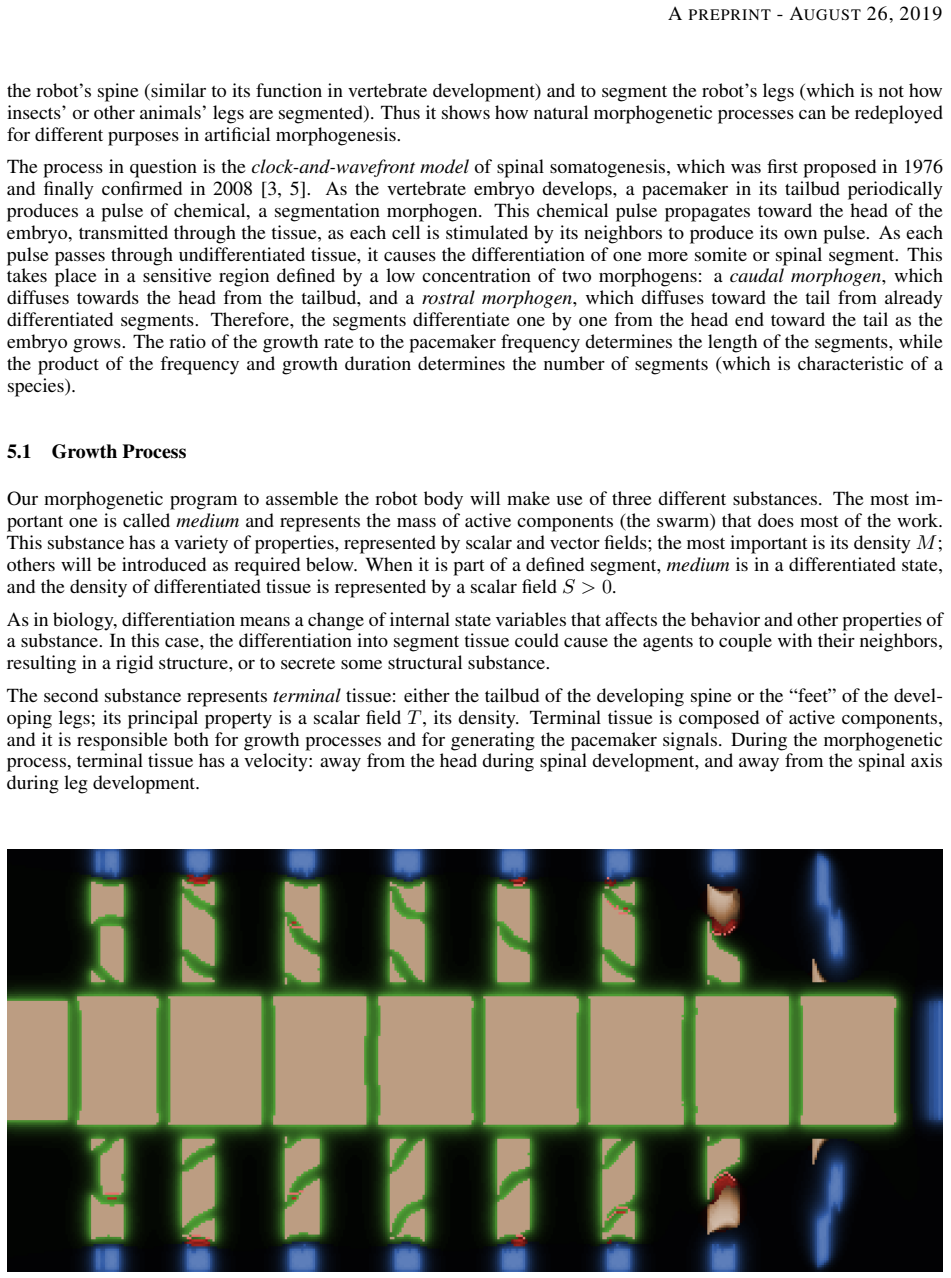
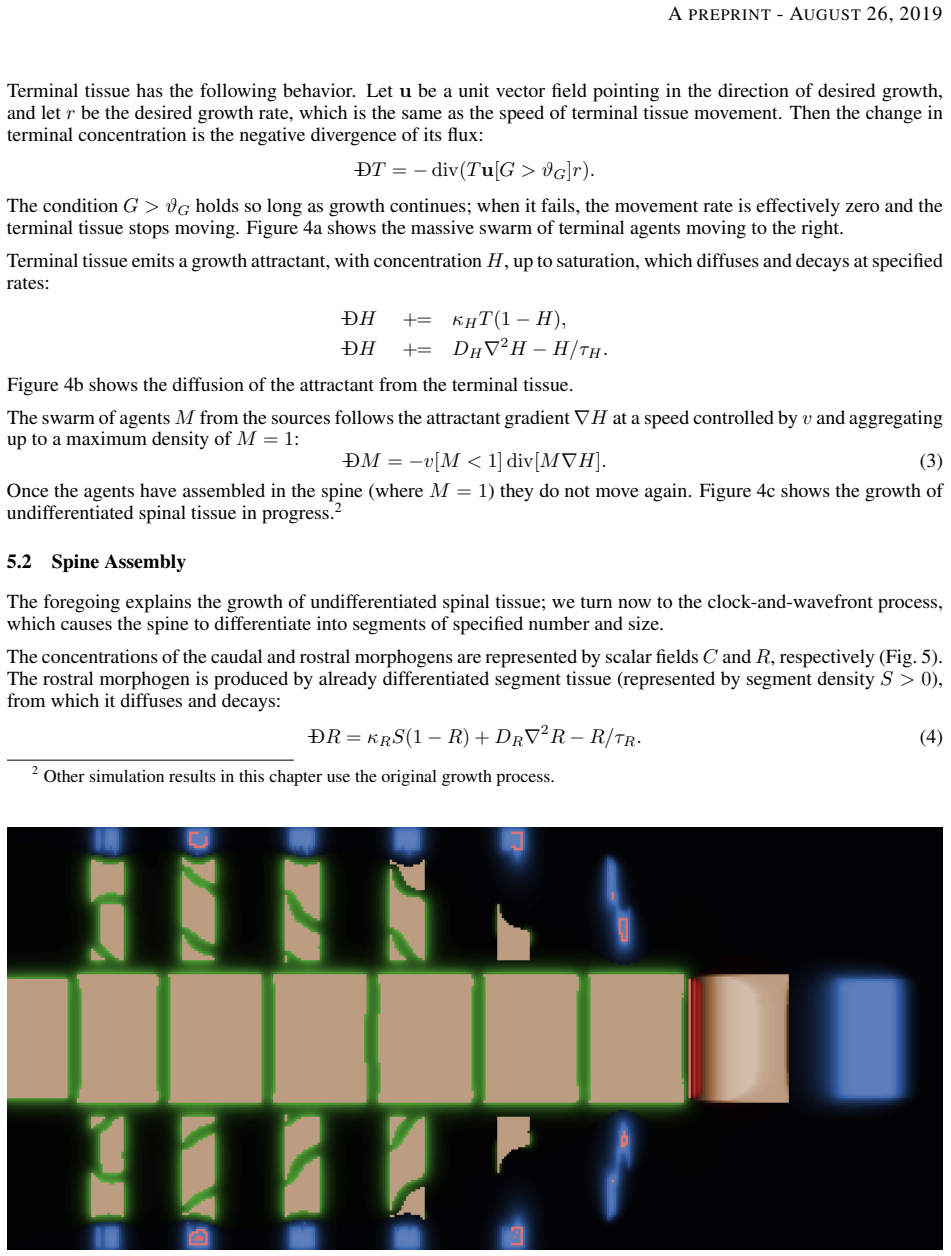
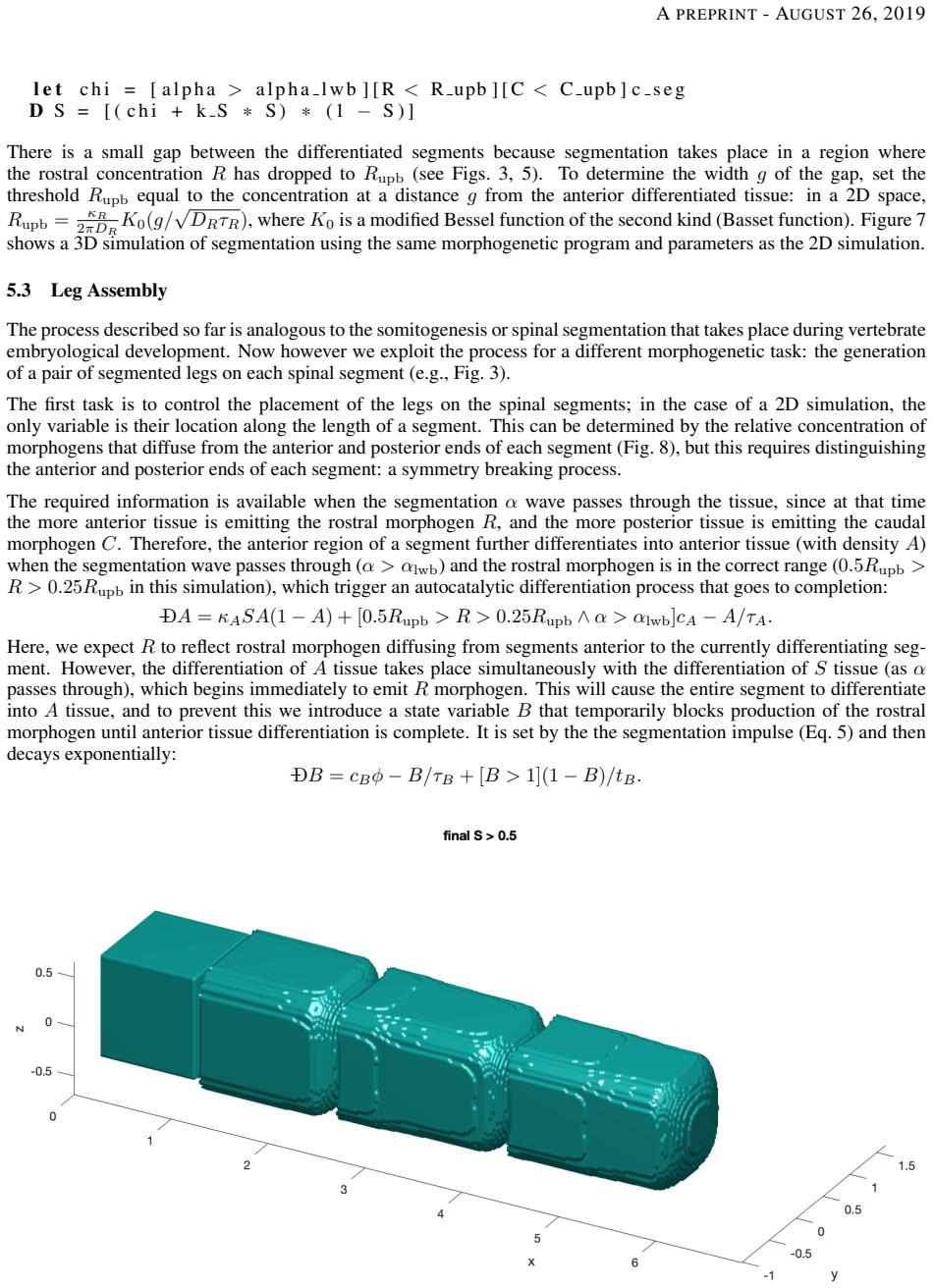
- The clock-and-wavefront example shows that the same morphogenetic motif can be redeployed for different structures (spine and legs), suggesting that these PDE-level processes are composable programming primitives.
Reading between the lines
- Editorial inference: because the natural smoothing function requirements do not mention chemistry, the same compilation scheme could be implemented with acoustic or electromagnetic fields distinguished by frequency, which would remove diffusion lag and moving-agent distortion and make the method usable in dry environments.
- Editorial inference: the transient correction for agent motion is a calibration table rather than a closed-loop control, so a natural testable extension is a controller that actively maintains equilibrium, for example by advecting the morphogen field opposite to agent motion, and checking whether the calibrated residual shrinks.
- Editorial inference: if the emission rule were implemented in engineered microorganisms that both produce and sense signaling molecules, the approach suggests a low-power, wireless-free route to collective computation at cellular scales, with the morphogen field doubling as communication and structural material.
Signed reviews
Editorial analysis
A structured set of objections, weighed in public.
Referee Report
Summary. This paper argues that embryological morphogenesis offers a model for coordinating massive swarms to assemble complex, multiscale structures, and it develops a PDE-based morphogenetic programming language (Morphgen) with a prototype implementation. Two application examples are presented: routing dense neural-fiber bundles via modified flocking (Sec. 4) and assembling a segmented insect-like robot body using a clock-and-wavefront process (Sec. 5). The paper's main technical contribution, in Sec. 6, is an embodied variation of smoothed particle hydrodynamics (SPH) for global-to-local compilation: under assumptions of point, unmoving agents in diffusion-decay equilibrium, the production rate r_j = k m_j f(x_j)/rho_j (Eq. 19) is derived so that summed morphogen concentration equals the SPH estimate of an arbitrary field f. Corrections for transient and motion-induced effects are proposed in Sec. 6.7, and a multi-scale path-finding simulation (Table 2) is offered as an illustration.
Significance. If the compilation mechanism were quantitatively validated, the NSF/MSF framework would be a noteworthy advance: it replaces O(n) neighbor-to-neighbor communication in traditional SPH swarm control with O(1) local sensing of a natural physical field, and it extends SPH-based robotics from fluid emulation toward arbitrary Morphgen PDEs. The derivation of Eq. (19) is internally consistent under its stated assumptions, the paper is explicit about the limitations of its transient corrections, and the multi-scale path-finding demo is honest about being qualitative. These strengths are real and should be credited. The central weakness is evidentiary: the only validation of the load-bearing Eq. (19) is a qualitative simulation that violates the derivation's assumptions, and no quantitative error analysis is reported.
major comments (3)
- [Sec. 6.6, Eq. (19); Sec. 6.9, Table 2] The central claim that Eq. (19) enables faithful global-to-local compilation is not supported by the presented evidence. The derivation assumes point sources, unmoving agents, and production-diffusion-degradation equilibrium (Sec. 6.6), while the path-finding simulation uses disk-shaped agents moving through a flowing medium and explicitly includes transient and motion-induced distortions (Sec. 6.7). No result in Table 2 or elsewhere reports a quantitative comparison between the sensed morphogen field (or the resulting density field) and the target SPH estimate or PDE solution. Since the paper argues the example validates the compilation mechanism, the absence of such a comparison is a load-bearing gap.
- [Sec. 6.7.2] The correction for motion-induced distortion is acknowledged to be partial and implementation-dependent: calibration is proposed only for an agent's own contribution to its gradient estimates, while neighbor contributions and curved paths are explicitly left uncorrected. The text does not bound the residual error or quantify how far the sensed field deviates from the equilibrium SPH estimate for the simulation's agent speeds and sizes. Without such an error analysis, the simulation cannot establish that Eq. (19)'s equilibrium relation holds approximately under the conditions of the demo.
- [Sec. 6.4, Eq. (14)] The derivation of the SPH Laplacian replaces the sum \sum_j (m_j/rho_j) W_j(x_i) by 1, treating the SPH estimate of unity as exact. For finite neighbor counts and non-uniform agent distributions this is an approximation whose magnitude is not bounded or discussed. This matters because the path-finding program (Sec. 6.9) uses Laplacian terms (e.g., kappa_S3 del^2 S) that would be computed through this formula. The paper should either provide a bound, cite standard SPH error estimates, or explicitly note the limitation as a source of error in the proposed compilation pipeline.
minor comments (5)
- [Sec. 3.3] The citation '[?]p. 20]Fleischer-PhD' is an unresolved reference and should be replaced with the proper bibliographic entry.
- [References] Several references are incomplete: [8] lacks volume/pages, [10] lacks page numbers, [12], [15], [19], and [37] lack journal names or full bibliographic details, and [44] lacks article numbering. The reference list needs a careful final edit.
- [Table 1] In the one-dimensional row, the normalized profile sqrt(k/E) e^{-sqrt(k/E) r} integrates to 1 over the half-line r > 0, but for a point source in an unbounded one-dimensional medium the symmetric two-sided solution has coefficient sqrt(k/E)/2; the table should specify which domain is intended.
- [Sec. 4.2, Eq. (2)] Equation (2) contains an unmatched closing bracket: "V = v[(1-lambda)V1 - lambda V2 + kW DW 2)]" has one more ')' than '('.
- [Figure 4] The panels (a)-(c) do not label axes or provide color/scale bars, so the reader cannot infer quantitative concentration or density values from the displayed fields.
Circularity Check
No significant circularity: the SPH morphogen production law is an explicitly solved design equation, not a fitted prediction; the simulation shortfall is a validation gap, not a circular reduction.
full rationale
The claimed derivation chain in Sec. 6.6 is self-contained and constructive. Eq. (15) states the design goal (an SPH estimate equals the summed morphogen concentration), Eq. (16) decomposes that goal per agent, and Eq. (19) is obtained by algebraically solving for the emission rate using the equilibrium relation C_j = r_j/k. This is an inverse control law, not a quantity fitted to data and then relabeled as a prediction; the equality is by construction only in the legitimate sense that a compiler is allowed to choose controls that realize its specification. The paper does not use measured morphogen concentrations to set r_j and then claim to predict those concentrations. The moving, disk-shaped agents and transient fields of Sec. 6.9 do not satisfy the point-source, equilibrium, unmoving-agent assumptions of Sec. 6.6, and the simulation is qualitative, but that is an unvalidated-application concern, not circularity. The segment counts in Sec. 5.4 are also chosen by setting the timer G_S from the desired N_S, again an explicit design parameter, not a predicted outcome. Self-citations [20]-[30] support the language and earlier examples, but the SPH/NSF derivation itself does not reduce to those citations and no uniqueness theorem or ansatz is imported from them. No circular step meeting the quoted-equation standard was found.
Assumptions & free parameters
free parameters (12)
- dA =
0.03
- tauA =
100
- kG =
100
- aP =
20
- thetaP =
0.3
- lambda =
0.1
- kW =
0.3
- tD =
5
- kP =
30
- tauP =
0.2
- nuS =
1/(2*pi) or 1/pi
- GS =
formula to produce NS segments
assumptions (6)
- domain assumption Agent swarms can be treated as continuous density fields (continuum approximation).
- domain assumption Morphogens obey Fickian diffusion and uniform first-order decay in a homogeneous medium.
- domain assumption Morphogen fields superpose linearly at an agent's sensors.
- standard math SPH smoothing functions have unity integral, are symmetric, and decrease smoothly and integrably.
- domain assumption For MSF equilibrium, agents are points, unmoving, and production, diffusion, and degradation are at steady state.
- domain assumption The clock-and-wavefront model is an appropriate template for artificial segmentation.
Cite this review
Pith. "Pith review of Swarm Intelligence for Morphogenetic Engineering." pith.science (2026). https://pith.science/paper/NEBTLGID
@misc{pith2026190808787,
  author       = {Pith},
  title        = {Pith review of: Swarm Intelligence for Morphogenetic Engineering},
  year         = {2026},
  howpublished = {\url{https://pith.science/paper/NEBTLGID}},
  note         = {Machine review of arXiv:1908.08787}
}
read the original abstract
We argue that embryological morphogenesis provides a model of how massive swarms of microscopic agents can be coordinated to assemble complex, multiscale hierarchical structures. This is accomplished by understanding natural morphogenetic processes in mathematical terms, abstracting from the biological specifics, and implementing these mathematical principles in artificial systems. We have developed a notation based on partial differential equations for artificial morphogenesis and have designed a prototype morphogenetic programming language, which permits precise description of morphogenetic algorithms and their automatic translation to simulation software. Morphogenetic programming is illustrated by two examples: (1) use of a modified flocking algorithm to route dense fiber bundles between regions of an artificial cortex while avoiding other bundles; (2) use of the clock-and-wavefront model of spinal segmentation for the assembly of the segmented spine of an insect-like robot body and for assembling segmented legs on the robot's spine. Finally, we show how a variation of smoothed particle hydrodynamics (SPH) swarm robotic control can be applied to the global-to-local compilation problem, that is, the derivation of individual agent control from global PDE specifications.
Figures


Figures from the paper (6 more)




Reference graph
Works this paper leans on
-
[1]
Knight, Jr., Radhika Nag- pal, Erik Rauch, Gerald Jay Sussman, and Ron Weiss
Harold Abelson, Don Allen, Daniel Coore, Chris Hanson, George Homsy, Thomas F. Knight, Jr., Radhika Nag- pal, Erik Rauch, Gerald Jay Sussman, and Ron Weiss. Amorphous computing. Commun. ACM, 43(5):74–82, May 2000
work page 2000
-
[2]
P. Bourgine and A. Lesne, editors. Morphogenesis: Origins of Patterns and Shapes, Berlin, 2011. Springer
work page 2011
-
[3]
J. Cooke and E. C. Zeeman. A clock and wavefront model for control of the number of repeated structures during animal morphogenesis. J. Theoretical Biology, 58:455–76, 1976
work page 1976
-
[4]
P. G. de Gennes. Soft matter. Science, 256:495–497, 1992
work page 1992
-
[5]
M.-L. Dequ ´eant and O. Pourqui ´e. Segmental patterning of the vertebrate embryonic axis. Nature Reviews Genetics, 9:370–82, 2008
work page 2008
-
[6]
Amin Doostmohammadi, Jordi Ign ´es-Mullol, Julia M. Yeomans, and Francesc Sagu´es. Active nematics. Nature Communications, 9(1):3246, 2018
work page 2018
-
[7]
Ren ´e Doursat. Organically grown architectures: Creating decentralized, autonomous systems by embryomorphic engineering. In R. P. W¨urtz, editor, Organic Computing, pages 167–200. Springer, 2008
work page 2008
-
[8]
A review of morphogenetic engineering
Ren ´e Doursat, Hiroki Sayama, and Olivier Michel. A review of morphogenetic engineering. 12(4):517–535
Show all 45 references
-
[9]
Gabor Forgacs and Stuart A. Newman. Biological Physics of the Developing Embryo . Cambridge University Press, Cambridge, UK, 2005
2005
-
[10]
Self-swarming robots that exploit hydrodynamical interaction
Ryo Fujiwara, Takeshi Kano, and Akio Ishiguro. Self-swarming robots that exploit hydrodynamical interaction. pages 1–7
-
[11]
Giavitto and A
J.-L. Giavitto and A. Spicher. Computer morphogenesis. In P. Bourgine and A. Lesne, editors, Morphogenesis: Origins of Patterns and Shapes, pages 315–340. Springer, Berlin, 2011
2011
-
[12]
Gingold and Joseph J
Robert A. Gingold and Joseph J. Monaghan. Smoothed particle hydrodynamics: theory and application to non- spherical stars. 181(3):375–389
-
[13]
S. C. Goldstein, J. D. Campbell, and T. C. Mowry. Programmable matter. Computer, 38(6):99–101, June 2005
2005
-
[14]
Space-Time Continuous Models of Swarm Robotic Systems , volume 9 of Cognitive Systems Monographs
Heiko Hamann. Space-Time Continuous Models of Swarm Robotic Systems , volume 9 of Cognitive Systems Monographs. Springer Berlin Heidelberg
-
[15]
Huang, J
C. Huang, J. M. Lei, M. B. Liu, and X. Y . Peng. An improved KGF-SPH with a novel discrete scheme of laplacian operator for viscous incompressible fluid flows. 81(6):377–396
-
[16]
H. Kitano. Morphogenesis for evolvable systems. In E. Sanchez and M. Tomassini, editors, Towards Evolvable Hardware: The Evolutionary Engineering Approach, pages 99–117. Springer, Berlin, 1996
1996
-
[17]
Lichtman and Winfried Denk
Jeff W. Lichtman and Winfried Denk. The big and the small: Challenges of imaging the brain’s circuits.Science, 334(6056):618–623, 4 November 2011
2011
-
[18]
G. R. Liu and M. B. Liu. Smoothed particle hydrodynamics: a meshfree particle method . World Scientific. OCLC: ocm52947194
-
[19]
Leon B. Lucy. A numerical approach to the testing of the fission hypothesis. 82:1013–1024
-
[20]
MacLennan
Bruce J. MacLennan. Preliminary development of a formalism for embodied computation and morphogenesis. Technical Report UT-CS-09-644, Department of Electrical Engineering and Computer Science, University of Tennessee, Knoxville, TN, 2009
2009
-
[21]
MacLennan
Bruce J. MacLennan. Models and mechanisms for artificial morphogenesis. In F. Peper, H. Umeo, N. Matsui, and T. Isokawa, editors, Natural Computing, Springer series, Proceedings in Information and Communications Technology (PICT) 2, pages 23–33, Tokyo, 2010. Springer
2010
-
[22]
MacLennan
Bruce J. MacLennan. Morphogenesis as a model for nano communication. Nano Communication Networks. , 1(3):199–208, 2010
2010
-
[23]
MacLennan
Bruce J. MacLennan. Artificial morphogenesis as an example of embodied computation. International Journal of Unconventional Computing., 7(1–2):3–23, 2011
2011
-
[24]
MacLennan
Bruce J. MacLennan. Embodied computation: Applying the physics of computation to artificial morphogenesis. Parallel Processing Letters, 22(3):1240013, 2012
2012
-
[25]
MacLennan
Bruce J. MacLennan. Molecular coordination of hierarchical self-assembly. Nano Communication Networks , 3(2):116–128, June 2012. 30 A PREPRINT - AUGUST 26, 2019
2012
-
[26]
MacLennan
Bruce J. MacLennan. Coordinating massive robot swarms. International Journal of Robotics Applications and Technologies, 2(2):1–19, 2014
2014
-
[27]
MacLennan
Bruce J. MacLennan. The morphogenetic path to programmable matter. Proceedings of the IEEE, 103(7):1226– 1232, 2015
2015
-
[28]
MacLennan
Bruce J. MacLennan. Coordinating swarms of microscopic agents to assemble complex structures. In Ying Tan, editor, Swarm Intelligence, Vol. 1: Principles, Current Algorithms and Methods , PBCE 119, chapter 20, pages 583–612. Institution of Engineering and Technology, 2018
2018
-
[29]
MacLennan
Bruce J. MacLennan. The Synmac syntax macroprocessor: Introduction and manual, version 5. Faculty Publi- cations and Other Works — EECS. http://trace.tennessee.edu/utk elecpubs/23, University of Tennessee Depart- ment of Electrical Engineering and Computer Science, 2018
2018
-
[30]
MacLennan
Bruce J. MacLennan. A morphogenetic program for path formation by continuous flocking. International Journal of Unconventional Computing, 14:91–119, 2019
2019
-
[31]
Maningo, Gerard Ely U
Jose Martin Z. Maningo, Gerard Ely U. Faelden, Reiichiro Christian S. Nakano, Argel A. Bandala, Ryan Rhay P. Vicerra, and Elmer P. Dadios. Formation control in quadrotor swarm aggregation using smoothed particle hy- drodynamics. In Region 10 Conference (TENCON), 2016 IEEE, pag...
2016
-
[32]
Murata and H
S. Murata and H. Kurokawa. Self-reconfigurable robots: Shape-changing cellular robots can exceed conventional robot flexibility. IEEE Robotics & Automation Magazine, pages 71–78, March 2007
2007
-
[33]
Programming methodology for biologically-inspired self-assembling systems
Radhika Nagpal, Attila Kondacs, and Catherine Chang. Programming methodology for biologically-inspired self-assembling systems. In AAAI Spring Symposium on Computational Synthesis: From Basic Building Blocks to High Level Functionality, March 2003
2003
-
[34]
Active matter at the interface between materials science and cell biology
Daniel Needleman and Zvonimir Dogic. Active matter at the interface between materials science and cell biology. Nature Reviews Materials, 2:17048 EP –, 07 2017
2017
-
[35]
Bio-inspired self-organising multi-robot pattern formation: A review
Hyondong Oh, Ataollah Ramezan Shirazi, Chaoli Sun, and Yaochu Jin. Bio-inspired self-organising multi-robot pattern formation: A review. 91:83–100
-
[36]
Pac, Aydan M
Muhammed R. Pac, Aydan M. Erkmen, and Ismet Erkmen. Control of robotic swarm behaviors based on smoothed particle hydrodynamics. In Intelligent Robots and Systems, 2007. IROS 2007. IEEE/RSJ International Conference on, pages 4194–4200. IEEE
2007
-
[37]
Perkinson and Bahram Shafai
James R. Perkinson and Bahram Shafai. A decentralized control algorithm for scalable robotic swarms based on mesh-free particle hydrodynamics. In Proc. of the IASTED Int. Conf. on Robot. and Applications , pages 102–107, 2005
2005
-
[38]
Luciano C. A. Pimenta, Guilherme A. S. Pereira, Nathan Michael, Renato C. Mesquita, Mateus M. Bosque, Luiz Chaimowicz, and Vijay Kumar. Swarm Coordination Based on Smoothed Particle Hydrodynamics Technique. IEEE Transactions on Robotics, 29(2):383–399, April 2013
2013
-
[39]
Salazar-Ciudad, J
I. Salazar-Ciudad, J. Jernvall, and S. A. Newman. Mechanisms of pattern formation in development and evolu- tion. Development, 130:2027–37, 2003
2027
-
[40]
Silic, Zhuoyuan Song, and Kamran Mohseni
Matthew B. Silic, Zhuoyuan Song, and Kamran Mohseni. Anisotropic flocking control of distributed multi-agent systems using fluid abstraction. In 2018 AIAA Information Systems-AIAA Infotech @ Aerospace . American Institute of Aeronautics and Astronautics
2018
-
[41]
Spicher, Olivier Michel, and J.-L
A. Spicher, Olivier Michel, and J.-L. Giavitto. Algorithmic self-assembly by accretion and by carving in MGS. In Proc. of the 7th International Conference on Artificial Evolution (EA ‘05), number 3871 in Lecture Notes in Computer Science, pages 189–200. Springer-Verlag, Berlin, 2005
2005
-
[42]
Larry A. Taber. Nonlinear Theory of Elasticity: Applications in Biomechanics . World Scientific, Singapore, 2004
2004
-
[43]
Teague, Patrick Guye, and Ron Weiss
Brian P. Teague, Patrick Guye, and Ron Weiss. Synthetic morphogenesis. page a023929
-
[44]
Tilki and A
U. Tilki and A. M. Erkmen. Fluid swarm formation control for hand gesture imitation by ellipse fitting. 51(6):473–475
-
[45]
Material approaches to active tissue mechanics
Wang Xi, Thuan Beng Saw, Delphine Delacour, Chwee Teck Lim, and Benoit Ladoux. Material approaches to active tissue mechanics. Nature Reviews Materials, 4(1):23–44, 2019. 31
2019
Reviewed August 14, 2026 · model on record in the stance chip above.
Discussion (0). Continue with ORCID to comment.