REVIEW 5 major objections 5 minor 4 references
A minimum set of stable blocks for rational design of polypeptide chains Running head: A set of stable blocks for protein rational design
T0 review · 5 major / 5 minor · reviewed 2026-08-14 · deepseek-v4-flash
Pith's one-line read The paper claims that 54 stable pentapeptide backbone shapes form a complete set of local folds for protein-like structures.
desk verdict The paper's real contribution is the reproducible catalog of stable pentapeptides; the 'complete set of topologies' claim outruns the evidence. read the letter →
The pith
A machine-rendered reading of the paper's core claim, the machinery that carries it, and where it could break.
The reading
What carries the argument
The load-bearing object is the 54-cluster library of stable pentapeptide backbone conformations, each cluster represented by one central structure and described by the eight backbone dihedral angles $\varphi$ and $\psi$ of its five residues. The argument is carried by a three-step pipeline: sequence generation from an alanine matrix with at most three substituted positions, giving 44,860 unique pentapeptides; molecular dynamics in vacuum with the AMBER/OPLS force field, saving 5,000 snapshots per peptide and declaring a peptide stable when a single cluster holds more than 80% of the trajectory; and a second clustering of the 1,225 stable representatives that yields the 54 topologies. The terminal tripeptide fragments of each topology are then compared with idealized secondary-structure coordinates, which lets the authors assign each block a functional role as initiator, maintainer, or terminator of $\alpha$-helix or $\beta$-structure, including transition blocks that redirect the chain from one secondary-structure element to another.
What would settle it
Enumerate pentapeptides with four or five substituted positions beyond the alanine matrix, up to the full 3.2 million sequence space, cluster their molecular dynamics trajectories with the same 80% stability threshold, and look for any backbone topology outside the 54; one new stable cluster would refute the completeness claim. A weaker but still decisive check is to rerun the same 44,860 simulations with explicit solvent and see whether the stable set changes.
Extended reading notes
Core claim
The central claim is that a minimal library of 54 backbone topologies, each realized by a conformationally stable pentapeptide, is sufficient to account for the local structural units (the paper calls them pre-folded conformations) that a polypeptide chain uses on the way to its native three-dimensional structure. Starting from the alanine pentapeptide AAAAA and allowing no more than three of the five positions to be replaced by any of the 20 canonical amino acids, the authors generated 44,860 unique sequences, simulated each for 10,000 picoseconds with molecular dynamics in vacuum using the AMBER/OPLS force field, and kept the 1,225 peptides whose largest conformational cluster occupied more than 80% of the trajectory. Clustering those representatives by their $(\varphi,\psi)$ torsion angles gave 54 topological types. Comparison of the terminal $C_\alpha$ atoms of each type with idealized $\alpha$-helix and parallel/antiparallel $\beta$-structure shows that 53 of the 54 clusters match one of these elements at one terminus with RMSD below 0.2 Å, and the authors classify each cluster as initiating, maintaining, or terminating secondary-structure elements. They further report that in human Na,K-ATPase, 79 of the 1,017 overlapping pentapeptides are stable and cover 32.4% of the sequence, which they read as evidence that stable blocks occupy a substantial part of real proteins and can guide rational design.
Load-bearing premise
The completeness claim rests on the assumption that replacing only three of the five alanine positions is enough to generate every topologically distinct stable pentapeptide shape; the paper states this assumption and says a proof will follow, but the proof is not given.
Editorial extensions
If this is right
- A scan of any protein sequence for the sequence patterns behind the 54 blocks would locate pre-folded regions; in the Na,K-ATPase example, 79 stable pentapeptides cover 32.4% of the chain.
- Rational design could assemble a desired backbone path by concatenating blocks, using the initiator, maintainer, and terminator roles to control where secondary structures start, persist, and end.
- The cluster-specific residue patterns (such as lysine or arginine at position +2 in cluster 1 and aspartate or glutamate at position +2 in cluster 2) give sequence rules for stabilizing each topology.
- If the set is complete as claimed, local backbone prediction reduces to choosing among 54 states instead of searching over continuous dihedral angles.
- The 54 types include both secondary-structure-maintaining blocks and transition blocks linking one secondary element to another, so the library covers direction changes of the chain.
Reading between the lines
- An untested corollary of the completeness claim is that four- or five-position substitutions should not create new stable backbone topologies; enumerating the full 3.2 million sequence space would settle that directly.
- A possible extension is to repeat the scan with explicit solvent, since the vacuum protocol omits water-mediated contacts; new topologies there would make the 54 blocks a baseline rather than a complete set.
- A design-oriented extension is to treat the 54 topologies as a structural alphabet with attached sequence rules and build chain backbones by concatenation, turning local stability into a planning problem.
- The paper suggests two-state pentapeptides as a follow-up; such peptides could act as conformational switches at hinges of moving protein parts.
Signed reviews
Editorial analysis
A structured set of objections, weighed in public.
Referee Report
Summary. The manuscript describes a computational search for pentapeptide sequences that adopt a single dominant backbone conformation in molecular dynamics simulations. Starting from the alanine pentapeptide AAAAA, the authors generated 44,860 sequences in which at most three positions are mutated, simulated each for 10 ns in vacuum with AMBER/OPLS, and classified a peptide as structurally stable if more than 80% of the sampled conformations fall into a single cluster (1,225 peptides). Clustering the representative conformations of these stable peptides produced 54 clusters, which are interpreted as topological types that can initiate, maintain, or terminate secondary-structure elements. The paper claims that these 54 types form a complete set needed for the pre-folded state of protein chains and illustrates the protocol on human Na,K-ATPase.
Significance. If the completeness claim were established, the 54-type catalog would provide a compact, rationally designable library of local backbone motifs, with obvious value for protein design and local-structure prediction. The paper's strengths are its large simulation set (44,860 independent 10-ns trajectories), the detailed supplementary tables of stable peptides, cluster representatives, dihedral angles, and RMSDs, and the reproducible description of the MD protocol in the Supplement. The significance is currently limited because the completeness claim rests on an unproven sequence-space restriction and on thresholds that are calibrated from the same data used to produce the catalog.
major comments (5)
- [Section 2.1 and Section 3] Section 2.1 introduces the restriction to at most three substituted positions, and Section 3 states 'Later we shall prove the validity of this assumption,' but no proof is provided anywhere in the manuscript; the Discussion only asserts that additional substitutions would 'unlikely' change the set of topological types. Because the abstract's 'complete set' claim is defined relative to this restricted subspace, the paper needs either a discharge of the promised proof, a saturation experiment (e.g., a sample of four- and five-substituted pentapeptides showing no new topologies), or a qualified claim restricted to the three-substitution subspace.
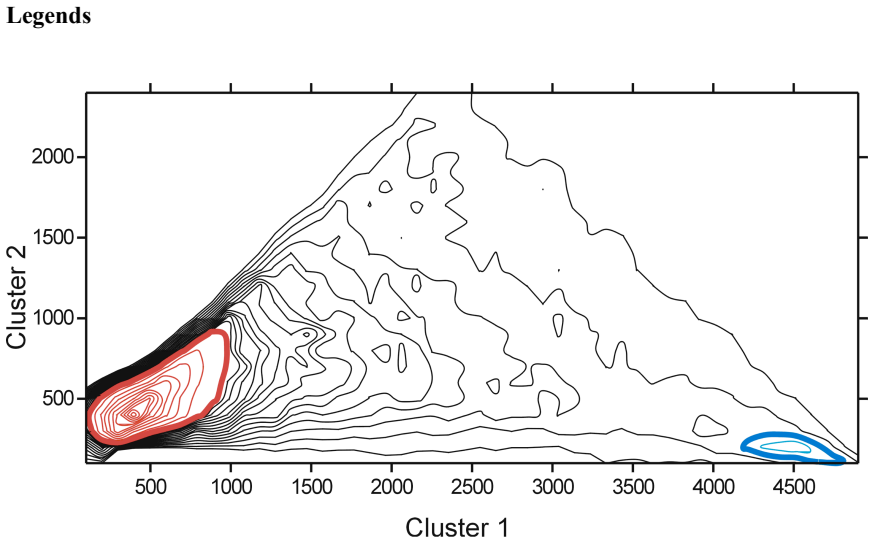
- [Section 2.3, Figure 1] The two parameters that define the catalog are chosen from the observed distribution: the 80% stability threshold is selected because of a local maximum in the largest-cluster size distribution, and the 0.15 clustering threshold is stated without any derivation. No sensitivity analysis is reported for either parameter. Since 1,225 stable peptides and the resulting 54 clusters are determined by these choices, the completeness and minimality of the 54-type set are not established.
- [Section 3, Na,K-ATPase paragraph] The human Na,K-ATPase analysis is presented as a demonstration, but it cannot validate the catalog: stability is assigned with the same vacuum-MD protocol, the same 80% threshold, and the same clustering distance that generated the 54 types. The reported 79 stable peptides and 32.4% coverage are not mapped onto the 54 topologies or compared with any independent prediction, so this result is descriptive rather than confirmatory.
- [Supplementary Table 2 and Section 2.4] Twenty-six of the 54 clusters contain exactly one pentapeptide (clusters 29-54). With 1,225 stable peptides and no saturation analysis, the 54-type catalog could change substantially if the sampled sequence set were enlarged or if the clustering threshold were varied; the 'complete set' claim therefore lacks empirical support even within the three-substitution subspace.
- [Section 2.2] The transferability of vacuum-MD stability to protein contexts is asserted but not demonstrated: all trajectories start from a single extended conformation, each peptide is simulated once for 10 ns with no solvent and no replicas, and no comparison with explicit-solvent simulations or experimentally observed conformations of the same sequences is reported. Given that the interpretation concerns pre-folded conformations in proteins, the stability measure needs a test of context dependence before the biological claim can be accepted.
minor comments (5)
- [Section 2.1] The list of possible pairs of substituted positions contains a duplicate ('-1 and 1' appears twice) and omits the pair '-2 and +1'; the count of six pairs is correct, but the enumeration should be corrected.
- [Section 3, Cluster 2 description] The residue name 'ASР' contains a Cyrillic character and should be written as 'ASP'.
- [Section 2.2] The time specification is ambiguous: 'within 10,000 picoseconds' followed by 'after 5,000 picoseconds of relaxation' could be clarified as 5 ns relaxation plus 5 ns production; currently it reads as if the total simulation is 10 ns with the first half discarded.
- [Supplementary Table 2] The supplementary table contains Russian column headers and several typographical artifacts (e.g., '127.6.2' and '119.4.'); these should be normalized to English and cleaned.
- [Figure 1] The figure caption refers to red and blue isolines (bold and thin) whose construction and numerical values are not described in the caption or Methods; the reader cannot reproduce the threshold choice without additional detail.
Circularity Check
No load-bearing circularity: the 54-type catalog is computed from explicit MD trajectories and clustering; the main weakness is an unproved sequence-sampling assumption, not a circular derivation.
full rationale
The paper's derivation chain is self-contained: sequences are generated by a stated substitution rule (Section 2.1), simulated with a stated force field/protocol (Section 2.2), clustered with stated distance and threshold (Section 2.3), and the 54 topologies are produced by a second clustering of representatives (Section 2.4). The 80% stability threshold is chosen from the observed distribution of cluster sizes, and the 0.15 clustering threshold is explicit; neither is fitted to any external target, so the catalog is not an input renamed as an output. The Na,K-ATPase application (Section 3: 'Molecular modeling showed that 79 structurally stable pentapeptides were identified among them, which cover 32.4% of its sequence') uses the same stability definition and is presented as an application, not as a validation of the catalog, so it is not a 'prediction' of the catalog from itself. The self-citations [6,23] are invoked only to frame the 'prefolded conformation' interpretation, not to derive the 54 types or the stability criterion. The genuine weakness is flagged in the paper itself: Section 2.1 states 'We assumed that the three functional groups should be sufficient...' and Section 3 promises 'Later we shall prove the validity of this assumption,' but no proof is supplied; the Discussion only asserts that additional substitutions are 'unlikely to change the set of topological types found.' That is a missing-support/completeness gap, not circularity. Accordingly, no circular step is exhibited, and the score reflects only the minor, non-load-bearing self-citation.
Assumptions & free parameters
free parameters (3)
- Structural stability threshold =
80% of simulation time
- Trajectory clustering distance threshold =
0.15 (squared Euclidean distance in torsion-angle space)
- Number of substituted functional-group positions =
3 (central residue plus two flanking positions)
assumptions (4)
- ad hoc to paper Three functional groups are sufficient to form all stable pentapeptide conformational states.
- domain assumption Vacuum MD without explicit solvent is adequate for pentapeptide stability.
- domain assumption AMBER/OPLS force field is appropriate for these simulations.
- ad hoc to paper The 80% largest-cluster fraction is a valid definition of structural stability.
Cite this review
Pith. "Pith review of A minimum set of stable blocks for rational design of polypeptide chains Running head: A set of stable blocks for protein rational design." pith.science (2026). https://pith.science/paper/NFKZIUWB
@misc{pith2026190805126,
  author       = {Pith},
  title        = {Pith review of: A minimum set of stable blocks for rational design of polypeptide chains Running head: A set of stable blocks for protein rational design},
  year         = {2026},
  howpublished = {\url{https://pith.science/paper/NFKZIUWB}},
  note         = {Machine review of arXiv:1908.05126}
}
read the original abstract
The aim of this work was to find a minimal set of structurally stable pentapeptides, which allows forming a polypeptide chain of a required 3D structure. To search for factors that ensure structural stability of the pentapeptide, we generated peptide sequences with no more than three functional groups, based on the alanine pentapeptide AAAAA. We analyzed 44,860 structures of peptides by the molecular dynamics method and found that 1,225 pentapeptides over 80% of the simulation time were in a stable conformation. Clustering of these conformations revealed 54 topological types of conformationally stable pentapeptides. These conformations relate to different combined elements of the protein secondary structure. So, we obtained a minimal set of amino acid structures of conformationally stable pentapeptides, creating a complete set of different topologies that ensure the formation of pre-folded conformation of protein structures.
Figures
Reference graph
Works this paper leans on
-
[1]
It is believed that interacting with proteins, peptides take a certain conformation
Introduction The folding of short peptide fragments is seldom discussed as they normally adopt random-coil conformations in water. It is believed that interacting with proteins, peptides take a certain conformation. Different authors underlined that both individual peptides in solution and peptides within proteins can have conformational preferences. They...
-
[2]
Methods 2.1 Pentapeptide sequence dataset There are 205=3 200 000 possible pentapeptide sequences of 20 types of amino acid residues. Study of stability for this number of pentapeptides by molecular dynamics method is very time consuming. We assumed that the three functional groups should be sufficient to form a stable conformational state of the pentapep...
-
[4]
Magnetic ordering in mackinawite (tetragonal FeS): evidence for strong itinerant spin fluctuations
Discussion In this paper, in the framework of our approach [6,23], we proposed a method for searching for conformationally stable pentapeptides for protein folding. For each protein sequence, it is possible to determine conformationally stable sites of the sequence and to predict their spatial structure. Such regions in the protein structure ensure the fo...
work page Pith review arXiv 2009
-
[17]
D.A. Case, T.E. Cheatham, T. Darden, H. Gohlke, R. Luo, K.M. Merz, A. Onufriev, C. Simmerling, B. Wang, R.J. Woods, The Amber biomolecular simulation programs, J. Comput. Chem. 26 (2005) 1668–1688. doi:10.1002/jcc.20290. [18] J.W. Ponder, D.A. Case, Force fields for protein simulations, Adv. Protein Chem. 66 (2003) 27–85. [19] G.V. Nikiforovich, Computati...
Reviewed August 14, 2026 · model on record in the stance chip above.
Discussion (0). Continue with ORCID to comment.