REVIEW 3 major objections 4 minor 4 cited by
pySTARBURST99: The Next Generation of STARBURST99
T0 review · 3 major / 4 minor · reviewed 2026-08-07 · deepseek-v4-flash
Pith's one-line read The updated population-synthesis code pySTARBURST99 reproduces STARBURST99 and predicts that allowing stars up to 300 solar masses raises early hydrogen-ionising flux by 0.3 dex (about a factor of two).
desk verdict A useful, honest update to a standard population synthesis code, with a headline VMS ionising-flux boost that is plausible but rests on model physics and grid coverage the paper does not fully document. read the letter →
The pith
A machine-rendered reading of the paper's core claim, the machinery that carries it, and where it could break.
The reading
What carries the argument
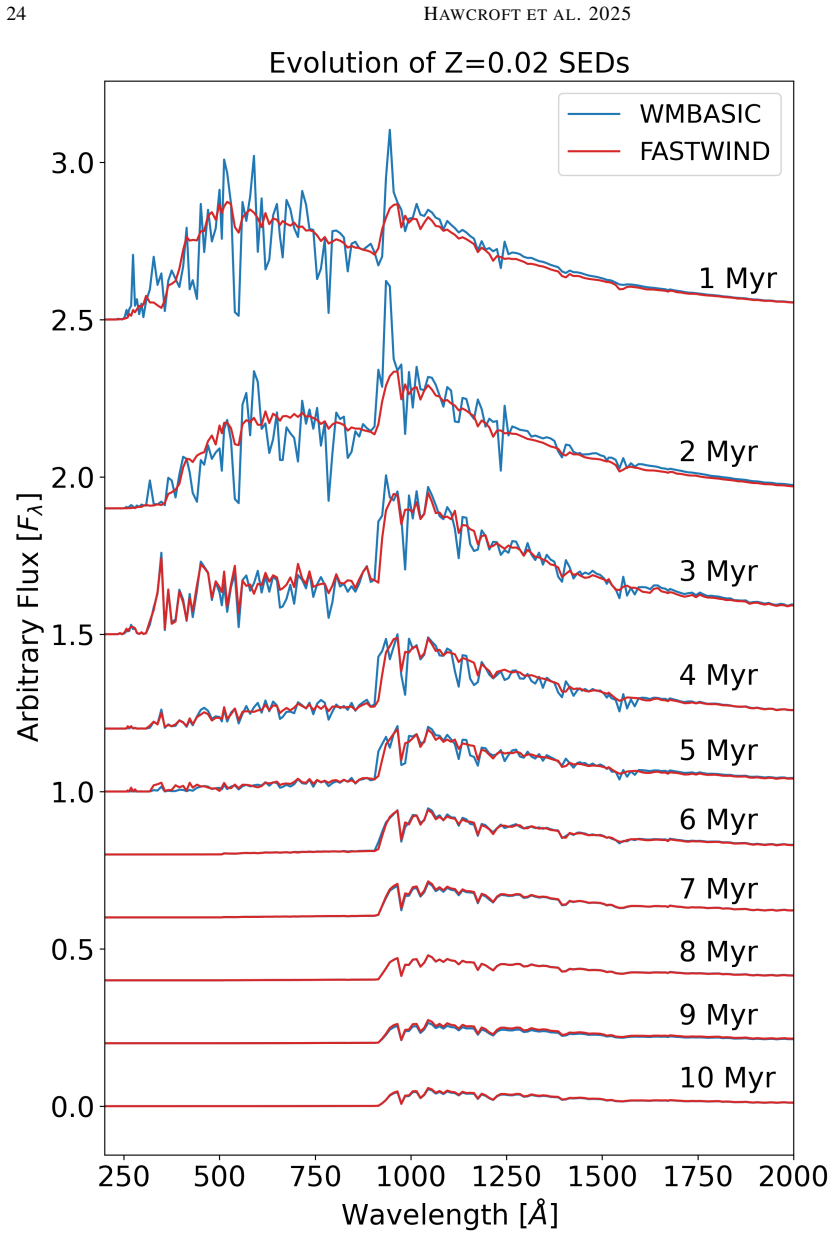
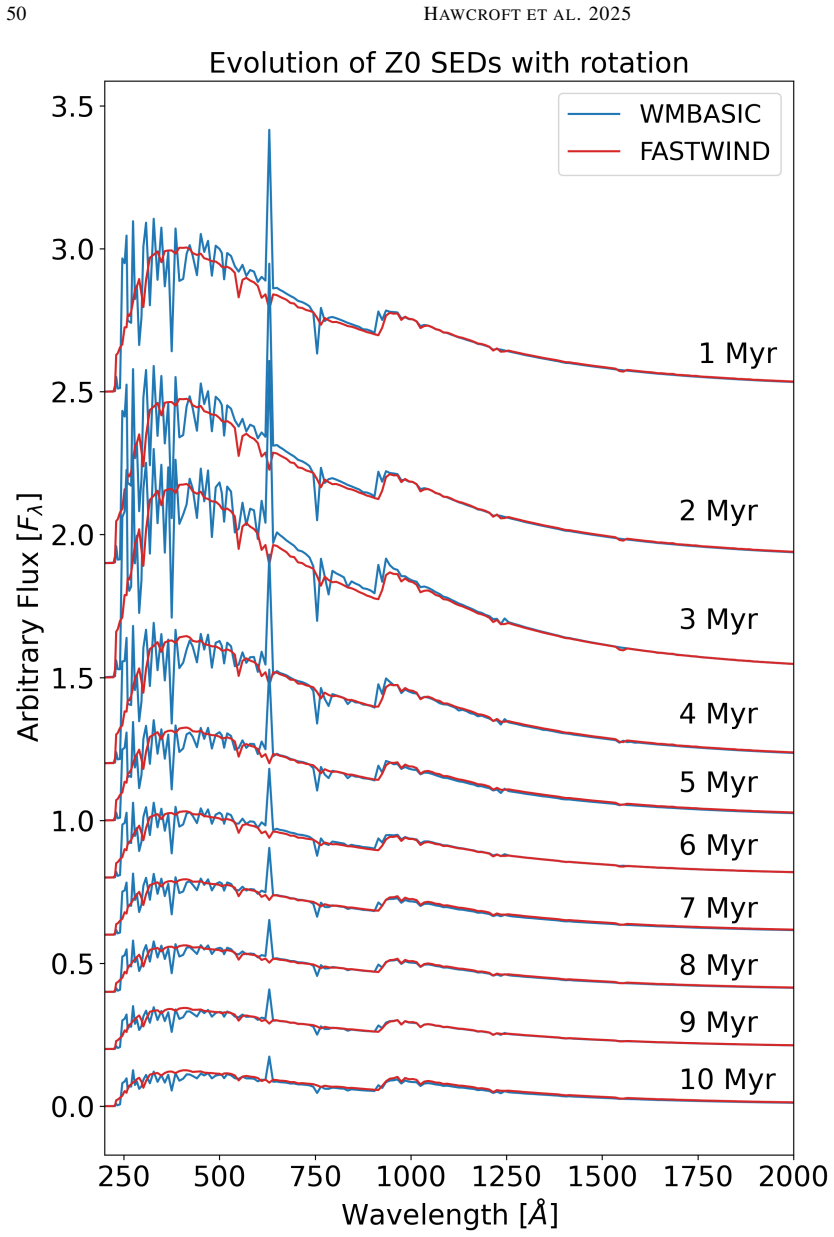
The engine is isochrone synthesis: GENEC evolutionary tracks are interpolated track-to-track to arbitrary mass resolution and turned into isochrones, and each stellar position is assigned a spectrum from a new FASTWIND model-atmosphere grid built to cover the extended parameter space, including very massive stars. This grid replaces the WMBASIC low-resolution SED library and is matched in metallicity to the evolutionary tracks ($Z=0.0$, $0.0004$, $0.002$, $0.006$, $0.014$, $0.02$). The Python port uses SciPy and NumPy interpolation so that runtimes stay comparable to the FORTRAN version; the new very-massive-star tracks extend to $300\,M_\odot$ at low metallicity and $500\,M_\odot$ at solar metallicity, and their early hot phase is what produces the 0.3 dex ionising flux boost.
What would settle it
Re-run the same synthesis with a very-massive-star grid that includes enhanced main-sequence mass loss, or measure the ionising flux of a young star-forming region whose upper mass limit is independently known; if the predicted difference between 120 and 300 solar-mass upper limits vanishes, or observations rule out the boost, the headline claim is wrong.
Extended reading notes
Core claim
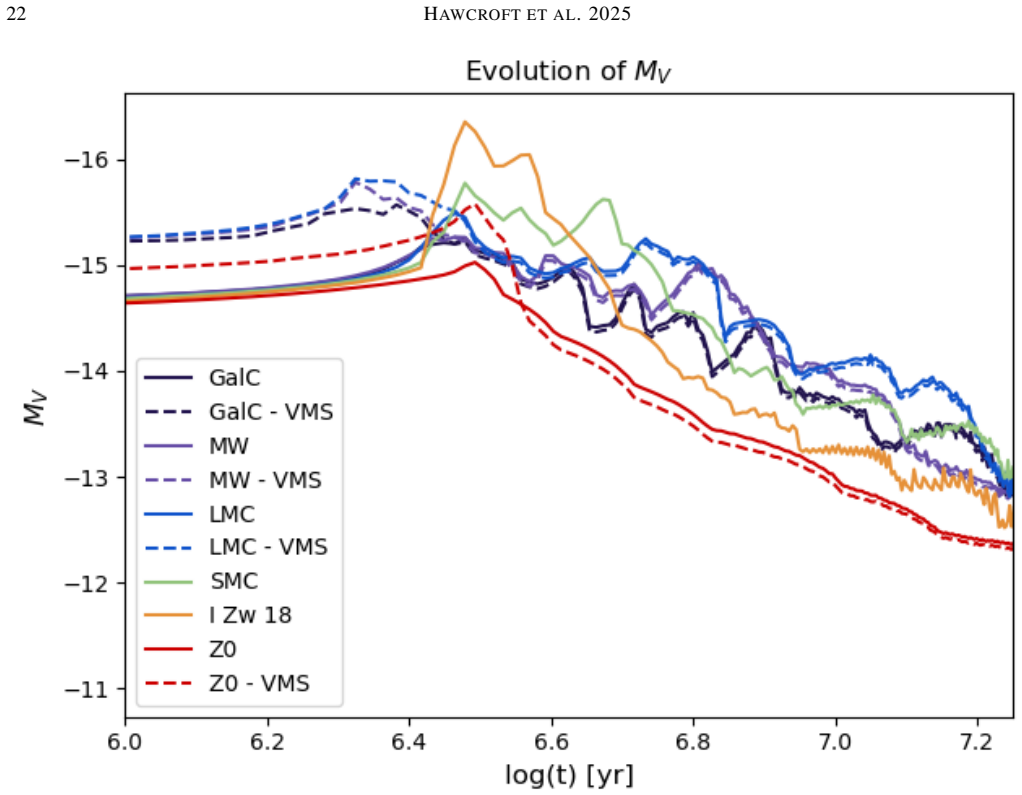
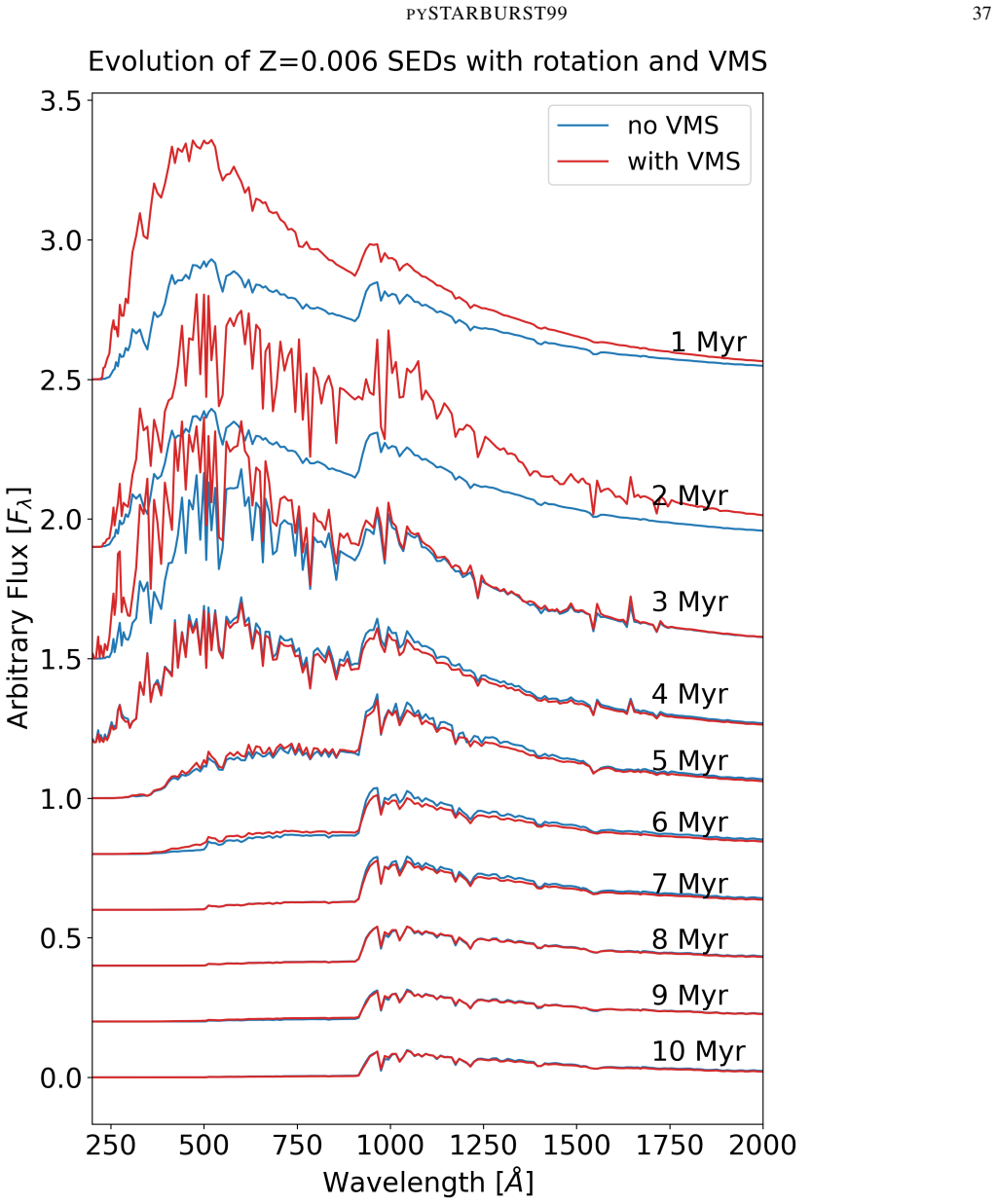
The central claim is that a modernised population synthesis code can both reproduce a well-tested legacy tool and extend it into new physical territory. Concretely, pySTARBURST99 produces SEDs that agree with STARBURST99 to within a few percent once small time-step and interpolation differences are accounted for, giving the authors confidence to adopt new GENEC tracks (including rotation and stars up to $300$–$500\,M_\odot$) and a new FASTWIND spectral library. Using these inputs, the code predicts that extending the initial-mass upper limit from $120$ to $300\,M_\odot$ increases the H I ionising flux by 0.3 dex in the first 2 Myr, that this boost disappears once the very massive stars die out within about 3 Myr, that metallicity has little effect on early H I ionising flux (0.015 dex across $Z=0.02$ to $0.0$) but lower metallicity raises later H I flux by about 1 dex, and that rotating models maintain higher ionising fluxes after 2 Myr. Similar behaviour holds for He I and He II ionising fluxes, bolometric luminosity, and wind momentum, while the H-$\alpha$ equivalent width and UV $\beta$ slope show more complex dependence on very massive stars.
Load-bearing premise
The load-bearing premise is that the evolutionary tracks for stars above 120 solar masses describe those stars correctly, even though the models do not include a general increase in mass loss for such stars while they steadily burn hydrogen in their cores; if these stars shed mass much faster than assumed, their temperatures, lifetimes, and luminosities would change, and the paper's headline 0.3 dex boost in ionising flux would change with them.
Editorial extensions
If this is right
- Raising the upper mass limit from $120$ to $300\,M_\odot$ raises H I ionising flux by 0.3 dex in the first 2 Myr, after which the flux returns to ordinary levels once very massive stars disappear within about 3 Myr.
- Metallicity has almost no effect on H I ionising flux before 2 Myr (0.015 dex from $Z=0.02$ to $0.0$), but after about 3 Myr lower metallicity raises the flux by roughly 1 dex, with zero-metallicity populations highest.
- Rotating populations keep H I, He I, and He II ionising fluxes, bolometric luminosity, and wind momentum higher for longer than non-rotating populations, roughly from 3 to 10 Myr.
- Including very massive stars boosts early wind momentum by about 0.43 to 0.47 dex, while overall wind momentum decreases toward low metallicity.
- The H-alpha equivalent width rises with very massive stars at first but dips between about 1.6 and 2.2 Myr because those stars cool sharply, then recovers when Wolf-Rayet stars appear.
Reading between the lines
- Beyond the paper's stated results, the missing general increase in main-sequence mass loss for very massive stars is the main open lever: if such mass loss is strong, the temperatures and lifetimes of $180$–$300\,M_\odot$ stars change, and the 0.3 dex early ionising flux boost could move substantially; a direct test would be to rerun the isochrones with an enhanced mass-loss prescription.
- The paper matched FASTWIND metallicities to the evolutionary tracks, so users comparing older WMBASIC-based models (computed at $Z=0.02$ for solar) with the new ones should attribute part of any flux difference to the change in atmosphere metallicity rather than to stellar evolution alone.
- Because binary interactions are excluded, late-time ionising flux predictions are likely lower bounds for real young populations; the paper itself notes that binary and stripped-star channels can raise ionising flux at ages beyond 10 Myr by about an order of magnitude, so combining pySTARBURST99 with binary population synthesis is a natural next test.
- For users, a practical consequence is that the current Python release covers low-resolution SEDs and derived quantities but not high-resolution UV line profiles, so line-profile work should wait for the planned high-resolution spectral library.
Editorial analysis
A structured set of objections, weighed in public.
Referee Report
Summary. The paper presents pySTARBURST99, a Python port of the STARBURST99 population synthesis code, and combines it with new GENEC evolutionary tracks (rotating and non-rotating, metallicities from Z=0.02 down to Z=0.0, and initial masses up to 300-500 Msol) and a new grid of FASTWIND synthetic spectra. The authors verify pySTARBURST99 against the FORTRAN version for the older GENEC/WMBASIC inputs, then use the new inputs to predict SEDs, HI/HeI/HeII ionising fluxes, bolometric luminosities, wind powers, H-alpha equivalent widths, and UV beta-slopes. The headline result is an increase in HI ionising flux of about 0.3 dex in the first 2 Myr when the upper IMF mass limit is raised from 120 to 300 Msol. The code and model grids are publicly available, with tabulated predictions in the appendix.
Significance. If the VMS-related predictions are robust, this paper provides a valuable community resource: a modern, open Python implementation of a widely used code, newly consistent low-metallicity evolution+atmosphere grids, and a clear set of falsifiable predictions for extreme star-forming populations. The explicit cross-checks against STARBURST99 in Section 3.1 and Appendix C, the tabulated output values, and the public code release are concrete strengths. The main significance risk is that the headline 0.3 dex ionising-flux boost depends on VMS evolutionary tracks that lack Eddington-enhanced mass loss and on a FASTWIND grid whose VMS coverage is not quantitatively documented; both issues are fixable with additional analysis and should be addressed before the predictions are used for quantitative inference.
major comments (3)
- [§2.1, §3.2, Table 2] The paper states in §2.1 that the VMS models of Martinet et al. (2023) 'do not contain a general increase in mass-loss rate for VMS on the main sequence', despite the physical expectation of Eddington-enhanced mass loss. The headline result of a ~0.3 dex increase in HI ionising flux when the upper mass limit is raised from 120 to 300 Msol (Abstract; §3.2; Table 2) depends on the temperatures, luminosities, and lifetimes of 180-300 Msol stars. If VMS mass loss is underestimated, these stars would be cooler or have shorter lifetimes, and the predicted ionising flux boost would change. Please quantify the sensitivity, for example by recomputing the isochrones with an enhanced mass-loss prescription or by applying a bracketing multiplicative factor to the VMS mass-loss rates and rerunning the synthesis. Without this, the 0.3 dex result rests on a known missing physical ingredient.
- [§2.2, Fig. 2] The extension of the FASTWIND grid for VMS is described only as a '33% increase in the size of the model grid' and is illustrated in Fig. 2. The paper does not provide the maximum effective temperature, luminosity, or surface gravity of the added grid points, nor does it state whether the 180-300 Msol GENEC tracks lie inside the grid or require extrapolation. Since the M300 columns of Table 2 and Fig. 7 rely on these spectra, the 0.3 dex HI ionising flux increase could be an artifact of extrapolation rather than a physical prediction. Please add a table of the grid parameter ranges (Teff, log g, mass-loss rate) for each metallicity, and show that the VMS tracks are covered by the grid or explain how interpolation/extrapolation is performed.
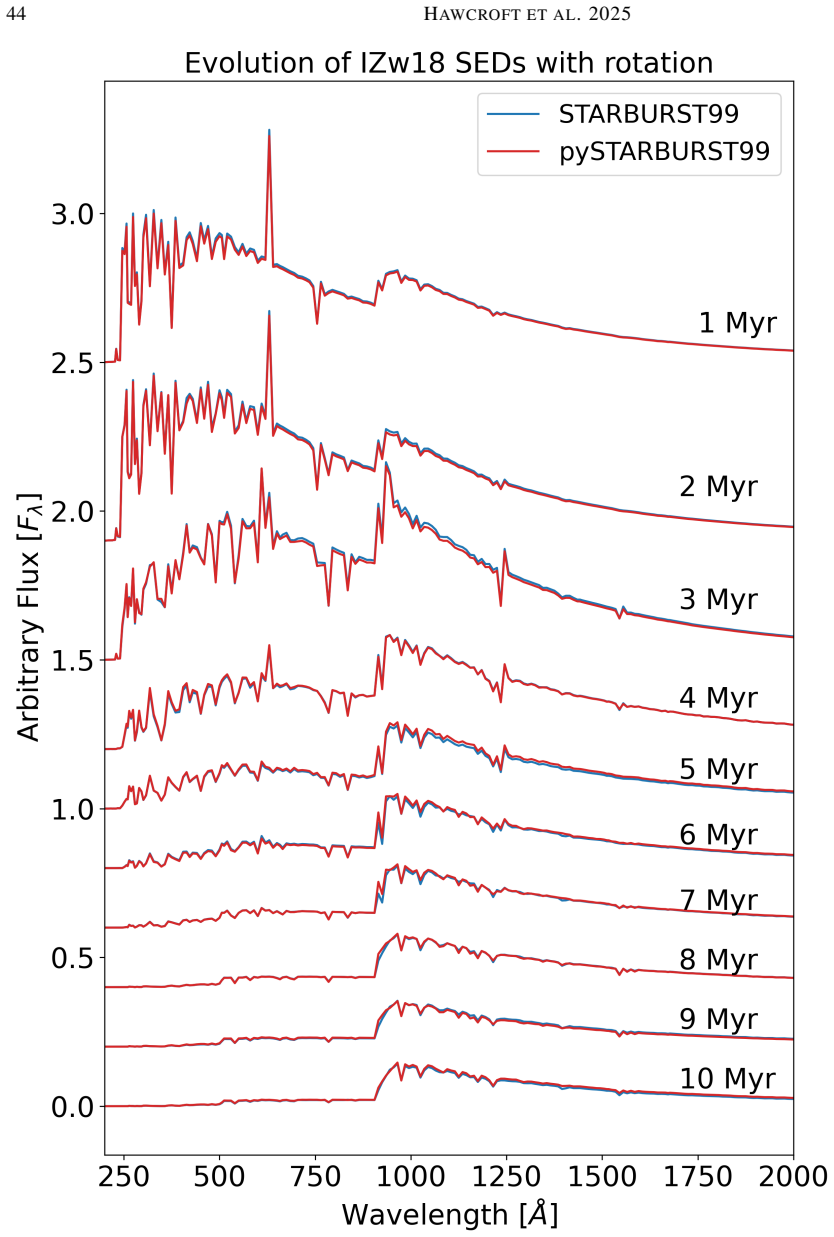
- [§3.1, Appendix C] The verification against STARBURST99 shows flux differences up to 300% at wavelengths <1000 A when both codes are evaluated at 1.01 Myr, and the agreement is recovered only by comparing the pySTARBURST99 output at 1.04 Myr. The text attributes this to the precision of the time increment, but the native time-step and its effect on the Appendix C comparisons are not quantified. Please state the time resolution of the isochrone outputs and confirm that the same 0.03 Myr offset (or similar) accounts for the residuals in all the Appendix C comparisons; otherwise the claim that pySTARBURST99 'faithfully reproduces' STARBURST99 is not fully established.
minor comments (4)
- [Fig. 23] The caption reads 'WMBASICspectra at Z=0.2', which appears to be a typo for Z=0.02.
- [§2.1] The sentence 'Available GENECevolutionary models for initial masses from from 1 to 120M⊙' contains a duplicated 'from'.
- [§3.3, Table 7] Please justify the choice of Z=10^-5 for the zero-metallicity terminal wind speed and state how the wind-power predictions depend on this assumed value; currently the Z0 wind-power entries in Table 7 are mostly empty, so the reader cannot assess the impact.
- [§2.2, §3.2] The footnote that Z0 FASTWIND models are computed with Z=10^-6 should be referenced explicitly when discussing the Z0 columns of Table 2, since the abstract and §3.2 describe these as zero-metallicity predictions; the paper's argument that Q(H) is insensitive to input metallicity for fixed stellar parameters mitigates this, but the statement should be made at the point of the Z0 predictions.
Circularity Check
No significant circularity: the headline predictions are forward-model outputs from external evolutionary tracks and newly computed atmosphere grids, with no fitted target quantity.
full rationale
The central derivation chain in pySTARBURST99 is a forward population-synthesis calculation: GENEC evolutionary tracks (including the VMS tracks of Martinet et al. 2023) supply stellar parameters as a function of time and initial mass, FASTWIND model atmospheres supply SEDs as functions of those parameters, and the code integrates these over a Kroupa IMF. The claimed 0.3 dex increase in H I ionising flux when the upper mass limit is raised from 120 to 300 Msol is obtained by re-running this same forward chain with a different IMF upper cutoff; no parameter is fitted to that flux value and no output quantity is used in the definition of an input. The code cross-check against the original FORTRAN STARBURST99 (Sect. 3.1, Figs. 1 and 3) is a genuine independent reproduction test using the old inputs and does not enter the new predictions. The many GENEC-affiliated authors are a normal overlap, not load-bearing circularity: the cited tracks are published, parameter-free model grids with stated physics assumptions (Sect. 2.1), and the paper explicitly flags the missing Eddington-enhanced mass-loss for VMS as a limitation rather than silently importing it. Similarly, the use of Z=1e-6 in FASTWIND for the 'zero' metallicity models (Sect. 2.2) and the lack of detailed observational comparison (Sect. 4) are acknowledged modeling compromises and validation gaps, not cases where an output is equivalent to an input by construction.
Assumptions & free parameters
free parameters (2)
- Adopted metallicity for zero-metallicity terminal wind speed =
Z=10^-5
- FASTWIND proxy metallicity for zero-metallicity spectra =
Z=10^-6
assumptions (3)
- domain assumption The GENEC stellar evolution tracks, including the new VMS tracks, correctly represent the physical properties of massive stars across Z=0.02 to 0.0 and up to 500 Msun.
- domain assumption The FASTWIND synthetic atmosphere grid with prescribed beta-velocity law and no tailored mass-loss rates yields SEDs accurate enough for integrated ionising fluxes.
- domain assumption Single-star evolution without binary interactions is sufficient for the quantities presented here.
Cite this review
Pith. "Pith review of pySTARBURST99: The Next Generation of STARBURST99." pith.science (2026). https://pith.science/paper/NFNCMJBA
@misc{pith2026250524841,
  author       = {Pith},
  title        = {Pith review of: pySTARBURST99: The Next Generation of STARBURST99},
  year         = {2026},
  howpublished = {\url{https://pith.science/paper/NFNCMJBA}},
  note         = {Machine review of arXiv:2505.24841}
}
read the original abstract
STARBURST99 is a population synthesis code tailored to predict the integrated properties or observational characteristics of star-forming galaxies. Here we present an update to STARBURST99 where we port the code to python, include new evolutionary tracks both rotating and non-rotating at a range of low metallicity environments. We complement these tracks with a corresponding grid of new synthetic SEDs. Additionally we include both evolutionary and spectral models of stars up to 300-500Msol. Synthesis models made with the python version of the code and new input stellar models are labelled pySTARBURST99. We make new predictions for many properties, such as ionising flux, SED, bolometric luminosity, wind power, hydrogen line equivalent widths and the UV beta-slope. These properties are all assessed over wider coverage in metallicity, mass and resolution than in previous versions of STARBURST99. A notable finding from these updates is an increase in H I ionising flux of 0.3 dex in the first 2Myr when increasing the upper mass limit from 120 to 300Msol. Changing metallicity has little impact on H I in the first 2Myr (range of 0.015 dex from Z = 0.02 to 0.0) but lower metallicities have higher H I by 1 dex (comparing Z = 0.02 to 0.0004) at later times, with Z = 0.0 having even higher H I at later times. Rotating models have significantly higher H I than their equivalent non-rotating models at any time after 2Myr. Similar trends are found for He I and He II, bolometric luminosity and wind momentum, with more complex relations found for hydrogen line equivalent widths and UV beta-slopes.
Figures


Figures from the paper (38 more)









Forward citations
Cited by 4 Pith papers
-
The COLIBRE-SKIRT pipeline: Calibration-free dust radiative transfer postprocessing for cosmological simulations
The COLIBRE-SKIRT pipeline reproduces the observed low-redshift cosmic SED without calibrating the post-processing, using live dust from the simulation and a new 'split & scale' grain-size mapping.
-
Unveiling Metal Mixing in a Grand-Design Spiral: A UV-optical multiphase spatially resolved study of M83
Multiphase abundance mapping of M83 reveals a persistent roughly 1.5 dex nitrogen excess in ionized gas relative to neutral gas around young clusters, indicating slow metal mixing in a massive spiral.
-
On the detection of Population III galaxies: Emission Line Diagnostics for Hybrid Stellar Populations
Existing HeII emission-line diagnostics identify pure Pop III galaxies but fail for hybrid Pop III/Pop II systems, introducing spectral degeneracies that hide residual first stars.
-
The Mysterious Case of Iron in XMPs: Anomalous High log(Fe/O) Observed in Extremely Metal-Poor Galaxies HSCJ1631+4426 and SDSSJ0811+4730
New KCWI spectroscopy of two ultra-low-metallicity galaxies shows Fe/O ratios near solar, implying enrichment by bright hypernovae or pair-instability supernovae.
Reference graph
Works this paper leans on
-
[1]
Agrawal , P., Hurley , J., Stevenson , S., Sz \'e csi , D., & Flynn , C. 2021, in MOBSTER-1 virtual conference: Stellar Variability as a Probe of Magnetic Fields in Massive Stars, 22, 10.5281/zenodo.5525465
-
[2]
Asplund , M., Grevesse , N., Sauval , A. J., & Scott , P. 2009, , 47, 481, 10.1146/annurev.astro.46.060407.145222
arXiv 2009
-
[3]
Backs , F., Brands , S. A., de Koter , A., et al. 2024, arXiv e-prints, arXiv:2411.06884, 10.48550/arXiv.2411.06884
-
[4]
Berg , D. A., James , B. L., King , T., et al. 2022, , 261, 31, 10.3847/1538-4365/ac6c03
-
[5]
Berg , D. A., Skillman , E. D., Chisholm , J., et al. 2024, , 971, 87, 10.3847/1538-4357/ad5292
-
[6]
M., Gr \" a fener, G., Vink, J
Bestenlehner, J. M., Gr \" a fener, G., Vink, J. S., et al. 2014, The VLT-FLAMES tarantula survey: XVII. Physical and wind properties of massive stars at the top of the main sequence , EDP Sciences, 10.1051/0004-6361/201423643
-
[7]
Bestenlehner , J. M., Crowther , P. A., Caballero-Nieves , S. M., et al. 2020, , 499, 1918, 10.1093/mnras/staa2801
-
[8]
Bj \"o rklund , R., Sundqvist , J. O., Puls , J., & Najarro , F. 2021, , 648, A36, 10.1051/0004-6361/202038384
Show all 141 references
-
[9]
2019, , 622, A103, 10.1051/0004-6361/201834156
Boquien , M., Burgarella , D., Roehlly , Y., et al. 2019, , 622, A103, 10.1051/0004-6361/201834156
2019 doi
-
[10]
C., Lanz , T., Hillier , D
Bouret , J. C., Lanz , T., Hillier , D. J., et al. 2015, , 449, 1545, 10.1093/mnras/stv379
2015 doi
-
[11]
A., de Koter , A., Bestenlehner , J
Brands , S. A., de Koter , A., Bestenlehner , J. M., et al. 2022, , 663, A36, 10.1051/0004-6361/202142742
2022 doi
-
[12]
S., Berger , E., Neijssel , C
Broekgaarden , F. S., Berger , E., Neijssel , C. J., et al. 2021, , 508, 5028, 10.1093/mnras/stab2716
2021 doi
-
[13]
E., Cantiello , M., et al
Brott , I., de Mink , S. E., Cantiello , M., et al. 2011, , 530, A115, 10.1051/0004-6361/201016113
2011 doi
-
[14]
2003, , 344, 1000, 10.1046/j.1365-8711.2003.06897.x
Bruzual , G., & Charlot , S. 2003, , 344, 1000, 10.1046/j.1365-8711.2003.06897.x
2003
-
[15]
J., Conroy , C., & Johnson , B
Byler , N., Dalcanton , J. J., Conroy , C., & Johnson , B. D. 2017, , 840, 44, 10.3847/1538-4357/aa6c66
2017 doi
-
[16]
M., Eldridge , J
Byrne , C. M., Eldridge , J. J., & Stanway , E. R. 2025, , 537, 2433, 10.1093/mnras/staf178
2025 doi
-
[17]
L., & Storchi-Bergmann , T
Calzetti , D., Kinney , A. L., & Storchi-Bergmann , T. 1994, , 429, 582, 10.1086/174346
1994 doi
-
[18]
J., Katz , H., Rey , M
Cameron , A. J., Katz , H., Rey , M. P., & Saxena , A. 2023, , 523, 3516, 10.1093/mnras/stad1579
2023 doi
-
[19]
P., Puls, J., Sundqvist, J
Carneiro, L. P., Puls, J., Sundqvist, J. O., & Hoffmann, T. L. 2016, Astronomy and Astrophysics, 590, 10.1051/0004-6361/201527718
2016 doi
-
[20]
2015, , 452, 1068, 10.1093/mnras/stv1281
Chen , Y., Bressan , A., Girardi , L., et al. 2015, , 452, 1068, 10.1093/mnras/stv1281
2015 doi
-
[21]
2018, , 616, A30, 10.1051/0004-6361/201832758
Chisholm , J., Gazagnes , S., Schaerer , D., et al. 2018, , 616, A30, 10.1051/0004-6361/201832758
2018 doi
-
[22]
2016, , 823, 102, 10.3847/0004-637X/823/2/102
Choi , J., Dotter , A., Conroy , C., et al. 2016, , 823, 102, 10.3847/0004-637X/823/2/102
2016 doi
-
[23]
Conroy , C., & Gunn , J. E. 2010, , 712, 833, 10.1088/0004-637X/712/2/833
2010 doi
-
[24]
E., & White , M
Conroy , C., Gunn , J. E., & White , M. 2009, , 699, 486, 10.1088/0004-637X/699/1/486
2009 doi
- [25]
-
[26]
A., Schnurr , O., Hirschi , R., et al
Crowther , P. A., Schnurr , O., Hirschi , R., et al. 2010, , 408, 731, 10.1111/j.1365-2966.2010.17167.x
2010
-
[27]
A., Caballero-Nieves , S
Crowther , P. A., Caballero-Nieves , S. M., Bostroem , K. A., et al. 2016, , 458, 624, 10.1093/mnras/stw273
2016 doi
-
[28]
E., McLure , R
Cullen , F., Shapley , A. E., McLure , R. J., et al. 2021, , 505, 903, 10.1093/mnras/stab1340
2021 doi
- [29]
-
[30]
de Jager , C., Nieuwenhuijzen , H., & van der Hucht , K. A. 1988, , 72, 259
1988
-
[31]
2016, , 222, 8, 10.3847/0067-0049/222/1/8
Dotter , A. 2016, , 222, 8, 10.3847/0067-0049/222/1/8
2016 doi
- [32]
-
[33]
2021, , 652, A137, 10.1051/0004-6361/202141222
Eggenberger , P., Ekstr \"o m , S., Georgy , C., et al. 2021, , 652, A137, 10.1051/0004-6361/202141222
2021 doi
-
[34]
2012, , 537, A146, 10.1051/0004-6361/201117751
Ekstr \"o m , S., Georgy , C., Eggenberger , P., et al. 2012, , 537, A146, 10.1051/0004-6361/201117751
2012 doi
-
[35]
J., & Stanway , E
Eldridge , J. J., & Stanway , E. R. 2022, arXiv e-prints, arXiv:2202.01413. 2202.01413
2022 arXiv
-
[36]
J., Stanway , E
Eldridge , J. J., Stanway , E. R., Xiao , L., et al. 2017, , 34, e058, 10.1017/pasa.2017.51
2017 doi
-
[37]
J., & Tout , C
Eldridge , J. J., & Tout , C. A. 2004, , 353, 87, 10.1111/j.1365-2966.2004.08041.x
2004
-
[38]
F., Najarro , F., Gilmore , D., et al
Figer , D. F., Najarro , F., Gilmore , D., et al. 2002, , 581, 258, 10.1086/344154
2002 doi
-
[39]
R., Jaskot , A
Flury , S. R., Jaskot , A. E., Ferguson , H. C., et al. 2022, , 260, 1, 10.3847/1538-4365/ac5331
2022 doi
-
[40]
J., Bavera , S
Fragos , T., Andrews , J. J., Bavera , S. S., et al. 2023, , 264, 45, 10.3847/1538-4365/ac90c1
2023 doi
- [41]
-
[42]
J., & Alejandro Urbaneja , M
Garcia , M., Herrero , A., Najarro , F., Lennon , D. J., & Alejandro Urbaneja , M. 2014, , 788, 64, 10.1088/0004-637X/788/1/64
2014 doi
-
[43]
A., et al
Geen , S., Agrawal , P., Crowther , P. A., et al. 2023, , 135, 021001, 10.1088/1538-3873/acb6b5
2023 doi
-
[44]
2013, , 558, A103, 10.1051/0004-6361/201322178
Georgy , C., Ekstr \"o m , S., Eggenberger , P., et al. 2013, , 558, A103, 10.1051/0004-6361/201322178
2013 doi
-
[45]
E., Groh , J
G \"o tberg , Y., de Mink , S. E., Groh , J. H., Leitherer , C., & Norman , C. 2019, , 629, A134, 10.1051/0004-6361/201834525
2019 doi
-
[46]
E., McQuinn , M., et al
G \"o tberg , Y., de Mink , S. E., McQuinn , M., et al. 2020, , 634, A134, 10.1051/0004-6361/201936669
2020 doi
-
[47]
Gr \"a fener , G., & Hamann , W. R. 2008, , 482, 945, 10.1051/0004-6361:20066176
2008 doi
-
[48]
Gr \" a fener, G., Koesterke, L., & Hamann, W. R. 2002, Astronomy and Astrophysics, 387, 244, 10.1051/0004-6361:20020269
2002 doi
-
[49]
S., & Kewley , L
Grasha , K., Roy , A., Sutherland , R. S., & Kewley , L. J. 2021, , 908, 241, 10.3847/1538-4357/abd6bf
2021 doi
-
[50]
H., Ekstr \"o m , S., Georgy , C., et al
Groh , J. H., Ekstr \"o m , S., Georgy , C., et al. 2019, , 627, A24, 10.1051/0004-6361/201833720
2019 doi
-
[51]
2019, , 621, A85, 10.1051/0004-6361/201833787
Hainich , R., Ramachandran , V., Shenar , T., et al. 2019, , 621, A85, 10.1051/0004-6361/201833787
2019 doi
-
[52]
2024 a , , 688, A105, 10.1051/0004-6361/202245588
Hawcroft , C., Sana , H., Mahy , L., et al. 2024 a , , 688, A105, 10.1051/0004-6361/202245588
2024 doi
-
[53]
2024 b , , 690, A126, 10.1051/0004-6361/202348478
Hawcroft , C., Mahy , L., Sana , H., et al. 2024 b , , 690, A126, 10.1051/0004-6361/202348478
2024 doi
-
[54]
J., & Miller, D
Hillier, D. J., & Miller, D. L. 1998, The Astrophysical Journal, 496, 407, 10.1086/305350
1998 doi
-
[55]
I., Schaerer , D., Thuan , T
Izotov , Y. I., Schaerer , D., Thuan , T. X., et al. 2016, , 461, 3683, 10.1093/mnras/stw1205
2016 doi
-
[56]
M., Horch , E
Kalari , V. M., Horch , E. P., Salinas , R., et al. 2022, , 935, 162, 10.3847/1538-4357/ac8424
2022 doi
-
[57]
2022, , 259, 21, 10.3847/1538-4365/ac426d
Kimm , T., Bieri , R., Geen , S., et al. 2022, , 259, 21, 10.3847/1538-4365/ac426d
2022 doi
-
[58]
2015, , 573, A71, 10.1051/0004-6361/201424356
K \"o hler , K., Langer , N., de Koter , A., et al. 2015, , 573, A71, 10.1051/0004-6361/201424356
2015 doi
-
[59]
2009, , 396, 462, 10.1111/j.1365-2966.2009.14717.x
Kotulla , R., Fritze , U., Weilbacher , P., & Anders , P. 2009, , 396, 462, 10.1111/j.1365-2966.2009.14717.x
2009
-
[60]
2002, Science, 295, 82, 10.1126/science.1067524
Kroupa , P. 2002, Science, 295, 82, 10.1126/science.1067524
2002 doi
-
[61]
2017, , 606, A31, 10.1051/0004-6361/201730723
Krti c ka , J., & Kub \'a t , J. 2017, , 606, A31, 10.1051/0004-6361/201730723
2017 doi
-
[62]
R., Fumagalli , M., da Silva , R
Krumholz , M. R., Fumagalli , M., da Silva , R. L., Rendahl , T., & Parra , J. 2015, , 452, 1447, 10.1093/mnras/stv1374
2015 doi
-
[63]
2000, , 38, 613, 10.1146/annurev.astro.38.1.613
Kudritzki , R.-P., & Puls , J. 2000, , 38, 613, 10.1146/annurev.astro.38.1.613
2000 doi
- [64]
-
[65]
2023, , 678, A60, 10.1051/0004-6361/202347179
Kummer , F., Toonen , S., & de Koter , A. 2023, , 678, A60, 10.1051/0004-6361/202347179
2023 doi
-
[66]
2012, , 50, 107, 10.1146/annurev-astro-081811-125534
Langer , N. 2012, , 50, 107, 10.1146/annurev-astro-081811-125534
2012 doi
-
[67]
2004, , 425, 881, 10.1051/0004-6361:200400044
Le Borgne , D., Rocca-Volmerange , B., Prugniel , P., et al. 2004, , 425, 881, 10.1051/0004-6361:200400044
2004 doi
-
[68]
2024, , 527, 9480, 10.1093/mnras/stad3838
Lecroq , M., Charlot , S., Bressan , A., et al. 2024, , 527, 9480, 10.1093/mnras/stad3838
2024 doi
-
[69]
2020, Galaxies, 8, 13, 10.3390/galaxies8010013
Leitherer , C. 2020, Galaxies, 8, 13, 10.3390/galaxies8010013
2020 doi
-
[70]
2014, , 212, 14, 10.1088/0067-0049/212/1/14
Leitherer , C., Ekstr \"o m , S., Meynet , G., et al. 2014, , 212, 14, 10.1088/0067-0049/212/1/14
2014 doi
-
[71]
A., Bresolin , F., et al
Leitherer , C., Ortiz Ot \'a lvaro , P. A., Bresolin , F., et al. 2010, , 189, 309, 10.1088/0067-0049/189/2/309
2010 doi
-
[72]
1992, , 401, 596, 10.1086/172089
Leitherer , C., Robert , C., & Drissen , L. 1992, , 401, 596, 10.1086/172089
1992 doi
-
[73]
D., et al
Leitherer , C., Schaerer , D., Goldader , J. D., et al. 1999, , 123, 3, 10.1086/313233
1999 doi
-
[74]
1997, , 125, 229, 10.1051/aas:1997373
Lejeune , T., Cuisinier , F., & Buser , R. 1997, , 125, 229, 10.1051/aas:1997373
1997 doi
-
[75]
M., Leitherer , C., Ekstrom , S., Meynet , G., & Schaerer , D
Levesque , E. M., Leitherer , C., Ekstrom , S., Meynet , G., & Schaerer , D. 2012, , 751, 67, 10.1088/0004-637X/751/1/67
2012 doi
- [76]
-
[77]
E., Clark , J
Lohr , M. E., Clark , J. S., Najarro , F., et al. 2018, , 617, A66, 10.1051/0004-6361/201832670
2018 doi
-
[78]
1994, , 287, 803
Maeder , A., & Meynet , G. 1994, , 287, 803
1994
- [79]
-
[80]
2024, , 62, 21, 10.1146/annurev-astro-052722-105936
Marchant , P., & Bodensteiner , J. 2024, , 62, 21, 10.1146/annurev-astro-052722-105936
2024 doi
-
[81]
2017, , 604, A55, 10.1051/0004-6361/201630188
Marchant , P., Langer , N., Podsiadlowski , P., et al. 2017, , 604, A55, 10.1051/0004-6361/201630188
2017 doi
-
[82]
Marcolino , W. L. F., Bouret , J. C., Rocha-Pinto , H. J., Bernini-Peron , M., & Vink , J. S. 2022, , 511, 5104, 10.1093/mnras/stac452
2022 doi
-
[83]
O., et al
Marques-Chaves , R., Schaerer , D., Amor \' n , R. O., et al. 2022, , 663, L1, 10.1051/0004-6361/202243598
2022 doi
-
[84]
2023, , 679, A137, 10.1051/0004-6361/202347514
Martinet , S., Meynet , G., Ekstr \"o m , S., Georgy , C., & Hirschi , R. 2023, , 679, A137, 10.1051/0004-6361/202347514
2023 doi
-
[85]
J., Paumard , T., et al
Martins , F., Hillier , D. J., Paumard , T., et al. 2008, , 478, 219, 10.1051/0004-6361:20078469
2008 doi
-
[86]
2022, arXiv e-prints, arXiv:2202.13703
Martins , F., & Palacios , A. 2022, arXiv e-prints, arXiv:2202.13703. 2202.13703
2022 arXiv
- [87]
-
[88]
2023, , 678, A159, 10.1051/0004-6361/202346732
Martins , F., Schaerer , D., Marques-Chaves , R., & Upadhyaya , A. 2023, , 678, A159, 10.1051/0004-6361/202346732
2023 doi
-
[89]
2023, , 673, A50, 10.1051/0004-6361/202345895
Me s tri \'c , U., Vanzella , E., Upadhyaya , A., et al. 2023, , 673, A50, 10.1051/0004-6361/202345895
2023 doi
-
[90]
2021, , 506, 4781, 10.1093/mnras/stab1969
Mill \'a n-Irigoyen , I., Moll \'a , M., Cervi \ n o , M., et al. 2021, , 506, 4781, 10.1093/mnras/stab1969
2021 doi
-
[91]
R., Mart \' n-Hern \'a ndez , N
Mokiem , M. R., Mart \' n-Hern \'a ndez , N. L., Lenorzer , A., de Koter , A., & Tielens , A. G. G. M. 2004, , 419, 319, 10.1051/0004-6361:20040074
2004 doi
-
[92]
R., de Koter , A., Vink , J
Mokiem , M. R., de Koter , A., Vink , J. S., et al. 2007, , 473, 603, 10.1051/0004-6361:20077545
2007 doi
-
[93]
1998, , 128, 471, 10.1051/aas:1998388
Mowlavi , N., Schaerer , D., Meynet , G., et al. 1998, , 128, 471, 10.1051/aas:1998388
1998 doi
-
[94]
B., Mirocha , J., Chisholm , J., Furlanetto , S
Mu \ n oz , J. B., Mirocha , J., Chisholm , J., Furlanetto , S. R., & Mason , C. 2024, , 535, L37, 10.1093/mnrasl/slae086
2024 doi
-
[95]
J., Groh , J
Murphy , L. J., Groh , J. H., Ekstr \"o m , S., et al. 2021, , 501, 2745, 10.1093/mnras/staa3803
2021 doi
-
[96]
F., Hillier , D
Najarro , F., Figer , D. F., Hillier , D. J., & Kudritzki , R. P. 2004, , 611, L105, 10.1086/423955
2004 doi
-
[97]
2024, , 684, A169, 10.1051/0004-6361/202346979
Nandal , D., Meynet , G., Ekstr \"o m , S., et al. 2024, , 684, A169, 10.1051/0004-6361/202346979
2024 doi
-
[98]
Nugis , T., & Lamers , H. J. G. L. M. 2000, , 360, 227
2000
-
[99]
J., Shapley , A., Faisst , A
Pahl , A. J., Shapley , A., Faisst , A. L., et al. 2020, , 493, 3194, 10.1093/mnras/staa355
2020 doi
-
[100]
W., Hoffmann, T
Pauldrach, A. W., Hoffmann, T. L., & Lennon, M. 2001, Astronomy and Astrophysics, 375, 161, 10.1051/0004-6361:20010805
2001 doi
-
[101]
R., Wang , C., & Marchant , P
Pauli , D., Langer , N., Aguilera-Dena , D. R., Wang , C., & Marchant , P. 2022, , 667, A58, 10.1051/0004-6361/202243965
2022 doi
-
[102]
2013, , 208, 4, 10.1088/0067-0049/208/1/4
Paxton , B., Cantiello , M., Arras , P., et al. 2013, , 208, 4, 10.1088/0067-0049/208/1/4
2013 doi
-
[103]
2021, , 908, 102, 10.3847/1538-4357/abd4d5
Pietrinferni , A., Hidalgo , S., Cassisi , S., et al. 2021, , 908, 102, 10.3847/1538-4357/abd4d5
2021 doi
-
[104]
2019, , 490, 978, 10.1093/mnras/stz2616
Plat , A., Charlot , S., Bruzual , G., et al. 2019, , 490, 978, 10.1093/mnras/stz2616
2019 doi
-
[105]
O., & Sen , K
Puls , J., Najarro , F., Sundqvist , J. O., & Sen , K. 2020, , 642, A172, 10.1051/0004-6361/202038464
2020 doi
-
[106]
A., Venero, R., et al
Puls, J., Urbaneja, M. A., Venero, R., et al. 2005, Astronomy and Astrophysics, 435, 669, 10.1051/0004-6361:20042365
2005 doi
- [107]
-
[108]
R., Taylor , J
Roman-Duval , J., Proffitt , C. R., Taylor , J. M., et al. 2020, Research Notes of the American Astronomical Society, 4, 205, 10.3847/2515-5172/abca2f
2020 doi
- [109]
-
[110]
N., Vink , J
Sabhahit , G. N., Vink , J. S., Higgins , E. R., & Sander , A. A. C. 2022, , 514, 3736, 10.1093/mnras/stac1410
2022 doi
-
[111]
E., de Koter, A., et al
Sana, H., de Mink, S. E., de Koter, A., et al. 2012, Science, 337, 444, 10.1126/science.1223344
2012 doi
-
[112]
E., et al
Sana , H., de Koter , A., de Mink , S. E., et al. 2013, , 550, A107, 10.1051/0004-6361/201219621
2013 doi
-
[113]
F., Barrera-Ballesteros , J
S \'a nchez , S. F., Barrera-Ballesteros , J. K., Lacerda , E., et al. 2022, , 262, 36, 10.3847/1538-4365/ac7b8f
2022 doi
-
[114]
2015, , 577, A13, 10.1051/0004-6361/201425356
Sander , A., Shenar , T., Hainich , R., et al. 2015, , 577, A13, 10.1051/0004-6361/201425356
2015 doi
-
[115]
Sander , A. A. C., & Vink , J. S. 2020, , 499, 873, 10.1093/mnras/staa2712
2020 doi
-
[116]
Sander , A. A. C., Bouret , J. C., Bernini-Peron , M., et al. 2024, , 689, A30, 10.1051/0004-6361/202449829
2024 doi
- [118]
-
[119]
N., Moffat , A
Schnurr , O., Casoli , J., Chen \'e , A. N., Moffat , A. F. J., & St-Louis , N. 2008, , 389, L38, 10.1111/j.1745-3933.2008.00517.x
2008
-
[120]
C., Ramachandran , V., Sander , A
Sch \"o sser , E. C., Ramachandran , V., Sander , A. A. C., et al. 2025, , 696, L3, 10.1051/0004-6361/202554027
2025 doi
-
[121]
P., Charlot , S., et al
Senchyna , P., Stark , D. P., Charlot , S., et al. 2021, , 503, 6112, 10.1093/mnras/stab884
2021 doi
-
[122]
J., Crowther , P
Smith , L. J., Crowther , P. A., Calzetti , D., & Sidoli , F. 2016, , 823, 38, 10.3847/0004-637X/823/1/38
2016 doi
-
[123]
J., Oey , M
Smith , L. J., Oey , M. S., Hernandez , S., et al. 2023, , 958, 194, 10.3847/1538-4357/ad00b4
2023 doi
-
[124]
C., Strom , A
Steidel , C. C., Strom , A. L., Pettini , M., et al. 2016, , 826, 159, 10.3847/0004-637X/826/2/159
2016 doi
-
[125]
2017, Nature Communications, 8, 14906, 10.1038/ncomms14906
Stevenson , S., Vigna-G \'o mez , A., Mandel , I., et al. 2017, Nature Communications, 8, 14906, 10.1038/ncomms14906
2017 doi
-
[126]
L., Rudie , G
Strom , A. L., Rudie , G. C., Steidel , C. C., & Trainor , R. F. 2022, , 925, 116, 10.3847/1538-4357/ac38a3
2022 doi
-
[127]
O., & Puls , J
Sundqvist , J. O., & Puls , J. 2018, , 619, A59, 10.1051/0004-6361/201832993
2018 doi
-
[128]
J., Skinner , C
Sylvester , R. J., Skinner , C. J., & Barlow , M. J. 1998, , 301, 1083, 10.1046/j.1365-8711.1998.02078.x
1998
-
[129]
2022, , 658, A125, 10.1051/0004-6361/202141536
Sz \'e csi , D., Agrawal , P., W \"u nsch , R., & Langer , N. 2022, , 658, A125, 10.1051/0004-6361/202141536
2022 doi
-
[130]
G., Chisholm , J., Sander , A
Telford , O. G., Chisholm , J., Sander , A. A. C., et al. 2024, , 974, 85, 10.3847/1538-4357/ad697e
2024 doi
-
[131]
2024, , 686, A185, 10.1051/0004-6361/202449184
Upadhyaya , A., Marques-Chaves , R., Schaerer , D., et al. 2024, , 686, A185, 10.1051/0004-6361/202449184
2024 doi
- [132]
-
[133]
2016, , 463, 3409, 10.1093/mnras/stw2231
Vazdekis , A., Koleva , M., Ricciardelli , E., R \"o ck , B., & Falc \'o n-Barroso , J. 2016, , 463, 3409, 10.1093/mnras/stw2231
2016 doi
-
[134]
S., de Koter , A., & Lamers , H
Vink , J. S., de Koter , A., & Lamers , H. J. G. L. M. 2001, , 369, 574, 10.1051/0004-6361:20010127
2001 doi
-
[135]
S., Muijres , L
Vink , J. S., Muijres , L. E., Anthonisse , B., et al. 2011, , 531, A132, 10.1051/0004-6361/201116614
2011 doi
-
[136]
S., & Sander , A
Vink , J. S., & Sander , A. A. C. 2021, , 504, 2051, 10.1093/mnras/stab902
2021 doi
-
[137]
S., Mehner , A., Crowther , P
Vink , J. S., Mehner , A., Crowther , P. A., et al. 2023, , 675, A154, 10.1051/0004-6361/202245650
2023 doi
-
[138]
E., Rigby , J
Welch , B., Rivera-Thorsen , T. E., Rigby , J. R., et al. 2025, , 980, 33, 10.3847/1538-4357/ada76c
2025 doi
-
[139]
2014, , 781, 122, 10.1088/0004-637X/781/2/122
Wofford , A., Leitherer , C., Chandar , R., & Bouret , J.-C. 2014, , 781, 122, 10.1088/0004-637X/781/2/122
2014 doi
-
[140]
2023, , 523, 3949, 10.1093/mnras/stad1622
Wofford , A., Sixtos , A., Charlot , S., et al. 2023, , 523, 3949, 10.1093/mnras/stad1622
2023 doi
-
[141]
R., & Eldridge , J
Xiao , L., Stanway , E. R., & Eldridge , J. J. 2018, , 477, 904, 10.1093/mnras/sty646
2018 doi
-
[142]
2022, , 511, 2814, 10.1093/mnras/stac230
Yusof , N., Hirschi , R., Eggenberger , P., et al. 2022, , 511, 2814, 10.1093/mnras/stac230
2022 doi
Reviewed August 7, 2026 · model on record in the stance chip above.
Discussion (0). Continue with ORCID to comment.