REVIEW 3 major objections 4 minor 46 references
Revisiting consensus protocols through wait-free parallelization
T0 review · 3 major / 4 minor · reviewed 2026-08-14 · deepseek-v4-flash
Pith's one-line read Any primary-backup Byzantine fault-tolerant consensus protocol can be parallelized into wait-free instances, so a slow or malicious leader throttles only its own instance and delays stay bounded.
desk verdict Step-wise parallelization is a genuine protocol-agnostic contribution; the wait-free theorem that supports the title is asserted, not proved, and rests on an unstated coordination assumption. read the letter →
The pith
A machine-rendered reading of the paper's core claim, the machinery that carries it, and where it could break.
The reading
What carries the argument
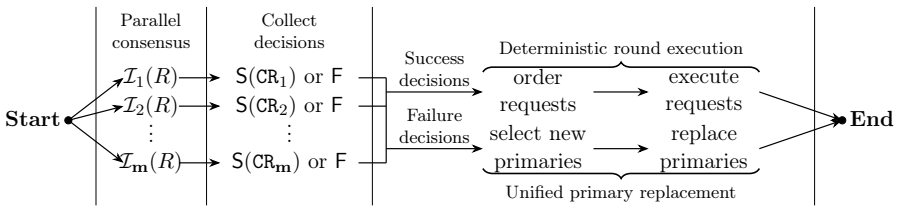
The load-bearing mechanism is the soft-failure principle (Definition 4.3) with the related gap size sigma and skip size epsilon. Each replica locally watches whether its instance is still working on round rho while another instance has already moved to round rho+sigma; if so, it treats the instance's primary as possibly faulty and pushes the instance's current round toward the failure decision F. The skip size epsilon then excludes the recovered instance from the next epsilon rounds so it can catch up, and the paper shows this keeps the per-request execution delay bounded even when one primary crashes or throttles. Two supporting mechanisms complete the design: the unified primary-replacement protocol, which deterministically selects a fresh, unused primary for every failed instance so that all non-faulty replicas agree on the same primary assignment without coordination, and the deterministic round-execution protocol, which orders the client requests accepted in a round by the permutation f_S(Hash(S) mod |S|!) of the accepted requests, so every replica executes them in the same order while no instance has a permanent position of privilege.
What would settle it
Deliver the same round rho on instance I_i to two non-faulty replicas over asymmetric links, and start round rho+sigma on another instance so that one replica's soft-failure detector classifies I_i as failed while the other has already accepted S(CR_rho) for I_i. If the first replica records F and the second records S(CR_rho) for the same instance and round, non-divergence is broken and Theorem 4.4 is refuted.
Extended reading notes
Core claim
The central claim is Theorem 4.4: when several instances of a primary-backup consensus protocol run in parallel under this design, each instance is wait-free—it can keep making successful consensus decisions without outside interference, and the delay between an instance accepting a client request and replicas executing it is upper-bounded. To get this, the paper introduces a soft-failure rule: an instance that falls more than sigma rounds behind the fastest instance is treated as failed, excluded from the next epsilon rounds, and its current round is moved to a failure decision using the underlying protocol's fault-detection machinery. Combined with a unified primary-replacement rule that lets all replicas pick the same new primary for a failed instance while keeping primaries distinct, and a deterministic hash-seeded permutation that orders each round's accepted requests identically on every replica, the paper argues that the whole parallelized protocol still satisfies termination and non-divergence. Theorem 4.6 states that this method turns any general primary-backup consensus protocol into a high-performance parallelized wait-free protocol in which every client eventually sees its requests executed, non-faulty replicas share load evenly, and faulty replicas have minimal impact.
Load-bearing premise
The whole design assumes that when one replica locally decides an instance is lagging, the underlying protocol's fault-detection machinery can make every non-faulty replica end that instance's current round with the same failure decision F, even though different replicas may have different views of who is lagging.
Editorial extensions
If this is right
- A single faulty primary can no longer throttle the entire replicated service; only the instance it leads stalls, and it either skips epsilon rounds or is replaced while the other instances keep committing.
- The delay between accepting a client request and executing it is bounded by parameters tied to network latency and timeouts, rather than by the slowest or most malicious instance.
- Existing PBFT-style implementations can be parallelized without rewriting their internals, because the method only assumes well-defined rounds, termination, and non-divergence.
- With round-robin client assignment and instance-change requests, every client eventually sees its request executed, and load is spread evenly across non-faulty replicas.
- The same wait-free parallelization applies to partial-consensus protocols, whose eventual checkpoint and recovery steps restore full agreement.
Reading between the lines
- The wait-free guarantee in Theorem 4.4 is inherited from a coordination assumption: a local soft-failure observation must be converted by the underlying protocol into a unified F decision across all non-faulty replicas; the paper treats this as infrastructure, so any implementation must supply it.
- Since the ordering digest is unknown to primaries until the round completes, the same hash-seeded ordering could be lifted out and used as a standalone front-running defence in any primary-backup protocol; the paper notes the unpredictability but does not develop this as an independent tool.
- A natural next step is empirical: run the design over m instances of an existing PBFT-style implementation, vary m, and compare measured acceptance-to-execution delays with the bound predicted from sigma and epsilon; the paper itself reports no experiments.
Signed reviews
Editorial analysis
A structured set of objections, weighed in public.
Referee Report
Summary. The paper proposes a protocol-agnostic paradigm for parallelizing primary-backup Byzantine fault-tolerant consensus protocols. The approach runs m instances of an underlying consensus protocol in parallel, with distinct primaries per instance. Section 3 develops a step-wise design: a deterministic round-execution protocol that orders accepted client requests via a hash-derived permutation, and a unified primary-replacement protocol that keeps the set of primaries distinct across instances. Section 4 introduces a wait-free redesign. The key idea is that instances should not wait for one another: successful instances proceed to future rounds, while lagging instances are declared to suffer a "soft failure" (Definition 4.3) and skip the next ε rounds. The paper claims in Theorem 4.4 that instances are wait-free and that the delay between accepting a client request and executing it is upper-bounded, and in Theorem 4.6 that the paradigm yields a high-performance parallelized wait-free consensus protocol with balanced load and minimized impact of faulty replicas. The proof of Theorem 4.6 is given, but it relies on Theorem 4.4, for which no proof is supplied.
Significance. If established, the result would be practically significant: it offers a black-box way to reduce primary load and mitigate the throughput impact of faulty or slow primaries in permissioned blockchain systems. The paper has real strengths: the black-box round model (Definition 3.1) is a clean abstraction; the deterministic ordering protocol (Section 3.1) is coherent; and the unified primary-replacement protocol comes with a stated invariant and a proof (Proposition 3.7). The paper also ships a formal-looking theorem structure, and the wait-free goal is clearly defined. However, the central wait-free claim is not proven, and the soft-failure mechanism relies on an unstated assumption about the underlying protocol's fault-detection interface. Because the headline contribution depends on these points, the significance is conditional until the missing proof and assumptions are supplied.
major comments (3)
- [Section 4.1, Theorem 4.4] Theorem 4.4 is the load-bearing claim of the paper, but it is asserted without proof. The theorem states that instances are wait-free and that the delay between accepting a client request and executing it is upper-bounded. No argument is given for either conjunct, and the bound is not derived from any explicit timing model. The text informally relates σ to network latency and timeouts, and ε to σ and primary-replacement time, but Definition 4.3 does not define a formal round structure or synchrony assumptions under which such a bound can be proven. The manuscript needs either a full proof of Theorem 4.4 or a precise statement of the timing assumptions and a derivation of the bound.
- [Section 4.1, Definition 4.3] The soft-failure rule assumes a capability that the black-box consensus model of Definition 3.1 does not provide. Definition 3.1 guarantees that a round fails with decision F only when all non-faulty replicas observe the failure; it gives no primitive by which a single replica that locally detects a lag can force the round to end with a unanimous F. In the soft-failure description, each replica locally detects the soft failure and "uses the fault detection infrastructure of the underlying consensus protocol to work towards ending the ongoing consensus round with a decision F." This leaves open the possibility that one non-faulty replica treats round ρ as failed and moves to ρ+ε while another non-faulty replica has already accepted S(CR) for round ρ. Such a split would violate the non-divergence invariant on which Proposition 3.7 and the overall correctness argument depend. The paper must either specify a fault-detection interface that guarantees a coordinated unanimous F decision, or change the soft-failure mechanism to one that provably maintains non-divergence.
- [Section 4.3, Theorem 4.6] The proof of Theorem 4.6 explicitly invokes Theorem 4.4 for the wait-free property and for the claim that the impact of faulty replicas is minimized. Since Theorem 4.4 is unsupported, the main conclusions of Theorem 4.6 are also unsupported. Additionally, the proof's termination argument is too brief: it says termination follows directly from termination of the underlying consensus protocol, but for the client-side guarantee (every client eventually sees its requests executed) one must also argue that a client assigned to an instance with a faulty primary eventually reaches a non-faulty primary or is reassigned, and that soft-failure skipping does not indefinitely defer the client's request. These points should be made explicit.
minor comments (4)
- [Abstract and title] The title contains a line-break artifact "paralle lization" in the supplied text; this should be corrected to "parallelization."
- [Section 3.1, Figure 3] The pseudocode calls fS(Hash(S) mod |S(Dρ)|!) but the domain of fS is {0, ..., |S|!-1}. Since |S| = |S(Dρ)|, the modulo expression is in range, but the notation is easy to misread; a short clarifying sentence would help.
- [Section 4.2, client instance-change] The instance-change mechanism says a client is reassigned "in round ρ + 2σ," but σ is a time duration while ρ is a round number. The manuscript uses σ, ε, and ρ in the same expressions without formally relating rounds to time; this makes the description hard to interpret and should be clarified.
- [Section 4.1, paragraph after Definition 4.3] The paragraph says that "natural fluctuations in the performance of an instance can cause an unjust replacement of its primary" and then describes a recovery mechanism, but no invariant or proof is given for the combined soft-failure-plus-replacement behavior. This is related to the major concern about coordinated failure decisions and should be addressed in the revision.
Circularity Check
No circularity: the parallelization paradigm and its wait-free claim are built directly on the black-box consensus model; the main gap is an unproven theorem, not a circular derivation.
full rationale
The paper's derivation chain is self-contained. The ordering protocol (Section 3.1) and the unified primary replacement protocol (Section 3.2) are constructed directly from the black-box consensus model of Definition 3.1, with non-divergence and determinism argued in Proposition 3.7 and Proposition 3.4. Theorem 4.6 is a composition of these pieces, the termination/non-divergence of the underlying consensus protocol, the client-assignment rules, and Theorem 4.4. None of these inputs is a fitted parameter, a renamed version of the claimed output, or an imported self-citation. The wait-free claim in Theorem 4.4 is asserted without proof and relies on the soft-failure rule of Definition 4.3, which assumes that a local detection can use the underlying consensus protocol's fault-detection infrastructure to end a round with F; this is a correctness assumption that the black-box model does not explicitly justify, but it is not circular because the paper does not define wait-freedom in terms of sigma and epsilon, nor does it use Theorem 4.4 as an input to itself. Self-citations [21,22,23,37] are announcements, background, or unrelated prior work and do not carry the derivation. No fitted input is called a prediction and no uniqueness theorem is imported. The central risk is therefore an unsupported liveness/safety assumption about the underlying protocol, not circularity.
Assumptions & free parameters
free parameters (3)
- m
- sigma (gap size)
- epsilon (skip size)
assumptions (7)
- domain assumption The system requires n > 3f, where n is the number of replicas and f is the number of Byzantine faulty replicas.
- domain assumption Non-faulty replicas are deterministic and behave according to the protocol.
- standard math A collision-resistant hash function exists and is practically impossible to invert or collide.
- domain assumption A consensus protocol can be modeled as a black box in which each round yields a single decision S(CR) or F agreed by all non-faulty replicas, and failure decisions are unanimous.
- domain assumption At most f replicas are faulty in a given window, and faulty replicas can recover over time.
- ad hoc to paper All instances coordinated by non-faulty primaries reach successful consensus decisions roughly within the same time, bounded by sigma.
- ad hoc to paper A replica that locally detects a soft failure can use the underlying protocol's fault detection infrastructure to end that instance's round with a unanimous F decision.
Cite this review
Pith. "Pith review of Revisiting consensus protocols through wait-free parallelization." pith.science (2026). https://pith.science/paper/NGUEEKPZ
@misc{pith2026190801458,
  author       = {Pith},
  title        = {Pith review of: Revisiting consensus protocols through wait-free parallelization},
  year         = {2026},
  howpublished = {\url{https://pith.science/paper/NGUEEKPZ}},
  note         = {Machine review of arXiv:1908.01458}
}
read the original abstract
The recent surge of blockchain systems has renewed the interest in traditional Byzantine fault-tolerant consensus protocols. Many such consensus protocols have a primary-backup design in which an assigned replica, the primary, is responsible for coordinating the consensus protocol. Although the primary-backup design leads to relatively simple and high performance consensus protocols, it places an unreasonable burden on a good primary and allows malicious primaries to substantially affect the system performance. In this paper, we propose a protocol-agnostic approach to improve the design of primary backup consensus protocols. At the core of our approach is a novel wait-free approach of running several instances of the underlying consensus protocol in parallel. To yield a high performance parallelized design, we present coordination-free techniques to order operations across parallel instances, deal with instance failures, and assign clients to specific instances. Consequently, the design we present is able to reduce the load on individual instances and primaries, while also reducing the adverse effects of any malicious replicas.
Figures


Figures from the paper (1 more)

Reference graph
Works this paper leans on
-
[1]
Ittai Abraham, Srinivas Devadas, Danny Dolev, Kartik Na yak, and Ling Ren. Synchronous byzantine agreement with expected O(1) rounds, expected O(n2) communication, and op- timal resilience, 2018
work page 2018
-
[2]
Pri me: Byzantine replication under attack
Yair Amir, Brian Coan, Jonathan Kirsch, and John Lane. Pri me: Byzantine replication under attack. IEEE Transactions on Dependable and Secure Computing , 8(4):564–577, 2011. doi:10.1109/TDSC.2010.70
-
[3]
Blockchain for development: Emerg- ing opportunities for mobile, identity and aid, 2017
GSM Association. Blockchain for development: Emerg- ing opportunities for mobile, identity and aid, 2017. URL: https://www.gsma.com/mobilefordevelopment/wp-content/uploads/2017/12/Blockchain-for-Development.pdf
work page 2017
-
[4]
Pierre-Louis Aublin, Rachid Guerraoui, Nikola Kneževi ć, Vivien Quéma, and Marko Vukolić. The next 700 BFT protocols. ACM Transactions on Computer Systems , 32(4):12:1–12:45,
-
[5]
RBFT: Redundant byzantine fault tolerance
Pierre-Louis Aublin, Sonia Ben Mokhtar, and Vivien Quéma . RBFT: Redundant byzantine fault tolerance. In 2013 IEEE 33rd International Conference on Distributed Com puting Systems, pages 297–306. IEEE, 2013. doi:10.1109/ICDCS.2013.53. 12
- [6]
-
[7]
Blockchain in Europe: Closing the s trat- egy gap
Burkhard Blechschmidt. Blockchain in Europe: Closing the s trat- egy gap. Technical report, Cognizant Consulting, 2018. URL : https://www.cognizant.com/whitepapers/blockchain-in-europe-closing-the-strategy-gap-codex3320.pdf
work page 2018
-
[8]
A leader-free byzantin e consensus algorithm
Fatemeh Borran and André Schiper. A leader-free byzantin e consensus algorithm. In Distributed Computing and Networking , pages 67–78. Springer Berlin Heidelberg, 2010. doi:10.1007/978-3-642-11322-2_11
Show all 46 references
-
[9]
Blockchain consensu s protocols in the wild (keynote talk)
Christian Cachin and Marko Vukolic. Blockchain consensu s protocols in the wild (keynote talk). In 31st International Symposium on Distributed Computing , volume 91 of Leibniz In- ternational Proceedings in Informatics (LIPIcs) , pages 1:1–1:16. Schloss Dagstuhl–Leibniz- Zentr...
2017 doi
-
[10]
The impact of blockchain technology on finance: A catalyst fo r change
Michael Casey, Jonah Crane, Gary Gensler, Simon Johnso n, and Neha Narula. The impact of blockchain technology on finance: A catalyst fo r change. Techni- cal report, International Center for Monetary and Banking St udies, 2018. URL: https://www.cimb.ch/uploads/1/1/5/4/11541416...
2018
-
[11]
Practical byzantine f ault tolerance
Miguel Castro and Barbara Liskov. Practical byzantine f ault tolerance. In Proceedings of the Third Symposium on Operating Systems Design and Imple mentation, pages 173–186. USENIX Association, 1999
1999
-
[12]
Practical byzantine f ault tolerance and proac- tive recovery
Miguel Castro and Barbara Liskov. Practical byzantine f ault tolerance and proac- tive recovery. ACM Transactions on Computer Systems , 20(4):398–461, 2002. doi:10.1145/571637.571640
2002
-
[13]
Major collection of the fall auction seaso n to be recorded with blockchain technology, 2018
Christie’s. Major collection of the fall auction seaso n to be recorded with blockchain technology, 2018. URL: https://www.christies.com/presscenter/pdf/9160/RELEASE_ChristiesxArtoryxEbsworth_9160_1.pdf
2018
-
[14]
Making byzantine fault tolerant systems tolerate byzantine fault s
Allen Clement, Edmund Wong, Lorenzo Alvisi, Mike Dahli n, and Mirco Marchetti. Making byzantine fault tolerant systems tolerate byzantine fault s. In Proceedings of the 6th USENIX Symposium on Networked Systems Design and Implementation , pages 153–168. USENIX Association, 2009
2009
-
[15]
Blockchain and GDPR: How blockchain could address five areas associated with gdpr compliance
Cindy Compert, Maurizio Luinetti, and Bertrand Portier . Blockchain and GDPR: How blockchain could address five areas associated with gdpr compliance. Technical report, IBM Security, 2018. URL: https://public.dhe.ibm.com/common/ssi/ecm/61/en/61014461usen/security-ibm-security-s...
2018
-
[16]
Bitcoin’s growing energy problem
Alex de Vries. Bitcoin’s growing energy problem. Joule, 2(5):801–805, 2018. doi:10.1016/j.joule.2018.04.016
2018 doi
-
[17]
Untangling blockchain: A data processing view of bl ockchain sys- tems
Tien Tuan Anh Dinh, Rui Liu, Meihui Zhang, Gang Chen, Beng Chin Ooi, and Ji Wang. Untangling blockchain: A data processing view of bl ockchain sys- tems. IEEE Transactions on Knowledge and Data Engineering , 30(7):1366–1385, 2018. doi:10.1109/TKDE.2017.2781227
2018
-
[18]
Blockchain for agriculture and food: Findings from the p i- lot study
Lan Ge, Christopher Brewster, Jacco Spek, Anton Smeenk, and Jan Top. Blockchain for agriculture and food: Findings from the p i- lot study. Technical report, Wageningen University, 2017. URL: https://www.wur.nl/nl/Publicatie-details.htm?publicationId=publication-way-353330323634
2017
-
[19]
Gordon and Christian Catalini
William J. Gordon and Christian Catalini. Blockchain te chnology for healthcare: Facilitat- ing the transition to patient-driven interoperability. Computational and Structural Biotech- nology Journal, 16:224–230, 2018. doi:10.1016/j.csbj.2018.06.003
2018 doi
-
[20]
Reiter, Dragos-Adrian Seredinschi, Orr Tamir, and Alin Tomescu
Guy Golan Gueta, Ittai Abraham, Shelly Grossman, Dahli a Malkhi, Benny Pinkas, Michael K. Reiter, Dragos-Adrian Seredinschi, Orr Tamir, and Alin Tomescu. SBFT: a scalable and decentralized trust infrastru cture, 2018. URL: https://arxiv.org/abs/1804.01626. 13
2018 arXiv
-
[21]
Bri ef announcement: revisiting consensus protocols through wait-free parallelization
Suyash Gupta, Jelle Hellings, and Mohammad Sadoghi. Bri ef announcement: revisiting consensus protocols through wait-free parallelization. I n 33nd International Symposium on Distributed Computing , 2019
2019
-
[22]
Blockchain Transaction Processing , pages 1–11
Suyash Gupta and Mohammad Sadoghi. Blockchain Transaction Processing , pages 1–11. Springer International Publishing, 2018. doi:10.1007/978-3-319-63962-8_333-1
2018 doi
-
[23]
Brief announcemen t: the fault-tolerant cluster- sending problem
Jelle Hellings and Mohammad Sadoghi. Brief announcemen t: the fault-tolerant cluster- sending problem. In 33nd International Symposium on Distributed Computing , 2019
2019
-
[24]
The promise of blockchain
Matt Higginson, Johannes-Tobias Lorenz, Björn Münster mann, and Peter Braad Ole- sen. The promise of blockchain. Technical report, McKinsey &Company, 2017. URL: https://www.mckinsey.com/industries/financial-services/our-insights/the-promise-of-blockchain
2017
-
[25]
Kamel Boulos, James T
Maged N. Kamel Boulos, James T. Wilson, and Kevin A. Claus on. Geospatial blockchain: promises, challenges, and scenarios in health and healthca re. International Journal of Health Geographics, 17(1):1211–1220, 2018. doi:10.1186/s12942-018-0144-x
2018 doi
-
[26]
Zyzzyva: Speculative byzantine fault tolerance
Ramakrishna Kotla, Lorenzo Alvisi, Mike Dahlin, Allen Clement, and Edmund Wong. Zyzzyva: Speculative byzantine fault tolerance. In Proceedings of Twenty-first ACM SIGOPS Symposium on Operating Systems Principles , pages 45–58. ACM, 2007. doi:10.1145/1294261.1294267
2007
-
[27]
Zyzzyva: Speculative byzantine fault tolerance
Ramakrishna Kotla, Lorenzo Alvisi, Mike Dahlin, Allen Clement, and Edmund Wong. Zyzzyva: Speculative byzantine fault tolerance. ACM Transactions on Computer Systems , 27(4):7:1–7:39, 2009. doi:10.1145/1658357.1658358
2009
-
[28]
Karame, and N
Jian Liu, Wenting Li, Ghassan O. Karame, and N. Asokan. S calable byzantine consensus via hardware-assisted secret sharing. IEEE Transactions on Computers , 68(1):139–151, 2019. doi:10.1109/TC.2018.2860009
2019
-
[29]
Menezes, Scott A
Alfred J. Menezes, Scott A. Vanstone, and Paul C. Van Oor schot. Handbook of Applied Cryptography. CRC Press, Inc., 1st edition, 1996
1996
-
[30]
The honey badger of BFT protocols
Andrew Miller, Yu Xia, Kyle Croman, Elaine Shi, and Dawn Song. The honey badger of BFT protocols. In Proceedings of the 2016 ACM SIGSAC Conference on Computer an d Communications Security, pages 31–42. ACM, 2016. doi:10.1145/2976749.2978399
2016
-
[31]
Bitcoin: A peer-to-peer electronic c ash system
Satoshi Nakamoto. Bitcoin: A peer-to-peer electronic c ash system. URL: https://bitcoin.org/en/bitcoin-paper
-
[32]
Nawab and M
F. Nawab and M. Sadoghi. Blockplane: A global-scale byza ntizing middleware. In 2019 IEEE 35th International Conference on Data Engineering (IC DE), pages 124–135, April
2019
-
[33]
Byzantine Agreement , pages 255–259
Michael Okun. Byzantine Agreement , pages 255–259. Springer New York, 2016. doi:10.1007/978-1-4939-2864-4_60
2016 doi
-
[34]
Blockchain and economic dev elopment: Hype vs
Michael Pisa and Matt Juden. Blockchain and economic dev elopment: Hype vs. reality. Technical report, Center for Global Developme nt, 2017. URL: https://www.cgdev.org/publication/blockchain-and-economic-development-hype-vs-reality
2017
-
[35]
Bitcoin developer guide: P2p network, 2 018
Bitcoin Project. Bitcoin developer guide: P2p network, 2 018. URL: https://bitcoin.org/en/developer-guide#p2p-network
-
[36]
Blockchain – an opportunity for energy producers an d consumers?, 2016
PwC. Blockchain – an opportunity for energy producers an d consumers?, 2016. URL: https://www.pwc.com/gx/en/industries/energy-utilities-resources/publications/opportunity-for-energy-pr oducers.html
2016
-
[37]
Transaction Proces sing on Modern Hardware
Mohammad Sadoghi and Spyros Blanas. Transaction Proces sing on Modern Hardware. Synthesis Lectures on Data Management , 14(2):1–138, 2019
2019
-
[38]
Conflict-free replicated data types
Marc Shapiro, Nuno Preguiça, Carlos Baquero, and Marek Z awirski. Conflict-free replicated data types. In Proceedings of the 13th International Conference on Stabil ization, Safety, and Security of Distributed Systems , pages 386–400. Springer-Verlag, 2011
2011
-
[39]
Introduction to Distributed Algorithms
Gerard Tel. Introduction to Distributed Algorithms . Cambridge University Press, 2nd edi- tion, 2001
2001
-
[40]
Tanenbaum
Maarten van Steen and Andrew S. Tanenbaum. Distributed Systems . Maarten van Steen, 3th edition, 2017. URL: https://www.distributed-systems.net/. 14
2017
-
[41]
Spin one’s wheels? byzantine fault tolerance with a spinnin g primary
Giuliana Santos Veronese, Miguel Correia, Alysson Nev es Bessani, and Lau Cheuk Lung. Spin one’s wheels? byzantine fault tolerance with a spinnin g primary. In 28th IEEE International Symposium on Reliable Distributed Systems , pages 135–144. IEEE, 2009. doi:10.1109/SRDS.2009.36
2009 doi
-
[42]
Sustainability of bitcoin and blockch ains
Harald Vranken. Sustainability of bitcoin and blockch ains. Current Opinion in Environ- mental Sustainability , 28:1–9, 2017. doi:10.1016/j.cosust.2017.04.011
2017 doi
-
[43]
Ethereum: a secure decentralised generali sed transaction ledger
Gavin Wood. Ethereum: a secure decentralised generali sed transaction ledger. EIP-150 revision. URL: https://gavwood.com/paper.pdf
-
[44]
LinBFT: Linear-communication byzantine faul t tolerance for public blockchains,
Yin Yang. LinBFT: Linear-communication byzantine faul t tolerance for public blockchains,
-
[2018]
URL: https://arxiv.org/abs/1807.01829. 15
-
[2019]
doi:10.1109/ICDE.2019.00020
2019
Reviewed August 14, 2026 · model on record in the stance chip above.
Discussion (0). Continue with ORCID to comment.