REVIEW 2 major objections 5 minor 58 references
Reinterpretation and Extension of Entropy Correction Terms for Residual Distribution and Discontinuous Galerkin Schemes: Application to Structure Preserving Discretization
T0 review · 2 major / 5 minor · reviewed 2026-08-14 · deepseek-v4-flash
Pith's one-line read This paper shows that entropy conservation for residual distribution and discontinuous Galerkin schemes can be enforced by adding one explicit, optimally small correction term to each degree of freedom.
desk verdict Sound semidiscrete core, honest limitations, but the fully discrete claim is over-sold and needs either proof or careful rescoping. read the letter →
The pith
A machine-rendered reading of the paper's core claim, the machinery that carries it, and where it could break.
The reading
What carries the argument
The load-bearing object is the explicit correction term $r_i = \lambda (F_i - \bar F)$ (with $\bar F$ the mass-matrix-weighted element average of the entropy variables), chosen as the unique minimizer of the quadratic program $\min \frac{1}{2}\|r\|_M^2$ subject to local conservation and the discrete entropy equality. The coefficient $\lambda$ is given in closed form as $\mathcal{E}/\|F - \bar F\|_M^2$, so no optimization solver is needed; the same quadratic program with linear constraints is the template for every extension in the paper, including the inequality, multi-constraint, kinetic-energy, and fully discrete variants.
What would settle it
Compute the discrete entropy budget $F^T M \,\partial_t U$ plus the numerical entropy flux boundary term on one element of a corrected nodal DG scheme for a smooth Euler vortex, using the paper's own quadrature; Theorem 2.8 predicts the budget is zero up to rounding whenever $F$ is not constant, so any significantly nonzero value would contradict the claimed identity.
Extended reading notes
Core claim
The central claim is that entropy conservation can be imposed on any semidiscretization of the form (25) by adding $r_i = \lambda\bigl(F_i - \frac{1^T M F}{1^T M 1}\mathbf{1}\bigr)$, where $F$ are the entropy variables, $M$ is the mass matrix, and $\lambda = \mathcal{E}/\|F - \bar F\|_M^2$; Theorem 2.8 shows this is the unique solution of $\min \frac{1}{2}\|r\|_M^2$ subject to the conservation constraint $1^T M r_i = 0$ and the entropy constraint $F^T M r = \mathcal{E}$. The paper also claims the same quadratic-program characterization yields closed-form corrections for entropy inequalities (Theorem 3.1), for two simultaneous constraints such as entropy and kinetic energy (Theorem 3.2), and for a fully discrete DeC update, so the framework is a unified recipe rather than a single formula for a single scheme.
Load-bearing premise
The whole construction assumes the entropy variables $F(u)$ can be evaluated from the numerical solution and are not constant inside an element, so the denominator in formulas (26) and (42) is nonzero; the paper's own experiments in Section 4.2.2 show that once density or pressure turns negative this assumption fails and the corrected scheme blows up.
Editorial extensions
If this is right
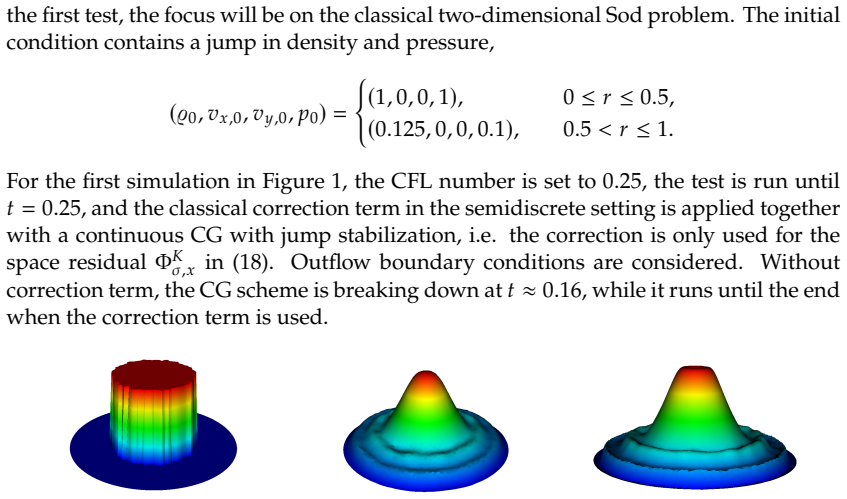
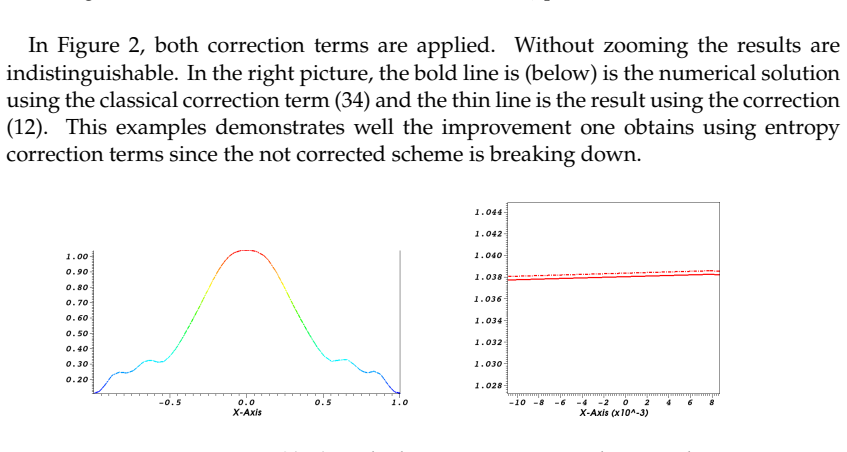
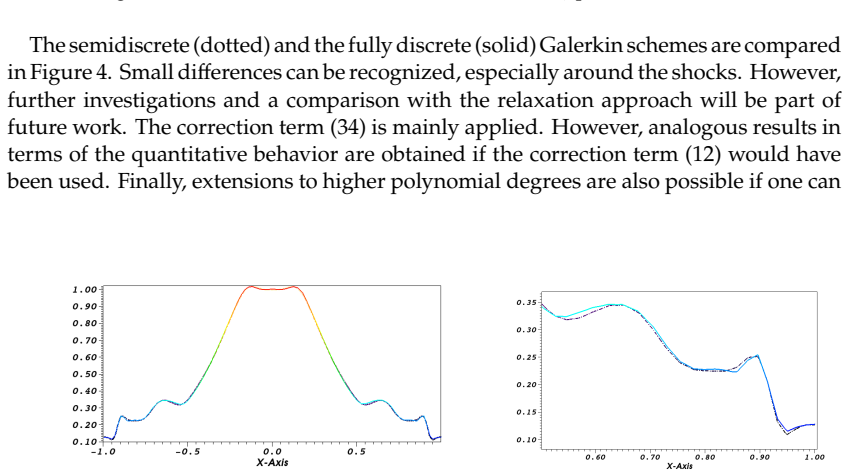
- Any locally conservative semidiscretization in the RD/DG/SBP class can be made discretely entropy-conservative without changing quadrature rules or grid structure, as demonstrated for continuous Galerkin, psi-scheme, and nodal DG discretizations.
- The inequality variant yields entropy-dissipative schemes that reduce to the baseline scheme when it is already dissipative, so no spurious dissipation is added to a good method.
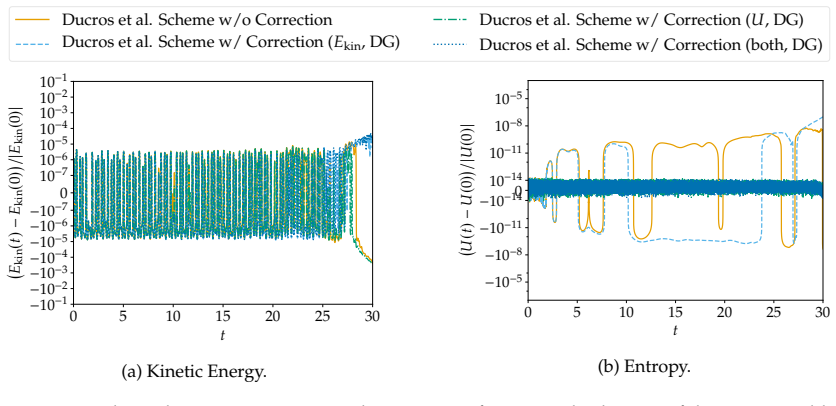
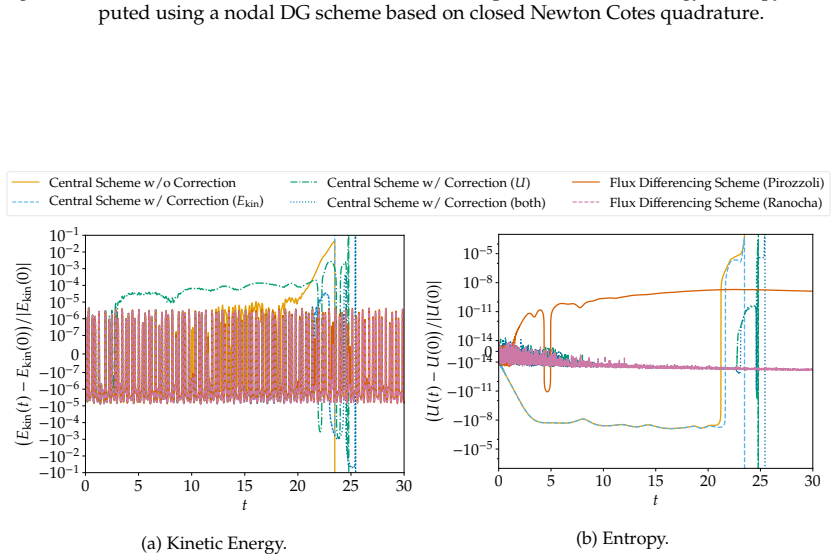
- Multiple linear constraints can be imposed simultaneously, e.g., entropy conservation and kinetic energy preservation for the Euler equations, with a closed-form two-by-two solve.
- Applying the correction to the full space-time residual in the deferred correction framework gives fully discrete entropy-conservative schemes, removing the need for special time integrators.
- The framework sidesteps the case-by-case derivation of entropy-conservative numerical fluxes, which the paper argues works cleanly for calorically perfect gases but becomes unclear for general or tabulated equations of state.
Reading between the lines
- The optimization formulation is constraint-agnostic: any additional linear conservation law (e.g., angular momentum) should be enforceable by adding its generalized variables to the constraint set, a route the paper does not explore.
- Because the correction is the minimal-norm repair, one can view the method as a stabilization-by-projection that preserves the baseline scheme's behavior where it is already good; this suggests using it as a general filter for any unstable discretization, not only for entropy.
- The vanishing-denominator case limits the approach at strong shocks: an element whose entropy variables are nearly constant acts like a finite-volume element, so a robust implementation would need to switch to the flux-difference correction there; the paper leaves this hybrid as future work.
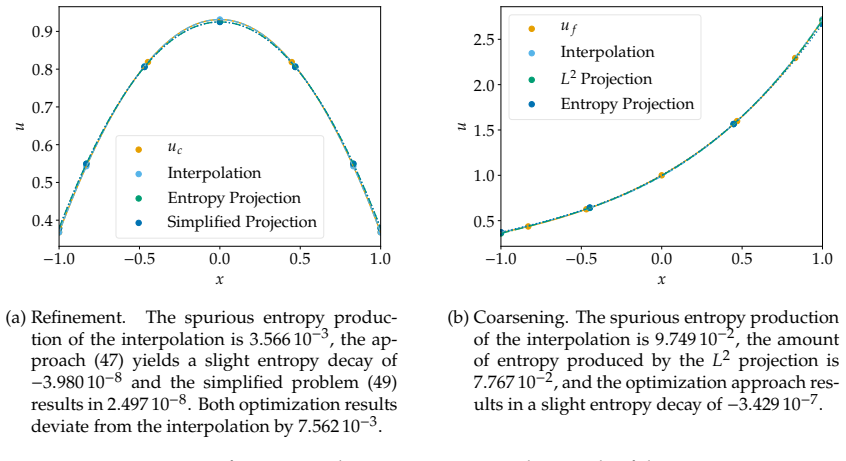
- A testable extension is to use the same quadratic-program correction for grid refinement and coarsening with explicit closed-form weights, since the paper only solves the inequality-constrained version with a generic optimizer.
Signed reviews
Editorial analysis
A structured set of objections, weighed in public.
Referee Report
Summary. The paper proposes a unified optimization-based interpretation of entropy correction terms for residual distribution (RD) and summation-by-parts/Simultaneous-Approximation-Term (SBP-SAT) semidiscretizations, including discontinuous Galerkin and finite difference methods. It characterizes the correction as the unique minimizer of a quadratic program subject to conservation and entropy constraints (Theorem 2.8), extends the setting to entropy inequalities (Theorem 3.1), multiple linear constraints (Theorem 3.2), and kinetic-energy preservation for the Euler equations (Prop. 3.5), and supplies explicit formulas in each case. The authors also describe a fully discrete variant obtained by correcting the whole space-time residual in a deferred-correction (DeC) framework, present numerical comparisons for CG, psi, and DG schemes, and give entropy-stable grid transfer operators in an appendix.
Significance. If the semidiscrete results are taken as the contribution, the paper is a valuable systematization: the explicit formulas remove the need for optimization solvers, the framework is independent of special quadrature rules, and the extension to multiple constraints and kinetic-energy preservation is a genuine generalization of Abgrall's earlier construction. The algebraic derivations in Theorems 2.8, 3.1, and 3.2 are sound, and the paper is commendably explicit about the positivity limitation in Section 4.2.2. The numerical tests confirm that the corrections enforce the imposed constraints, as expected by construction rather than as empirical discovery. The main weakness is that the fully discrete entropy-conservation claim is asserted rather than proved, and the abstract presents this fully discrete extension as a headline contribution.
major comments (2)
- [2.1] The fully discrete FEC/D claim is not supported by a proof. The paper shows that the correction is optimal in the semidiscrete setting (Theorem 2.8), but for the DeC update (18) the final value U^{n+1} is obtained after p correction sweeps over several substages, and no discrete entropy identity for the complete step is derived. The algorithm described after Eq. (19) is also underspecified: it gives the steps conceptually but no explicit correction formula for the full space-time residual analogous to (26). The numerical section reports 'fully discrete EC' results but does not provide a quantitative fully discrete entropy residual (for example, entropy change as a function of dt or number of correction sweeps). Without such an identity or error analysis, the abstract's statement that the approach yields 'for the first time a fully discrete entropy conservative/dissipative RD scheme' is a claim rather than a demonstrated result. I recommend either proving the discrete entropy balance for the DeC correction or reframing the contribution as semidiscrete, with the fully discrete variant presented as a numerical demonstration.
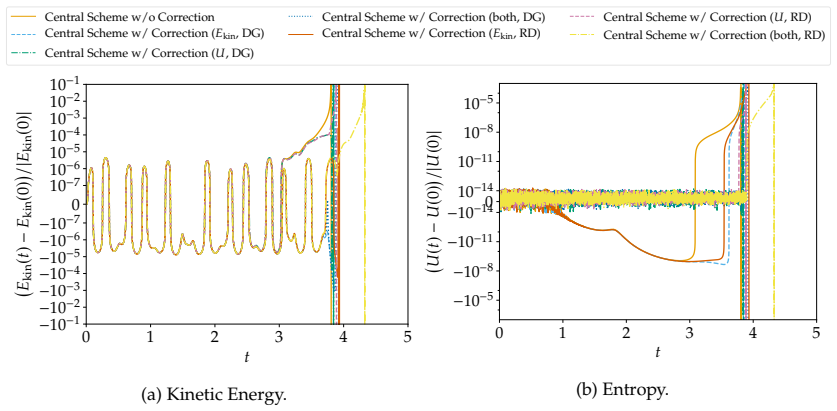
- [4.2.2] The 'universal tool' claim should be qualified in the abstract and introduction. The correction formulas (26) and (42) require the entropy variables F to be well-defined, which for the Euler equations requires positive density and pressure; the denominator in (26) also vanishes for constant states. The Taylor-Green experiments in Section 4.2.2 show that when negative density or pressure appears, the correction cannot be applied and the simulation crashes. Since the correction itself does not preserve admissibility, the paper should state clearly that the framework applies to any scheme only for admissible states, and that positivity preservation is an additional requirement outside the scope of the correction. This is not an internal inconsistency, but it limits the claimed universality and should be stated prominently.
minor comments (5)
- [Eq. (13)] The denominator in (13) should use a norm squared, e.g., sum_i ||F_i - Fbar||^2, to avoid confusion about vector-valued entropy variables.
- [2.1] Remark 2.2 emphasizes that the paper focuses on semidiscrete corrections, yet the abstract presents the fully discrete extension as a major novelty. The abstract should reflect the actual emphasis of the paper.
- [4.2.2] There is a typo 'formulation formulation' in the sentence about motivating examples; it should read 'formulation'.
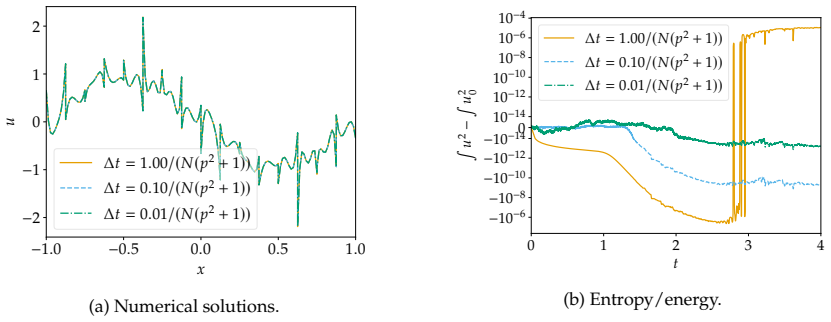
- [A.2] The observation that the entropy change decreases as dt^4 in Figure 10 is explained by the order of the time integrator, but the text should state this explicitly rather than leaving the reader to infer it.
- [3.2] The nondegeneracy condition for the multiple-constraint theorem is only expressed verbally as 'the constraints do not contradict each other'. It would help to state explicitly that the coefficient matrix in the theorem must be invertible, and to comment on when this can fail for the combined entropy and kinetic-energy constraints.
Circularity Check
No significant circularity: the correction terms are explicit solutions of the stated constrained optimization problems, and the numerical checks verify the imposed constraints rather than predict them.
full rationale
The paper's central construction is to add correction terms that enforce discrete entropy and/or kinetic-energy identities. These identities are imposed as equality constraints in quadratic programs (Theorems 2.8, 3.1, 3.2 and Proposition 3.5), and the correction terms are derived as explicit solutions, e.g. r_i = lambda (F_i - mean) in (26). The verification that these terms satisfy (23) and (24) is a direct algebraic substitution, not a prediction of an independent quantity. The numerical experiments therefore confirm the design constraints rather than test a theory that is independent of the construction. The baseline correction formula is cited from Abgrall (2018), a work by one of the authors, but the paper re-derives it as the unique minimizer of a well-posed QP and proves the required optimality in the text using standard convex-optimization arguments; it does not rely on the citation for the load-bearing step. The fully discrete DeC claim is underdeveloped: Remark 2.2 explicitly states that the paper focuses on semidiscrete corrections and that fully discrete combinations with relaxation are deferred, and no discrete entropy identity is proven for the full DeC update. That is a missing justification or correctness gap, not circularity, because the proposed fully discrete correction, if implemented, would again enforce the entropy balance by construction rather than as a fitted result. No fitted parameters are used, no empirical input is renamed as a prediction, and no author-imposed uniqueness theorem is used to forbid alternatives. Hence the derivation chain is self-contained and the appropriate finding is no significant circularity.
Assumptions & free parameters
assumptions (4)
- domain assumption The entropy function U is convex and the entropic variable map F = grad_U U is one-to-one on the state space.
- domain assumption The discrete operators satisfy the SBP property (20) and the mass matrix M is diagonal.
- domain assumption Inside each element, the entropy variables F are not constant, so the denominator in (26) is nonzero.
- ad hoc to paper Correcting the full space-time residual in the DeC update (19) preserves both the order of accuracy and the entropy balance.
Cite this review
Pith. "Pith review of Reinterpretation and Extension of Entropy Correction Terms for Residual Distribution and Discontinuous Galerkin Schemes: Application to Structure Preserving Discretization." pith.science (2026). https://pith.science/paper/NHBSTELX
@misc{pith2026190804556,
  author       = {Pith},
  title        = {Pith review of: Reinterpretation and Extension of Entropy Correction Terms for Residual Distribution and Discontinuous Galerkin Schemes: Application to Structure Preserving Discretization},
  year         = {2026},
  howpublished = {\url{https://pith.science/paper/NHBSTELX}},
  note         = {Machine review of arXiv:1908.04556}
}
read the original abstract
For the general class of residual distribution (RD) schemes, including many finite element (such as continuous/discontinuous Galerkin) and flux reconstruction methods, an approach to construct entropy conservative/ dissipative semidiscretizations by adding suitable correction terms has been proposed by Abgrall (J.~Comp.~Phys. 372: pp. 640--666, 2018). In this work, the correction terms are characterized as solutions of certain optimization problems and are adapted to the SBP-SAT framework, focusing on discontinuous Galerkin methods. Novel generalizations to entropy inequalities, multiple constraints, and kinetic energy preservation for the Euler equations are developed and tested in numerical experiments. For all of these optimization problems, explicit solutions are provided. Additionally, the correction approach is applied for the first time to obtain a fully discrete entropy conservative/dissipative RD scheme. Here, the application of the deferred correction (DeC) method for the time integration is essential. This paper can be seen as describing a systematic method to construct structure preserving discretization, at least for the considered example.
Figures

Figures from the paper (8 more)


Reference graph
Works this paper leans on
-
[1]
R. Abgrall. ‘A general framework to construct schemes satisfying additional con- servation relations. Application to entropy conservative and entropy dissipative schemes’. In:J. Comput. Phys.372 (2018), pp. 640–666
work page 2018
-
[2]
R. Abgrall. ‘An extension of Roe’s upwind scheme to algebraic equilibrium real gas models.’ In:Comput. Fluids19.2 (1991), pp. 171–182
work page 1991
-
[3]
R. Abgrall. ‘High order schemes for hyperbolic problems using globally continu- ous approximation and avoiding mass matrices’. In:J. Sci. Comput.73.2-3 (2017), pp. 461–494
work page 2017
-
[4]
R. Abgrall, P. Bacigaluppi and S. Tokareva. ‘A high-order nonconservative ap- proachforhyperbolicequationsinfluiddynamics’.In: Comp.Fluids 19.1-3(2017)
work page 2017
-
[5]
R. Abgrall, P. Bacigaluppi and S. Tokareva. ‘High-order residual distribution scheme for the time-dependent Euler equations of fluid dynamics’. In:Computers & Mathematics with Applications78.2 (2019), pp. 274–297
work page 2019
-
[6]
R. Abgrall, A. Larat and M. Ricchiuto. ‘Construction of very high order residual distribution schemes for steady inviscid flow problems on hybrid unstructured meshes’. In:J. Comput. Phys.230.11 (2011), pp. 4103–4136
work page 2011
-
[7]
R. Abgrall, E. l. Meledo and P. Öffner. ‘On the Connection between Residual DistributionSchemesandFluxReconstruction’.In: arXivpreprintarXiv:1807.01261 (2018)
arXiv 2018
-
[8]
Relaxation Deferred Correction Methods and their Applications to Residual Distribution Schemes
R. Abgrall, E. L. Meledo, P. Öffner and D. Torlo. ‘Relaxation Deferred Correc- tion Methods and their Applications to Residual Distribution Schemes’. In:arXiv preprint arXiv:2106.05005(2021)
work page Pith review arXiv 2021
Show all 58 references
-
[9]
Abgrall, J
R. Abgrall, J. Nordström, P. Öffner and S. Tokareva. ‘Analysis of the SBP-SAT Stabilization for Finite Element Methods Part I: Linear Problems’. In:Journal of Scientific Computing85.2 (2020), pp. 1–29
2020
-
[10]
Abgrall, J
R. Abgrall, J. Nordström, P. Öffner and S. Tokareva. ‘Analysis of the SBP-SAT sta- bilizationforfiniteelementmethodspartII:entropystability’.In: Communications on Applied Mathematics and Computation(2021), pp. 1–23. 35
2021
-
[11]
Abramowitz and I
M. Abramowitz and I. A. Stegun. Handbook of mathematical functions. National Bureau of Standards, 1972
1972
-
[12]
APosteriori
P.Bacigaluppi,R.AbgrallandS.Tokareva.‘"APosteriori"LimitedHighOrderand Robust Residual Distribution Schemes for Transient Simulations of Fluid Flows in Gas Dynamics’. In:arXiv preprint arXiv:1902.07773(2019)
2019 arXiv
-
[13]
M. H. Carpenter, M. Parsani, T. C. Fisher and E. J. Nielsen. ‘Towards an entropy stable spectral element framework for computational fluid dynamics’. In:54th AIAA Aerospace Sciences Meeting. American Institute of Aeronautics and Astro- nautics. 2016
2016
-
[14]
J. Chan. ‘On discretely entropy conservative and entropy stable discontinuous Galerkin methods’. In:J. Comput. Phys.362 (2018), pp. 346–374
2018
-
[15]
NIST-JANAFThermochemicalTables.JournalofPhysicalandChemical Reference Data.https://janaf.nist.gov/
M.J.Chase. NIST-JANAFThermochemicalTables.JournalofPhysicalandChemical Reference Data.https://janaf.nist.gov/. 1998
1998
-
[16]
Chen and C.-W
T. Chen and C.-W. Shu. ‘Entropy stable high order discontinuous Galerkin meth- odswithsuitablequadraturerulesforhyperbolicconservationlaws’.In: J.Comput. Phys.345 (2017), pp. 427–461
2017
-
[17]
In:CSIAM Transactions on Applied Mathematics1.1 (2020), pp
T.ChenandC.-W.Shu.‘ReviewofentropystablediscontinuousGalerkinmethods for systems of conservation laws on unstructured simplex meshes’. In:CSIAM Transactions on Applied Mathematics1.1 (2020), pp. 1–52./d.sc/o.sc/i.sc: 10 . 4208 / csiam - am.2020-0003
2020
-
[18]
161.1(2000),pp.114–139
FDucros,FLaporte,TSouleres,VGuinot,PMoinatandBCaruelle.‘High-Order Fluxes for Conservative Skew-Symmetric-Like Schemes in Structured Meshes: ApplicationtoCompressibleFlows’.In: J.Comput.Phys. 161.1(2000),pp.114–139
2000
-
[19]
Dunning, J
I. Dunning, J. Huchette and M. Lubin. ‘JuMP: A Modeling Language for Math- ematical Optimization’. In:SIAM Review59.2 (2017), pp. 295–320
2017
-
[20]
D. C. D. R. Fernández, P. D. Boom and D. W. Zingg. ‘A generalized framework for nodal first derivative summation-by-parts operators’. In:J. Comput. Phys.266 (2014), pp. 214–239
2014
-
[21]
T. C. Fisher and M. H. Carpenter. ‘High-order entropy stable finite difference schemesfornonlinearconservationlaws:Finitedomains’.In: J.Comput.Phys. 252 (2013), pp. 518–557
2013
-
[22]
Friedrich, A
L. Friedrich, A. R. Winters, D. C. D. R. Fernández, G. J. Gassner, M. Parsani and M.H.Carpenter.‘Anentropystableh/pnon-conformingdiscontinuousGalerkin method with the summation-by-parts property’. In:J. Sci. Comput.77.2 (2018), pp. 689–725
2018
-
[23]
G. J. Gassner. ‘A Skew-Symmetric Discontinuous Galerkin Spectral Element Dis- cretizationandItsRelationtoSBP-SATFiniteDifferenceMethods’.In: SIAMJ.Sci. Comput.35.3 (2013), A1233–A1253. 36
2013
-
[24]
G. J. Gassner, A. R. Winters and D. A. Kopriva. ‘Split Form Nodal Discontinuous GalerkinSchemeswithSummation-By-PartsPropertyfortheCompressibleEuler Equations’. In:J. Comput. Phys.327 (2016), pp. 39–66
2016
-
[25]
In:Applied Numerical Mathem- atics151 (2020), pp
J.GlaubitzandP.Öffner.‘Stablediscretisationsofhigh-orderdiscontinuousGaler- kin methods on equidistant and scattered points’. In:Applied Numerical Mathem- atics151 (2020), pp. 98–118
2020
-
[26]
In:Theory, Numerics and Applications of Hyperbolic Problems II
J.Glaubitz,P.Öffner,H.RanochaandT.Sonar.‘ArtificialViscosityforCorrection Procedure via Reconstruction Using Summation-by-Parts Operators’. In:Theory, Numerics and Applications of Hyperbolic Problems II. Ed. by C. Klingenberg and M. Westdickenberg. Vol. 237. Springer Proceedings...
2018
-
[27]
Han Veiga, P
M. Han Veiga, P. Öffner and D. Torlo. ‘DeC and ADER: Similarities, Differences andanUnifiedFramework’.In:JournalofScientificComputing 87.1(2021),pp.1–35
2021
-
[28]
NodalDiscontinuousGalerkinMethods:Algorithms, Analysis, and Applications
J.S.HesthavenandT.Warburton. NodalDiscontinuousGalerkinMethods:Algorithms, Analysis, and Applications. Vol. 54. Texts in Applied Mathematics. New York: Springer Science & Business Media, 2007
2007
-
[29]
A. Jameson. ‘Formulation of Kinetic Energy Preserving Conservative Schemes forGasDynamicsandDirectNumericalSimulationofOne-DimensionalViscous CompressibleFlowinaShockTubeUsingEntropyandKineticEnergyPreserving Schemes.’ In:J Sci Comput34.2 (2008), pp. 188–208
2008
-
[30]
D. I. Ketcheson. ‘Highly Efficient Strong Stability-Preserving Runge-Kutta Meth- ods with Low-Storage Implementations’. In:SIAM J. Sci. Comput.30.4 (2008), pp. 2113–2136
2008
-
[31]
D. I. Ketcheson. ‘Relaxation Runge–Kutta Methods: Conservation and Stability for Inner-Product Norms’. In:SIAM J. Numer. Anal.57.6 (2019), pp. 2850–2870
2019
-
[32]
D. Kuzmin. ‘Entropy stabilization and property-preserving limiters for discon- tinuous Galerkin discretizations of nonlinear hyperbolic equations’. In:arXiv pre- print arXiv:2004.03521(2020)
2020 arXiv
-
[33]
P. G. LeFloch, J.-M. Mercier and C. Rohde. ‘Fully Discrete, Entropy Conservative Schemes of Arbitrary Order’. In:SIAM Journal on Numerical Analysis40.5 (2002), pp. 1968–1992
2002
-
[34]
R.-H.Ni.‘AmultiplegridschemeforsolvingtheEulerequations’.In: 5thCompu- tational Fluid Dynamics Conference. 1981, p. 1025
1981
-
[35]
Nocedal and S
J. Nocedal and S. J. Wright.Numerical Optimization. New York: Springer-Verlag, 1999
1999
-
[36]
Nordström and T
J. Nordström and T. Lundquist. ‘Summation-by-parts in time’. In:Journal of Com- putational Physics251 (2013), pp. 487–499
2013
-
[37]
arXiv:1609.02393 [math.NA]
P.Öffner,J.GlaubitzandH.Ranocha.‘AnalysisofArtificialDissipationofExplicit andImplicitTime-IntegrationMethods’.In:(Dec.2019).AcceptedinInternational Journal of Numerical Analysis and Modeling. arXiv:1609.02393 [math.NA]. 37
2019 arXiv
-
[38]
S. Osher. ‘Riemann solvers, the entropy condition, and difference’. In:SIAM J. Numer. Anal.21.2 (1984), pp. 217–235
1984
-
[39]
Pirozzoli
S. Pirozzoli. ‘Numerical Methods for High-Speed Flows’. In:Annual Review of Fluid Mechanics43 (2011), pp. 163–194
2011
-
[40]
76.1(July2018),pp.216–242.arXiv: 1701.02264 [math.NA]
H.Ranocha.‘ComparisonofSomeEntropyConservativeNumericalFluxesforthe EulerEquations’.In:J.Sci.Comput. 76.1(July2018),pp.216–242.arXiv: 1701.02264 [math.NA]
-
[41]
H. Ranocha. ‘Entropy Conserving and Kinetic Energy Preserving Numerical MethodsfortheEulerEquationsUsingSummation-by-PartsOperators’.In: Spec- tral and High Order Methods for Partial Differential Equations ICOSAHOM 2018. Ed. byS.J.Sherwin,D.Moxey,J.Peiró,P.E.VincentandC.Schwab....
2018 doi
-
[42]
H.Ranocha.‘GeneralisedSummation-by-PartsOperatorsandEntropyStabilityof NumericalMethodsforHyperbolicBalanceLaws’.PhDthesis.TUBraunschweig, Feb. 2018
2018
-
[43]
H. Ranocha. ‘On Strong Stability of Explicit Runge–Kutta Methods for Nonlinear Semibounded Operators’. In:IMA Journal of Numerical Analysis(Apr. 2020)./d.sc/o.sc/i.sc: 10.1093/imanum/drz070
2020 doi
-
[44]
H. Ranocha. ‘Shallow water equations: Split-form, entropy stable, well-balanced, and positivity preserving numerical methods’. In:GEM – International Journal on Geomathematics8.1 (Apr. 2017), pp. 85–133
2017
-
[45]
Ranocha, L
H. Ranocha, L. Dalcin and M. Parsani. ‘Fully-Discrete Explicit Locally Entropy- Stable Schemes for the Compressible Euler and Navier-Stokes Equations’. In: Computers and Mathematics with Applications80.5 (July 2020), pp. 1343–1359./d.sc/o.sc/i.sc: 10.1016/j.camwa.2020.06.016. ...
2020 arXiv
-
[47]
Preventingpressureoscillationsdoesnotfixlocallinear stabilityissuesofentropy-basedsplit-formhigh-orderschemes .AcceptedinCommunic- ations on Applied Mathematics and Computation
H.RanochaandG.J.Gassner. Preventingpressureoscillationsdoesnotfixlocallinear stabilityissuesofentropy-basedsplit-formhigh-orderschemes .AcceptedinCommunic- ations on Applied Mathematics and Computation. June 2021. arXiv:2009.13139 [math.NA]
2021 arXiv
-
[48]
In:Numerische Mathem- atik 146 (Oct
H.Ranocha,L.LócziandD.I.Ketcheson.‘GeneralRelaxationMethodsforInitial- Value Problems with Application to Multistep Schemes’. In:Numerische Mathem- atik 146 (Oct. 2020), pp. 875–906./d.sc/o.sc/i.sc: 10 . 1007 / s00211 - 020 - 01158 - 4. arXiv: 2003.03012 [math.NA]
2020 arXiv
-
[49]
Comput.75.2 (May 2018), pp
H.RanochaandP.Öffner.‘!2 StabilityofExplicitRunge-KuttaSchemes’.In: J.Sci. Comput.75.2 (May 2018), pp. 1040–1056. 38
2018
-
[50]
Ranocha, M
H. Ranocha, M. Sayyari, L. Dalcin, M. Parsani and D. I. Ketcheson. ‘Relaxation Runge–Kutta Methods: Fully-Discrete Explicit Entropy-Stable Schemes for the Compressible Euler and Navier–Stokes Equations’. In:SIAM J. Sci. Comput.42.2 (Mar. 2020), A612–A638
2020
-
[51]
229.16(2010), pp
M.RicchiutoandR.Abgrall.‘ExplicitRunge–Kuttaresidualdistributionschemes fortimedependentproblems:secondordercase’.In: J.Comput.Phys. 229.16(2010), pp. 5653–5691
2010
-
[52]
P.L.Roe.‘ApproximateRiemannsolvers,parametervectors,anddifferenceschemes’. In:J. Comput. Phys.43.2 (1981), pp. 357–372
1981
-
[53]
Singh and S
V. Singh and S. Frankel.Kinetic energy preserving split form flux reconstruction for the compressible Euler equations at Gauss nodes. Talk presented at the European Workshop on High Order Nonlinear Numerical Methods for Evolutionary PDEs: Theory and Applications (HONOM). Madrid, 2019
2019
-
[54]
Sjögreen and H
B. Sjögreen and H. C. Yee. ‘High order entropy conservative central schemes for wide ranges of compressible gas dynamics and MHD flows’. In:J. Comput. Phys. 364 (2018), pp. 153–185
2018
-
[55]
In: (2019)
Z.SunandC.-W.Shu.‘EnforcingstrongstabilityofexplicitRunge–Kuttamethods with superviscosity’. In: (2019). arXiv:1912.11596 [math.NA]
2019 arXiv
-
[56]
Svärd and J
M. Svärd and J. Nordström. ‘Review of summation-by-parts schemes for initial- boundary-value problems’. In:J. Comput. Phys.268 (2014), pp. 17–38
2014
-
[57]
E. Tadmor. ‘Entropy stability theory for difference approximations of nonlinear conservation laws and related time-dependent problems’. In:Acta Numerica12 (2003), pp. 451–512
2003
-
[58]
E. Tadmor. ‘The numerical viscosity of entropy stable schemes for systems of conservation laws. I’. In:Math. Comp.49.179 (1987), pp. 91–103
1987
-
[59]
Wächter and L
A. Wächter and L. T. Biegler. ‘On the implementation of an interior-point filter line-search algorithm for large-scale nonlinear programming’. In:Mathematical Programming106.1 (2006), pp. 25–57. 39
2006
Reviewed August 14, 2026 · model on record in the stance chip above.
Discussion (0). Continue with ORCID to comment.