REVIEW 5 major objections 4 minor 70 references
Machine learning-based hybrid dynamic modeling and economic predictive control of carbon capture process for ship decarbonization
T0 review · 5 major / 4 minor · reviewed 2026-08-08 · deepseek-v4-flash
Pith's one-line read A hybrid physics-plus-neural-network model drives an economic MPC that, in simulation, runs shipboard carbon capture at 8.07% lower cost than set-point tracking with only a small capture-rate penalty.
desk verdict A competent simulation study of hybrid DAE modeling with an algebraic-state-inference network; the architecture is genuinely useful, but the quantitative control gains are only as trustworthy as the unvalidated simulator. read the letter →
The pith
A machine-rendered reading of the paper's core claim, the machinery that carries it, and where it could break.
The reading
What carries the argument
The load-bearing object is the hybrid model, a three-part structure built from the imperfect first-principles model, DNN1, and DNN2. DNN1 is an algebraic-state inference network: it learns the map $(x_k, u_k, d_k) \mapsto \hat z_k$ so that the implicit algebraic constraint can be skipped during prediction. DNN2 is a dynamics-compensation network: it learns the one-step-ahead residual $\hat x^{\mathrm{NN}}_{k+1}$ between the imperfect model output $\tilde{x}^{\mathrm{FP}}_{k+1}$ and the ground truth, giving the hybrid prediction $\hat x_{k+1} = \tilde{x}^{\mathrm{FP}}_{k+1} + \hat x^{\mathrm{NN}}_{k+1}$. The second pillar is the economic MPC built on this hybrid model, whose stage cost charges fuel consumption and emissions above a CO2 release threshold, with the cross-entropy method solving the resulting non-convex optimization by sampling candidate control sequences from Gaussian distributions and iteratively re-centering the distribution on low-cost feasible sequences.
What would settle it
Run the same hybrid-modeling and EMPC pipeline on experimental data from a pilot-scale shipboard amine-based carbon capture unit under varying engine loads rather than simulator data; if the hybrid model's state predictions do not beat the imperfect first-principles model on the real trajectories, or if the EMPC's cost saving relative to set-point tracking MPC disappears or comes solely from unacceptably low capture rates, the central claim is refuted.
Extended reading notes
Core claim
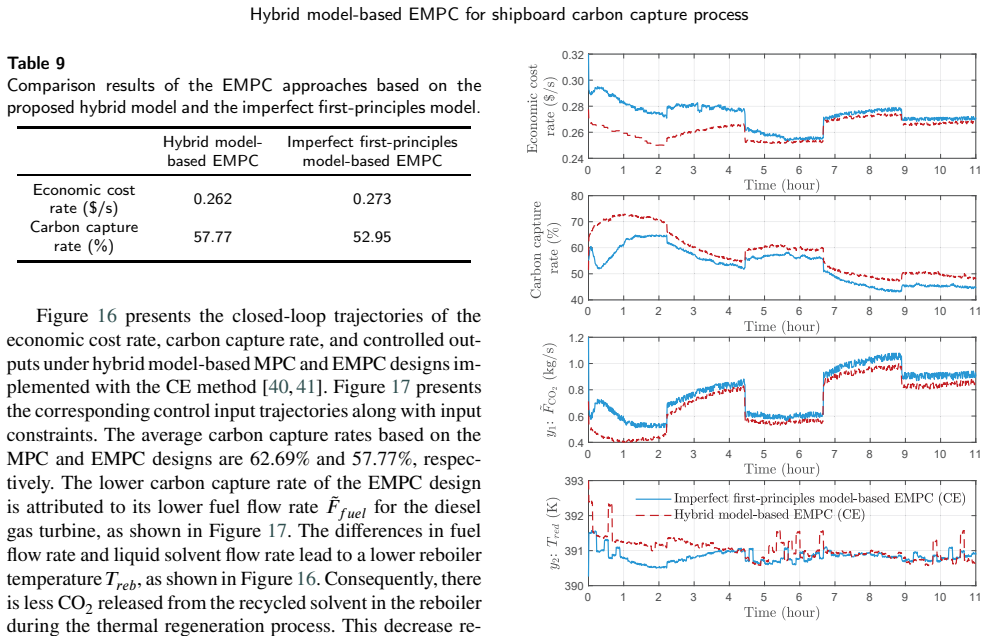
The central claim is that the gap between an imperfect large-scale first-principles model of a shipboard carbon capture plant and the plant's true dynamics can be closed by two small feedforward networks, and that the resulting hybrid model is accurate enough to support economic model predictive control. DNN1 replaces the algebraic constraint of the DAE system with a learned static map from differential states, control inputs, and engine load to the seven algebraic states, so online prediction no longer requires solving the full DAE. DNN2 learns the residual between the imperfect model's one-step-ahead differential states and the ground truth, and the hybrid prediction is the sum of the physics-based prediction and this learned correction. The authors report that this hybrid model cuts 1800-step-ahead open-loop prediction mean-squared error by 91.86% for differential states and 58.33% for algebraic states relative to the imperfect first-principles model, and that it matches or beats purely data-driven neural networks with substantially less training data, including on operating conditions not seen in training. In closed loop, the hybrid-model-based EMPC achieves an average economic cost rate of 0.262 USD/s versus 0.285 USD/s for set-point tracking MPC, an 8.07% reduction, and a 4.20% cost reduction with a 9.10% capture-rate improvement relative to EMPC built on the imperfect first-principles model alone.
Load-bearing premise
The comprehensive first-principles model in Eq. (14) is treated as the ground truth for a real shipboard carbon capture plant, and it is never validated against measurements from an actual ship.
Editorial extensions
If this is right
- The hybrid model reduces 1800-step-ahead prediction error by 91.86% for differential states and 58.33% for algebraic states compared to the imperfect first-principles model, and it needs far fewer training samples than purely data-driven neural networks.
- The hybrid-model-based EMPC cuts average economic cost by 8.07% versus set-point tracking MPC (0.262 USD/s vs 0.285 USD/s) while keeping the average capture rate at 57.77%.
- The hybrid-model-based EMPC also beats EMPC built on the imperfect first-principles model, with a 4.20% cost reduction and a 9.10% higher average carbon capture rate.
- Using the cross-entropy method, the EMPC optimization can be solved faster than with IPOPT (up to 88.41% time reduction) or SQP (up to 44.58% reduction) across the tested control horizons, making online implementation more plausible.
- A hybrid model trained only on slow-steaming data still tracks states under maneuvering and low-load conditions better than a purely data-driven model, indicating that embedding physics improves extrapolation to unseen operating regimes.
Reading between the lines
- Editorial extrapolation: if the simulator faithfully represents a real ship, the 8.07% per-second cost reduction would amplify over a ship's operating lifetime; the paper reports only per-second rates and does not compute voyage-level or annual savings.
- The two-network correction structure (infer algebraic states, learn the residual) is not limited to carbon capture: any large-scale process model with uncertain parameters could use the same split, though the paper does not make or test that claim.
- A natural next step not pursued here is validating the ground-truth simulator against pilot-plant or onboard data; without that, the reported cost and accuracy gains are conditional on Eq. (14) being a faithful surrogate.
- The CE-based solver's stochastic sampling suggests a testable variant in which the sampled control sequences are used to estimate constraint-violation probabilities, turning the hard output constraints into chance constraints; the paper keeps constraints deterministic.
Editorial analysis
A structured set of objections, weighed in public.
Referee Report
Summary. The paper develops a hybrid dynamic model and an economic model predictive controller for an integrated ship-engine/post-combustion carbon capture process. The hybrid model combines an imperfect first-principles DAE model with two feedforward neural networks: one infers algebraic states and one compensates for the one-step differential-state mismatch. The EMPC minimizes an economic cost that includes CO2 tax and gas-turbine fuel cost, and is solved with the cross-entropy method. Simulation results show that the hybrid model reduces open-loop prediction error relative to the imperfect model and to purely data-driven networks, and that the EMPC achieves an average economic cost rate of $0.262/s versus $0.285/s for set-point tracking MPC, an 8.07% reduction, with a 57.77% average capture rate versus 62.69%. The paper explicitly notes in Section 3.3 that the ground-truth data are generated by the first-principles simulator and are not experimental data.
Significance. If taken as a simulation-based proof of concept, the proposed architecture is a useful contribution to hybrid modeling of DAE process systems: the algebraic-state inference network is a natural way to avoid repeated DAE solves, the training objectives are clearly stated, and the comparisons against purely data-driven models and against alternative solvers are informative. The paper is transparent about the simulator being the ground truth, and the strengths of the work include the explicit DAE-aware hybrid structure, the data-efficiency comparison, and the reproducible-looking algorithmic descriptions. The main limitation is that the central quantitative claims are established only for a smooth, structured, low-dimensional model-plant mismatch generated from the same simulator, and one architectural detail (training of the compensation network with ground-truth algebraic states) is inconsistent with deployment.
major comments (5)
- [Section 3.3, Section 5.1.1, Section 5.4.2] The evaluation is entirely internal to one simulator. Section 3.3 states that the ground-truth data are generated with the comprehensive first-principles model in Eq. (14), and Section 5.1.1 explains that the imperfect model is formed by changing only four empirical constants (gas and liquid mass-transfer coefficients from 5.23 to 3.08 and from 0.0051 to 0.0031, interfacial heat-transfer coefficient times 0.8, and desorption enhancement factor times 1.05). Consequently, the 8.07% cost reduction and the 9.10% capture-rate improvement reported in Section 5.4 are demonstrations that the architecture can compensate this specific parametric mismatch; they are not evidence about realistic shipboard operation, where structural error, unmeasured disturbances, and sensor noise are present. I ask the authors to add mismatch scenarios outside this parametric family (e.g., unmodeled dynamics or stochastic disturbances) or pilot-plant data, and to rephrase the abstract and conclusion claims as simulator-based rather than as general operational improvements.
- [Section 3.4, Algorithm 2, Eq. (22)] There is a training/deployment mismatch for the dynamics-compensation network. Algorithm 2 trains DNN2 using the ground-truth algebraic states Z, and the objective in Eq. (20) is evaluated with the true z_k. In the deployed hybrid model of Eq. (22), however, DNN2 receives the algebraic states inferred by DNN1, not the ground-truth values. Since Table 6 reports a nonzero algebraic-state MSE for DNN1, DNN2 is used in closed loop on inputs it was not trained on. Please either train DNN2 end-to-end through DNN1, or augment the training data with DNN1 predictions, and report the effect on the open-loop and closed-loop predictions.
- [Section 5.3.3, Table 8] The claim of 'superior generalization capability' is overstated. In Case II, the hybrid model trained on Condition 1 achieves an MSE of 0.0040 on Condition 1 and 0.0101 on Condition 2, but its MSE on Condition 3 is 0.1852, roughly 46 times the in-distribution error. The relative comparison against the NN1 baseline (0.8784 on Condition 3) is valid, but the absolute accuracy under the low-engine-load condition is poor. The paper should either provide an absolute accuracy criterion, analyze the failure mode, or soften the generalization claim in the highlights and conclusion.
- [Section 4.1, Section 5.4.1] The 8.07% cost reduction of EMPC over set-point tracking MPC is by construction rather than a discovery: the same economic function L1 in Eq. (23) is used both as the EMPC objective and as the evaluation metric, while the set-point MPC minimizes a quadratic tracking cost. This comparison is still informative, but the text should state explicitly that the result is a consequence of the chosen objective, and it should include a sensitivity analysis with respect to the carbon tax α, the fuel price β, and the CO2 release threshold y_min to show how robust the reported reduction is.
- [Section 5.4.1, Contribution (d)] The paper describes the effect on carbon capture as a 'small impact', but the reported average capture rate drops from 62.69% under MPC to 57.77% under EMPC, a decrease of 4.92 percentage points in the process's primary environmental metric. This is a substantive trade-off and should be quantified in the contribution claim, for example by reporting the cost per tonne of CO2 captured or an explicit trade-off curve, rather than only the economic cost rate.
minor comments (4)
- [Table 10] Table 10 swaps the solver labels: the text and the reference list identify IPOPT as [68] and SQP as [69], but the table header assigns 'SQP [68]' and 'IPOPT [69]'.
- [Section 4.3, after Eq. (26)] The sentence 'As λ decreases, the updates converge faster to the new distribution' appears to be the reverse of the behavior of the moving-average update in Eq. (26): a smaller λ makes the mean and covariance move more slowly toward the elite-sample statistics.
- [Throughout] Several typographical errors should be corrected, including 'acheives' in Section 5.4.2, 'trajectoris' in the caption of Figure 13, 'suh' in Section 1, 'Mode mass of CO2' in Table 3, and 'volumne' in Table A.1.
- [Section 5.1.1] When comparing data efficiency between the hybrid model and the purely data-driven baselines, the text states that the structures are the same except for the number of neurons. Reporting the total number of trainable parameters and training time for each model would make the comparison more conclusive.
Circularity Check
No circularity: the hybrid model and EMPC results are genuine out-of-sample simulations; the unvalidated-simulator caveat affects external validity, not derivation circularity.
full rationale
The paper's derivation chain is self-contained and non-circular. The dynamics-compensation network is trained to fit the residual between the imperfect first-principles model and the simulator (Eqs. 18-21), but the reported modeling errors are evaluated on held-out test data over 1800-step open-loop horizons (Figs. 7-14, Tables 6-8), so the accuracy claims are out-of-sample predictions rather than re-statements of training targets. The EMPC comparison is likewise a closed-loop simulation in which the controller minimizes a cost function that explicitly includes fuel price and carbon tax (Eq. 23); observing lower fuel use and an 8.07% cost reduction is the expected consequence of the stated economic objective, not a fitted constant renamed as a prediction. Self-citations ([13], [23], [39]) serve as background, baselines, or prior model equations, and no uniqueness or forcing theorem is imported from them. The paper explicitly discloses that ground-truth data are generated by the first-principles simulator and are not real experimental data (Section 3.3), and that the imperfect model is a structured parameter perturbation of that simulator (Section 5.1.1). This is a genuine external-validity limitation, since the simulator is not validated against shipboard plant data, but it does not make any derivation step reduce to its own inputs.
Assumptions & free parameters
free parameters (3)
- Imperfect model perturbation factors =
mass transfer constants 3.08 and 0.0031; heat transfer coefficient x0.8; enhancement factor x1.05
- Neural network hyperparameters =
layers 107-150-7 and 114-600-103; batch size 200; epochs 1000; learning rate 1e-4
- EMPC and CE method parameters =
carbon tax $0.05/kg, fuel price $1.2852/kg, CO2 threshold 0.5 kg/s, horizon Np=5, update every 10 samples; CE…
assumptions (4)
- domain assumption The first-principles mass/energy balance equations in Eqs. (5)-(12) accurately describe the ideal shipboard PCC process.
- domain assumption Amine degradation reactions and other side reactions are negligible.
- standard math Neural networks with one hidden layer can approximate the algebraic state map and the dynamics mismatch sufficiently well.
- ad hoc to paper The deliberately perturbed imperfect model represents a realistic level of model uncertainty.
Cite this review
Pith. "Pith review of Machine learning-based hybrid dynamic modeling and economic predictive control of carbon capture process for ship decarbonization." pith.science (2026). https://pith.science/paper/NI4YACP4
@misc{pith2026250205833,
  author       = {Pith},
  title        = {Pith review of: Machine learning-based hybrid dynamic modeling and economic predictive control of carbon capture process for ship decarbonization},
  year         = {2026},
  howpublished = {\url{https://pith.science/paper/NI4YACP4}},
  note         = {Machine review of arXiv:2502.05833}
}
read the original abstract
Implementing carbon capture technology on-board ships holds promise as a solution to facilitate the reduction of carbon intensity in international shipping, as mandated by the International Maritime Organization. In this work, we address the energy-efficient operation of shipboard carbon capture processes by proposing a hybrid modeling-based economic predictive control scheme. Specifically, we consider a comprehensive shipboard carbon capture process that encompasses the ship engine system and the shipboard post-combustion carbon capture plant. To accurately and robustly characterize the dynamic behaviors of this shipboard plant, we develop a hybrid dynamic process model that integrates available imperfect physical knowledge with neural networks trained using process operation data. An economic model predictive control approach is proposed based on the hybrid model to ensure carbon capture efficiency while minimizing energy consumption required for the carbon capture process operation. The cross-entropy method is employed to efficiently solve the complex non-convex optimization problem associated with the proposed hybrid model-based economic model predictive control method. Extensive simulations, analyses, and comparisons are conducted to verify the effectiveness and illustrate the superiority of the proposed framework.
Figures


Figures from the paper (16 more)




Reference graph
Works this paper leans on
-
[1]
H. Bach and T. Hansen. IMO off course for decarboni- sation of shipping? Three challenges for stricter policy. Marine Policy, 147:105379, 2023
work page 2023
-
[2]
Y . Bicer and I. Dincer. Clean fuel options with hydro- gen for sea transportation: A life cycle approach. In- ternational Journal of Hydrogen Energy , 43(2):1179– 1193, 2018
work page 2018
- [3]
-
[4]
Marine Environment Protection Commit- tee, Resolution, 2023
2023 IMO strategy on reduction of GHG emissions from ships. Marine Environment Protection Commit- tee, Resolution, 2023
work page 2023
- [5]
-
[6]
P. T. Aakko-Saksa, K. Lehtoranta, N. Kuittinen, A. Järvinen, J. Jalkanen, K. Johnson, H. Jung, L. Ntzi- achristos, S. Gagné, C. Takahashi, P. Karjalainen, T. Rönkkö, and H. Timonen. Reduction in greenhouse gas and other emissions from ship engines: Current trends and future options. Progress in Energy and Combustion Science, 94:101055, 2023
work page 2023
-
[7]
Y . Wang, Q. Cao, L. Liu, Y . Wu, H. Liu, Z. Gu, and C. Zhu. A review of low and zero carbon fuel technologies: Achieving ship carbon reduction targets. Sustainable Energy Technologies and Assessments , 54:102762, 2022
work page 2022
-
[8]
M. Feenstra, J. Monteiro, J. T. van den Akker, M. R. Abu-Zahra, E. Gilling, and E. Goetheer. Ship- based carbon capture onboard of diesel or LNG-fuelled ships. International Journal of Greenhouse Gas Con- trol, 85:1–10, 2019
work page 2019
Show all 70 references
-
[9]
Luo and M
X. Luo and M. Wang. Study of solvent-based carbon capture for cargo ships through process modelling and simulation. Applied Energy, 195:402–413, 2017
2017
-
[10]
J. A. Ros, E. Skylogianni, V . Doedée, J. T. van den Akker, A. W . Vredeveldt, M. J. G. Linders, E. L. V . Goetheer, and J. G. M. Monteiro. Ad- vancements in ship-based carbon capture technology on board of LNG-fuelled ships. International Journal of Greenhouse Gas Control, 11...
2022
-
[11]
Bayramoğlu
K. Bayramoğlu. Application of post-combustion car- bon capture process in marine diesel engine. Energy Sources, Part A: Recovery, Utilization, and Environ- mental Effects , 45(4):10909–10925, 2023
2023
-
[12]
D. N. Vo, X. Zhang, K. W . Huang, and X. Yin. Ad- vanced designs and optimization for efficiently enhanc- ing shipboard CO 2 capture. Industrial & Engineering Chemistry Research, 63(48):20963–20977, 2024
2024
-
[13]
Decardi-Nelson, S
B. Decardi-Nelson, S. Liu, and J. Liu. Improving flexibility and energy efficiency of post-combustion CO2 capture plants using economic model predictive control. Processes, 6(9):135, 2018
2018
-
[14]
Morari and L
M. Morari and L. J. Lee. Model predictive control: past, present and future. Computers & Chemical Engineering, 23(4-5):667–682, 1999. Xuewen. Zhang et al.: Preprint submitted to Elsevier Page 22 of 25 Hybrid model-based EMPC for shipboard carbon capture proce ss
1999
-
[15]
M. H. Sahraei and L. A. Ricardez-Sandoval. Control- lability and optimal scheduling of a CO 2 capture plant using model predictive control. International Journal of Greenhouse Gas Control , 30:58–71, 2014
2014
-
[16]
Z. He, M. H. Sahraei, and L. A. Ricardez-Sandoval. Flexible operation and simultaneous scheduling and control of a CO 2 capture plant using model predictive control. International Journal of Greenhouse Gas Control, 48:300–311, 2016
2016
-
[17]
H. Jung, S. Heo, and J. H. Lee. Model predictive control for amine-based CO2 capture process with advanced flash stripper Control Engineering Practice, 114:104885, 2021
2021
-
[18]
Zhang, R
Q. Zhang, R. Turton, and D. Bhattacharyya. De- velopment of model and model-predictive control of an MEA-based postcombustion CO 2 capture pro- cess. Industrial & Engineering Chemistry Research , 55(5):1292–1308, 2016
2016
-
[19]
Zhang, R
Q. Zhang, R. Turton, and D. Bhattacharyya. Nonlinear model predictive control and H ∞ robust control for a post-combustion CO 2 capture process. Interna- tional Journal of Greenhouse Gas Control , 70:105– 116, 2018
2018
-
[20]
T. E. Akinola, E. Oko, X. Wu, K. Ma, and M. Wang. Nonlinear model predictive control (NMPC) of the solvent-based post-combustion CO 2 capture process. Energy, 213:118840, 2020
2020
-
[21]
Panahi and S
M. Panahi and S. Skogestad. Economically efficient operation of CO 2 capturing process. Part II. Design of control layer. Chemical Engineering and Processing: Process Intensification , 52:112–124, 2012
2012
-
[22]
G. D. Patrón and L. Ricardez-Sandoval. An integrated real-time optimization, control, and estimation scheme for post-combustion CO 2 capture. Applied Energy , 308:118302, 2022
2022
-
[23]
Han and X
M. Han and X. Yin. Deep neural Koopman operator-based economic model predictive control of shipboard carbon capture system. arXiv preprint arXiv:2504.06818, 2025. [Online]. Available: https://arxiv.org/abs/2504.06818
2025 arXiv
-
[24]
Harun, T
N. Harun, T. Nittaya, P. L. Douglas, E. Croiset, and L. A. Ricardez-Sandoval. Dynamic simulation of MEA absorption process for CO 2 capture from power plants. International Journal of Greenhouse Gas Con- trol, 10:295–309, 2012
2012
-
[25]
X. Yin, B. Decardi-Nelson, and J. Liu. Distributed monitoring of the absorption column of a post- combustion CO2 capture plant. International Journal of Adaptive Control and Signal Processing, 34(6):757– 776, 2020
2020
-
[26]
M. S. F. Bangi and J. S. Kwon. Deep hybrid modeling of chemical process: Application to hydraulic fractur- ing. Computers & Chemical Engineering, 134:106696, 2020
2020
-
[27]
P. Shah, M. Z. Sheriff, M. S. F. Bangi, C. Kravaris, J. S. I. Kwon, C. Botre, and J. Hirota. Deep neu- ral network-based hybrid modeling and experimental validation for an industry-scale fermentation process: Identification of time-varying dependencies among pa- rameters. Chemic...
2022
-
[28]
Ghosh, E
D. Ghosh, E. Hermonat, P. Mhaskar, S. Snowling, and R. Goel. Hybrid modeling approach integrat- ing first-principles models with subspace identifica- tion. Industrial & Engineering Chemistry Research , 58(30):13533–13543, 2019
2019
-
[29]
Oliveira
R. Oliveira. Combining first principles modelling and artificial neural networks: a general framework. Computers & Chemical Engineering , 28(5):755–766, 2004
2004
-
[30]
H. T. Su, N. Bhat, P. A. Minderman, and T. J. McAvoy. Integrating neural networks with first principles mod- els for dynamic modeling. IFAC Proceedings Volumes, 25:327–332, 1992
1992
-
[31]
M. A. Hosen, M. A. Hussain, and F. S. Mjalli. Control of polystyrene batch reactors using neural network based model predictive control (NNMPC): An exper- imental investigation. Control Engineering Practice , 19(5):454–467, 2011
2011
-
[32]
D. C. Psichogios and L. H. Ungar. A hybrid neural network-first principles approach to process modeling. AIChE Journal, 38(10):1499–1511, 1992
1992
-
[33]
J. B. Rawlings, D. Angeli, and C. N. Bates. Fundamen- tals of economic model predictive control. IEEE Con- ference on Decision and Control , 3851–3861, 2021, Maui, Hawaii, USA
2021
-
[34]
Ellis, H
M. Ellis, H. Durand, and P. D. Christofides. A tutorial review of economic model predictive control methods. Journal of Process Control , 24(8):1156–1178, 2014
2014
-
[35]
L. Wu, X. Yin, L. Pan, and J. Liu. Economic model pre- dictive control of integrated energy systems: A multi- time-scale framework. Applied Energy , 328:120187, 2022
2022
-
[36]
Zhang, X
A. Zhang, X. Yin, S. Liu, J. Zeng, and J. Liu. Dis- tributed economic model predictive control of wastew- ater treatment plants. Chemical Engineering Research and Design, 141:144–155, 2019
2019
-
[37]
M. Han, J. Yao, A. W . K. Law, and X. Yin. Efficient economic model predictive control of water treatment process with learning-based Koopman operator. Con- trol Engineering Practice, 149:105975, 2024. Xuewen. Zhang et al.: Preprint submitted to Elsevier Page 23 of 25 Hybrid mod...
2024
-
[38]
H. Tian, Q. Lu, R. B. Gopaluni, V . M. Zavala, and J. A. Olson. An economic model predictive control framework for mechanical pulping processes. Control Engineering Practice, 85:100–109, 2019
2019
-
[39]
Zhang, K
X. Zhang, K. W . Huang, D. N. Vo, M. Han, B. Decardi- Nelson, and X. Yin. Learning-enabled hybrid model- ing and economic predictive control of carbon capture process for ship decarbonization. 2024 AIChE Annual Meeting, 2024, San Diego, CA
2024
-
[40]
Wen and U
M. Wen and U. Topcu. Constrained cross-entropy method for safe reinforcement learning. Advances in Neural Information Processing Systems 31 , 2018, Montréal, Canada
2018
-
[41]
Z. Liu, H. Zhou, B. Chen, S. Zhong, M. Hebert, and D. Zhao. Constrained model-based reinforcement learning with robust cross-entropy method. arXiv preprint arXiv:2010.07968, 2020
2010 arXiv
-
[42]
Wärtsilä, 2020
Wärtsilä 46F product guide. Wärtsilä, 2020
2020
-
[43]
Winnes and E
H. Winnes and E. Fridell. Emissions of NO /u1D44Band parti- cles from manoeuvring ships. Transportation Research Part D: Transport and Environment , 15(4):205–211, 2010
2010
-
[44]
H. H. Tai and Y . H. Chang. Reducing pollutant emis- sions from vessel maneuvering in port areas. Maritime Economics & Logistics , 24(3):651–671, 2022
2022
-
[45]
H. N. Psaraftis and C. A. Kontovas. Ship speed optimization: Concepts, models and combined speed- routing scenarios. Transportation Research Part C: Emerging Technologies, 44:52–69, 2014
2014
-
[46]
A. Fan, J. Yang, L. Yang, D. Wu, and N. Vladimir. A review of ship fuel consumption models. Ocean Engineering, 264:112405, 2022
2022
-
[47]
Jouhara, N
H. Jouhara, N. Khordehgah, S. Almahmoud, B. Delpech, A. Chauhan, and S. A. Tassou. Waste heat recovery technologies and applications. Thermal Science and Engineering Progress, 6:268–289, 2018
2018
-
[48]
S. N. Danov and A. K. Gupta. Modeling the performance characteristics of diesel engine based combined-cycle power plants—Part I: Mathematical models. Journal of Engineering for Gas Turbines and Power, 126(1):28–34, 2004
2004
-
[49]
C. Chao, Y . Deng, R. Dewil, J. Baeyens, and X. Fan. Post-combustion carbon capture. Renewable and Sus- tainable Energy Reviews, 138:110490, 2021
2021
-
[50]
B. Metz, O. Davidson,H. C. De Coninck, M. Loos, and L. Meyer. IPCC special report on carbon dioxide cap- ture and storage. Cambridge: Cambridge University Press, 2005
2005
-
[51]
C. Alie, P. Douglas, and E. Croiset. Simulation and optimization of a coal-fired power plant with integrated CO2 capture using MEA scrubbing. International Conference on Greenhouse Gas Control Technologies, 2006, Trondhein, Norway
2006
-
[52]
J. A. E. Andersson, J. Gillis, G. Horn, J. B. Rawlings, and M. Diehl. CasADi: a software framework for non- linear optimization and optimal control. Mathematical Programming Computation, 11:1–36, 2019
2019
-
[53]
K. Onda, H. Takeuchi, and Y . Okumoto. Mass transfer coefficients between gas and liquid phases in packed columns. Journal of Chemical Engineering of Japan , 1(1):56–62, 1968
1968
-
[54]
Geankoplis
C. Geankoplis. Transport processes and separation process principles (includes unit operations). Prentice Hall Press, 2003
2003
-
[55]
F. A. Tobiesen, O. Juliussen, and H. F. Svendsen. Ex- perimental validation of a rigorous desorber model for CO2 post-combustion capture. Chemical Engineering Science, 63(10):2641–2656, 2008
2008
-
[56]
Bebis and M
G. Bebis and M. Georgiopoulos. Feed-forward neural networks. IEEE Potentials, 13(4):27–31, 1994
1994
-
[57]
Y . Yu, X. Si, C. Hu, and J. Zhang. A review of recurrent neural networks: LSTM cells and network architectures. Neural Computation, 31(7):1235–1270, 2019
2019
-
[58]
Vatankhah and M
B. Vatankhah and M. Farrokhi. Nonlinear adaptive model predictive control of constrained systems with offset-free tracking behavior.Asian Journal of Control, 21(5):2232–2244, 2019
2019
-
[59]
S. H. Hong, J. Cornelius, Y . Wang, and K. Pant. Fault compensation by online updating of genetic algorithm- selected neural network model for model predictive control. SN Applied Sciences , 1:1–16, 2019
2019
-
[60]
K. R. Muske and J. B. Rawlings. Nonlinear moving horizon state estimation. Methods of Model Based Process Control, 349–365, 1995
1995
-
[61]
Alsac, N
O. Alsac, N. Vempati, B. Stott, and A. Monticelli. Generalized state estimation. IEEE Transactions on Power Systems, 13(3):1069–1075
-
[62]
Yin and J
X. Yin and J. Liu. Distributed moving horizon state estimation of two-time-scale nonlinear systems. Auto- matica, 79:152–161, 2017
2017
-
[63]
P. T. De Boer, D. P. Kroese, S. Mannor, and R. Y . Ru- binstein. A tutorial on the cross-entropy method. Annals of Operations Research, 134:19–67, 2005
2005
-
[64]
Bharadhwaj, K
H. Bharadhwaj, K. Xie, and F. Shkurti. Model- predictive control via cross-entropy and gradient-based optimization. Learning for Dynamics and Control , 277–286, 2020. Xuewen. Zhang et al.: Preprint submitted to Elsevier Page 24 of 25 Hybrid model-based EMPC for shipboard carbo...
2020
-
[65]
Ben Salah, P
S. Ben Salah, P. Nancarrow, and A. Al Othman. Desul- furization of diesel using ionic liquids: Process design and optimization using COSMO-based models and Aspen Plus. ACS Omega, 8(33):30001–30023, 2023
2023
-
[66]
Faber, D
J. Faber, D. Nelissen, G. Hon, H. Wang, and M. Tsim- plis. Regulated slow steaming in maritime transport. An assessment of options, costs and benefits. CE Delft, 2012
2012
-
[67]
Pelić, O
V . Pelić, O. Bukovac, R. Radonja, and N. Degiuli. The impact of slow steaming on fuel consumption and CO2 emissions of a container ship. Journal of Marine Science and Engineering , 11(3):675, 2023
2023
-
[68]
Wächter and L
A. Wächter and L. T. Biegler. On the implemen- tation of an interior-point filter line-search algorithm for large-scale nonlinear programming. Mathematical Programming, 106:25–57, 2006
2006
-
[69]
Version 9.12.0.2009381 (R2022a)
MATLAB. Version 9.12.0.2009381 (R2022a). Natick, Massachusetts: The MathWorks Inc., 2022. Xuewen. Zhang et al.: Preprint submitted to Elsevier Page 25 of 25
2022
-
[2013]
European Commission, 2013
2013
Reviewed August 8, 2026 · model on record in the stance chip above.
Discussion (0). Continue with ORCID to comment.