REVIEW 2 major objections 4 minor 23 references
D-splitting methods: 2N -storage embedded explicit pseudo-geometric Runge-Kutta methods using splitting methods
T0 review · 2 major / 4 minor · reviewed 2026-07-13 · grok-4.5
Pith's one-line read Splitting methods on a duplicated phase space give 2N-storage embedded Runge–Kutta schemes of any order, without a third register, and can raise order by averaging.
desk verdict Clean, usable map from duplicated-phase-space splitting to 2N-storage embedded RK of any order; order-elevation and pseudo-geometry are real but only partly developed. read the letter →
The pith
A machine-rendered reading of the paper's core claim, the machinery that carries it, and where it could break.
The reading
What carries the argument
The duplicated-phase-space splitting (D-splitting): the autonomous ODE is rewritten as the separable pair u′=f(v), v′=f(u); any s-stage splitting composition then yields an explicit 2s-stage RK tableau whose only free storage is the pair (u,v), with the difference providing an embedded error estimate and the average optionally elevating the order.
What would settle it
Construct a D-splitting whose coefficients satisfy the stated antisymmetry condition yet whose average fails to gain the predicted extra order on a smooth nonlinear test problem, or show that energy or mass error grows at the formal order rather than higher.
Extended reading notes
Core claim
D-splitting methods—splitting methods written on the extended phase space u′=f(v), v′=f(u)—are exactly 2N-storage embedded explicit Runge–Kutta schemes of arbitrary order. The average of the two final vectors raises the order whenever the leading error operator is antisymmetric under interchange of the two fields, and the same schemes act as pseudo-geometric integrators that conserve qualitative properties beyond their formal order.
Load-bearing premise
The cancellations that raise order and give extra geometric accuracy rest on the special (non-free) Lie algebra of the duplicated operators; the paper shows one algebraic condition and one example, but treats the general structure as still open.
Editorial analysis
A structured set of objections, weighed in public.
Referee Report
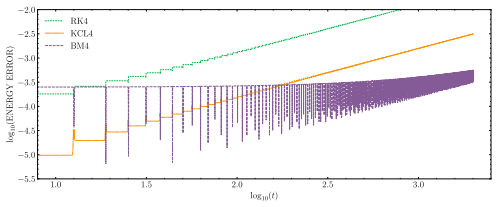
Summary. The paper shows that splitting methods applied to the duplicated phase space (u'=f(v), v'=f(u)) produce explicit Runge–Kutta schemes that are 2N-storage by construction and come with a free embedded error estimate ||u_s-v_s||, without a third register. The average (u_s+v_s)/2 inherits the order p of the underlying splitting method; under an antisymmetry condition on the leading error operator the average can raise the order further. Existing optimised splitting coefficients (BM4, BM6) are reused as 2N-storage RK methods, a new symmetric 4th-order splitting that becomes 6th-order after averaging (2N-S6) is given, and the schemes are tested on a linear wave equation and the Kepler problem, where they exhibit competitive efficiency and pseudo-symplectic energy behaviour.
Significance. The construction supplies a transparent route from the large literature on splitting methods to high-order 2N-storage embedded RK schemes, which is practically valuable for method-of-lines discretisations of high-dimensional PDEs where memory is the bottleneck. The Butcher tableau (8), the embedding via the difference of the two copies, and the recovery of a rejected step by the inverse method are correctly derived and immediately usable. Numerical evidence for efficiency and for higher-order conservation is concrete. The algebraic cancellations that enable order elevation and the precise characterisation of pseudo-geometric preservation are only partially developed, but the authors flag these gaps; the basic algorithmic claim does not depend on them.
major comments (2)
- [§3.2, Eq. (9) and 2N-S6 coefficients] Section 3.2 and Eq. (9): the order-elevation claim that underpins the construction of tailored methods with reduced stage counts rests on a single algebraic condition and a single numerical example (2N-S6). Because the Lie algebra generated by the duplicated operators is not free, satisfaction of (9) alone does not automatically guarantee that all higher-order error terms cancel after averaging. A short verification (e.g., expansion of the averaged map up to order 6, or the corresponding Butcher order conditions) is needed to confirm that 2N-S6 is rigorously order 6 rather than merely order 4 with a cancelled leading term.
- [§3.3 and Conclusions] Section 3.3 and the Conclusions: the assertion that the methods are “pseudo-geometric” (preserving mass/energy to higher order than the formal order) is supported only by numerical observation and a citation to related work on Hamiltonian systems. No general statement of the order of preservation, nor a backward-error argument for the averaged map, is supplied. Since the abstract and title advertise this property, a minimal theoretical characterisation (or an explicit disclaimer that it remains observational) is required for the claim to be load-bearing.
minor comments (4)
- [throughout] Numerous typographical errors appear throughout (e.g., “showh”, “importat”, “requeired”, “Howen”, “V alència”, inconsistent hyphenation of “pseudo-geometric”). A careful proof-reading pass is needed.
- [§3.3, Figure 1] Figure 1 caption and axis labels should state the precise norms used and the range of step sizes; the stability restriction mentioned in the text is not quantified, which makes the efficiency comparison harder to interpret for hyperbolic problems.
- [Conclusions] The non-autonomous extension at the end of the Conclusions is correct but terse; a one-line remark that the same Butcher coefficients c^{[a]}_i, c^{[b]}_i already appear in the autonomous tableau would improve readability.
- [References] Reference [14] misspells van der Houwen; several arXiv preprints are cited without final publication data where available.
Circularity Check
No significant circularity: D-splitting construction and order claims are self-contained; BM4/BM6 reuse is ordinary citation of published coefficients, not a forced derivation.
-
self citation load bearing
[Section 3.1, BM4/BM6 coefficients and citation [4]]
"one can use the already existing optimised splitting methods from the literature [19, 22] (see also [7] and references there in). At order p=4 o o o the optimised method (BM4) [4] o o o and at order p=6 o o o (BM6) [4]."
The concrete high-order coefficient sets BM4 and BM6 are imported from the authors’ earlier paper rather than re-derived. The citation is not load-bearing for the algorithmic claim (any consistent splitting of order p yields a 2N-storage RK of order p via (8)); it merely supplies convenient numerical values. The circularity is therefore minor and does not force the central result.
full rationale
The central claim maps known splitting methods on the duplicated system (7) to the explicit 2N-storage RK scheme (8) and the embedding via ||u_s - v_s||. That mapping is derived directly from the flows of the two trivially integrable vector fields and does not reduce to a fit or to a self-citation that itself asserts the target result. Order elevation is obtained from the algebraic condition (9) on the leading error operators; the 2N-S6 coefficients are newly chosen to satisfy that condition and are not fitted to the numerical examples. BM4 and BM6 are taken from Blanes–Moan (2002) and simply re-used as 2N-storage schemes; this is ordinary self-citation of published methods whose order and coefficients were established independently of the present 2N-storage interpretation. Numerical comparisons employ independent classical baselines (Heun, classical RK4, Kennedy–Carpenter KCL4). The paper itself flags the non-free Lie algebra and the pseudo-geometric observations as open for further investigation, so those claims are not presented as closed first-principles derivations. Consequently the derivation chain contains no step that is equivalent to its inputs by construction.
Assumptions & free parameters
free parameters (2)
- 2N-S6 splitting coefficients (a1,a2,a3,b1,b2) =
a1≈0.34117711626608893, a2≈−0.11556397880852943, a3≈0.0091007844006896624, b1≈−0.19048598865349396, b2≈−0.43215518907354
- BM4 / BM6 coefficients (from Blanes–Moan 2002) =
as listed in §3.1 (e.g. BM4 a1≈0.07920369643119565, …)
assumptions (4)
- standard math Standard order theory for composition/splitting methods via BCH/Lie operators: a consistent composition of flows has an asymptotic expansion in nested commutators.
- standard math The duplicated system u'=f(v), v'=f(u) with u(t0)=v(t0)=x0 has solution u(t)=v(t)=x(t), so any consistent integrator of the split system approximates the original ODE.
- domain assumption For non-stiff high-dimensional MOL systems, explicit low-storage RK methods are the relevant efficiency class (storage and force evaluations dominate).
- ad hoc to paper If Ê_{p+1}(Â[1],Â[2]) = −Ê_{p+1}(Â[2],Â[1]), averaging cancels the order-p error and raises the order of (u_s+v_s)/2 (by two if the scheme is symmetric).
invented entities (2)
-
D-splitting methods
independent evidence
-
Pseudo-geometric / pseudo-symplectic 2N-storage RK methods (as framed here)
Cite this review
Pith. "Pith review of D-splitting methods: 2N -storage embedded explicit pseudo-geometric Runge-Kutta methods using splitting methods." pith.science (2026). https://pith.science/paper/NIJ3GZGZ
@misc{pith2026260403457,
  author       = {Pith},
  title        = {Pith review of: D-splitting methods: 2N -storage embedded explicit pseudo-geometric Runge-Kutta methods using splitting methods},
  year         = {2026},
  howpublished = {\url{https://pith.science/paper/NIJ3GZGZ}},
  note         = {Machine review of arXiv:2604.03457}
}
read the original abstract
Low-storage explicit Runge-Kutta schemes are particularly popular for the numerical integration of time-dependent partial differential equations based on the method-of-lines due to their efficiency and their reduced memory requirements. We show that D-splitting methods, splitting methods on the extended phase space, can be used as high performance 2N-storage embedded explicit RK methods without a third storage register. They are pseudo-geometric methods preserving some of the qualitative properties of the exact solution up to a higher order than the order of the method. Some of their properties are analysed, to build new tailored methods, and are tested on numerical examples.
Figures

Reference graph
Works this paper leans on
-
[1]
A. Bazavov, 2N-storage Runge-Kutta methods: Order conditions, general properties and some analytic solu- tions, arXiv:2506.07359, 2025
arXiv 2025
-
[2]
Blanes, On the construction of symmetric second order methods for ODEs, App
S. Blanes, On the construction of symmetric second order methods for ODEs, App. Math. Lett. 98 (2019), 41-48
2019
-
[3]
Blanes and F
S. Blanes and F. Casas, A Concise Introduction to Geometric Numerical Integration, Second revised ed. CRC Press, Boca Raton, 2025
2025
-
[4]
Blanes and P
S. Blanes and P. C. Moan, Practical symplectic partitioned Runge–Kutta and Runge–Kutta–Nystrom methods, J. Comput. Appl. Math. 142 (2002), 313–330
2002
-
[5]
Blanes, F
S. Blanes, F. Casas, A. Escorihuela-Tomàs, Families of efficient low order processed composition methods, Appl. Num. Math. 204 (2024), 86-100
2024
-
[6]
Blanes, F
S. Blanes, F. Casas and J. Ros, Symplectic integrators with processing: a general study, SIAM J. Sci. Comput. 21 (1999), 711–727
1999
-
[7]
Blanes, F
S. Blanes, F. Casas, A. Murua, Splitting methods for differential equations, Acta Numerica (204), 1-161
-
[8]
Butcher, Numerical Methods for Ordinary Differential Equations, Third revised ed., John Wiley & Sons, Chichester, 2016
J.C. Butcher, Numerical Methods for Ordinary Differential Equations, Third revised ed., John Wiley & Sons, Chichester, 2016
2016
Show all 23 references
-
[9]
Calvo, J
M. Calvo, J. Franco, L. Rández, A new minimum storage Runge–Kutta scheme for computational acoustics, J. Comput. Phys. 201 (2004)1–12. 6
2004
-
[10]
Carpenter and C.A
M.H. Carpenter and C.A. Kennedy, Fourth-order 2N-storage Runge-Kutta schemes, Technical Report NASA- TM-109112, NASA (1994)
1994
-
[11]
Hairer, C
E. Hairer, C. Lubich, and G. Wanner, Geometric Numerical Integration. Structure-Preserving Algorithms for Ordinary Differential Equations, 2nd edition, Springer-Verlag, 2006
2006
-
[12]
Hairer, S.P
E. Hairer, S.P. Nørsett, and G. Wanner, Solving Ordinary Differential Equations I. Nonstiff Problems, 2nd ed., Springer-Verlag, 1993
1993
-
[13]
Higueras, J.I
I. Higueras, J.I. Montijano, L. Rández, Low-storage exponentially fitted explicit Runge-Kutta methods, Appl. Numer. Math. 217 (2025), 372-389
2025
-
[14]
van der Howen, Construction of Integration Formulas for Initial Value Problems, North-Holland Pub., Ams- terdam, 1977
P.J. van der Howen, Construction of Integration Formulas for Initial Value Problems, North-Holland Pub., Ams- terdam, 1977
1977
-
[15]
Iserles, A First Course in the Numerical Analysis of Differential Equations, 2nd ed
A. Iserles, A First Course in the Numerical Analysis of Differential Equations, 2nd ed. Cambridge University Press, Cambridge, 2008
2008
-
[16]
Kennedy, M.H
C.A. Kennedy, M.H. Carpenter, and R.M. Lewis, Low-storage, explicit Runge–Kutta schemes for the compress- ible Navier–Stokes equations, Appl. Num. Math. 35 (2000), 177-219
2000
-
[17]
Ketcheson, Runge-Kutta methods with minimum storage implementations, J.f Comput
D.I. Ketcheson, Runge-Kutta methods with minimum storage implementations, J.f Comput. Phys. 229(5), 1763–1773 (2010)
2010
-
[18]
McLachlan, Runge–Kutta methods determined from extended phase space methods for Hamiltonian sys- tems, Numer
R.I. McLachlan, Runge–Kutta methods determined from extended phase space methods for Hamiltonian sys- tems, Numer. Alg. 100 (2025), 983-993
2025
-
[19]
R. I. McLachlan and R. Quispel, Splitting methods, Acta Numerica 11 (2002), 341–434
2002
-
[20]
J. M. Sanz-Serna and M. P. Calvo, Numerical Hamiltonian Problems, AMMC 7. Chapman & Hall, 1994
1994
-
[21]
Trefethen,Spectral Methods in MATLAB, SIAM, 2000
L.N. Trefethen,Spectral Methods in MATLAB, SIAM, 2000
2000
-
[22]
Yoshida, Construction of higher order symplectic integrators, Phys
H. Yoshida, Construction of higher order symplectic integrators, Phys. Lett. A 150 (1990), 262–268
1990
-
[23]
Williamson, Low-storage Runge-Kutta schemes, J
J.H. Williamson, Low-storage Runge-Kutta schemes, J. Comput. Phys. 35 (1980), 48–56. 7
1980
Reviewed July 13, 2026 · model on record in the stance chip above.
Discussion (0). Continue with ORCID to comment.