REVIEW 2 major objections 4 minor 53 references
An Asymptotic-Preserving Dynamical Low-Rank Semi-Lagrangian Method for Multiscale Linear Kinetic Transport Equations
T0 review · 2 major / 4 minor · reviewed 2026-08-01 · deepseek-v4-flash
Pith's one-line read A low-rank semi-Lagrangian scheme keeps the diffusion limit while cutting cost
desk verdict A solid, genuinely useful combination of AP semi-Lagrangian and low-rank BUG with QDEIM angular sampling; the main gap is that the implemented NNLS weight fallback is not covered by the sampling-error analysis, though the diffusive-limit claim probably survives. read the letter →
The pith
A machine-rendered reading of the paper's core claim, the machinery that carries it, and where it could break.
The reading
What carries the argument
The central object is the weighted low-rank representation Y = F M = X S V^T of the kinetic distribution, with M diagonal in square-root quadrature weights, advanced by a BUG integrator. The second key mechanism is the QDEIM-sampled angular quadrature for the backtracked semi-Lagrangian flux derivative: an angular target space Z is built from the low-rank velocity basis such as [1, Q1, Q M^{-1} V], column-pivoted QR selects sampled directions, and effective weights enforce exactness on Z. The sampling error is then controlled by the distance of the flux vector to Z (Lemma 3), and in the diffusive limit the prefactor alpha_1/epsilon suppresses it (Lemma 4 and Proposition 6). The unconditional
What would settle it
In the non-equilibrium transition-regime test (Example 5.2), monitor the l1 norm of the QDEIM effective weights and the NNLS residual on successive mesh refinements with fixed rank and Delta t = Delta x. If the weight norm grows without bound or the density error fails to track SL-DLR(full) as the mesh refines, the claimed sampling-error bound and AP inheritance do not hold.
Extended reading notes
Core claim
The central claim is that the proposed SL-DLR scheme couples an approximate macroscopic density update from a semi-Lagrangian reformulation of the transport equation with a basis-update-Galerkin dynamical low-rank integrator for the microscopic distribution, and evaluates the semi-Lagrangian flux derivative using QDEIM-sampled angular directions with effective weights that enforce exactness on a target angular space. The paper establishes that the full-quadrature low-rank scheme is unconditionally stable in the constant-coefficient case, that the angular-sampling error is bounded by the target-space approximation error, and that both low-rank schemes are asymptotic-preserving: as the Knudsen
Load-bearing premise
The load-bearing premise is that the QDEIM effective weights have a uniformly bounded l1 norm and satisfy the exactness condition with negligible residual, because the sampling-error and AP analyses (Lemma 3 and Propositions 6-7) rely on those bounds; when negative weights trigger the nonnegative least-squares fallback, the resulting residual is not included in the error estimates.
Editorial extensions
If this is right
- If correct, kinetic solvers can take large time steps set by the macroscopic dynamics rather than by the small mean free path, because the diffusive limit is preserved.
- Per-step computational cost drops from O(N^{d_x+d_Omega}) to O(N^{max{d_x,d_Omega}}) for fixed rank, making higher-dimensional computations such as 3D2V feasible.
- The sampled angular quadrature with effective weights gives a systematic way to avoid the full angular sweep in semi-Lagrangian low-rank solvers, with an error controlled by the chosen target space.
- The unconditional stability result in the constant-coefficient case suggests the scheme remains robust under mesh refinement and large time steps.
- The AP inheritance means a single implementation can handle kinetic, transition, and diffusive regimes without resolving epsilon explicitly.
Reading between the lines
- The analysis suggests a practical recipe for the transition regime: enlarging the target space to include v^2-weighted basis terms reduces sampling error, so an adaptive target-space selection driven by the estimated backtracking correction could be worthwhile.
- Because the sampling error enters through alpha_1/epsilon, near-diffusive regimes may tolerate much coarser angular sampling for the same accuracy, allowing the number of sampled directions to be adapted as epsilon changes.
- When the nonnegative least-squares fallback is used, the exactness condition is violated; monitoring the NNLS residual could provide an a posteriori indicator for when to enlarge the target space or refine the sampling.
- The complexity gain assumes bounded GMRES iteration counts; in strongly anisotropic or high-contrast scattering settings, preconditioning may become the real bottleneck rather than the flux assembly.
Editorial analysis
A structured set of objections, weighed in public.
Referee Report
Summary. The paper proposes SL-DLR, a low-rank semi-Lagrangian method for multiscale linear kinetic transport equations. It couples a macroscopic density update obtained from the AP finite-difference semi-Lagrangian reformulation of Zhang–Zhu–Xiong with a BUG low-rank integrator for a weighted microscopic distribution. To avoid a full angular sweep in the non-separable backtracked flux derivative, the flux is evaluated on QDEIM-selected angular directions with effective quadrature weights satisfying an exactness condition on a target angular space. The authors establish unconditional energy stability of the full-quadrature low-rank scheme in the constant-coefficient setting, derive a sampling-error estimate in terms of the target-space approximation error, and state an AP inheritance result for both full-quadrature and sampled schemes. Numerical experiments in 1D, 2D, and 3D demonstrate agreement with the full-rank SL reference and diffusion limits, and report a per-step cost reduction from O(N^{d_x+d_Ω}) to O(N^{max{d_x,d_Ω}}).
Significance. If the main results are correct, this is a valuable contribution to the low-rank kinetic solver literature. The paper addresses a real bottleneck: the semi-Lagrangian flux derivative is direction-dependent and therefore not directly separable in the low-rank factors. The energy-stability proof in Appendix A is nontrivial and appears internally coherent; the sampling-error framework, which reduces the error to the distance of the angular flux vector to a target space, is conceptually appealing; and the numerical section is extensive, including a comparison with an existing IMEX-S-BUG scheme and high-dimensional tests. The complexity tables and timings support the claimed cost reduction. However, the sampled scheme as implemented is not fully covered by the theory: the nonnegative least-squares fallback for the effective weights breaks the exactness condition and the uniform l1-bound assumption on which Lemmas 3–4, Proposition 6, and the last step of Proposition 7 rely. The AP claim for the sampled scheme is therefore not established as it stands. The significance of the paper is conditional on closing this gap.
major comments (2)
- [Section 3.3, Eq. (9); Lemmas 3–4; Prop. 6] The sampling-error analysis assumes that the effective weights satisfy the exactness condition (9) and the uniform l1 bound ||ŵ^n||_1 ≤ C_w (see Eq. (10), Eq. (11), Lemma 4, and Prop. 6). However, the algorithm replaces the exact solve by the NNLS solve 'min_{ŵ≥0} ||(P^T Z)^T ŵ − Z^T w||_2' whenever negative entries appear. This NNLS solution does not, in general, enforce (9); the residual is not included in the error estimates. Moreover, no bound on ||ŵ^n||_1 is provided, and nothing prevents the NNLS weights from growing as ε→0 or Δx→0, which would invalidate the suppression argument in (15). Since the final step of Prop. 7 ('SL-DLR has the same limiting diffusion equation as SL-DLR(full)') invokes Prop. 6, the AP claim for the implemented sampled scheme does not follow. To fix this, the authors should either modify the quadrature construction so that nonnegativity and exactness are gu
- [Section 4.3, Prop. 7] The AP proof is a formal asymptotic argument. The statements 'the leading ε^{-2} K-step balance and L-step balance give ...' are asserted without deriving the o(1) terms or showing that they are uniform in the fixed-mesh, fixed-Δt limit ε→0. In particular, the initial transient (K^n and L^n are arbitrary non-equilibrium low-rank factors), the lower-order upwind terms of size 1/ε, and the QR normalization after the K/L steps are not controlled. Since AP is a central claim of the manuscript, this gap is load-bearing. The proof should either quantify the error in ρ^{n+1,*} and Y^{n+1} with explicit ε-dependence (constants allowed to depend on the data but not on ε), or be explicitly labeled as a formal asymptotic derivation, with the rigorous AP property inherited only from the full-rank scheme [51] and verified numerically for the low-rank schemes.
minor comments (4)
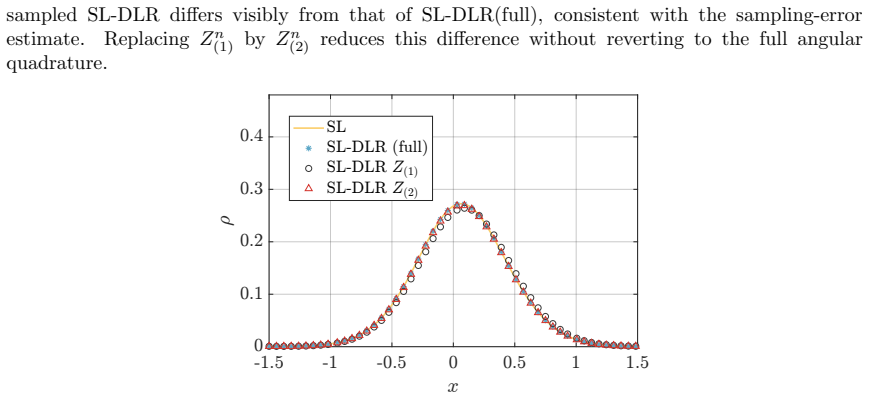
- [Section 5, Figures 2–3] Captions should define the notation Z^(1) and Z^(2) locally; the text defines them only in Section 3.3. This would make the comparison in Example 5.2 easier to read.
- [Section 4.2.2, Lemma 4] The assumption max_j ||f^n_j − ρ^n||∞ ≤ C_g is an assumption on the numerical solution, not on the scheme. For diffusive-limit propagation over many steps, the uniformity in n should be clarified or justified; as written, the bound is a one-step estimate.
- [Section 3.5, Table 1] The complexity table reports the 'Sampling construction' cost as O(N_Ω r^2). Since QDEIM is applied to the target matrix Z^n and the effective weights are recomputed each step, please state whether the pivoting is done on the (N_Ω × O(r)) matrix directly; the cost O(N_Ω r^2) is then plausible for fixed r but should be stated explicitly for the O(r) target dimension.
- [Remark 1] For velocity-dependent sources, the macroscopic equation is modified with an additional flux term containing ⟨vΦ⟩. In the manufactured-solution tests, the paper says the source is 'obtained by substituting (18) into the model equation'; please clarify precisely how the discrete source term is inserted into both the macroscopic and microscopic updates so that the comparison is unambiguous.
Circularity Check
No significant circularity: the low-rank and sampling derivations are self-contained; the AP reformulation is imported from an independent published source and the sampling analysis is a direct projection/approximation argument.
full rationale
The derivation chain is not circular. The macroscopic AP reformulation is explicitly imported from the independently published FD-SL scheme [51] (“We recall the semi-Lagrangian AP reformulation [51, 4]”), and the new paper proves its low-rank variant’s constant-coefficient energy stability in Appendix A rather than assuming the low-rank result. The sampling analysis (Lemma 3, Eq. (10)–(11), Proposition 6) is a standard projection argument: the sampled quadrature weights are constructed to satisfy the exactness condition (9) on a target space Z^n, and the error is bounded by inf_{ξ∈Z^n} ||h^n_i − ξ||_∞. The target space is chosen to contain the leading angular structure of the backtracked flux derivative via span(Q1, QM^{-1}V^n), which is a model-reduction construction rather than a circular definition. No fitted parameter is renamed as a prediction, and Proposition 7 proves AP inheritance through explicit limiting balances rather than by invoking a uniqueness theorem or ansatz from the authors’ prior work. The only substantive caveat is the NNLS fallback in Section 3.3: when negative weights occur, the exactness condition (9) and the uniform l1 bound assumed in Lemmas 3–4 and Proposition 6 are not guaranteed, so the AP/sampling-error estimates are conditional on those hypotheses. That is a correctness/completeness gap in the implemented algorithm, not a circularity. Numerical comparisons against the diffusion-limit reference and the external analytical benchmark provide independent support. Hence the central claims do not reduce to their inputs by construction.
Assumptions & free parameters
free parameters (3)
- low-rank r =
fixed per run (e.g., r=50,8,3 in 1D; r=8,4,32,64 in 2D/3D)
- sampled angular set size m_n =
r+2 for Z^(1); 2r+3 for Z^(2)
- target angular space Z^n =
Z^(1) = [1, Q1, Q M^{-1} V^n] or Z^(2) = Z^(1) + [Q^2 1, Q^2 M^{-1} V^n]
assumptions (6)
- domain assumption The semi-Lagrangian AP reformulation (3) from [51] is accepted: slowly varying factors inside the integrals are frozen at (x*, t*).
- domain assumption The solution is well approximated on the rank-r manifold and the BUG tangent-space projection error is acceptable.
- ad hoc to paper The effective quadrature weights satisfy the exactness condition (9) and the uniform l1 bound ||\tilde{w}^n||_1 <= C_{\tilde{w}} independent of epsilon, Delta x, Delta t.
- domain assumption In the diffusive limit, the nonequilibrium part satisfies max_j ||f^n_j - rho^n||_infinity <= C_g independent of epsilon.
- ad hoc to paper Formal asymptotic balance: in the epsilon^{-2} K/L/S steps, the o(1) terms are uniform enough to imply rho^{n+1,*} in span(X^{n+1}) + o(1) and M1 in span(V^{n+1}) + o(1).
- domain assumption Constant-coefficient, periodic, source-free setting for the energy stability analysis.
Cite this review
Pith. "Pith review of An Asymptotic-Preserving Dynamical Low-Rank Semi-Lagrangian Method for Multiscale Linear Kinetic Transport Equations." pith.science (2026). https://pith.science/paper/NJHAQRXI
@misc{pith2026260727736,
  author       = {Pith},
  title        = {Pith review of: An Asymptotic-Preserving Dynamical Low-Rank Semi-Lagrangian Method for Multiscale Linear Kinetic Transport Equations},
  year         = {2026},
  howpublished = {\url{https://pith.science/paper/NJHAQRXI}},
  note         = {Machine review of arXiv:2607.27736}
}
read the original abstract
In this paper, we develop an asymptotic-preserving (AP) dynamical low-rank semi-Lagrangian method for multiscale linear kinetic transport equations. The method combines the large-time-step capability of semi-Lagrangian discretizations with the storage and cost reduction provided by low-rank representations. The proposed scheme couples an approximate macroscopic density update with the basis update Galerkin integrator for the kinetic distribution. To retain the reduced complexity in the semi-Lagrangian flux evaluation, the flux derivative is computed through a sampled angular quadrature strategy. We establish an unconditional stability analysis of the full-quadrature low-rank scheme in the constant-coefficient case. The error induced by angular sampling in the flux derivative is quantified. The resulting scheme is shown to be AP in the diffusive limit. Numerical experiments, including high-dimensional test cases, demonstrate that the proposed method is AP, stable under large time steps, and computationally efficient across kinetic and diffusive regimes.
Figures

Figures from the paper (5 more)


Reference graph
Works this paper leans on
-
[51]
Asymptotic Preserving and Uniformly Un- conditionally Stable Finite Difference Schemes for Kinetic Transport Equations.SIAM Journal on Scientific Computing, 45(5):B697–B730, 2023
Guoliang Zhang, Hongqiang Zhu, and Tao Xiong. Asymptotic Preserving and Uniformly Un- conditionally Stable Finite Difference Schemes for Kinetic Transport Equations.SIAM Journal on Scientific Computing, 45(5):B697–B730, 2023
2023
-
[1]
Optimizing cubature for efficient integration of subspace deformations.ACM transactions on graphics (TOG), 27(5):1–10, 2008
Steven S An, Theodore Kim, and Doug L James. Optimizing cubature for efficient integration of subspace deformations.ACM transactions on graphics (TOG), 27(5):1–10, 2008
2008
-
[2]
Low-rank tensor methods for partial differential equations.Acta Numerica, 32:1–121, 2023
Markus Bachmayr. Low-rank tensor methods for partial differential equations.Acta Numerica, 32:1–121, 2023. 26
2023
-
[3]
Implicit-explicit runge–kutta schemes for hyperbolic systems and kinetic equations in the diffusion limit.SIAM Journal on Scientific Computing, 35(1):A22–A51, 2013
Sebastiano Boscarino, Lorenzo Pareschi, and Giovanni Russo. Implicit-explicit runge–kutta schemes for hyperbolic systems and kinetic equations in the diffusion limit.SIAM Journal on Scientific Computing, 35(1):A22–A51, 2013
2013
-
[4]
Asymptotic preserving semi- Lagrangian discontinuous Galerkin methods for multiscale kinetic transport equations.Journal of Computational Physics, 513:113190, 2024
Yi Cai, Guoliang Zhang, Hongqiang Zhu, and Tao Xiong. Asymptotic preserving semi- Lagrangian discontinuous Galerkin methods for multiscale kinetic transport equations.Journal of Computational Physics, 513:113190, 2024
2024
-
[5]
K. M. Case and P. F. Zweifel.Linear Transport Theory. Addison-Wesley, 1967
1967
-
[6]
Springer, 1988
Carlo Cercignani.The Boltzmann Equation and Its Applications, volume 67 ofApplied Math- ematical Sciences. Springer, 1988
1988
-
[7]
Gianluca Ceruti, Nicolas Crouseilles, and Lukas Einkemmer. A galerkin alternating projection method for kinetic equations in the diffusive limit.arXiv preprint arXiv:2505.19929, 2025
arXiv 2025
Show all 53 references
-
[8]
A rank-adaptive robust integrator for dynamical low-rank approximation.BIT Numerical Mathematics, 62(4):1149–1174, 2022
Gianluca Ceruti, Jonas Kusch, and Christian Lubich. A rank-adaptive robust integrator for dynamical low-rank approximation.BIT Numerical Mathematics, 62(4):1149–1174, 2022
2022
-
[9]
An unconventional robust integrator for dynamical low-rank approximation.BIT Numerical Mathematics, 62:23–44, 2022
Gianluca Ceruti and Christian Lubich. An unconventional robust integrator for dynamical low-rank approximation.BIT Numerical Mathematics, 62:23–44, 2022
2022
-
[10]
Chandrasekhar.Radiative Transfer
S. Chandrasekhar.Radiative Transfer. Dover Publications, 1960
1960
-
[11]
Nonlinear model reduction via discrete empirical interpolation.SIAM Journal on Scientific Computing, 32(5):2737–2764, 2010
Saifon Chaturantabut and Danny C Sorensen. Nonlinear model reduction via discrete empirical interpolation.SIAM Journal on Scientific Computing, 32(5):2737–2764, 2010
2010
-
[12]
Interpolatory dynamical low-rank approximation for the 3+3d Boltzmann-BGK equation.arXiv preprint arXiv:2411.15990, 2024
Alec Dektor and Lukas Einkemmer. Interpolatory dynamical low-rank approximation for the 3+3d Boltzmann-BGK equation.arXiv preprint arXiv:2411.15990, 2024
2024 arXiv
-
[13]
Numerical methods for kinetic equations.Acta Numerica, 23:369–520, 2014
Giacomo Dimarco and Lorenzo Pareschi. Numerical methods for kinetic equations.Acta Numerica, 23:369–520, 2014
2014
-
[14]
Accuracy and stability analysis of the semi- lagrangian method for stiff hyperbolic relaxation systems and kinetic BGK model.Multiscale Modeling & Simulation, 21(1):143–167, 2023
Mingchang Ding, Jing-Mei Qiu, and Ruiwen Shu. Accuracy and stability analysis of the semi- lagrangian method for stiff hyperbolic relaxation systems and kinetic BGK model.Multiscale Modeling & Simulation, 21(1):143–167, 2023
2023
-
[15]
Dynamical low-rank integrator for the linear boltzmann equation: Error analysis in the diffusion limit.SIAM Journal on Numerical Anal- ysis, 59(4):2254–2285, 2021
Zhiyan Ding, Lukas Einkemmer, and Qin Li. Dynamical low-rank integrator for the linear boltzmann equation: Error analysis in the diffusion limit.SIAM Journal on Numerical Anal- ysis, 59(4):2254–2285, 2021
2021
-
[16]
A new selection operator for the discrete empirical inter- polation method—improved a priori error bound and extensions.SIAM Journal on Scientific Computing, 38(2):A631–A648, 2016
Zlatko Drmac and Serkan Gugercin. A new selection operator for the discrete empirical inter- polation method—improved a priori error bound and extensions.SIAM Journal on Scientific Computing, 38(2):A631–A648, 2016
2016
-
[17]
Asymptotic-preserving and energy stable dynamical low-rank approximation.SIAM Journal on Numerical Analysis, 62(1):73–92, 2024
Lukas Einkemmer, Jingwei Hu, and Jonas Kusch. Asymptotic-preserving and energy stable dynamical low-rank approximation.SIAM Journal on Numerical Analysis, 62(1):73–92, 2024
2024
-
[18]
An asymptotic-preserving dynamical low-rank method for the multi-scale multi-dimensional linear transport equation.Journal of Computa- tional Physics, 439:110353, 2021
Lukas Einkemmer, Jingwei Hu, and Yubo Wang. An asymptotic-preserving dynamical low-rank method for the multi-scale multi-dimensional linear transport equation.Journal of Computa- tional Physics, 439:110353, 2021. 27
2021
-
[19]
An efficient dynamical low-rank algorithm for the Boltzmann-BGK equation close to the compressible viscous flow regime.SIAM Journal on Scientific Computing, 43(5):B1057–B1080, 2021
Lukas Einkemmer, Jingwei Hu, and Lexing Ying. An efficient dynamical low-rank algorithm for the Boltzmann-BGK equation close to the compressible viscous flow regime.SIAM Journal on Scientific Computing, 43(5):B1057–B1080, 2021
2021
-
[20]
McClarren, and Jing-Mei Qiu
Lukas Einkemmer, Katharina Kormann, Jonas Kusch, Ryan G. McClarren, and Jing-Mei Qiu. A review of low-rank methods for time-dependent kinetic simulations.Journal of Computa- tional Physics, 538:114191, 2025
2025
-
[21]
A low-rank projector-splitting integrator for the Vlasov–Poisson equation.SIAM Journal on Scientific Computing, 40(5):B1330–B1360, 2018
Lukas Einkemmer and Christian Lubich. A low-rank projector-splitting integrator for the Vlasov–Poisson equation.SIAM Journal on Scientific Computing, 40(5):B1330–B1360, 2018
2018
-
[22]
Asymptotic-preserving and energy stable dynamical low-rank approximation for thermal radiative transfer equations.Multiscale Modeling & Simulation, 23(1):278–312, 2025
Martin Frank, Jonas Kusch, and Chinmay Patwardhan. Asymptotic-preserving and energy stable dynamical low-rank approximation for thermal radiative transfer equations.Multiscale Modeling & Simulation, 23(1):278–312, 2025
2025
-
[23]
Ganapol.Analytical Benchmarks for Nuclear Engineering Applications: Case Studies in Neutron Transport Theory
Barry D. Ganapol.Analytical Benchmarks for Nuclear Engineering Applications: Case Studies in Neutron Transport Theory. Number NEA/DB/DOC(2008)1 in OECD/NEA Data Bank. Nuclear Energy Agency, Organisation for Economic Co-operation and Development, Issy-les- Moulineaux, France, 2...
2008
-
[24]
A DEIM Tucker tensor cross algorithm and its application to dynamical low-rank approximation.Computer Methods in Applied Mechanics and Engineering, 423:116879, 2024
Behzad Ghahremani and Hessam Babaee. A DEIM Tucker tensor cross algorithm and its application to dynamical low-rank approximation.Computer Methods in Applied Mechanics and Engineering, 423:116879, 2024
2024
-
[25]
A local macroscopic conservative (LoMaC) low rank tensor method with the discontinuous galerkin method for the Vlasov dynamics
Wei Guo, Jannatul Ferdous Ema, and Jing-Mei Qiu. A local macroscopic conservative (LoMaC) low rank tensor method with the discontinuous galerkin method for the Vlasov dynamics. Communications on Applied Mathematics and Computation, 6(1):550–575, 2024
2024
-
[26]
An inexact low-rank source iteration for steady-state radiative transfer equation with diffusion synthetic acceleration.arXiv preprint arXiv:2509.00805, 2025
Wei Guo and Zhichao Peng. An inexact low-rank source iteration for steady-state radiative transfer equation with diffusion synthetic acceleration.arXiv preprint arXiv:2509.00805, 2025
2025 arXiv
-
[27]
Highly efficient rank-adaptive sweep-based SI-DSA for the radia- tive transfer equation via mild space augmentation.arXiv preprint arXiv:2603.25233, 2026
Wei Guo and Zhichao Peng. Highly efficient rank-adaptive sweep-based SI-DSA for the radia- tive transfer equation via mild space augmentation.arXiv preprint arXiv:2603.25233, 2026
2026 arXiv
-
[28]
A conservative low rank tensor method for the Vlasov dynamics
Wei Guo and Jing-Mei Qiu. A conservative low rank tensor method for the Vlasov dynamics. SIAM Journal on Scientific Computing, 46(1):A232–A263, 2024
2024
-
[29]
Efficient SN-like and PN-like dynamic low rank methods for thermal radiative transfer
Terry Haut, John Loffeld, Lukas Einkemmer, Pierson Guthrey, Stefan Brunner, and William Schill. Efficient SN-like and PN-like dynamic low rank methods for thermal radiative transfer. arXiv preprint arXiv:2601.18705, 2026
2026
-
[30]
Dimensional hyper- reduction of nonlinear finite element models via empirical cubature.Computer methods in applied mechanics and engineering, 313:687–722, 2017
Joaquin Alberto Hernandez, Manuel Alejandro Caicedo, and Alex Ferrer. Dimensional hyper- reduction of nonlinear finite element models via empirical cubature.Computer methods in applied mechanics and engineering, 313:687–722, 2017
2017
-
[31]
J. Jang, F. Li, J.-M. Qiu, and T. Xiong. High order asymptotic preserving DG-IMEX schemes for discrete-velocity kinetic equations in a diffusive scaling.Journal of Computational Physics, 281:199–224, 2015
2015
-
[32]
Efficient asymptotic-preserving (AP) schemes for some multiscale kinetic equations
Shi Jin. Efficient asymptotic-preserving (AP) schemes for some multiscale kinetic equations. SIAM Journal on Scientific Computing, 21:441–454, 1999. 28
1999
-
[33]
Asymptotic-preserving schemes for multiscale physical problems.Acta Numerica, 31:1–82, 2022
Shi Jin. Asymptotic-preserving schemes for multiscale physical problems.Acta Numerica, 31:1–82, 2022
2022
-
[34]
Discretized dynamical low-rank approxima- tion in the presence of small singular values.SIAM Journal on Numerical Analysis, 54:1020– 1038, 2016
Emil Kieri, Christian Lubich, and Hanna Walach. Discretized dynamical low-rank approxima- tion in the presence of small singular values.SIAM Journal on Numerical Analysis, 54:1020– 1038, 2016
2016
-
[35]
Dynamical low-rank approximation.SIAM Journal on Matrix Analysis and Applications, 29(2):434–454, 2007
Othmar Koch and Christian Lubich. Dynamical low-rank approximation.SIAM Journal on Matrix Analysis and Applications, 29(2):434–454, 2007
2007
-
[36]
A semi-lagrangian Vlasov solver in tensor train format.SIAM Journal on Scientific Computing, 37(4):B613–B632, 2015
Katharina Kormann. A semi-lagrangian Vlasov solver in tensor train format.SIAM Journal on Scientific Computing, 37(4):B613–B632, 2015
2015
-
[37]
A robust collision source method for rank adaptive dynamical low-rank approximation in radiation therapy.ESAIM: Mathematical Modelling and Numerical Analysis, 57(2):865–891, 2023
Jonas Kusch and Pia Stammer. A robust collision source method for rank adaptive dynamical low-rank approximation in radiation therapy.ESAIM: Mathematical Modelling and Numerical Analysis, 57(2):865–891, 2023
2023
-
[38]
McClarren, and Martin Frank
Jonas Kusch, Benjamin Whewell, Ryan G. McClarren, and Martin Frank. A low-rank power iteration scheme for neutron transport criticality problems.Journal of Computational Physics, 470:111587, 2022
2022
-
[39]
Larsen and Jim E
Edward W. Larsen and Jim E. Morel. Advances in discrete-ordinates methodology.Nuclear Computational Science: A Century in Review, pages 1–84, 2009
2009
-
[40]
A new asymptotic preserving scheme based on micro- macro formulation for linear kinetic equations in the diffusion limit.SIAM Journal on Scientific Computing, 31:334–368, 2008
Mohammed Lemou and Luc Mieussens. A new asymptotic preserving scheme based on micro- macro formulation for linear kinetic equations in the diffusion limit.SIAM Journal on Scientific Computing, 31:334–368, 2008
2008
-
[41]
John Wiley and Sons, Inc., New York, NY, 1983
Elmer Eugene Lewis and Warren F Miller.Computational Methods of Neutron Transport. John Wiley and Sons, Inc., New York, NY, 1983
1983
-
[42]
Temporal-stability-enhanced and energy-stable dynamical low-rank approximation for multiscale linear kinetic transport equa- tions.arXiv preprint arXiv:2602.12337, 2026
Shun Li, Yan Jiang, Mengping Zhang, and Tao Xiong. Temporal-stability-enhanced and energy-stable dynamical low-rank approximation for multiscale linear kinetic transport equa- tions.arXiv preprint arXiv:2602.12337, 2026
2026
-
[43]
Analysis of an asymptotic preserving scheme for linear kinetic equations in the diffusion limit.SIAM Journal on Numerical Analysis, 48:1474–1491, 2010
Jian-Guo Liu and Luc Mieussens. Analysis of an asymptotic preserving scheme for linear kinetic equations in the diffusion limit.SIAM Journal on Numerical Analysis, 48:1474–1491, 2010
2010
-
[44]
Oseledets
Christian Lubich and Ivan V. Oseledets. A projector-splitting integrator for dynamical low- rank approximation.BIT Numerical Mathematics, 54:171–188, 2014
2014
-
[45]
Asymptotic preserving IMEX-DG-S schemes for linear kinetic transport equations based on schur complement.SIAM Journal on Scientific Computing, 43(2):A1194–A1220, 2021
Zhichao Peng and Fengyan Li. Asymptotic preserving IMEX-DG-S schemes for linear kinetic transport equations based on schur complement.SIAM Journal on Scientific Computing, 43(2):A1194–A1220, 2021
2021
-
[46]
McClarren
Zhuogang Peng and Ryan G. McClarren. A sweep-based low-rank method for the discrete ordinate transport equation.Journal of Computational Physics, 473:111748, 2023
2023
-
[47]
McClarren, and Martin Frank
Zhuogang Peng, Ryan G. McClarren, and Martin Frank. A low-rank method for two- dimensional time-dependent radiation transport calculations.Journal of Computational Physics, 421:109735, 2020. 29
2020
-
[48]
William A Sands, Wei Guo, Jing-Mei Qiu, and Tao Xiong. High-order adaptive rank integra- tors for multiscale linear kinetic transport equations in the hierarchical tucker format.SIAM Journal on Scientific Computing, 47(6):A3383–A3412, 2025
2025
-
[49]
Sands, Jing-Mei Qiu, Daniel Hayes, and Nanyi Zheng
William A. Sands, Jing-Mei Qiu, Daniel Hayes, and Nanyi Zheng. An adaptive-rank ap- proach with greedy sampling for multi-scale BGK equations.Journal of Computational Physics, 547:114523, 2026
2026
-
[50]
Tyrtyshnikov, Sergei A
Eugene E. Tyrtyshnikov, Sergei A. Goreinov, and Nikolai L. Zamarashkin. Pseudo-skeleton approximations.Doklady Akademii Nauk, 343(2):151–152, 1995
1995
-
[52]
A semi-lagrangian adaptive- rank (SLAR) method for linear advection and nonlinear Vlasov-Poisson system.Journal of Computational Physics, 532:113970, 2025
Nanyi Zheng, Daniel Hayes, Andrew Christlieb, and Jing-Mei Qiu. A semi-lagrangian adaptive- rank (SLAR) method for linear advection and nonlinear Vlasov-Poisson system.Journal of Computational Physics, 532:113970, 2025
2025
-
[53]
Sands, Daniel Hayes, Andrew J
Nanyi Zheng, William A. Sands, Daniel Hayes, Andrew J. Christlieb, and Jing-Mei Qiu. A semi-lagrangian adaptive rank (SLAR) method for high-dimensional Vlasov dynamics.arXiv preprint arXiv:2510.24861, 2025. 30
2025
Reviewed August 1, 2026 · model on record in the stance chip above.
Discussion (0). Continue with ORCID to comment.