Correcting the hydrostatic mass for non-thermal gas motions: a comparison of two approaches
Pith reviewed 2026-07-02 07:21 UTC · model grok-4.3
The pith
Two methods for correcting hydrostatic mass estimates for non-thermal gas motions produce different radial profiles in three-dimensional cluster data.
A machine-rendered reading of the paper's core claim, the machinery that carries it, and where it could break.
Core claim
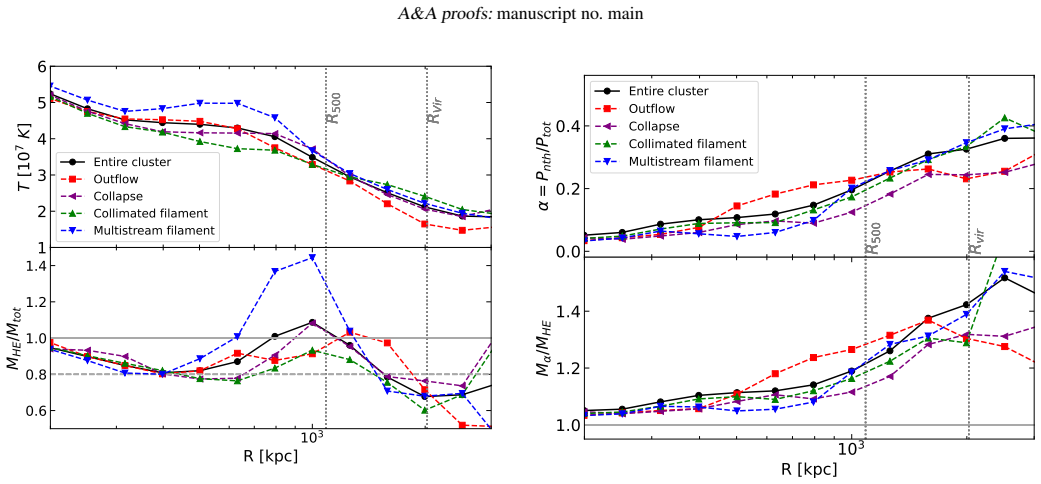
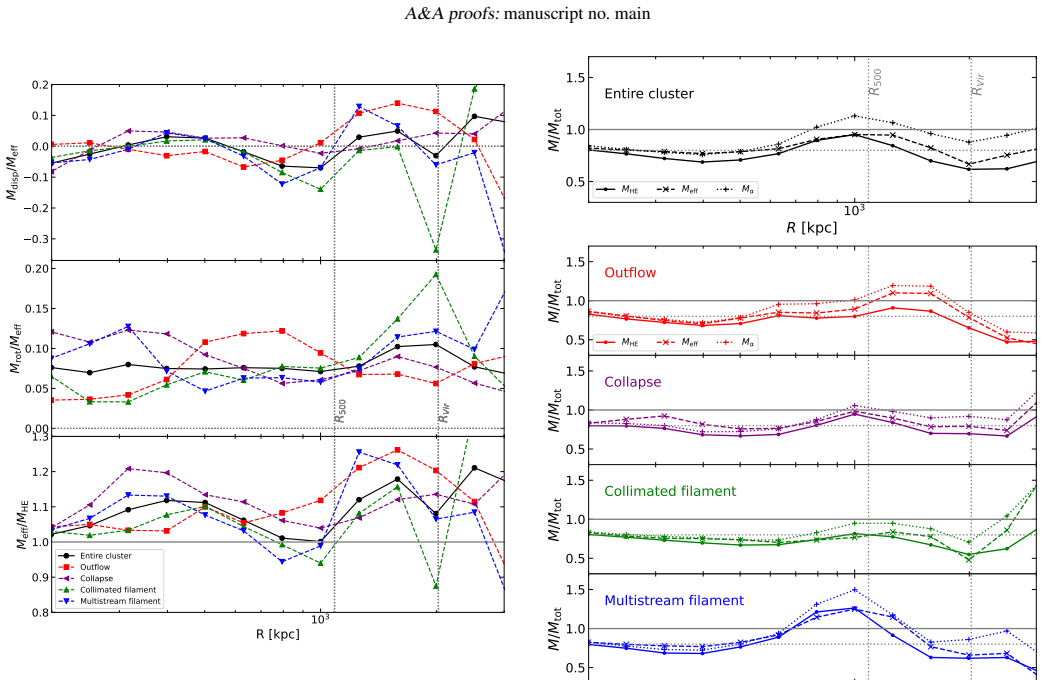
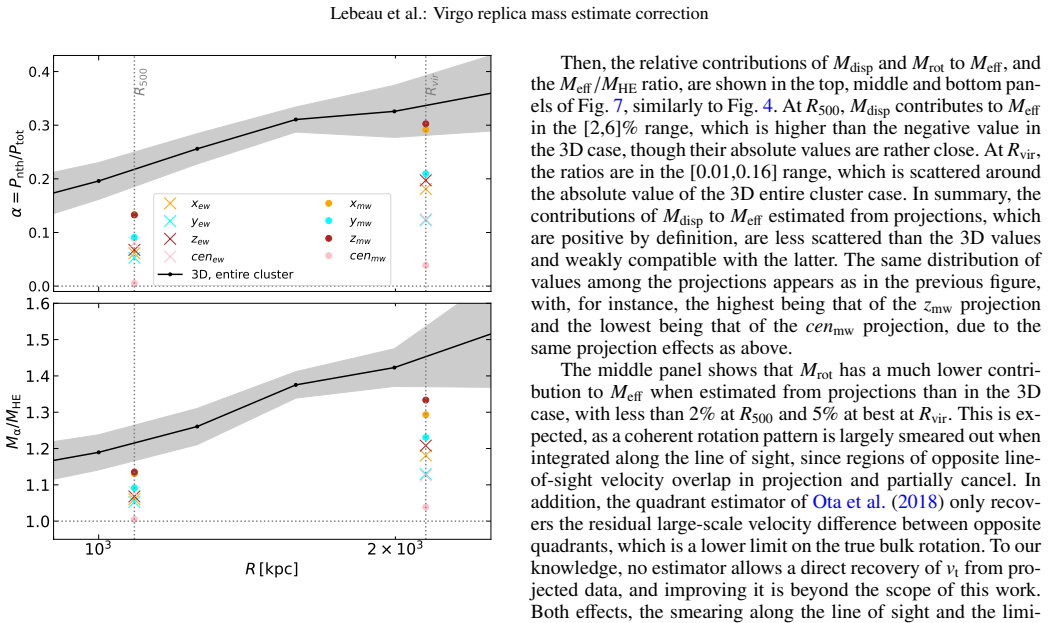
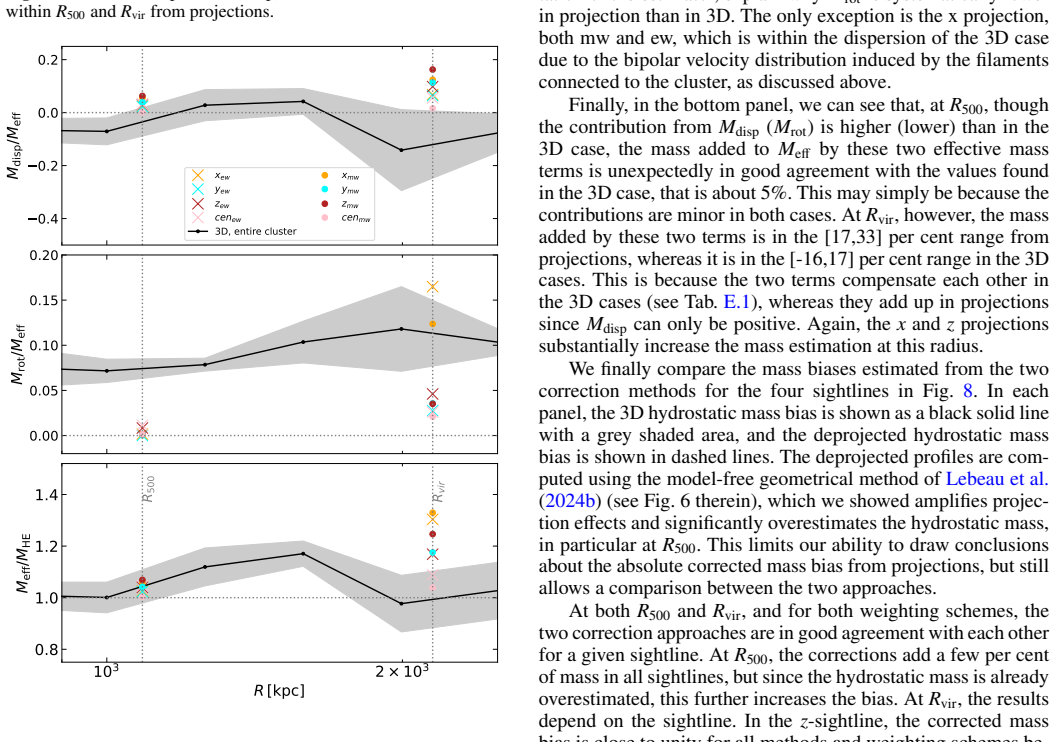
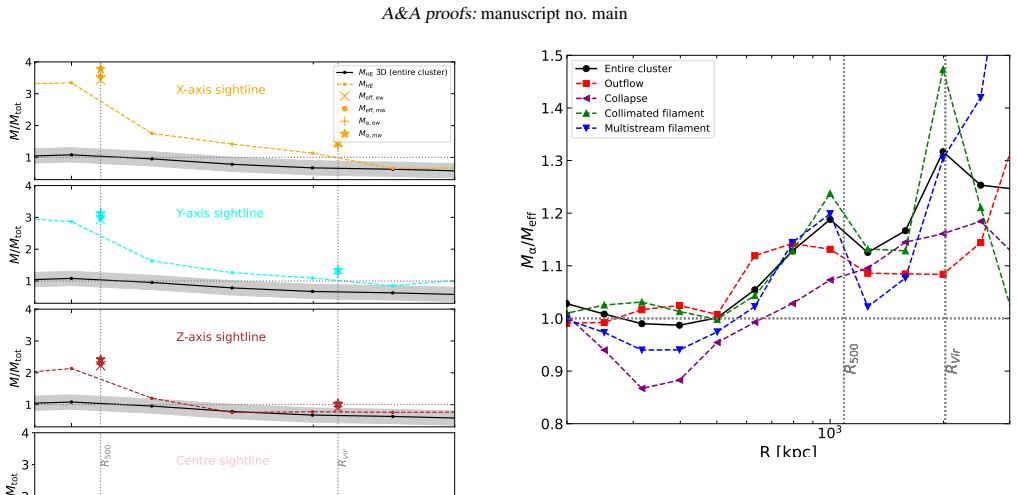
The non-thermal pressure correction increases the mass by a growing amount with radius from a few per cent in the core to ∼40% at the virial radius, whereas the effective mass terms provide a correction that varies less with radius. When estimated from projections, the two methods agree to within a few per cent for a given sightline, but the non-thermal pressure fraction is underestimated by about a factor of 2 compared to the 3D case. Projection effects can change the inferred non-thermal pressure fraction by up to a factor of 2, particularly when the sightline is aligned with cosmic filaments.
What carries the argument
Application of the gas momentum equation to simulated intracluster gas to obtain either total pressure or effective mass correction terms for the hydrostatic equilibrium equation.
If this is right
- The total-pressure method produces a mass bias that increases steadily outward while the effective-mass method produces a roughly constant bias.
- Projected data cause both methods to underestimate the non-thermal pressure fraction by a factor of approximately two.
- Alignment of the line of sight with filaments can shift the recovered non-thermal pressure fraction by up to a factor of two.
- The choice between the two corrections therefore changes the inferred radial dependence of the hydrostatic mass bias.
Where Pith is reading between the lines
- The differing radial behaviors imply that cosmological parameter constraints derived from cluster abundance could shift depending on which correction is adopted at large radii.
- Line-of-sight velocity measurements will require explicit modeling of projection geometry to avoid systematic underestimation of non-thermal support.
- Repeating the comparison across multiple independent cluster simulations would test whether the discrepancy between the two methods is a general feature.
Load-bearing premise
The distribution of non-thermal gas motions in one simulated galaxy cluster is representative of their distribution in real clusters.
What would settle it
Independent weak-lensing mass profiles for a sample of clusters whose three-dimensional velocity fields have been measured, compared against the radial correction curves predicted by each method.
Figures
read the original abstract
An accurate estimation of the mass of galaxy clusters is key to precisely and unbiasedly constraining cosmological parameters through their number count. The hydrostatic mass, estimated from the properties of the intracluster medium (ICM) assuming hydrostatic equilibrium, sphericity, and thermal-only pressure, is known to be biased by 10 to 20%, most likely due to non-thermal pressure support from gas motions. Two corrections have been proposed: i) replacing the thermal pressure by the total pressure $P_\mathrm{tot}=P_\mathrm{th}+P_\mathrm{nth}$, or ii) adding effective mass terms derived from the gas momentum equation. We compare these approaches using a numerical replica of the Virgo cluster as a case study, estimating corrected masses from 3D radial profiles in different cluster regions and from projected sightline velocities mimicking XRISM observations. We find that the two methods do not yield the same results in 3D: the non-thermal pressure correction increases the mass by a growing amount with radius (from a few per cent in the core to $\sim$40% at the virial radius), whereas the effective mass terms provide a correction that varies less with radius. When estimated from projections, the two methods agree to within a few per cent for a given sightline, but the non-thermal pressure fraction is underestimated by about a factor of 2 compared to the 3D case. Furthermore, projection effects can change the inferred non-thermal pressure fraction by up to a factor of 2, particularly when the sightline is aligned with cosmic filaments.
Editorial analysis
A structured set of objections, weighed in public.
Referee Report
Summary. The manuscript compares two methods for correcting hydrostatic mass estimates of galaxy clusters for non-thermal gas motions: (i) replacing thermal pressure with total pressure P_tot = P_th + P_nth, and (ii) adding effective mass terms derived from the gas momentum equation. Using 3D radial profiles and projected sightline velocities from a numerical replica of the Virgo cluster, the authors report that the methods differ in 3D (non-thermal pressure correction grows from a few percent in the core to ~40% at R_vir, while effective-mass terms vary less radially), but agree to within a few percent in projections; projections underestimate the non-thermal fraction by a factor of ~2 relative to 3D, and sightline alignment with filaments can change the inferred fraction by up to a factor of 2.
Significance. If the reported differences hold, the work is significant for cluster cosmology because it quantifies how the choice of non-thermal correction affects mass bias estimates that enter number-count constraints. The direct comparison against the known true mass in a controlled simulation provides a clear benchmark, and the projection analysis is timely for interpreting XRISM data. The use of a high-resolution numerical replica as an external benchmark is a methodological strength.
major comments (2)
- [Section 3 and Results (3D profiles)] The central claim that the two correction methods produce different radial behaviors in 3D (non-thermal pressure term reaching ~40% at R_vir versus less radial variation for effective-mass terms) rests on a single numerical replica of the Virgo cluster (Section 3, simulation setup). Both the definition of P_nth and the momentum-equation derivation of the effective-mass terms depend on the specific velocity field (bulk flows plus dispersion) realized in that run; if the turbulence spectrum, radial decline, or filamentary structure differs from the ensemble of real clusters, the reported mismatch need not be general.
- [Projection results section] In the projection analysis, the manuscript states that the non-thermal pressure fraction is underestimated by a factor of ~2 and can vary by up to a factor of 2 across sightlines, yet no error bars, number of independent sightlines sampled, or multiple simulation realizations are reported (abstract and projection results). This leaves the robustness of the agreement between methods (to within a few percent) and the factor-of-2 offset uncertain when extrapolated beyond the specific geometry of this replica.
minor comments (2)
- [Abstract and Section 2] The abstract and main text would benefit from explicit statements of the radial range over which the ~40% correction is measured (e.g., in units of R_vir) and the precise definition of the effective-mass terms (reference to the relevant equation in the momentum-equation derivation).
- [Methods] Notation for P_nth and the effective-mass terms should be introduced consistently in the methods section before being used in the results; a short table summarizing the two correction formulae side-by-side would improve clarity.
Simulated Author's Rebuttal
We thank the referee for the constructive comments, which help clarify the scope and robustness of our results. We respond point-by-point to the major comments below.
read point-by-point responses
-
Referee: [Section 3 and Results (3D profiles)] The central claim that the two correction methods produce different radial behaviors in 3D (non-thermal pressure term reaching ~40% at R_vir versus less radial variation for effective-mass terms) rests on a single numerical replica of the Virgo cluster (Section 3, simulation setup). Both the definition of P_nth and the momentum-equation derivation of the effective-mass terms depend on the specific velocity field (bulk flows plus dispersion) realized in that run; if the turbulence spectrum, radial decline, or filamentary structure differs from the ensemble of real clusters, the reported mismatch need not be general.
Authors: We agree that the analysis uses a single high-resolution replica and that the quantitative radial trends are tied to the specific velocity field realized in that run. The manuscript presents the work explicitly as a case study chosen for its fidelity to a well-observed cluster and the availability of the true mass. The methodological difference (local P_nth versus integrated momentum terms) produces the reported radial divergence even when applied to identical velocity data; this comparison remains valid for the chosen setup. We will revise the text to state more explicitly that the results are specific to this replica and to note that ensemble simulations would be required to assess generality across different turbulence realizations. revision: partial
-
Referee: [Projection results section] In the projection analysis, the manuscript states that the non-thermal pressure fraction is underestimated by a factor of ~2 and can vary by up to a factor of 2 across sightlines, yet no error bars, number of independent sightlines sampled, or multiple simulation realizations are reported (abstract and projection results). This leaves the robustness of the agreement between methods (to within a few percent) and the factor-of-2 offset uncertain when extrapolated beyond the specific geometry of this replica.
Authors: The projection results are derived from multiple sightlines through the single replica, chosen to sample a range of orientations including filament alignments. To address the concern we will add the precise number of sightlines, report the variation across them (including a measure of spread), and include error bars on the projected quantities where appropriate. The agreement between methods to within a few percent and the factor-of-2 offset relative to 3D are observed consistently across the sampled sightlines; we will make these details explicit in the revised manuscript. Multiple independent cluster realizations are not available in the present study. revision: yes
Circularity Check
No circularity: results obtained from direct comparison against external simulation benchmark
full rationale
The paper's central comparison between non-thermal pressure correction and effective-mass terms is performed by applying both methods to 3D radial profiles and projected sightlines extracted from a numerical Virgo replica. These outputs serve as an independent external benchmark; the reported radial growth (few percent to ~40%) and projection effects are measured quantities rather than quantities fitted or defined in terms of the target result. No self-citations, ansatzes, or uniqueness theorems are invoked in the provided text to justify the methods or the difference between them. The derivation chain therefore remains self-contained against the simulation data.
Axiom & Free-Parameter Ledger
axioms (2)
- domain assumption Hydrostatic equilibrium holds in the simulated cluster except for the non-thermal motions being corrected.
- domain assumption The simulation provides accurate 3D profiles of thermal and non-thermal pressures and velocities.
Reference graph
Works this paper leans on
-
[1]
Velocity fields and turbulence from cosmic filaments to galaxy clusters. , keywords =. doi:10.1051/0004-6361/202553780 , archivePrefix =. 2501.09573 , primaryClass =
-
[2]
Gas motion in the intracluster medium of the Virgo cluster replica
Gas motion in the intracluster medium of the Virgo cluster replica. , keywords =. doi:10.1051/0004-6361/202555991 , archivePrefix =. 2506.14441 , primaryClass =
work page internal anchor Pith review Pith/arXiv arXiv doi:10.1051/0004-6361/202555991
-
[3]
, volume=
Exploring the hydrostatic mass bias in MUSIC clusters: application to the NIKA2 mock sample , author=. , volume=. 2021 , publisher=
2021
-
[4]
The Astronomical Journal , volume=
The efficiency of globular cluster formation , author=. The Astronomical Journal , volume=. 1999 , publisher=
1999
-
[5]
Planck 2013 results. XV. CMB power spectra and likelihood , author=. , volume=. 2014 , publisher=
2013
-
[6]
First M87 event horizon telescope results. IV. Imaging the central supermassive black hole , author=. Letters , volume=. 2019 , publisher=
2019
-
[7]
Planck 2013 results. XVI. Cosmological parameters , author=. , volume=
2013
-
[8]
, volume=
Constraints from thermal Sunyaev-Zel’dovich cluster counts and power spectrum combined with CMB , author=. , volume=. 2018 , publisher=
2018
-
[9]
Space science reviews , volume=
Simulation techniques for cosmological simulations , author=. Space science reviews , volume=. 2008 , publisher=
2008
-
[10]
, volume=
Simulations of the Local Universe constrained by observational peculiar velocities , author=. , volume=. 2014 , publisher=
2014
-
[11]
, volume=
I--A hydrodynamical clone of the Virgo cluster of galaxies to confirm observationally driven formation scenarios , author=. , volume=. 2021 , publisher=
2021
-
[12]
, volume=
Virgo: an unlikely cluster of galaxies because of its environment , author=. , volume=. 2019 , publisher=
2019
-
[13]
Journal of Computational Physics , volume=
Smoothed particle hydrodynamics and magnetohydrodynamics , author=. Journal of Computational Physics , volume=. 2012 , publisher=
2012
-
[14]
Annual Review of Astronomy and Astrophysics , volume=
Grid-based hydrodynamics in astrophysical fluid flows , author=. Annual Review of Astronomy and Astrophysics , volume=. 2015 , publisher=
2015
-
[15]
, volume=
Cosmological hydrodynamics with adaptive mesh refinement-A new high resolution code called RAMSES , author=. , volume=. 2002 , publisher=
2002
-
[16]
, volume=
Building merger trees from cosmological N-body simulations-Towards improving galaxy formation models using subhaloes , author=. , volume=. 2009 , publisher=
2009
-
[17]
Annual Review of Astronomy and Astrophysics , volume=
Formation of Galaxy Clusters , author=. Annual Review of Astronomy and Astrophysics , volume=
-
[18]
2020 , publisher=
The large-scale structure of the universe , author=. 2020 , publisher=
2020
-
[19]
Comments on Astrophysics and Space Physics , volume=
The observations of relic radiation as a test of the nature of X-ray radiation from the clusters of galaxies , author=. Comments on Astrophysics and Space Physics , volume=
-
[20]
Classical and Quantum Gravity , volume=
In the realm of the Hubble tension—a review of solutions , author=. Classical and Quantum Gravity , volume=. 2021 , publisher=
2021
-
[21]
Physical Review D , volume=
Evolution of the f 8 tension with the Planck 15/ CDM determination and implications for modified gravity theories , author=. Physical Review D , volume=. 2018 , publisher=
2018
-
[22]
IAU General Assembly , volume=
The magneticum simulations, from galaxies to galaxy clusters , author=. IAU General Assembly , volume=
-
[23]
Computational Astrophysics and Cosmology , volume=
The IllustrisTNG simulations: public data release , author=. Computational Astrophysics and Cosmology , volume=. 2019 , publisher=
2019
-
[24]
, volume=
The HORIZON-AGN simulation: morphological diversity of galaxies promoted by AGN feedback , author=. , volume=. 2016 , publisher=
2016
-
[25]
Space Science Reviews , volume=
Masses of galaxy clusters from gravitational lensing , author=. Space Science Reviews , volume=. 2013 , publisher=
2013
-
[26]
Annual Review of Astronomy and Astrophysics , volume=
Cosmological parameters from observations of galaxy clusters , author=. Annual Review of Astronomy and Astrophysics , volume=. 2011 , publisher=
2011
-
[27]
, volume=
Evolution of the cosmic web , author=. , volume=. 2014 , publisher=
2014
-
[28]
, volume=
Constraining the mass and redshift evolution of the hydrostatic mass bias using the gas mass fraction in galaxy clusters , author=. , volume=. 2023 , publisher=
2023
-
[29]
Universal thermodynamic properties of the intracluster medium over two decades in radius in the X-COP sample. , keywords =. doi:10.1051/0004-6361/201833325 , archivePrefix =. 1805.00042 , primaryClass =
work page internal anchor Pith review Pith/arXiv arXiv doi:10.1051/0004-6361/201833325
-
[30]
, volume=
Gas distribution from clusters to filaments in IllustrisTNG , author=. , volume=. 2022 , publisher=
2022
-
[31]
Reviews of Modern Physics , volume=
X-ray emission from clusters of galaxies , author=. Reviews of Modern Physics , volume=. 1986 , publisher=
1986
-
[32]
, volume=
Toward unbiased galaxy cluster masses from line-of-sight velocity dispersions , author=. , volume=. 2013 , publisher=
2013
-
[33]
The Astronomy and Astrophysics Review , volume=
X-ray spectroscopy of galaxy clusters: studying astrophysical processes in the largest celestial laboratories , author=. The Astronomy and Astrophysics Review , volume=. 2010 , publisher=
2010
-
[34]
, volume=
The XMM-LSS survey: the Class 1 cluster sample over the initial 5 deg2 and its cosmological modelling , author=. , volume=. 2007 , publisher=
2007
-
[35]
, volume=
Chandra sample of nearby relaxed galaxy clusters: Mass, gas fraction, and mass-temperature relation , author=. , volume=. 2006 , publisher=
2006
-
[36]
, volume=
The eROSITA Final Equatorial-Depth Survey (eFEDS)-X-ray properties and scaling relations of galaxy clusters and groups , author=. , volume=. 2022 , publisher=
2022
-
[37]
The cluster catalogue , author=
The ROSAT-ESO Flux Limited X-ray (REFLEX) Galaxy cluster survey-V. The cluster catalogue , author=. , volume=. 2004 , publisher=
2004
-
[38]
, volume=
SUNYAEV--ZEL’DOVICH CLUSTER PROFILES MEASURED WITH THE SOUTH POLE TELESCOPE , author=. , volume=. 2010 , publisher=
2010
-
[39]
, volume=
THE ATACAMA COSMOLOGY TELESCOPE: SUNYAEV--ZEL'DOVICH-SELECTED GALAXY CLUSTERS AT 148 GHz IN THE 2008 SURVEY , author=. , volume=. 2011 , publisher=
2008
-
[40]
Planck 2013 results. XXIX. The Planck catalogue of Sunyaev-Zeldovich sources , author=. , volume=. 2014 , publisher=
2013
-
[41]
Annual Review of Astronomy and Astrophysics , volume=
Cosmology with the Sunyaev-Zel’dovich effect , author=. Annual Review of Astronomy and Astrophysics , volume=. 2002 , publisher=
2002
-
[42]
Space Science Reviews , volume=
Mass profiles of Galaxy Clusters from X-ray analysis , author=. Space Science Reviews , volume=. 2013 , publisher=
2013
-
[43]
Space Science Reviews , volume=
The galaxy cluster mass scale and its impact on cosmological constraints from the cluster population , author=. Space Science Reviews , volume=. 2019 , publisher=
2019
-
[44]
Cosmology from Sunyaev-Zeldovich cluster counts , author=
Planck 2015 results-XXIV. Cosmology from Sunyaev-Zeldovich cluster counts , author=. , volume=. 2016 , publisher=
2015
-
[45]
, volume=
A study of the hydrostatic mass bias dependence and evolution within The Three Hundred clusters , author=. , volume=. 2023 , publisher=
2023
-
[46]
, volume=
Mass bias evolution in tSZ cluster cosmology , author=. , volume=. 2019 , publisher=
2019
-
[47]
, volume=
Chandra imaging of the X-ray core of the Virgo cluster , author=. , volume=. 2002 , publisher=
2002
-
[48]
, volume=
X-ray spectroscopy of the Virgo Cluster out to the virial radius , author=. , volume=. 2011 , publisher=
2011
-
[49]
The Sunyaev-Zeldovich signal from the Virgo cluster , author=
Planck intermediate results-XL. The Sunyaev-Zeldovich signal from the Virgo cluster , author=. , volume=. 2016 , publisher=
2016
-
[50]
, volume=
The active assembly of the virgo cluster: Indications for recent group infall from early-type dwarf galaxies , author=. , volume=. 2018 , publisher=
2018
-
[51]
, volume=
Merger types forming the Virgo cluster in recent gigayears , author=. , volume=. 2018 , publisher=
2018
-
[52]
, volume=
Hydrostatic mass estimates of massive galaxy clusters: a study with varying hydrodynamics flavours and non-thermal pressure support , author=. , volume=. 2020 , publisher=
2020
-
[53]
, volume=
Sunyaev--Zel’dovich clusters in Millennium gas simulations , author=. , volume=. 2012 , publisher=
2012
-
[54]
ON THE CLUSTER PHYSICS OF SUNYAEV--ZEL'DOVICH AND X-RAY SURVEYS. III. MEASUREMENT BIASES AND COSMOLOGICAL EVOLUTION OF GAS AND STELLAR MASS FRACTIONS , author=. , volume=. 2013 , publisher=
2013
-
[55]
, volume=
On the nature of hydrostatic equilibrium in galaxy clusters , author=. , volume=. 2016 , publisher=
2016
-
[56]
, volume=
SZE observables, pressure profiles and centre offsets in Magneticum simulation galaxy clusters , author=. , volume=. 2017 , publisher=
2017
-
[57]
, volume=
The scatter and evolution of the global hot gas properties of simulated galaxy cluster populations , author=. , volume=. 2017 , publisher=
2017
-
[58]
, pages=
The impact of baryons on massive galaxy clusters: halo structure and cluster mass estimates , author=. , pages=. 2016 , publisher=
2016
-
[59]
, volume=
The Three Hundred Project: Correcting for the hydrostatic-equilibrium mass bias in X-ray and SZ surveys , author=. , volume=. 2020 , publisher=
2020
-
[60]
, volume=
Characterizing hydrostatic mass bias with MOCK-X , author=. , volume=. 2021 , publisher=
2021
-
[61]
, volume=
Cosmic gas highways in C-EAGLE simulations , author=. , volume=
-
[62]
Physics Reports , volume=
Shocks and cold fronts in galaxy clusters , author=. Physics Reports , volume=. 2007 , publisher=
2007
-
[63]
, volume=
Cosmicflows constrained local universe simulations , author=. , volume=. 2016 , publisher=
2016
-
[64]
, author=
Structure of the Virgo Cluster of Galaxies. , author=. Supplement Series , volume=
-
[65]
, volume=
Infall of nearby galaxies into the Virgo Cluster as traced with Hubble Space Telescope , author=. , volume=. 2014 , publisher=
2014
-
[66]
The UV luminosity function of the Virgo cluster and its surrounding regions , author=
The GALEX Ultraviolet Virgo Cluster Survey (GUViCS)-VI. The UV luminosity function of the Virgo cluster and its surrounding regions , author=. , volume=. 2016 , publisher=
2016
-
[67]
SPIRE point-source catalogs and number counts , author=
The Herschel Virgo Cluster Survey-XVII. SPIRE point-source catalogs and number counts , author=. , volume=. 2015 , publisher=
2015
-
[68]
The next generation virgo cluster survey (NGVS). XIII. The luminosity and mass function of galaxies in the core of the virgo cluster and the contribution from disrupted satellites , author=. , volume=. 2016 , publisher=
2016
-
[69]
, author=
The Virgo cluster redshift survey. , author=. European Southern Observatory Conference and Workshop Proceedings , volume=
-
[70]
VI-Morphological and kinematical structure of the Virgo cluster , author=
Studies of the Virgo cluster. VI-Morphological and kinematical structure of the Virgo cluster , author=. Astronomical Journal (ISSN 0004-6256), vol. 94, Aug. 1987, p. 251-277. SNSF-supported research. , volume=
1987
-
[71]
, volume=
crescendo: an on-the-fly Fokker--Planck solver for spectral cosmic rays in cosmological simulations , author=. , volume=. 2023 , publisher=
2023
-
[72]
, volume=
Hydrodynamic simulation of non-thermal pressure profiles of galaxy clusters , author=. , volume=. 2014 , publisher=
2014
-
[73]
Pressure profiles of galaxy clusters from the Sunyaev-Zeldovich effect , author=
Planck intermediate results-V. Pressure profiles of galaxy clusters from the Sunyaev-Zeldovich effect , author=. , volume=. 2013 , publisher=
2013
-
[74]
, volume=
X-rays from hot plasma in clusters of galaxies , author=. , volume=
-
[75]
, volume=
The distribution of hot gas in clusters of galaxies , author=. , volume=
-
[76]
and Fusco-Femiano R., 1976, A&A, 49, 137 , author=
The -model of the intracluster medium-Commentary on: Cavaliere A. and Fusco-Femiano R., 1976, A&A, 49, 137 , author=. , volume=. 2009 , publisher=
1976
-
[77]
, volume=
Dancing in the dark: galactic properties trace spin swings along the cosmic web , author=. , volume=. 2014 , publisher=
2014
-
[78]
, volume=
Introducing the NEWHORIZON simulation: Galaxy properties with resolved internal dynamics across cosmic time , author=. , volume=. 2021 , publisher=
2021
-
[79]
Galaxy clusters in local Universe simulations without density constraints: a long uphill struggle
Galaxy clusters in local Universe simulations without density constraints: a long uphill struggle. , keywords =. doi:10.1093/mnras/sty1631 , archivePrefix =. 1806.09633 , primaryClass =
work page internal anchor Pith review Pith/arXiv arXiv doi:10.1093/mnras/sty1631
-
[80]
, volume=
Rhapsody-c simulations--anisotropic thermal conduction, black hole physics, and the robustness of massive galaxy cluster scaling relations , author=. , volume=. 2023 , publisher=
2023
discussion (0)
Sign in with ORCID, Apple, or X to comment. Anyone can read and Pith papers without signing in.