Hot AI in Cold Space: Thermal-Crosstalk-Aware Scheduling for Sustainable Orbital AI Clusters
Pith reviewed 2026-07-01 07:07 UTC · model grok-4.3
The pith
Thermal-Load Balancing migrates orbital AI workloads to cooler nodes to restore training throughput and cut hardware stress.
A machine-rendered reading of the paper's core claim, the machinery that carries it, and where it could break.
Core claim
The Thermal-Aware Heterogeneity Thesis treats spatial cooling variances as a primary resource management dimension. Thermal-Load Balancing dynamically migrates intensive workloads to the coolest available units based on instantaneous fluid temperatures or absorbed radiation. This resolves thermal bottlenecks to restore Model Flops Utilization while reducing physical thermal stress, extending hardware lifespan to amortize the embodied carbon of rocket launches.
What carries the argument
Thermal-Load Balancing (TLB), a software framework that dynamically migrates workloads to the coolest units based on instantaneous fluid temperatures or absorbed radiation.
If this is right
- TLB resolves thermal bottlenecks to restore Model Flops Utilization in distributed LLM training.
- TLB reduces physical thermal stress on orbital hardware.
- Extended hardware lifespan amortizes the embodied carbon cost of launches.
- Orbital AI can scale without accelerating premature space e-waste.
- Uniform load-sharing is replaced by thermal-aware heterogeneity as the default scheduling rule.
Where Pith is reading between the lines
- If TLB preserves low latency, the same migration logic could be tested in terrestrial dense clusters that already experience uneven cooling.
- Software-driven thermal management might allow future orbital designs to increase node density without proportional increases in radiator area.
- Longer hardware life would reduce the frequency of replacement launches and thereby lower the total launch-related carbon footprint of an orbital cluster.
Load-bearing premise
Dynamic workload migration based on instantaneous fluid temperatures or absorbed radiation can be performed without violating the sub-10 microsecond inter-node latency required for synchronized LLM training.
What would settle it
Implementation of TLB that either exceeds 10 microsecond migration latency and breaks training synchronization, or produces no measurable drop in thermal stress compared with uniform scheduling.
Figures
read the original abstract
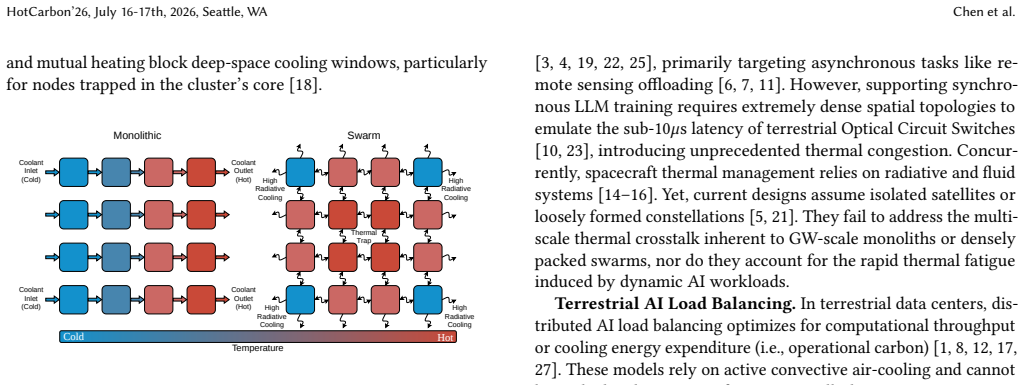
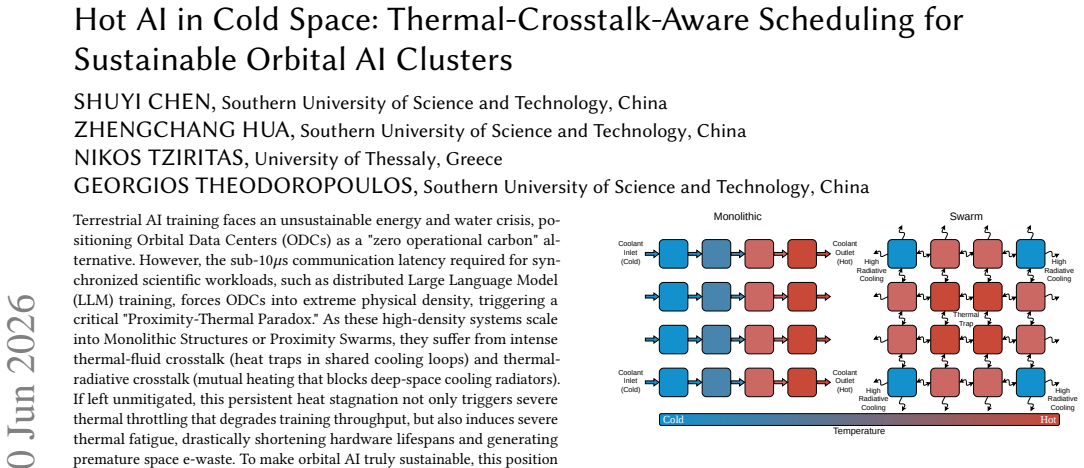
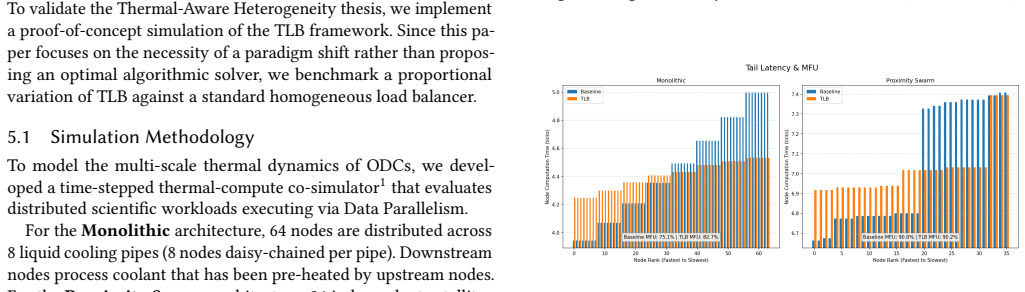
Terrestrial AI training faces an unsustainable energy and water crisis, positioning Orbital Data Centers (ODCs) as a "zero operational carbon" alternative. However, the sub-$10\mu\text{s}$ communication latency required for synchronized scientific workloads, such as distributed Large Language Model (LLM) training, forces ODCs into extreme physical density, triggering a critical "Proximity-Thermal Paradox." As these high-density systems scale into Monolithic Structures or Proximity Swarms, they suffer from intense thermal-fluid crosstalk (heat traps in shared cooling loops) and thermal-radiative crosstalk (mutual heating that blocks deep-space cooling radiators). If left unmitigated, this persistent heat stagnation not only triggers severe thermal throttling that degrades training throughput, but also induces severe thermal fatigue, drastically shortening hardware lifespans and generating premature space e-waste. To make orbital AI truly sustainable, this position paper challenges traditional uniform load-sharing. We propose the Thermal-Aware Heterogeneity Thesis, which treats spatial cooling variances as a primary resource management dimension. Building on this, we introduce Thermal-Load Balancing (TLB), a software framework that dynamically migrates these intensive workloads to the coolest available units based on instantaneous fluid temperatures or absorbed radiation. Our analysis demonstrates that TLB resolves thermal bottlenecks to restore Model Flops Utilization (MFU), while simultaneously reducing physical thermal stress. Extending the operational lifespan of orbital hardware is crucial to amortize the massive embodied carbon of rocket launches, outlining a necessary pathway to scale orbital AI without accelerating e-waste.
Editorial analysis
A structured set of objections, weighed in public.
Referee Report
Summary. The manuscript is a position paper on orbital data centers (ODCs) for AI training. It identifies a 'Proximity-Thermal Paradox' arising from the sub-10μs latency demands of synchronized LLM training, which force extreme node density and produce thermal-fluid crosstalk (heat traps in cooling loops) and thermal-radiative crosstalk (mutual heating of radiators). The authors introduce the 'Thermal-Aware Heterogeneity Thesis' treating spatial cooling variance as a scheduling resource and propose 'Thermal-Load Balancing (TLB)', a dynamic migration policy that moves workloads to the coolest available units based on instantaneous fluid temperatures or absorbed radiation. The central claim is that this policy 'resolves thermal bottlenecks to restore Model Flops Utilization (MFU)' while reducing thermal stress and extending hardware lifetime to amortize launch embodied carbon.
Significance. The sustainability of dense orbital AI infrastructure is an emerging topic. If a quantitative model or simulation were supplied showing that TLB restores MFU by a measurable amount without violating latency bounds, the work could inform scheduler design for future ODCs. As presented, however, the manuscript offers only conceptual framing and an unsupported assertion of benefit; no equations, simulations, baseline comparisons, or effect-size estimates appear. No machine-checked proofs, reproducible artifacts, or falsifiable predictions are provided.
major comments (2)
- [Abstract] Abstract: the statement 'Our analysis demonstrates that TLB resolves thermal bottlenecks to restore Model Flops Utilization (MFU), while simultaneously reducing physical thermal stress' is asserted without any supporting model, equations, simulation results, or data. This claim is load-bearing for the paper's contribution yet has no internal grounding.
- [Abstract] Abstract (TLB description paragraph): the assumption that dynamic workload migration based on instantaneous fluid temperatures or absorbed radiation can be performed without violating the sub-10μs inter-node latency required for synchronized LLM training is stated but not supported by any timing analysis, migration-overhead model, or discussion of synchronization impact.
minor comments (2)
- The manuscript introduces the terms 'Thermal-Aware Heterogeneity Thesis', 'Proximity-Thermal Paradox', and 'Thermal-Load Balancing (TLB)' without formal definitions or explicit comparison to prior thermal-aware or heterogeneity-aware scheduling literature.
- No citations to existing work on orbital data centers, radiative cooling models, or thermal management in high-density systems are referenced.
Simulated Author's Rebuttal
We thank the referee for the detailed review of our position paper. We address each major comment below and indicate the revisions we will make to strengthen the manuscript.
read point-by-point responses
-
Referee: [Abstract] Abstract: the statement 'Our analysis demonstrates that TLB resolves thermal bottlenecks to restore Model Flops Utilization (MFU), while simultaneously reducing physical thermal stress' is asserted without any supporting model, equations, simulation results, or data. This claim is load-bearing for the paper's contribution yet has no internal grounding.
Authors: We agree that the current wording in the abstract overstates the manuscript's content. As a position paper, the work introduces the Thermal-Aware Heterogeneity Thesis and TLB framework conceptually without quantitative evaluation. We will revise the abstract to replace 'Our analysis demonstrates' with 'We propose that' and qualify the benefits as hypothesized outcomes of the TLB policy, to be validated in future modeling work. revision: yes
-
Referee: [Abstract] Abstract (TLB description paragraph): the assumption that dynamic workload migration based on instantaneous fluid temperatures or absorbed radiation can be performed without violating the sub-10μs inter-node latency required for synchronized LLM training is stated but not supported by any timing analysis, migration-overhead model, or discussion of synchronization impact.
Authors: The manuscript assumes migration can be integrated into existing distributed training schedulers without breaking synchronization, but provides no supporting analysis. We will add a short paragraph in the revised manuscript discussing this assumption, including the possibility of predictive rather than reactive migration and the use of migration at the level of training steps rather than individual operations. A full timing model remains outside the scope of this position paper. revision: partial
Circularity Check
No circularity; position paper states claims without derivations or equations
full rationale
The paper is a position paper proposing TLB as a scheduling framework. It contains no equations, models, fitted parameters, or derivation chain. The claim that 'Our analysis demonstrates that TLB resolves thermal bottlenecks to restore Model Flops Utilization (MFU)' is asserted without supporting quantitative content, but this is an unsupported assertion rather than a circular reduction of any result to its own inputs. No self-citations, ansatzes, or renamings of known results appear as load-bearing steps. The derivation is absent, so no circularity exists.
Axiom & Free-Parameter Ledger
axioms (2)
- domain assumption Orbital Data Centers provide a zero operational carbon alternative to terrestrial training
- domain assumption Sub-10μs latency forces extreme physical density that triggers the Proximity-Thermal Paradox
invented entities (2)
-
Thermal-Aware Heterogeneity Thesis
no independent evidence
-
Thermal-Load Balancing (TLB)
no independent evidence
Reference graph
Works this paper leans on
-
[1]
Rui Chen, Bo Liu, WeiWei Lin, JianPeng Lin, HuiWen Cheng, and KeQin Li. 2023. Power and thermal-aware virtual machine scheduling optimization in cloud data center.Future Generation Computer Systems145 (2023), 578–589
2023
-
[2]
Gowtham Reddy Enjam. 2022. Energy-Efficient Load Balancing in Distributed Insurance Systems Using AI-Optimized Switching Techniques.International Journal of Artificial Intelligence, Data Science, and Machine Learning3, 4 (2022), 68–76
2022
-
[3]
Ezra Feilden, Adi Oltean, and Philip Johnston. 2024. Why we should train AI in space.Lumen Orbit Inc(2024)
2024
-
[4]
Ran Ginosar and David Steenari. 2025. Beyond Traditional Payload Data Han- dling: Micro-Datacenter in Space for Converged Software-Defined Storage and Payload Processing. In2025 European Data Handling & Data Processing Conference (EDHPC). 1–7
2025
-
[5]
Carlos Guimarães, Alessio Netti, Markus Sauer, Florian Zeiger, Hans-Peter Huth, and Elizaveta Boriskova. 2026. A Survey on Satellite Computing: Connecting ACM SIGENERGY Energy Informatics Review Volume 6 Issue 2, July 2026 the Dots Between Networks and Applications.IEEE Communications Surveys & Tutorials28 (2026), 567–592. doi:10.1109/COMST.2025.3579525
-
[6]
Emre Gures, Ibraheem Shayea, Mustafa Ergen, Marwan Hadri Azmi, and Ayman A El-Saleh. 2022. Machine learning-based load balancing algorithms in future heterogeneous networks: A survey.IEEE Access10 (2022), 37689–37717
2022
-
[7]
Mohamad Hnayno, Ali Chehade, Henryk Klaba, Hadrien Bauduin, Guillaume Polidori, and Chadi Maalouf. 2022. Performance analysis of new liquid cooling topology and its impact on data centres.Applied Thermal Engineering213 (2022), 118733
2022
-
[8]
Yifei Hu and Wenbin Gong. 2023. An On-Orbit Task-Offloading Strategy Based on Satellite Edge Computing.Sensors23, 9 (2023). doi:10.3390/s23094271
-
[9]
Qiangqiang Jiang, Lujie Zheng, Yu Zhou, Hao Liu, Qinglei Kong, Yamin Zhang, and Bo Chen. 2025. Efficient On-Orbit Remote Sensing Imagery Processing via Satellite Edge Computing Resource Scheduling Optimization.IEEE Transactions on Geoscience and Remote Sensing63 (2025), 1–19. doi:10.1109/TGRS.2025.3528015
-
[10]
Mingwei Li, Jilin Zhang, Jian Wan, Yongjian Ren, Li Zhou, Baofu Wu, Rui Yang, and Jue Wang. 2020. Distributed machine learning load balancing strategy in cloud computing services.Wireless Networks26, 8 (2020), 5517–5533
2020
-
[11]
Shigang Li, Tal Ben-Nun, Salvatore Di Girolamo, Dan Alistarh, and Torsten Hoefler. 2020. Taming unbalanced training workloads in deep learning with partial collective operations. InProceedings of the 25th ACM SIGPLAN Symposium on Principles and Practice of Parallel Programming. 45–61
2020
-
[12]
Yingzhi Li, Baisong Chen, Haolun Du, Ziming Wang, Heming Hu, Xuetong Li, Huan Qu, Jie Li, Weipeng Wang, Min Tao, et al . 2026. Integrated Optical Wireless Communication Featured With Optical Phased Array Transceivers for Full-Duplex and NonLine-of-Sight Transmission.Laser & Photonics Reviews20, 7 (2026), e00822
2026
-
[13]
Yuejin Li, Mi Wang, Kai Hwang, Zhengdao Li, and Tongkai Ji. 2023. LEO Satellite Constellation for Global-Scale Remote Sensing With On-Orbit Cloud AI Com- puting.IEEE Journal of Selected Topics in Applied Earth Observations and Remote Sensing16 (2023), 9369–9381. doi:10.1109/JSTARS.2023.3316298
-
[14]
Jianpeng Lin, Weiwei Lin, Wentai Wu, Wenjun Lin, and Keqin Li. 2024. Energy- aware virtual machine placement based on a holistic thermal model for cloud data centers.Future Generation Computer Systems161 (2024), 302–314
2024
-
[15]
Rui Lu and Dan Wang. 2025. A Thermal-Aware Workload Scheduler for High- Performance LLM Inference in Cooling-Regulated Datacenters.SIGENERGY Energy Inform. Rev.5, 2 (Aug. 2025), 98–104. doi:10.1145/3757892.3757906
-
[16]
Yi-Gao Lv, Yao-Ting Wang, Tong Meng, Qiu-Wang Wang, and Wen-Xiao Chu
-
[17]
Review on thermal management technologies for electronics in spacecraft environment.Energy Storage and Saving3, 3 (2024), 153–189. doi:10.1016/j.enss. 2024.03.001
-
[18]
Erdinç Mermer and Rahmi Ünal. 2023. Passive thermal control systems in space- crafts.Journal of the Brazilian Society of Mechanical Sciences and Engineering45, 3 (2023), 160
2023
-
[19]
2021.Spacecraft thermal control technologies
Jianyin Miao, Qi Zhong, Qiwei Zhao, and Xin Zhao. 2021.Spacecraft thermal control technologies. Springer
2021
-
[20]
Sergio Moreno-Alvarez, Juan M Haut, Mercedes E Paoletti, Juan A Rico-Gallego, Juan C Diaz-Martin, and Javier Plaza. 2020. Training deep neural networks: a static load balancing approach: S. Moreno-Álvarez et al.The Journal of Supercomputing 76, 12 (2020), 9739–9754
2020
-
[21]
Yunus Murat, Hatice Mercan, Nedim Sözbir, and Ahmet Selim Dalkilic. 2025. Thermal design for a communications satellite payload module.Proceedings of the Institution of Mechanical Engineers, Part C: Journal of Mechanical Engineering Science239, 18 (2025), 7629–7646
2025
-
[22]
Shimaa Naser, Maryam Tariq, Raneem Abdel-Rahim, De Mi, Azzam Mourad, Hadi Otrok, Mahmoud Al-Qutayri, Ayman Elnashar, and Sami Muhaidat. 2026. From Connectivity to Multi-Orbit Intelligence: Space-Based Data Center Architectures for 6G and Beyond. arXiv:2603.18601 [cs.ET] https://arxiv.org/abs/2603.18601
-
[23]
Aravind Nuthalapati et al. 2024. Advanced techniques for distributing and timing artificial intelligence based heavy tasks in cloud ecosystems. (2024)
2024
-
[24]
Stock, Andreas Schmidt, Juan A
Robin Ohs, Gregory F. Stock, Andreas Schmidt, Juan A. Fraire, and Holger Hermanns. 2025. Dirty Bits in Low-Earth Orbit: The Carbon Footprint of Launching Computers.SIGENERGY Energy Inform. Rev.5, 2 (Aug. 2025), 26–33. doi:10.1145/3757892.3757896
-
[25]
Yeon-Kyu Park, Geuk-Nam Kim, and Sang-Young Park. 2021. Novel structure and thermal design and analysis for cubesats in formation flying.Aerospace8, 6 (2021), 150
2021
-
[26]
Cong Peng, Yuanzhi He, Shanghong Zhao, Lingyang Song, and Boyu Deng
-
[27]
Integration of Data Center into the Distributed Satellite Cluster Net- works: Challenges, Techniques, and Trends.IEEE Network37, 3 (2023), 52–58. doi:10.1109/MNET.105.2100614
-
[28]
Leon Poutievski, Omid Mashayekhi, Joon Ong, Arjun Singh, Mukarram Tariq, Rui Wang, Jianan Zhang, Virginia Beauregard, Patrick Conner, Steve Gribble, et al. 2022. Jupiter evolving: transforming google’s datacenter network via optical circuit switches and software-defined networking. InProceedings of the ACM SIGCOMM 2022 Conference. 66–85
2022
-
[29]
Arvind R Singh, R Seshu Kumar, K Reddy Madhavi, Faisal Alsaif, Mohit Bajaj, and Ievgen Zaitsev. 2024. Optimizing demand response and load balancing in smart EV charging networks using AI integrated blockchain framework.Scientific Reports14, 1 (2024), 31768
2024
- [30]
-
[31]
Guoping Wang, Gang Wan, Zhijuan Su, Yang Wang, Yutong Jia, Gong Li, and Shi Liang. 2025. High-Performance On-Orbit Intelligent Computing and Real-Time Services for Remote Sensing Satellites Based on Large-Scale Computing Power in Space.IEEE Access13 (2025), 92114–92133. doi:10.1109/ACCESS.2025.3573932
-
[32]
Wan-fan Wu, Na Liu, Wen-long Cheng, and Yi Liu. 2013. Study on the effect of shape-stabilized phase change materials on spacecraft thermal control in extreme thermal environment.Energy conversion and management69 (2013), 174–180
2013
-
[33]
Richard Yu, and Tao Huang
Renchao Xie, Qinqin Tang, Qiuning Wang, Xu Liu, F. Richard Yu, and Tao Huang
-
[34]
doi:10.1109/ MNET.011.1900369
Satellite-Terrestrial Integrated Edge Computing Networks: Architecture, Challenges, and Open Issues.IEEE Network34, 3 (2020), 224–231. doi:10.1109/ MNET.011.1900369
2020
-
[35]
Yuzhe Xu, Thaha Mohammed, Mario Di Francesco, and Carlo Fischione. 2022. Distributed assignment with load balancing for DNN inference at the edge.IEEE Internet of Things Journal10, 2 (2022), 1053–1065
2022
-
[36]
Blaise Agüera y Arcas, Travis Beals, Maria Biggs, Jessica V Bloom, Thomas Fis- chbacher, Konstantin Gromov, Urs Köster, Rishiraj Pravahan, and James Manyika
-
[37]
Towards a future space-based, highly scalable AI infrastructure system design.arXiv preprint arXiv:2511.194684 (2025)
work page internal anchor Pith review Pith/arXiv arXiv 2025
-
[38]
Qing Ye, Yuhao Zhou, Mingjia Shi, Yanan Sun, and Jiancheng Lv. 2022. DLB: A dynamic load balance strategy for distributed training of deep neural networks. IEEE Transactions on Emerging Topics in Computational Intelligence7, 4 (2022), 1217–1227. ACM SIGENERGY Energy Informatics Review Volume 6 Issue 2, July 2026
2022
discussion (0)
Sign in with ORCID, Apple, or X to comment. Anyone can read and Pith papers without signing in.