REVIEW 2 major objections 3 minor 39 references
Shortest filling geodesics on hyperbolic surfaces
T0 review · 2 major / 3 minor · reviewed 2026-08-07 · deepseek-v4-flash
Pith's one-line read For every closed orientable hyperbolic surface of genus g, the shortest total length of a filling multi-geodesic is exactly half the perimeter of the regular right-angled hyperbolic (8g−4)-gon, and a single filling geodesic attains it.
desk verdict Likely-true main theorem, but the proof has a load-bearing gap in the isoperimetric inequality and a concrete miscount in the construction; worth refereeing after revision. read the letter →
The pith
A machine-rendered reading of the paper's core claim, the machinery that carries it, and where it could break.
The reading
What carries the argument
The argument rests on two mechanisms: a reduction (Theorem 2.1) that converts any filling multi-geodesic into a filling geodesic graph of no greater length whose complementary polygons each have at least five sides, with the side-count identity sum(m_i − 4) = 8g − 8; and an isoperimetric inequality (Theorem 3.1) that bounds the total perimeter of such a polygon family below by P_{8g−4}. The inequality is proved by studying perimeter functions of regular hyperbolic polygons and relies on a generalization of Sanki-Vadnere's even-polygon isoperimetric result.
What would settle it
Construct a genus-g hyperbolic surface and a filling multi-geodesic of total length strictly less than 1/2 P_{8g−4}, or exhibit a filling multi-geodesic of length exactly 1/2 P_{8g−4} whose complement is not a regular right-angled (8g−4)-gon.
Extended reading notes
Core claim
The central discovery is that the filling length infimum over the moduli space of genus-g hyperbolic surfaces equals 1/2 P_{8g−4}, where P_k is the perimeter of the regular right-angled hyperbolic k-gon. The proof proceeds in two steps: first, any filling multi-geodesic is shortened to a filling geodesic graph whose complement has only polygons with at least five sides and satisfies sum(m_i − 4) = 8g − 8; second, an isoperimetric inequality shows the total perimeter of such a collection is at least P_{8g−4}, with equality only for a single regular right-angled (8g−4)-gon. An explicit construction exhibits a single filling geodesic of this length, so the bound is sharp.
Load-bearing premise
The lower bound rests on the reduction in Theorem 2.1, which asserts that every filling multi-geodesic can be replaced by a filling geodesic graph of no greater length whose complementary polygons all have at least five sides; if that reduction produced triangles or increased length, the isoperimetric inequality of Theorem 3.1 could not be applied and the bound would not follow.
Editorial extensions
If this is right
- The bound is sharp for every genus g ≥ 2: a single filling geodesic whose complement is a regular right-angled (8g−4)-gon has length exactly 1/2 P_{8g−4}.
- Equality is rigid: a filling multi-geodesic of length 1/2 P_{8g−4} must be a single geodesic whose complement is the regular right-angled (8g−4)-gon.
- For surfaces whose systole set fills, the kissing number satisfies sys(X) · kiss(X) ≥ 1/2 P_{8g−4}, yielding kiss(X) ≥ (3.525) g / log g for large g, improving the previous constant.
- The reduction and isoperimetric inequality apply to arbitrary filling multi-geodesics, including those with multiple intersection points and self-intersections, settling a conjecture previously known only for filling pairs.
Reading between the lines
- The triangle-free condition in the reduction is essential, since the isoperimetric inequality fails for triangles; this suggests that any relaxation of the filling-graph hypothesis would need an explicit correction term that accounts for triangular regions.
- The same two-step strategy (reduce the graph, then apply a polygon isoperimetric inequality) could be adapted to other settings, such as filling curves on punctured surfaces or on non-orientable surfaces, where the relevant regular polygon side count would change.
- The equality case forces the surface to be a regular polygonal gluing, hinting that global minimizers of filling length in moduli space are highly symmetric; it would be natural to ask whether these are the only critical points of the filling-length function.
Editorial analysis
A structured set of objections, weighed in public.
Referee Report
Summary. The paper claims to determine the minimal length of a filling multi-geodesic on a closed orientable hyperbolic surface of genus g, minimized over moduli space. Theorem 1.1 states this minimum equals half the perimeter of a regular right-angled (8g−4)-gon, and that it is realized by a single filling geodesic. The proof has two main ingredients: Theorem 2.1, which replaces a filling multi-geodesic by a filling geodesic graph of no larger length whose complementary components are polygons with at least five sides and satisfy a side-count identity, and Theorem 3.1, an isoperimetric inequality comparing the perimeter sum of such polygons with the perimeter of a regular polygon of the same area. Section 4 constructs a hyperbolic surface and a single filling geodesic whose complement is the desired regular polygon.
Significance. If correct, the result settles a natural question about filling geodesics and extends the Aougab–Huang conjecture from filling pairs to arbitrary filling multi-geodesics. The construction of a single filling geodesic attaining the bound is explicit, and the corollaries on the kissing number of surfaces with filling systole are of independent interest. The paper also provides a clean statement of the isoperimetric inequality for polygons with at least four sides, which is a useful contribution in itself. However, the proof of the isoperimetric theorem is currently incomplete, so the main result is not yet established as written.
major comments (2)
- [Section 2.3, proof of Theorem 2.1] The theorem is stated for arbitrary hyperbolic mi-gons, but the proof from Proposition 3.8 onward only treats regular polygons. Proposition 3.8 assumes D1 and D2 are regular hyperbolic polygons, Lemma 3.10 assumes each Di is regular, and the induction in the proof of Theorem 3.1 compares the regular replacements eD_j. There is no argument showing that, among hyperbolic polygons with a fixed number of sides and fixed area, the regular polygon minimizes perimeter. Reference [10] (Bezdek) is listed but never cited in the proof. Consequently the key step in the proof of Theorem 1.1, namely ℓ(G) = 1/2 Σ Perim(D_i) ≥ 1/2 P_{8g−4}, does not follow for the arbitrary polygons produced by Theorem 2.1. This is the load-bearing connection between the graph reduction and the numerical lower bound, so the proof of Theorem 3.1 is incomplete as written.
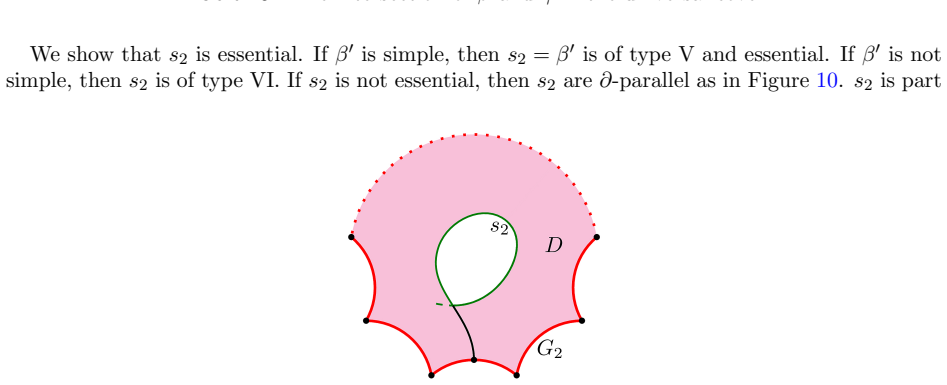
- [Section 2.3, proof of Theorem 2.1] The iterative construction ends with the assertion: 'Since Γ is a finite filling graph, the repeating process will eventually stop.' This is not justified in the general case. The replacement step replaces an arc β by a shortest proper geodesic arc β′ that may not lie in Γ, so the intermediate graph Θ_i is no longer a subgraph of Γ. Finiteness of Γ therefore does not, by itself, bound the number of iterations. A rigorous termination argument—for instance, a monotone complexity measure for the pair (Θ_i, G_i) or a bound on the number of essential cutting curves needed to fill the surface—is required. The termination of the process is essential to the existence of the graph G, so this gap also affects the lower bound.
minor comments (3)
- [References] Reference [10] (Bezdek) is never cited in the body of the paper. Either it should be used to supply the missing regularization step in Theorem 3.1, or it should be removed.
- [Section 4] The claim that the curve α in Figure 12 is filling and that its complement is an (8g−4)-gon is stated without proof. Since the construction of the extremal surface depends on this assertion, a brief justification or a more detailed reading of the figure would be helpful.
- [Throughout] There are several typographical errors, including 'SHOR TEST' in the title, 'olygons' in Section 2.2, 'essencity' in Section 2.3, and some malformed summation indices such as 'kX k=1'. The manuscript would benefit from a careful proofreading pass.
Circularity Check
No circularity found: the main lower bound is derived from an independent isoperimetric inequality and a self-contained graph-reduction lemma; the noted proof gap in Theorem 3.1 is a completeness issue, not circularity.
full rationale
The derivation chain is not circular. Theorem 2.1 is a self-contained combinatorial-geometric reduction: it builds a filling convex geodesic graph G from Gamma with length(G) <= length(Gamma) and side counts m_i >= 5 satisfying sum(m_i - 4) = 8g - 8, using only Gauss-Bonnet and geodesic convexity arguments (Section 2). The lower bound then rests on Theorem 3.1, whose proof uses Proposition 3.5 from Sanki-Vadnere [29] - prior independent published work not by these authors - and calculus on the regular hyperbolic polygon perimeter function P_n(a). No equation in the paper defines the target (1/2)P_{8g-4} in terms of the quantities being bounded, and no fitted parameter is renamed as a prediction. The paper's self-citations ([32], [38]) appear only in background remarks on non-simple geodesics and are not load-bearing. The legitimate concern in this manuscript is a completeness gap in the proof of Theorem 3.1: the statement allows arbitrary hyperbolic m_i-gons, but from Proposition 3.8 onward the proof silently treats the D_i as regular (e.g., 'We consider a series of hyperbolic regular polygons eD1, eD2, ..., eDk' and then applies Proposition 3.8 to D1,D2), and the cited isoperimetric result [10] is never invoked to justify this regularization. That is a missing argument or correctness issue, not a circular reduction: Theorem 3.1 is not assumed in its own proof, and the main theorem would follow if the regularization lemma were supplied.
Assumptions & free parameters
assumptions (5)
- standard math Gauss-Bonnet theorem for hyperbolic surfaces and polygons
- standard math Hyperbolic polygon isoperimetric inequality: among convex hyperbolic m-gons of fixed area, the regular m-gon has minimal perimeter (Bezdek [10])
- domain assumption Sanki-Vadnere's Proposition 3.5 (convexity and monotonicity properties of perimeter functions)
- standard math Existence of a minimizer via Mumford compactness and the collar lemma
- ad hoc to paper Topological assertion that the curve in Figure 12 is filling with complement an (8g-4)-gon
Cite this review
Pith. "Pith review of Shortest filling geodesics on hyperbolic surfaces." pith.science (2026). https://pith.science/paper/NKKJTKL5
@misc{pith2026250612465,
  author       = {Pith},
  title        = {Pith review of: Shortest filling geodesics on hyperbolic surfaces},
  year         = {2026},
  howpublished = {\url{https://pith.science/paper/NKKJTKL5}},
  note         = {Machine review of arXiv:2506.12465}
}
abstract
In this paper, we obtain the minimal length of a filling (multi-)geodesic on a genus $g$ hyperbolic surface in the moduli space of hyperbolic surfaces and show that it is realized by the geodesic whose complement is a right-angled regular $(8g-4)$-gon. A single geodesic realizing this minimum is provided.
Figures


Figures from the paper (10 more)




Reference graph
Works this paper leans on
-
[10]
K´ aroly Bezdek. Ein elementarer Beweis f¨ ur die isoperimetrische Ungleichung in der Euklidischen und hyperbolis- chen Ebene. Annales Universitatis Scientiarum Budapestinensis de Rolando E¨ otv¨ os Nominatae. Sectio Mathe- matica, Volume 27, 107–112, 1984
work page 1984
-
[1]
Minimally intersecting filling pairs on surfaces
Tarik Aougab and Shinnyih Huang. Minimally intersecting filling pairs on surfaces. Algebraic and Geometric Topology, Volume 15, Issue 2, 903–932, 2015
work page 2015
-
[2]
Small filling sets of curves on a surface
James W Anderson, Hugo Parlier, and Alexandra Pettet. Small filling sets of curves on a surface. Topology and its Applications, Volume 158, Issue 1, 84–92, 2011
work page 2011
-
[3]
The geometry and combinatorics of closed geodesics on hyperbolic surfaces
Chris Arettines. The geometry and combinatorics of closed geodesics on hyperbolic surfaces. Thesis. City Uni- versity of New York, 2015
work page 2015
-
[4]
Friedman-Ramanujan functions in random hyperbolic geometry and appli- cation to spectral gaps II
Nalini Anantharaman, Laura Monk. Friedman-Ramanujan functions in random hyperbolic geometry and appli- cation to spectral gaps II. Preprint, arXiv:2502.12268, 2025
arXiv 2025
-
[5]
Closed geodesics on pairs of pants
Claire M Baribaud. Closed geodesics on pairs of pants. Israel Journal of Mathematics , Volume 109, 339–347, 1999
work page 1999
-
[6]
The stable neighborhood theorem and lengths of closed geodesics
Ara Basmajian. The stable neighborhood theorem and lengths of closed geodesics. Proceedings of the American Mathematical Society, Volume 119, Issue 1, 217–224, 1993
work page 1993
-
[7]
Universal length bounds for non-simple closed geodesics on hyperbolic surfaces
Ara Basmajian. Universal length bounds for non-simple closed geodesics on hyperbolic surfaces. Journal of Topology, Volume 6, Issue 2, 513–524, 2013
work page 2013
Show all 39 references
-
[8]
The shortest non-simple closed geodesics on hyperbolic surfaces
Ara Basmajian, Hugo Parlier, and Hanh Vo. The shortest non-simple closed geodesics on hyperbolic surfaces. Mathematische Zeitschrift , Volume 306, Number 1, No. 8, 19 pp, 2024
2024
-
[9]
La systole des surfaces hyperelliptiques
Christophe Bavard. La systole des surfaces hyperelliptiques. Prepublication de l’ENS Lyon , Volume 71, 1992
1992
-
[11]
Injectivity radius and low eigenvalues of hyperbolic manifolds
Robert Brooks. Injectivity radius and low eigenvalues of hyperbolic manifolds. Journal f¨ ur die Reine und Ange- wandte Mathematik , Volume 390, Issue 953681, 117–129, 1988
1988
-
[12]
On the period matrix of a Riemann surface of large genus
Peter Buser and Peter Sarnak. On the period matrix of a Riemann surface of large genus. Inventiones Mathe- maticae, Volume 117, Issue 1, 27–56, 1994
1994
-
[13]
A construction of minimal coherent filling pairs
Hong Chang and William W Menasco. A construction of minimal coherent filling pairs. Preprint, arXiv:2302.03632, 2023
2023 arXiv
-
[14]
Counting geodesics on expander surfaces
Benjamin Dozier and Jenya Sapir. Counting geodesics on expander surfaces. Preprint, arXiv:2304.07938, 2023. 18 YUE GAO, JIAJUN W ANG, AND ZHONGZI W ANG
2023
-
[15]
Short closed geodesics with self-intersections
Viveka Erlandsson and Hugo Parlier. Short closed geodesics with self-intersections. Mathematical Proceedings of the Cambridge Philosophical Society , Volume 169, Issue 3, 623–638, 2020
2020
-
[16]
Linear programming bounds for hyperbolic surfaces
Maxime Fortier-Bourque and Bram Petri. Linear programming bounds for hyperbolic surfaces. Preprint, arXiv:2302.02540, 2023
2023
-
[17]
A short proof of a conjecture of Aougab-Huang
Jonah Gaster. A short proof of a conjecture of Aougab-Huang. Geometriae Dedicata, Volume 213, 339–343, 2021
2021
-
[18]
Traces, lengths, and simplicity for loops on surfaces
John Hempel. Traces, lengths, and simplicity for loops on surfaces. Topology and its Applications , Volume 18, Number 2-3, 153–161, 1984
1984
-
[19]
Logarithmic systolic growth for hyperbolic surfaces in every genus
Mikhail G Katz and St´ ephane Sabourau. Logarithmic systolic growth for hyperbolic surfaces in every genus. Proceedings of the American Mathematical Society, Volume 153, Issue 1, 325–330, 2025
2025
-
[20]
Logarithmic growth of systole of arithmetic Riemann surfaces along congruence subgroups
Mikhail G Katz, Mary Schaps, and Uzi Vishne. Logarithmic growth of systole of arithmetic Riemann surfaces along congruence subgroups. Journal of Differential Geometry , Volume 76, Issue 3, 399–422, 2007
2007
-
[21]
The nielsen realization problem
Steven P Kerckhoff. The nielsen realization problem. Annals of Mathematics , Volume 117, Number 2, 235–265, 1983
1983
-
[22]
Felix Jenni. ¨Uber den ersten Eigenwert des Laplace-Operators auf ausgew¨ ahlten Beispielen kompakter Rie- mannscher Fl¨ achen.Commentarii Mathematici Helvetici , Volume 59, Issue 2, 193–203, 1984
1984
-
[23]
Random surfaces with large systoles
Mingkun Liu and Bram Petri. Random surfaces with large systoles. Preprint, arXiv:2312.11428, 2023
2023 arXiv
-
[24]
Annals of Probability, Volume 52, Number 2, 545–575, 2024
Michael Lipnowski and Alex Wright Towards optimal spectral gaps in large genus. Annals of Probability, Volume 52, Number 2, 545–575, 2024
2024
-
[25]
Geometry of the complex of curves
Howard Masur and Yair Nathan Minsky. Geometry of the complex of curves. I. Hyperbolicity. Inventiones Mathematicae, Volume 138, Issue 1, 103–149, 1999
1999
-
[26]
Geometry of the complex of curves
Howard Masur and Yair Nathan Minsky. Geometry of the complex of curves. II. Hierarchical structure.Geometric and Functional Analysis , Volume 10, Issue 4, 902–974, 2000
2000
-
[27]
A remark on Mahler’s compactness theorem
David Mumford. A remark on Mahler’s compactness theorem. Proceedings of the American Mathematical Society, Volume 28, Issue 276410, 289–294, 1971
1971
-
[28]
Connected-sum decompositions of surfaces with minimally-intersecting filling pairs
Mark Nieland. Connected-sum decompositions of surfaces with minimally-intersecting filling pairs. Thesis, State University of New York at Buffalo, ProQuest Dissertations & Thesis 10750145, 2018
2018
-
[29]
A conjecture on the lengths of filling pairs
Bidyut Sanki and Arya Vadnere. A conjecture on the lengths of filling pairs. Geometriae Dedicata, Volume 213, 359–373, 2021
2021
-
[30]
Systoles and topological Morse functions for Riemann surfaces
Paul Schmutz Schaller. Systoles and topological Morse functions for Riemann surfaces. Journal of Differential Geometry, Volume 52, Issue 3, 407–452, 1999
1999
-
[31]
Nonsimple closed geodesics with given intersection number on hyperbolic surfaces
Wujie Shen. Nonsimple closed geodesics with given intersection number on hyperbolic surfaces. Preprint, arXiv:2305.00638, 2023
2023 arXiv
-
[32]
Minimal length of nonsimple closed geodesics on hyperbolic surfaces
Wujie Shen and Jiajun Wang. Minimal length of nonsimple closed geodesics on hyperbolic surfaces. Preprint, arXiv:2207.08360, 2022
2022 arXiv
-
[33]
A spine for Teichm¨ uller space
William P Thurston. A spine for Teichm¨ uller space. Preprint, 1986
1986
-
[34]
On the geometry and dynamics of diffeomorphisms of surfaces
William P Thurston. On the geometry and dynamics of diffeomorphisms of surfaces. Bulletin of the American Mathematical Society, Volume 19, Number 2, 417–431, 1988
1988
-
[35]
Short closed geodesics on cusped hyperbolic surfaces
Hanh Vo. Short closed geodesics on cusped hyperbolic surfaces. Pacific Journal of Mathematics , Volume 318, Issue 1, 127–151, 2022
2022
-
[36]
Random hyperbolic surfaces of large genus have first eigenvalues greater than 3 16 − ϵ
Yunhui Wu and Yuhao Xue. Random hyperbolic surfaces of large genus have first eigenvalues greater than 3 16 − ϵ. Geometric and Functional Analysis , Volume 32, Issue 2, 340–410, 2022
2022
-
[37]
Prime geodesic theorem and closed geodesics for large genus.Journal of the European Mathematical Society, doi:10.4171/JEMS/1653, 2025
Yunhui Wu and Yuhao Xue. Prime geodesic theorem and closed geodesics for large genus.Journal of the European Mathematical Society, doi:10.4171/JEMS/1653, 2025
2025 doi
-
[38]
Length minima for an infinite family of filling closed curves on a one-holed torus
Zhongzi Wang and Ying Zhang. Length minima for an infinite family of filling closed curves on a one-holed torus. Geometriae Dedicata, Volume 218(1): 6, 2024
2024
-
[39]
On Marden’s universal constant of Fuchsian groups, II
Akira Yamada. On Marden’s universal constant of Fuchsian groups, II. Journal d’Analyse Math´ ematique, Volume 41, 234–248, 1982. School of Mathematics and Statistics, Anhui Normal University, Wuhu, Anhui, 241002, P. R. China Email address : yuegao@ahnu.edu.cn LMAM, School of M...
1982
Reviewed August 7, 2026 · model on record in the stance chip above.
Discussion (0). Continue with ORCID to comment.