REVIEW 4 major objections 6 minor 37 references
High-Spatial Resolution Transmission and Storage Expansion Planning for High Renewable Grids: A Case Study
T0 review · 4 major / 6 minor · reviewed 2026-08-11 · deepseek-v4-flash
Pith's one-line read A 2,000-bus synthetic Texas case study finds that co-investing in transmission upgrades and battery storage is necessary to meet future demand, while either technology alone begins load shedding in 2040.
desk verdict Solid 2000-bus TEP+storage case study, but the storage-candidate heuristic undercuts the 'neither technology alone' claim. read the letter →
The pith
A machine-rendered reading of the paper's core claim, the machinery that carries it, and where it could break.
The reading
What carries the argument
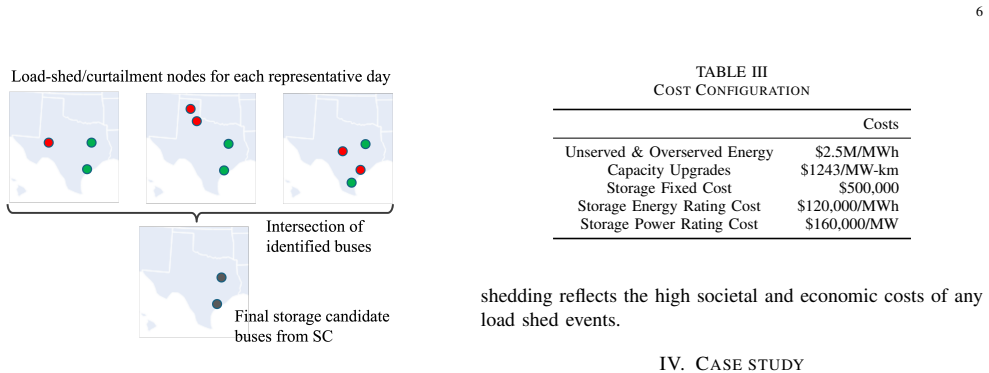
The storage candidates (SC) method is the mechanism that carries the argument: solve the operational recourse problem with no transmission or storage investments for each representative day, identify the nodes that experience load shedding or renewable curtailment, and take the intersection of those node sets across all representative days as the allowed storage siting set. This reduces the storage siting decision from 2,000 binary variables to roughly 50-150 candidate nodes, cutting the total number of binaries from 50,000 to a few thousand and bringing solve times from over 72 hours down to under 5 hours. The intersection rule is also the source of the main suboptimality the paper identifies, since a node that sheds load on only some days is excluded.
What would settle it
Re-run the TEP+Storage model with the SC candidate set expanded to the union of load-shedding and curtailment nodes across days, or with Fort Worth-Dallas nodes added manually as the paper does; if the expanded set eliminates or markedly reduces the 2050 load shed at equal or lower total cost, the intersection rule is a true bottleneck. A smaller-scale test: solve the full TEP+Storage problem on a 24- or 53-bus system and compare against SC-restricted solutions to check whether the heuristic can provably miss optimal sites.
Extended reading notes
Core claim
The central claim is that transmission and storage are complementary investments in a high-renewable grid: line upgrades let zero-cost renewable generation reach load centers, while batteries store energy from low-load hours to meet the afternoon peak. On the synthetic Texas network, the co-optimized TEP+Storage plan installs no storage until 2040, then builds 109.6 GWh by 2050, while the Transmission Only and Storage Only configurations each begin load shedding in 2040. Co-investment delays but does not eliminate load shedding: the model still sheds 3343 GWh in 2050, which the authors attribute largely to the storage-candidates method missing the Fort Worth-Dallas area. The authors state this as evidence that neither technology alone can meet future load and that co-optimization is necessary to keep costs low.
Load-bearing premise
The load-bearing assumption is that the nodes which show curtailment or load shedding in every representative day of a no-investment simulation already contain all the storage locations a good plan could need; the paper's own Fort Worth-Dallas counterexample shows this assumption can fail.
Editorial extensions
If this is right
- Co-investment delays the onset of load shedding from 2040 to 2050 on the studied system, although it does not eliminate it.
- Transmission upgrades concentrate in high-renewable western regions and dominate early investments, while storage appears later and is placed in solar-rich and load-center nodes.
- Storage investment remains necessary across cost variations from 75% to 150% of the baseline, indicating the modeled system needs storage regardless of price.
- The storage-candidates heuristic makes a 2,000-bus TEP+Storage model solvable in hours, where the unrestricted model times out after 72 hours.
Reading between the lines
- An iterative version of the SC method that adds newly revealed load-shedding centers to the candidate set after each investment period would likely recover part of the missed savings; the paper's own manual experiment adding Fort Worth-Dallas storage cut 2050 load shed by 25-29%.
- The end-of-day half-charge constraint on storage may be inflating the reported 2050 load shedding, because the paper notes the shed could be reduced by discharging batteries below that residual level.
- A sub-hourly operational model would likely recommend more storage than this hourly model, since the paper expects the hourly timescale to miss storage's value for ramping and ancillary services.
Signed reviews
Editorial analysis
A structured set of objections, weighed in public.
Referee Report
Summary. The paper formulates a mixed-integer linear program for co-optimized transmission and storage expansion planning (TEP+Storage), with line capacity upgrades and short-duration battery siting/sizing, and applies it to the ACTIVSg2000 synthetic Texas grid over 2030-2050. To make the 2000-bus problem tractable, the authors propose a Storage Candidates (SC) heuristic that restricts storage siting to nodes exhibiting renewable curtailment or load shedding in a no-investment recourse run, intersected across representative days. The case study compares TEP+Storage with Transmission Only and Storage Only configurations and reports investment patterns, costs, and load shedding. The paper's central claims are that co-investment in transmission and storage is necessary because neither technology alone can meet future load, that transmission is driven by renewable integration, and that storage is primarily used for peak shaving.
Significance. The 2000-bus spatial resolution substantially exceeds prior TEP+Storage case studies (typically up to 240 buses), and the computational results in Table II show that the SC heuristic converts an intractable instance into solvable ones, which is a practically useful contribution if the heuristic is reliable. The paper is also transparent: Section V.G explicitly documents a failure of the SC heuristic (Fort Worth-Dallas) and reports the resulting load-shedding reduction. However, because the heuristic's candidate restriction is load-bearing for the headline conclusion, the quantitative policy conclusions should be treated as provisional.
major comments (4)
- [Section III.A and Section V.G] The SC heuristic described in Section III.A restricts storage siting to the intersection of nodes with curtailment or load shedding across all representative days. Section V.G shows that this intersection excludes Fort Worth-Dallas in the 2050 TEP+Storage solution despite significant load shedding there, and manually adding those nodes reduces annual load shedding by 25-29%. The spatial conclusion that storage is sited at curtailment/load-shedding nodes is therefore partly an artifact of the candidate selection. More importantly, the Storage Only configuration in Table VI is solved with the same restricted candidate set, and the unrestricted storage siting problem timed out (Table II). The claim that 'neither technology alone can meet future load' is consequently not established for storage alone: a better storage-only plan with an expanded candidate set might delay or eliminate load shedding. Please re-run at least the Storage Only configuration with a union-based or iteratively expanded candidate set, or explicitly limit the claim to storage sited under the SC heuristic.
- [Section V.B] The statement in Section V.B that storage installations 'are concentrated in regions with significant solar capacity, as well as in major load centers' and 'align with the paradigm set by the SC heuristic' is circular: the SC heuristic by construction only permits storage at nodes with curtailment or load shedding. As a result, the geographic findings about storage siting do not provide independent evidence about where storage is economically optimal. Please either derive the siting conclusions from the expanded-candidate experiments or acknowledge that the spatial pattern is at least partially predetermined.
- [Section V.F and Eq. (8)] The half-charge residual-energy constraint in Eq. (8) forces storage to end each representative day at 50% state of charge. Section V.F admits that load shedding in the 2050 TEP+Storage case 'could easily be resolved' by violating this constraint. Since the paper emphasizes storage's peak-shaving role and uses representative days, this assumption may systematically undervalue storage and bias the co-investment conclusion. A sensitivity analysis that relaxes Eq. (8) or uses longer storage operational horizons (as in refs [35], [36]) should be reported.
- [Table VI and Section V.G] The Storage Only configuration has no reported results for 2045 and 2050 in Table VI, and several rows of Table VII are incomplete due to timeouts, as explained in Section V.G. The conclusion that 'neither technology alone can meet future load' rests on the Storage Only case shedding load in 2040; without later-year results, the comparison with TEP+Storage and Transmission Only is asymmetric. Please report the timed-out instances explicitly (e.g., with optimality gaps and best bounds) or justify why 2040 results suffice for the claim.
minor comments (6)
- [Constraints (13)-(16)] In Constraints (13)-(16), the index r is used for the storage operation variables, whereas the model formulation and nomenclature define the set S with index s; this should be made consistent.
- [Figure 6] Figure 6 is missing subfigure (l) for the 2045 Storage Only case and (o) for 2050 Storage Only, despite panel labels in the caption; the visual comparison for Storage Only is therefore incomplete.
- [Table VI] Table VI does not include 2045 and 2050 rows for Storage Only; if these instances timed out, indicate this explicitly with an entry such as 'timed out' rather than omitting the rows.
- [Table VI header] The column header 'SC # max investments' is unclear; it should be split into e.g., 'Number of storage candidates' and 'Number of lines with maximum upgrade level'.
- [Table VII] In Table VII, the 150% storage-cost case is missing the 2045 and 2050 rows without a note until Section V.G; add a table note so the incomplete rows are interpretable.
- [Abstract and Section V.A] The paper states in the abstract that co-optimization 'enhances grid reliability,' but the TEP+Storage configuration still sheds 3343 GWh in 2050 (Table VI); consider qualifying the reliability claim as a reduction in load shedding relative to single-technology investments rather than elimination.
Circularity Check
Storage siting conclusions are definitional under the SC heuristic; the 'storage alone cannot meet load' claim is tested only under that same restrictive candidate set.
-
self definitional
[Section III.A (Search Space Reduction via Storage Candidates), Section V.B (Spatial and Temporal Distribution of Investments), Abstract]
"Nodes that experience load shedding or renewable curtailment during any hour are identified as SC. ... Storage installations are concentrated in regions with significant solar capacity, as well as in major load centers. These placements align with the paradigm set by the SC heuristic, targeting areas that may experience high volumes of curtailment and/or load shedding otherwise."
The SC method defines the allowable storage siting set as exactly the buses that show curtailment or load-shedding in the no-investment recourse. The paper then presents, as an empirical finding, that storage investments are 'shaped by renewable curtailment and load-shedding events' and are placed at sites that 'align with the paradigm set by the SC heuristic.' Because storage cannot be sited anywhere else by construction, the spatial conclusion is an input to the model, not a discovered output. The only non-tautological content is which pre-selected nodes are chosen and at what size; the claimed locational driver is already encoded in the feasible set.
-
fitted input called prediction
[Section V.A (Key Observations), Section V.C, Section V.G (Evaluating the SC method)]
"Co-investment in line upgrades and storage investments is necessary to meet electricity demand of future years while keeping costs low. Neither technology alone can meet future load. ... With the TEP+Storage configuration, the Fort Worth-Dallas area experiences significant load shedding in 2050 (Figure 8b), but was not considered as a potential storage site for the TEP+Storage. ... A similar observation is made for the Houston area with the Storage Only configuration in 2040 (Figure 8c)."
The 'neither technology alone' conclusion is tested only under the SC restriction, since 'storage investments decisions are restricted to sites identified by the SC method' (Section III.B). The Storage Only arm is therefore not a test of storage alone, but of storage sited exclusively at the no-investment curtailment and load-shedding nodes. The paper itself documents that this fitted candidate set omitted Fort Worth-Dallas for TEP+Storage and Houston for Storage Only, and that manually adding Fort Worth-Dallas nodes reduced annual shedding by 25-29%. Thus the central comparative claim is partly an artifact of the candidate set fitted from the same failure pattern the storage is meant to remedy; a less restricted input changed the output in the paper's own experiment.
full rationale
The transmission-expansion results are largely self-contained: line upgrades are optimized over all branches, and their congestion-relief role is evaluated against no-investment and transmission-only baselines without the SC restriction. Those findings do not reduce to the storage heuristic. The circularity is concentrated in the storage-siting narrative: the SC method defines storage candidates as the nodes that already exhibit curtailment or load-shedding, so the paper's conclusion that storage is sited at such nodes is true by construction. The broader claim that storage alone cannot meet future load is also compromised rather than established, because the Storage Only configuration inherits the same candidate restriction and the paper itself shows that adding an excluded load center cuts shedding by 25-29%. No load-bearing self-citation chain or imported uniqueness theorem was found; citations to the authors' prior work are not central to the derivation. Because the paper explicitly acknowledges the SC limitation in Section V.G and proposes an iterative fix, this is partial circularity (score 6), not a fully forced derivation (score 8-10).
Assumptions & free parameters
free parameters (3)
- Load growth rate =
1.5% per year
- Unserved energy penalty lambda =
$2.5M/MWh
- Number of representative days k =
5
assumptions (6)
- domain assumption DC power flow approximation is adequate for TEP+Storage planning
- domain assumption Five representative days capture yearly operational variability
- domain assumption Future load and generation scale uniformly across all buses by technology
- domain assumption Only capacity upgrades of existing lines are allowed; no new transmission lines
- ad hoc to paper Storage is short-duration only (max 4h) with half-charge state at beginning and end of each representative day
- ad hoc to paper The SC candidate set (intersection of curtailment/load-shed nodes across representative days) is a sufficient search space for storage siting
Cite this review
Pith. "Pith review of High-Spatial Resolution Transmission and Storage Expansion Planning for High Renewable Grids: A Case Study." pith.science (2026). https://pith.science/paper/NKSQNW2Z
@misc{pith2026241203799,
  author       = {Pith},
  title        = {Pith review of: High-Spatial Resolution Transmission and Storage Expansion Planning for High Renewable Grids: A Case Study},
  year         = {2026},
  howpublished = {\url{https://pith.science/paper/NKSQNW2Z}},
  note         = {Machine review of arXiv:2412.03799}
}
read the original abstract
Transmission Expansion Planning (TEP) is the process of optimizing the development and upgrade of the power grid to ensure reliable, efficient, and cost-effective electricity delivery while addressing grid constraints. To support growing demand and renewable energy integration, energy storage is emerging as a pivotal asset that provides temporal flexibility and alleviates congestion. This paper presents a TEP model that incorporates the sizing and siting of short-duration storage. With a focus on high spatial resolution, the model is applied to a 2,000-bus synthetic Texas power system, offering detailed insights into geographic investment and operational patterns. To maintain computational feasibility, a simple yet effective storage candidates (SC) method is introduced, significantly reducing the search space. Results highlight that transmission investments are primarily driven by renewable energy expansion, while storage investments are shaped by renewable curtailment and load-shedding events, with their primary function being peak load shaving. The findings underscore the importance of co-optimizing transmission and storage to minimize costs and enhance grid reliability. However, limitations in the ability of the SC method to identify optimal storage locations to meet long-term needs suggest opportunities for future research, including dynamic candidate selection and hybrid optimization techniques.
Figures


Figures from the paper (6 more)


Reference graph
Works this paper leans on
-
[21]
Optimal energy storage siting and sizing: A wecc case study,
R. Fern ´andez-Blanco, Y . Dvorkin, B. Xu, Y . Wang, and D. S. Kirschen, “Optimal energy storage siting and sizing: A wecc case study,” IEEE transactions on sustainable energy , vol. 8, no. 2, pp. 733–743, 2016
work page 2016
-
[35]
Optimal planning of energy storage using a sequence representative period method,
Q. Wang, X. Luo, and H. Ma, “Optimal planning of energy storage using a sequence representative period method,” in 2022 Power System and Green Energy Conference (PSGEC) . IEEE, 2022, pp. 370–374
work page 2022
-
[36]
Enhanced representative days and system states modeling for energy storage investment analysis,
D. A. Tejada-Arango, M. Domeshek, S. Wogrin, and E. Centeno, “Enhanced representative days and system states modeling for energy storage investment analysis,” IEEE Transactions on Power Systems , vol. 33, no. 6, pp. 6534–6544, 2018
work page 2018
-
[1]
Crossed wires: Modernizing the us electric grid,
R. Schmalensee, “Crossed wires: Modernizing the us electric grid,” Resources for the Future , 2024, accessed: 2024- 11-20. [Online]. Available: https://www.resources.org/archives/ crossed-wires-modernizing-the-us-electric-grid/
work page 2024
-
[2]
S. Cho, C. Li, and I. E. Grossmann, “Recent advances and challenges in optimization models for expansion planning of power systems and reliability optimization,” Computers & Chemical Engineering , vol. 165, p. 107924, 2022
work page 2022
-
[3]
Comprehen- sive review of generation and transmission expansion planning,
R. Hemmati, R.-A. Hooshmand, and A. Khodabakhshian, “Comprehen- sive review of generation and transmission expansion planning,” IET Generation, Transmission & Distribution , vol. 7, no. 9, pp. 955–964, 2013
work page 2013
-
[4]
Strong mixed-integer formulations for transmission expansion planning with facts devices,
K. Wu, M. Tanneau, and P. V . Hentenryck, “Strong mixed-integer formulations for transmission expansion planning with facts devices,” Electric Power Systems Research , vol. 235, p. 110695, 2024. [Online]. Available: https://www.sciencedirect.com/science/article/pii/ S0378779624005819
work page 2024
-
[5]
Energy storage system expansion planning in power systems: a review,
M. R. Sheibani, G. R. Yousefi, M. A. Latify, and S. Hacopian Dolatabadi, “Energy storage system expansion planning in power systems: a review,” IET Renewable Power Generation, vol. 12, no. 11, pp. 1203–1221, 2018
2018
Show all 37 references
-
[6]
Grid flexibility and storage required to achieve very high penetration of variable renewable electricity,
P. Denholm and M. Hand, “Grid flexibility and storage required to achieve very high penetration of variable renewable electricity,” Energy Policy, vol. 39, no. 3, pp. 1817–1830, 2011. [Online]. Available: https://www.sciencedirect.com/science/article/pii/S0301421511000292
2011
-
[7]
Energy Information Administration (EIA)
U.S. Energy Information Administration (EIA). (2024) Battery storage projects are getting larger in the united states. Accessed: 2024-11-18. [Online]. Available: https://www.eia.gov/todayinenergy/detail.php?id= 61202
2024
-
[8]
A review of energy storage technologies’ application potentials in renewable energy sources grid integration,
H. A. Behabtu, M. Messagie, T. Coosemans, M. Berecibar, K. An- lay Fante, A. A. Kebede, and J. V . Mierlo, “A review of energy storage technologies’ application potentials in renewable energy sources grid integration,” sustainability, vol. 12, no. 24, p. 10511, 2020
2020
-
[9]
Quantifying the impact of energy system model resolution on siting, cost, reliability, and emissions,
A. F. Jacobson, D. L. Mauzerall, and J. D. Jenkins, “Quantifying the impact of energy system model resolution on siting, cost, reliability, and emissions,” arXiv preprint arXiv:2406.16924 , 2024
2024 arXiv
-
[10]
Assessments of linear power flow and transmission loss approximations in coordinated capacity expansion problems,
F. Neumann, V . Hagenmeyer, and T. Brown, “Assessments of linear power flow and transmission loss approximations in coordinated capacity expansion problems,” Applied Energy , vol. 314, p. 118859, 2022. [Online]. Available: https://www.sciencedirect.com/science/article/pii/ S03...
2022
-
[11]
Optimal planning of storage in power systems integrated with wind power generation,
P. Xiong and C. Singh, “Optimal planning of storage in power systems integrated with wind power generation,” IEEE Transactions on Sustain- able Energy, vol. 7, no. 1, pp. 232–240, 2015
2015
-
[12]
Security constrained co-planning of transmission expansion and energy storage,
W. Gan, X. Ai, J. Fang, M. Yan, W. Yao, W. Zuo, and J. Wen, “Security constrained co-planning of transmission expansion and energy storage,” Applied energy, vol. 239, pp. 383–394, 2019
2019
-
[13]
A compu- tationally efficient benders decomposition for energy systems planning problems with detailed operations and time-coupling constraints,
A. Jacobson, F. Pecci, N. Sepulveda, Q. Xu, and J. Jenkins, “A compu- tationally efficient benders decomposition for energy systems planning problems with detailed operations and time-coupling constraints,” IN- FORMS Journal on Optimization , vol. 6, no. 1, pp. 32–45, 2024
2024
-
[14]
Long duration battery sizing, siting, and operation under wildfire risk using progressive hedging,
R. Piansky, G. Stinchfield, A. Kody, D. K. Molzahn, and J.-P. Watson, “Long duration battery sizing, siting, and operation under wildfire risk using progressive hedging,” arXiv preprint arXiv:2404.12296 , 2024
2024 arXiv
-
[15]
Regional energy deployment system (reeds) model documentation (version 2020),
J. Ho, J. Becker, M. Brown, P. Brown, I. Chernyakhovskiy, S. Cohen, W. Cole, S. Corcoran, K. Eurek, W. Frazier et al. , “Regional energy deployment system (reeds) model documentation (version 2020),” Na- tional Renewable Energy Lab.(NREL), Golden, CO (United States), Tech. Rep., 2021
2020
-
[16]
Value of model enhancements: quantifying the benefit of improved transmission planning models,
Q. Xu and B. F. Hobbs, “Value of model enhancements: quantifying the benefit of improved transmission planning models,” IET Generation, Transmission & Distribution, vol. 13, no. 13, pp. 2836–2845, 2019
2019
-
[17]
Renewable generation and transmission expansion planning coordina- tion with energy storage system: a flexibility point of view,
M. R. Ansari, S. Pirouzi, M. Kazemi, A. Naderipour, and M. Benbouzid, “Renewable generation and transmission expansion planning coordina- tion with energy storage system: a flexibility point of view,” Applied Sciences, vol. 11, no. 8, p. 3303, 2021
2021
-
[18]
Integrated expansion planning of electric energy generation, transmission, and storage for handling high shares of wind and solar power generation,
M. Moradi-Sepahvand and T. Amraee, “Integrated expansion planning of electric energy generation, transmission, and storage for handling high shares of wind and solar power generation,” Applied energy, vol. 298, p. 117137, 2021
2021
-
[19]
Co-planning of investments in transmission and merchant energy storage,
Y . Dvorkin, R. Fernandez-Blanco, Y . Wang, B. Xu, D. S. Kirschen, H. Pand ˇzi´c, J.-P. Watson, and C. A. Silva-Monroy, “Co-planning of investments in transmission and merchant energy storage,” IEEE Trans- actions on Power Systems , vol. 33, no. 1, pp. 245–256, 2017
2017
-
[20]
A benders decomposition approach to transmission expansion planning considering energy storage,
C. MacRae, A. Ernst, and M. Ozlen, “A benders decomposition approach to transmission expansion planning considering energy storage,” Energy, vol. 112, pp. 795–803, 2016
2016
-
[22]
Reconductoring with advanced conductors can accelerate the rapid transmission expansion required for a clean grid,
E. Chojkiewicz, U. Paliwal, N. Abhyankar, C. Baker, R. O’Connell, D. Callaway, and A. Phadke, “Reconductoring with advanced conductors can accelerate the rapid transmission expansion required for a clean grid,” GridLab, Tech. Rep., April 2024. [Online]. Available: https://www....
2024
-
[23]
Transmission q and a,
T. A. of Northern California (TANC), “Transmission q and a,” 2024, accessed: 2024-11-25. [Online]. Available: https://www.tanc.us/understanding-transmission/transmission-qanda/#: ∼:text=Timeline%3A%20On%20average%20it%20can,%2C%20land% 20acquisition%2C%20and%20construction
2024
-
[24]
The future of energy storage,
R. Armstrong and M. E. Initiative, “The future of energy storage,” MIT Energy Initiative, Tech. Rep., 2022, accessed: 2024-11-20. [Online]. Available: https://energy.mit.edu/wp-content/uploads/2022/05/ The-Future-of-Energy-Storage.pdf
2022
-
[25]
Robust multi-stage economic dispatch with renewable generation and storage,
U. Yıldıran, “Robust multi-stage economic dispatch with renewable generation and storage,” European Journal of Operational Research , vol. 309, no. 2, pp. 890–909, 2023
2023
-
[26]
Transmission expansion planning including tcscs and sfcls: A minlp approach,
M. Esmaili, M. Ghamsari-Yazdel, N. Amjady, C. Chung, and A. J. Conejo, “Transmission expansion planning including tcscs and sfcls: A minlp approach,” IEEE Transactions on Power Systems , vol. 35, no. 6, pp. 4396–4407, 2020
2020
-
[27]
Cost projections for utility-scale battery storage: 2023 update,
W. Cole and A. Karmakar, “Cost projections for utility-scale battery storage: 2023 update,” National Renewable Energy Laboratory, Tech. Rep. NREL/TP-6A40-85332, June 2023. [Online]. Available: https://www.nrel.gov/docs/fy23osti/85332.pdf
2023
-
[28]
Grid structural characteristics as validation criteria for synthetic networks,
A. B. Birchfield, T. Xu, K. M. Gegner, K. S. Shetye, and T. J. Over- bye, “Grid structural characteristics as validation criteria for synthetic networks,” IEEE Transactions on power systems , vol. 32, no. 4, pp. 3258–3265, 2016
2016
-
[29]
Annual Energy Outlook 2023,
U.S. Energy Information Administration, “Annual Energy Outlook 2023,” 2023, accessed: 2024-11-23. [Online]. Available: https://www. eia.gov/outlooks/aeo/
2023
-
[30]
JuMP 1.0: Recent improvements to a modeling language for mathematical optimization,
M. Lubin, O. Dowson, J. Dias Garcia, J. Huchette, B. Legat, and J. P. Vielma, “JuMP 1.0: Recent improvements to a modeling language for mathematical optimization,” Mathematical Programming Computation , 2023
2023
-
[31]
PACE, Partnership for an Advanced Computing Environment (PACE) ,
-
[32]
Welfare impacts of electricity storage and the implications of ownership structure,
R. Sioshansi, “Welfare impacts of electricity storage and the implications of ownership structure,” The Energy Journal , vol. 31, no. 2, pp. 173–198, 2010. [Online]. Available: https://doi.org/10.5547/ ISSN0195-6574-EJ-V ol31-No2-7
2010
-
[33]
Operation scheduling of battery storage systems in joint energy and ancillary services markets,
M. Kazemi, H. Zareipour, N. Amjady, W. D. Rosehart, and M. Ehsan, “Operation scheduling of battery storage systems in joint energy and ancillary services markets,” IEEE Transactions on Sustainable Energy , vol. 8, no. 4, pp. 1726–1735, 2017
2017
-
[34]
Grid-side flexibility of power systems in integrating large-scale renewable generations: A critical review on concepts, formulations and solution approaches,
J. Li, F. Liu, Z. Li, C. Shao, and X. Liu, “Grid-side flexibility of power systems in integrating large-scale renewable generations: A critical review on concepts, formulations and solution approaches,” Renewable and Sustainable Energy Reviews , vol. 93, pp. 272–284, 2018
2018
-
[2017]
Available: http://www.pace.gatech.edu
[Online]. Available: http://www.pace.gatech.edu
Reviewed August 11, 2026 · model on record in the stance chip above.
Discussion (0). Continue with ORCID to comment.