REVIEW 4 major objections 5 minor 32 references
DOA Estimation via Continuous Aperture Arrays: MUSIC and CRLB
T0 review · 4 major / 5 minor · reviewed 2026-08-06 · deepseek-v4-flash
Pith's one-line read CAPA-MUSIC estimates DOAs near the Cramér-Rao bound and proves continuous apertures beat discrete arrays.
desk verdict The CAPA-MUSIC algorithm is a plausible practical method, but the paper's continuous-limit derivation is internally inconsistent, so the CRLB and the CAPA-vs-SPDA gain claim are not established as written. read the letter →
The pith
A machine-rendered reading of the paper's core claim, the machinery that carries it, and where it could break.
The reading
What carries the argument
The load-bearing device is the continuous-to-discrete transformation in Section III-B: the eigendecomposition of the infinite-dimensional covariance operator is reduced to that of the finite $T \times T$ matrix $K = X^H X/T$, and the eigenvectors of the noise subspace are reconstructed by the Moore-Penrose pseudo-inverse in Eq. (38). The continuous inner products in $K$ and in the MUSIC spectrum are then evaluated by Gauss-Legendre quadrature (Eqs. (30)-(33)), giving a finite, tunable approximation and a complexity of $O(T^3 + K^4 T + N_S K^4)$. The CRLB analysis rests on a second device, the limit model $Z \to 0$ in Eqs. (16)-(21), in which the aperture is split into infinitesimal elements; that limit produces a finite non-vanishing covariance from which the Fisher information matrix is computed.
What would settle it
Generate a simulated CAPA with a large but finite number of very small antenna elements, run CAPA-MUSIC on a single target over many independent trials at a fixed SNR, and compare the empirical azimuth and elevation MSE with the claimed $CRLB_u$ from Eqs. (75)-(76); if the MSE remains clearly above the bound after increasing the quadrature order $K$ and the snapshot count $T$, the finite-rank noise-subspace reconstruction is not faithful and the central claim fails.
Extended reading notes
Core claim
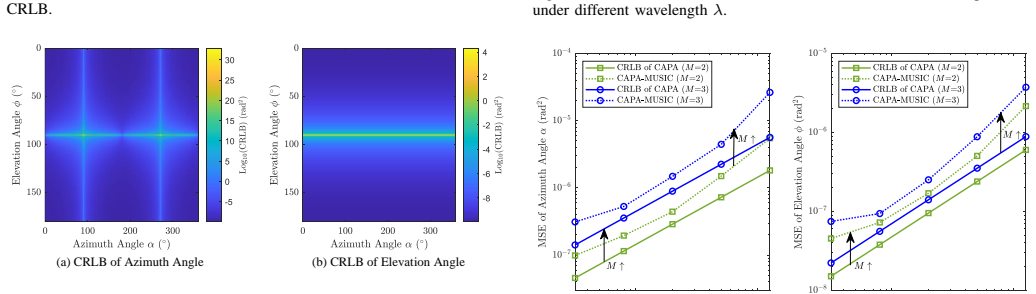
The central claim is that CAPA-MUSIC (Eq. (40), Algorithm 1) estimates azimuth and elevation of multiple targets with mean squared error close to the CAPA Cramér-Rao lower bound, and that a CAPA reduces that bound by a factor on the order of $\lambda^2/(8 l_r^2)$ compared to a conventional spatially discrete array (Remark 5). The paper derives closed-form CRLBs for both known and unknown snapshot signals, proves that unknown snapshots never improve the bound, and shows that for a symmetric aperture with a single target the two bounds coincide (Proposition 1). It attributes the accuracy gain to the continuous aperture's large spatial degrees of freedom and demonstrates numerically that the algorithm's MSE approaches the bound as the quadrature order $K$ grows.
Load-bearing premise
The load-bearing premise is that the finite snapshot matrix $K = X^H X/T$ captures the continuous noise subspace faithfully enough that the pseudo-inverse reconstruction of eigenvectors yields a valid MUSIC spectrum; the paper acknowledges information loss in Remark 2 and supports the assumption only numerically.
Editorial extensions
If this is right
- CAPA-MUSIC achieves estimation performance close to the Cramér-Rao bound for multiple targets, with computational complexity $O(T^3 + K^4 T + N_S K^4)$.
- CAPAs lower the CRLB by a factor on the order of $\lambda^2/(8 l_r^2)$ versus half-wavelength-spaced short-dipole arrays, implying an accuracy gain of roughly $8\pi^2$ for $l_r = \lambda/(8\pi)$.
- The CRLB with known snapshots is always no larger than the CRLB with unknown snapshots, and the two are equal for a symmetric aperture with a single target.
- Enlarging the CAPA dimensions $L_x$ and $L_y$ sharpens the MUSIC peaks and reduces the CRLB through terms like $L_x^3 L_y$ and $L_x L_y^3$.
- With multiple targets, the algorithm's MSE approaches the CAPA CRLB and worsens gracefully as the number of closely spaced targets grows.
Reading between the lines
- For real hardware, the continuous limit is a mathematical idealization; at finite element densities the gain over discrete arrays will be smaller, and a quantitative model of discretization loss would sharpen the practical prediction.
- The same continuous-discrete transformation could carry other subspace methods (e.g., ESPRIT or tensor-based estimators) over to CAPAs, and the CRLB framework could extend to near-field DOA or joint position-and-attitude estimation.
- The paper's own Remark 2 suggests a testable design rule: the number of snapshots $T$ needed for a faithful noise subspace may scale with the number of targets $M$, and a systematic study of that scaling would tell practitioners how large $T$ must be.
- Because the CRLB expressions depend explicitly on aperture geometry, optimizing the aperture shape (not just its size) could yield further accuracy gains beyond the square CAPAs tested here.
Editorial analysis
A structured set of objections, weighed in public.
Referee Report
Summary. The paper studies direction-of-arrival (DOA) estimation with continuous aperture arrays (CAPAs). It proposes CAPA-MUSIC, which avoids eigendecomposition of an infinite-dimensional covariance operator by forming a T-by-T matrix K from field snapshots, reconstructing noise-subspace eigenvectors through Gauss-Legendre quadrature and a pseudo-inverse, and then searching a MUSIC spectrum. It derives Cramér-Rao lower bounds (CRLBs) for DOA estimation in both known-snapshot and unknown-snapshot cases, and claims a theoretical accuracy advantage of CAPA over conventional spatially discrete arrays (SPDAs), quantified in Remark 5 as a reduction by roughly lambda^2/(8 l_r^2). Numerical experiments show the proposed algorithm's MSE closely tracking the derived CRLB for single- and multi-target scenarios.
Significance. If the central claims are correct, the paper would provide a practical, low-complexity MUSIC algorithm for continuous apertures and a useful CRLB benchmark, together with a theoretical argument that CAPAs offer a substantial accuracy gain over SPDAs. The algorithm is clearly specified with a complexity analysis, and the numerical validation is extensive. However, the theoretical comparison and the CRLB formulas rest on a limiting discretization that is internally inconsistent. The claimed CAPA-over-SPDA gain is not established by the derivation as written. With a repaired normalization of the continuous-limit model, the contribution could be significant for the CAPA sensing literature.
major comments (4)
- [§II-B and §III-B, Eqs. (16), (20), (21), (29)] The limiting discretization is internally inconsistent. From Eq. (16), x_n(t)=Z(a^T(r_n)s(t)+n(r_n,t)) with noise variance sigma_nu^2=Z sigma^2, so Eq. (20) is a vector whose entries scale as Z; taken literally the limit is the zero vector, and the covariance in Eq. (21) should be Z^2 A R_s A^H + Z sigma^2 I_N, not A R_s A^H + sigma^2 I_N. Consequently, in Eq. (29), Z^2 sum_n E^*(r_n,i)E(r_n,j) tends to 0 as Z->0, not to the surface integral; the displayed equality is dimensionally wrong. The same scaling issue affects the eigenvector reconstruction in Eqs. (34)-(38), where the components of u_i acquire a Z-dependent normalization. The paper needs to define the limiting continuous observation model explicitly (for example, by normalizing voltages per unit area or by working directly with the integral covariance operator) and redo Eqs. (21)-(38) under that model.
- [§IV-A, Eqs. (43)-(46)] The likelihood limit in Eq. (44) has the same normalization error. With x(r_n,t)=Z E(r_n,t) and sigma_nu^2=Z sigma^2, the exponent in Eq. (43) equals -(1/(Z sigma^2)) sum_t sum_n Z^2 |E-a^H s|^2 = -(Z/sigma^2) sum_t sum_n |E-a^H s|^2, whose limit is -(1/sigma^2) sum_t int_S |E-a^H s|^2 dr, not -(1/sigma_nu^2) sum_t int_S |E-a^H s|^2 dr. Thus the FIM in Eq. (46) should be proportional to 1/sigma^2 rather than 1/sigma_nu^2 = 1/(Z sigma^2). As written, sigma_nu^2->0 makes the CRLBs in Eqs. (89)-(90) tend to zero, i.e., infinite precision from a finite aperture, which is unphysical. The CRLB derivation must be redone with a consistent noise normalization.
- [§IV-C, Remark 5] The claimed CAPA-over-SPDA gain factor lambda^2/(8 l_r^2) is not obtained from the displayed formulas under any consistent assignment of noise variances. If one evaluates the elevation CRLB ratio from Eqs. (90) and (98) with P=2 L_x/lambda, Q=2 L_y/lambda, and a common noise variance, the ratio is approximately 2 l_r^2/lambda^2 (i.e., CAPA improves by lambda^2/(2 l_r^2)), not lambda^2/(8 l_r^2). If instead the infinitesimal-element variance sigma_nu^2=Z sigma^2 is retained, the CAPA CRLB vanishes with Z and the comparison is meaningless. A corrected comparison after the normalization fix is required before the theoretical superiority claim can be sustained.
- [§III-B, Eqs. (34)-(38) and Remark 2] The reduction of the infinite-dimensional eigendecomposition to the T-by-T matrix K is not fully justified. The exact algebraic relation between eigenvectors of X X^H and X^H X is u_i = (1/lambda_i) X e_i; the paper instead reconstructs u_i from e_i via the pseudo-inverse of the quadrature matrix E^H Omega in Eq. (38). It is not shown that this pseudo-inverse recovers the noise-subspace eigenvectors, nor that the Gauss-Legendre quadrature error remains controlled after the pseudo-inverse. Remark 2 concedes information loss but does not quantify it. Please provide a consistency argument or error bound for this step, or replace it by the exact algebraic reconstruction.
minor comments (5)
- [Eq. (18)] The dimension of A(alpha, phi) is stated as C^{M x N}, but the construction [a(r_1), ..., a(r_N)]^T with a(r_n) in C^M gives an N x M matrix; the product A s(t) in Eq. (20) also requires A to be N x M.
- [Eqs. (34)-(35)] There are notation slips: Eq. (34) integrates E^*(r, k) where the index should be t, and Eq. (35) states omega = diag{omega_1,...,omega_K} in R^{K^2 x K^2}; the intended object is likely a K x K diagonal matrix before the Kronecker product.
- [§V-C] In the M=3 target list, the third target location z3 = [200, 50, 15] is identical to the second target's location; this appears to be a typo and should be corrected for reproducibility.
- [Proposition 1 and Remark 4] Proposition 1 proves that CRLB_k equals CRLB_u for a symmetric single-target aperture, but Remark 4 then states that uncertainty in the signal still affects estimation performance; the remark appears to contradict the proposition and should be clarified or removed.
- [Eq. (12)] The delta-correlated noise in Eq. (12) is not pointwise well-defined; the derivation should integrate the noise over each cell before taking the limit, rather than writing n(r_n, t) as a pointwise random variable.
Circularity Check
No significant circularity is found: the CAPA-MUSIC estimator and the CRLBs are derived from the stated signal model, the near-CRLB claim is benchmarked against the paper's own bound in standard practice, and the self-citations are background only.
full rationale
The claimed derivation chain is self-contained, so no circular step is identified. Algorithm 1 estimates angles by searching peaks of a MUSIC spectrum built from the data-dependent matrix K = X^H X/T (Eqs. (29)-(40)); no parameter is fitted to targets, and the eigenvector reconstruction u_i is approximated by (E^H Omega)^dagger e_i (Eq. (38)), which is the exact algebraic relation e_i = X^H u_i of the finite sample model combined with a Gauss-Legendre quadrature whose convergence is checked externally in Fig. 3. Remark 2 candidly admits the information loss of this finite-rank reduction, but that stated limitation does not make the near-CRLB result circular, because the CRLB is derived independently from the Gaussian likelihood in Section IV, with the unknown-snapshot FIM block attributed to the non-self reference [22]. The CAPA-versus-SPDA comparison in Remark 5 is a closed-form ratio of two independently derived CRLBs, hence an algebraic consequence of the model rather than a value fitted after the fact; whether the ratio is physically meaningful depends on the noise normalization and on the consistency of the Z-to-0 limiting model in Eqs. (16)-(29) (the x_n = |S_n|E(r_n) normalization carries implicit Z factors that are dropped), but those are modeling-consistency and correctness concerns, not a derivation loop, since the CAPA-superiority conclusion never appears as an input to the derivation. Self-citations ([3], [14], [15], [21], [23], and the cited position paper defining CAPA) motivate the architecture only and are not load-bearing for the MUSIC derivation or the CRLB formulas, and no uniqueness theorem from the authors' prior work is invoked. Benchmarking the estimator's MSE against the paper's own CRLB is standard practice for optimality claims and does not constitute renaming or fitting. Verdict: no significant circularity.
Assumptions & free parameters
free parameters (2)
- dipole length l_r in SPDA comparison =
lambda/(4 pi) approximately 0.00796 m in simulations
- Gauss-Legendre dimension K =
30
assumptions (4)
- domain assumption Far-field planar wave approximation (Eqs. (8)-(9)): the received phase at point r is e^{jk r dot d(alpha, phi)}, neglecting the second-order Fresnel term.
- domain assumption Spatially white Gaussian noise with correlation sigma^2 delta(r1 - r2) across the aperture (Eq. (12)).
- domain assumption Non-coherent point sources with T >= M snapshots so that the sample covariance has rank M signal-plus-noise structure (Section III-A).
- ad hoc to paper The Z to 0 discretization limit in Eqs. (16)-(21) yields a nonvanishing covariance R_x = A R_s A^H + sigma^2 I.
Cite this review
Pith. "Pith review of DOA Estimation via Continuous Aperture Arrays: MUSIC and CRLB." pith.science (2026). https://pith.science/paper/NKUP3HL4
@misc{pith2026250721347,
  author       = {Pith},
  title        = {Pith review of: DOA Estimation via Continuous Aperture Arrays: MUSIC and CRLB},
  year         = {2026},
  howpublished = {\url{https://pith.science/paper/NKUP3HL4}},
  note         = {Machine review of arXiv:2507.21347}
}
read the original abstract
Direction-of-arrival (DOA) estimation using continuous aperture array (CAPA) is studied. Compared to the conventional spatially discrete array (SPDA), CAPA significantly enhances the spatial degrees-of-freedoms (DoFs) for DOA estimation, but its infinite-dimensional continuous signals render the conventional estimation algorithm non-applicable. To address this challenge, a new multiple signal classification (MUSIC) algorithm is proposed for CAPAs. In particular, an equivalent continuous-discrete transformation is proposed to facilitate the eigendecomposition of continuous operators. Subsequently, the MUSIC spectrum is accurately approximated using the Gauss-Legendre quadrature, effectively reducing the computational complexity. Furthermore, the Cram\'er-Rao lower bounds (CRLBs) for DOA estimation using CAPAs are analyzed for both cases with and without priori knowledge of snapshot signals. It is theoretically proved that CAPAs significantly improve the DOA estimation accuracy compared to traditional SPDAs. Numerical results further validate this insight and demonstrate the effectiveness of the proposed MUSIC algorithm for CAPA. The proposed method achieves near-optimal estimation performance while maintaining a low computational complexity.
Figures


Figures from the paper (3 more)


Reference graph
Works this paper leans on
-
[1]
Z. Wang, P. Ramezani, Y . Liu, and E. Bj ¨ornson, “Near-field localiza- tion and sensing with large-aperture arrays: From signal modeling to processing,” IEEE Signal Process Mag. , vol. 42, no. 1, pp. 74–87, Jan. 2025
work page 2025
-
[2]
CSI transfer from sub-6G to mmwave: Reduced-overhead multi-user hybrid beamforming,
W. Deng, M. Li, M.-M. Zhao, M.-J. Zhao, and O. Simeone, “CSI transfer from sub-6G to mmwave: Reduced-overhead multi-user hybrid beamforming,” IEEE J. Sel. Areas Commun., vol. 43, no. 3, pp. 973–987, Mar. 2025
work page 2025
-
[3]
H. Si, X. Hou, J. Wang, G. O. Boateng, Z. Zhang, X. Guo, and D. Niyato, “Unsupervised localization toward crowdsourced trajectory data: A deep reinforcement learning approach,” IEEE Trans. Wireless Commun. , pp. 1–1, Apr. 2025. doi: 10.1109/TWC.2025.3563766
arXiv 2025
-
[4]
Collaborative sensing in internet of things: A comprehensive survey,
S. He, K. Shi, C. Liu, B. Guo, J. Chen, and Z. Shi, “Collaborative sensing in internet of things: A comprehensive survey,” IEEE Commun. Surv. Tutorials, vol. 24, no. 3, pp. 1435–1474, 3rd Quart. 2022
work page 2022
-
[5]
M. Pesavento, M. Trinh-Hoang, and M. Viberg, “Three more decades in array signal processing research: An optimization and structure exploitation perspective,” IEEE Signal Process Mag. , vol. 40, no. 4, pp. 92–106, Jun. 2023
work page 2023
-
[6]
B. Wang, H. Li, S. Shen, Z. Cheng, and B. Clerckx, “A dual-function radar-communication system empowered by beyond diagonal reconfig- urable intelligent surface,” IEEE Trans. Commun. , vol. 73, no. 3, pp. 1501–1516, Mar. 2025
work page 2025
-
[7]
Nested MIMO radar: Coarrays, tensor modeling, and angle estimation,
J. Shi, F. Wen, and T. Liu, “Nested MIMO radar: Coarrays, tensor modeling, and angle estimation,” IEEE Trans. Aerosp. Electron. Syst. , vol. 57, no. 1, pp. 573–585, Feb. 2021
work page 2021
-
[8]
An overview of signal processing techniques for millimeter wave MIMO systems,
R. W. Heath, N. Gonz ´alez-Prelcic, S. Rangan, W. Roh, and A. M. Sayeed, “An overview of signal processing techniques for millimeter wave MIMO systems,” IEEE J. Sel. Top. Signal Process., vol. 10, no. 3, pp. 436–453, Apr. 2016
work page 2016
Show all 32 references
-
[9]
What will 5G be?
J. G. Andrews, S. Buzzi, W. Choi, S. V . Hanly, A. Lozano, A. C. K. Soong, and J. C. Zhang, “What will 5G be?” IEEE J. Sel. Areas Commun., vol. 32, no. 6, pp. 1065–1082, Jun. 2014
2014
-
[10]
Gigantic MIMO channel characterization: Challenges and enabling solutions,
M. Li, Z. Yuan, Y . Lyu, P. Ky ¨osti, J. Zhang, and W. Fan, “Gigantic MIMO channel characterization: Challenges and enabling solutions,” IEEE Commun. Mag. , vol. 61, no. 10, pp. 140–146, Oct. 2023
2023
-
[11]
Reconfigurable holographic surfaces for ultra-massive MIMO in 6G: Practical design, optimization and implementation,
R. Deng, Y . Zhang, H. Zhang, B. Di, H. Zhang, H. V . Poor, and L. Song, “Reconfigurable holographic surfaces for ultra-massive MIMO in 6G: Practical design, optimization and implementation,” IEEE J. Sel. Areas Commun., vol. 41, no. 8, pp. 2367–2379, Jun. 2023
2023
-
[12]
Holographic MIMO for LEO satellite communications aided by reconfigurable holographic surfaces,
R. Deng, B. Di, H. Zhang, H. V . Poor, and L. Song, “Holographic MIMO for LEO satellite communications aided by reconfigurable holographic surfaces,” IEEE J. Sel. Areas Commun. , vol. 40, no. 10, pp. 3071–3085, Oct. 2022
2022
-
[13]
Wideband RCS reduction for circular-polarized slot array antennas based on composite metasurface,
X. Ren, H. Zhai, Y . Jia, M. Wang, and Y . Lei, “Wideband RCS reduction for circular-polarized slot array antennas based on composite metasurface,” IEEE Antennas Wirel. Propag. Lett. , vol. 23, no. 12, pp. 4867–4871, Dec. 2024
2024
-
[14]
CAPA: Continuous-aperture arrays for revolutionizing 6G wireless communica- tions,
Y . Liu, C. Ouyang, Z. Wang, J. Xu, X. Mu, and Z. Ding, “CAPA: Continuous-aperture arrays for revolutionizing 6G wireless communica- tions,” arXiv preprint arXiv:2412.00894 , 2024
2024 arXiv
-
[15]
Optimal beamforming for multi-user continuous aperture array (CAPA) systems,
Z. Wang, C. Ouyang, and Y . Liu, “Optimal beamforming for multi-user continuous aperture array (CAPA) systems,” IEEE Trans. Commun., pp. 1–1, Mar. 2025. doi: 10.1109/TCOMM.2025.3554644
2025
-
[16]
Terahertz massive MIMO with holographic reconfigurable intelligent surfaces,
Z. Wan, Z. Gao, F. Gao, M. D. Renzo, and M.-S. Alouini, “Terahertz massive MIMO with holographic reconfigurable intelligent surfaces,” IEEE Trans. Commun. , vol. 69, no. 7, pp. 4732–4750, Jul. 2021
2021
-
[17]
A small-aperture and high-performance endfire holo- graphic antenna based on spoof surface plasmon polaritons,
S. Zohrevand, M. A. Chaychi Zadeh, E. Farokhipour, D. Erni, and N. Komjani, “A small-aperture and high-performance endfire holo- graphic antenna based on spoof surface plasmon polaritons,” IEEE Antennas Wirel. Propag. Lett., vol. 23, no. 9, pp. 2743–2747, Sep. 2024
2024
-
[18]
Communicating with large intelligent surfaces: Fundamen- tal limits and models,
D. Dardari, “Communicating with large intelligent surfaces: Fundamen- tal limits and models,” IEEE J. Sel. Areas Commun. , vol. 38, no. 11, pp. 2526–2537, Nov. 2020
2020
-
[19]
Wavenumber-division multiplexing in line-of-sight holographic MIMO communications,
L. Sanguinetti, A. A. D’Amico, and M. Debbah, “Wavenumber-division multiplexing in line-of-sight holographic MIMO communications,” IEEE Trans. Wireless Commun. , vol. 22, no. 4, pp. 2186–2201, Apr. 2023
2023
-
[20]
On the spectral efficiency of multi-user holographic MIMO uplink transmission,
M. Qian, L. You, X.-G. Xia, and X. Gao, “On the spectral efficiency of multi-user holographic MIMO uplink transmission,” IEEE Trans. Wireless Commun., vol. 23, no. 10, pp. 15421–15434, Oct. 2024
2024
-
[21]
Beamforming optimization for contin- uous aperture array (CAPA)-based communications,
Z. Wang, C. Ouyang, and Y . Liu, “Beamforming optimization for contin- uous aperture array (CAPA)-based communications,” IEEE Trans. Wire- less Commun., pp. 1–1, Mar. 2025. doi: 10.1109/TWC.2025.3545770
2025
-
[22]
Cram´er-Rao bounds for holographic positioning,
A. A. D’Amico, A. de Jesus Torres, L. Sanguinetti, and M. Win, “Cram´er-Rao bounds for holographic positioning,” IEEE Trans. Signal Process., vol. 70, pp. 5518–5532, Nov. 2022
2022
-
[23]
Cram ´er-Rao bound optimization for near-field sensing with continuous-aperture arrays,
H. Jiang, Z. Wang, Y . Liu, and A. Nallanathan, “Cram ´er-Rao bound optimization for near-field sensing with continuous-aperture arrays,” arXiv preprint arXiv:2412.15007 , 2024
2024
-
[24]
Near-field positioning and attitude sensing based on electromagnetic propagation modeling,
A. Chen, L. Chen, Y . Chen, N. Zhao, and C. You, “Near-field positioning and attitude sensing based on electromagnetic propagation modeling,” IEEE J. Sel. Areas Commun. , vol. 42, no. 9, pp. 2179–2195, Sep. 2024
2024
-
[25]
Efficient application of music algorithm under the coexistence of far-field and near-field sources,
J. He, M. N. S. Swamy, and M. O. Ahmad, “Efficient application of music algorithm under the coexistence of far-field and near-field sources,” IEEE Trans. Signal Process. , vol. 60, no. 4, pp. 2066–2070, Apr. 2012
2012
-
[26]
Gridless DOA estimation and root- MUSIC for non-uniform linear arrays,
M. Wagner, Y . Park, and P. Gerstoft, “Gridless DOA estimation and root- MUSIC for non-uniform linear arrays,” IEEE Trans. Signal Process. , vol. 69, pp. 2144–2157, Mar. 2021
2021
-
[27]
S. J. Orfanidis, Electromagnetic waves and antennas . Rutgers Univer- sity New Brunswick, NJ, 2016
2016
-
[28]
Spatial characterization of electromagnetic random channels,
A. Pizzo, L. Sanguinetti, and T. L. Marzetta, “Spatial characterization of electromagnetic random channels,” IEEE Open J. Commun. Soc., vol. 3, pp. 847–866, Apr. 2022
2022
-
[29]
Capacity of the continuous-space electromagnetic channel,
M. A. Jensen and J. W. Wallace, “Capacity of the continuous-space electromagnetic channel,” IEEE Trans. Antennas Propag., vol. 56, no. 2, pp. 524–531, Feb. 2008
2008
-
[30]
Ralston and P
A. Ralston and P. Rabinowitz, A first course in numerical analysis . Courier Corporation, 2001
2001
-
[31]
S. M. Kay, Fundamentals of statistical signal processing: Estimation theory. Prentice-Hall, Inc., 1993
1993
-
[32]
G. B. Folland, Real analysis: Modern techniques and their applications . John Wiley & Sons, 1999, vol. 40
1999
Reviewed August 6, 2026 · model on record in the stance chip above.
Discussion (0). Continue with ORCID to comment.