Why Machines Misread Pedagogical Quality: Human-Machine Alignment in LLM-Based Pretest Question Evaluation
Pith reviewed 2026-06-26 06:57 UTC · model grok-4.3
The pith
Human and LLM judgments on pretest question quality disagree systematically, with rubric revisions improving alignment more than rationale-first prompting.
A machine-rendered reading of the paper's core claim, the machinery that carries it, and where it could break.
Core claim
Our findings show that human-machine disagreements are systematic rather than random, that rubric revision has a larger effect on alignment than rationale-first evaluation, and that the two interventions are complementary. These findings highlight that scalable AI-assisted pretesting depends not only on generation capability but on how pedagogical quality is operationalized for machine interpretation.
What carries the argument
A 2x2 experimental design varying rubric operationalization and evaluation mode to quantify human-LLM agreement on pretest question scores.
If this is right
- Improving how rubrics describe quality criteria offers a practical lever for better machine filtering of educational questions.
- Using both rubric revision and rationale prompts together yields higher alignment than applying either change alone.
- Because disagreements are systematic, they can be addressed through targeted adjustments instead of generic model improvements.
- The workflow can support larger volumes of pretest question development once machine scoring is brought closer to human standards.
Where Pith is reading between the lines
- The same operationalization issues may appear when LLMs score other educational artifacts such as lesson plans or student answers.
- Testing the interventions across different subjects or question formats would show whether the relative importance of rubric revision holds more broadly.
- If systematic biases can be reduced through rubric design, it could lower the amount of ongoing human oversight needed in AI education pipelines.
Load-bearing premise
The 2x2 design captures the main factors that drive alignment, and the chosen rubrics and questions are representative of typical pedagogical quality assessment.
What would settle it
A replication in which rubric revision no longer shows a larger alignment gain than rationale-first evaluation, or in which disagreements appear random rather than patterned.
Figures
read the original abstract
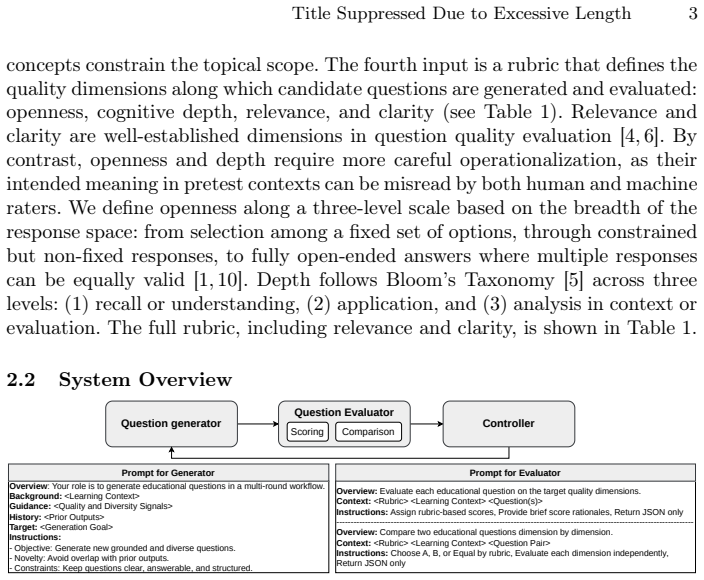
Designing effective pretest questions is challenging at scale: high-quality questions require careful calibration of openness, cognitive depth, and alignment with learning objectives, yet generating and evaluating them manually is time-consuming. We present an AI-assisted workflow for pretest question development that combines automated generation, rubric-based evaluation, and iterative selection. Because the workflow relies on machine evaluation to filter questions at scale, we investigate the alignment between human and machine judgments across a 2x2 design varying rubric operationalization and evaluation mode. Our findings show that human-machine disagreements are systematic rather than random, that rubric revision has a larger effect on alignment than rationale-first evaluation, and that the two interventions are complementary. These findings highlight that scalable AI-assisted pretesting depends not only on generation capability but on how pedagogical quality is operationalized for machine interpretation.
Editorial analysis
A structured set of objections, weighed in public.
Referee Report
Summary. The manuscript presents an AI-assisted workflow for pretest question development combining LLM generation, rubric-based evaluation, and iterative selection. It reports results from a 2x2 experimental design that varies rubric operationalization and evaluation mode (rationale-first vs. direct), finding that human-machine disagreements on pedagogical quality are systematic rather than random, that revising the rubric has a larger positive effect on alignment than rationale-first prompting, and that the two interventions are complementary.
Significance. If the empirical results are robust, the work provides actionable guidance on operationalizing pedagogical rubrics for LLMs, showing that alignment depends more on how quality criteria are defined than on the order of rationale generation. This could inform scalable educational content tools, though the absence of reported sample sizes, statistical tests, and selection criteria in the abstract limits immediate assessment of effect sizes and generalizability.
major comments (1)
- [Abstract] Abstract: the central claims (systematic disagreements, larger effect of rubric revision, complementarity) are stated without any accompanying quantitative details such as number of questions, number of human evaluators, inter-rater reliability, or statistical tests. This absence makes it impossible to determine whether the data actually support the reported ordering of effects or the conclusion that disagreements are systematic.
Simulated Author's Rebuttal
We thank the referee for their constructive feedback. We address the major comment on the abstract below.
read point-by-point responses
-
Referee: [Abstract] Abstract: the central claims (systematic disagreements, larger effect of rubric revision, complementarity) are stated without any accompanying quantitative details such as number of questions, number of human evaluators, inter-rater reliability, or statistical tests. This absence makes it impossible to determine whether the data actually support the reported ordering of effects or the conclusion that disagreements are systematic.
Authors: We agree with the referee that the abstract would benefit from including key quantitative details to allow readers to better assess the strength of our claims. The full manuscript contains these details (including the number of questions evaluated in the 2x2 design, the number of human evaluators, inter-rater reliability metrics, and the statistical tests used to compare effects). We will revise the abstract to incorporate these elements, such as sample sizes and a brief mention of the statistical findings supporting the ordering of effects. This revision will make the central claims more verifiable from the abstract alone. revision: yes
Circularity Check
Empirical study with no derivation chain or self-referential elements
full rationale
This paper reports results from a 2x2 experimental design comparing rubric operationalization and evaluation modes in an LLM-based pretest question evaluation workflow. The abstract and described structure contain no equations, fitted parameters, predictions derived from inputs, or load-bearing self-citations that reduce claims to prior author work. Findings on systematic disagreements and intervention effects are presented as direct outcomes of the human-machine comparison experiment, with no mathematical or definitional reductions to the inputs. The analysis is therefore self-contained as standard empirical reporting.
Axiom & Free-Parameter Ledger
axioms (1)
- domain assumption Rubric operationalization and evaluation mode are the primary controllable factors affecting human-LLM alignment in question evaluation
Reference graph
Works this paper leans on
-
[1]
and Rahman, Shuhebur and Perkins, Kyle , title =
Carpenter, Shana K. and Rahman, Shuhebur and Perkins, Kyle , title =. Journal of Experimental Psychology: Applied , year =. doi:10.1037/xap0000145 , pmid =
-
[2]
Pan, Steven C. and Sana, Faria , title =. Journal of Experimental Psychology: Applied , year =. doi:10.1037/xap0000345 , pmid =
-
[3]
and Kornell, Nate and Kao, Liche Sean , title =
Richland, Lindsey E. and Kornell, Nate and Kao, Liche Sean , title =. Journal of Experimental Psychology: Applied , year =. doi:10.1037/a0016496 , pmid =
-
[4]
Sana, Faria and Carpenter, Shana K. , title =. Psychonomic Bulletin & Review , year =. doi:10.3758/s13423-023-02274-6 , pmid =
-
[5]
and Sana, Faria and Samani, Joshua and Cooke, James and Kim, Joseph A
Pan, Steven C. and Sana, Faria and Samani, Joshua and Cooke, James and Kim, Joseph A. , title =. Memory , year =. doi:10.1080/09658211.2020.1815790 , pmid =
-
[6]
Journal of Educational Measurement , volume=
Construct equivalence of multiple-choice and constructed-response items: A random effects synthesis of correlations , author=. Journal of Educational Measurement , volume=. 2003 , publisher=
2003
-
[7]
Bennett, Randy Elliot and Ward, William C. and Rock, Donald A. and LaHart, Charles , title =. 1990 , type =. doi:10.1002/j.2333-8504.1990.tb01348.x , url =
-
[8]
Research Monograph No
Criteria for Alignment of Expectations and Assessments in Mathematics and Science Education. Research Monograph No. 6. , author=. 1997 , publisher=
1997
-
[9]
International journal of artificial intelligence in education , volume=
A systematic review of automatic question generation for educational purposes , author=. International journal of artificial intelligence in education , volume=. 2020 , publisher=
2020
-
[10]
Theory into practice , volume=
A revision of Bloom's taxonomy: An overview , author=. Theory into practice , volume=. 2002 , publisher=
2002
-
[11]
Liu, Yang and Iter, Dan and Xu, Yichong and Wang, Shuohang and Xu, Ruochen and Zhu, Chenguang , booktitle=. G-Eval:
-
[12]
Findings of the Association for Computational Linguistics: EMNLP 2023 , year=
A Closer Look into Automatic Evaluation Using Large Language Models , author=. Findings of the Association for Computational Linguistics: EMNLP 2023 , year=
2023
-
[13]
Education and Information Technologies , volume=
Exploring quality criteria and evaluation methods in automated question generation: A comprehensive survey , author=. Education and Information Technologies , volume=
discussion (0)
Sign in with ORCID, Apple, or X to comment. Anyone can read and Pith papers without signing in.