REVIEW 4 major objections 6 minor 57 references
FractionalDiffEq.jl: High Performance Fractional Differential Equation Solver in Julia
T0 review · 4 major / 6 minor · reviewed 2026-08-07 · deepseek-v4-flash
Pith's one-line read A new Julia package claims to solve fractional differential equations faster than existing Python, Julia, and MATLAB tools.
desk verdict A genuinely useful Julia FDE solver package whose paper overclaims benchmark superiority; the package deserves use and the paper deserves revision. read the letter →
The pith
A machine-rendered reading of the paper's core claim, the machinery that carries it, and where it could break.
The reading
What carries the argument
The load-bearing machinery is the discretization of the Caputo FODE as a weakly singular Volterra integral equation, combined with three families of methods: product-integration rules (explicit and implicit rectangular and trapezoidal), predictor-corrector methods as a fractional generalization of Adams-Bashforth-Moulton, and fractional linear multistep methods whose convolution quadrature weights come from generating functions such as BDF2 and Newton-Gregory. These methods reduce the solution to history-dependent convolution sums, which the package computes efficiently using Julia's multiple dispatch, just-in-time compilation, and type-stable code, along with fast numerical evaluation of Mittag-Leffler functions. The implicit variants, notably BDF and implicit trapezoidal product-integration, are what allow the package to handle stiff systems.
What would settle it
Run the paper's public benchmark scripts on a single controlled machine with current versions of the competing Julia, Python, and MATLAB solvers, recording wall-clock time and error at each step size; if a competitor matches or beats FractionalDiffEq.jl on the stiff problem at comparable accuracy, or if an explicit solver converges when given the same step sizes, the central superiority claim is refuted.
Extended reading notes
Core claim
On the paper's own terms, the discovery is that a unified Julia implementation of established fractional FDE algorithms—predictor-corrector, product-integration, and fractional linear multistep methods—can be made much faster than existing implementations while retaining accuracy, and that its implicit methods extend solvability to stiff fractional problems. The evidence is presented as work-precision diagrams on linear and nonlinear single-term FODEs, a non-stiff three-state system, a stiff nonlinear problem, and a linear multi-term benchmark. The paper asserts that its solvers dominate the competing implementations in speed at matched accuracy, and that competitors with only explicit methods diverge on the stiff problem. The package is positioned as a drop-in solving library with a define-then-solve API, built-in Mittag-Leffler function evaluation, and coverage of both FODE systems and multi-term FODEs.
Load-bearing premise
The benchmarks fairly represent every solver: the same problems, the same tolerances, and the same machine, with each competitor run at its best settings; if the hardware or configuration favored FractionalDiffEq.jl, the superiority claim collapses.
Editorial extensions
If this is right
- On stiff fractional problems, users should reach for implicit methods; the paper shows explicit predictor-corrector solvers failing across all tested tolerances.
- Fractional models with memory effects, such as the fermentation example, can be fit to experimental data with lower root-mean-square error than integer-order counterparts using the same package and a standard optimizer.
- A single unified API can cover both FODE systems and linear multi-term FODEs, a combination the paper says competing packages do not offer.
- Built-in Mittag-Leffler function evaluation removes a barrier to solving equations whose analytic solutions depend on that function.
- Benchmarking methodology matters: the paper argues that problem selection and setup in an earlier comparison reversed the apparent performance ranking of solvers.
Reading between the lines
- Editorial inference: the paper's hardware description is internally inconsistent, so the reported speedups should be treated as provisional until the benchmark suite is rerun on a single documented machine with variance reporting.
- Editorial inference: the implicit-solver advantage suggests that adaptive time-stepping for stiff fractional problems would be a natural next feature, since the current benchmarks use fixed step sizes.
- Editorial inference: the fermentation application shows fractional-order parameter estimation working inside an ordinary optimization loop, so coupling the solver with automatic differentiation could make gradient-based model calibration a routine workflow.
- Editorial inference: if the speedups hold at scale, GPU-parallel evaluation of the history-dependent convolution sums, which the paper flags as future work, is a direct extension because those sums dominate the computational cost.
Editorial analysis
A structured set of objections, weighed in public.
Referee Report
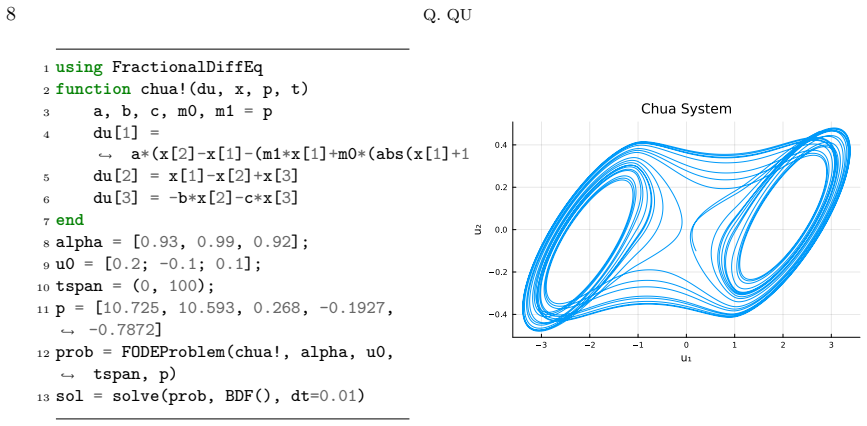
Summary. This paper introduces FractionalDiffEq.jl, a Julia package for solving fractional ordinary differential equations (FODEs), including systems of FODEs and linear multi-term FODEs, using predictor-corrector, product-integration, and fractional linear multistep methods. The authors describe the package's design, demonstrate its API on several examples (Chua's circuit, Bagley-Torvik equation), benchmark its runtime and accuracy against FdeSolver.jl, pycaputo, and MATLAB routines on non-stiff and stiff problems, and present two applications: a fractional-order tequila fermentation model and a fractional harmonic oscillator. The paper's central claim is that FractionalDiffEq.jl outperforms the compared solvers on both stiff and non-stiff problems.
Significance. FractionalDiffEq.jl is a substantial open-source software contribution, with a permanent Zenodo DOI, publicly available benchmark scripts, and a unified API in the SciML ecosystem. If the performance claims are validated, the package would be a valuable resource for the fractional-calculus community, particularly for stiff problems where explicit solvers fail. The paper's reliance on work-precision diagrams with analytical solutions is a strength, as is the inclusion of parameter estimation in a real fermentation dataset. However, the central superiority claim is currently under-supported by the benchmark methodology.
major comments (4)
- [Section 3.2, benchmark environment] The sentence describing the benchmark hardware, 'on a computer equipped with a CPU Intel i7-9750H at 2.60 GHz running on the MacOS 14.6 Sonoma M3 chip', names two incompatible processors; it is therefore impossible to determine whether all solvers were run on the same machine. Because the central superiority claim is based entirely on wall-clock comparisons, the manuscript must state the exact machine(s) and provide the measurement protocol for MATLAB and Python (BenchmarkTools.jl is Julia-specific), including warm-up, repetitions, reported statistic, and variance data.
- [Section 3.2.1, stiff problem benchmark] The stiff benchmark of Eq. (3.8) does not support a speed-superiority claim: FdeSolver.jl and pycaputo fail to converge because they lack implicit methods, so the result is a capability difference rather than a performance comparison. The abstract and Section 5 state that the benchmarks 'prove superiority' on stiff problems; this wording should be qualified to indicate that implicit methods in FractionalDiffEq.jl succeed where explicit-only competitors fail.
- [Section 3.1.2, Bagley-Torvik example] The text states that Eq. (3.4) is solved with initial conditions u(0)=u'(0)=1, but the code in Figure 3 sets u0=[0.0, 0.0]. Additionally, the coefficient array [1, 1/2, 1/2] and order array [2, 1.5, 0] are not explicitly linked to the parameters A, B, C of Eq. (3.4), leaving ambiguity about the intended problem and making the example non-reproducible as printed.
- [Section 4.1, fermentation model] Table 4 lists all kinetic parameters as having Value 0, while Table 5 reports nonzero fitted values; the text and Figure 7 caption refer to 'Equation (4.2)' for the fractional-order model even though Eq. (4.2) is the integer-order ODE model, and the sentence 'the predictive ability if more accurate than ordinary models' is incomplete. These inconsistencies make the parameter-estimation demonstration unreliable.
minor comments (6)
- [Equation (3.5)] The symbol beta appears in the first term but is not defined; it is likely a typo for alpha.
- [Section 4.2] The critical order theta* = 0.81695 is stated without a derivation or citation; please provide a reference or a computation for this value.
- [Introduction] The phrase 'fermentation fermentation dynamics' contains a duplicated word.
- [Conclusion] The word 'dispensable' should be 'indispensable' in the sentence describing FractionalDiffEq.jl as a tool for researchers.
- [Table 5] The heading 'Estimations Models' is awkward; 'Estimated parameters' would be clearer.
- [Figure 4 caption] The phrase 'exhibited significantly performance' is a grammatical error; it should be 'exhibited significantly better performance'.
Circularity Check
Benchmark superiority claims are externally grounded; the fermentation model's 'predictive ability' is an in-sample fit with three extra fitted orders, a non-central fitted-input-called-prediction.
-
fitted input called prediction
[Section 4.1 (Fractional-order fermentation models), Table 5 and Figure 7 discussion]
"The kinetic parameters of the fractional-order and integer-order tequila fermentation model were both estimated from nonlinear curve fitting with Optim.jl [38]. ... by utilizing the fractional-order fermentation model, we can better describe the underlying mathematical model compared to using integer-order model with a small number of parameters and a much simpler numerical expression, and the predictive ability if more accurate than ordinary models."
Table 5 shows the fractional model has three additional fitted parameters (alpha1=0.775347, alpha2=0.873674, alpha3=0.976698) beyond the shared kinetic constants. Both models are fitted to the same experimental data, and the reported RMSD (0.012339 vs 0.036507) is in-sample training error. Calling the lower RMSD 'predictive ability' is fitting labeled as prediction: the extra degrees of freedom were consumed in the fit, so the improvement is forced by construction, and no held-out or cross-validated prediction is provided. The claim that the fractional model uses 'a small number of parameters' is also inaccurate, confirming that the comparison presents a flexibility artifact as a predictive advantage.
full rationale
The paper's central performance claim — that FractionalDiffEq.jl solves benchmark FODEs faster and more robustly than FdeSolver.jl, pycaputo, and MATLAB routines — is checked against known analytical solutions and against independent, externally implemented solvers, so it does not reduce to the package's own definitions or to a self-citation chain. No load-bearing self-citation was found; references to the SciML ecosystem are about interface compatibility, not about justifying the benchmark outcomes. The only identified circularity is application-side: in Section 4.1, the fractional fermentation model's better RMSD is attributed to superior 'predictive ability' even though both models were fitted to the same data and the fractional model has three additional fitted orders. This is a fitted-input-called-prediction, but it is not the central solver-superiority derivation; the benchmark claim stands on independent ground. Concerns about the contradictory hardware description (Intel i7-9750H vs Apple M3) and unspecified competitor configurations are correctness/reproducibility risks, not circularity, and were not counted in the score beyond the mild overall caveat.
Assumptions & free parameters
free parameters (7)
- k_c (biomass growth rate, fractional model) =
0.004265
- k_m (mortality rate, fractional model) =
0.000499
- k_s (substrate consumption rate, fractional model) =
0.055166
- k_p (ethanol formation rate, fractional model) =
0.015805
- alpha_1 =
0.775347
- alpha_2 =
0.873674
- alpha_3 =
0.976698
assumptions (4)
- standard math Caputo derivative definition given by Eq. 2.1
- domain assumption The right-hand side function f is continuous and differentiable
- standard math Reformulation of an FODE as a weakly-singular Volterra integral equation (Eq. 2.7)
- domain assumption Stability criterion for multi-term FODEs from Brandibur and Kaslik [41]
Cite this review
Pith. "Pith review of FractionalDiffEq.jl: High Performance Fractional Differential Equation Solver in Julia." pith.science (2026). https://pith.science/paper/NLZGWBUP
@misc{pith2026250607926,
  author       = {Pith},
  title        = {Pith review of: FractionalDiffEq.jl: High Performance Fractional Differential Equation Solver in Julia},
  year         = {2026},
  howpublished = {\url{https://pith.science/paper/NLZGWBUP}},
  note         = {Machine review of arXiv:2506.07926}
}
read the original abstract
We present FractionalDiffEq.jl, a comprehensive solver suite for solving fractional differential equations, featuring high-performance numerical algorithms in the Julia programming language. FractionalDiffEq.jl is designed to be user-friendly and scalable, tackling different types of fractional differential equations, encompassing powerful numerical algorithms including predictor-corrector methods, product-integral methods, and linear multistep methods, etc, and providing a unifying API to accommodate diverse solver features. This paper illustrates the convenient usage of FractionalDiffEq.jl in modeling various scientific problems, accompanied by detailed examples and applications. FractionalDiffEq.jl leverages best practices in Julia to ensure the high performance of numerical solvers. To validate the efficiency of FractionalDiffEq.jl , we conducted extensive benchmarks that prove the superiority of FractionalDiffEq.jl against other implementations on both stiff and non-stiff problems. We further demonstrate its capability on several challenging real-life scenarios including parameter estimation in fractional-order tequila fermentation processes, and harmonic oscillator problems, etc, emphasizing the robustness and flexibility of FractionalDiffEq.jl.
Figures


Figures from the paper (5 more)


Reference graph
Works this paper leans on
-
[1]
FractionalDiffEq.jl: High Performance Fractional Differential Equation Solver in Julia
Introduction. As modeling complexity increases in various scientific fields, it is crucial to establish an appropriate numerical model to capture the underlying dynamics of complicated systems. In this context, fractional-order models are gaining significant traction due to their superior and unique approach to depicting complex systems than integer-order...
work page Pith review arXiv 2025
-
[2]
Mathematical Description. This section introduces the primary mathematical definitions of fractional calculus and fractional differential equations and recalls the properties that will be used in the subsequent sections. For a more detailed and comprehensive introduction to fraction calculus and fractional differential equations, we recommend readers to r...
-
[3]
define the problem then solve the problem
Usage and Benchmarks.In the following section, we provide a comprehensive guide on utilizing FractionalDiffEq.jl through a series of numerical examples. These examples are selected to illustrate the tool’s intuitive usability, highlighting its flexibility and computational robustness in diverse scenarios. By systematically exploring various problem settin...
-
[4]
Applications. In the following chapter, we delve into three exemplary application scenarios that highlighting the unique advantages of fractional ordinary differential equations in modeling complex systems. These scenarios are chosen to underscore the limitations of traditional integer-order differential HIGH-PERFORMANCE FRACTIONAL DIFFERENTIAL EQUATION S...
-
[5]
Discussion. In this work, we present a high performance package for numerically solve frac- tional differential equations within the Julia language and SciML ecosystem. In Subsection 3.2, we demonstrated FractionalDiffEq.jl superior performance comparing counterparts, especially in Subsec- tion 3.2.1 benchmarks on stiff fractional ordinary differential eq...
-
[6]
Conclusion. Solving fractional differential equations is becoming a fundamental challenge that arises across various scientific domains. This paper presented FractionalDiffEq.jl, a high-performance and robust open-source solver for fractional differential equations implemented natively in the Julia programming language. To provide easy and convenient user...
-
[7]
Algorithm xxxx: Fdesolver, a julia package for solving fractional differential equations.ACM Trans
Moein Khalighi, Giulio Benedetti, and Leo Lahti. Algorithm xxxx: Fdesolver, a julia package for solving fractional differential equations.ACM Trans. Math. Softw., July 2024. ISSN 0098-3500. doi: 10.1145/3680280. URL https://doi.org/10.1145/3680280. Just Accepted
-
[8]
Julia: A fresh approach to numerical computing
Jeff Bezanson, Alan Edelman, Stefan Karpinski, and Viral B Shah. Julia: A fresh approach to numerical computing. SIAM review, 59(1):65–98, 2017
2017
Show all 57 references
-
[9]
Differentialequations
Christopher Rackauckas and Qing Nie. Differentialequations. jl–a performant and feature-rich ecosystem for solving differential equations in julia.Journal of open research software, 5(1):15–15, 2017
2017
-
[10]
A review and evaluation of numerical tools for fractional calculus and fractional order controls.International journal of control, 90(6):1165–1181, 2017
Zhuo Li, Lu Liu, Sina Dehghan, YangQuan Chen, and Dingyü Xue. A review and evaluation of numerical tools for fractional calculus and fractional order controls.International journal of control, 90(6):1165–1181, 2017. doi: 10.1080/00207179.2015.1124290. URL https://doi.org/10. 1...
2017
-
[11]
Numerical solution of fractional differential equations: A survey and a software tutorial
Roberto Garrappa. Numerical solution of fractional differential equations: A survey and a software tutorial. Mathematics, 6(2):16, 2018. doi: 10.3390/math6020016. URL https://doi.org/10.3390/ HIGH-PERFORMANCE FRACTIONAL DIFFERENTIAL EQUATION SOLVERS 21 math6020016
2018 doi
-
[12]
On initial conditions for fractional delay differential equations
Roberto Garrappa and Eva Kaslik. On initial conditions for fractional delay differential equations. Communications in Nonlinear Science and Numerical Simulation, 90:105359, 2020
2020
-
[13]
Matrix approach to discrete fractional calculus.Fractional calculus and applied analysis, 3(4):359–386, 2000
Igor Podlubny. Matrix approach to discrete fractional calculus.Fractional calculus and applied analysis, 3(4):359–386, 2000
2000
-
[14]
Elsevier, 1974
Keith Oldham and Jerome Spanier.The fractional calculus theory and applications of differentiation and integration to arbitrary order. Elsevier, 1974
1974
-
[15]
alexfikl/pycaputo: v0.8.1, October 2024
Alex Fikl. alexfikl/pycaputo: v0.8.1, October 2024. URL https://doi.org/10.5281/zenodo.13926507
2024 doi
-
[16]
A novel adaptive procedure for solving fractional differential equations
Alessandra Jannelli. A novel adaptive procedure for solving fractional differential equations. Journal of Computational Science, 47:101220, 2020
2020
-
[17]
Fotf toolbox for fractional-order control systems.Applications in control, 6:237–266, 2019
Dingyü Xue. Fotf toolbox for fractional-order control systems.Applications in control, 6:237–266, 2019
2019
-
[18]
Springer Nature, 2024
Dingyü Xue and Lu Bai.Fractional Calculus: High-Precision Algorithms and Numerical Imple- mentations. Springer Nature, 2024
2024
-
[19]
Numerical evaluation of two and three parameter mittag-leffler functions
Roberto Garrappa. Numerical evaluation of two and three parameter mittag-leffler functions. SIAM Journal on Numerical Analysis, 53(3):1350–1369, 2015
2015
-
[20]
elsevier, 1998
Igor Podlubny.Fractional differential equations: an introduction to fractional derivatives, fractional differential equations, to methods of their solution and some of their applications. elsevier, 1998
1998
-
[21]
Discretized fractional calculus.SIAM Journal on Mathematical Analysis, 17(3):704–719, 1986
Ch Lubich. Discretized fractional calculus.SIAM Journal on Mathematical Analysis, 17(3):704–719, 1986
1986
-
[22]
Handbook of fractional calculus for engineering and science
Harendra Singh, Hari M Srivastava, and Juan J Nieto. Handbook of fractional calculus for engineering and science. CRC Press, 2022. doi: 10.1201/9781003263517. URL https://doi.org/10. 1201/9781003263517
2022 doi
-
[23]
World Scientific, 2012
Dumitru Baleanu, Kai Diethelm, Enrico Scalas, and Juan J Trujillo.Fractional calculus: models and numerical methods, volume 3. World Scientific, 2012
2012
-
[24]
Springer, 1997
Rudolf Gorenflo and Francesco Mainardi.Fractional calculus: integral and differential equations of fractional order. Springer, 1997
1997
-
[25]
CRC Press, 2015
Changpin Li and Fanhai Zeng.Numerical methods for fractional calculus. CRC Press, 2015
2015
-
[26]
Numerical treatment of differential equations of fractional order.Numerical Analysis Report-University of Manchester Department of Mathematics, 1996
Luise Blank. Numerical treatment of differential equations of fractional order.Numerical Analysis Report-University of Manchester Department of Mathematics, 1996
1996
-
[27]
WORLD SCIENTIFIC, 2nd edition, 2016
Dumitru Baleanu, Kai Diethelm, Enrico Scalas, and Juan J Trujillo.Fractional Calculus. WORLD SCIENTIFIC, 2nd edition, 2016. doi: 10.1142/10044. URL https://www.worldscientific.com/doi/ abs/10.1142/10044
2016 doi
-
[28]
Numerical solution of the bagley-torvik equation.BIT numerical mathematics, 42:490–507, 2002
Kai Diethelm and J Ford. Numerical solution of the bagley-torvik equation.BIT numerical mathematics, 42:490–507, 2002. doi: 10.1023/A:1021973025166. URL https://dx.doi.org/10.1023/A: 1021973025166
2002 doi
-
[29]
Trapezoidal methods for fractional differential equations: Theoretical and computational aspects
Roberto Garrappa. Trapezoidal methods for fractional differential equations: Theoretical and computational aspects. Mathematics and Computers in Simulation, 110:96–112, 2015
2015
-
[30]
Approximate product-integration.Proceedings of the Royal Society of London
Andrew Young. Approximate product-integration.Proceedings of the Royal Society of London. Series A. Mathematical and Physical Sciences, 224(1159):552–561, 1954
1954
-
[31]
It is important to note that variations in software versions or hardware configurations may lead to discrepancies in performance outcomes
and provided a comprehensive user manual detailing the benchmarking procedures, facilitating the reproducibility of the evaluations. It is important to note that variations in software versions or hardware configurations may lead to discrepancies in performance outcomes. 3.2.1...
-
[32]
A predictor-corrector approach for the numerical solution of fractional differential equations.Nonlinear Dynamics, 29:3–22, 2002
Kai Diethelm, Neville J Ford, and Alan D Freed. A predictor-corrector approach for the numerical solution of fractional differential equations.Nonlinear Dynamics, 29:3–22, 2002
2002
-
[33]
Fractional-order nonlinear systems: modeling, analysis and simulation
Ivo Petráš. Fractional-order nonlinear systems: modeling, analysis and simulation. Springer Science & Business Media, 2011. doi: 10.1007/978-3-642-18101-6. URL https://doi.org/10.1007/ 978-3-642-18101-6
2011 doi
-
[34]
Westerlund and L
S. Westerlund and L. Ekstam. Capacitor theory.IEEE Transactions on Dielectrics and Electrical Insulation, 1(5):826–839, 1994. doi: 10.1109/94.326654. URL https://doi.org/10.1109/94.326654
1994 doi
-
[35]
Dead matter has memory!Physica scripta, 43(2):174, 1991
Svante Westerlund. Dead matter has memory!Physica scripta, 43(2):174, 1991
1991
-
[36]
Benchmark problems for caputo fractional-order ordinary differential equations
Dingyü Xue and Lu Bai. Benchmark problems for caputo fractional-order ordinary differential equations. Fractional Calculus and Applied Analysis, 20(5):1305–1312, 2017. doi: 10.1515/ 22 Q. QU fca-2017-0068. URL https://doi.org/10.1515/fca-2017-0068
2017 doi
-
[37]
Implicit-explicit difference schemes for nonlinear fractional differential equations with nonsmooth solutions.SIAM Journal on Scientific Computing, 38(5):A3070–A3093, 2016
Wanrong Cao, Fanhai Zeng, Zhongqiang Zhang, and George Em Karniadakis. Implicit-explicit difference schemes for nonlinear fractional differential equations with nonsmooth solutions.SIAM Journal on Scientific Computing, 38(5):A3070–A3093, 2016. doi: 10.1137/16M1070323. URL http...
2016 doi
-
[38]
Benchmarktools
Jarrett Revels et al. Benchmarktools. jl, 2017
2017
-
[39]
A singular integral equation with a generalized mittag leffler function in the kernel
Tilak Raj Prabhakar. A singular integral equation with a generalized mittag leffler function in the kernel. Yokohama Mathematical Journal, 19(1):7–15, 1971
1971
-
[40]
Fractional calculus as a generalized kinetic model for biochemical methane potential tests
Cristopher Da Silva, Miriam Peces, Aldonza Jaques, Jose J Muñoz, Joan Dosta, and Sergi Astals. Fractional calculus as a generalized kinetic model for biochemical methane potential tests. Bioresource Technology, 396:130412, 2024
2024
-
[41]
A brief review of fractional calculus as a tool for applications in physics: Adsorption phenomena and electrical impedance in complex fluids.Fractal and Fractional, 8(7):369, 2024
Giovanni Barbero, Luiz R Evangelista, Rafael S Zola, Ervin K Lenzi, and Antonio M Scarfone. A brief review of fractional calculus as a tool for applications in physics: Adsorption phenomena and electrical impedance in complex fluids.Fractal and Fractional, 8(7):369, 2024
2024
-
[42]
A fractional calculus approach to the dynamic optimization of biological reactive systems
Rasiel Toledo-Hernandez, Vicente Rico-Ramirez, Gustavo A Iglesias-Silva, and Urmila M Diwekar. A fractional calculus approach to the dynamic optimization of biological reactive systems. part i: Fractional models for biological reactions.Chemical Engineering Science, 117:217–228, 2014
2014
-
[43]
Growth kinetics of suspended microbial cells: from single-substrate-controlled growth to mixed-substrate kinetics.Microbiology and molecular biology reviews, 62(3):646–666, 1998
Karin Kovárová-Kovar and Thomas Egli. Growth kinetics of suspended microbial cells: from single-substrate-controlled growth to mixed-substrate kinetics.Microbiology and molecular biology reviews, 62(3):646–666, 1998
1998
-
[44]
Unstructured kinetic model for tequila batch fermentation.Int J Math Comput Simul, 1(1), 2007
M Arellano-Plaza, EJ Herrera-López, DM Díaz-Montaño, A Moran, and JJ Ramírez-Córdova. Unstructured kinetic model for tequila batch fermentation.Int J Math Comput Simul, 1(1), 2007
2007
-
[45]
Optim: A mathematical optimization package for Julia
Patrick Kofod Mogensen and Asbjørn Nilsen Riseth. Optim: A mathematical optimization package for Julia. Journal of Open Source Software, 3(24):615, 2018. doi: 10.21105/joss.00615
2018 doi
-
[46]
Springer, 1999
Jorge Nocedal and Stephen J Wright.Numerical optimization. Springer, 1999
1999
-
[47]
Juliastats/statsbase.jl: v0.34.4, December
Dahua Lin, Milan Bouchet-Valat, and Andreas Noack. Juliastats/statsbase.jl: v0.34.4, December
-
[48]
Automated translation and accelerated solving of differential equations on multiple gpu platforms.Computer Methods in Applied Mechanics and Engineering, 419:116591, 2024
Utkarsh Utkarsh, Valentin Churavy, Yingbo Ma, Tim Besard, Prakitr Srisuma, Tim Gymnich, HIGH-PERFORMANCE FRACTIONAL DIFFERENTIAL EQUATION SOLVERS 23 Adam R Gerlach, Alan Edelman, George Barbastathis, Richard D Braatz, et al. Automated translation and accelerated solving of dif...
2024
-
[49]
Stability analysis of multi-term fractional-differential equations with three fractional derivatives
Oana Brandibur and Eva Kaslik. Stability analysis of multi-term fractional-differential equations with three fractional derivatives. Journal of Mathematical Analysis and Applications, 495(2): 124751, 2021
2021
-
[50]
Modelingtoolkit: A composable graph transformation system for equation-based modeling, 2021
Yingbo Ma, Shashi Gowda, Ranjan Anantharaman, Chris Laughman, Viral Shah, and Chris Rackauckas. Modelingtoolkit: A composable graph transformation system for equation-based modeling, 2021. URL https://doi.org/10.48550/arXiv.2103.05244
-
[51]
Universal differential equations for scientific machine learning
Christopher Rackauckas, Yingbo Ma, Julius Martensen, Collin Warner, Kirill Zubov, Rohit Supekar, Dominic Skinner, and Ali Ramadhan. Universal differential equations for scientific machine learning. arXiv preprint arXiv:2001.04385, 2020
2001 arXiv
-
[52]
Shah, Krishna Bhogaonker, Anubhab Haldar, Morten Piibeleht, Francesco Martinuzzi, Kanav Gupta, and Jeffrey Sarnoff
LudovicoBessi, Christopher Rackauckas, Vikram, Rohit Singh Rathaur, Sathvik Bhagavan, Thomas Marks, Ranjan Anantharaman, marcoq, Arno Strouwen, Andrea Cognolato, Dreycen Foiles, Pawel Latawiec, Ashutosh Bharambe, michiboo, Sharan Yalburgi, Fergus Baker, Jürgen Fuhrmann, st, An...
-
[53]
Diffeqflux
Chris Rackauckas, Mike Innes, Yingbo Ma, Jesse Bettencourt, Lyndon White, and Vaibhav Dixit. Diffeqflux. jl-a julia library for neural differential equations.arXiv preprint arXiv:1902.02376, 2019
1902 arXiv
-
[54]
Neuralpde: Au- tomating physics-informed neural networks (pinns) with error approximations.arXiv preprint arXiv:2107.09443, 2021
Kirill Zubov, Zoe McCarthy, Yingbo Ma, Francesco Calisto, Valerio Pagliarino, Simone Azeglio, Luca Bottero, Emmanuel Luján, Valentin Sulzer, Ashutosh Bharambe, et al. Neuralpde: Au- tomating physics-informed neural networks (pinns) with error approximations.arXiv preprint arXi...
2021 arXiv
-
[55]
Nonlinearsolve
Avik Pal, Flemming Holtorf, Axel Larsson, Torkel Loman, Frank Schäefer, Qingyu Qu, Alan Edelman, Chris Rackauckas, et al. Nonlinearsolve. jl: High-performance and robust solvers for systems of nonlinear equations in julia.arXiv preprint arXiv:2403.16341, 2024
2024 arXiv
-
[57]
Effective extensible programming: unleashing julia on gpus.IEEE Transactions on Parallel and Distributed Systems, 30(4):827–841, 2018
Tim Besard, Christophe Foket, and Bjorn De Sutter. Effective extensible programming: unleashing julia on gpus.IEEE Transactions on Parallel and Distributed Systems, 30(4):827–841, 2018
2018
-
[2024]
URL https://doi.org/10.5281/zenodo.14438491
Reviewed August 7, 2026 · model on record in the stance chip above.
Discussion (0). Sign in to comment.