REVIEW 3 major objections 5 minor 5 references
Repeated Auctions with Speculators: Arbitrage Incentives and Forks in DAOs
T0 review · 3 major / 5 minor · reviewed 2026-08-07 · deepseek-v4-flash
Pith's one-line read This paper claims that in a repeated English auction for governance shares with a forking threshold, equilibrium play falls into one of three types: a fork is guaranteed, expected, or never occurs, depending on the arbitrageur's optimal…
desk verdict Timely DAO speculation model, but the arbitrageur's payoff ignores that the auction price feeds into the treasury, so the central bidding lemma and equilibrium typology rest on a misspecified objective. read the letter →
The pith
A machine-rendered reading of the paper's core claim, the machinery that carries it, and where it could break.
The reading
What carries the argument
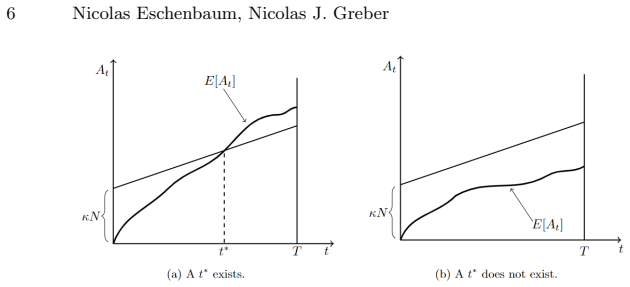
The load-bearing object is the arbitrageur's optimal maximum bid $b_t^*(h_t)$ in the repeated English auction. Lemma 3 derives the first-order condition $$ b_t^* = V_t^e(h_t) + \frac{1}{n}\frac{F(b_t^*)}{f(b_t^*)} \frac{\partial V_t^e}{\partial b_t^*}, $$ which shows how the bid is adjusted because winning today changes the treasury and hence future redemption values. Combined with members' truthful bidding (Lemma 1) and the forking condition that the number of arbitrageur-held nouns reach $\kappa(N+t)$ (Lemma 2), this bid determines the per-period win probability $F(b_t^*)^n$ and whether the expected accumulation of wins crosses the threshold. The proof of Proposition 1 uses this condition to express expected future bids as a multiple $g(\alpha,\tau,h_t)$ of the current bid and to translate the forking condition into the inequalities (5) and (6).
What would settle it
If the model were run with the redemption value written as a function of the winning price, $V_t^e = \alpha_t(S_{t-1}+p_t)$ with $p_t$ replacing the exogenous price expectation, the first-order condition in Lemma 3 would lose its overbidding term because $\partial V_t^e/\partial b_t^*$ would be negative; the question is whether Type II equilibria survive. A concrete check is a simulation that solves the model with this feedback for the same parameter grid as Tables 1-3 and reports whether each equilibrium type still appears; a disappearance of Type II would falsify the current classification as a description of the true game.
Extended reading notes
Core claim
Proposition 1 is the paper's central result. It says the equilibrium of the repeated auction game is of one of three types. In a Type I equilibrium the arbitrageur's optimal maximum bid is at least the upper bound $\bar{v}$ of member valuations, so every auction is won by the arbitrageur and a fork is guaranteed provided the horizon $T$ is long enough to cross the forking threshold ($T \geq \kappa N/(1-\kappa)$) and the initial treasury is large enough ($S_0 \geq \bar{v}/(\delta^{T-t}\alpha)$). In a Type II equilibrium the optimal bid lies in $(0,\bar{v})$, the winning probability per period is $F(b_t^*)^n$, and a fork occurs in expectation if the accumulated win probabilities reach $\kappa(N+T)-A_t$. In a Type III equilibrium the optimal bid is zero because the expected redemption value is too low, and the same accumulation condition fails for every possible forking time. The three types are exhaustive under the model's assumptions, and the paper verifies them numerically for four redemption mechanisms.
Load-bearing premise
The load-bearing premise is that an arbitrageur's value for winning a share is the ex ante expected redemption value, held fixed even though the price she pays is added to the treasury and therefore raises the share of the treasury she could redeem; this neglects the winner's curse.
Editorial extensions
If this is right
- With a pro-rata redemption mechanism, a low forking threshold makes a fork expected even from an empty treasury: early wins by members pay into the pool that the arbitrageur later redeems.
- Capping the redeemable share at the contribution (Mechanism 4) makes speculation unprofitable; no Type I or Type II equilibrium exists, so no fork occurs.
- A vesting delay of $\Delta$ periods raises the initial treasury needed for a guaranteed fork to $S_0 \geq \bar{v}/(\delta^{T-t+\Delta}\alpha)$, so delay reduces but does not eliminate the attack.
- Committing to an exponentially decaying spending path $z_t = kS_{t-1}e^{-\lambda(t-1)}$ with sufficiently large $k$ or $\lambda$ removes both Type I and Type II equilibria, leaving only no-fork outcomes.
- Under atomic exits with contribution-based shares (Mechanism 3), a fork is certain whenever the treasury exceeds the sum of past prices, so a positive initial treasury invites immediate arbitrage.
Reading between the lines
- If the winner's curse were incorporated, the parameter region for Type II equilibria would likely shrink, since an arbitrageur who pays more reduces her own redemption value; several of the paper's sufficient conditions for forks would become harder to satisfy.
- The three-type classification probably transfers to repeated auctions for equity-style claims beyond DAOs, such as IPO flipping or crowdfunding secondary-market listings, where the claim value is tied to a common pool rather than resale.
- The mechanism comparison suggests a general principle: speculative pooling attacks are prevented either by decoupling the claim from the contributor's payment (the cap in Mechanism 4) or by committing to shrink the pool over time; this could be tested across DAOs with observable spending rules.
- A natural empirical test would use the Nouns DAO's own auction data to estimate member valuation distributions and check which equilibrium type the observed treasury and forking threshold place the DAO in.
Editorial analysis
A structured set of objections, weighed in public.
Referee Report
Summary. This paper studies a repeated English auction in which a DAO mints one governance token (a 'noun') per period, with the auction price added to a common treasury, and in which a speculator ('arbitrageur') can accumulate tokens until reaching a fork threshold and then redeem tokens for a share of the treasury. The paper claims a three-way equilibrium typology—guaranteed fork (Type I), expected fork (Type II), no fork (Type III)—characterized by the arbitrageur's optimal maximum bid relative to the distribution of member valuations (Proposition 1). It then compares four redemption mechanisms and extends the model to atomic exits, vesting delays, and treasury spending, with numerical simulations.
Significance. The paper addresses a timely and economically relevant question: whether DAO exit and redemption mechanisms designed to protect minority members can instead attract speculative entry. Its modeling choices—repeated auctions, a forking threshold, and heterogeneous redemption mechanisms—are sensible, and the paper is transparent about the fact that its equilibrium conditions are expressed through the endogenously determined arbitrageur bid rather than model primitives. It also provides numerical tables for several mechanisms. However, the central equilibrium characterization rests on an arbitrageur payoff that ignores the price-feedback effect of the auction price on the redemption value. Because this error enters the derivation of Lemma 3 and hence Proposition 1, the main typology is not established by the current analysis. If corrected, the framework could be valuable, but as it stands the paper's central claim is unsupported.
major comments (3)
- [§2, Eq. (2)] The arbitrageur's payoff in Eq. (2) uses the pre-auction expected redemption value V^e_t(h_t) as the value of winning, independent of the realized auction price. This is incorrect for the model's own redemption mechanisms. If the arbitrageur wins at price p, the price is added to the treasury, so the per-noun redemption value becomes a function of p. For the pro-rata mechanism, the net payoff of winning at price p is α_{t*}(S_{t-1}+p+E[future prices]) − p = α_{t*} S_{t-1} − (1−α_{t*})p + α_{t*}E[future prices], which is strictly decreasing in p for α_{t*}<1, whereas Eq. (2) treats the gross value as the constant V^e_t(h_t). Because the arbitrageur wins only when p is below her maximum bid, the unconditional expectation V^e_t also ignores the selection effect. This misspecification is not a presentational issue: it is the payoff whose first-order condition is derived in Lemma 3.
- [§3, Lemma 3 and Appendix C.3, Eqs. (18a)–(20)] The proof of Lemma 3 differentiates the integral ∫_0^{bhat} (V^e_t − v) nF(v)^{n−1}f(v)dv with respect to bhat while holding V^e_t constant in the integration variable v. With the correct conditional redemption value, the integrand is V^e_t + α_{t*}(v − E[p]) − v, not V^e_t − v; the extra term α_{t*}(v − E[p]) depends on the integration variable and cannot be absorbed into V^e_t. Consequently, the derivative with respect to bhat acquires an additional boundary term (or, equivalently, the coefficient on bhat in the first-order condition becomes 1−α_{t*} rather than 1). The displayed first-order condition (4) for b*_t is therefore not the correct optimality condition, and the equilibrium typology in Proposition 1, which is stated in terms of b*_t in conditions (5)–(8), inherits the error. The paper's caveat that its conditions are expressed via the equilibrium bid rather than primitives is orthogonal to this problem.
- [§4, Proposition 1, Eq. (5)] In the Type II condition, the sum runs from τ=t to t*, but the right-hand side is κ(N+T)−A_t; Lemma 2 and the proof in Appendix C.4 (Eq. (27)) both use κ(N+t*)−A_t. As written, the condition in Proposition 1 is inconsistent with the forking threshold and needs correction.
minor comments (5)
- [§4, Proposition 1, Type I condition] The Type I condition 'S_0 ≥ v̄/(δ^{T−t} α)' uses α without a time subscript; since the redemption share generally varies with t (e.g., α_t=1/(N+t)), please specify which α is meant.
- [§3, Lemma 2] Lemma 2 and the surrounding text use both F(bhat_τ) and [F(bhat_τ)]^n for the probability of an arbitrageur win; the exponent is essential and should be used consistently.
- [Appendix B, Table 3] The column headers 'P=0' and 'P=10' are not defined; the text discusses initial treasury S_0, so the relationship between P and S_0 should be clarified.
- [Appendix C.6, Proof of Proposition 2] The proof refers to Eq. (34a), but that equation is not numbered in the main text; the numbering should be aligned.
- [§4, Proposition 1] Proposition 1 says the equilibrium is 'characterized' by the listed conditions, yet as the text itself notes, the Type I condition is only sufficient (there may be intermediate parameter values leading to Type I not captured by the condition). Please rephrase so that the proposition does not imply a full characterization.
Circularity Check
No significant circularity: Proposition 1 is an acknowledged fixed-point characterization, not a reduction of the prediction to its inputs.
full rationale
Walking the derivation chain, Lemma 1 derives nouners' truthful bidding from payoff (1), Lemma 2 derives the expected-fork inequality from the forking threshold and the win probabilities implied by Lemma 1, and Lemma 3 obtains the arbitrageur's first-order condition by differentiating payoff (18c). Proposition 1 combines these: the Type II/III conditions are Lemma 2 rewritten with future equilibrium bids expressed as b*_t/g, where g is defined as the ratio b*_t/E[b*_tau], and the Type I condition comes from the corner case b*_t >= vbar. This is an implicit fixed-point characterization, not a circular reduction: b* is pinned down by the FOC in Lemma 3, not by the Type II/III inequalities, and no parameter is fitted to the predicted outcome. The paper explicitly acknowledges that the conditions are 'not precise restrictions on the model primitives' but are expressed in terms of the optimal arbitrageur bid and the redemption value; that is a limitation of analytical tractability, not a circularity. There are no self-citations, no imported uniqueness theorems, and no renamed known results. The possible winner's-curse concern about payoff (2) (redemption value treated as independent of the realized price) is a modeling-consistency issue outside the circularity definition.
Assumptions & free parameters
assumptions (4)
- standard math In an English auction with private values, bidders bidding their true valuation is an equilibrium.
- ad hoc to paper Arbitrageurs value a noun solely at the expected redemption value V^e_t(h_t), and this value is independent of the realized auction price paid.
- domain assumption A fork occurs when the number of arbitrageur-held nouns exceeds the threshold κ(N+t).
- domain assumption The auction price is added to the treasury, and treasury spending is reduced-form in the extensions.
Cite this review
Pith. "Pith review of Repeated Auctions with Speculators: Arbitrage Incentives and Forks in DAOs." pith.science (2026). https://pith.science/paper/NMGOIYYE
@misc{pith2026250521296,
  author       = {Pith},
  title        = {Pith review of: Repeated Auctions with Speculators: Arbitrage Incentives and Forks in DAOs},
  year         = {2026},
  howpublished = {\url{https://pith.science/paper/NMGOIYYE}},
  note         = {Machine review of arXiv:2505.21296}
}
read the original abstract
We analyze the vulnerability of decentralized autonomous organizations (DAOs) to speculative exploitation via their redemption mechanisms. Studying a game-theoretic model of repeated auctions for governance shares with speculators, we characterize the conditions under which -- in equilibrium -- an exploitative exit is guaranteed to occur, occurs in expectation, or never occurs. We evaluate four redemption mechanisms and extend our model to include atomic exits, time delays, and DAO spending strategies. Our results highlight an inherent tension in DAO design: mechanisms intended to protect members from majority attacks can inadvertently create opportunities for costly speculative exploitation. We highlight governance mechanisms that can be used to prevent speculation.
Figures


Reference graph
Works this paper leans on
-
[1]
Bukhchandani, S., Huang, C.F.: Auctions with resale markets: An exploratory model of treasury bill markets. Rev. Financ. Stud. 2(3), 311–339 (1989)
work page 1989
-
[2]
Econometrica 74(3), 753–769 (2006)
Garratt, R., Tr¨ oger, T.: Speculation in Standard Auctions with Resale. Econometrica 74(3), 753–769 (2006). https://ideas.repec.org/a/ecm/emetrp/ v74y2006i3p753-769.html
work page 2006
-
[3]
Haile, P.A.: Auctions with resale markets: An application to US Forest Service timber sales. Am. Econ. Rev. 91(3), 399–427 (2001)
work page 2001
-
[4]
Lukkarinen, A., Schwienbacher, A.: Secondary market listings in equity crowdfund- ing: The missing link? Res. Policy 52(1), 104648 (2023)
work page 2023
-
[5]
Pagnozzi, M.: Are speculators unwelcome in multi-object auctions? Am. Econ. J. Microecon. 2(2), 97–131 (2010). 16 Nicolas Eschenbaum, Nicolas J. Greber A Additional Figures Fig. 3: Contribution-based Share 1 and 2. B Tables Table 1: Equilibrium types for different values of the initial treasury (vertical) and forking threshold (horizontal) and Mechanism 1...
work page 2010
Reviewed August 7, 2026 · model on record in the stance chip above.
Discussion (0). Sign in to comment.