REVIEW 3 major objections 4 minor 48 references
Equilibrium in Production Chains with Multiple Upstream Partners
T0 review · 3 major / 4 minor · reviewed 2026-08-14 · deepseek-v4-flash
Pith's one-line read A production chain in which every firm may hire many upstream partners has a unique equilibrium price schedule, reached by iteration and computable by a fast grid algorithm.
desk verdict A solid extension of Kikuchi et al. with a genuinely useful algorithm; the main proof has a fixable gap and the stochastic part is under-proved. read the letter →
The pith
A machine-rendered reading of the paper's core claim, the machinery that carries it, and where it could break.
The reading
What carries the argument
The load-bearing tool is a fixed-point theorem for monotone concave operators (stated as Theorem 3.1): if $A$ is increasing and concave on an order interval, with $Au_0\ge u_0+\epsilon(v_0-u_0)$ and $Av_0\le v_0$, then $A$ has a unique fixed point and iteration converges globally. The paper checks these hypotheses for $T$: Lemma A.2 shows $T$ is increasing and concave (the minimum of affine expressions in $p$ is concave), Lemma A.3 shows $Tu_0$ lies strictly above $u_0$, and Lemma A.4 shows $Tv_0\le v_0$ by choosing one partner and no subcontracting. This theory replaces the contraction-mapping argument, which fails here because $\delta>1$ can amplify differences.
What would settle it
Take the constant price function $p(s)=-1$ on $[0,1]$. For any $t>0$, the term $\delta^k p(t/k)=-\delta^k$ tends to $-\infty$ as $k\to\infty$, so $Tp(s)$ has no finite minimum. This shows Lemma A.1 cannot hold for all continuous $p$; Theorem 3.2 escapes because its order interval $[u_0,v_0]$ contains only nonnegative functions.
Extended reading notes
Core claim
The central result is Theorem 3.2: under Assumptions 2.1 and 2.2, the operator $T$ defined by $Tp(s)=\min_{t\le s, k\in\mathbb{N}}\{c(s-t)+g(k)+\delta^k p(t/k)\}$ has a unique fixed point $p^*$ in the order interval $[u_0,v_0]$, where $u_0(s)=c'(0)s$ and $v_0(s)=c(s)$, and $T^n p\to p^*$ uniformly for every starting point $p$ in that interval. This extends the earlier single-upstream-partner result to the multiple-partner case, which the earlier analysis left open. The paper further proves that the equilibrium price is strictly increasing, that raising either transaction cost raises the whole price schedule, that the non-iterative grid algorithm of Section 4 converges uniformly to $p^*$, and that the stochastic Poisson version satisfies the same existence, uniqueness, and convergence statements.
Load-bearing premise
The proof of Lemma A.1 assumes that the search over the number of partners can be bounded by one finite cutoff uniformly for every continuous price function, which is only guaranteed if prices stay nonnegative; the main theorem works on nonnegative prices, but the lemma as stated does not restrict them.
Editorial extensions
If this is right
- With multiple upstream partners allowed, equilibrium prices are still determinate: every stage of the chain has a single price consistent with zero profits, so the allocation is not arbitrary.
- Because $p^*$ is strictly increasing and the comparative-statics result holds, a rise in either transaction cost raises the entire price schedule, shifting the boundary between in-house production and subcontracting.
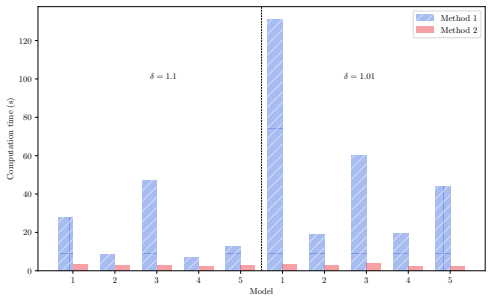
- The Section 4 algorithm converges uniformly to $p^*$ with a fixed number of minimization steps per grid, and in the paper's simulations it is up to around forty times faster than successive iteration, especially when $\delta$ is close to one.
- In the stochastic Poisson model, uniqueness and convergence still hold, and simulated networks are asymmetric even across firms at the same layer; higher $\delta$ or lower $g$ shortens the network, while lower curvature of $c$ also reduces layers.
Reading between the lines
- A direct extension the paper does not spell out: the same argument should work for stage spaces that are multidimensional or discrete, as long as the operator remains increasing and concave and the tangent lower bound holds.
- The stochastic model implies a testable prediction about firm-size dispersion: if the number of partners is Poisson with mean and variance increasing in search effort $\lambda$, a policy that lowers additive partnership costs should raise the variance of firm sizes across the network; the paper notes the mechanism is unclear, so this is an inference.
- The dyadic-grid algorithm suggests a rate-of-convergence question the paper leaves open: bounding the sup-norm distance between $p_n$ and $p^*$ by the modulus of continuity of $c$ and $p^*$ would convert the numerical method into a certified approximation scheme.
- A practical consequence for modelers is that the equilibrium price can be computed reliably by the grid algorithm even when successive approximation converges slowly, so computational cost no longer restricts the choice of $\delta$ near one.
Signed reviews
Editorial analysis
A structured set of objections, weighed in public.
Referee Report
Summary. The paper studies a production-chain model in which each firm may choose multiple upstream partners, extending Kikuchi et al. (2018). The equilibrium price function is characterized as the unique fixed point of the operator Tp(s) = min_{t≤s, k∈N} {c(s−t)+g(k)+δkp(t/k)}. The authors prove existence, uniqueness, and global stability on an order interval [u0,v0] using Du's theorem for monotone concave operators, propose a non-iterative grid algorithm with a uniform convergence result, and extend the model to a stochastic version in which the number of upstream partners is Poisson-distributed with an endogenously chosen parameter. The paper also reports numerical simulations on computation time and on network shapes.
Significance. If the results are made fully rigorous, the paper is a useful contribution: it replaces the ad hoc arguments of Kikuchi et al. with a unified monotone-concave-operator proof, handles multiple upstream partners, gives a fast and provably convergent algorithm, and adds a stochastic heterogeneity channel. The Du-theorem approach is well matched to the problem, and the algorithmic convergence proof is a concrete, checkable contribution. The main economic conclusions are plausible and the proof gaps identified below appear repairable without changing the model or the central claims.
major comments (3)
- [Appendix A, Lemma A.1] The statement that Tp∈C([0,1]) for all p∈C([0,1]) is false. For example, with g(k)=k−1 and p≡−1, the expression c(s−t)+g(k)+δkp(t/k)=c(s−t)+k−1−δk is unbounded below as k→∞, so Tp is not real-valued on (0,1]. The proof's restriction of Θ(s) to {1,...,k̄}×[0,s] is valid only when p is bounded below (and bounded above, so that k̄ can be chosen uniformly). This matters because Theorem 3.2 applies Du's theorem to T on [u0,v0], and the proof relies on Lemma A.1 to conclude that T maps that interval into C(X). The fix is straightforward: restate Lemma A.1 for nonnegative continuous functions, or directly for the order interval [u0,v0], and invoke it only there. As written, however, the proof of the main theorem is not valid.
- [Section 3.2, Proposition 3.3] The proof of strict monotonicity of p* is incomplete. The argument shows that if p is strictly increasing and p∈[u0,v0], then Tp is strictly increasing. The proof then invokes T^n c→p* and concludes that p* is strictly increasing. But a uniform limit of strictly increasing functions need only be nondecreasing; the argument does not rule out flat segments in p*. Since strict monotonicity is an explicitly stated property of the equilibrium price function, either a direct argument from the fixed-point equation p*=Tp* (using p*≥u0 and strict convexity of c) or a weakening of the proposition is needed.
- [Appendix C, Theorem 5.1] The stochastic extension is a main contribution, but its proof is largely omitted. The text says the lemmas 'still hold' and 'to avoid redundancy, we omit the proofs', yet additional nontrivial verification is required: one must show that the objective (λ,t) ↦ c(s−t)+E^λ_k[g(k)+δkp(t/k)] is jointly continuous in λ on the compact set [0,¯λ], and that the restriction of λ to [0,¯λ] does not change the minimum, using dominance arguments for the Poisson expectation. These steps are not immediate from the deterministic case because the expectation involves an infinite sum of g(k) terms. Please supply the missing details or state precisely which standard lemma covers them.
minor comments (4)
- [Appendix A, Lemma A.3] The claim that pointwise strict inequality Tu0(s)>u0(s) for s>0 implies the existence of a uniform ε with Tu0≥u0+ε(v0−u0) is not fully justified; one should argue by compactness that the ratio (Tu0−u0)/(v0−u0) is bounded away from zero on neighborhoods away from s=0.
- [Appendix A, Lemma A.2] The concavity proof is written for arbitrary p,q∈C([0,1]), but the operator T is not well-defined on all of C([0,1]) because of the issue raised in the first major comment. Restricting the domain to [u0,v0] (or to nonnegative continuous functions) makes the proof correct.
- [Introduction, footnote 5] There is a typographical error: 'Knaester–Tarski' should be 'Knaster–Tarski'.
- [Section 5, after (5)] The discussion of the shifted Poisson distribution should state explicitly that k has support {1,2,...}; the current text says 'k starts from 1', which is understandable but could be made precise.
Circularity Check
No circularity: uniqueness and stability follow from an external fixed-point theorem applied to verified hypotheses.
full rationale
The paper's central claim, Theorem 3.2, is not equivalent to its inputs. The equilibrium price is defined as a fixed point of the operator T in (3), and the uniqueness/global-stability conclusion is obtained by verifying the hypotheses of Du's (1989) monotone concave operator theorem (Theorem 3.1): Lemma A.2 proves monotonicity and concavity, Lemma A.3 proves Au0 >= u0 + eps(v0-u0), and Lemma A.4 proves Av0 <= v0. The order interval [u0,v0] is not assumed to contain the fixed point; it is shown to be mapped appropriately. No parameter is fitted to the target quantity, and no result is imported from the authors' own prior work: the model is attributed to Kikuchi et al. (2018), and the uniqueness theorem used is external (Du 1989; Guo et al. 2004). Algorithm convergence in Theorem 4.1 is proved separately via compactness and the already-established uniqueness, not derived from the theorem being proved. The stochastic extension (Theorem 5.1) is supported by the same external operator theory plus a cited median bound (Choi 1994). The noted weakness of Lemma A.1 for arbitrary continuous p taking negative values is a domain/regularity gap, not a circularity: Theorem 3.2 only needs the lemma on [u0,v0], where p>=0, so the derivation does not presuppose its conclusion.
Assumptions & free parameters
free parameters (3)
- delta (transaction cost coefficient) in simulations =
1.01, 1.1, 10, 15
- beta (additive transaction cost slope) in simulations =
0.0001, 0.0005, 50, 100
- theta (cost curvature) in stochastic simulations =
1.15, 1.2
assumptions (6)
- domain assumption Assumption 2.1: cost function c is differentiable, strictly increasing, strictly convex, with c(0)=0 and c'(0)>0.
- domain assumption Assumption 2.2: additive transaction cost g is strictly increasing, g(1)=0, and g(k)→∞ as k→∞.
- standard math Du's monotone concave operator fixed point theorem (Theorem 3.1).
- domain assumption Equilibrium zero-profit condition, Equation (2): p(s)=min_{t≤s,k∈N}{c(s-t)+g(k)+δkp(t/k)}.
- domain assumption Poisson distribution of partner counts in Section 5, with shift so k starts at 1.
- standard math Normality of the positive cone in C(X) under the sup norm.
Cite this review
Pith. "Pith review of Equilibrium in Production Chains with Multiple Upstream Partners." pith.science (2026). https://pith.science/paper/NN4BJCV3
@misc{pith2026190808208,
  author       = {Pith},
  title        = {Pith review of: Equilibrium in Production Chains with Multiple Upstream Partners},
  year         = {2026},
  howpublished = {\url{https://pith.science/paper/NN4BJCV3}},
  note         = {Machine review of arXiv:1908.08208}
}
read the original abstract
In this paper, we extend and improve the production chain model introduced by Kikuchi et al. (2018). Utilizing the theory of monotone concave operators, we prove the existence, uniqueness, and global stability of equilibrium price, hence improving their results on production networks with multiple upstream partners. We propose an algorithm for computing the equilibrium price function that is more than ten times faster than successive evaluations of the operator. The model is then generalized to a stochastic setting that offers richer implications for the distribution of firms in a production network.
Figures


Figures from the paper (1 more)

Reference graph
Works this paper leans on
-
[1]
author Acemoglu, D. , author Carvalho, V.M. , author Ozdaglar, A. , author Tahbaz-Salehi, A. , year 2012 . title The network origins of aggregate fluctuations . journal Econometrica volume 80 , pages 1977--2016
work page 2012
-
[2]
author Acemoglu, D. , author Ozdaglar, A. , author Tahbaz-Salehi, A. , year 2015 a. title Networks, shocks, and systemic risk . type Technical Report . National Bureau of Economic Research
work page 2015
-
[3]
author Acemoglu, D. , author Ozdaglar, A. , author Tahbaz-Salehi, A. , year 2015 b. title Systemic risk and stability in financial networks . journal American Economic Review volume 105 , pages 564--608
work page 2015
-
[4]
author Aliprantis, C.D. , author Border, K.C. , year 2006 . title Infinite Dimensional Analysis: A Hitchhiker's Guide . publisher Springer
work page 2006
-
[5]
author Balbus, L. , year 2016 . title On non-negative recursive utilities in dynamic programming with nonlinear aggregator and ces . journal University of Zielora G \'o ra Working Paper
work page 2016
-
[6]
author Balbus, . , author Reffett, K. , author Wo \'z ny, . , year 2013 . title A constructive geometrical approach to the uniqueness of markov stationary equilibrium in stochastic games of intergenerational altruism . journal Journal of Economic Dynamics and Control volume 37 , pages 1019--1039
work page 2013
-
[7]
author Baldwin, R. , author Venables, A.J. , year 2013 . title Spiders and snakes: offshoring and agglomeration in the global economy . journal Journal of International Economics volume 90 , pages 245--254
work page 2013
-
[8]
author Becker, G.S. , author Murphy, K.M. , year 1992 . title The division of labor, coordination costs, and knowledge . journal The Quarterly Journal of Economics volume 107 , pages 1137--1160
work page 1992
Show all 48 references
-
[9]
, author Rinc \'o n-Zapatero, J.P
author Becker, R.A. , author Rinc \'o n-Zapatero, J.P. , year 2017 . title Recursive utiity and thompson aggregators
2017
-
[10]
, year 1957
author Bellman, R.E. , year 1957 . title Dynamic Programming . publisher Princeton University Press
1957
-
[11]
fixed-point principle
author Bessaga, C. , year 1959 . title On the converse of banach “fixed-point principle” . journal Colloquium Mathematicum volume 7 , pages 41–43 . http://dx.doi.org/10.4064/cm-7-1-41-43, :10.4064/cm-7-1-41-43
1959 doi
-
[12]
, author La’O, J
author Bigio, S. , author La’O, J. , year 2016 . title Financial frictions in production networks . type Technical Report . National Bureau of Economic Research
2016
-
[13]
, author Vailakis, Y
author Bloise, G. , author Vailakis, Y. , year 2018 . title Convex dynamic programming with (bounded) recursive utility . journal Journal of Economic Theory volume 173 , pages 118--141
2018
-
[14]
, author Stachurski, J
author Borovi c ka, J. , author Stachurski, J. , year 2017 . title Necessary and sufficient conditions for existence and uniqueness of recursive utilities . type Technical Report . National Bureau of Economic Research
2017
-
[15]
, author Stachurski, J
author Borovi c ka, J. , author Stachurski, J. , year 2018 . title Existence and uniqueness of equilibrium asset prices over infinite horizons . type Technical Report
2018
-
[16]
, year 2007
author Carvalho, V. , year 2007 . title Aggregate fluctuations and the network structure of intersectoral trade
2007
-
[17]
, year 2013
author Cheney, W. , year 2013 . title Analysis for applied mathematics . volume volume 208 . publisher Springer Science & Business Media
2013
-
[18]
, year 1994
author Choi, K.P. , year 1994 . title On the medians of gamma distributions and an equation of ramanujan . journal Proceedings of the American Mathematical Society volume 121 , pages 245--251
1994
-
[19]
, year 2002
author Ciccone, A. , year 2002 . title Input chains and industrialization . journal The Review of Economic Studies volume 69 , pages 565--587
2002
-
[20]
, year 1937
author Coase, R.H. , year 1937 . title The nature of the firm . journal Economica volume 4 , pages 386--405
1937
-
[21]
, year 1991
author Coleman, W.J. , year 1991 . title Equilibrium in a production economy with an income tax . journal Econometrica: Journal of the Econometric Society , pages 1091--1104
1991
-
[22]
, year 2000
author Coleman, W.J. , year 2000 . title Uniqueness of an equilibrium in infinite-horizon economies subject to taxes and externalities . journal Journal of Economic Theory volume 95 , pages 71--78
2000
-
[23]
, author Mirman, L.J
author Datta, M. , author Mirman, L.J. , author Morand, O.F. , author Reffett, K.L. , year 2002 a. title Monotone methods for markovian equilibrium in dynamic economies . journal Annals of Operations Research volume 114 , pages 117--144
2002
-
[24]
, author Mirman, L.J
author Datta, M. , author Mirman, L.J. , author Reffett, K.L. , year 2002 b. title Existence and uniqueness of equilibrium in distorted dynamic economies with capital and labor . journal Journal of Economic Theory volume 103 , pages 377--410
2002
-
[25]
, author Kraemer, K.L
author Dedrick, J. , author Kraemer, K.L. , author Linden, G. , year 2011 . title The distribution of value in the mobile phone supply chain . journal Telecommunications Policy volume 35 , pages 505--521
2011
-
[26]
, year 1989
author Du, Y. , year 1989 . title Fixed points of a class of non-compact operators and applications . journal Acta Mathematica Sinica volume 32 , pages 618--627
1989
-
[27]
, author Cho, Y.J
author Guo, D. , author Cho, Y.J. , author Zhu, J. , year 2004 . title Partial ordering methods in nonlinear problems . publisher Nova Publishers
2004
-
[28]
, author Lakshmikantham, V
author Guo, D. , author Lakshmikantham, V. , year 1988 . title Nonlinear problems in abstract cones . publisher Academic Press . :https://doi.org/10.1016/C2013-0-10750-7
1988 doi
-
[29]
, year 1967
author Janos, L. , year 1967 . title A converse of banach's contraction theorem . journal Proceedings of the American Mathematical Society volume 18 , pages 287--289
1967
-
[30]
, year 2011
author Jones, C.I. , year 2011 . title Intermediate goods and weak links in the theory of economic development . journal American Economic Journal: Macroeconomics volume 3 , pages 1--28
2011
-
[31]
, author Nishimura, K
author Kikuchi, T. , author Nishimura, K. , author Stachurski, J. , year 2018 . title Span of control, transaction costs, and the structure of production chains . journal Theoretical Economics volume 13 , pages 729--760
2018
-
[32]
, author Linden, G
author Kraemer, K.L. , author Linden, G. , author Dedrick, J. , year 2011 . title Capturing value in global networks: Apple’s ipad and iphone . journal University of California, Irvine, University of California, Berkeley, y Syracuse University, NY. http://pcic. merage. uci. ed...
2011
-
[33]
title Positive Solutions of Operator Equations
author Krasnosel'skii , year 1964 . title Positive Solutions of Operator Equations
1964
-
[34]
, author Zabre i ko, P
author Krasnosel'skii, M. , author Zabre i ko, P. , year 1984 . title Geometrical methods of nonlinear analysis . Grundlehren der mathematischen Wissenschaften, publisher Springer-Verlag . https://books.google.com.au/books?id=8Q2oAAAAIAAJ
1984
-
[35]
, author Vainikko, G.M
author Krasnosel’skii, M.A. , author Vainikko, G.M. , author Zabreiko, P.P. , author Rutitskii, Y.B. , author Stetsenko, V.Y. , year 1972 . title Approximate Solution of Operator Equations . publisher Springer Netherlands . http://dx.doi.org/10.1007/978-94-010-2715-1, :10.1007...
1972 doi
-
[36]
, author Schreft, S
author Lacker, J.M. , author Schreft, S. , year 1991 . title Money, trade credit and asset prices
1991
-
[37]
, year 1982
author Leader, S. , year 1982 . title Uniformly contractive fixed points in compact metric spaces . journal Proceedings of the American Mathematical Society volume 86 , pages 153--158
1982
-
[38]
, year 2012
author Levine, D.K. , year 2012 . title Production chains . journal Review of Economic Dynamics volume 15 , pages 271--282
2012
-
[39]
, year 1978
author Lucas, R.E. , year 1978 . title On the size distribution of business firms . journal The Bell Journal of Economics , pages 508--523
1978
-
[40]
, author Montrucchio, L
author Marinacci, M. , author Montrucchio, L. , year 2010 . title Unique solutions for stochastic recursive utilities . journal Journal of Economic Theory volume 145 , pages 1776--1804
2010
-
[41]
, author Montrucchio, L
author Marinacci, M. , author Montrucchio, L. , year 2017 . title Unique Tarski fixed points . type Technical Report
2017
-
[42]
, author Reffett, K.L
author Morand, O.F. , author Reffett, K.L. , year 2003 . title Existence and uniqueness of equilibrium in nonoptimal unbounded infinite horizon economies . journal Journal of Monetary Economics volume 50 , pages 1351--1373
2003
-
[43]
, author Sleet, C
author Pavoni, N. , author Sleet, C. , author Messner, M. , year 2018 . title The dual approach to recursive optimization: theory and examples . journal Econometrica volume 86 , pages 133--172
2018
-
[44]
, author Stachurski, J
author Ren, G. , author Stachurski, J. , year 2018 . title Dynamic programming with recursive preferences: Optimality and applications . journal arXiv preprint arXiv:1812.05748
2018 arXiv
-
[45]
, author Rodr \'i guez-Palmero, C
author Rinc \'o n-Zapatero, J.P. , author Rodr \'i guez-Palmero, C. , year 2003 . title Existence and uniqueness of solutions to the bellman equation in the unbounded case . journal Econometrica volume 71 , pages 1519--1555
2003
-
[46]
, year 1963
author Thompson, A.C. , year 1963 . title On certain contraction mappings in a partially ordered vector space . journal Proceedings of the American Mathematical Society volume 14 , pages 438--443
1963
-
[47]
, author Janos, L
author Williamson, R. , author Janos, L. , year 1987 . title Constructing metrics with the heine-borel property . journal Proceedings of the American Mathematical Society volume 100 , pages 567--573
1987
-
[48]
, year 2013
author Zhang, Z. , year 2013 . title Variational, Topological, and Partial Order Methods with Their Applications . volume volume 29 of series Developments in Mathematics . publisher Springer Berlin Heidelberg . :10.1007/978-3-642-30709-6
2013 doi
Reviewed August 14, 2026 · model on record in the stance chip above.
Discussion (0). Continue with ORCID to comment.