REVIEW 4 major objections 8 minor 55 references
SGCR: Spherical Gaussians for Efficient 3D Curve Reconstruction
T0 review · 4 major / 8 minor · reviewed 2026-08-15 · deepseek-v4-flash
Pith's one-line read Fixed-radius spherical Gaussians turn multi-view 2D edge maps into accurate 3D parametric curves, cutting training from hours to under two minutes.
desk verdict A well-engineered pipeline that makes 3D curve reconstruction from images fast; the SOTA accuracy claim is real but rests on small margins without error bars. read the letter →
The pith
A machine-rendered reading of the paper's core claim, the machinery that carries it, and where it could break.
The reading
What carries the argument
The central object is the Spherical Gaussian: a Gaussian primitive with no covariance matrix and no spherical harmonics, defined only by center, fixed radius, opacity, and gray color. Its role is to act as a small isotropic atom that a rendering loss can push onto 3D edges while remaining geometrically interpretable. The opacity-color loss $L_{\mathrm{oc}}$ couples each sphere's opacity to its color so that occluded or detector-missed edges are not pruned prematurely. The extraction algorithm SGCR then uses line fitting with dilated Chamfer distance followed by global rational Bezier optimization to produce parametric curves.
What would settle it
Take a multi-view set in which one sharp edge is occluded in all but a single view, run the pipeline, and compare the reconstructed curve to a ground-truth scan: if the opacity-color loss cannot keep the occluded Gaussians alive, the edge will be absent from the wireframe and the Chamfer distance to ground truth will jump above the matching threshold.
Extended reading notes
Core claim
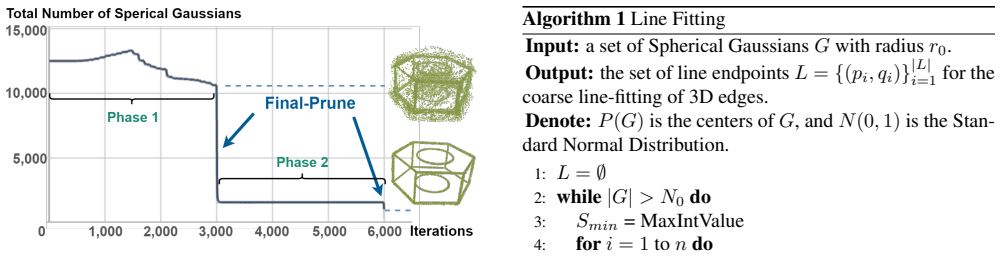
Spherical Gaussians are 3D Gaussian primitives stripped of covariance and spherical harmonics: each is a sphere of fixed radius carrying only opacity and gray-scale color. The paper claims that when initialized on a regular grid and trained with an edge-aware rendering loss, an opacity-color consistency loss, opacity regularization, and two-phase pruning, these spheres settle on the sharp edges of the object rather than forming the redundant ellipsoids produced by ordinary 3D Gaussian Splatting. The SGCR extraction then fits third-order rational Bezier curves through the sphere centers, first by greedy line fitting with dilated Chamfer distance and then by global optimization with opacity-weighted Chamfer distance and endpoint-joining loss. On the ABC-NEF and ModelNet benchmarks the method is reported to beat prior edge-reconstruction methods on Chamfer distance and F-score, while cutting single-scene training from over an hour to 87 seconds.
Load-bearing premise
The method assumes that 2D edge maps, together with the opacity-color consistency loss, contain enough cross-view information to place spheres on true 3D edges even when those edges are occluded or missed in some views.
Editorial extensions
If this is right
- 3D curve reconstruction from images drops from hours to minutes per scene, making interactive or near-real-time pipelines feasible.
- Because supervision is only 2D edge maps, the method scales to arbitrary captured image sets without 3D annotations or point clouds.
- The extracted output is parametric rational Bezier curves, directly usable in CAD, reverse engineering, and surface-reconstruction downstream tasks.
- The sphere representation may serve as a general bridge between 2D rendering losses and 3D line-like geometry, beyond edges.
Reading between the lines
- A stronger 2D edge detector should directly improve the 3D curves, since the method inherits the detector's misses and false positives; this suggests a modular pipeline where detector and curve extraction can be improved independently.
- The same fixed-radius isotropic primitive could be extended to other feature types, such as corners, creases, or semantic curves, by changing only the rendering target.
- The method's speed opens the door to online reconstruction from video streams, where each frame updates the spheres rather than restarting training.
Signed reviews
Editorial analysis
A structured set of objections, weighed in public.
Referee Report
Summary. The paper introduces SGCR, a two-stage method for reconstructing 3D parametric edge curves from calibrated multi-view images. In the first stage, the method optimizes a set of spherical Gaussians—isotropic, fixed-radius, grayscale primitives—using a view-based rendering loss that compares rendered 2D edge maps against PiDiNet-extracted edge maps, augmented by an opacity-color consistency loss and a regularization loss, within a two-phase training and pruning strategy. In the second stage, a RANSAC-style line fitting algorithm (Algorithm 1) followed by global optimization of rational Bézier control points and weights extracts the final curves, using a weighted Chamfer distance and an endpoint-connection loss. Experiments are reported on ABC-NEF, ModelNet, DTU, and Replica, claiming state-of-the-art accuracy on ABC-NEF and ModelNet, with training time of 87 seconds per scene versus over one hour for NEF and over two hours for EMAP.
Significance. If the results are robust, the paper offers a practical and interpretable alternative to neural implicit edge fields such as NEF and EMAP, with an order-of-magnitude training speedup and a simple geometric primitive that could be reused in other geometry-from-images tasks. The release of code and the systematic ablations of each pipeline component are strengths. However, the claimed accuracy advantage over EMAP is small (e.g., CD 0.0280 vs 0.0291, F-score 0.926 vs 0.921 on ABC-NEF), and the statistical evidence for this advantage is currently thin, which tempers the significance of the headline claim.
major comments (4)
- [Table 1] Table 1 reports improvements over EMAP that are small in absolute terms (CD 0.0280 vs 0.0291; F-score 0.926 vs 0.921 on ABC-NEF), but no standard deviations, confidence intervals, number of runs, or per-scene breakdowns are provided. The pipeline is stochastic: Algorithm 1 uses RandomChoice for seed line fits, and the Gaussian optimization presumably has random initialization and pruning order. Without multiple seeded runs and a significance test, the claimed superiority over EMAP is not established and could be within run-to-run variation.
- [Section 4.4 / Tables 2 and 3] The central accuracy claim is based on ABC-NEF comparisons in Table 1, but the hyperparameters (r0, lambda1, lambda2, lambda3, delta1, delta2, lambda, and pruning thresholds) are selected by ablations run on the same ABC-NEF dataset, as shown in Tables 2 and 3. No held-out validation split is described. This creates a risk that the reported improvement is partly a result of tuning on the test set, and it weakens the generality of the results on other datasets. A proper validation split or cross-dataset hyperparameter transfer should be reported.
- [Section 4.2 / Comparisons] The input point cloud for the point-cloud baselines (RFEPS and NerVE) is not specified. If these methods are given ground-truth point clouds from the CAD models while NEF, EMAP, and the proposed method only receive rendered images, the comparison is not apples-to-apples and would understate the difficulty of the image-based setting. If the point clouds are derived from the same rendered images, the derivation procedure must be described. Please clarify this protocol.
- [Section 3.3.1 / Algorithm 1] Algorithm 1 depends on several parameters that are never specified: n (the number of random searches), Ns (the number of interpolation points), and the exact optimization procedure for p and q (e.g., optimizer, iterations, learning rate). These details are essential for reproducibility. Similarly, the Spherical Gaussian training stage omits optimizer settings, learning rate, densification thresholds, and the initialization scheme for the grid. Without these, an independent implementation cannot verify the reported numbers.
minor comments (8)
- [Equation (4)] The text says "The regularization loss is defines as" which should be "is defined as"; please also check the formula formatting for readability.
- [Table 2] The header contains the typo "Sperical Gaussians" which should be "Spherical Gaussians".
- [Equation (10)] The expression for L_endpoints is algebraically equivalent to a sum of squared endpoint distances for pairs within delta2, but the current form with the min multiplied by the fraction is confusing and appears to contain a division that cancels; please simplify for clarity.
- [Section 3.3.1] N0 is introduced in the text before Algorithm 1 but is not labeled inside the algorithm; adding a line defining N0 in the pseudocode would make the algorithm self-contained.
- [Section 4.1] The sentence "which consisting of 115 distinct and challenging CAD models" contains a grammatical error; it should be "which consists of".
- [Section 4.3] The real-world evaluation on DTU and Replica is only qualitative. Adding quantitative metrics, or at least a discussion of failure cases, would strengthen the claim of generalization.
- [Abstract] The phrase "Spherical Gaussians serve as intermedia" should be "intermediate".
- [Table 1 / Timing] Please specify the GPU/CPU hardware used for all training and reconstruction time measurements, as the efficiency comparison is a central part of the paper's claim.
Circularity Check
No construction-level circularity in the SGCR pipeline; the only circular element is that the ABC-NEF hyperparameter r0 is tuned on the same benchmark later reported as the headline SOTA result.
-
fitted input called prediction
[Section 4.4, Table 3 (radius ablation) feeding Section 4.2, Table 1 (ABC-NEF comparison).]
"Using r0 = 0.005 leads to the optimal reconstruction metrics as well as a reasonable running time."
The ABC-NEF rows of Table 1 are generated with the radius r0 selected in Section 4.4 precisely because it produced the best CD and F-score on the ABC-NEF benchmark. The same benchmark is then reused in Table 1 to claim state-of-the-art accuracy over EMAP and NEF. Thus the ABC-NEF comparison is in-sample: the hyperparameter was chosen to optimize the exact metric on the exact dataset being reported, so part of the claimed advantage is fitted to the test set rather than independently predicted. This is an evaluative circularity, not a collapse of the underlying optimization, since the reported curves are still outputs of a genuine rendering-to-curve pipeline.
full rationale
The derivation chain itself is self-contained: Spherical Gaussians are optimized from grid initialization against 2D edge maps through the loss in Eq. (5), and SGCR extracts rational Bezier curves by minimizing Chamfer-based objectives (Eqs. (6), (9), (11)) over the resulting Gaussian centers. No predicted quantity is defined as an input, no load-bearing step is justified by a self-citation, and no uniqueness theorem is imported from the authors' prior work. The only circular element is evaluative: r0 is chosen in Section 4.4 because it optimizes metrics on ABC-NEF, and the same ABC-NEF benchmark is then used in Table 1 as evidence of SOTA accuracy. ModelNet provides a partially independent check, and the efficiency claim (87s vs hours) is independent of this tuning, so the central method retains substantive content. The score reflects this partial in-sample benchmarking rather than any definitional equivalence between inputs and outputs.
Assumptions & free parameters
free parameters (14)
- Sphere radius r0 =
0.005
- Edge threshold eta =
0.3
- D-SSIM weight lambda1 =
0.2
- Opacity-color loss weight lambda2 =
2.0
- Regularization weight lambda3 =
0.01
- Final-prune opacity threshold =
0.5
- Final-prune color threshold =
0.1
- Line fitting distance threshold delta1 =
0.02
- Endpoint merge threshold delta2 =
0.01
- Chamfer balance gamma1, gamma2 =
2, 2
- Endpoint loss weight lambda =
0.005
- Sampling count Ns
- Grid resolution =
50x50x50
- Training iterations and schedule =
3000+3000, densify every 200, opacity reset 0.1
assumptions (5)
- domain assumption Differentiable Gaussian splatting rendering from 3DGS supports gradient-based optimization of Gaussian positions, opacities, and colors.
- domain assumption PiDiNet edge maps are a reliable proxy for the true 3D edges visible in each view.
- domain assumption All target edges can be represented as a set of 3rd-order rational Bezier curves.
- ad hoc to paper Coupling opacity to color resolves cross-view occlusion inconsistencies.
- standard math Standard Bezier basis functions, Chamfer distance, and gradient-based optimization behave as expected.
Cite this review
Pith. "Pith review of SGCR: Spherical Gaussians for Efficient 3D Curve Reconstruction." pith.science (2026). https://pith.science/paper/NOOUFEIB
@misc{pith2026250504668,
  author       = {Pith},
  title        = {Pith review of: SGCR: Spherical Gaussians for Efficient 3D Curve Reconstruction},
  year         = {2026},
  howpublished = {\url{https://pith.science/paper/NOOUFEIB}},
  note         = {Machine review of arXiv:2505.04668}
}
read the original abstract
Neural rendering techniques have made substantial progress in generating photo-realistic 3D scenes. The latest 3D Gaussian Splatting technique has achieved high quality novel view synthesis as well as fast rendering speed. However, 3D Gaussians lack proficiency in defining accurate 3D geometric structures despite their explicit primitive representations. This is due to the fact that Gaussian's attributes are primarily tailored and fine-tuned for rendering diverse 2D images by their anisotropic nature. To pave the way for efficient 3D reconstruction, we present Spherical Gaussians, a simple and effective representation for 3D geometric boundaries, from which we can directly reconstruct 3D feature curves from a set of calibrated multi-view images. Spherical Gaussians is optimized from grid initialization with a view-based rendering loss, where a 2D edge map is rendered at a specific view and then compared to the ground-truth edge map extracted from the corresponding image, without the need for any 3D guidance or supervision. Given Spherical Gaussians serve as intermedia for the robust edge representation, we further introduce a novel optimization-based algorithm called SGCR to directly extract accurate parametric curves from aligned Spherical Gaussians. We demonstrate that SGCR outperforms existing state-of-the-art methods in 3D edge reconstruction while enjoying great efficiency.
Figures


Figures from the paper (5 more)


Reference graph
Works this paper leans on
-
[1]
Large-scale data for multiple-view stereopsis
Henrik Aanæs, Rasmus Ramsbøl Jensen, George V ogiatzis, Engin Tola, and Anders Bjorholm Dahl. Large-scale data for multiple-view stereopsis. International Journal of Computer Vision, 120:153–168, 2016. 2, 6, 7
work page 2016
-
[2]
L2d2: Learnable line detector and descriptor
Hichem Abdellali, Robert Frohlich, Viktor Vilagos, and Zoltan Kato. L2d2: Learnable line detector and descriptor. In 2021 International Conference on 3D Vision (3DV), pages 442–452. IEEE, 2021. 3
work page 2021
-
[3]
The crust and the β-skeleton: Combinatorial curve reconstruc- tion
Nina Amenta, Marshall Bern, and David Eppstein. The crust and the β-skeleton: Combinatorial curve reconstruc- tion. Graphical models and image processing , 60(2):125– 135, 1998. 3
work page 1998
-
[4]
Structure-from-motion us- ing lines: Representation, triangulation, and bundle adjust- ment
Adrien Bartoli and Peter Sturm. Structure-from-motion us- ing lines: Representation, triangulation, and bundle adjust- ment. Computer vision and image understanding , 100(3): 416–441, 2005. 3
work page 2005
-
[5]
Edc-net: Edge detection capsule network for 3d point clouds
Dena Bazazian and M Eul `alia Par´es. Edc-net: Edge detection capsule network for 3d point clouds. Applied Sciences, 11 (4):1833, 2021. 3
work page 2021
-
[6]
Neusg: Neural im- plicit surface reconstruction with 3d gaussian splatting guid- ance
Hanlin Chen, Chen Li, and Gim Hee Lee. Neusg: Neural im- plicit surface reconstruction with 3d gaussian splatting guid- ance. arXiv preprint arXiv:2312.00846, 2023. 2
arXiv 2023
-
[7]
Detection of closed sharp edges in point clouds using normal estimation and graph theory
Kris Demarsin, Denis Vanderstraeten, Tim V olodine, and Dirk Roose. Detection of closed sharp edges in point clouds using normal estimation and graph theory. Computer-Aided Design, 39(4):276–283, 2007. 3
work page 2007
-
[8]
Strobl, Matthias Humt, and Rudolph Triebel
Maximilian Denninger, Dominik Winkelbauer, Martin Sun- dermeyer, Wout Boerdijk, Markus Knauer, Klaus H. Strobl, Matthias Humt, and Rudolph Triebel. Blenderproc2: A procedural pipeline for photorealistic rendering. Journal of Open Source Software, 8(82):4901, 2023. 6
work page 2023
Show all 55 references
-
[9]
Curve re- construction: Connecting dots with good reason
Tamal K Dey, Kurt Mehlhorn, and Edgar A Ramos. Curve re- construction: Connecting dots with good reason. InProceed- ings of the fifteenth annual symposium on Computational ge- ometry, pages 197–206, 1999. 2, 3
1999
-
[10]
Fast plane extraction in organized point clouds using agglomerative hi- erarchical clustering
Chen Feng, Yuichi Taguchi, and Vineet R Kamat. Fast plane extraction in organized point clouds using agglomerative hi- erarchical clustering. In 2014 IEEE International Confer- ence on Robotics and Automation (ICRA), pages 6218–6225. IEEE, 2014. 3
2014
-
[11]
Lifting freehand concept sketches into 3d
Yulia Gryaditskaya, Felix H ¨ahnlein, Chenxi Liu, Alla Shef- fer, and Adrien Bousseau. Lifting freehand concept sketches into 3d. ACM Transactions on Graphics (TOG), 39(6):1–16,
-
[12]
Sugar: Surface- aligned gaussian splatting for efficient 3d mesh recon- struction and high-quality mesh rendering
Antoine Gu ´edon and Vincent Lepetit. Sugar: Surface- aligned gaussian splatting for efficient 3d mesh recon- struction and high-quality mesh rendering. arXiv preprint arXiv:2311.12775, 2023. 2, 3
2023 arXiv
-
[13]
Fea- ture extraction from point clouds
Stefan Gumhold, Xinlong Wang, Rob S MacLeod, et al. Fea- ture extraction from point clouds. In IMR, pages 293–305,
-
[14]
Pl- vio: Tightly-coupled monocular visual–inertial odometry us- ing point and line features
Yijia He, Ji Zhao, Yue Guo, Wenhao He, and Kui Yuan. Pl- vio: Tightly-coupled monocular visual–inertial odometry us- ing point and line features. Sensors, 18(4):1159, 2018. 3
2018
-
[15]
Pcednet: A lightweight neural network for fast and interac- tive edge detection in 3d point clouds
Chems-Eddine Himeur, Thibault Lejemble, Thomas Pelle- grini, Mathias Paulin, Loic Barthe, and Nicolas Mellado. Pcednet: A lightweight neural network for fast and interac- tive edge detection in 3d point clouds. ACM Transactions on Graphics (TOG), 41(1):1–21, 2021. 3
2021
-
[16]
Efficient 3d scene abstraction using line segments
Manuel Hofer, Michael Maurer, and Horst Bischof. Efficient 3d scene abstraction using line segments. Computer Vision and Image Understanding, 157:167–178, 2017. 3
2017
-
[17]
2d gaussian splatting for geometrically accu- rate radiance fields
Binbin Huang, Zehao Yu, Anpei Chen, Andreas Geiger, and Shenghua Gao. 2d gaussian splatting for geometrically accu- rate radiance fields. arXiv preprint arXiv:2403.17888, 2024. 2
2024 arXiv
-
[18]
Edge-aware point set resam- pling
Hui Huang, Shihao Wu, Minglun Gong, Daniel Cohen-Or, Uri Ascher, and Hao Zhang. Edge-aware point set resam- pling. ACM transactions on graphics (TOG) , 32(1):1–12,
-
[19]
3d gaussian splatting for real-time radiance field rendering
Bernhard Kerbl, Georgios Kopanas, Thomas Leimk ¨uhler, and George Drettakis. 3d gaussian splatting for real-time radiance field rendering. ACM Transactions on Graphics, 42 (4), 2023. 1, 2, 3, 4, 5, 8
2023
-
[20]
Abc: A big cad model dataset for geometric deep learning
Sebastian Koch, Albert Matveev, Zhongshi Jiang, Francis Williams, Alexey Artemov, Evgeny Burnaev, Marc Alexa, Denis Zorin, and Daniele Panozzo. Abc: A big cad model dataset for geometric deep learning. In Proceedings of the IEEE/CVF conference on computer vision and pattern re...
2019
-
[21]
Curve and surface reconstruction from points: an approach based on self-organizing maps
G Saravana Kumar, Prem Kumar Kalra, and Sanjay G Dhande. Curve and surface reconstruction from points: an approach based on self-organizing maps. Applied Soft Com- puting, 5(1):55–66, 2004. 2, 3
2004
-
[22]
Curve reconstruction from unorganized points
In-Kwon Lee. Curve reconstruction from unorganized points. Computer aided geometric design , 17(2):161–177,
-
[23]
3d neural edge recon- struction
Lei Li, Songyou Peng, Zehao Yu, Shaohui Liu, R´emi Pautrat, Xiaochuan Yin, and Marc Pollefeys. 3d neural edge recon- struction. In IEEE/CVF Conference on Computer Vision and Pattern Recognition (CVPR), 2024. 3, 6, 7
2024
-
[24]
Uv-slam: Unconstrained line-based slam using vanishing points for structural mapping
Hyunjun Lim, Jinwoo Jeon, and Hyun Myung. Uv-slam: Unconstrained line-based slam using vanishing points for structural mapping. IEEE Robotics and Automation Letters, 7(2):1518–1525, 2022. 3
2022
-
[25]
3d line mapping revisited
Shaohui Liu, Yifan Yu, R ´emi Pautrat, Marc Pollefeys, and Viktor Larsson. 3d line mapping revisited. InProceedings of the IEEE/CVF Conference on Computer Vision and Pattern Recognition, pages 21445–21455, 2023. 3
2023
-
[26]
Pc2wf: 3d wireframe reconstruction from raw point clouds
Yujia Liu, Stefano D’Aronco, Konrad Schindler, and JanDirk Wegner. Pc2wf: 3d wireframe reconstruction from raw point clouds. Cornell University - arXiv,Cornell University - arXiv, 2021. 2, 3
2021
-
[27]
Scaffold-gs: Structured 3d gaussians for view-adaptive rendering
Tao Lu, Mulin Yu, Linning Xu, Yuanbo Xiangli, Limin Wang, Dahua Lin, and Bo Dai. Scaffold-gs: Structured 3d gaussians for view-adaptive rendering. In Proceedings of the IEEE/CVF Conference on Computer Vision and Pattern Recognition, pages 20654–20664, 2024. 3
2024
-
[28]
Def: Deep estimation of sharp geometric features in 3d shapes
Albert Matveev, Ruslan Rakhimov, Alexey Artemov, Gleb Bobrovskikh, Vage Egiazarian, Emil Bogomolov, Daniele Panozzo, Denis Zorin, and Evgeny Burnaev. Def: Deep estimation of sharp geometric features in 3d shapes. ACM Transactions on Graphics, 41(4), 2022. 2, 3
2022
-
[29]
Nerf: Representing scenes as neural radiance fields for view syn- thesis
Ben Mildenhall, Pratul P Srinivasan, Matthew Tancik, Jonathan T Barron, Ravi Ramamoorthi, and Ren Ng. Nerf: Representing scenes as neural radiance fields for view syn- thesis. Communications of the ACM, 65(1):99–106, 2021. 2, 3
2021
-
[30]
Sold2: Self-supervised occlusion- aware line description and detection
R ´emi Pautrat, Juan-Ting Lin, Viktor Larsson, Martin R Os- wald, and Marc Pollefeys. Sold2: Self-supervised occlusion- aware line description and detection. In Proceedings of the IEEE/CVF Conference on Computer Vision and Pattern Recognition, pages 11368–11378, 2021. 3
2021
-
[31]
Deeplsd: Line segment detection and refinement with deep image gradients
R ´emi Pautrat, Daniel Barath, Viktor Larsson, Martin R Os- wald, and Marc Pollefeys. Deeplsd: Line segment detection and refinement with deep image gradients. InProceedings of the IEEE/CVF Conference on Computer Vision and Pattern Recognition, pages 17327–17336, 2023. 3
2023
-
[32]
Gluestick: Robust image matching by sticking points and lines together
R ´emi Pautrat, Iago Su ´arez, Yifan Yu, Marc Pollefeys, and Viktor Larsson. Gluestick: Robust image matching by sticking points and lines together. In Proceedings of the IEEE/CVF International Conference on Computer Vision , pages 9706–9716, 2023. 3
2023
-
[33]
Pointnet++: Deep hierarchical feature learning on point sets in a metric space
Charles Ruizhongtai Qi, Li Yi, Hao Su, and Leonidas J Guibas. Pointnet++: Deep hierarchical feature learning on point sets in a metric space. Advances in neural information processing systems, 30, 2017. 3
2017
-
[34]
3d modeling with silhouettes
Alec Rivers, Fr ´edo Durand, and Takeo Igarashi. 3d modeling with silhouettes. In Acm siggraph 2010 papers , pages 1–8
2010
-
[35]
Analytic drawing of 3d scaffolds
Ryan Schmidt, Azam Khan, Karan Singh, and Gord Kurten- bach. Analytic drawing of 3d scaffolds. InACM SIGGRAPH Asia 2009 papers, pages 1–10. 2009. 3
2009
-
[36]
Seitz, and Richard Szeliski
Noah Snavely, Steven M. Seitz, and Richard Szeliski. Photo tourism. ACM Transactions on Graphics , page 835–846,
-
[37]
The replica dataset: A digital replica of indoor spaces
Julian Straub, Thomas Whelan, Lingni Ma, Yufan Chen, Erik Wijmans, Simon Green, Jakob J Engel, Raul Mur-Artal, Carl Ren, Shobhit Verma, et al. The replica dataset: A digital replica of indoor spaces. arXiv preprint arXiv:1906.05797,
1906 arXiv
-
[38]
Pixel difference networks for efficient edge detection
Zhuo Su, Wenzhe Liu, Zitong Yu, Dewen Hu, Qing Liao, Qi Tian, Matti Pietik ¨ainen, and Li Liu. Pixel difference networks for efficient edge detection. In Proceedings of the IEEE/CVF international conference on computer vision, pages 5117–5127, 2021. 3, 6
2021
-
[39]
Reconstruction of curve networks from unorganized spatial points
Shuangbu Wang, Yu Xia, Lihua You, and Jianjun Zhang. Reconstruction of curve networks from unorganized spatial points. Journal of Universal Computer Science (J. UCS), 26 (9):1265–1280, 2020. 3
2020
-
[40]
Fitting b- spline curves to point clouds by curvature-based squared dis- tance minimization
Wenping Wang, Helmut Pottmann, and Yang Liu. Fitting b- spline curves to point clouds by curvature-based squared dis- tance minimization. ACM Transactions on Graphics (ToG), 25(2):214–238, 2006. 3
2006
-
[41]
Pie-net: Parametric inference of point cloud edges
Xiaogang Wang, Yuelang Xu, Kai Xu, Andrea Tagliasac- chi, Bin Zhou, Ali Mahdavi-Amiri, and Hao Zhang. Pie-net: Parametric inference of point cloud edges. Advances in neu- ral information processing systems, 33:20167–20178, 2020. 2, 3
2020
-
[42]
Sharp feature detection in point clouds
Christopher Weber, Stefanie Hahmann, and Hans Hagen. Sharp feature detection in point clouds. In 2010 shape mod- eling international conference, pages 175–186. IEEE, 2010. 3
2010
-
[43]
Elsr: Efficient line segment reconstruc- tion with planes and points guidance
Dong Wei, Yi Wan, Yongjun Zhang, Xinyi Liu, Bin Zhang, and Xiqi Wang. Elsr: Efficient line segment reconstruc- tion with planes and points guidance. In Proceedings of the IEEE/CVF Conference on Computer Vision and Pattern Recognition, pages 15807–15815, 2022. 3
2022
-
[44]
3d shapenets: A deep representation for volumetric shapes
Zhirong Wu, Shuran Song, Aditya Khosla, Fisher Yu, Lin- guang Zhang, Xiaoou Tang, and Jianxiong Xiao. 3d shapenets: A deep representation for volumetric shapes. In Proceedings of the IEEE conference on computer vision and pattern recognition, pages 1912–1920, 2015. 2, 6, 7
1912
-
[45]
Physgaussian: Physics- integrated 3d gaussians for generative dynamics
Tianyi Xie, Zeshun Zong, Yuxin Qiu, Xuan Li, Yutao Feng, Yin Yang, and Chenfanfu Jiang. Physgaussian: Physics- integrated 3d gaussians for generative dynamics. arXiv preprint arXiv:2311.12198, 2023. 3
2023 arXiv
-
[46]
True2form: 3d curve networks from 2d sketches via selective regularization
Baoxuan Xu, William Chang, Alla Sheffer, Adrien Bousseau, James McCrae, and Karan Singh. True2form: 3d curve networks from 2d sketches via selective regularization. ACM Transactions on Graphics, 33(4), 2014. 3
2014
-
[47]
Rfeps: Re- constructing feature-line equipped polygonal surface
Rui Xu, Zixiong Wang, Zhiyang Dou, Chen Zong, Shiqing Xin, Mingyan Jiang, Tao Ju, and Changhe Tu. Rfeps: Re- constructing feature-line equipped polygonal surface. ACM Transactions on Graphics (TOG), 41(6):1–15, 2022. 3, 6, 7
2022
-
[48]
Holistically- attracted wireframe parsing: From supervised to self- supervised learning
Nan Xue, Tianfu Wu, Song Bai, Fu-Dong Wang, Gui-Song Xia, Liangpei Zhang, and Philip HS Torr. Holistically- attracted wireframe parsing: From supervised to self- supervised learning. IEEE Transactions on Pattern Analysis and Machine Intelligence, 2023. 3
2023
-
[49]
Automated registration of dense terrestrial laser-scanning point clouds using curves
Bisheng Yang and Yufu Zang. Automated registration of dense terrestrial laser-scanning point clouds using curves. ISPRS journal of photogrammetry and remote sensing , 95: 109–121, 2014. 3
2014
-
[50]
Nef: Neural edge fields for 3d parametric curve reconstruction from multi-view images
Yunfan Ye, Renjiao Yi, Zhirui Gao, Chenyang Zhu, Zhiping Cai, and Kai Xu. Nef: Neural edge fields for 3d parametric curve reconstruction from multi-view images. In Proceed- ings of the IEEE/CVF Conference on Computer Vision and Pattern Recognition (CVPR), pages 8486–8495, 2023...
2023
-
[51]
Ec-net: an edge-aware point set consoli- dation network
Lequan Yu, Xianzhi Li, Chi-Wing Fu, Daniel Cohen-Or, and Pheng-Ann Heng. Ec-net: an edge-aware point set consoli- dation network. In Proceedings of the European conference on computer vision (ECCV), pages 386–402, 2018. 3
2018
-
[52]
Gsdf: 3dgs meets sdf for improved rendering and reconstruction
Mulin Yu, Tao Lu, Linning Xu, Lihan Jiang, Yuanbo Xiangli, and Bo Dai. Gsdf: 3dgs meets sdf for improved rendering and reconstruction. arXiv preprint arXiv:2403.16964, 2024. 2
2024 arXiv
-
[53]
Mip-splatting: Alias-free 3d gaussian splat- ting
Zehao Yu, Anpei Chen, Binbin Huang, Torsten Sattler, and Andreas Geiger. Mip-splatting: Alias-free 3d gaussian splat- ting. In Proceedings of the IEEE/CVF Conference on Com- puter Vision and Pattern Recognition (CVPR), pages 19447– 19456, 2024. 3
2024
-
[54]
Nerve: Neural volumetric edges for parametric curve extraction from point cloud
Xiangyu Zhu, Dong Du, Weikai Chen, Zhiyou Zhao, Yinyu Nie, and Xiaoguang Han. Nerve: Neural volumetric edges for parametric curve extraction from point cloud. In Pro- ceedings of the IEEE/CVF Conference on Computer Vision and Pattern Recognition, pages 13601–13610, 2023. 2, 3, 6, 7
2023
-
[55]
Driv- able 3d gaussian avatars
Wojciech Zielonka, Timur Bagautdinov, Shunsuke Saito, Michael Zollh ¨ofer, Justus Thies, and Javier Romero. Driv- able 3d gaussian avatars. arXiv preprint arXiv:2311.08581,
Reviewed August 15, 2026 · model on record in the stance chip above.
Discussion (0). Continue with ORCID to comment.