Dual Line Coherent Detection
Pith reviewed 2026-06-26 23:44 UTC · model grok-4.3
The pith
Dual-line coherent detection with an optical frequency comb local oscillator achieves 200 GHz frequency offset tolerance for 400 Gbit/s signals with low penalty.
A machine-rendered reading of the paper's core claim, the machinery that carries it, and where it could break.
Core claim
Dual-line coherent detection using an optical frequency comb local oscillator enables large frequency offset tolerance with minimal additional signal processing, achieving 200 GHz offset tolerance for 400 Gbit/s signals with low penalty.
What carries the argument
Dual-line coherent detection paired with an optical frequency comb local oscillator, which processes two spectral lines to compensate frequency offsets without requiring tight locking or extensive digital processing.
If this is right
- The method supports uncooled low-cost coherent transceivers by relaxing frequency locking requirements.
- Minimal extra processing keeps receiver complexity low while handling 200 GHz offsets.
- The approach applies directly to 400 Gbit/s data rates in coherent optical systems.
- Large offset tolerance reduces the need for temperature stabilization in transceivers.
Where Pith is reading between the lines
- If the tolerance scales with comb line spacing, similar dual-line schemes could apply to other data rates or modulation formats.
- Network operators might simplify wavelength management in dense wavelength-division multiplexing systems by relying on this tolerance instead of precise laser control.
- Integration with existing comb sources could lower overall system power draw by removing active cooling components.
Load-bearing premise
The optical frequency comb local oscillator can be paired with dual-line detection to maintain signal integrity across large frequency offsets without introducing unaccounted penalties or requiring substantial additional processing.
What would settle it
An experiment at 200 GHz offset showing bit-error-rate penalties exceeding the low-penalty regime described, or failure to recover the 400 Gbit/s signal with the stated minimal processing, would falsify the tolerance claim.
Figures
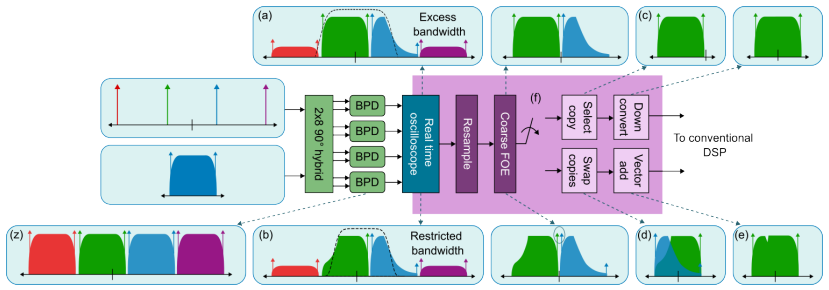
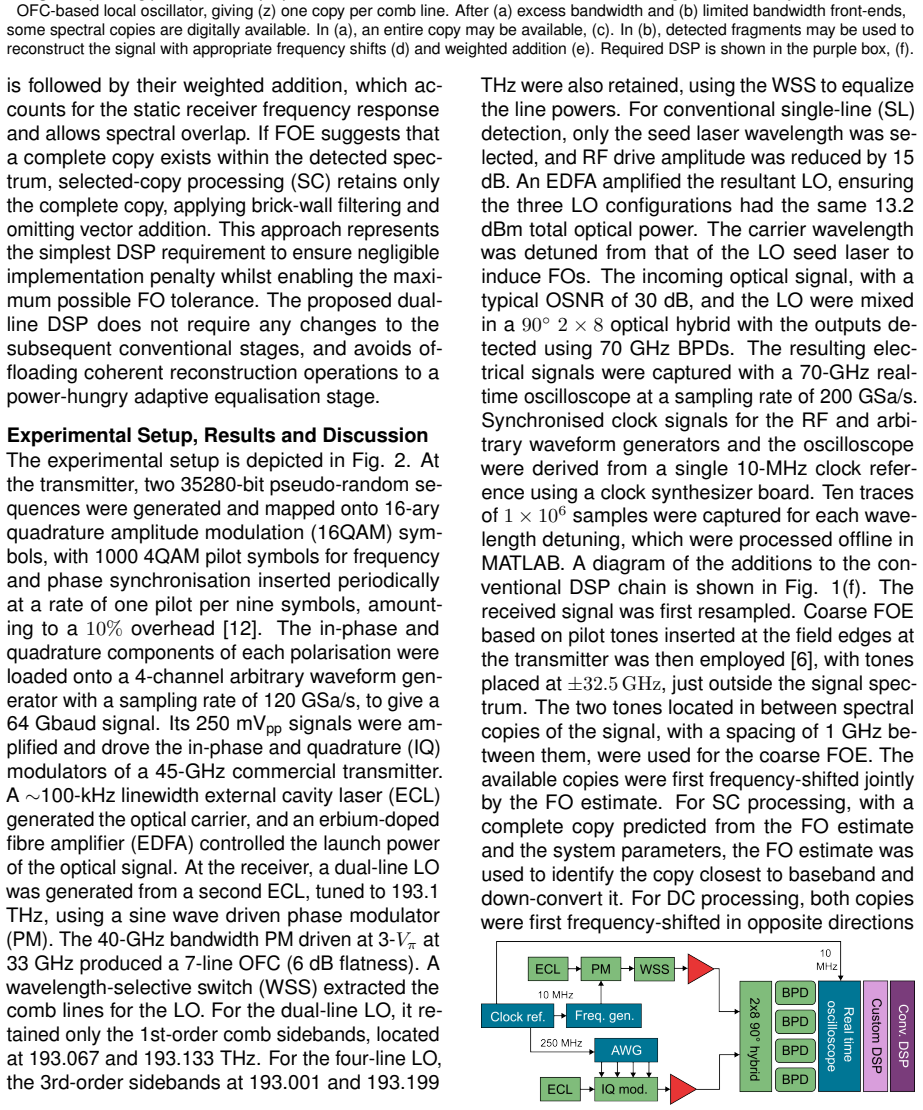
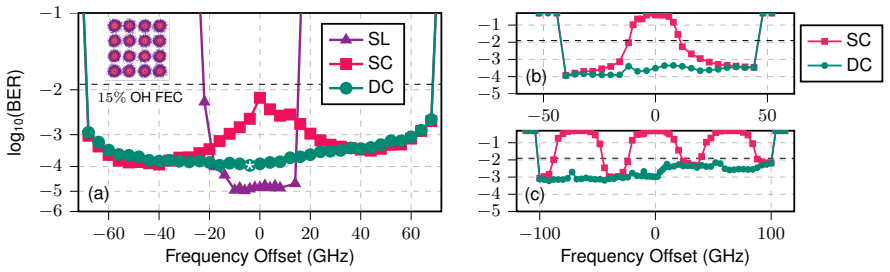
read the original abstract
We experimentally demonstrate dual-line coherent detection using an optical frequency comb local oscillator, enabling large frequency offset tolerance with minimal additional signal processing. The proposed method achieves 200 GHz offset tolerance for 400 Gbit/s signals with low penalty, supporting uncooled, low-cost coherent transceivers.
Editorial analysis
A structured set of objections, weighed in public.
Referee Report
Summary. The manuscript claims an experimental demonstration of dual-line coherent detection employing an optical frequency comb as the local oscillator. This technique is reported to achieve 200 GHz frequency offset tolerance for 400 Gbit/s signals with low penalty, thereby enabling uncooled, low-cost coherent transceivers.
Significance. If the experimental claims are substantiated with verifiable data, the work would address a practical limitation in coherent optical systems by relaxing laser frequency stability requirements, with potential impact on cost-sensitive applications.
major comments (1)
- The abstract asserts an experimental demonstration and quotes specific performance metrics (200 GHz offset tolerance, 400 Gbit/s signals, low penalty), yet the manuscript supplies no experimental setup description, DSP details, measured data, error bars, figures, or verification procedures. Without these elements the central claim cannot be evaluated.
Simulated Author's Rebuttal
We thank the referee for their review and the opportunity to respond. The major comment is addressed point-by-point below. We agree that additional details are required to substantiate the experimental claims.
read point-by-point responses
-
Referee: The abstract asserts an experimental demonstration and quotes specific performance metrics (200 GHz offset tolerance, 400 Gbit/s signals, low penalty), yet the manuscript supplies no experimental setup description, DSP details, measured data, error bars, figures, or verification procedures. Without these elements the central claim cannot be evaluated.
Authors: We acknowledge that the current manuscript version does not provide the experimental setup description, DSP details, measured data with error bars, figures, or verification procedures needed to evaluate the claims. This is a substantive omission. We will revise the manuscript to include a complete experimental setup diagram and description, details of the DSP algorithms, measured performance results (e.g., BER versus frequency offset curves with error bars), supporting figures, and the verification methodology. These additions will allow proper assessment of the 200 GHz offset tolerance for 400 Gbit/s signals. revision: yes
Circularity Check
No derivation chain or equations present; experimental claim only
full rationale
The supplied manuscript consists solely of the abstract, which reports an experimental demonstration of dual-line coherent detection with an optical frequency comb LO and states measured performance (200 GHz offset tolerance for 400 Gbit/s signals). No equations, derivations, DSP descriptions, self-citations, or load-bearing assumptions are visible. Per the skeptic note, absence of methods, results, or any mathematical steps precludes identification of any reduction to inputs by construction. This is the normal case of an experimental paper with no claimed derivation to inspect.
Axiom & Free-Parameter Ledger
axioms (1)
- domain assumption Standard properties of optical frequency combs and coherent detection hold for the described setup.
Reference graph
Works this paper leans on
-
[1]
Clustering algorithm recommendation: A meta-learning approach,
X. Zhou, R. Urata, and H. Liu, “Beyond 1 Tb/s intra-data center interconnect technology: IM-DD or coherent?”, Journal of Lightwave Technology, vol. 38, no. 2, pp. 475– 484, 2020.DOI:10.1109/JLT.2019.2956779
-
[2]
Demonstration of 100 Gbps coherent free-space optical communications at LEO tracking rates
S. M. Walsh, S. F . E. Karpathakis, A. S. McCann, B. P . Dix-Matthews, A. M. Frost, D. R. Gozzard, C. T. Grave- stock, and S. W. Schediwy, “Demonstration of 100 Gbps coherent free-space optical communications at LEO tracking rates”,Scientific Reports, vol. 12, no. 1, p. 18 345, Oct. 2022.DOI: 10 . 1038 / s41598 - 022 - 22027-0
2022
-
[3]
W. Ren, Y . Zhang, P . Hou, Y . Jiang, Z. Zhao, F . Wei, and J. Sun, “Arbitrary frequency difference locking method for carrier in intersatellite coherent laser communication”, Optics Express, vol. 33, no. 21, pp. 45 171–45 186, Oct. 2025.DOI:10.1364/OE.569319
-
[4]
Probabilistic shaping for nonlinearity tolerance
A. Shahpari, R. M. Ferreira, R. S. Luis, Z. Vujicic, F . P . Guiomar, J. D. Reis, and A. L. Teixeira, “Coherent access: A review”,Journal of Lightwave Technology, vol. 35, no. 4, pp. 1050–1058, 2017.DOI: 10.1109/JLT. 2016.2623793
work page doi:10.1109/jlt 2017
-
[5]
Simplified transceivers for short- reach coherent-lite systems
X. Y e and S. J. Savory, “Simplified transceivers for short- reach coherent-lite systems”,Journal of Lightwave Tech- nology, vol. 43, no. 13, pp. 6017–6028, 2025.DOI: 10. 1109/JLT.2025.3581121
-
[6]
Optics Express19(10), 9315–9329 (2011).https://doi.org/10.1364/OE
X. Zeng, H. Ren, M. Fu, H. Jiang, L. Yi, W. Hu, and Q. Zhuge, “Frequency-offset-tolerant optical fre- quency comb-based coherent transmission for intra- datacenter interconnections”,Optics Express, vol. 29, no. 11, pp. 17 522–17 533, May 2021.DOI: 10.1364/OE. 423293
work page doi:10.1364/oe 2021
-
[7]
M. M. H. Adib, C. Füllner, J. N. Kemal, P . Marin-Palomo, A. Ramdane, C. Koos, W. Freude, and S. Randel, “Colorless coherent TDM-PON based on a frequency- comb laser”,Journal of Lightwave Technology, vol. 40, no. 13, pp. 4287–4299, 2022.DOI: 10.1109/JLT.2022. 3164168
-
[8]
Colorless detec- tion of a 3.2-Tb/s-class WDM superchannel aiming for uncooled coherent optics
D. Che, M. Mazur, and N. K. Fontaine, “Colorless detec- tion of a 3.2-Tb/s-class WDM superchannel aiming for uncooled coherent optics”, inOptical Fiber Communica- tion Conference (OFC) 2025, Optica Publishing Group, 2025, Th1D.2.DOI:10.1364/OFC.2025.Th1D.2
-
[9]
2.4-Thz bandwidth optical coherent receiver based on a photonic crystal microcomb
C. Deakin, J. Zang, X. Chen, D. Che, L. Dallachiesa, B. Stern, N. K. Fontaine, and S. Papp, “2.4-Thz bandwidth optical coherent receiver based on a photonic crystal microcomb”, inECOC 2024; 50th European Conference on Optical Communication, 2024, pp. 766–769
2024
-
[10]
J. Lu, X. Li, S. Fu, M. Luo, M. Xiang, H. Zhou, M. Tang, and D. Liu, “Joint carrier phase and frequency- offset estimation with parallel implementation for dual- polarization coherent receiver”,Optics Express, vol. 25, no. 5, pp. 5217–5231, Mar. 2017.DOI: 10.1364/OE.25. 005217
-
[11]
Spectrally-sliced coherent receiver utilizing a gain-switched optical frequency comb
H. Othman, X. Ouyang, C. Antony, F . Smyth, and P . D. Townsend, “Spectrally-sliced coherent receiver utilizing a gain-switched optical frequency comb”,Journal of Lightwave Technology, vol. 41, no. 16, pp. 5262–5274, Aug. 2023
2023
-
[12]
Digital signal process- ing for coherent transceivers employing multilevel for- mats
M. S. Faruk and S. J. Savory, “Digital signal process- ing for coherent transceivers employing multilevel for- mats”,Journal of Lightwave Technology, vol. 35, no. 5, pp. 1125–1141, 2017.DOI: 10 . 1109 / JLT . 2017 . 2662319
2017
-
[13]
Smith, I
B. Smith, I. Lyubomirsky, and S. Bhoja,Leveraging 400G ZR FEC technology, IEEE 802.3 Beyond 10km Optical PHYs Study Group, [Online]. Available: http://www. ieee802.org/3/B10K/public/17_11/lyubomirsky_ b10k_01_1117.pdf, Orlando, FL, USA, Nov. 2017
2017
-
[14]
Performance limits in optical communications due to fiber nonlinearity
A. D. Ellis, M. E. McCarthy, M. A. Z. A. Khateeb, M. Sorokina, and N. J. Doran, “Performance limits in optical communications due to fiber nonlinearity”,Advances in Optics and Photonics, vol. 9, no. 3, pp. 429–503, Sep. 2017.DOI:10.1364/AOP.9.000429
discussion (0)
Sign in with ORCID, Apple, or X to comment. Anyone can read and Pith papers without signing in.