REVIEW 3 major objections 2 minor 24 references
Observing the Peculiar Acceleration of our Solar System with Quasar Proper Motions
T0 review · 3 major / 2 minor · reviewed 2026-06-30 · grok-4.3
Pith's one-line read Quasar proper motions reveal Solar System acceleration at 5.72 μas per year, with uncertainties 1.5-2.5 times larger after accounting for higher multipoles.
desk verdict The paper widens the error bars on the Solar System acceleration dipole by marginalizing higher multipoles with SBI, but the cross-correlation checks for systematics look incomplete. read the letter →
The pith
A machine-rendered reading of the paper's core claim, the machinery that carries it, and where it could break.
The reading
What carries the argument
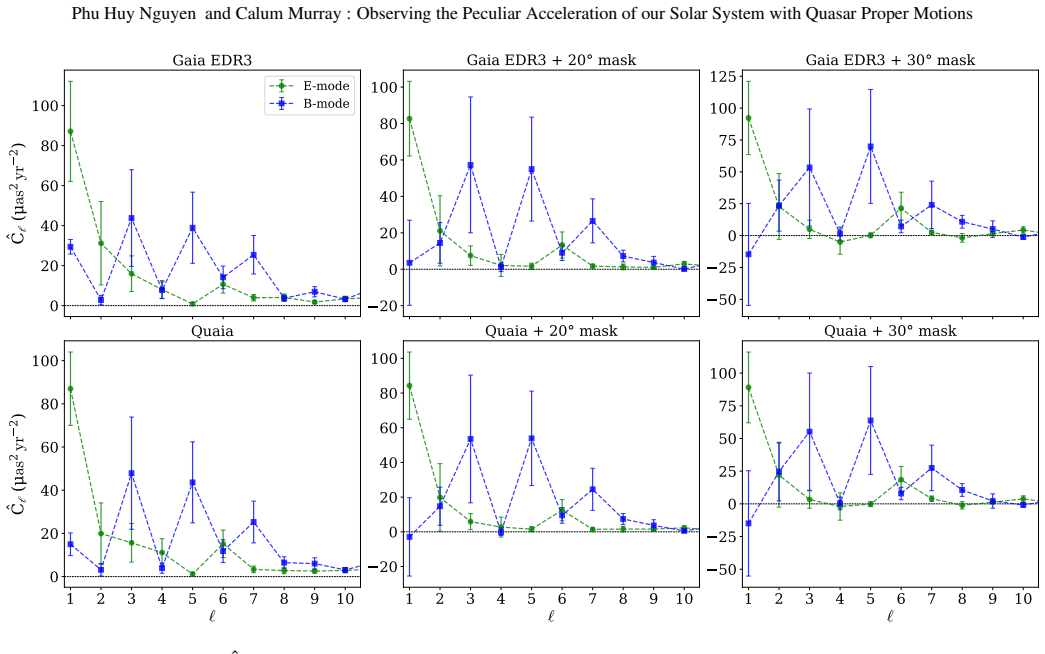
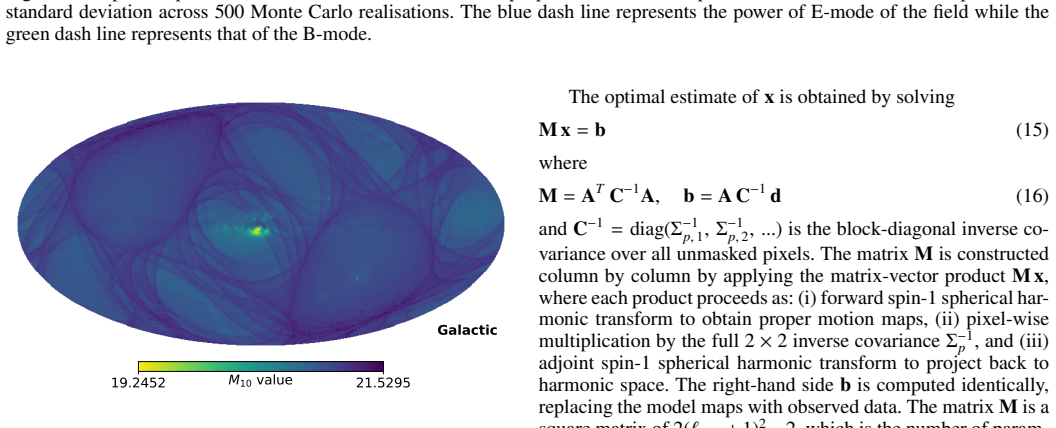
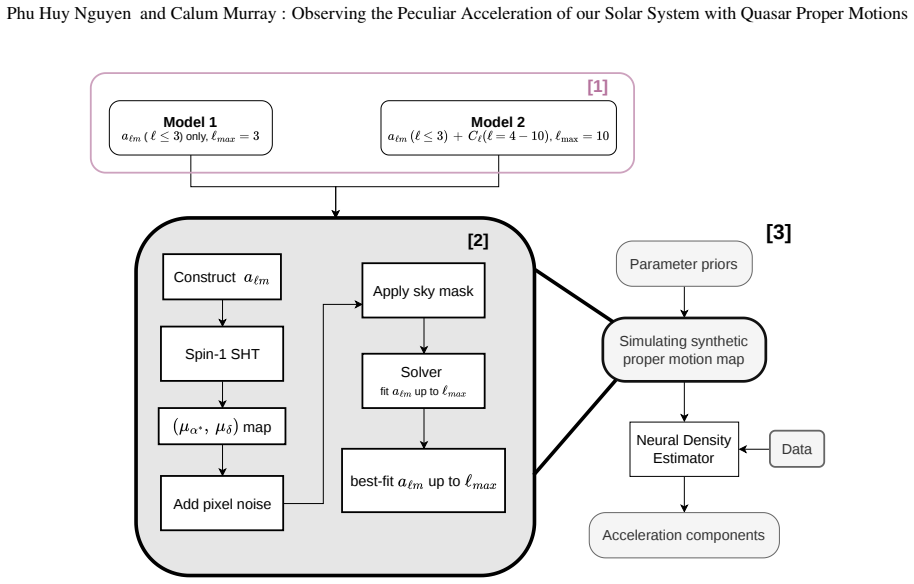
The pseudo-C_ℓ formalism paired with simulation-based inference that jointly constrains the dipole and higher multipole power in the proper motion field while using cross-correlations to diagnose systematics.
What would settle it
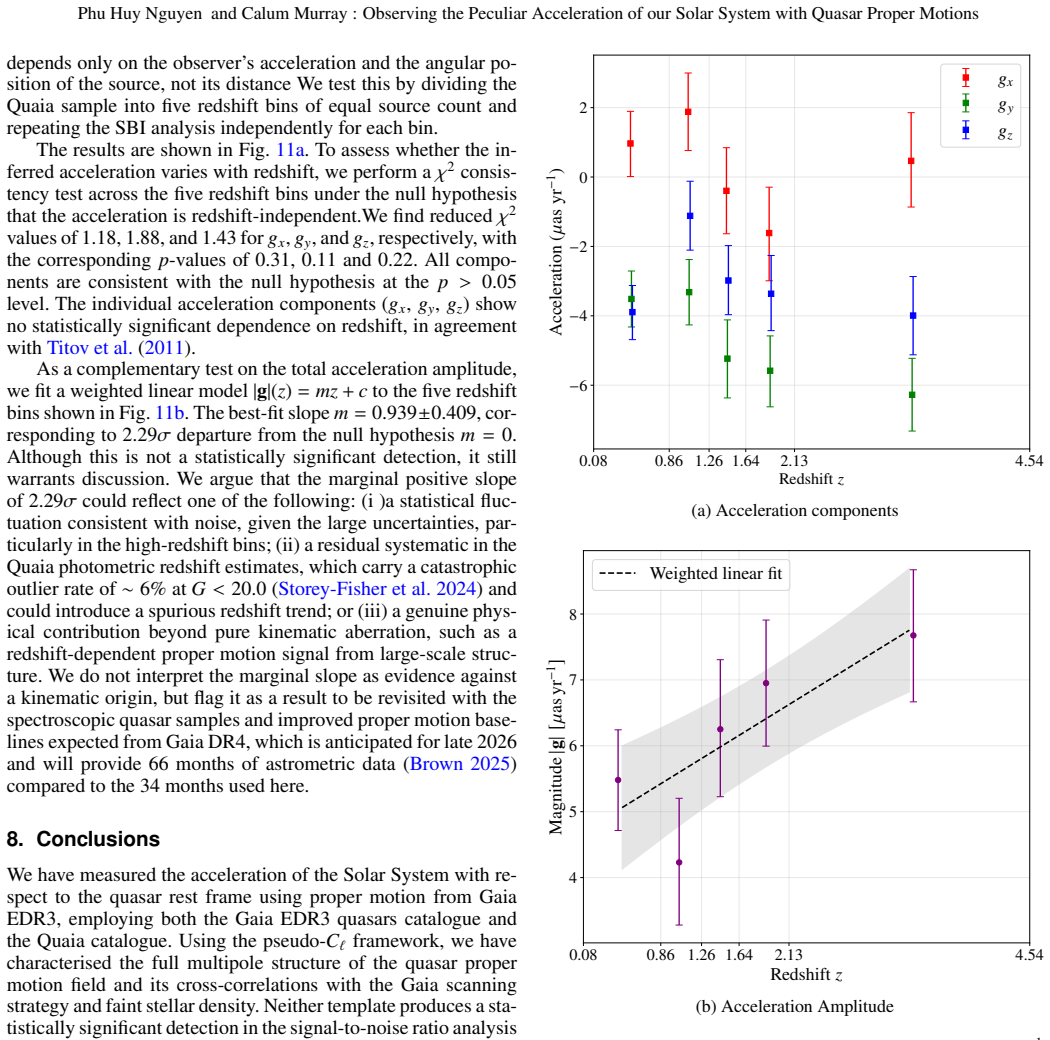
Detection of statistically significant redshift dependence in the measured acceleration amplitude or a result inconsistent with independent determinations of Solar System motion relative to the cosmic microwave background.
Extended reading notes
Core claim
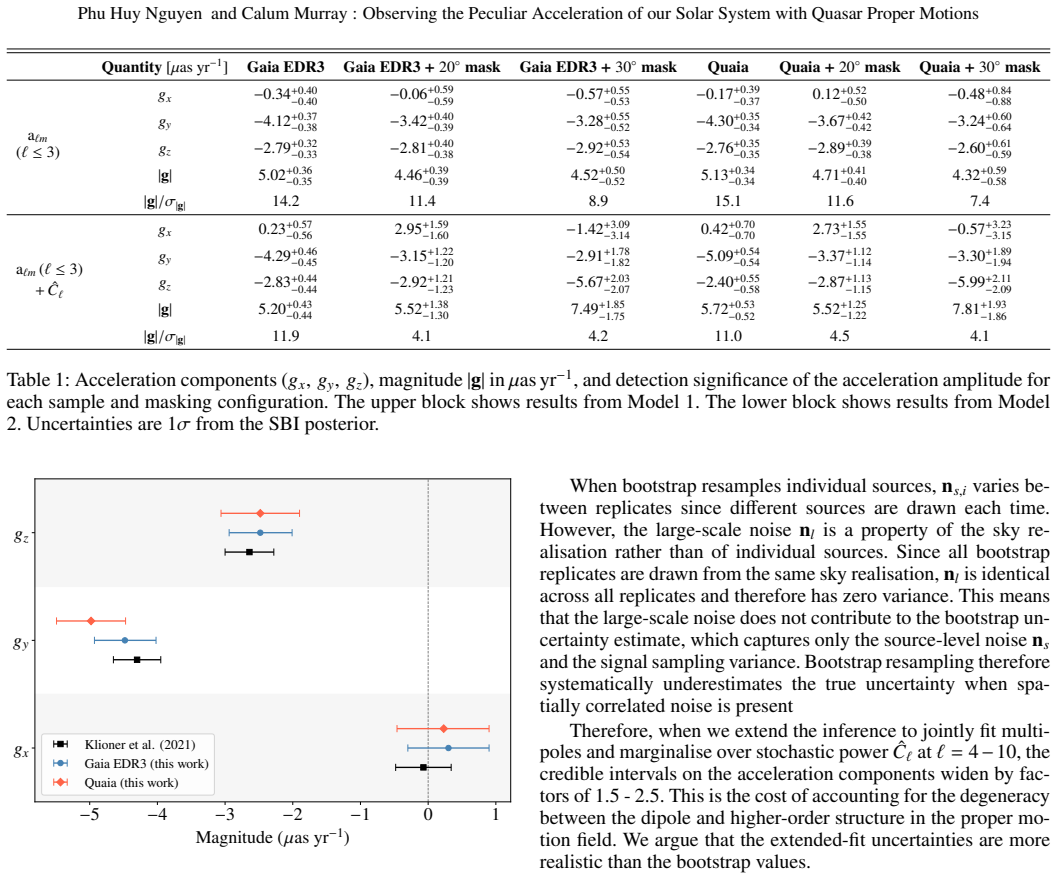
The acceleration of the Solar System is (0.40^{+0.70}_{-0.70}, -5.09^{+0.54}_{-0.54}, -2.40^{+0.55}_{-0.58}) μas yr^{-1} with amplitude 5.72 μas yr^{-1} from the Quaia catalogue. This value is consistent with prior determinations, yet the credible intervals widen by factors of 1.5 to 2.5 once higher-multipole degeneracies are marginalised, indicating earlier uncertainty estimates were optimistic. The signal exhibits no significant redshift dependence, supporting its kinematic origin.
Load-bearing premise
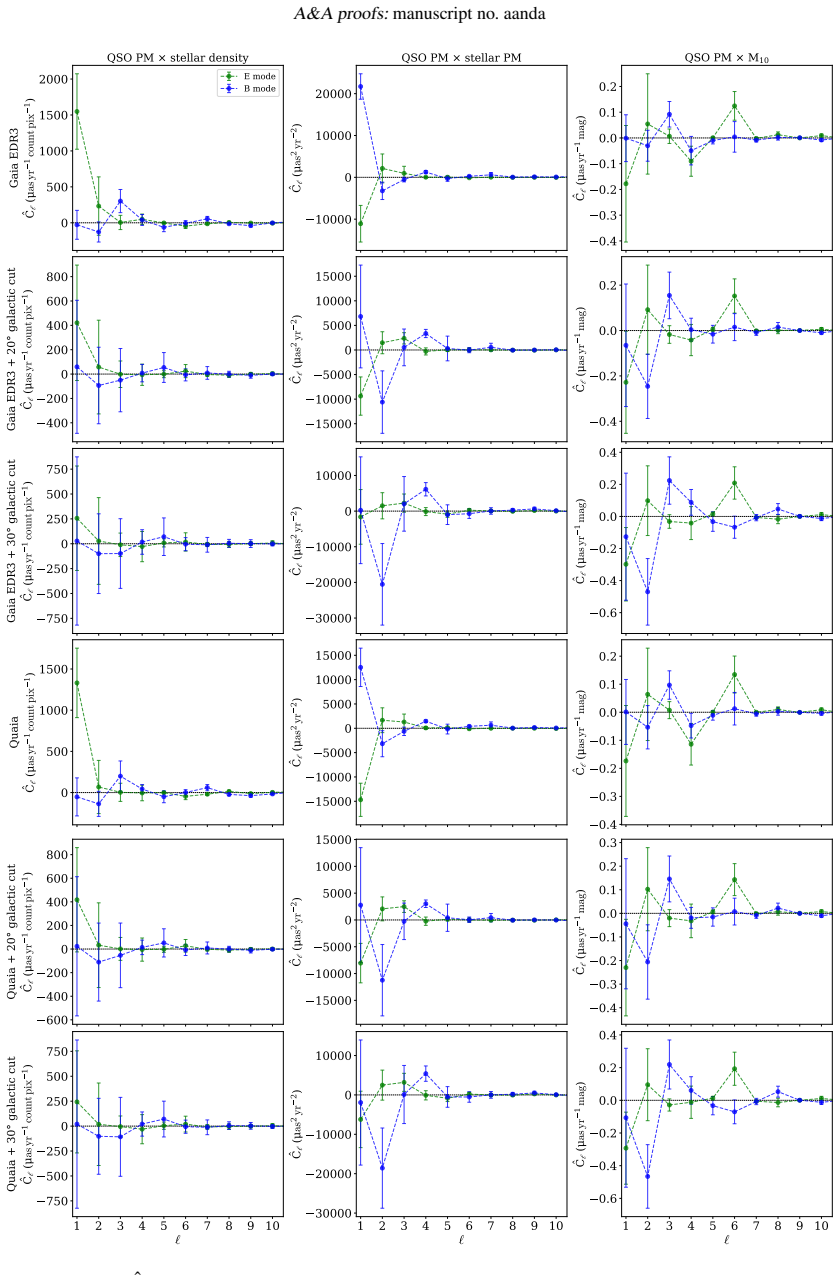
Cross-correlations with Gaia scanning strategy, stellar density, and stellar proper motion maps suffice to identify and remove non-kinematic contributions to higher multipoles that could bias the dipole.
Editorial extensions
If this is right
- Earlier published uncertainties on the Solar System acceleration were optimistic by factors of 1.5-2.5.
- The absence of redshift dependence strengthens the case that the dipole is kinematic rather than systematic.
- Joint modelling of dipole and higher multipoles is required for unbiased dipole inference in future astrometric catalogues.
- The framework can be reapplied to larger or deeper quasar samples to tighten the acceleration constraints.
Reading between the lines
- Similar higher-multipole marginalisation may be needed in other large-scale astrometric dipole studies to avoid underestimating errors.
- The widened intervals could shift how this acceleration measurement is combined with galactic dynamics or local group motion models.
- If non-kinematic residuals remain after the cross-correlation tests, they would most likely appear as excess power at specific multipoles tied to the scanning law.
Signed reviews
Editorial analysis
A structured set of objections, weighed in public.
Referee Report
Summary. The paper measures the Solar System's acceleration vector via the dipole in quasar proper motions using Gaia EDR3 and Quaia catalogues. It characterizes the full angular power spectrum with the pseudo-C_ℓ estimator and uses simulation-based inference (SBI) to jointly constrain the dipole (g_x, g_y, g_z) and higher multipoles, applying cross-correlations with Gaia scanning strategy, stellar density, and stellar proper-motion maps to diagnose systematics. The inferred acceleration is consistent with prior results but with credible intervals widened by factors of 1.5–2.5; the best estimate from Quaia is (0.40^{+0.70}_{-0.70}, -5.09^{+0.54}_{-0.54}, -2.40^{+0.55}_{-0.58}) μas yr^{-1} (amplitude 5.72 μas yr^{-1}), with no significant redshift dependence, supporting a kinematic origin.
Significance. If the systematic control holds, the result provides a more conservative and robust determination of the acceleration by properly marginalizing higher-multipole degeneracies that previous analyses appear to have neglected, yielding wider but more reliable uncertainties. The absence of redshift dependence adds supporting evidence for the kinematic interpretation. The use of SBI for joint inference and explicit cross-correlation diagnostics are methodological strengths that could be adopted more broadly in astrometric dipole studies.
major comments (3)
- [Abstract, framework description] Abstract and framework description: the assertion that cross-correlations with the Gaia scanning law, stellar density, and stellar proper-motion maps are sufficient to diagnose and remove all non-kinematic contributions to higher multipoles is load-bearing for the central claim of a clean kinematic dipole. No quantitative completeness test (e.g., power-spectrum residuals after subtraction, null tests on injected systematics, or recovery fractions for simulated non-kinematic modes) is described, leaving open the possibility that residual power couples into the dipole even after SBI marginalization.
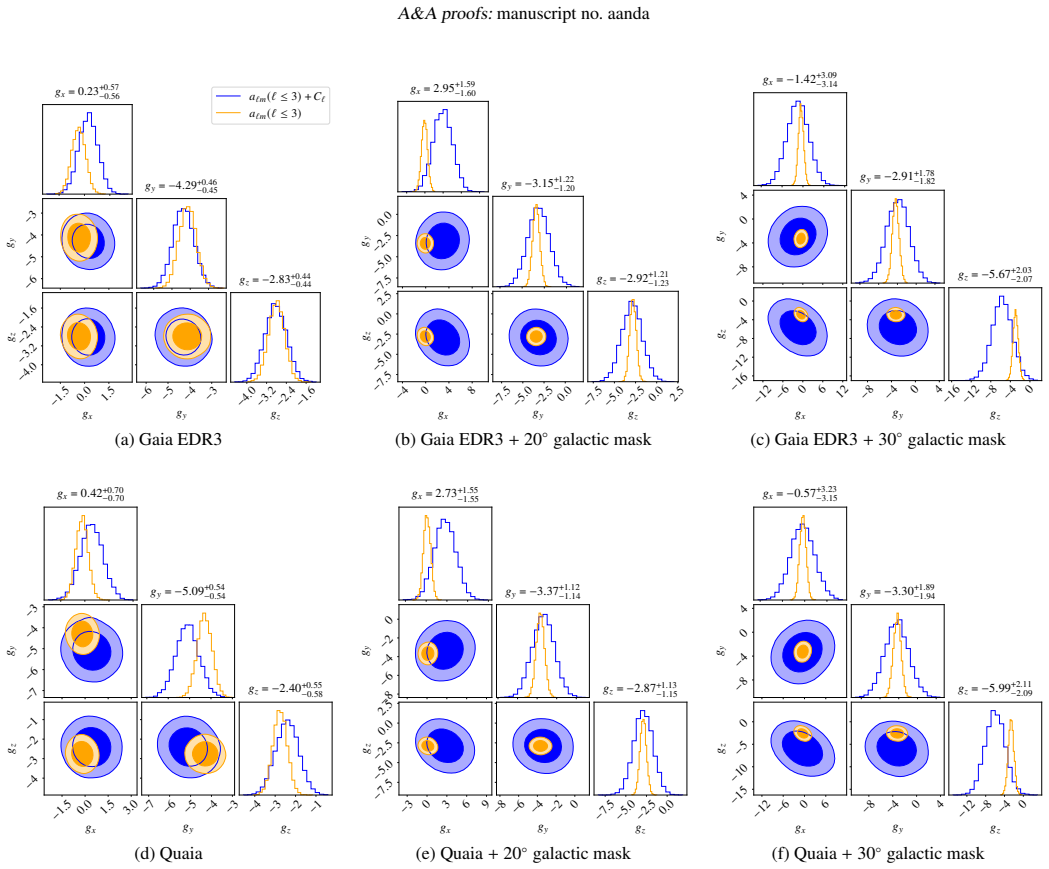
- [Results] Results section (Quaia best estimate): the reported credible intervals already incorporate higher-multipole marginalization, but without an explicit comparison table or figure showing the dipole posterior with versus without the higher-multipole model (or with versus without the cross-correlation cleaning step), it is difficult to quantify how much of the factor 1.5–2.5 widening is due to each component.
- [Methods] Methods (pseudo-C_ℓ + SBI): the pseudo-C_ℓ estimator and SBI prior must be shown to be insensitive to any unmodeled redshift-dependent selection or colour-dependent astrometric systematics that could survive the stellar-map cross-correlations; a dedicated injection-recovery test on the full pipeline would directly address this.
minor comments (2)
- [Abstract] Notation: the amplitude is quoted as 5.72_{-0.52}^{+0.53} while the vector components use asymmetric errors; a brief statement on how the amplitude posterior is derived from the vector components would improve clarity.
- [Figures] Figure clarity: the cross-correlation maps and power spectra should include explicit labels for which multipole ranges are used in the SBI fit versus those used only for diagnostics.
Simulated Author's Rebuttal
We thank the referee for their careful reading and constructive comments. We address each major comment below and describe the revisions we will implement.
read point-by-point responses
-
Referee: [Abstract, framework description] Abstract and framework description: the assertion that cross-correlations with the Gaia scanning law, stellar density, and stellar proper-motion maps are sufficient to diagnose and remove all non-kinematic contributions to higher multipoles is load-bearing for the central claim of a clean kinematic dipole. No quantitative completeness test (e.g., power-spectrum residuals after subtraction, null tests on injected systematics, or recovery fractions for simulated non-kinematic modes) is described, leaving open the possibility that residual power couples into the dipole even after SBI marginalization.
Authors: We agree that quantitative validation strengthens the central claim. We will add a new subsection to the Methods describing power-spectrum residuals after modeled subtraction and injection-recovery tests using simulated non-kinematic modes. These tests will quantify residual coupling into the dipole after SBI marginalization and support the diagnostic power of the cross-correlations. revision: yes
-
Referee: [Results] Results section (Quaia best estimate): the reported credible intervals already incorporate higher-multipole marginalization, but without an explicit comparison table or figure showing the dipole posterior with versus without the higher-multipole model (or with versus without the cross-correlation cleaning step), it is difficult to quantify how much of the factor 1.5–2.5 widening is due to each component.
Authors: We will add a new figure to the Results section comparing the dipole posterior under four cases: full model, without higher-multipole marginalization, without cross-correlation cleaning, and without both. This will explicitly quantify the contribution of each element to the reported widening of the credible intervals. revision: yes
-
Referee: [Methods] Methods (pseudo-C_ℓ + SBI): the pseudo-C_ℓ estimator and SBI prior must be shown to be insensitive to any unmodeled redshift-dependent selection or colour-dependent astrometric systematics that could survive the stellar-map cross-correlations; a dedicated injection-recovery test on the full pipeline would directly address this.
Authors: We will add a dedicated injection-recovery test to the Methods section. Mock catalogues will be generated with injected redshift-dependent selection and colour-dependent astrometric systematics, processed through the full pseudo-C_ℓ + SBI pipeline, and the recovered dipole parameters examined for bias after cross-correlation cleaning. revision: yes
Circularity Check
No significant circularity; result is data-driven measurement from external catalogs
full rationale
The paper applies the pseudo-C_ℓ formalism and simulation-based inference to external Gaia EDR3 and Quaia quasar proper-motion catalogs to infer the solar acceleration dipole while marginalizing higher multipoles. Cross-correlations with scanning strategy and stellar maps are used only for diagnosis, not as a self-referential fit. The central claim (widened but consistent dipole with no redshift dependence) is a direct statistical output from the data and simulations; no equation reduces a prediction to a fitted input by construction, no load-bearing self-citation chain is invoked, and no ansatz or uniqueness theorem is smuggled in. The derivation remains self-contained against external benchmarks.
Assumptions & free parameters
free parameters (1)
- acceleration vector components (g_x, g_y, g_z)
assumptions (1)
- domain assumption Quasars define an inertial rest frame with negligible intrinsic proper motions on the relevant timescales
Cite this review
Pith. "Pith review of Observing the Peculiar Acceleration of our Solar System with Quasar Proper Motions." pith.science (2026). https://pith.science/paper/NPPXYEWO
@misc{pith2026260530367,
  author       = {Pith},
  title        = {Pith review of: Observing the Peculiar Acceleration of our Solar System with Quasar Proper Motions},
  year         = {2026},
  howpublished = {\url{https://pith.science/paper/NPPXYEWO}},
  note         = {Machine review of arXiv:2605.30367}
}
abstract
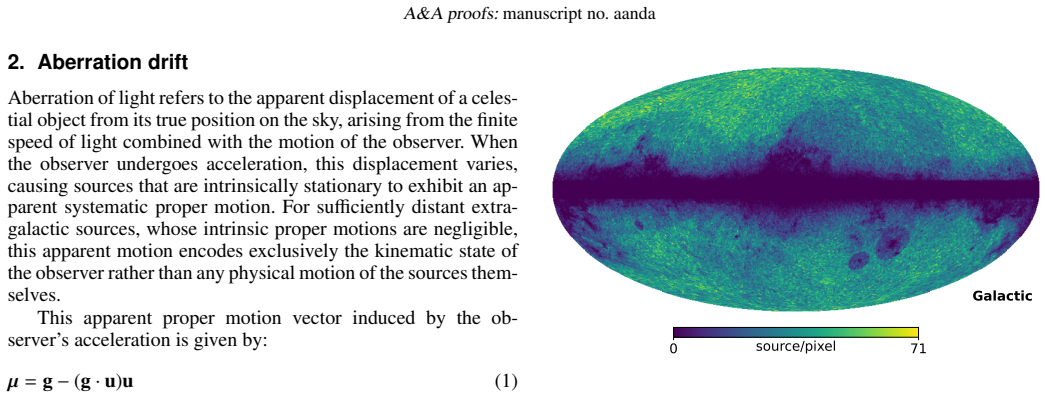
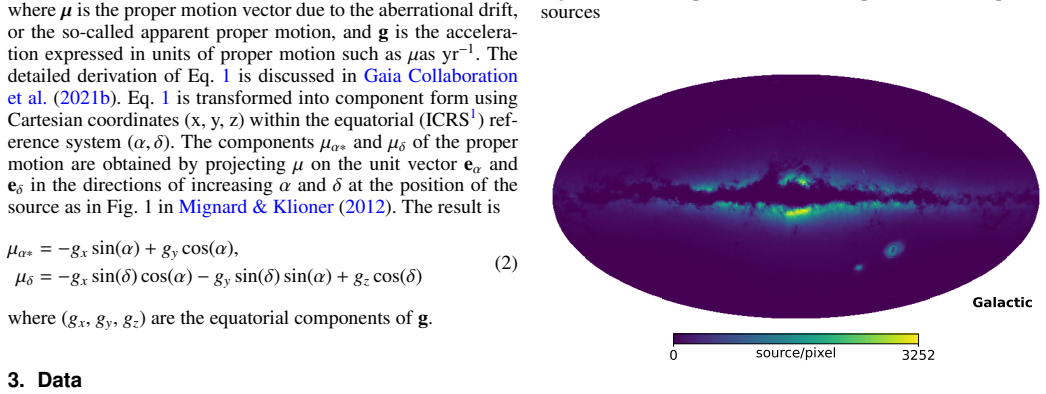
We measure the proper motion dipole of quasars observed by Gaia to determine the acceleration of the Solar System with respect to the quasar rest frame. We characterise the full angular power spectrum of the proper motion field using the pseudo-$C_\ell$ formalism and employ simulation-based inference to jointly constrain the dipole and higher multipole power. Cross-correlation with the Gaia scanning strategy, stellar density, and stellar proper motion maps is used to diagnose the origin of systematic power beyond the dipole. We apply this framework to both the Gaia EDR3 quasar catalogue and the Quaia catalogue. The inferred acceleration is consistent with the previous determination, but the credible intervals widen by factors of 1.5 to 2.5 when higher-multipole degeneracies are properly marginalised, indicating that previous uncertainty estimates were optimistic. Our best estimate, based on the Quaia catalogue is $(g_x,\, g_y, \,g_z) =( 0.40^{+0.70}_{-0.70},\,-5.09^{+0.54}_{-0.54},\,-2.40^{+0.55}_{-0.58}) \;\mu as \,yr^{-1}$, corresponding to an amplitude of $5.72_{-0.52}^{+0.53}\,\rm \mu as\,yr^{-1}$. The acceleration shows no significant dependence on source redshift, providing further evidence for its kinematic origin.
Figures
Figures from the paper (8 more)
Reference graph
Works this paper leans on
-
[1]
2019, Monthly Notices of the Royal Astro- nomical Society, 484, 4127–4151
Alonso, D., Sanchez, J., & Slosar, A. 2019, Monthly Notices of the Royal Astro- nomical Society, 484, 4127–4151
work page 2019
-
[2]
Book, L. G. & Flanagan, É. É. 2011, Phys. Rev. D, 83, 024024
work page 2011
- [3]
- [4]
-
[5]
Cantat-Gaudin, T., Fouesneau, M., Rix, H.-W., et al. 2023, A&A, 669, A55
work page 2023
- [6]
- [7]
-
[8]
2021, A&A, 649, A5 Gaia Collaboration, Brown, A
Fabricius, C., Luri, X., Arenou, F., et al. 2021, A&A, 649, A5 Gaia Collaboration, Brown, A. G. A., Vallenari, A., et al. 2021a, A&A, 649, A1 Gaia Collaboration, Klioner, S. A., Lindegren, L., et al. 2022, A&A, 667, A148 Gaia Collaboration, Klioner, S. A., Mignard, F., et al. 2021b, A&A, 649, A9 Gaia Collaboration, Prusti, T., de Bruijne, J. H. J., et al....
work page 2021
Show all 24 references
-
[9]
2019, MNRAS, 486, 145
Hall, A. 2019, MNRAS, 486, 145
2019
-
[10]
M., Netterfield, C
Hivon, E., Górski, K. M., Netterfield, C. B., et al. 2002, ApJ, 567, 2
2002
-
[11]
Hunter, J. D. 2007, Computing in Science and Engineering, 9, 90
2007
-
[12]
2023, MNRAS, 524, 3609
Jaraba, S., García-Bellido, J., Kuroyanagi, S., Ferraiuolo, S., & Braglia, M. 2023, MNRAS, 524, 3609
2023
-
[13]
A., Hernández, J., et al
Lindegren, L., Klioner, S. A., Hernández, J., et al. 2021, A&A, 649, A2
2021
-
[14]
W., Higley, A
Lyke, B. W., Higley, A. N., McLane, J. N., et al. 2020, ApJS, 250, 8
2020
-
[15]
M., Lang, D., Schlafly, E
Meisner, A. M., Lang, D., Schlafly, E. F., & Schlegel, D. J. 2019, Publications of the Astronomical Society of the Pacific, 131, 124504
2019
-
[16]
& Klioner, S
Mignard, F. & Klioner, S. 2012, A&A, 547, A59
2012
-
[17]
2026, arXiv e-prints, arXiv:2602.01911
Payerne, C., Murray, C., & Simon, H. 2026, arXiv e-prints, arXiv:2602.01911
2026 arXiv
-
[18]
W., Rix, H.-W., et al
Storey-Fisher, K., Hogg, D. W., Rix, H.-W., et al. 2024, The Astrophysical Jour- nal, 964, 69
2024
-
[19]
2020, Journal of Open Source Software, 5, 2505
Tejero-Cantero, A., Boelts, J., Deistler, M., et al. 2020, Journal of Open Source Software, 5, 2505
2020
-
[20]
B., & Gontier, A.-M
Titov, O., Lambert, S. B., & Gontier, A.-M. 2011, A&A, 529, A91 Van Der Walt, S., Colbert, S. C., & Varoquaux, G. 2011, Computing in Science and Engineering, 13, 22
2011
-
[21]
E., et al
Virtanen, P., Gommers, R., Oliphant, T. E., et al. 2020, Nature Medicine, 17, 261
2020
-
[22]
L., Eisenhardt, P
Wright, E. L., Eisenhardt, P. R. M., Mainzer, A. K., et al. 2010, AJ, 140, 1868
2010
-
[23]
P., Koposov, S
Yao, Y ., Ji, A. P., Koposov, S. E., & Limberg, G. 2024, MNRAS, 527, 10937
2024
-
[24]
Zonca, A., Singer, L., Lenz, D., et al. 2019, Journal of Open Source Software, 4, 1298 Article number, page 12 of 18 Phu Huy Nguyen and Calum Murray : Observing the Peculiar Acceleration of our Solar System with Quasar Proper Motions Appendix A: Signal-to-noise ratio of the an...
2019
Reviewed June 30, 2026 · model on record in the stance chip above.
Discussion (0). Continue with ORCID to comment.