REVIEW 4 major objections 6 minor 110 references
MusicScaffold: Bridging Machine Efficiency and Human Growth in Adolescent Creative Education through Generative AI
T0 review · 4 major / 6 minor · reviewed 2026-08-04 · deepseek-v4-flash
Pith's one-line read MusicScaffold, an AI framework that explains musical attributes and supports iterative refinement, produced greater gains in adolescents' expressive specificity, self-regulation, and confidence than direct generation or attribute sliders in
desk verdict A promising scaffold design for adolescent music creation, but the cognitive-growth claim is weakened by outcome measures the system itself may generate; needs a transfer test before it supports the abstract's headline. read the letter →
The pith
A machine-rendered reading of the paper's core claim, the machinery that carries it, and where it could break.
The reading
What carries the argument
The load-bearing mechanism is the symbolic prompt explanation loop: a large language model maps a vague natural-language input u to a structured attribute set v = M_LLM(u) of musical elements (mood, key, tempo, timbre), each paired with a short 'why' explanation; a music prompt sketching stage aligns and refines these attributes into an editable MIDI-like symbolic prompt s; and a large music model renders the final audio o. Because the student can revisit any stage, the system surfaces the mapping between emotion and musical structure as a visible, manipulable object—this transparency is what carries the growth claim.
What would settle it
A transfer condition in which, after the four-week program, all students write a music description in a plain text box with no scaffolding: if the MusicScaffold group's prompts are no more specific or multi-dimensional than the controls', the central growth claim fails.
Extended reading notes
Core claim
The central claim is that scaffolding, not generation, is what makes generative AI educationally valuable for adolescents. MusicScaffold's closed-loop interaction—structure-oriented intent interpretation, music prompt sketching, and complete music generation with reflective feedback—shifted students from vague, single-dimensional prompts to precise, multi-dimensional ones; from blind regeneration to deliberate prompt modification; and from low self-efficacy to confident, voluntary participation. The paper reports these gains as statistically significant relative to two control conditions, and interprets them as evidence that AI can act as a guide, coach, and partner in creative learning.
Load-bearing premise
The growth claim assumes that the measured improvements in prompt specificity and element coverage reflect the students' own acquired expressive skill, rather than the system's readily visible attribute set that students accept or copy.
Editorial extensions
If this is right
- Generative AI tools for education should expose and make editable their intermediate reasoning steps rather than jumping from prompt to output.
- Adolescents can acquire transferable expressive strategies—such as linking staccato to liveliness or minor key to sadness—through structured AI explanations in a matter of weeks.
- Attribute sliders alone are insufficient: structured options without explanation produced little improvement over free-form generation, suggesting explanation, not just structure, drives the effect.
- The guide-coach-partner role set offers a template for designing AI creativity partners in domains with stable mappings between intent and formal structure.
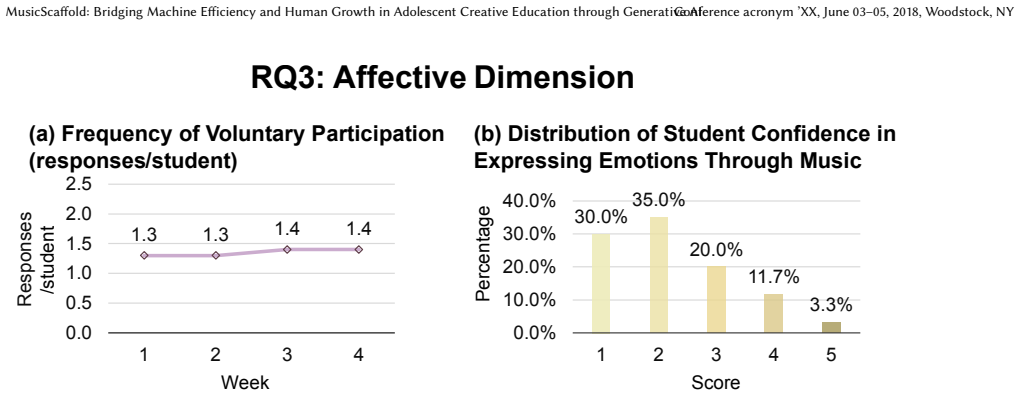
- Voluntary after-class participation more than doubled over four weeks for the scaffolded group, indicating that intrinsic motivation can be cultivated by interface design.
Reading between the lines
- A transfer test is the obvious next step: if the gains are internalized, scaffolded students should write more specific, multi-dimensional prompts in a blank interface or a new tool after the study; the current design does not demonstrate this.
- The pedagogy is only as good as the LLM's explanations; inaccurate or overly complex rationales could turn the scaffold into a script-following exercise rather than understanding.
- Music may be an easy testbed because emotion-to-structure mappings are fairly standard; visual art or open-ended writing may require different scaffolding and may show weaker or different effects.
- The Week-4 homogeneity difference may partly reflect novelty or social dynamics in the classroom; a longer or cross-classroom study would clarify whether the behavioral change is durable.
Editorial analysis
A structured set of objections, weighed in public.
Referee Report
Summary. The paper presents MusicScaffold, an AI-based music creation framework for adolescents that maps free-text descriptions to structured musical attributes with explanations, supports iterative refinement, and then generates audio. The authors report an exploratory study (N=60) showing that commercial prompt-to-music tools leave adolescents at low levels of prompt specificity, element coverage, strategic adjustment, and self-efficacy. They then report a four-week comparative study (N=270, nine classes, three conditions) in which the MusicScaffold group outperformed direct-generation and attribute-slider controls on prompt specificity and coverage, prompt modifications, homogeneity reduction, after-class participation, and self-efficacy. These results are interpreted as evidence that scaffolding-based generative AI can foster cognitive, behavioral, and affective growth rather than only output efficiency.
Significance. If the causal claims were secure, this would be a valuable contribution to HCI and creativity-support research: it articulates a clear design framework, grounds it in educational theory, and tests it with a large adolescent sample (330 students total across two studies). The mixed-methods design, the detailed system description, and the explicit operationalization of theory into interface mechanisms are strengths. The central empirical claim, however, currently rests on outcome measures that are partly confounded with the intervention itself, and the statistical analysis ignores the cluster-randomized design. With additional transfer measures or a re-scoping of the claims, the work could become a solid contribution; as presented, the evidence does not yet support the abstract's unqualified growth claims.
major comments (4)
- [Section 5.2.1, Eq. (1), Fig. 8] The RQ1 dependent variables—prompt specificity and element coverage—are confounded with the intervention. The paper never states whether the rated 'prompts' are the students' original free-text input u, the LLM-generated attribute set v = M_LLM(u), or the final attribute set after student edits. Because Group C's interface surfaces v with explanations (Sections 4.2–4.3), the large advantage (mean 3.00 vs 1.53/1.80 for specificity; 2.88 vs 1.47/1.84 for coverage) may partly measure the language model's output rather than the student's internalized expressive skill. No unassisted prompt-writing or transfer task is reported. Section 6.3 lists limitations but does not acknowledge this missing measure. Without it, the abstract's 'enhanced cognitive specificity' claim does not follow.
- [Section 5.1.1 / 5.1.3] Randomization was performed at the class level: nine parallel classes were assigned to three conditions, yielding 90 students per group. However, all statistical tests treat the 270 students as independent units, ignoring within-class correlation and leaving condition effects potentially confounded with class-level differences (e.g., teacher, time of day). A multilevel model or cluster-robust inference is needed. As reported, the p-values across RQ1–RQ3 are likely anticonservative, and the headline comparisons may not reflect the true effective sample size.
- [Sections 5.2.2–5.2.3] The teacher-rated homogeneity (Week 4 chi-square, p=.03) and the teacher-rated prompt specificity (Fig. 8) appear to be non-blinded: the teacher knew which class used which tool. Expectancy effects could inflate the differences between Group C and the controls. Similarly, self-efficacy is a self-report measure collected in a non-blind setting. The paper should report whether the teacher was blind to condition during rating, and ideally use independent raters who are blind to condition. At minimum, this limitation must be acknowledged and discussed.
- [Section 5.2.2 / Fig. 9] The RQ2 behavioral measure 'prompt modifications' is directly enabled by the MusicScaffold interface: Group C's design explicitly provides editable attributes and symbolic prompt previews, while the control conditions do not offer a comparable 'modify prompt' affordance. The large difference in modification rates (51.1% vs 2.2%/1.1%) is therefore partly a design confound, not necessarily evidence of internalized self-regulation. To support the behavioral-growth claim, the paper needs either a control condition with equivalent editing affordances or a transfer/post-test measure showing that students carry the strategy forward without the scaffold.
minor comments (6)
- [Section 1 (Fig. 1)] The reference to Figure 1 appears as 'Fig. ??' — an unresolved cross-reference that must be fixed.
- [Section 3.4.3] The text mentions a 'voluntary campus life themed competition,' but Section 3.2.2 only describes an after-class activity of listening to peers' outputs and guessing prompts. This inconsistency should be clarified.
- [Section 5.2.1] The Kruskal–Wallis statistics appear transposed: the text reports specificity H(2)=65.71 and coverage H(2)=91.50, whereas the preceding chi-square values are χ²=91.50 and χ²=96.31, respectively. Please correct the reporting.
- [Section 5.2.2] The text states Control Group A relied on non-strategic regeneration at 76.7%, but Figure 9(a) shows 72.2%. The numbers should be reconciled.
- [Section 4.3, Eq. (2)] The notation D_i[x_j] in Eq. (2) is undefined. Please clarify how a candidate symbolic segment stores attribute values so that the indicator function is well-defined.
- [Template / front matter] The ACM reference format still contains '2018,' 'Conference acronym ’XX,' and received/revised dates from 2007/2009. These template artifacts must be updated for the final version.
Circularity Check
RQ1's cognitive-specificity result is built into MusicScaffold: the rated 'prompts' in Group C are the system's own M_LLM attribute output, so the main cognitive claim is partly a restatement of the tool's design.
-
self definitional
[Section 5.2.1 (RQ1 results, Fig. 8); cf. Section 4.3 Eq. (1)]
"In contrast, Experimental Group C (MusicScaffold framework) exhibited a striking shift: only 31.1% of inputs were Level 1 and Level 2, while 38.9% reached Level 3, 21.1% Level 4, and 8.9% Level 5. The average score for Group C (3.00) was nearly double that of Group A (1.53) and Group B (1.80)."
RQ1's dependent variable, prompt specificity, is defined (Sec. 3.3) as students' ability to translate vague ideas into structured musical descriptions. But in Group C the pipeline itself performs that translation: Eq. (1) maps a vague input u to a structured attribute set v = M_LLM(u) = {(x_i, α_i)}, and Sec. 4.3 states these attributes are 'surfaced in the attribute view with explanations.' The paper never reports rating the student's original free-text input separately from the system-generated attribute set (or attributes after student edits). Thus Group C's higher specificity and element-coverage scores partly measure the scaffold's own LLM output, not the student's internalized expressive skill. The cognitive-growth conclusion is therefore not separable from the tool's visible behavio
full rationale
The central cognitive claim in the abstract and Section 5.2.1 is that MusicScaffold 'enhanced cognitive specificity.' However, the specificity and element-coverage metrics used for Group C are structurally confounded with the intervention: Eq. (1) makes the system's LLM convert a vague natural-language input into a structured attribute set that is then shown in the interface as the editable prompt. If the teacher-rated 'prompts' are these system-generated attributes, then high specificity is a design property of the tool, not evidence of student growth. The paper supplies no unassisted prompt-writing test or transfer task, and Section 6.3, while listing limitations, does not acknowledge this missing construct-validity check. Behavioral (RQ2) and affective (RQ3) outcomes—modification counts, reduced homogeneity, self-efficacy, voluntary participation—are less affected by this circularity because they are measured on student actions and self-reports rather than on the system's generated attribute text. There are no load-bearing self-citations or imported uniqueness theorems; the circularity is concentrated in the RQ1 measurement chain. For that reason the overall score is 6: the paper's headline cognitive result partially reduces to the scaffold's own attribute-generation behavior, but not every claimed contribution is circular.
Assumptions & free parameters
free parameters (1)
- Attribute weight w_j in text-symbolic alignment =
Not reported; hand-chosen per attribute
assumptions (4)
- domain assumption Teacher ratings of prompt specificity, element coverage, and homogeneity are reliable and unbiased.
- domain assumption Student-level statistical inference is valid despite class-level random assignment.
- ad hoc to paper The prompt-based measures capture learned expressive competence rather than momentary interface affordances.
- domain assumption Anonymized self-report and voluntary participation reflect intrinsic motivation and self-efficacy.
Cite this review
Pith. "Pith review of MusicScaffold: Bridging Machine Efficiency and Human Growth in Adolescent Creative Education through Generative AI." pith.science (2026). https://pith.science/paper/NPQDJMOK
@misc{pith2026250910327,
  author       = {Pith},
  title        = {Pith review of: MusicScaffold: Bridging Machine Efficiency and Human Growth in Adolescent Creative Education through Generative AI},
  year         = {2026},
  howpublished = {\url{https://pith.science/paper/NPQDJMOK}},
  note         = {Machine review of arXiv:2509.10327}
}
read the original abstract
Adolescence is marked by strong creative impulses but limited strategies for structured expression, often leading to frustration or disengagement. While generative AI lowers technical barriers and delivers efficient outputs, its role in fostering adolescents' expressive growth has been overlooked. We propose MusicScaffold, the first adolescent-centered framework that repositions AI as a guide, coach, and partner, making expressive strategies transparent and learnable, and supporting autonomy. In a four-week study with middle school students (ages 12--14), MusicScaffold enhanced cognitive specificity, behavioral self-regulation, and affective confidence in music creation. By reframing generative AI as a scaffold rather than a generator, this work bridges the machine efficiency of generative systems with human growth in adolescent creative education.
Figures


Figures from the paper (7 more)


Reference graph
Works this paper leans on
-
[1]
Andrea Agostinelli, Timo I Denk, Zalán Borsos, Jesse Engel, Mauro Verzetti, An- toine Caillon, Qingqing Huang, Aren Jansen, Adam Roberts, Marco Tagliasacchi, et al. 2023. Musiclm: Generating music from text.arXiv preprint arXiv:2301.11325 (2023)
arXiv 2023
-
[2]
Sayed Fayaz Ahmad, Heesup Han, Muhammad Mansoor Alam, Mohd Rehmat, Muhammad Irshad, Marcelo Arraño-Muñoz, Antonio Ariza-Montes, et al. 2023. Impact of artificial intelligence on human loss in decision making, laziness and safety in education.Humanities and Social Sciences Communications10, 1 (2023), 1–14
2023
-
[3]
Even Though I Went Through Everything, I Didn’t Feel Like I Learned a Lot
Murtaza Ali and Sayamindu Dasgupta. 2025. " Even Though I Went Through Everything, I Didn’t Feel Like I Learned a Lot": Insights From Experiences of Non-Computer Science Students Learning to Code. InProceedings of the 2025 CHI Conference on Human Factors in Computing Systems. 1–18
2025
-
[4]
2018.Creativity in context: Update to the social psychology of creativity
Teresa M Amabile. 2018.Creativity in context: Update to the social psychology of creativity. Routledge
2018
-
[5]
Saleema Amershi, Dan Weld, Mihaela Vorvoreanu, Adam Fourney, Besmira Nushi, Penny Collisson, Jina Suh, Shamsi Iqbal, Paul N Bennett, Kori Inkpen, et al. 2019. Guidelines for human-AI interaction. InProceedings of the 2019 chi conference on human factors in computing systems. 1–13
2019
-
[6]
Mistakes can be beautiful
Ross C Anderson, Michele Haney, Christine Pitts, Lorna Porter, and Tracy Bous- selot. 2020. “Mistakes can be beautiful”: Creative engagement in arts integration for early adolescent learners.The Journal of Creative Behavior54, 3 (2020), 662–675
2020
-
[7]
Ronald A Beghetto and James C Kaufman. 2014. Classroom contexts for creativity. High ability studies25, 1 (2014), 53–69
2014
-
[8]
Maciej Besta, Nils Blach, Ales Kubicek, Robert Gerstenberger, Michal Podstawski, Lukas Gianinazzi, Joanna Gajda, Tomasz Lehmann, Hubert Niewiadomski, Piotr Nyczyk, et al. 2024. Graph of thoughts: Solving elaborate problems with large language models. InProceedings of the AAAI Conference on Artificial Intelligence, Vol. 38. 17682–17690
2024
Show all 110 references
-
[9]
Keshav Bhandari, Abhinaba Roy, Kyra Wang, Geeta Puri, Simon Colton, and Dorien Herremans. 2025. text2midi: Generating Symbolic Music from Captions. InAAAI
2025
-
[10]
Charlotte Bird. 2025. Diffraction, Creativity and AI: Towards New Methods for Design Research. InProceedings of the Extended Abstracts of the CHI Conference on Human Factors in Computing Systems. 1–6
2025
-
[11]
Tim Brooks, Aleksander Holynski, and Alexei A Efros. 2023. Instructpix2pix: Learning to follow image editing instructions. InProceedings of the IEEE/CVF conference on computer vision and pattern recognition. 18392–18402
2023
-
[12]
Tom Brown, Benjamin Mann, Nick Ryder, Melanie Subbiah, Jared D Kaplan, Prafulla Dhariwal, Arvind Neelakantan, Pranav Shyam, Girish Sastry, Amanda Askell, et al. 2020. Language models are few-shot learners.Advances in neural information processing systems33 (2020), 1877–1901
2020
-
[13]
1974.Toward a theory of instruction
Jerome Seymour Bruner. 1974.Toward a theory of instruction. Harvard university press
1974
-
[14]
Zhenyao Cai, Ariel Han, Xiaofei Zhou, Eva Durall Gazulla, and Kylie Peppler
-
[15]
Vincent Cavez, Catherine Letondal, Caroline Appert, and Emmanuel Pietriga
-
[16]
Vincent Cavez, Catherine Letondal, Emmanuel Pietriga, and Caroline Appert
-
[17]
In Proceedings of the 2025 CHI Conference on Human Factors in Computing Systems
EuterPen: Unleashing Creative Expression in Music Score Writing. In Proceedings of the 2025 CHI Conference on Human Factors in Computing Systems. 1–16
2025
-
[18]
Tuhin Chakrabarty, Philippe Laban, Divyansh Agarwal, Smaranda Muresan, and Chien-Sheng Wu. 2024. Art or artifice? large language models and the false promise of creativity. InProceedings of the 2024 CHI Conference on Human Factors in Computing Systems. 1–34
2024
-
[19]
Hila Chefer, Yuval Alaluf, Yael Vinker, Lior Wolf, and Daniel Cohen-Or. 2023. Attend-and-excite: Attention-based semantic guidance for text-to-image diffusion models.ACM transactions on Graphics (TOG)42, 4 (2023), 1–10
2023
-
[20]
Macarena-Paz Celume, Maud Besançon, and Franck Zenasni. 2019. Fostering children and adolescents’ creative thinking in education. Theoretical model of drama pedagogy training.Frontiers in Psychology9 (2019), 2611
2019
-
[21]
Yu-Peng Chen, Julia Woodward, Dinank Bista, Xuanpu Zhang, Ishvina Singh, Oluwatomisin Obajemu, Meena N Shankar, Kathryn M Ross, Jaime Ruiz, and Lisa Anthony. 2024. Investigating contextual notifications to drive self-monitoring in mHealth apps for weight maintenance. InProceed...
2024
-
[22]
Youjin Choi, Junryeol Jeon, ChungHa Lee, Yeo-Gyeong Noh, and Jin-Hyuk Hong
-
[23]
Haoxin Chen, Yong Zhang, Xiaodong Cun, Menghan Xia, Xintao Wang, Chao Weng, and Ying Shan. 2024. Videocrafter2: Overcoming data limitations for high-quality video diffusion models. InProceedings of the IEEE/CVF Conference on Computer Vision and Pattern Recognition. 7310–7320
2024
-
[24]
Youjin Choi, JaeYoung Moon, JinYoung Yoo, and Jin-Hyuk Hong. 2025. Under- standing the Potentials and Limitations of Prompt-based Music Generative AI. In Proceedings of the 2025 CHI Conference on Human Factors in Computing Systems. 1–15
2025
-
[25]
Ananta Chowdhury and Andrea Bunt. 2023. Co-Designing with Early Adoles- cents: Understanding Perceptions of and Design Considerations for Tech-Based Mediation Strategies that Promote Technology Disengagement. InProceedings of the 2023 CHI Conference on Human Factors in Computi...
2023
-
[26]
InProceedings of the 2024 CHI Conference on Human Factors in Computing Systems
A way for deaf and hard of hearing people to enjoy music by exploring and customizing cross-modal music concepts. InProceedings of the 2024 CHI Conference on Human Factors in Computing Systems. 1–17
2024
-
[27]
Youjin Choi, JaeYoung Moon, JinYoung Yoo, and Jin-Hyuk Hong. 2025. Exploring the Potential of Music Generative AI for Music-Making by Deaf and Hard of Hearing People. InProceedings of the 2025 CHI Conference on Human Factors in Computing Systems. 1–20
2025
-
[28]
Deepak Varuvel Dennison, Raycelle CC Garcia, Parth Sarin, Jacob Wolf, Christine Bywater, Benjamin Xie, and Victor R Lee. 2024. From consumers to critical users: Prompty, an AI literacy tool for high school students. InProceedings of the AAAI Conference on Artificial Intelligen...
2024
-
[29]
Paul Denny, Sumit Gulwani, Neil T Heffernan, Tanja Käser, Steven Moore, Anna N Rafferty, and Adish Singla. 2024. Generative AI for education (GAIED): Advances, opportunities, and challenges.arXiv preprint arXiv:2402.01580(2024)
2024 arXiv
-
[30]
Jade Copet, Felix Kreuk, Itai Gat, Tal Remez, David Kant, Gabriel Synnaeve, Yossi Adi, and Alexandre Défossez. 2024. Simple and controllable music generation. NeurIPS36 (2024)
2024
-
[31]
Edward L Deci and Richard M Ryan. 2012. Self-determination theory.Handbook of theories of social psychology1, 20 (2012), 416–436
2012
-
[32]
Jennifer A Fredricks, Phyllis C Blumenfeld, and Alison H Paris. 2004. School engagement: Potential of the concept, state of the evidence.Review of educational research74, 1 (2004), 59–109
2004
-
[33]
Jonas Frich, Lindsay MacDonald Vermeulen, Christian Remy, Michael Mose Biskjaer, and Peter Dalsgaard. 2019. Mapping the landscape of creativity support tools in HCI. InProceedings of the 2019 CHI conference on human factors in computing systems. 1–18
2019
-
[34]
Pablo Egana-delSol. 2023. The impacts of a high-school art-based program on academic achievements, creativity, and creative behaviors.npj Science of Learning 8, 1 (2023), 39
2023
-
[35]
Min Fan, Xinyue Cui, Jing Hao, Renxuan Ye, Wanqing Ma, Xin Tong, and Meng Li. 2024. StoryPrompt: Exploring the Design Space of an AI-Empowered Creative Storytelling System for Elementary Children. InExtended Abstracts of the CHI Conference on Human Factors in Computing Systems. 1–8
2024
-
[36]
1905.Adolescence: Its psychology and its relations to physiology, anthropology, sociology, sex, crime, religion and education
Granville Stanley Hall. 1905.Adolescence: Its psychology and its relations to physiology, anthropology, sociology, sex, crime, religion and education. Vol. 2. D. Appleton
1905
-
[37]
Ariel Han, Xiaofei Zhou, Zhenyao Cai, Shenshen Han, Richard Ko, Seth Corrigan, and Kylie A Peppler. 2024. Teachers, parents, and students’ perspectives on integrating generative AI into elementary literacy education. InProceedings of the 2024 CHI Conference on Human Factors in...
2024
-
[38]
Andreas Göldi, Thiemo Wambsganss, Seyed Parsa Neshaei, and Roman Rietsche
-
[39]
InProceedings of the 2024 CHI Conference on Human Factors in Computing Systems
Intelligent support engages writers through relevant cognitive processes. InProceedings of the 2024 CHI Conference on Human Factors in Computing Systems. 1–12
2024
-
[40]
GPT-4o. 2025. Official website. https://chatgpt.com/. Accessed: 2025-09-01
2025
-
[41]
Amir Hertz, Ron Mokady, Jay Tenenbaum, Kfir Aberman, Yael Pritch, and Daniel Cohen-Or. 2022. Prompt-to-prompt image editing with cross attention control. arXiv preprint arXiv:2208.01626(2022)
2022 arXiv
-
[42]
Chiaki Ishiguro, Toru Ishihara, and Noriteru Morita. 2023. Extracurricular music and visual arts activities are related to academic performance improvement in school-aged children.npj Science of Learning8, 1 (2023), 7
2023
-
[43]
Katrin Hartwig, Tom Biselli, Franziska Schneider, and Christian Reuter. 2024. From adolescents’ eyes: Assessing an indicator-based intervention to combat misinformation on TikTok. InProceedings of the 2024 CHI Conference on Human Factors in Computing Systems. 1–20
2024
-
[44]
Don’t Forget the Teachers
Emma Harvey, Allison Koenecke, and Rene F Kizilcec. 2025. " Don’t Forget the Teachers": Towards an Educator-Centered Understanding of Harms from Large Language Models in Education. InProceedings of the 2025 CHI Conference on Human Factors in Computing Systems. 1–19
2025
-
[45]
Michael A Hedderich, Natalie N Bazarova, Wenting Zou, Ryun Shim, Xinda Ma, and Qian Yang. 2024. A piece of theatre: Investigating how teachers design LLM chatbots to assist adolescent cyberbullying education. InProceedings of the 2024 CHI Conference on Human Factors in Computi...
2024
-
[46]
ChungHa Lee, DaeHo Lee, and Jin-Hyuk Hong. 2025. MVPrompt: Building Music- Visual Prompts for AI Artists to Craft Music Video Mise-en-scène. InProceedings of the 2025 CHI Conference on Human Factors in Computing Systems. 1–21
2025
-
[47]
Jamie Lee, Kyuha Jung, Erin Gregg Newman, Emilie Chow, and Yunan Chen
-
[48]
Purnima Kamath, Fabio Morreale, Priambudi Lintang Bagaskara, Yize Wei, and Suranga Nanayakkara. 2024. Sound designer-generative ai interactions: Towards designing creative support tools for professional sound designers. InProceedings of the 2024 CHI Conference on Human Factors...
2024
-
[49]
Alexandra Kitson, Alissa N Antle, Sadhbh Kenny, Ashu Adhikari, Kenneth Karthik, Artun Cimensel, and Melissa Chan. 2024. ’I Call Upon a Friend’: Vir- tual Reality-Based Supports for Cognitive Reappraisal Identified through Co- designing with Adolescents. InProceedings of the 20...
2024
-
[50]
Stephen James Krol, Maria Teresa Llano Rodriguez, and Miguel J Loor Paredes
-
[51]
InProceedings of the 2025 CHI Conference on Human Factors in Computing Systems
Exploring the Needs of Practising Musicians in Co-Creative AI Through Co- Design. InProceedings of the 2025 CHI Conference on Human Factors in Computing Systems. 1–13
2025
-
[52]
Bria Long, Judith E Fan, Holly Huey, Zixian Chai, and Michael C Frank. 2024. Parallel developmental changes in children’s production and recognition of line drawings of visual concepts.Nature Communications15, 1 (2024), 1191
2024
-
[53]
Duri Long, Jiaxi Yang, Cassandra Naomi, and Brian Magerko. 2024. Xylocode: A Novel Approach to Fostering Interest in Computer Science via an Embodied Music Simulation. InProceedings of the 2024 CHI Conference on Human Factors in Computing Systems. 1–16
2024
-
[54]
InProceedings of the 2025 CHI Conference on Human Factors in Computing Systems
Understanding Adolescents’ Perceptions of Benefits and Risks in Health AI Technologies through Design Fiction. InProceedings of the 2025 CHI Conference on Human Factors in Computing Systems. 1–20
2025
-
[55]
From Unseen Needs to Classroom Solutions
Hanqi Li, Ruiwei Xiao, Hsuan Nieu, Ying-Jui Tseng, and Guanze Liao. 2025. “From Unseen Needs to Classroom Solutions”: Exploring AI Literacy Challenges & Opportunities with Project-Based Learning Toolkit in K-12 Education. In Proceedings of the AAAI Conference on Artificial Int...
2025
-
[56]
Yuyu Lin, Jiahao Guo, Yang Chen, Cheng Yao, and Fangtian Ying. 2020. It is your turn: Collaborative ideation with a co-creative robot through sketch. In Proceedings of the 2020 CHI conference on human factors in computing systems. 1–14
2020
-
[57]
Haohe Liu, Yi Yuan, Xubo Liu, Xinhao Mei, Qiuqiang Kong, Qiao Tian, Yuping Wang, Wenwu Wang, Yuxuan Wang, and Mark D Plumbley. 2024. Audioldm 2: Learning holistic audio generation with self-supervised pretraining.IEEE/ACM Transactions on Audio, Speech, and Language Processing(2024)
2024
-
[58]
Lanjing Liu, Chao Zhang, and Zhicong Lu. 2024. Wrist-bound Guanxi, Jiazu, and Kuolie: Unpacking Chinese Adolescent Smartwatch-Mediated Socialization. In Proceedings of the 2024 CHI Conference on Human Factors in Computing Systems. 1–21
2024
-
[59]
Midjourney. 2025. Official website. https://www.midjourney.com. Accessed: 2025-09-01. Conference acronym ’XX, June 03–05, 2018, Woodstock, NY Trovato et al
2025
-
[60]
Landon Morrison and Andrew McPherson. 2024. Entangling entanglement: A diffractive dialogue on HCI and musical interactions. InProceedings of the 2024 CHI Conference on Human Factors in Computing Systems. 1–17
2024
-
[61]
Leon Lu, Chase Crispin, Ziyue Piao, Aino Eze-Anyanwu, and Audrey Girouard
-
[62]
InProceedings of the 2025 CHI Conference on Human Factors in Computing Systems
Project TapTap: A Longitudinal Study Exploring Non-Verbal Communi- cation through Vibration Signals Between Teachers and Blind or Low Vision Music Learners. InProceedings of the 2025 CHI Conference on Human Factors in Computing Systems. 1–15
2025
-
[63]
Peiling Lu, Xin Xu, Chenfei Kang, Botao Yu, Chengyi Xing, Xu Tan, and Jiang Bian. 2023. Musecoco: Generating symbolic music from text.arXiv preprint arXiv:2306.00110(2023)
2023 arXiv
-
[64]
Aman Madaan, Niket Tandon, Prakhar Gupta, Skyler Hallinan, Luyu Gao, Sarah Wiegreffe, Uri Alon, Nouha Dziri, Shrimai Prabhumoye, Yiming Yang, et al
-
[65]
María del Carmen Pérez-Fuentes, María del Mar Molero Jurado, José Jesús Gázquez Linares, Nieves Fátima Oropesa Ruiz, María del Mar Simón Márquez, and Mahia Saracostti. 2019. Self-expressive creativity in the adolescent digital domain: Personality, self-esteem, and emotions.Int...
2019
-
[66]
Atefeh Mahdavi Goloujeh, Anne Sullivan, and Brian Magerko. 2024. Is It AI or Is It Me? Understanding Users’ Prompt Journey with Text-to-Image Generative AI Tools. InProceedings of the 2024 CHI Conference on Human Factors in Computing Systems. 1–13
2024
-
[67]
Jan Melechovský, Zixun Guo, Deepanway Ghosal, Navonil Majumder, Dorien Herremans, and Soujanya Poria. 2024. Mustango: Toward Controllable Text-to- Music Generation. InNAACL. 8293–8316
2024
-
[68]
Jeba Rezwana and Mary Lou Maher. 2023. Designing creative AI partners with COFI: A framework for modeling interaction in human-AI co-creative systems. ACM Transactions on Computer-Human Interaction30, 5 (2023), 1–28
2023
-
[69]
Susan M Rostan. 2010. Studio learning: Motivation, competence, and the devel- opment of young art students’ talent and creativity.Creativity Research Journal 22, 3 (2010), 261–271
2010
-
[70]
Michael Muller, Lydia B Chilton, Anna Kantosalo, Charles Patrick Martin, and Greg Walsh. 2022. GenAICHI: generative AI and HCI. InCHI conference on human factors in computing systems extended abstracts. 1–7
2022
-
[71]
Michael D Mumford, Vincent Giorgini, Carter Gibson, and Jensen Mecca. 2013. Creative thinking: Processes, strategies and knowledge. InHandbook of research on creativity. Edward Elgar Publishing, 249–264
2013
-
[72]
Emiliana Murgia, Zahra Abbasiantaeb, Mohammad Aliannejadi, Theo Huibers, Monica Landoni, and Maria Soledad Pera. 2023. ChatGPT in the classroom: A preliminary exploration on the feasibility of adapting ChatGPT to support chil- dren’s information discovery. InAdjunct Proceeding...
2023
-
[73]
I want it to talk like Darth Vader
Michele Newman, Kaiwen Sun, Ilena B Dalla Gasperina, Grace Y Shin, Matthew Kyle Pedraja, Ritesh Kanchi, Maia B Song, Rannie Li, Jin Ha Lee, and Jason Yip. 2024. " I want it to talk like Darth Vader": Helping Children Con- struct Creative Self-Efficacy with Generative AI. InPro...
2024
-
[74]
Claire E Stevenson, Sietske W Kleibeuker, Carsten KW de Dreu, and Eveline A Crone. 2014. Training creative cognition: adolescence as a flexible period for improving creativity.Frontiers in human neuroscience8 (2014), 827
2014
-
[75]
Hua Xuan Qin, Shan Jin, Ze Gao, Mingming Fan, and Pan Hui. 2024. Char- acterMeet: Supporting Creative Writers’ Entire Story Character Construction Processes Through Conversation with LLM-Powered Chatbot Avatars. InPro- ceedings of the 2024 CHI Conference on Human Factors in Co...
2024
-
[76]
Aditya Ramesh, Mikhail Pavlov, Gabriel Goh, Scott Gray, Chelsea Voss, Alec Radford, Mark Chen, and Ilya Sutskever. 2021. Zero-shot text-to-image generation. InInternational conference on machine learning. Pmlr, 8821–8831
2021
-
[77]
Udio. 2024. Official website. https://www.udio.com/. Accessed: 2025-09-06
2024
-
[78]
Craig Vear, Adrian Hazzard, Solomiya Moroz, and Johann Benerradi. 2024. Jess+: AI and robotics with inclusive music-making. InProceedings of the 2024 CHI Conference on Human Factors in Computing Systems. 1–17
2024
-
[79]
Richard M Ryan and Edward L Deci. 2000. Self-determination theory and the facilitation of intrinsic motivation, social development, and well-being.American psychologist55, 1 (2000), 68
2000
-
[80]
Ben Shneiderman. 2007. Creativity support tools: accelerating discovery and innovation.Commun. ACM50, 12 (2007), 20–32
2007
-
[81]
Gale M Sinatra, Benjamin C Heddy, and Doug Lombardi. 2015. The challenges of defining and measuring student engagement in science. 13 pages
2015
-
[82]
Anna Smout, Dharshani Tharanga Chandrasekara, Ling Wu, Glenn Melvin, Joshua Paolo Seguin, Patrick Olivier, Mairead Claire Cardamone-Breen, Tom Bartindale, Roisin Mcnaney, and Marie BH Yap. 2023. Enabling digital parenting interventions to promote empathic partnerships among pa...
2023
-
[83]
Xiaomei Wei, Nadira Saab, and Wilfried Admiraal. 2021. Assessment of cognitive, behavioral, and affective learning outcomes in massive open online courses: A systematic literature review.Computers & Education163 (2021), 104097
2021
-
[84]
Yuling Sun, Jiaju Chen, Xiaomu Zhou, Xiaojuan Ma, Bingsheng Yao, Kai Zhang, Liang He, and Dakuo Wang. 2025. Live-Streaming-Based Dual-Teacher Classes for Equitable Education: Insights and Challenges From Local Teachers’ Perspective in Disadvantaged Areas. InProceedings of the ...
2025
-
[85]
Suno. 2025. Official website. https://suno.com. Accessed: 2025-09-01
2025
-
[86]
Chenfei Wu, Shengming Yin, Weizhen Qi, Xiaodong Wang, Zecheng Tang, and Nan Duan. 2023. Visual chatgpt: Talking, drawing and editing with visual foun- dation models.arXiv preprint arXiv:2303.04671(2023)
2023 arXiv
-
[87]
Ling Wu, Joshua Paolo Seguin, Dharshani Chandrasekara, Mairead Claire Cardamone-Breen, Jue Xie, Roisin Mcnaney, Tom Bartindale, Patrick Olivier, and Marie BH Yap. 2024. Designing online peer support for parents of adoles- cents at risk of mental health challenges. InProceeding...
2024
-
[88]
1978.Mind in society: The development of higher psychological processes
Lev S Vygotsky. 1978.Mind in society: The development of higher psychological processes. Vol. 86. Harvard university press
1978
-
[89]
Samangi Wadinambiarachchi, Ryan M Kelly, Saumya Pareek, Qiushi Zhou, and Eduardo Velloso. 2024. The effects of generative ai on design fixation and diver- gent thinking. InProceedings of the 2024 CHI Conference on Human Factors in Computing Systems. 1–18
2024
-
[90]
Zhijie Wang, Yuheng Huang, Da Song, Lei Ma, and Tianyi Zhang. 2024. Promptcharm: Text-to-image generation through multi-modal prompting and refinement. InProceedings of the 2024 CHI Conference on Human Factors in Com- puting Systems. 1–21
2024
-
[91]
Florian Weber, Thiemo Wambsganss, Seyed Parsa Neshaei, and Matthias Soellner
-
[92]
InProceedings of the 2024 CHI Conference on Human Factors in Computing Systems
LegalWriter: An intelligent writing support system for structured and persuasive legal case writing for novice law students. InProceedings of the 2024 CHI Conference on Human Factors in Computing Systems. 1–23
2024
-
[93]
Lyumanshan Ye, Jiandong Jiang, Yuhan Liu, Yihan Ran, and Danni Chang. 2025. Colin: A Multimodal Human-AI Co-Creation Storytelling System to Support children’s Multi-Level Narrative Skills. InProceedings of the Extended Abstracts of the CHI Conference on Human Factors in Comput...
2025
-
[94]
David Wood, Jerome S Bruner, and Gail Ross. 1976. The role of tutoring in problem solving.Journal of child psychology and psychiatry17, 2 (1976), 89–100
1976
-
[95]
Matthew Wragg, Raj Sengupta, Dario Cazzola, and Jason Alexander. 2025. Inves- tigating the Benefits of Physical Models for Anatomical Education in Augmented Reality. InProceedings of the 2025 CHI Conference on Human Factors in Computing Systems. 1–19
2025
-
[96]
Lvmin Zhang, Anyi Rao, and Maneesh Agrawala. 2023. Adding conditional con- trol to text-to-image diffusion models. InProceedings of the IEEE/CVF international conference on computer vision. 3836–3847
2023
-
[97]
Jingyu Zhuang, Chen Wang, Liang Lin, Lingjie Liu, and Guanbin Li. 2023. Dreameditor: Text-driven 3d scene editing with neural fields. InSIGGRAPH Asia 2023 Conference Papers. 1–10
2023
-
[98]
Shih-Lun Wu, Chris Donahue, Shinji Watanabe, and Nicholas J Bryan. 2024. Music controlnet: Multiple time-varying controls for music generation.IEEE/ACM Transactions on Audio, Speech, and Language Processing32 (2024), 2692–2703
2024
-
[99]
Zhiheng Xi, Senjie Jin, Yuhao Zhou, Rui Zheng, Songyang Gao, Jia Liu, Tao Gui, Qi Zhang, and Xuan-Jing Huang. 2023. Self-Polish: Enhance Reasoning in Large Language Models via Problem Refinement. InFindings of the Association for Computational Linguistics: EMNLP 2023. 11383–11406
2023
-
[100]
Obviously, Nothing’s Gonna Happen in Five Minutes
Tian Xu, Emily Jost, Laurel H Messer, Paul F Cook, Gregory P Forlenza, Sriram Sankaranarayanan, Casey Fiesler, and Stephen Voida. 2024. “Obviously, Nothing’s Gonna Happen in Five Minutes”: How Adolescents and Young Adults Infrastruc- ture Resources to Learn Type 1 Diabetes Man...
2024
-
[101]
Shunyu Yao, Dian Yu, Jeffrey Zhao, Izhak Shafran, Tom Griffiths, Yuan Cao, and Karthik Narasimhan. 2023. Tree of thoughts: Deliberate problem solving with large language models.Advances in neural information processing systems36 (2023), 11809–11822
2023
-
[102]
Shunyu Yao, Jeffrey Zhao, Dian Yu, Nan Du, Izhak Shafran, Karthik Narasimhan, and Yuan Cao. 2023. React: Synergizing reasoning and acting in language models. InInternational Conference on Learning Representations (ICLR)
2023
-
[104]
Chao Zhang, Cheng Yao, Jiayi Wu, Weijia Lin, Lijuan Liu, Ge Yan, and Fangtian Ying. 2022. StoryDrawer: a child–AI collaborative drawing system to support children’s creative visual storytelling. InProceedings of the 2022 CHI conference on human factors in computing systems. 1–15
2022
-
[105]
Helen Zhang, Irene Lee, and Katherine Moore. 2024. An effectiveness study of teacher-led AI literacy curriculum in K-12 classrooms. InProceedings of the AAAI Conference on Artificial Intelligence, Vol. 38. 23318–23325
2024
-
[108]
Aleksandra Zielińska, Izabela Lebuda, Zorana Ivcevic, and Maciej Karwowski
-
[110]
Barry J Zimmerman. 2002. Becoming a self-regulated learner: An overview. Theory into practice41, 2 (2002), 64–70. Received 20 February 2007; revised 12 March 2009; accepted 5 June 2009
2002
-
[2022]
How adolescents develop and implement their ideas? On self-regulation of creative action.Thinking Skills and Creativity43 (2022), 100998
2022
-
[2023]
Self-refine: Iterative refinement with self-feedback.Advances in Neural Information Processing Systems36 (2023), 46534–46594
2023
-
[2024]
InProceedings of the 2024 CHI Conference on Human Factors in Computing Systems
Challenges of Music Score Writing and the Potentials of Interactive Surfaces. InProceedings of the 2024 CHI Conference on Human Factors in Computing Systems. 1–16. MusicScaffold: Bridging Machine Efficiency and Human Growth in Adolescent Creative Education through Generative A...
2024
-
[2025]
Child-AI Co-Creation: A Review of the Current Research Landscape and a Proposal for Six Design Considerations.Proceedings of the 24th Interaction Design and Children(2025), 916–922
2025
Reviewed August 4, 2026 · model on record in the stance chip above.
Discussion (0). Sign in to comment.