REVIEW 3 major objections 5 minor 131 references
Is There a Fundamental Upper Limit to the Mass of a Star Cluster?
T0 review · 3 major / 5 minor · reviewed 2026-08-14 · deepseek-v4-flash
Pith's one-line read Genuine star clusters cap out near 10^8 solar masses at birth, this census argues.
desk verdict The paper is a carefully argued and honest reinforcement of the authors' earlier predicted upper mass limit, but the central evidence remains partly circular and the catalog inhomogeneous; it supports rather than establishes the limit. read the letter →
The pith
A machine-rendered reading of the paper's core claim, the machinery that carries it, and where it could break.
The reading
What carries the argument
The machinery is the compiled catalog of spectroscopically confirmed compact stellar systems (CSSs) and the luminosity function built from it. Because the underlying photometry is too heterogeneous to compare masses directly, the paper uses absolute V magnitude as the mass proxy, and everything turns on the boundary at $M_V \approx -13$ where the counts flatten. For old stellar populations this boundary maps to a current stellar mass of roughly $3$ to $7\times10^7\,M_\odot$; after about 30 per cent evolutionary mass loss over 10 Gyr, the initial mass is about $7\times10^7$ to $10^8\,M_\odot$. The catalog and this boundary are what carry the argument: the plateau above $M_V = -13$, the concentration of confirmed stripped nuclei at or above it, and the agreement with earlier predictions from the globular cluster luminosity function.
What would settle it
One unambiguous old compact stellar system with a present-day mass above roughly $7\times10^7\,M_\odot$ and no stripped-nucleus signature would break the claimed limit; more generally, a complete volume-limited survey that finds the confirmed star cluster luminosity function continuing to rise at $M_V < -13$ would show the flattening is a sample artifact.
Extended reading notes
Core claim
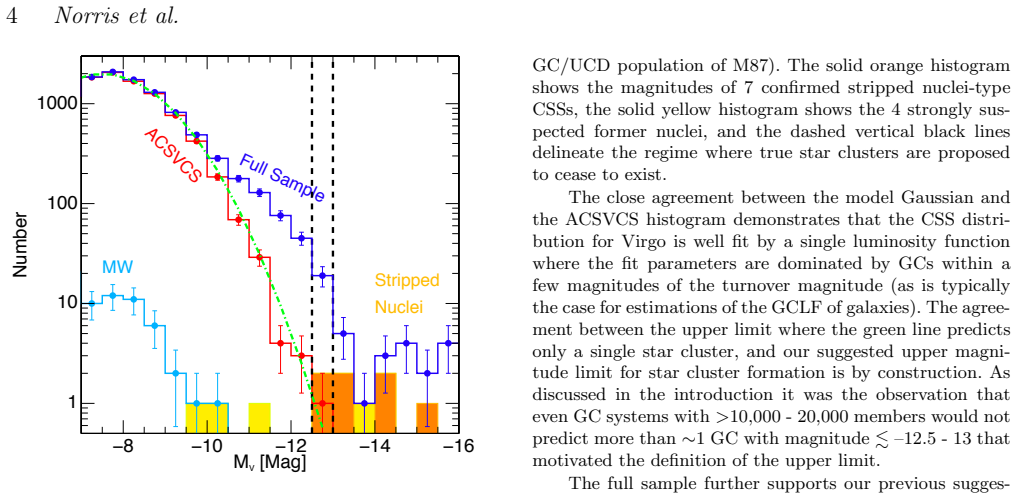
The central claim is that old, genuine star clusters are bounded in mass: none reaches a present-day stellar mass much above $5\times10^7\,M_\odot$, and allowing for roughly 30 per cent stellar mass loss over 10 Gyr under the adopted initial mass function, the corresponding mass at birth is close to $10^8\,M_\odot$. The boundary is identified observationally at $M_V \approx -13$: in the compiled catalog there are 19 compact stellar systems in the bin $-12.5 < M_V < -13$, but above $M_V = -13$ the number per half-magnitude bin stays roughly constant at about 3, even though such luminous objects are the easiest to discover. Seven of the best-confirmed stripped-nucleus ultra-compact dwarfs are all at or brighter than this magnitude, and the most massive young cluster known in the nearby universe, NGC 7252-W3 at about $8\times10^7\,M_\odot$, formed in a major merger close to the proposed cap. The paper concludes that the bright end of the ultra-compact dwarf population consists of stripped galaxy substructures rather than heavier star clusters, and that the limit could be set by any of four physical or statistical mechanisms.
Load-bearing premise
The load-bearing premise is that the assembled catalog is essentially complete for luminous compact systems, so the flat counts above $M_V \approx -13$ reflect a real absence of heavier star clusters rather than missed objects or misclassified galaxy remnants.
Editorial extensions
If this is right
- Any compact stellar system brighter than $M_V \approx -13$ found in future surveys should be treated as a stripped galactic nucleus unless individual evidence shows otherwise; the genuine star cluster mass function is truncated below about $10^8\,M_\odot$ at birth.
- The most massive true star clusters at $z=0$ should form in major mergers, because only merger-driven compression supplies the interstellar gas pressures needed to approach $10^8\,M_\odot$, matching the proximity of NGC 7252-W3 to the cap.
- Because roughly 30 per cent of initial stellar mass is lost over 10 Gyr under the assumed initial mass function, quoted mass limits for old compact systems must distinguish current mass (about $5\times10^7\,M_\odot$) from birth mass (about $10^8\,M_\odot$); comparisons with high-redshift cluster formation should use the birth mass.
- All four candidate mechanisms—extreme interstellar pressure, limited molecular gas, shear, and stellar feedback—predict the same observable cutoff, so identifying the dominant one requires merger simulations and cold-gas surveys rather than the luminosity function alone.
Reading between the lines
- Beyond the paper: if the cutoff is real, the bright end of the ultra-compact dwarf luminosity function becomes a tracer of galaxy disruption rather than of star cluster formation, so counts above $M_V \approx -13$ in different environments should track merger and stripping history.
- Beyond the paper: the gas-supply mechanism implies the cap may have been higher at high redshift, when molecular gas reservoirs above $10^{11}\,M_\odot$ were common; the most massive old clusters surviving today could be frozen relics of an earlier epoch with a looser limit.
- Beyond the paper: a volume-limited survey comparing old compact systems at $M_V$ between $-12$ and $-13$ with those brighter than $-13$ could test the classification directly—the fainter group should show cluster-like metallicities and simple stellar populations, while the brighter group should show nucleus-like properties such as black holes, debris streams, or extended star formation histories.
Signed reviews
Editorial analysis
A structured set of objections, weighed in public.
Referee Report
Summary. The paper compiles a heterogeneous catalog of spectroscopically confirmed compact stellar systems (CSSs) and uses its V-band luminosity function to argue for an upper limit on the mass of ancient star clusters at M_V ≈ -12.5 to -13, corresponding to a current stellar mass near 5×10^7 M_sun and a birth mass near 10^8 M_sun. The authors interpret an apparent flattening of the bright-end counts as evidence that objects brighter than M_V = -13 are stripped galaxy nuclei rather than genuine star clusters, and they discuss four mechanisms (extreme ISM pressure/density, insufficient gas supply, shear, and stellar feedback) that could produce such a limit. The paper explicitly acknowledges that the catalog is inhomogeneous and incomplete, and it states that the agreement between the Gaussian GCLF curve and the ACSVCS histogram is partly by construction.
Significance. If the proposed upper mass limit is real, it is an important constraint on the formation physics of the most massive star clusters and on the origin of ultra-compact dwarfs, and the paper usefully assembles the relevant observational evidence and candidate mechanisms. The compiled catalog is a valuable resource, and the authors are transparent that the green curve in Fig. 2 is not an independent fit. The central empirical claim, however, is not yet statistically established: the break is not fitted to the data, completeness is not quantified, and the classification of all bright CSSs as stripped nuclei goes beyond the seven confirmed cases. The paper therefore provides a strong motivation for future volume-limited surveys rather than a demonstration of a fundamental limit.
major comments (3)
- [§2, Fig. 2] The central evidence for a truncation is the flattening above M_V = -13 in Fig. 2, but this flattening is not established against a null model in data of known completeness. The text concedes in Section 2 that the catalog is "by no means homogeneous, or complete" and asserts that the census is "close to complete for the area surveyed" without a quantified selection function. A heterogeneous combination of surveys with different footprints, depths, and spectroscopic completeness can produce a bright-end plateau even if the intrinsic cluster mass function has no truncation. Please provide a quantified completeness estimate or a robustness test restricted to the best-characterized subsamples (e.g., ACSVCS and M87), and fit the histogram with and without a break to report the significance of the claimed flattening.
- [§3, Fig. 2 green curve] The paper explicitly states that the agreement between the green Gaussian curve and the ACSVCS histogram is "by construction," because the proposed upper limit was inferred from the same GCLF extrapolation. Consequently, the visual agreement of the curve with the histogram does not independently validate the break; the only direct evidence is the approximate constancy of counts at about three objects per 0.5 mag bin above M_V = -13. Given the small numbers and the lack of a statistical test, the break location is not yet constrained by the compiled data. Please fit the break to the full sample, compare it with a no-break model, and quantify the uncertainty on the transition magnitude.
- [§3, stripped-nuclei inference] The interpretation that all CSSs above M_V = -13 are stripped galaxy substructures extrapolates from seven confirmed ex-nuclei, while the paper admits that the remaining bright objects "have not yet been studied in detail, or have no definitive evidence." A flat tail in the luminosity function does not by itself demonstrate that every object in the tail is a stripped nucleus; genuine clusters could account for part of the tail population. Please provide either a classification-completeness estimate for the bright tail or a quantitative demonstration that the confirmed and suspected stripped nuclei dominate the tail counts.
minor comments (5)
- [§4.2, Eq. (1)] Equation (1) is typeset ambiguously: the terms M^(2-β)/(2-β) and ln[M/M_min] appear as a single expression separated by a comma instead of as the two cases β ≠ 2 and β = 2; please present the piecewise definition explicitly.
- [Fig. 2 caption] The caption says the green curve is "arbitrarily normalised to match the ACSVCS distribution" while the text says it is "not a fit"; please clarify which parameters are fixed and which are matched, since the normalization is effectively fitted.
- [Abstract and §1] There are typographical errors in the abstract and introduction, including "millenium" and "wo decades," and the header date shows "MNRAS 000, 1–10 (2015)" for a 2019 arXiv submission; these should be corrected.
- [§2] The paper describes the compiled catalog as comprehensive, but no catalog table or machine-readable file is provided; please include one or state where it can be obtained.
- [§5 and title] Section 4.2 explicitly describes scenario B as statistical, but the title and conclusions use the phrase "fundamental upper limit"; please clarify whether the proposed limit is a hard physical cutoff or a practical/environmental maximum.
Circularity Check
The proposed M_V≈−13 cutoff is partly defined by the same GCLF green curve used to display agreement, though the compiled catalog and observed plateau provide independent support.
-
self definitional
[Section 3 (Figure 2 discussion)]
"The agreement between the upper limit where the green line predicts only a single star cluster, and our suggested upper magnitude limit for star cluster formation is by construction. As discussed in the introduction it was the observation that even GC systems with>10,000 - 20,000 members would not predict more than∼1 GC with magnitude ≲ –12.5 - 13 that motivated the definition of the upper limit."
The proposed upper magnitude limit (M_V ≈ -12.5 to -13) is defined as the point where the Gaussian GCLF extrapolation predicts fewer than one cluster. The green curve in Figure 2 is built from that same GCLF construction, with mean and dispersion from M87 and normalization matched to the histogram, so its bright-end cutoff agrees with the proposed limit by construction rather than by independent measurement. The compiled histogram's plateau is real data, but the threshold location is not fitted to those data; it is inherited from the same curve used to draw the green line, so this agreement cannot independently confirm the limit.
full rationale
The paper compiles a large catalog of compact stellar systems and presents the observed flattening of the luminosity function above M_V ≈ -13 as evidence for an upper limit to genuine star cluster mass. This central claim is not wholly circular: the compiled histogram and the seven confirmed stripped nuclei provide independent empirical grounding. However, one supporting element is explicitly admitted to be by construction: the green Gaussian curve in Figure 2 is constructed from the same GCLF extrapolation that motivated the M_V ≈ -12.5 to -13 limit, so the agreement between the curve's 'fewer than one cluster' point and the proposed cutoff is not an independent test. The paper's transparency about this by-construction agreement mitigates the severity, but the circular step is real. Separately, the catalog's completeness is asserted rather than quantified, so the plateau could in principle be a sample-construction artifact; that is a correctness risk rather than a circularity. Overall, the central claim retains independent content, but the specific green-curve confirmation reduces to its own input, warranting a partial circularity score.
Assumptions & free parameters
free parameters (6)
- Effective GC system size for cD galaxies =
~10,000 members
- Cluster formation efficiency eta_c =
0.25
- Star formation efficiency eta_star =
2% (alternative 20-40%)
- Minimum bound cluster mass M_min =
10 M_sun
- Transition magnitude M_V =
-13 mag (range -12.5 to -13)
- Stellar mass loss fraction over 10 Gyr =
~30%
assumptions (5)
- domain assumption The globular cluster luminosity function is approximately Gaussian with a universal turnover magnitude and weak dependence of width on galaxy mass.
- domain assumption The initial cluster mass function follows dN/dM proportional to M^-2 with no physical truncation.
- domain assumption The bright end of the compiled CSS catalog is close to complete for the surveyed area.
- domain assumption Objects brighter than M_V = -13 in the sample are stripped galaxy nuclei or galaxies, not genuine star clusters.
- domain assumption The effective in-situ GC system of a cD galaxy contains about 10,000 members after accounting for a 50% accreted fraction.
Cite this review
Pith. "Pith review of Is There a Fundamental Upper Limit to the Mass of a Star Cluster?." pith.science (2026). https://pith.science/paper/NQG6KGU4
@misc{pith2026190800550,
  author       = {Pith},
  title        = {Pith review of: Is There a Fundamental Upper Limit to the Mass of a Star Cluster?},
  year         = {2026},
  howpublished = {\url{https://pith.science/paper/NQG6KGU4}},
  note         = {Machine review of arXiv:1908.00550}
}
abstract
The discovery around the turn of the millenium of a population of very massive (M$_\star$ > 2$\times$10$^6$ M$_\odot$) compact stellar systems (CSS) with physical properties (radius, velocity dispersion, stellar mass etc.) that are intermediate between those of the classical globular cluster (GC) population and galaxies led to questions about their exact nature. Recently a consensus has emerged that these objects, usually called ultra compact dwarfs (UCDs), are a mass-dependent mixture of high mass star clusters and remnant nuclei of tidally disrupted galaxies. The existence of genuine star clusters with stellar masses >10$^7$ M$_\odot$ naturally leads to questions about the upper mass limit of the star cluster formation process. In this work we compile a comprehensive catalog of compact stellar systems, and reinforce the evidence that the true ancient star cluster population has a maximum mass of M$_\star$ ~ 5$\times$10$^7$ M$_\odot$, corresponding to a stellar mass at birth of close to 10$^8$ M$_\odot$. We then discuss several physical and statistical mechanisms potentially responsible for creating this limiting mass.
Figures

Reference graph
Works this paper leans on
-
[1]
, " * write output.state after.block = add.period write newline
ENTRY address author booktitle chapter edition editor howpublished institution journal key month note number organization pages publisher school series title type volume year label extra.label sort.label short.list INTEGERS output.state before.all mid.sentence after.sentence after.block FUNCTION init.state.consts #0 'before.all := #1 'mid.sentence := #2 '...
-
[2]
write newline
" write newline "" before.all 'output.state := FUNCTION n.dashify 't := "" t empty not t #1 #1 substring "-" = t #1 #2 substring "--" = not "--" * t #2 global.max substring 't := t #1 #1 substring "-" = "-" * t #2 global.max substring 't := while if t #1 #1 substring * t #2 global.max substring 't := if while FUNCTION word.in bbl.in " " * FUNCTION format....
-
[3]
write newline
" write newline "" before.all 'output.state := FUNCTION fin.entry write newline FUNCTION new.block output.state before.all = 'skip after.block 'output.state := if FUNCTION new.sentence output.state after.block = 'skip output.state before.all = 'skip after.sentence 'output.state := if if FUNCTION not #0 #1 if FUNCTION and 'skip pop #0 if FUNCTION or pop #1...
-
[4]
Adamo A., Bastian N., 2015, arXiv e-prints, https://ui.adsabs.harvard.edu/abs/2015arXiv151108212A p. arXiv:1511.08212
arXiv 2015
-
[5]
Adamo A., Kruijssen J. M. D., Bastian N., Silva-Villa E., Ryon J., 2015, @doi [ ] 10.1093/mnras/stv1203 , http://adsabs.harvard.edu/abs/2015MNRAS.452..246A 452, 246
-
[6]
Adamo A., et al., 2017, @doi [ ] 10.3847/1538-4357/aa7132 , http://adsabs.harvard.edu/abs/2017ApJ...841..131A 841, 131
-
[7]
Afanasiev A. V., et al., 2018, @doi [ ] 10.1093/mnras/sty913 , http://adsabs.harvard.edu/abs/2018MNRAS.477.4856A 477, 4856
-
[8]
Ahn C. P., et al., 2017, @doi [ ] 10.3847/1538-4357/aa6972 , http://adsabs.harvard.edu/abs/2017ApJ...839...72A 839, 72
Show all 131 references
-
[9]
P., et al., 2018, @doi [ ] 10.3847/1538-4357/aabc57 , http://adsabs.harvard.edu/abs/2018ApJ...858..102A 858, 102
Ahn C. P., et al., 2018, @doi [ ] 10.3847/1538-4357/aabc57 , http://adsabs.harvard.edu/abs/2018ApJ...858..102A 858, 102
2018 doi
-
[10]
Bastian N., 2008, @doi [ ] 10.1111/j.1365-2966.2008.13775.x , http://adsabs.harvard.edu/abs/2008MNRAS.390..759B 390, 759
2008
-
[11]
S., Kissler-Patig M., 2013, @doi [ ] 10.1093/mnras/stt253 , http://adsabs.harvard.edu/abs/2013MNRAS.431.1252B 431, 1252
Bastian N., Schweizer F., Goudfrooij P., Larsen S. S., Kissler-Patig M., 2013, @doi [ ] 10.1093/mnras/stt253 , http://adsabs.harvard.edu/abs/2013MNRAS.431.1252B 431, 1252
2013 doi
-
[12]
J., 2003, @doi [ ] 10.1086/379054 , http://adsabs.harvard.edu/abs/2003ApJ...596L..13B 596, L13
Bekki K., Couch W. J., 2003, @doi [ ] 10.1086/379054 , http://adsabs.harvard.edu/abs/2003ApJ...596L..13B 596, L13
2003 doi
-
[13]
Bournaud F., Duc P.-A., Emsellem E., 2008, @doi [ ] 10.1111/j.1745-3933.2008.00511.x , http://ads.ari.uni-heidelberg.de/abs/2008MNRAS.389L...8B 389, L8
2008
-
[14]
J., van Dokkum P
Bouwens R. J., van Dokkum P. G., Illingworth G. D., Oesch P. A., Maseda M., Ribeiro B., Stefanon M., Lam D., 2017, preprint, http://adsabs.harvard.edu/abs/2017arXiv171102090B ( @eprint arXiv 1711.02090 )
2017 arXiv
-
[15]
P., Romanowsky A
Brodie J. P., Romanowsky A. J., Strader J., Forbes D. A., 2011, @doi [ ] 10.1088/0004-6256/142/6/199 , http://adsabs.harvard.edu/abs/2011AJ....142..199B 142, 199
2011 doi
-
[16]
Cabrera-Ziri I., Bastian N., Davies B., Magris G., Bruzual G., Schweizer F., 2014, @doi [ ] 10.1093/mnras/stu764 , https://ui.adsabs.harvard.edu/abs/2014MNRAS.441.2754C 441, 2754
2014 doi
-
[17]
Cabrera-Ziri I., et al., 2015, @doi [ ] 10.1093/mnras/stv163 , https://ui.adsabs.harvard.edu/abs/2015MNRAS.448.2224C 448, 2224
2015 doi
-
[18]
P., Bassino L
Caso J. P., Bassino L. P., Richtler T., Smith Castelli A. V., Faifer F. R., 2013, @doi [ ] 10.1093/mnras/sts687 , http://adsabs.harvard.edu/abs/2013MNRAS.430.1088C 430, 1088
2013 doi
-
[19]
P., Bassino L
Caso J. P., Bassino L. P., Richtler T., Calder \'o n J. P., Smith Castelli A. V., 2014, @doi [ ] 10.1093/mnras/stu876 , https://ui.adsabs.harvard.edu/abs/2014MNRAS.442..891C 442, 891
2014 doi
-
[20]
M., Whitmore B
Chandar R., Fall S. M., Whitmore B. C., Mulia A. J., 2017, @doi [ ] 10.3847/1538-4357/aa92ce , http://adsabs.harvard.edu/abs/2017ApJ...849..128C 849, 128
2017 doi
-
[21]
Chiboucas K., et al., 2011, @doi [ ] 10.1088/0004-637X/737/2/86 , http://adsabs.harvard.edu/abs/2011ApJ...737...86C 737, 86
2011 doi
-
[22]
Y., 2019, arXiv e-prints, https://ui.adsabs.harvard.edu/abs/2019arXiv190505199C p
Choksi N., Gnedin O. Y., 2019, arXiv e-prints, https://ui.adsabs.harvard.edu/abs/2019arXiv190505199C p. arXiv:1905.05199
2019 arXiv
-
[23]
Y., Li H., 2018, @doi [ ] 10.1093/mnras/sty1952 , https://ui.adsabs.harvard.edu/abs/2018MNRAS.480.2343C 480, 2343
Choksi N., Gnedin O. Y., Li H., 2018, @doi [ ] 10.1093/mnras/sty1952 , https://ui.adsabs.harvard.edu/abs/2018MNRAS.480.2343C 480, 2343
2018 doi
-
[24]
G., 2018, @doi [ ] 10.1093/mnras/sty1229 , https://ui.adsabs.harvard.edu/abs/2018MNRAS.478.3994C 478, 3994
Clauwens B., Schaye J., Franx M., Bower R. G., 2018, @doi [ ] 10.1093/mnras/sty1229 , https://ui.adsabs.harvard.edu/abs/2018MNRAS.478.3994C 478, 3994
2018 doi
-
[25]
Colombo D., et al., 2014, @doi [ ] 10.1088/0004-637X/784/1/3 , http://esoads.eso.org/abs/2014ApJ...784....3C 784, 3
2014 doi
-
[26]
C \^o t \'e P., et al., 2004, @doi [ ] 10.1086/421490 , http://adsabs.harvard.edu/abs/2004ApJS..153..223C 153, 223
2004 doi
-
[27]
A., et al., 2015, @doi [ ] 10.1093/mnras/stv725 , http://adsabs.harvard.edu/abs/2015MNRAS.450.1937C 450, 1937
Crain R. A., et al., 2015, @doi [ ] 10.1093/mnras/stv725 , http://adsabs.harvard.edu/abs/2015MNRAS.450.1937C 450, 1937
2015 doi
-
[28]
M., Krumholz M
Crocker R. M., Krumholz M. R., Thompson T. A., Baumgardt H., Mackey D., 2018, @doi [ ] 10.1093/mnras/sty2659 , http://adsabs.harvard.edu/abs/2018MNRAS.481.4895C 481, 4895
2018 doi
-
[29]
Y., Hilker M., Ziegler B
Da Rocha C., Mieske S., Georgiev I. Y., Hilker M., Ziegler B. L., Mendes de Oliveira C., 2011, @doi [ ] 10.1051/0004-6361/201015353 , http://adsabs.harvard.edu/abs/2011A
2011 doi
-
[30]
J., Jones J
Drinkwater M. J., Jones J. B., Gregg M. D., Phillipps S., 2000, Publications of the Astronomical Society of Australia, http://adsabs.harvard.edu/abs/2000PASA...17..227D 17, 227
2000
-
[31]
Du M., et al., 2018, arXiv e-prints, http://adsabs.harvard.edu/abs/2018arXiv181106778D
2018
-
[32]
G., 2018, @doi [ ] 10.3847/1538-4357/aaed45 , https://ui.adsabs.harvard.edu/abs/2018ApJ...869..119E 869, 119
Elmegreen B. G., 2018, @doi [ ] 10.3847/1538-4357/aaed45 , https://ui.adsabs.harvard.edu/abs/2018ApJ...869..119E 869, 119
2018 doi
-
[33]
G., Malhotra S., Rhoads J., 2012, @doi [ ] 10.1088/0004-637X/757/1/9 , http://adsabs.harvard.edu/abs/2012ApJ...757....9E 757, 9
Elmegreen B. G., Malhotra S., Rhoads J., 2012, @doi [ ] 10.1088/0004-637X/757/1/9 , http://adsabs.harvard.edu/abs/2012ApJ...757....9E 757, 9
2012 doi
-
[35]
R., Escudero C
Faifer F. R., Escudero C. G., Scalia M. C., Smith Castelli A. V., Norris M., De Rossi M. E., Forte J. C., Cellone S. A., 2017, @doi [ ] 10.1051/0004-6361/201730493 , http://adsabs.harvard.edu/abs/2017A
2017 doi
-
[36]
Falgarone E., et al., 2017, @doi [ ] 10.1038/nature23298 , http://adsabs.harvard.edu/abs/2017Natur.548..430F 548, 430
2017 doi
-
[37]
M., Chandar R., Whitmore B
Fall S. M., Chandar R., Whitmore B. C., 2009, @doi [ ] 10.1088/0004-637X/704/1/453 , http://adsabs.harvard.edu/abs/2009ApJ...704..453F 704, 453
2009 doi
-
[38]
Fellhauer M., Kroupa P., 2002, @doi [ ] 10.1046/j.1365-8711.2002.05087.x , http://adsabs.harvard.edu/abs/2002MNRAS.330..642F 330, 642
2002
-
[39]
Ferrarese L., et al., 2012, @doi [ ] 10.1088/0067-0049/200/1/4 , http://adsabs.harvard.edu/abs/2012ApJS..200....4F 200, 4
2012 doi
-
[40]
A., Bridges T., 2010, @doi [ ] 10.1111/j.1365-2966.2010.16373.x , http://adsabs.harvard.edu/abs/2010MNRAS.404.1203F 404, 1203
Forbes D. A., Bridges T., 2010, @doi [ ] 10.1111/j.1365-2966.2010.16373.x , http://adsabs.harvard.edu/abs/2010MNRAS.404.1203F 404, 1203
2010
-
[41]
A., Kroupa P., 2011, @doi [ ] 10.1071/AS10029 , http://adsabs.harvard.edu/abs/2011PASA...28...77F 28, 77
Forbes D. A., Kroupa P., 2011, @doi [ ] 10.1071/AS10029 , http://adsabs.harvard.edu/abs/2011PASA...28...77F 28, 77
2011 doi
-
[42]
A., Norris M
Forbes D. A., Norris M. A., Strader J., Romanowsky A. J., Pota V., Kannappan S. J., Brodie J. P., Huxor A., 2014, @doi [ ] 10.1093/mnras/stu1631 , http://adsabs.harvard.edu/abs/2014MNRAS.444.2993F 444, 2993
2014 doi
-
[43]
Galleti S., Federici L., Bellazzini M., Fusi Pecci F., Macrina S., 2004, @doi [ ] 10.1051/0004-6361:20035632 , http://adsabs.harvard.edu/abs/2004A
2004 doi
-
[44]
Y., B \"o ker T., 2014, @doi [ ] 10.1093/mnras/stu797 , http://adsabs.harvard.edu/abs/2014MNRAS.441.3570G 441, 3570
Georgiev I. Y., B \"o ker T., 2014, @doi [ ] 10.1093/mnras/stu797 , http://adsabs.harvard.edu/abs/2014MNRAS.441.3570G 441, 3570
2014 doi
-
[45]
Gieles M., 2009, @doi [ ] 10.1111/j.1365-2966.2009.14473.x , https://ui.adsabs.harvard.edu/abs/2009MNRAS.394.2113G 394, 2113
2009
-
[46]
S., Scheepmaker R
Gieles M., Larsen S. S., Scheepmaker R. A., Bastian N., Haas M. R., Lamers H. J. G. L. M., 2006, @doi [ ] 10.1051/0004-6361:200500224 , https://ui.adsabs.harvard.edu/abs/2006A&A...446L...9G 446, L9
2006 doi
-
[47]
Goodman M., Bekki K., 2018, @doi [ ] 10.1093/mnras/sty1187 , http://adsabs.harvard.edu/abs/2018MNRAS.478.3564G 478, 3564
2018 doi
-
[48]
Goudfrooij P., 2012, @doi [ ] 10.1088/0004-637X/750/2/140 , http://adsabs.harvard.edu/abs/2012ApJ...750..140G 750, 140
2012 doi
-
[49]
C., Schweizer F., 2004, @doi [ ] 10.1086/425071 , https://ui.adsabs.harvard.edu/abs/2004ApJ...613L.121G 613, L121
Goudfrooij P., Gilmore D., Whitmore B. C., Schweizer F., 2004, @doi [ ] 10.1086/425071 , https://ui.adsabs.harvard.edu/abs/2004ApJ...613L.121G 613, L121
2004 doi
-
[50]
G., Carretta E., Bragaglia A., 2012, @doi [ ] 10.1007/s00159-012-0050-3 , http://adsabs.harvard.edu/abs/2012A
Gratton R. G., Carretta E., Bragaglia A., 2012, @doi [ ] 10.1007/s00159-012-0050-3 , http://adsabs.harvard.edu/abs/2012A
2012 doi
-
[51]
Y., Hopkins P
Grudi \'c M. Y., Hopkins P. F., Quataert E., Murray N., 2019, @doi [ ] 10.1093/mnras/sty3386 , https://ui.adsabs.harvard.edu/abs/2019MNRAS.483.5548G 483, 5548
2019 doi
-
[52]
Ha s egan M., et al., 2005, @doi [ ] 10.1086/430342 , http://adsabs.harvard.edu/abs/2005ApJ...627..203H 627, 203
2005 doi
-
[53]
E., 1996, @doi [ ] 10.1086/118116 , http://adsabs.harvard.edu/abs/1996AJ....112.1487H 112, 1487
Harris W. E., 1996, @doi [ ] 10.1086/118116 , http://adsabs.harvard.edu/abs/1996AJ....112.1487H 112, 1487
1996 doi
-
[54]
E., et al., 2014, @doi [ ] 10.1088/0004-637X/797/2/128 , http://adsabs.harvard.edu/abs/2014ApJ...797..128H 797, 128
Harris W. E., et al., 2014, @doi [ ] 10.1088/0004-637X/797/2/128 , http://adsabs.harvard.edu/abs/2014ApJ...797..128H 797, 128
2014 doi
-
[55]
A., Boeche C., Walker M., Johnson C
Hendricks B., Koch A., Lanfranchi G. A., Boeche C., Walker M., Johnson C. I., Pe \ n arrubia J., Gilmore G., 2014, @doi [ ] 10.1088/0004-637X/785/2/102 , http://adsabs.harvard.edu/abs/2014ApJ...785..102H 785, 102
2014 doi
-
[56]
Hilker M., 2006, ArXiv Astrophysics e-prints, http://adsabs.harvard.edu/abs/2006astro.ph..5447H
2006
-
[57]
Hilker M., 2009, ArXiv e-prints:0906.0776, http://adsabs.harvard.edu/abs/2009arXiv0906.0776H
2009 arXiv
-
[58]
Hilker M., Infante L., Vieira G., Kissler-Patig M., Richtler T., 1999, @doi [ ] 10.1051/aas:1999434 , http://adsabs.harvard.edu/abs/1999A
1999 doi
-
[59]
F., Murray N., Quataert E., Thompson T
Hopkins P. F., Murray N., Quataert E., Thompson T. A., 2010, @doi [ ] 10.1111/j.1745-3933.2009.00777.x , http://adsabs.harvard.edu/abs/2010MNRAS.401L..19H 401, L19
2010
-
[61]
Into T., Portinari L., 2013, @doi [ ] 10.1093/mnras/stt071 , http://adsabs.harvard.edu/abs/2013MNRAS.430.2715I 430, 2715
2013 doi
-
[62]
Janz J., et al., 2016, @doi [ ] 10.1093/mnras/stv2636 , http://adsabs.harvard.edu/abs/2016MNRAS.456..617J 456, 617
2016 doi
-
[63]
G., et al., 2015, @doi [ ] 10.1088/2041-8205/812/1/L10 , http://adsabs.harvard.edu/abs/2015ApJ...812L..10J 812, L10
Jennings Z. G., et al., 2015, @doi [ ] 10.1088/2041-8205/812/1/L10 , http://adsabs.harvard.edu/abs/2015ApJ...812L..10J 812, L10
2015 doi
-
[64]
Jord \'a n A., et al., 2007, @doi [ ] 10.1086/516840 , http://adsabs.harvard.edu/abs/2007ApJS..171..101J 171, 101
2007 doi
-
[65]
Kim J.-h., et al., 2018, @doi [ ] 10.1093/mnras/stx2994 , https://ui.adsabs.harvard.edu/abs/2018MNRAS.474.4232K 474, 4232
2018 doi
-
[66]
Kissler-Patig M., Jord \'a n A., Bastian N., 2006, @doi [ ] 10.1051/0004-6361:20054384 , http://adsabs.harvard.edu/abs/2006A
2006 doi
-
[67]
K., Wyse R
Koch A., Grebel E. K., Wyse R. F. G., Kleyna J. T., Wilkinson M. I., Harbeck D. R., Gilmore G. F., Evans N. W., 2006, @doi [ ] 10.1086/499490 , http://adsabs.harvard.edu/abs/2006AJ....131..895K 131, 895
2006 doi
-
[68]
B., Cornell M
Kormendy J., Fisher D. B., Cornell M. E., Bender R., 2009, @doi [ ] 10.1088/0067-0049/182/1/216 , http://adsabs.harvard.edu/abs/2009ApJS..182..216K 182, 216
2009 doi
-
[69]
Kroupa P., 2001, @doi [ ] 10.1046/j.1365-8711.2001.04022.x , http://adsabs.harvard.edu/abs/2001MNRAS.322..231K 322, 231
2001
-
[71]
Kruijssen J. M. D., 2014, @doi [Classical and Quantum Gravity] 10.1088/0264-9381/31/24/244006 , http://adsabs.harvard.edu/abs/2014CQGra..31x4006K 31, 244006
2014 doi
-
[72]
S., 2009, @doi [ ] 10.1051/0004-6361:200811212 , https://ui.adsabs.harvard.edu/abs/2009A&A...494..539L 494, 539
Larsen S. S., 2009, @doi [ ] 10.1051/0004-6361:200811212 , https://ui.adsabs.harvard.edu/abs/2009A&A...494..539L 494, 539
2009 doi
-
[73]
A., Mendel J
Leaman R., VandenBerg D. A., Mendel J. T., 2013, @doi [ ] 10.1093/mnras/stt1540 , http://adsabs.harvard.edu/abs/2013MNRAS.436..122L 436, 122
2013 doi
-
[74]
N., Thaddeus P., 1989, @doi [ ] 10.1086/191357 , http://adsabs.harvard.edu/abs/1989ApJS...70..731L 70, 731
Leisawitz D., Bash F. N., Thaddeus P., 1989, @doi [ ] 10.1086/191357 , http://adsabs.harvard.edu/abs/1989ApJS...70..731L 70, 731
1989 doi
-
[75]
S., 2004, @doi [ ] 10.1086/425320 , http://adsabs.harvard.edu/abs/2004ApJ...614L..29L 614, L29
Li Y., Mac Low M.-M., Klessen R. S., 2004, @doi [ ] 10.1086/425320 , http://adsabs.harvard.edu/abs/2004ApJ...614L..29L 614, L29
2004 doi
-
[76]
Y., Gnedin N
Li H., Gnedin O. Y., Gnedin N. Y., Meng X., Semenov V. A., Kravtsov A. V., 2017, @doi [ ] 10.3847/1538-4357/834/1/69 , https://ui.adsabs.harvard.edu/abs/2017ApJ...834...69L 834, 69
2017 doi
-
[77]
Liu C., et al., 2015, @doi [ ] 10.1088/0004-637X/812/1/34 , http://adsabs.harvard.edu/abs/2015ApJ...812...34L 812, 34
2015 doi
-
[78]
arXiv:1906.11261
Ma X., et al., 2019, arXiv e-prints, https://ui.adsabs.harvard.edu/abs/2019arXiv190611261M p. arXiv:1906.11261
2019 arXiv
-
[79]
M., Obreschkow D., Jarvis M
Maddox N., Hess K. M., Obreschkow D., Jarvis M. J., Blyth S.-L., 2015, @doi [ ] 10.1093/mnras/stu2532 , http://adsabs.harvard.edu/abs/2015MNRAS.447.1610M 447, 1610
2015 doi
-
[80]
P., Donzelli C
Madrid J. P., Donzelli C. J., 2013, @doi [ ] 10.1088/0004-637X/770/2/158 , http://adsabs.harvard.edu/abs/2013ApJ...770..158M 770, 158
2013 doi
-
[81]
Maji M., Zhu Q., Li Y., Charlton J., Hernquist L., Knebe A., 2017, @doi [ ] 10.3847/1538-4357/aa7aa1 , https://ui.adsabs.harvard.edu/abs/2017ApJ...844..108M 844, 108
2017 doi
-
[82]
P., Kissler-Patig M., Schweizer F., Goudfrooij P., 2004, @doi [ ] 10.1051/0004-6361:20031604 , http://adsabs.harvard.edu/abs/2004A
Maraston C., Bastian N., Saglia R. P., Kissler-Patig M., Schweizer F., Goudfrooij P., 2004, @doi [ ] 10.1051/0004-6361:20031604 , http://adsabs.harvard.edu/abs/2004A
2004 doi
-
[83]
Matsui H., et al., 2012, @doi [ ] 10.1088/0004-637X/746/1/26 , http://adsabs.harvard.edu/abs/2012ApJ...746...26M 746, 26
2012 doi
-
[84]
S., Turner J
Meier D. S., Turner J. L., Beck S. C., Gorjian V., Tsai C.-W., Van Dyk S. D., 2010, @doi [ ] 10.1088/0004-6256/140/5/1294 , http://adsabs.harvard.edu/abs/2010AJ....140.1294M 140, 1294
2010 doi
-
[85]
Y., Li H., 2019, @doi [ ] 10.1093/mnras/stz925 , https://ui.adsabs.harvard.edu/abs/2019MNRAS.486.1574M 486, 1574
Meng X., Gnedin O. Y., Li H., 2019, @doi [ ] 10.1093/mnras/stz925 , https://ui.adsabs.harvard.edu/abs/2019MNRAS.486.1574M 486, 1574
2019 doi
-
[86]
Mieske S., Hilker M., Infante L., 2004, @doi [ ] 10.1051/0004-6361:20035723 , http://adsabs.harvard.edu/abs/2004A
2004 doi
-
[87]
Mieske S., Hilker M., Misgeld I., 2012, @doi [ ] 10.1051/0004-6361/201117634 , http://adsabs.harvard.edu/abs/2012A
2012 doi
-
[88]
W., Whitmore B
Miller B. W., Whitmore B. C., Schweizer F., Fall S. M., 1997, @doi [ ] 10.1086/118655 , https://ui.adsabs.harvard.edu/abs/1997AJ....114.2381M 114, 2381
1997 doi
-
[89]
Minniti D., Kissler-Patig M., Goudfrooij P., Meylan G., 1998, @doi [ ] 10.1086/300173 , https://ui.adsabs.harvard.edu/abs/1998AJ....115..121M 115, 121
1998 doi
-
[91]
Y., Schuberth Y., 2011, @doi [ ] 10.1051/0004-6361/201116728 , http://adsabs.harvard.edu/abs/2011A
Misgeld I., Mieske S., Hilker M., Richtler T., Georgiev I. Y., Schuberth Y., 2011, @doi [ ] 10.1051/0004-6361/201116728 , http://adsabs.harvard.edu/abs/2011A
2011 doi
-
[92]
A., 2010, @doi [ ] 10.1088/0004-637X/709/1/191 , http://adsabs.harvard.edu/abs/2010ApJ...709..191M 709, 191
Murray N., Quataert E., Thompson T. A., 2010, @doi [ ] 10.1088/0004-637X/709/1/191 , http://adsabs.harvard.edu/abs/2010ApJ...709..191M 709, 191
2010 doi
-
[94]
A., et al., 2014, @doi [ ] 10.1093/mnras/stu1186 , http://adsabs.harvard.edu/abs/2014MNRAS.443.1151N 443, 1151
Norris M. A., et al., 2014, @doi [ ] 10.1093/mnras/stu1186 , http://adsabs.harvard.edu/abs/2014MNRAS.443.1151N 443, 1151
2014 doi
-
[95]
A., Escudero C
Norris M. A., Escudero C. G., Faifer F. R., Kannappan S. J., Forte J. C., van den Bosch R. C. E., 2015, @doi [ ] 10.1093/mnras/stv1221 , http://adsabs.harvard.edu/abs/2015MNRAS.451.3615N 451, 3615
2015 doi
-
[96]
P., Naab T., Johansson P
Oser L., Ostriker J. P., Naab T., Johansson P. H., Burkert A., 2010, @doi [ ] 10.1088/0004-637X/725/2/2312 , https://ui.adsabs.harvard.edu/abs/2010ApJ...725.2312O 725, 2312
2010 doi
-
[97]
P., Kroupa P., Baumgardt H., 2008, @doi [ ] 10.1086/587137 , http://adsabs.harvard.edu/abs/2008ApJ...678..347P 678, 347
Parmentier G., Goodwin S. P., Kroupa P., Baumgardt H., 2008, @doi [ ] 10.1086/587137 , http://adsabs.harvard.edu/abs/2008ApJ...678..347P 678, 347
2008 doi
-
[98]
J., Forbes D
Penny S. J., Forbes D. A., Conselice C. J., 2012, @doi [ ] 10.1111/j.1365-2966.2012.20669.x , http://adsabs.harvard.edu/abs/2012MNRAS.422..885P 422, 885
2012
-
[99]
J., Forbes D
Penny S. J., Forbes D. A., Strader J., Usher C., Brodie J. P., Romanowsky A. J., 2014, @doi [ ] 10.1093/mnras/stu232 , https://ui.adsabs.harvard.edu/abs/2014MNRAS.439.3808P 439, 3808
2014 doi
-
[100]
Pfeffer J., Baumgardt H., 2013, @doi [ ] 10.1093/mnras/stt867 , http://adsabs.harvard.edu/abs/2013MNRAS.433.1997P 433, 1997
2013 doi
-
[101]
F., Baumgardt H., Hilker M., 2014, @doi [ ] 10.1093/mnras/stu1705 , http://adsabs.harvard.edu/abs/2014MNRAS.444.3670P 444, 3670
Pfeffer J., Griffen B. F., Baumgardt H., Hilker M., 2014, @doi [ ] 10.1093/mnras/stu1705 , http://adsabs.harvard.edu/abs/2014MNRAS.444.3670P 444, 3670
2014 doi
-
[102]
F., 2016, @doi [ ] 10.1093/mnras/stw498 , http://adsabs.harvard.edu/abs/2016MNRAS.458.2492P 458, 2492
Pfeffer J., Hilker M., Baumgardt H., Griffen B. F., 2016, @doi [ ] 10.1093/mnras/stw498 , http://adsabs.harvard.edu/abs/2016MNRAS.458.2492P 458, 2492
2016 doi
-
[104]
Pfeffer J., Kruijssen J. M. D., Crain R. A., Bastian N., 2018b, @doi [ ] 10.1093/mnras/stx3124 , http://adsabs.harvard.edu/abs/2018MNRAS.475.4309P 475, 4309
-
[105]
J., Gregg M
Phillipps S., Drinkwater M. J., Gregg M. D., Jones J. B., 2001, @doi [ ] 10.1086/322517 , http://adsabs.harvard.edu/abs/2001ApJ...560..201P 560, 201
2001 doi
-
[106]
Qu Y., et al., 2017, @doi [ ] 10.1093/mnras/stw2437 , http://adsabs.harvard.edu/abs/2017MNRAS.464.1659Q 464, 1659
2017 doi
-
[107]
W., Glover S
Rahner D., Pellegrini E. W., Glover S. C. O., Klessen R. S., 2017, @doi [ ] 10.1093/mnras/stx1532 , http://adsabs.harvard.edu/abs/2017MNRAS.470.4453R 470, 4453
2017 doi
-
[108]
Reina-Campos M., Kruijssen J. M. D., 2017, @doi [ ] 10.1093/mnras/stx790 , http://adsabs.harvard.edu/abs/2017MNRAS.469.1282R 469, 1282
2017 doi
-
[109]
Renaud F., et al., 2013, @doi [ ] 10.1093/mnras/stt1698 , http://adsabs.harvard.edu/abs/2013MNRAS.436.1836R 436, 1836
2013 doi
-
[110]
Renaud F., Bournaud F., Kraljic K., Duc P.-A., 2014, @doi [ ] 10.1093/mnrasl/slu050 , http://adsabs.harvard.edu/abs/2014MNRAS.442L..33R 442, L33
2014 doi
-
[111]
Renaud F., Bournaud F., Duc P.-A., 2015, @doi [ ] 10.1093/mnras/stu2208 , http://ads.ari.uni-heidelberg.de/abs/2015MNRAS.446.2038R 446, 2038
2015 doi
-
[112]
Rodriguez-Gomez V., et al., 2016, @doi [ ] 10.1093/mnras/stw456 , http://adsabs.harvard.edu/abs/2016MNRAS.458.2371R 458, 2371
2016 doi
-
[113]
Rudnick G., et al., 2017, @doi [ ] 10.3847/1538-4357/aa87b2 , http://adsabs.harvard.edu/abs/2017ApJ...849...27R 849, 27
2017 doi
-
[114]
Schaye J., et al., 2015, @doi [ ] 10.1093/mnras/stu2058 , http://adsabs.harvard.edu/abs/2015MNRAS.446..521S 446, 521
2015 doi
-
[115]
Schechter P., 1976, @doi [ ] 10.1086/154079 , http://adsabs.harvard.edu/abs/1976ApJ...203..297S 203, 297
1976 doi
-
[116]
Schinnerer E., et al., 2013, @doi [ ] 10.1088/0004-637X/779/1/42 , http://esoads.eso.org/abs/2013ApJ...779...42S 779, 42
2013 doi
-
[117]
Schweizer F., Seitzer P., 2007, @doi [ ] 10.1086/513317 , http://adsabs.harvard.edu/abs/2007AJ....133.2132S 133, 2132
2007 doi
-
[118]
C., Kelson D
Schweizer F., Seitzer P., Whitmore B. C., Kelson D. D., Villanueva E. V., 2018, @doi [ ] 10.3847/1538-4357/aaa424 , http://adsabs.harvard.edu/abs/2018ApJ...853...54S 853, 54
2018 doi
-
[119]
Scoville N., et al., 2016, @doi [ ] 10.3847/0004-637X/820/2/83 , http://adsabs.harvard.edu/abs/2016ApJ...820...83S 820, 83
2016 doi
-
[120]
C., et al., 2014, @doi [ ] 10.1038/nature13762 , http://adsabs.harvard.edu/abs/2014Natur.513..398S 513, 398
Seth A. C., et al., 2014, @doi [ ] 10.1038/nature13762 , http://adsabs.harvard.edu/abs/2014Natur.513..398S 513, 398
2014 doi
-
[121]
N., Ostriker E
Shetty R., Vogel S. N., Ostriker E. C., Teuben P. J., 2007, @doi [ ] 10.1086/520037 , http://esoads.eso.org/abs/2007ApJ...665.1138S 665, 1138
2007 doi
-
[122]
Silva-Villa E., Adamo A., Bastian N., 2013, @doi [ ] 10.1093/mnrasl/slt115 , http://adsabs.harvard.edu/abs/2013MNRAS.436L..69S 436, L69
2013 doi
-
[123]
D., et al., 2015, @doi [ ] 10.1088/2041-8205/812/2/L23 , http://adsabs.harvard.edu/abs/2015ApJ...812L..23S 812, L23
Silverman J. D., et al., 2015, @doi [ ] 10.1088/2041-8205/812/2/L23 , http://adsabs.harvard.edu/abs/2015ApJ...812L..23S 812, L23
2015 doi
-
[124]
Smith R., Fellhauer M., Goodwin S., Assmann P., 2011, @doi [ ] 10.1111/j.1365-2966.2011.18604.x , http://cdsads.u-strasbg.fr/abs/2011MNRAS.414.3036S 414, 3036
2011
-
[125]
Starkenburg E., et al., 2013, @doi [ ] 10.1051/0004-6361/201220349 , http://adsabs.harvard.edu/abs/2013A
2013 doi
-
[126]
P., Spitler L., Beasley M
Strader J., Brodie J. P., Spitler L., Beasley M. A., 2006, @doi [ ] 10.1086/509124 , http://adsabs.harvard.edu/abs/2006AJ....132.2333S 132, 2333
2006 doi
-
[127]
M., et al., 2011, @doi [ ] 10.1088/0004-637X/742/1/11 , http://adsabs.harvard.edu/abs/2011ApJ...742...11S 742, 11
Swinbank A. M., et al., 2011, @doi [ ] 10.1088/0004-637X/742/1/11 , http://adsabs.harvard.edu/abs/2011ApJ...742...11S 742, 11
2011 doi
-
[128]
J., et al., 2013, @doi [ ] 10.1088/0004-637X/768/1/74 , http://adsabs.harvard.edu/abs/2013ApJ...768...74T 768, 74
Tacconi L. J., et al., 2013, @doi [ ] 10.1088/0004-637X/768/1/74 , http://adsabs.harvard.edu/abs/2013ApJ...768...74T 768, 74
2013 doi
-
[129]
A., Puzia T
Taylor M. A., Puzia T. H., Harris G. L., Harris W. E., Kissler-Patig M., Hilker M., 2010, @doi [ ] 10.1088/0004-637X/712/2/1191 , http://adsabs.harvard.edu/abs/2010ApJ...712.1191T 712, 1191
2010 doi
-
[130]
Usher C., Pfeffer J., Bastian N., Kruijssen J. M. D., Crain R. A., Reina-Campos M., 2018, @doi [ ] 10.1093/mnras/sty1895 , http://adsabs.harvard.edu/abs/2018MNRAS.480.3279U 480, 3279
2018 doi
-
[131]
Vanzella E., et al., 2017, @doi [ ] 10.1093/mnras/stx351 , http://adsabs.harvard.edu/abs/2017MNRAS.467.4304V 467, 4304
2017 doi
-
[132]
Voggel K., Hilker M., Richtler T., 2016, @doi [ ] 10.1051/0004-6361/201527070 , http://adsabs.harvard.edu/abs/2016A
2016 doi
-
[133]
C., Schweizer F., Kundu A., Miller B
Whitmore B. C., Schweizer F., Kundu A., Miller B. W., 2002, @doi [ ] 10.1086/340808 , https://ui.adsabs.harvard.edu/abs/2002AJ....124..147W 124, 147
2002 doi
-
[134]
C., et al., 2010, @doi [ ] 10.1088/0004-6256/140/1/75 , https://ui.adsabs.harvard.edu/abs/2010AJ....140...75W 140, 75
Whitmore B. C., et al., 2010, @doi [ ] 10.1088/0004-6256/140/1/75 , https://ui.adsabs.harvard.edu/abs/2010AJ....140...75W 140, 75
2010 doi
-
[135]
Willman B., Strader J., 2012, @doi [ ] 10.1088/0004-6256/144/3/76 , http://adsabs.harvard.edu/abs/2012AJ....144...76W 144, 76
2012 doi
-
[136]
Zhang H.-X., et al., 2015, @doi [ ] 10.1088/0004-637X/802/1/30 , http://adsabs.harvard.edu/abs/2015ApJ...802...30Z 802, 30
2015 doi
-
[137]
van der Wel A., et al., 2014, @doi [ ] 10.1088/0004-637X/788/1/28 , http://adsabs.harvard.edu/abs/2014ApJ...788...28V 788, 28
2014 doi
Reviewed August 14, 2026 · model on record in the stance chip above.
Discussion (0). Continue with ORCID to comment.